Gozzoli: The Journey of the Magi
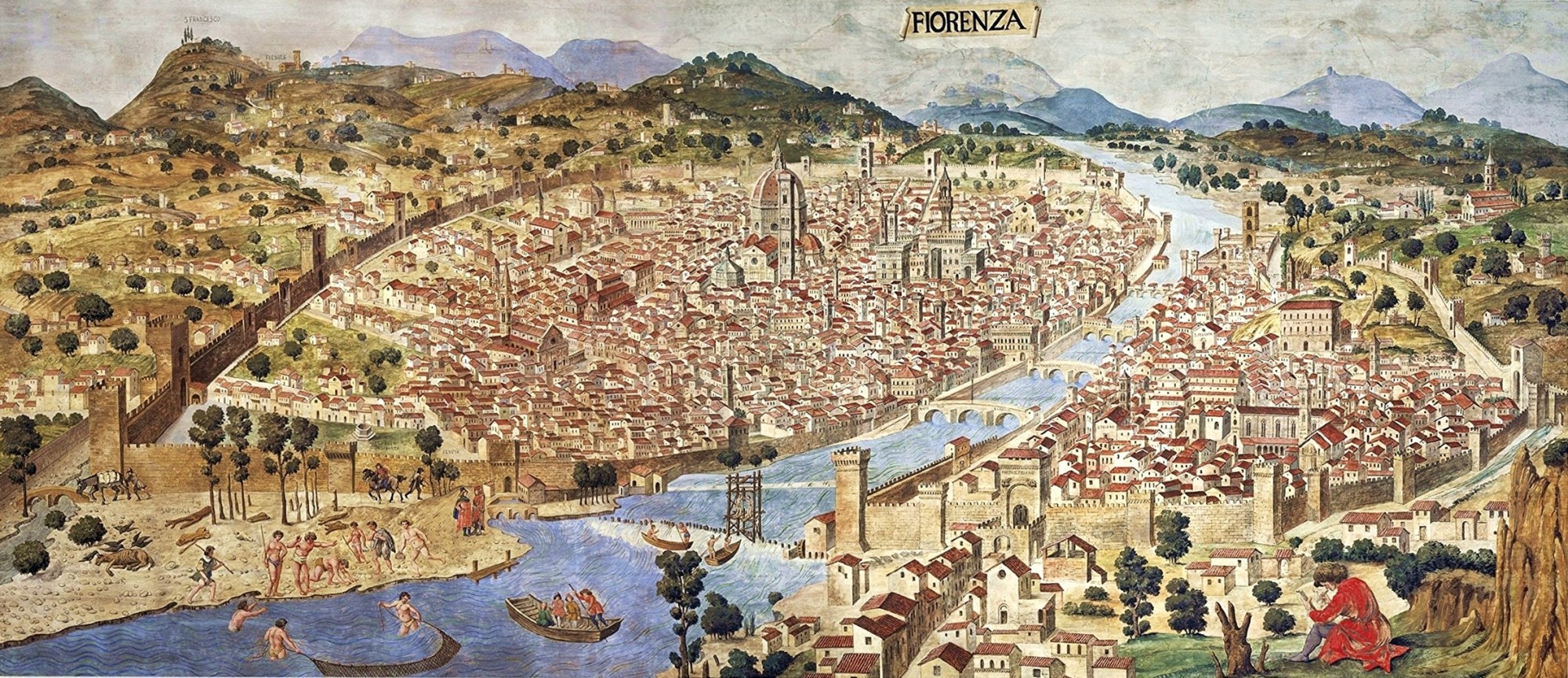
The upper image reminds you of the magnificent panorama of the city of Florence at its apogee, executed in about 1480, which I have shown several times in earlier lectures.
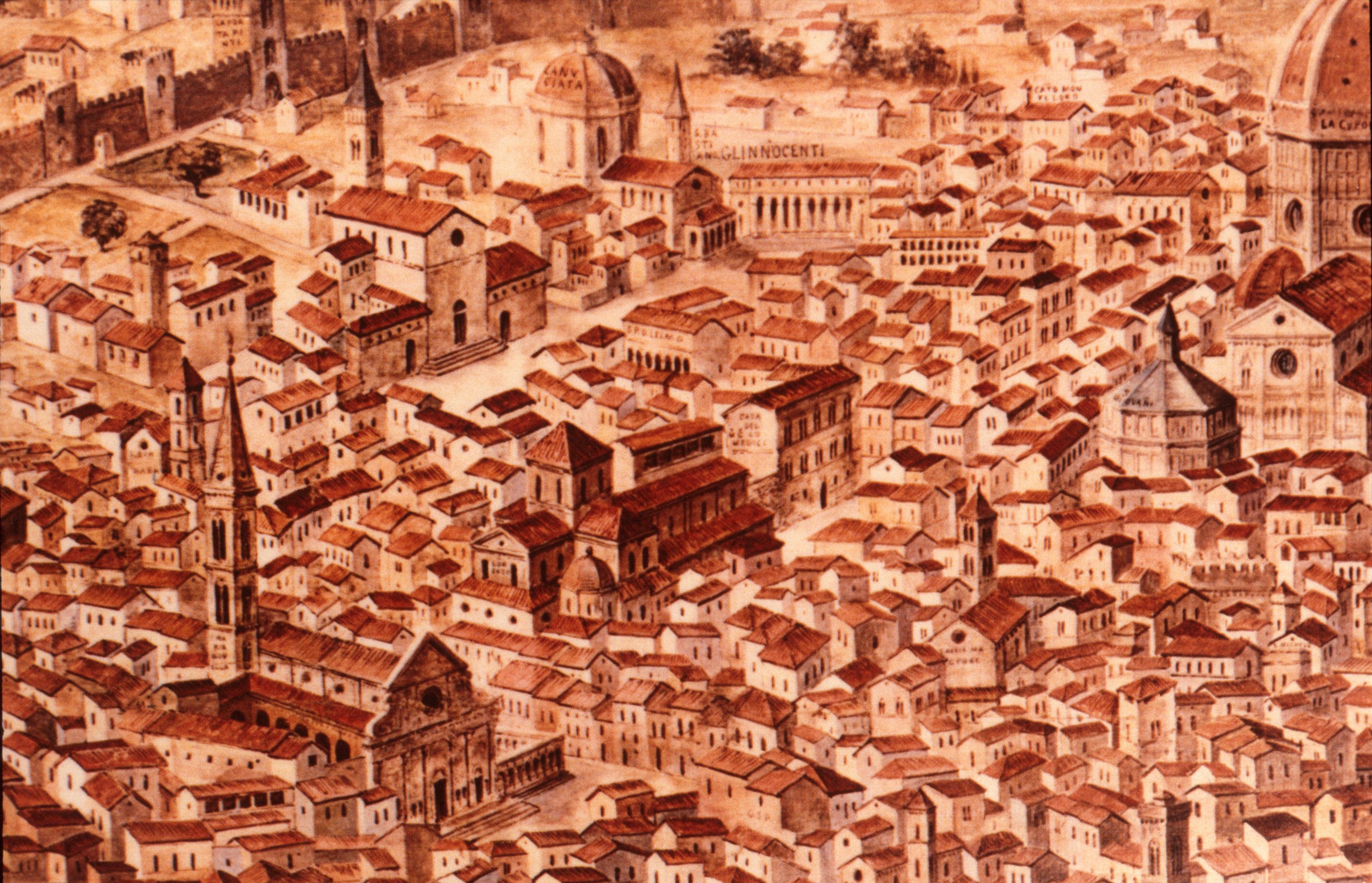
The lower image is a detail of the panorama, enlarging one small area of the city to the east of the cathedral, where a family of bankers called the ‘Doctors’ lived—the Medici.
This is the quarter that contains their palatial home (now called Palazzo Mèdici Riccardi, but I will venture to omit the name of the later occupants). It also contains the vast Basilica of San Lorenzo, where members of the family are buried, and the Convent of St Mark, where the father of the dynasty, Cosimo de’ Medici (1389–1464), used to retire and pray. This is now the seat of the Museo di San Marco which houses some of the most famous paintings by Cosimo’s favourite painter, a Dominican who came to be known as Fra Angelico (1398–1455).
In this lecture, we shall be looking at the best-known work of the principal assistant of Fra Angelico, a Florentine called Benozzo Gózzoli (1420–1497).
Benozzo Gozzoli would have been about forty years of age when he was commissioned, in 1459, to paint frescos on the walls of the Medici family chapel.
This was a not untypical commission (as was noted apropos of Giotto and Masaccio in relation to their fresco cycles for the chapels of the Bardi and the Brancacci families in Santa Croce and Santa Maria del Cármine). But in this case there was a significant difference. The chapel in question was not in the local church, but inside the magnificent new townhouse that the Medici had been building, and which was approaching completion in the 1450s.
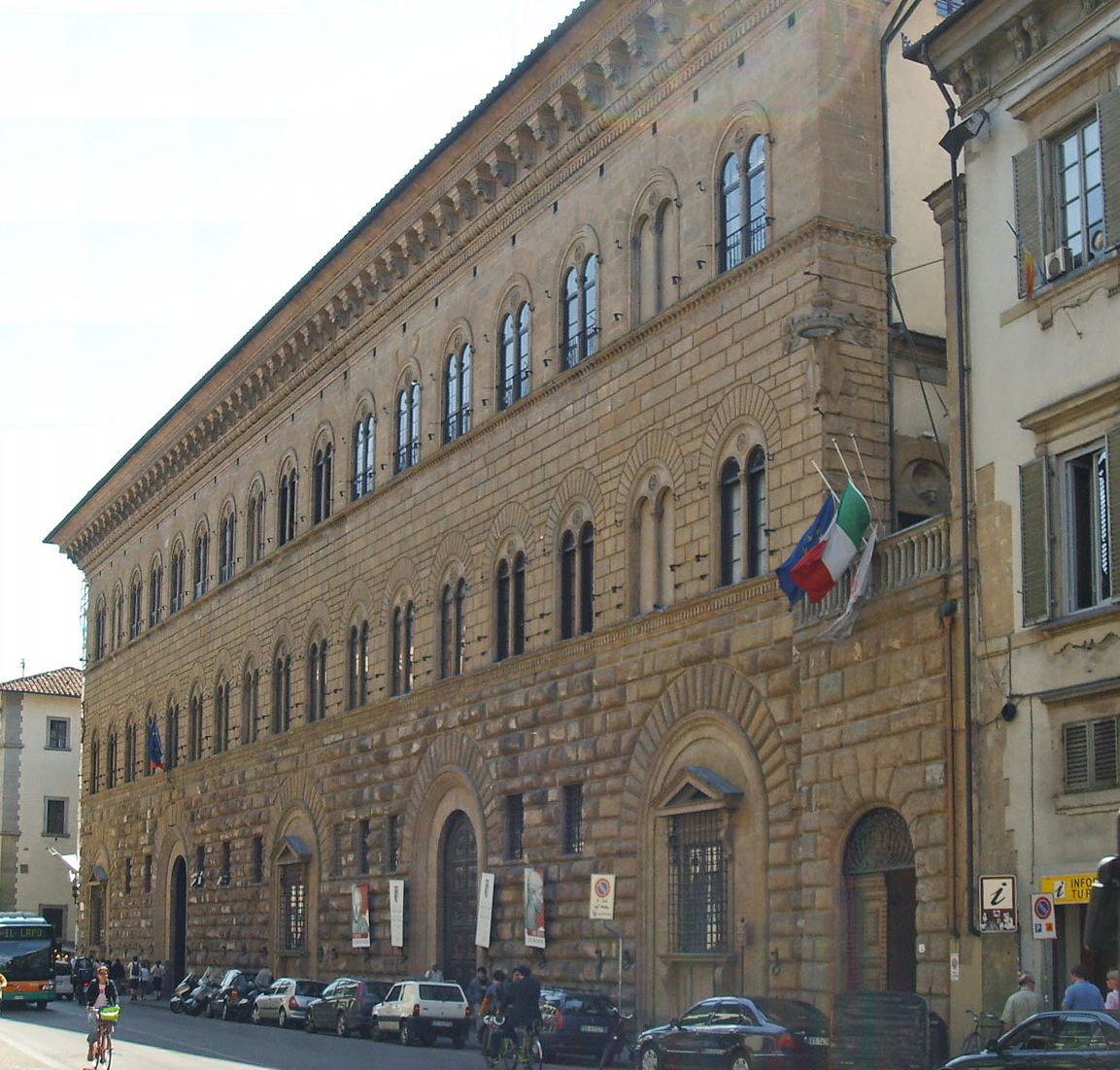
The chapel lies in what would later be called the ‘noble’ storey, piano nobile.
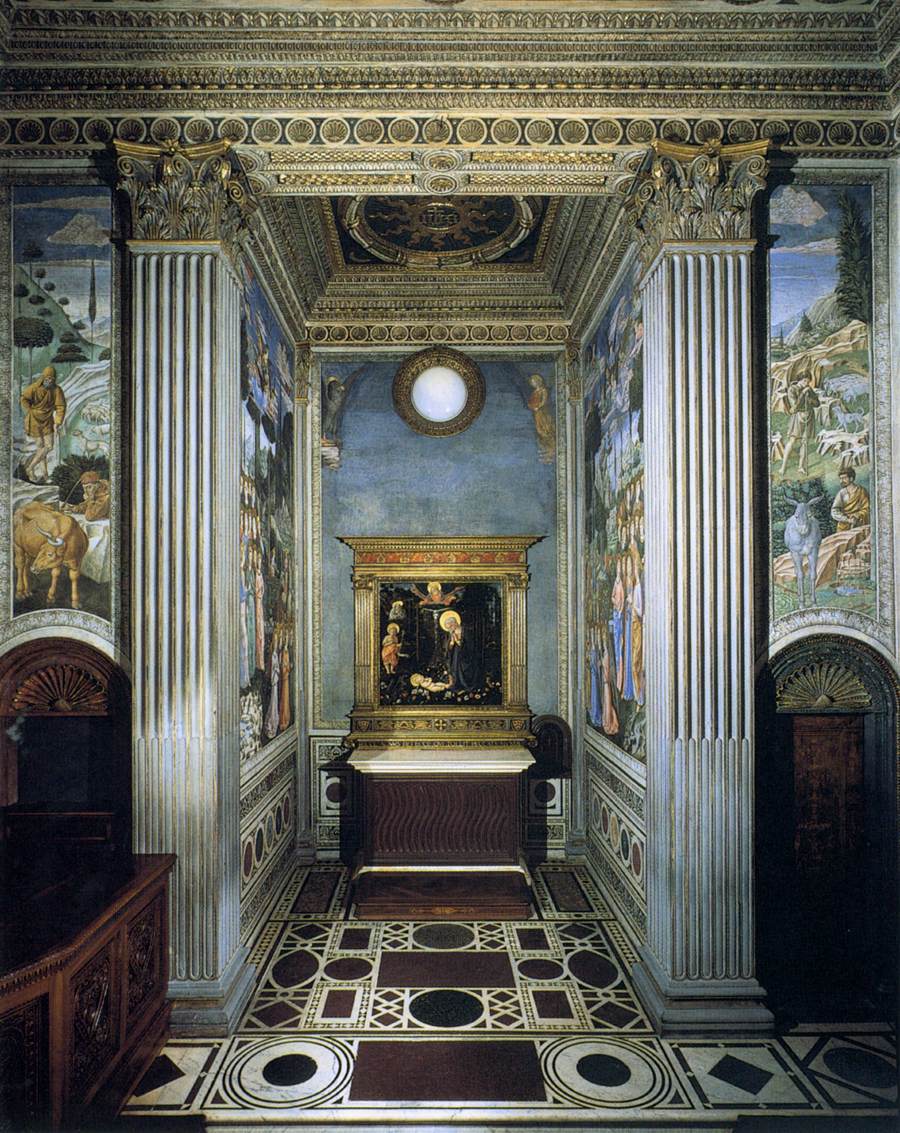
It is a fairly small room, in which the main area forms almost a square, about sixteen feet by eighteen feet. There is also, as you can see in the lower photo, a smaller rectangle, opening up from the front wall, to accommodate the altar.
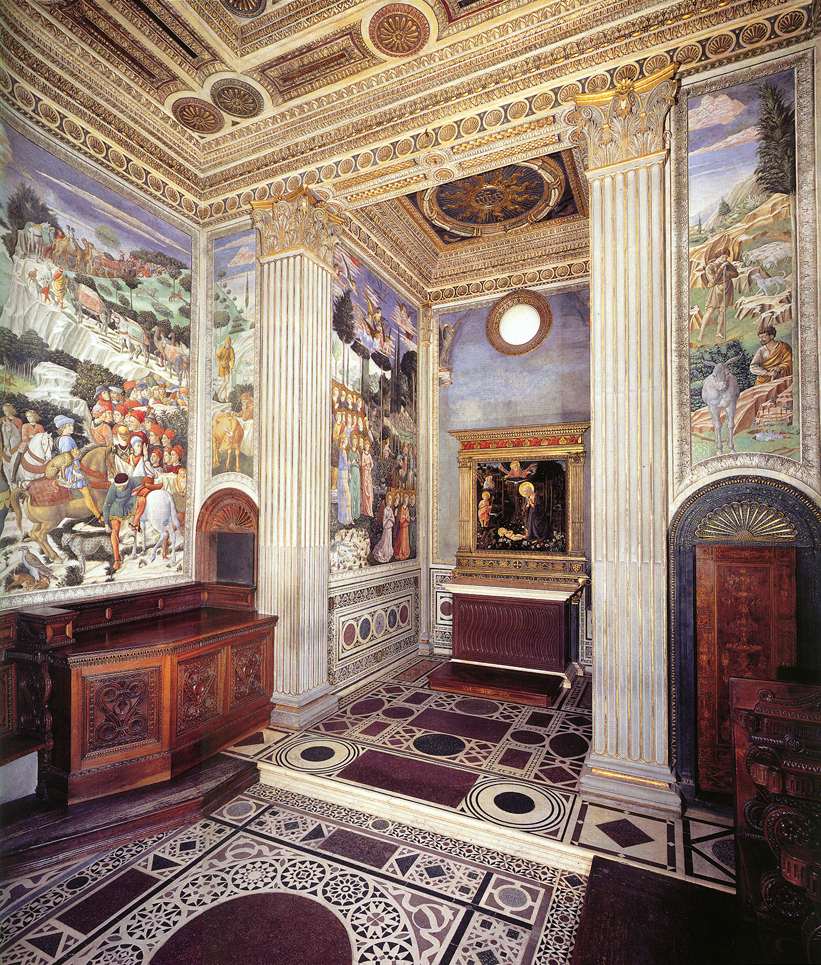
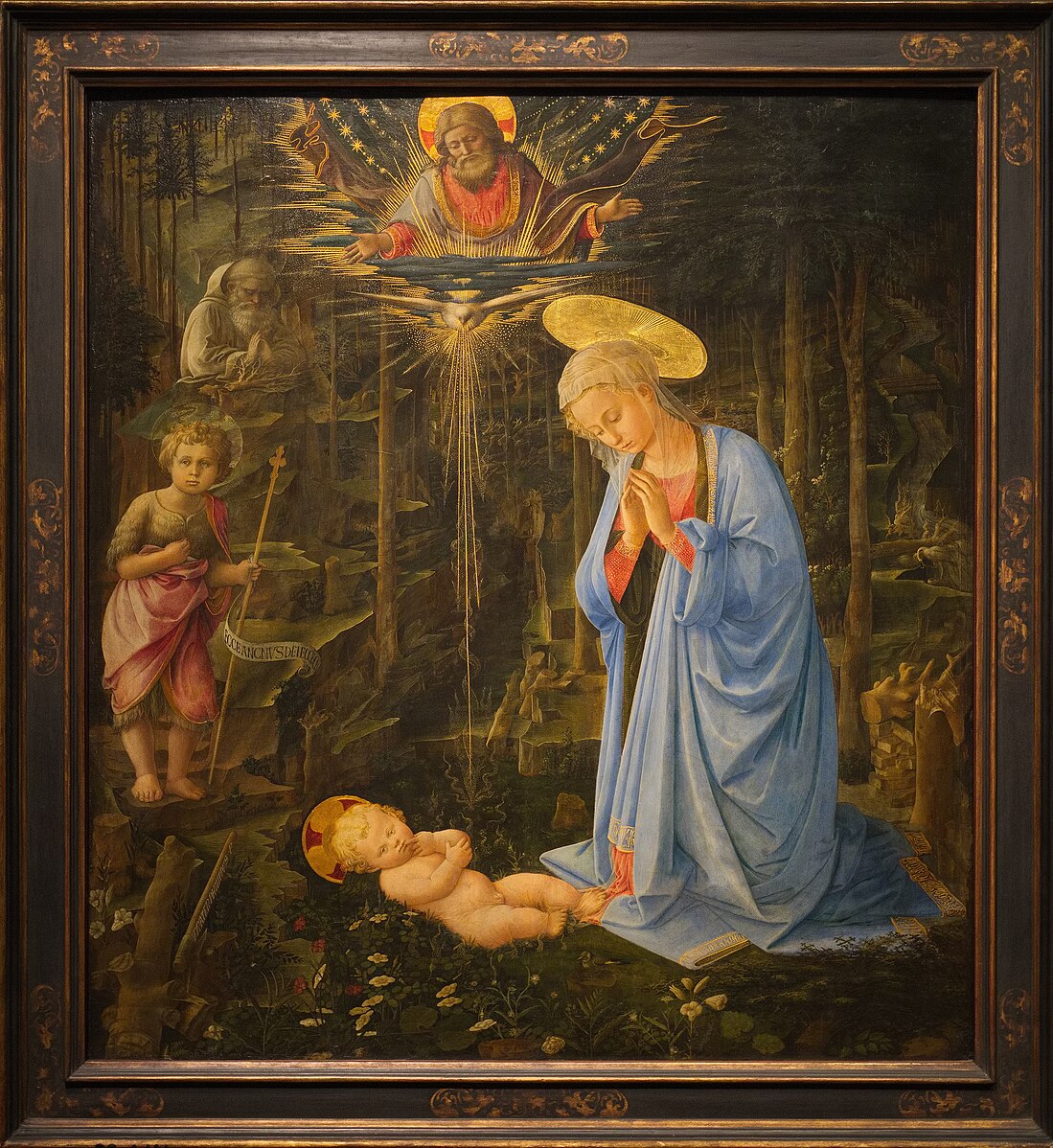
This altar already had a magnificent altarpiece, painted in the early 1450s by Filippo Lippi, showing a very dark grove where a slim and beautiful Mary is adoring a chubby Jesus on the ground, in the presence of a young John the Baptist (Giovannino), Saint Bernard of Clairvaux, God the Father, and the Holy Spirit in the form of a dove descending. There is not a shepherd or a Wise Man in sight: this is a so-called ‘Mystic Nativity’.
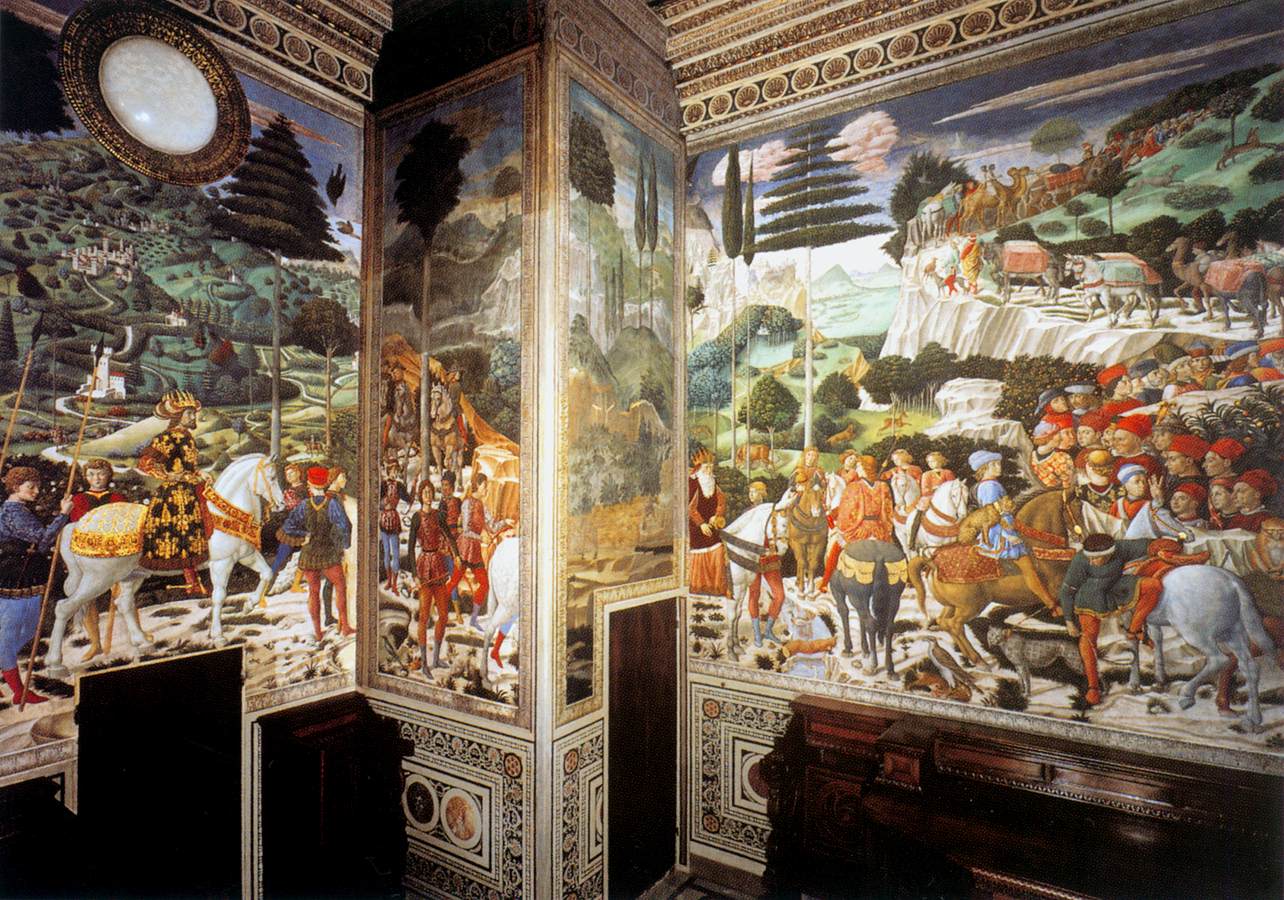
The seats in the chapel are veneered, the floor is inlaid, and the ceiling is splendidly coffered. There is also one important detail which is missing from the two photographs. In the centre of the main ceiling, and also in the centre of the smaller altar ceiling, there is a golden star, which would catch the faint light coming from the two oculi.
Gozzoli was asked to decorate the three walls surrounding the altar with frescos that would represent the journey of the Magi, who were to be imagined as ‘following yonder star’ in the ceiling.
They would apparently ride round the walls, until they came to a halt where the star had stopped over the altar, where they would find Mary adoring her baby.
Gozzoli achieved this goal by placing one of the Three Wise Men in the centre of each of these walls, and linking them by means of pages, grooms and attendant lords, so that all three walls can be read as one continuous pageant, one continuous cavalcade entering the chapel on one side, and leaving on the other.
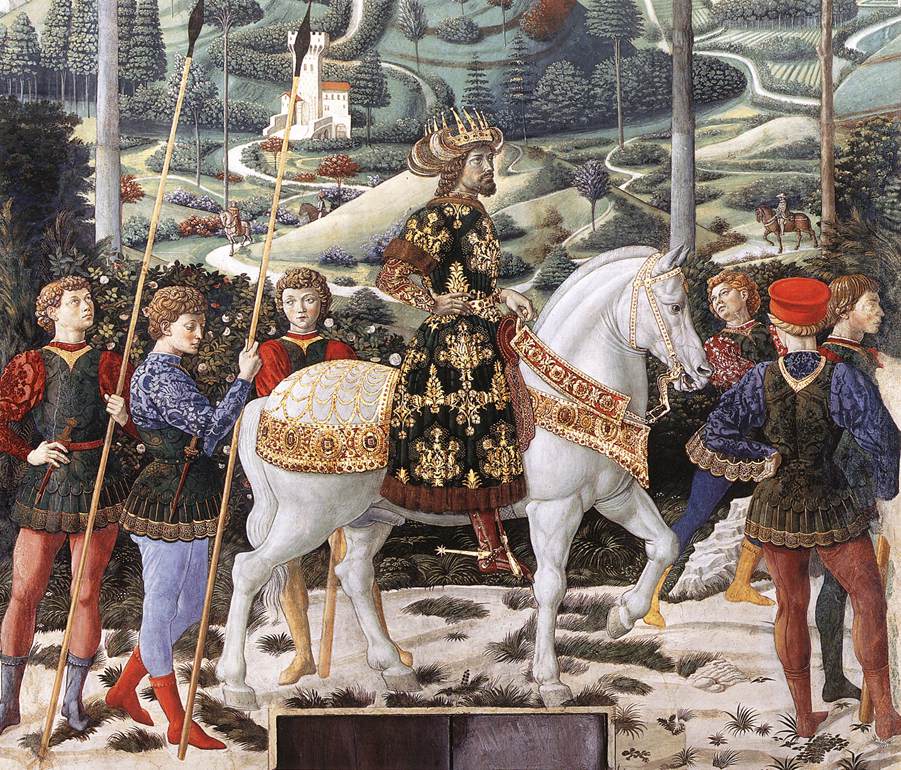
In the second half of this lecture, we shall take a close look at this pageant and enjoy a host of lovely details. When you have seen them, you will understand why tourists who visit the little chapel always walk out with a smile on their faces and tend to remember what they saw there more clearly than many of the other sights which they crammed into a week’s holiday in Florence.
Benozzo, however, is not one of the Great Ones in the history of art; and he hit the jackpot just this once. His career does not require much by way of explanation, and (unlike the Legend of the True Cross) there is virtually no story to tell. So I am going to spend the first half of this lecture talking about the representation of the Three Wise Men in earlier centuries.
I hope this will be enjoyable in itself; and although I shall confine myself to representations found in Italy, you will have seen enough for you to distinguish what Gozzoli took over from ancient traditions from what is relatively new.
First, however, I must remind you of the bones of the Gospel story. So let us go back to the Gospel of St Matthew (the only source):
Now when Jesus was born in Bethlehem of Judea in the days of Herod the King, behold, wise men from the east came to Jerusalem, saying, “Where is he who has been born King of the Jews? For we have seen his star in the east and have come to worship him.”
When Herod the King heard this…he enquired of them where the Christ was to be born. They told him, “In Bethlehem of Judea.”…
Then Herod…sent them to Bethlehem, saying, “Go and search urgently for the child, and when you have found him bring me word, that I too may come and worship him.”
When they had heard the King, they went their way, and lo, the star which they had seen in the east went before them till it came to rest over the place where the child was. When they saw the star, they rejoiced exceedingly with great joy; and going into the house they saw the child with Mary his mother and they fell down and worshipped him. Then, opening their treasures, they offered him gifts, gold and frankincense and myrrh. And being warned in a dream not to return to Herod, they departed to their own country by another way.
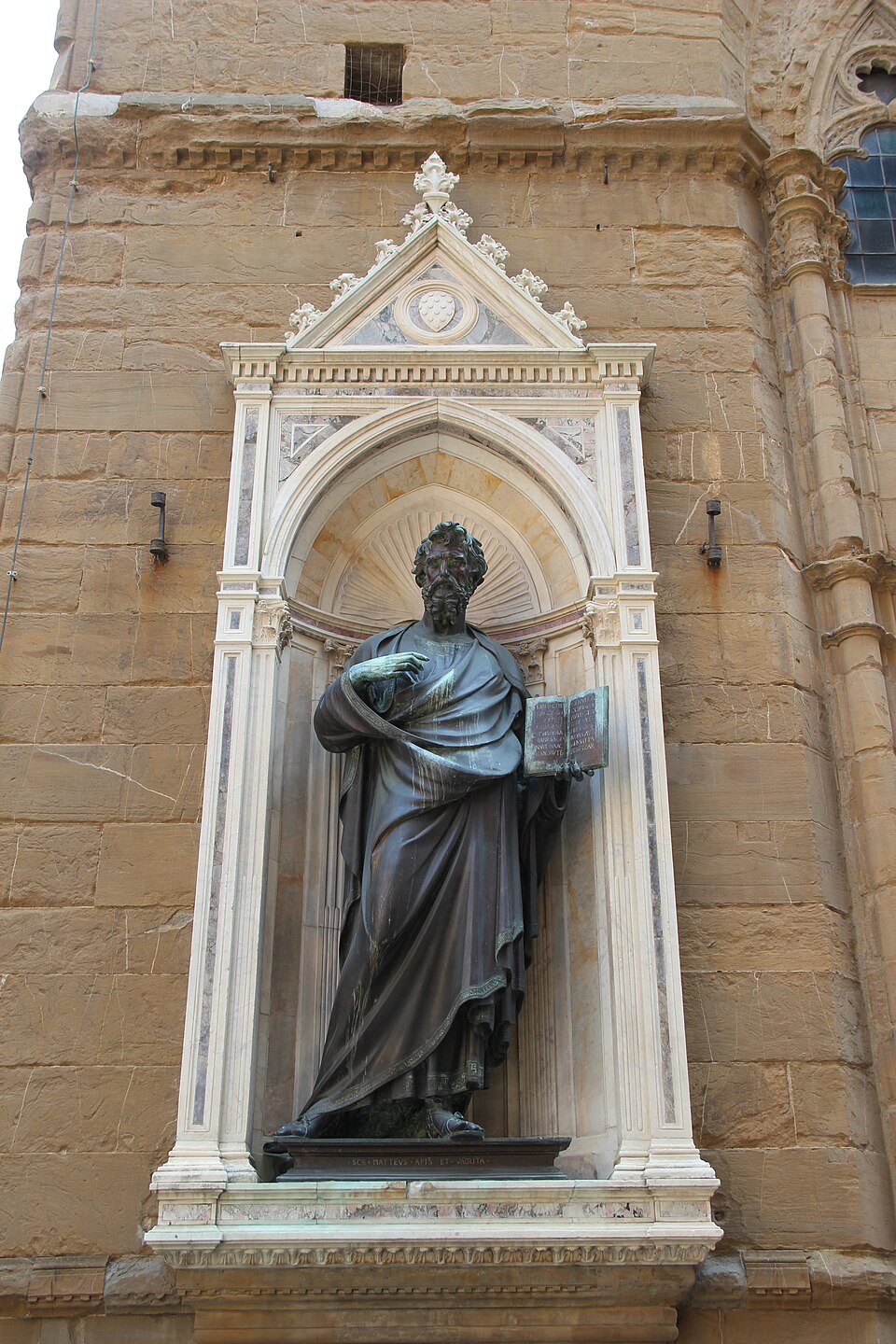
As a romance or legend, the story has everything: sages from the East with the power to read the stars; a journey; a council scene with a wily opponent; a miraculous star that actually leads the way; and the offering of exotic gifts to a baby who is also the Saviour of the World.
Most importantly, the moment of adoration was interpreted as being the first ‘manifestation’ or ‘appearance’ of Christ to the pagans, the ‘gentiles’ (that is, to the non-Jews). This is why the feast day of the Magi on January 6th is known as Epiphany, which is simply the Greek word for ‘appearance’.
If you turn to the Golden Legend (the widely read thirteenth-century compilation of reading matter for every day in the liturgical year), and look at the entry for Epiphany, you will find the author quoting St Bernard of Clairvaux, who offers a very literal and practical interpretation of the meaning of the gifts:
The gold was intended to give testimony of the poverty of the Blessed Virgin; the incense to purify the smell of the stable; and the myrrh to give strength to the limbs of the child by driving out the worms from the entrails.
It was more usual, however, to dwell on the symbolic or the allegorical meanings. Notably (as the Golden Legend also reports), ‘these three gifts signified the royalty, the divinity, and the humanity of Christ. Because gold is used for royal tribute,…incense for divine worship,…and myrrh for the burial of the dead.’
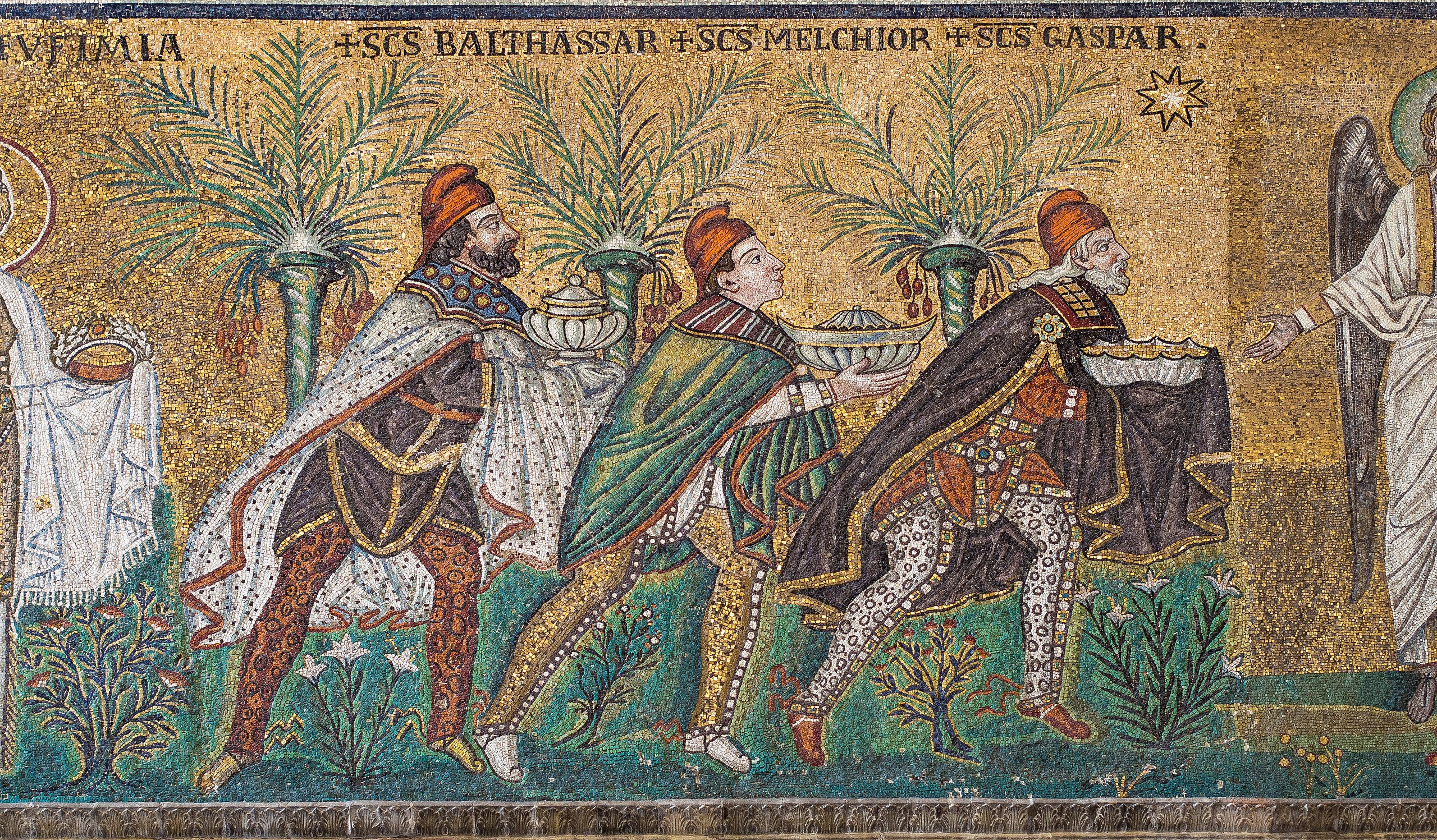
My earliest Italian example of their ‘epiphany-in-art’ anticipates the Medici Chapel by representing the three sages at the head of a long procession.
To find them you have to go to Ravenna on the Adriatic Coast, to the Basilica of Sant’Apollinare Nuovo, where a single mosaic runs the length of the whole nave, showing a procession of virgins, who are advancing to adore Mary and her child, enthroned between four angels.
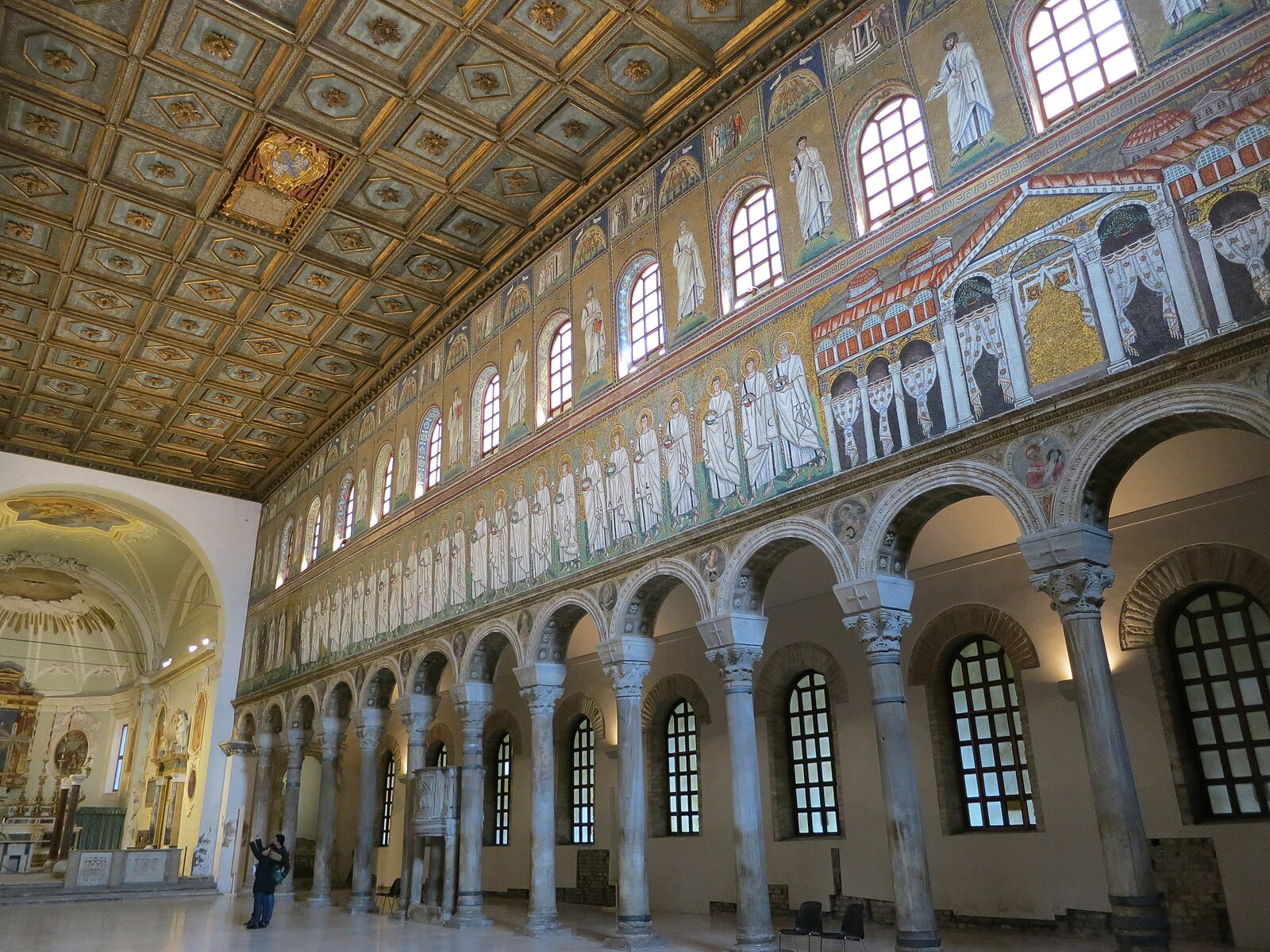
The Magi lead the procession, carrying large bowls, which resemble soup tureens, containing their gifts.
The mosaic is from the middle of the sixth century; and you will see that the number of Magi, left unspecified by St Matthew, has been fixed at three, one bearing each gift.
By this time, too, they have acquired names: Caspar, Melchior, and Balthasar (which is the Latin form of Belshazzar). Further, they have become representatives of the three ages of man: middle, young, and old.
In later centuries, they would also be interpreted as representatives of the three known continents—Europe, Asia, and Africa—and later still, one of the three would be portrayed as black.
It is also worth noting that the layout of the figures is derived, in general terms, from those in a low relief sculpture of a Roman triumph—and, specifically, from reliefs showing pagan nations approaching to offer homage to a female figure of Victory.
It is from this source, ultimately, that we get the very oriental dress of the Magi at Ravenna, with their Phrygian hats, brightly ornamented cloaks (contrasting with the white of the virgins and the angels) and the very un-Roman trousers or breeches—admire especially the leopard-skin trousers with spurs!
I jump forward now a good seven hundred years to the thirteenth and early fourteenth centuries, to show you how the Three Wise Men appear—or ‘epiphanise’—in the works of three great Tuscan artists: the painters Duccio and Giotto, and, before them, the sculptor Nicola Pisano.
I am able to make this jump because Nicola carved two versions of the scene, and revealed himself as something of a Janus, who with one face looked back to the remote Classical past, and with the other, far into the future.
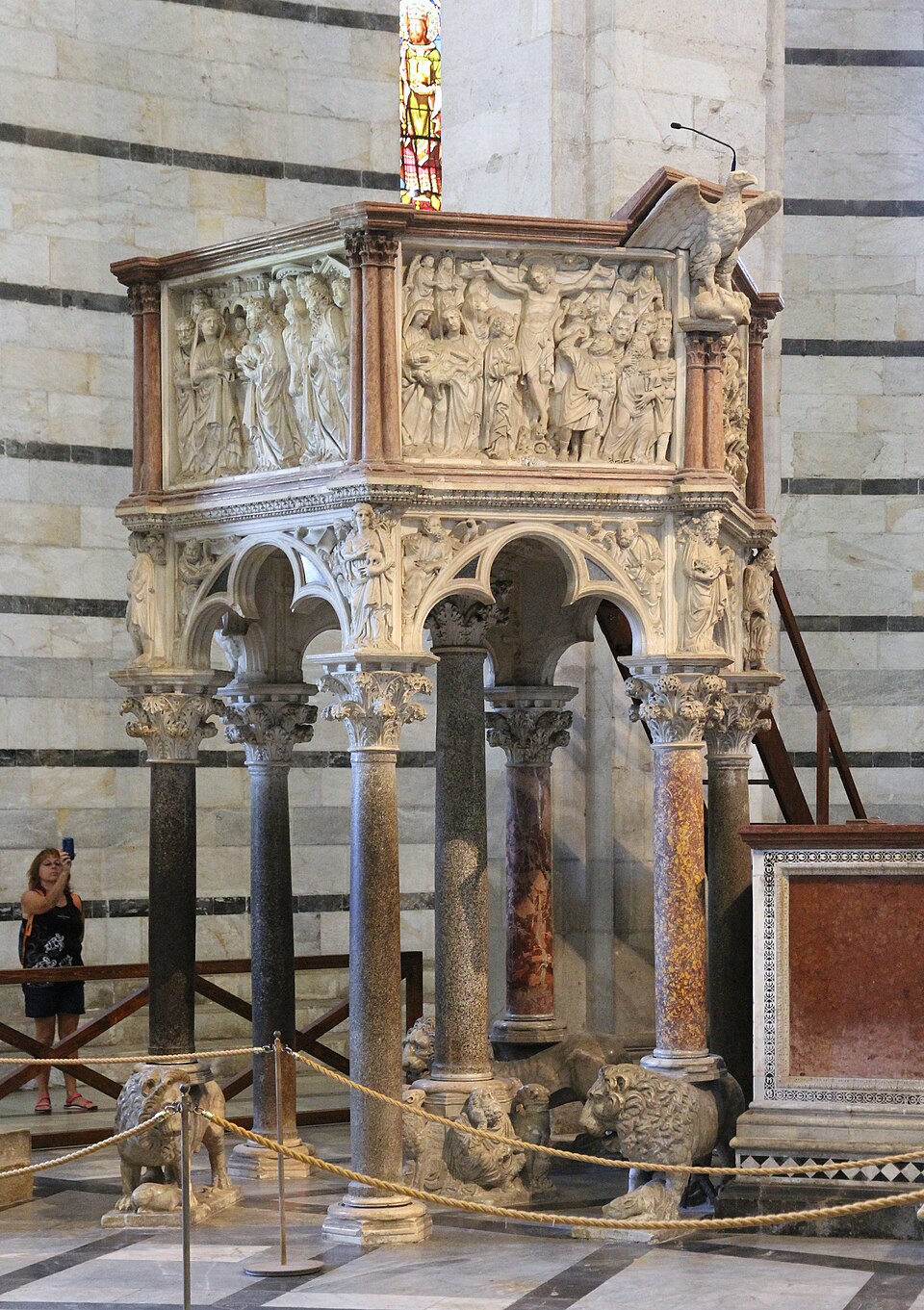
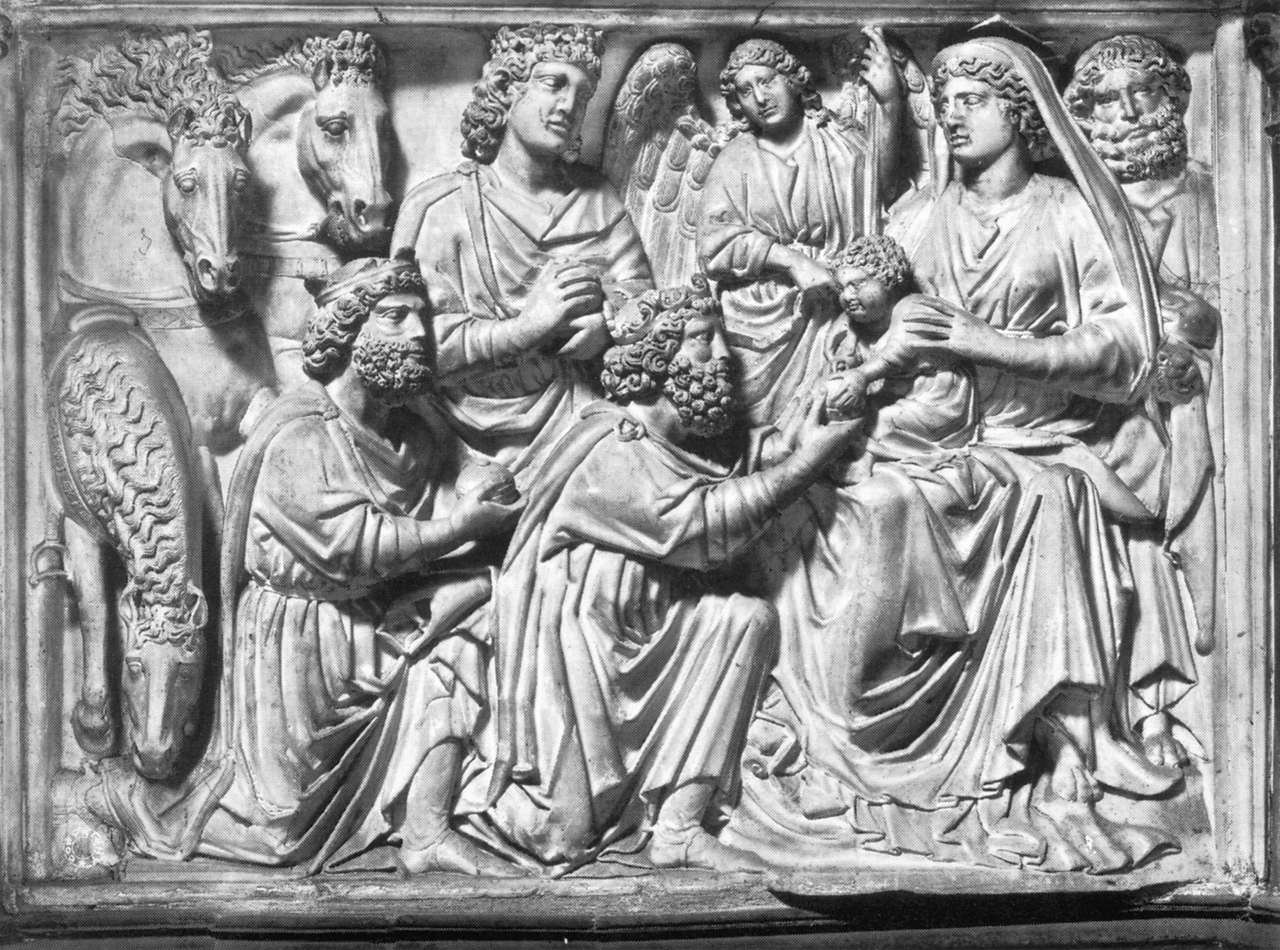
His first attempt is to be found on the panels of the marble pulpit which stands in the Baptistry (next to the cathedral and the leaning tower in Pisa), from which I have picked out the panel that concerns us now.
Here, Nicola was clearly inspired by relief sculptures of ancient Rome, and particularly by some of the many sarcophagi that had been, and still are, preserved in the Camposanto at Pisa.
Mary is flanked by an angel and by Joseph. She sits regally, full front, as at Ravenna—every inch a Roman matron. Two of the Kings (I call them ‘kings’ because they are always crowned by this time in Christian art) are kneeling in profile, as we saw at Ravenna, but they are less clearly distinguished in age, and are kneeling rather than advancing. Young Melchior stands behind, as sturdy as a statue of Hercules, inclining his head in reverence.
The antecedent journey is indicated, very economically, by the heads of three horses, one for each rider.
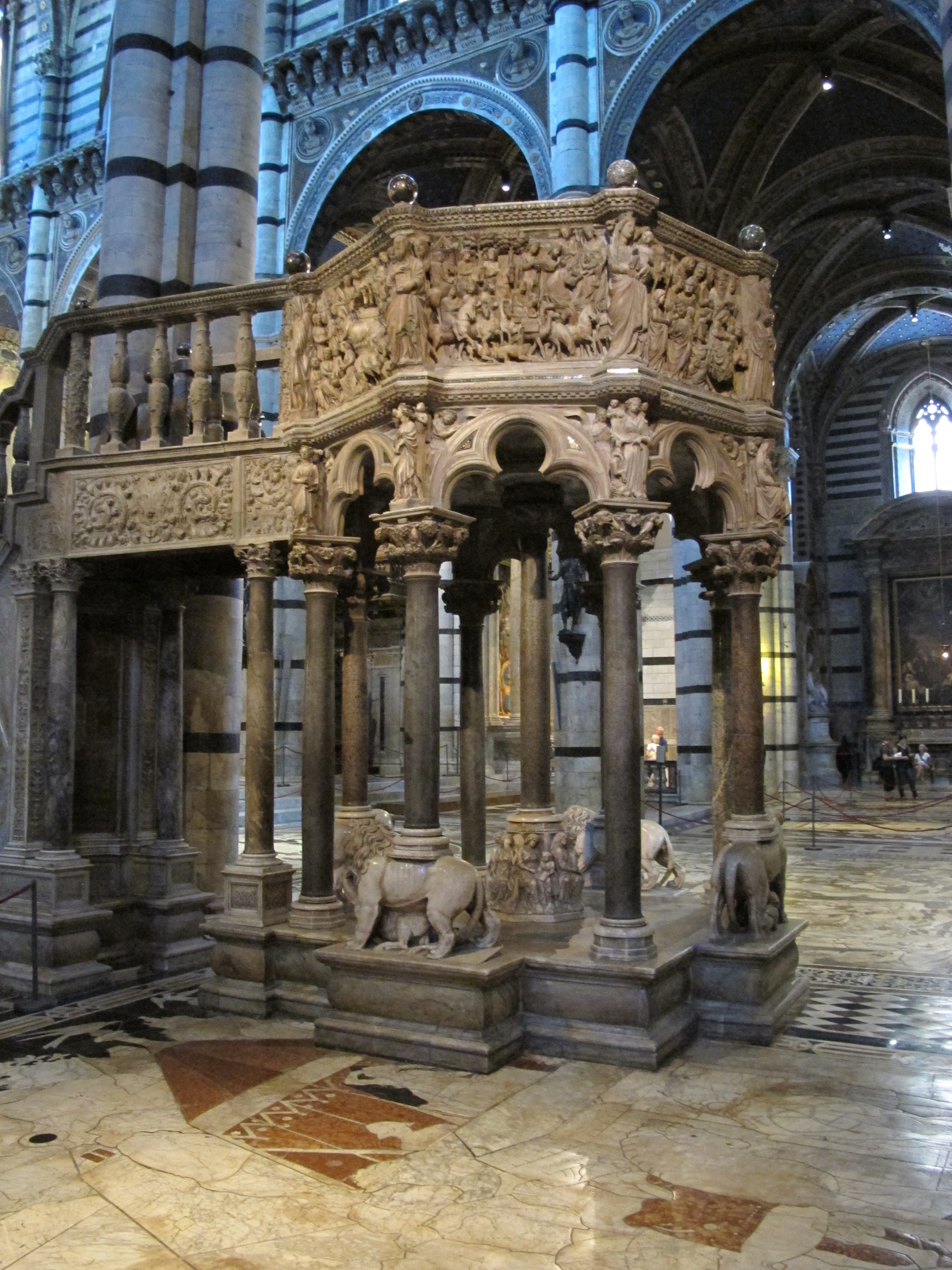
The Pisan panel was carved in about 1260. Only a few years later, in the 1270s, Nicola was working on a second huge pulpit, this time for the cathedral at Siena.
At first sight it looks very much like the one at Pisa, but as soon as one focuses on the relevant panel, one becomes aware of a totally different, Gothic sensibility.
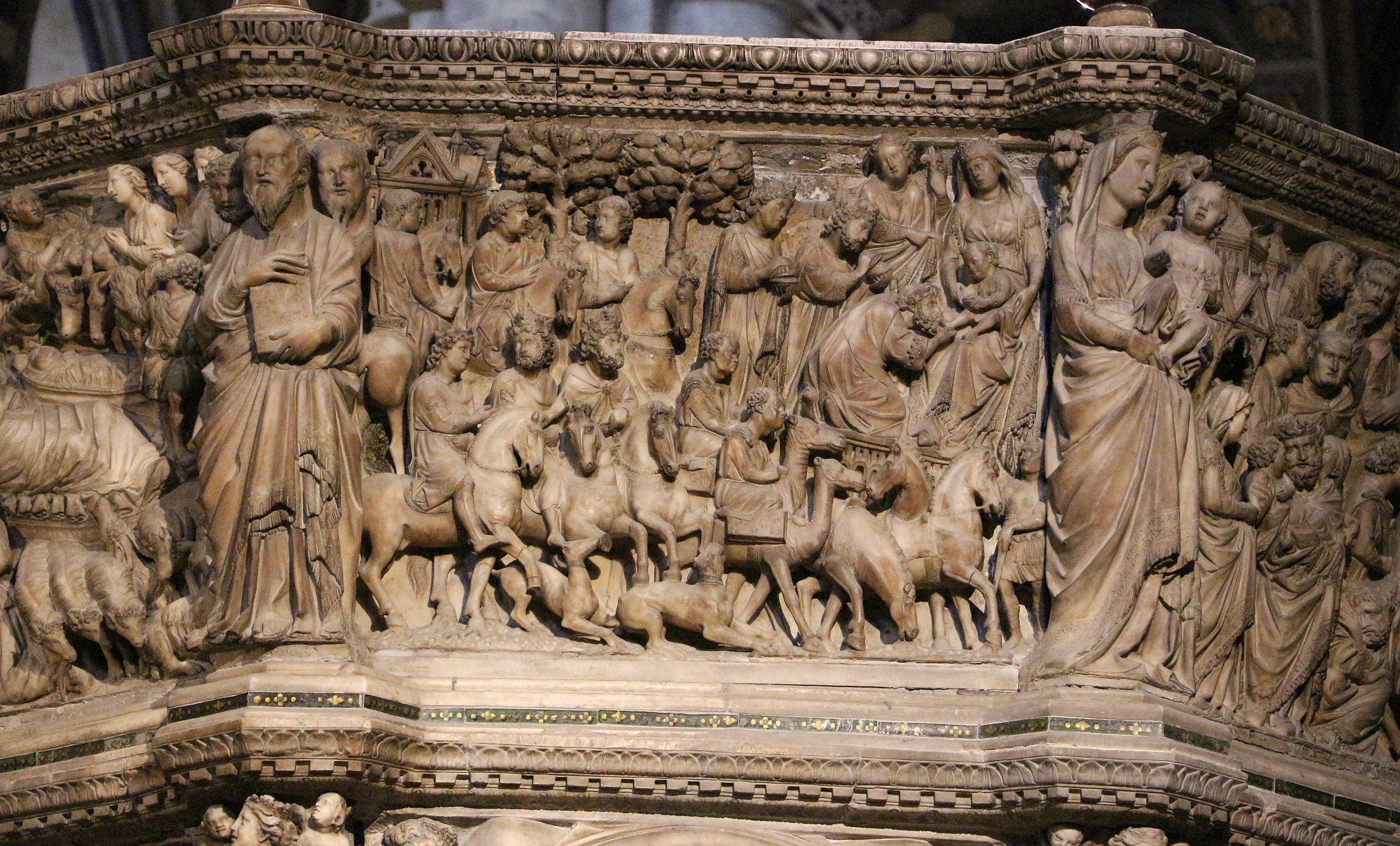
There is one angel on duty in the stable, but no Joseph. Mary is dressed in contemporary costume, while the crowned Kings are arranged in the order: young, middle, old; and they are standing, inclining, and kneeling, The oldest King kisses the feet of the infant in homage, as had become prescribed by the tradition.
However, the greater part of the panel shows the journey of the Kings, who are riding on superb horses, with two regal greyhounds beside them. They are followed by three mounted attendants who are wheeling their horses, and they are preceded by other attendants, on camels, while their grooms bring the packhorses to a halt in the front of the stable.
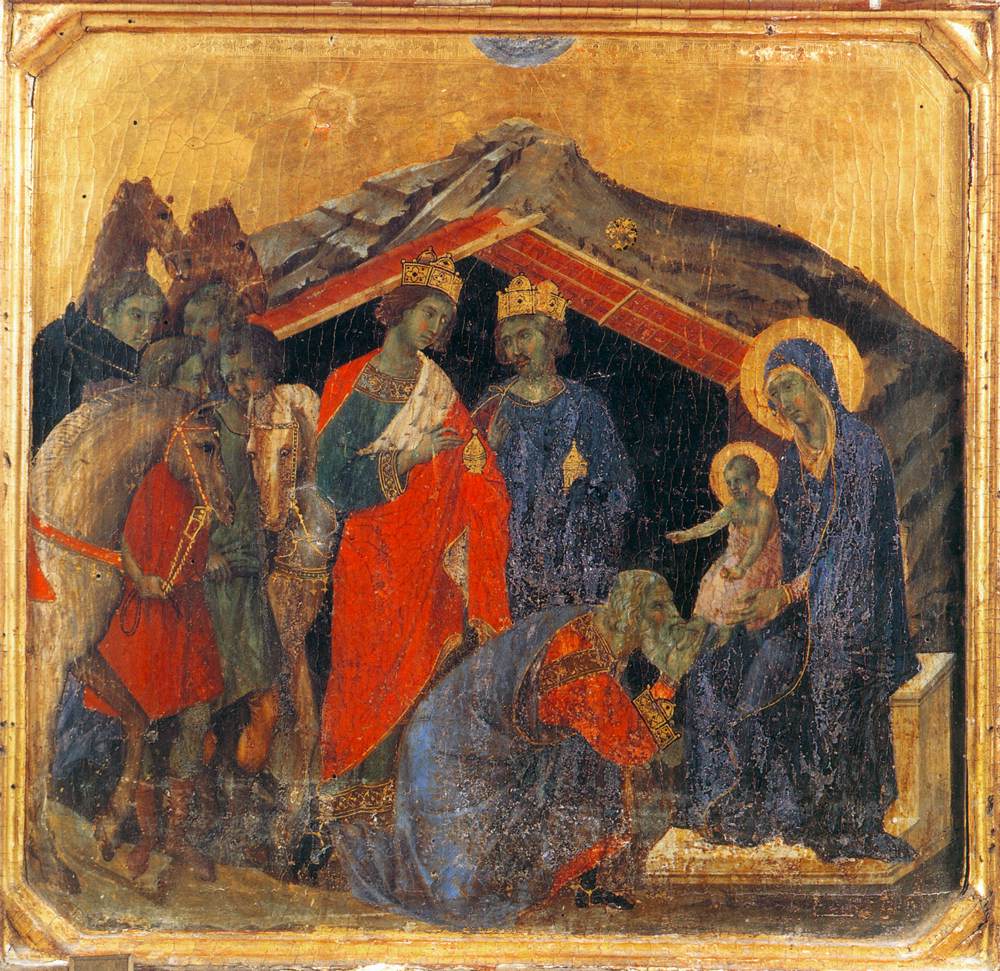
We move forward forty years to 1310, when Duccio painted this panel, no more than eighteen inches high, as part of the predella for his gigantic altarpiece which was going to stand only twenty yards away from Nicola’s pulpit in Siena Cathedral.
Here, everything is restrained and balanced. Duccio combines the cave, which was traditional in eastern or Byzantine representations of the Nativity, with the stable or barn, which had been favoured in the pictorial tradition of the Western Church, to form a central arch that frames the figures of Balthasar and Melchior. They exchange glances, as do the horses and the two pairs of grooms, while the two camels use their superior height to look down their long noses to the very heart of the scene. Old Caspar arches his back while kneeling, so that he may look up to the child whose foot he is kissing, while Jesus holds out his hand in blessing.
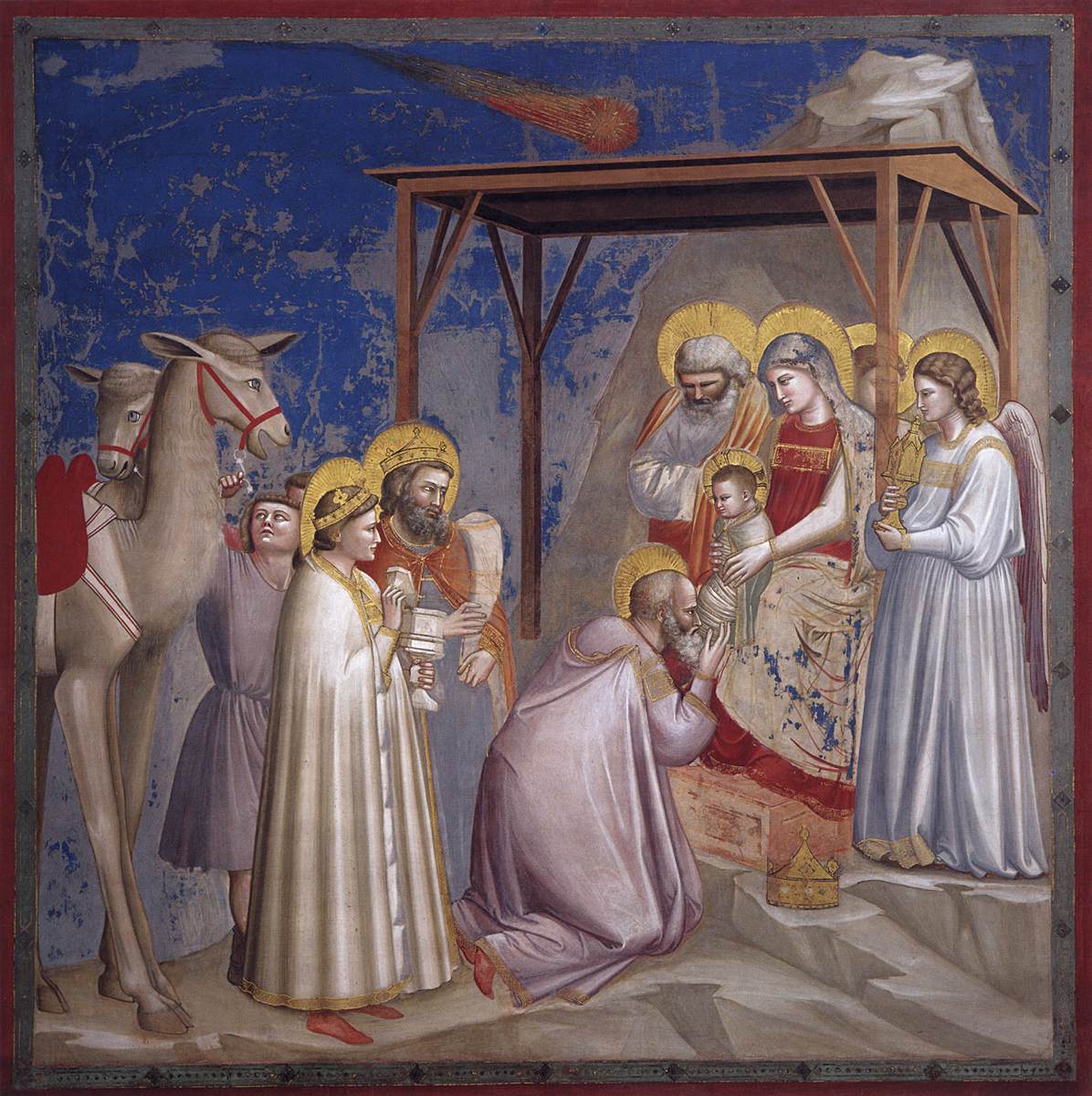
The very deep blues and reds and the dark gold leaf on Duccio’s little panel make a superb foil to the pastel shades of this fresco, about six feet square, which you will probably recognise immediately as being by Giotto, and as coming from the middle tier of the Scrovegni Chapel in Padua.
As always, Giotto tries to break away from a simple frieze—that is to say, a composition in which all the figures and all the action are parallel to the picture plane—by setting his ‘Dutch barn’ on a gentle diagonal, while the figures of Mary, Joseph and the angels are set on an even steeper diagonal, extending backwards into the space which is created, inside the picture, by the foreshortening of the barn (which here assumes the pictorial function of a canopy to a throne).
Caspar kneels, as in the earlier image, but with his eyes lowered. The figures that stick in the mind are young Melchior, massive and stock-still in his heavy, bell-shaped, un-patterned cloak, the groom reaching up to restrain the camel, and, in the sky, the star—which is also present in the Duccio—but which here is represented from the life as a comet. (Halley’s Comet had appeared in the year 1301, shortly before this fresco was painted in around 1304.)
Each of the four Adorations I have shown you so far were integral parts of a narrative cycle, and subordinate to the needs of the whole. The four I am about to show you—from the period between c. 1380 and c. 1435—were independent paintings. So it is hardly surprising that they should be more elaborate, adding a great many participants to the action, and a lot of local detail. (Generally speaking, they are following the lead given by the second of Nicola’s panels, the one from Siena.)
The earliest of the four is by a Sienese, Bartolo, son of Fredi, and is about six feet high; while the latest is a panel, about two feet high, by the northern artist Stefano da Verona.
Despite all the differences in size, quality, local traditions and date (they are separated by fifty years), the two pictures do share a number of generic features which art historians like to gather together under the label International Gothic, and which we need to recognise if we are going to place the art of Benozzo Gozzoli.
Very roughly, then, the compositions are strongly influenced by the conventions used in tapestries—secular tapestries, especially scenes of hunting. The stylised landscape extends to the very top of the painted surface, which is usually closed by a cluster of small buildings, or hills, or both, with virtually no sky. Most of the lower surface is typically covered by a mass of closely packed, overlapping figures, surrounded by animals and plants. The human actors are dressed in the most sumptuous costumes, very bright, with elaborate patterns; the servants or shepherds may be dumpy and almost caricatured, but the aristocrats have slender, willowy bodies, very often subjected to a flattened S curve, like the sound holes on a violin.
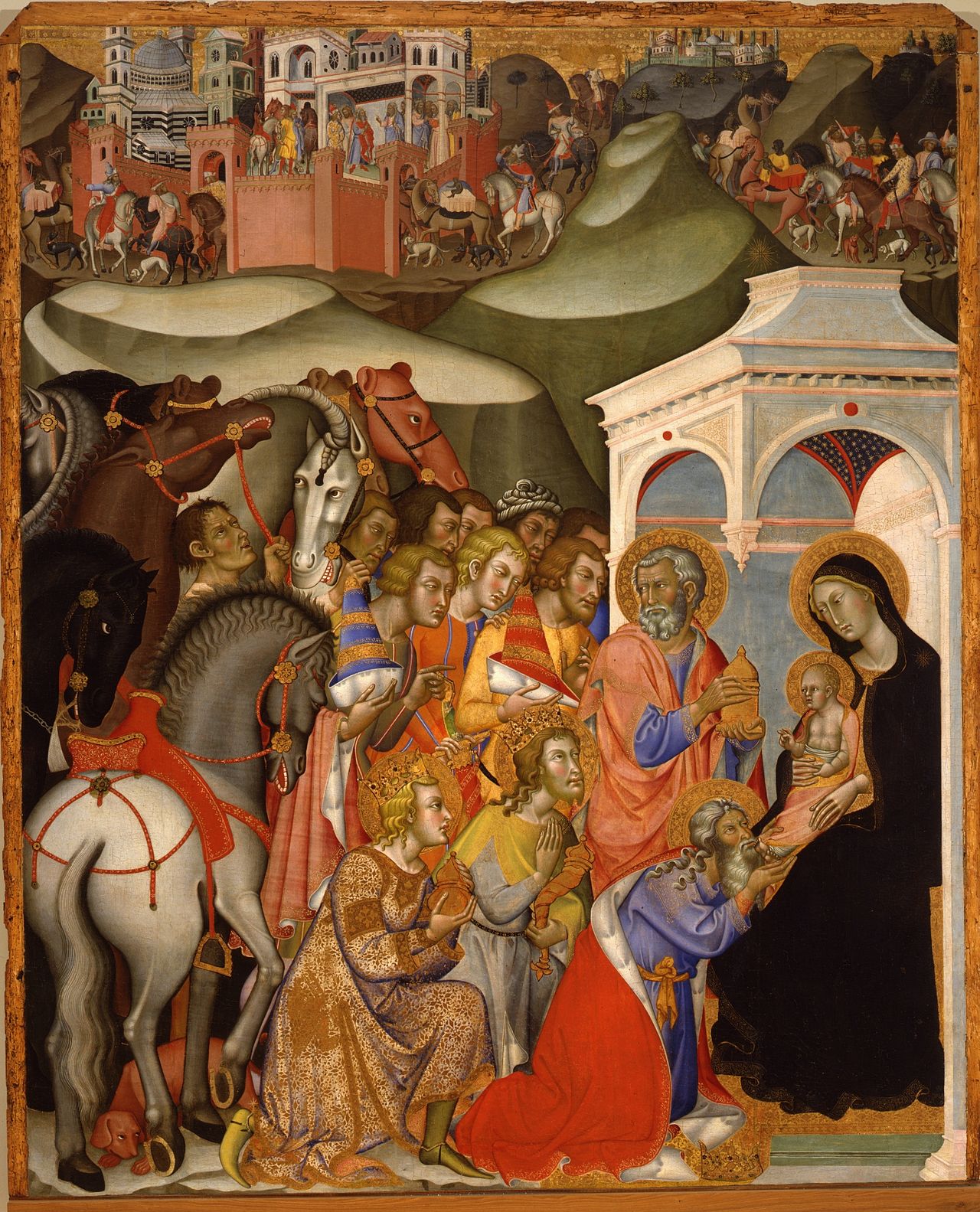
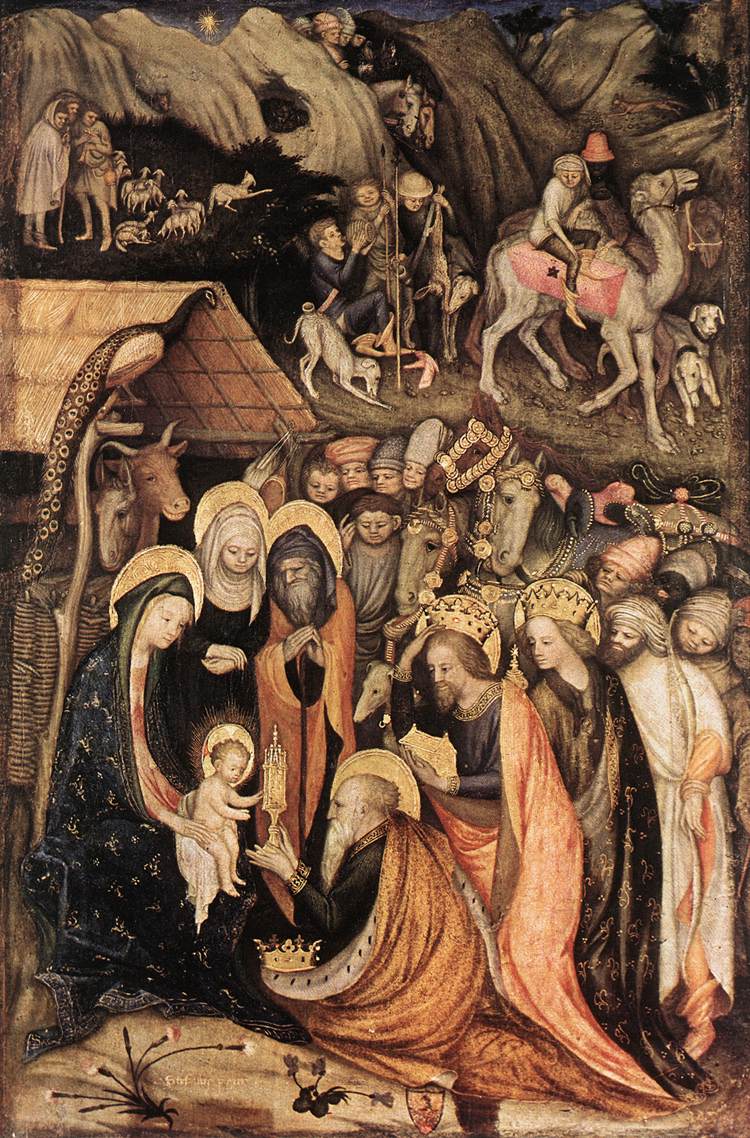
In the highest register of Bartolo’s altarpiece, you can see the procession of the Kings entering Jerusalem (which has a pronounced resemblance to Siena) and immediately leaving the city by the lower gate before reappearing at Bethlehem in the foreground to present their gifts, hemmed in by their ill-disciplined horses and followers, and, finally (top right) leaving for ‘their own country by another way’.
In Stefano’s little panel, you can see in addition the star, the shepherds abiding in the fields, and some hunters.
The procession here is limited to two men on camels and two dogs; but the stable has its ox and ass, and a symbolic peacock.
The Kings form a beautiful, lyrical group (with the S-curves very prominent); and the emphasis is on the Presentation, rather than the Adoration and Blessing.
Now let us come to Florence itself, and to two altarpieces that were painted near the beginning of the fifteenth century.
The first is now in the Uffizi, and is the work of ‘Laurence the Monk’, Lorenzo Monaco, who was a major influence on the early Fra Angelico.
It measures about three and a half feet by five, and in general terms, the composition is much the same as in the two we have just looked at. You can make out the angel and the shepherds, Jerusalem, the hint of a procession (with one camel, one horse and one dog); then the compact mass of followers, the Three Kings (young, middle-aged and old), Mary and Jesus, the stable with an ox and an ass.
The style, too, is clearly related to that of Bartolo and Stefano, although there are a few features to which I want to call attention because they either point forward to what we shall find in Benozzo, or act as a foil to his work.
Let us begin with the contrasts. The architecture here is very schematic indeed; the colours are extremely bright; the animals could hardly be less lifelike; and the human figures are even more elongated and subject to that S-curve than anything you have seen so far—all their movements seem to echo the scimitar on the thigh of the man in the foreground.
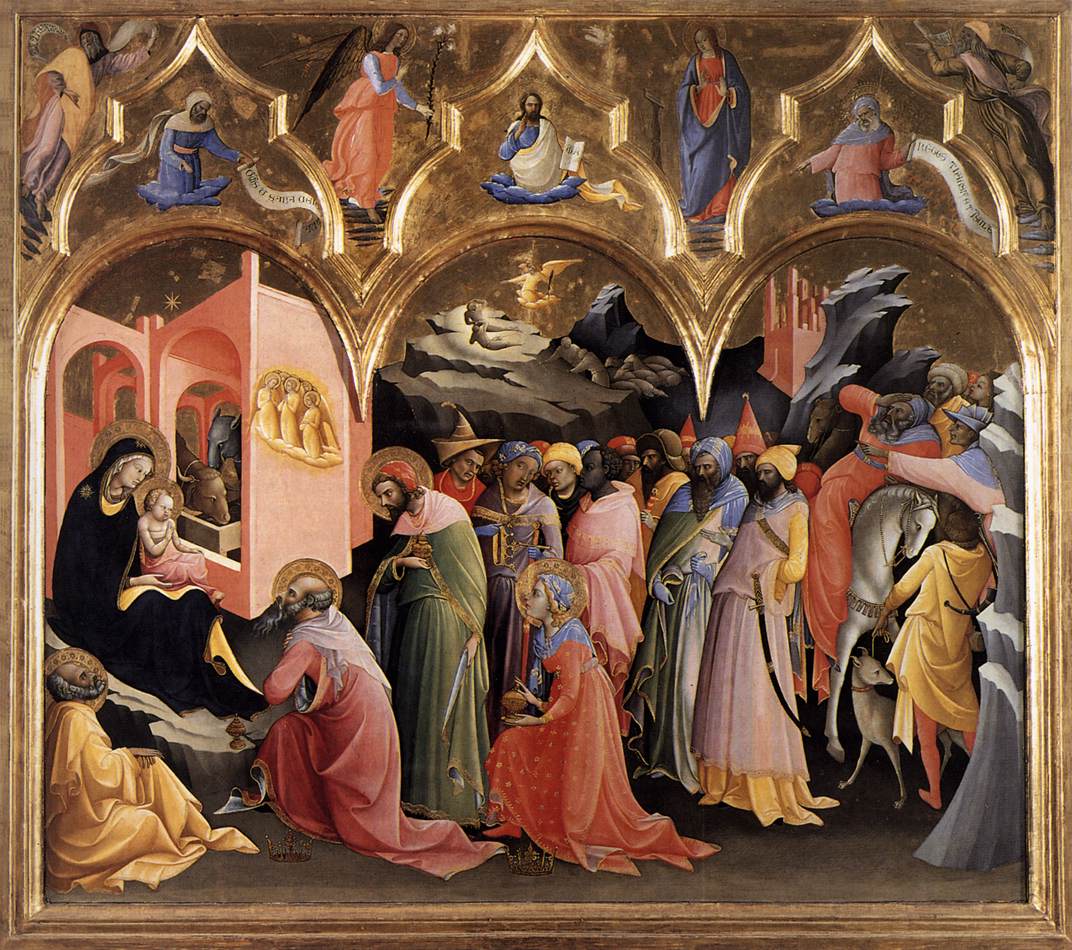
All these features are backward-looking by the year 1420.
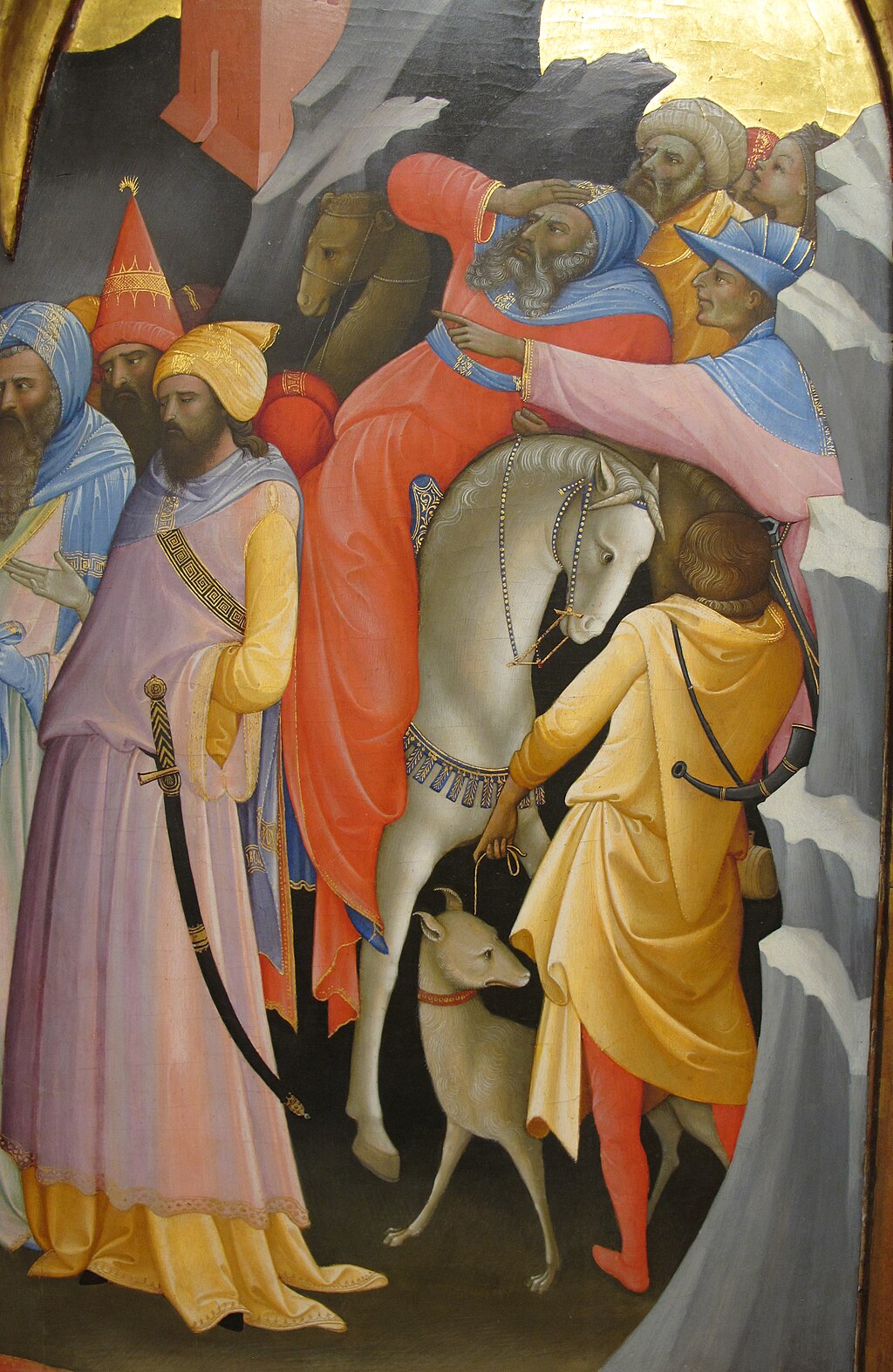
On the other hand, there is a more determined attempt to express the ‘easternness’ of the visitors, not just through the scimitar and the beards (Florentines at this time were all clean shaven), but with a reasonably convincing depiction of the black follower, and a splendid array of exotic headgear—pointed, or turban-like, or peaked.
(I adore this detail from Lorenzo’s Adoration.)
My final example before returning to the Medici Chapel, and to Benozzo, is one of the most famous images of the Magi in all European art.
It was painted for a family who were the rivals of the Medici (and whose palazzo was eventually to be even bigger than that of their rivals)—the Strozzi.
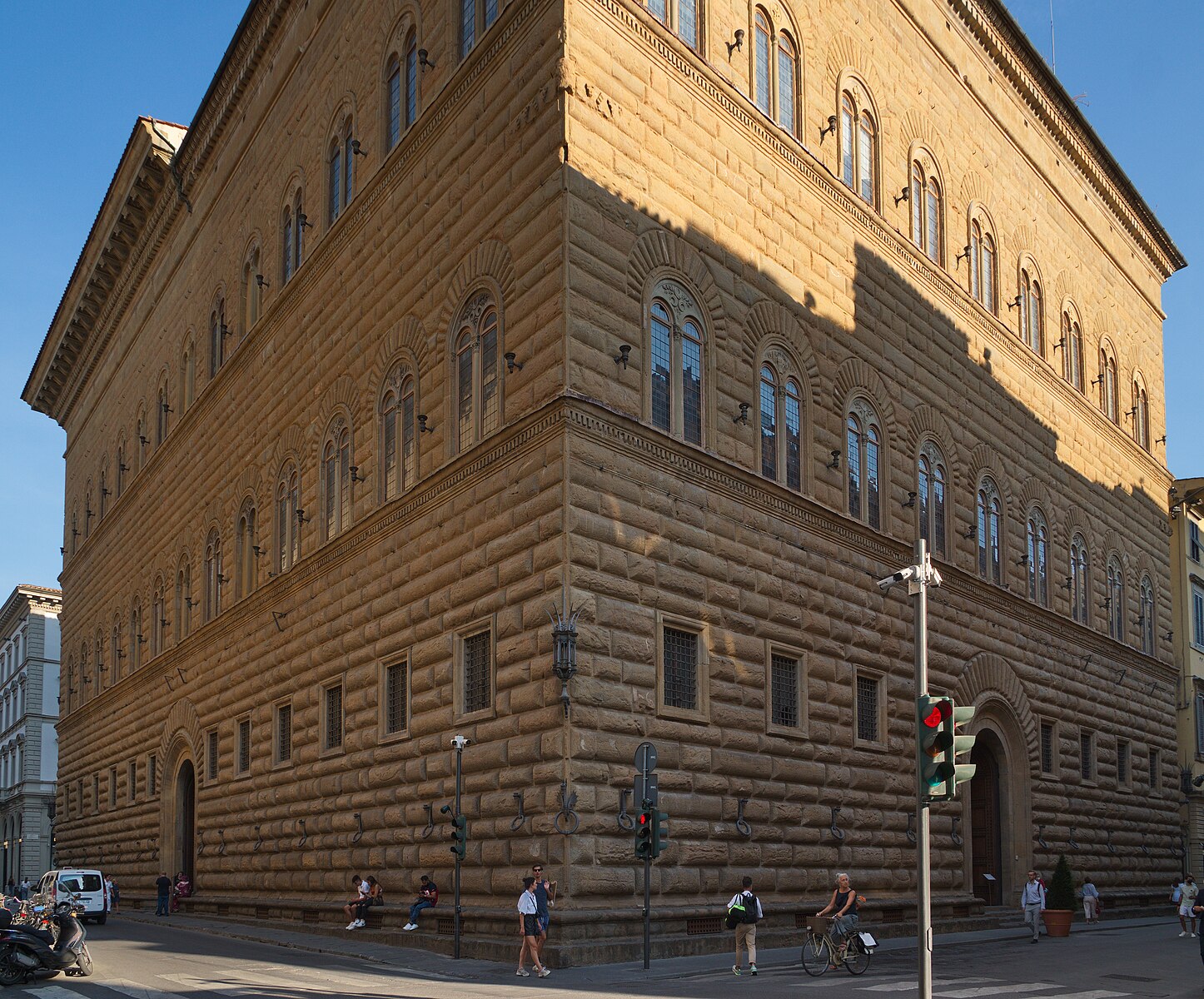
It was commissioned as an altarpiece for a new sacristy in the nearby church of Santa Trinita.
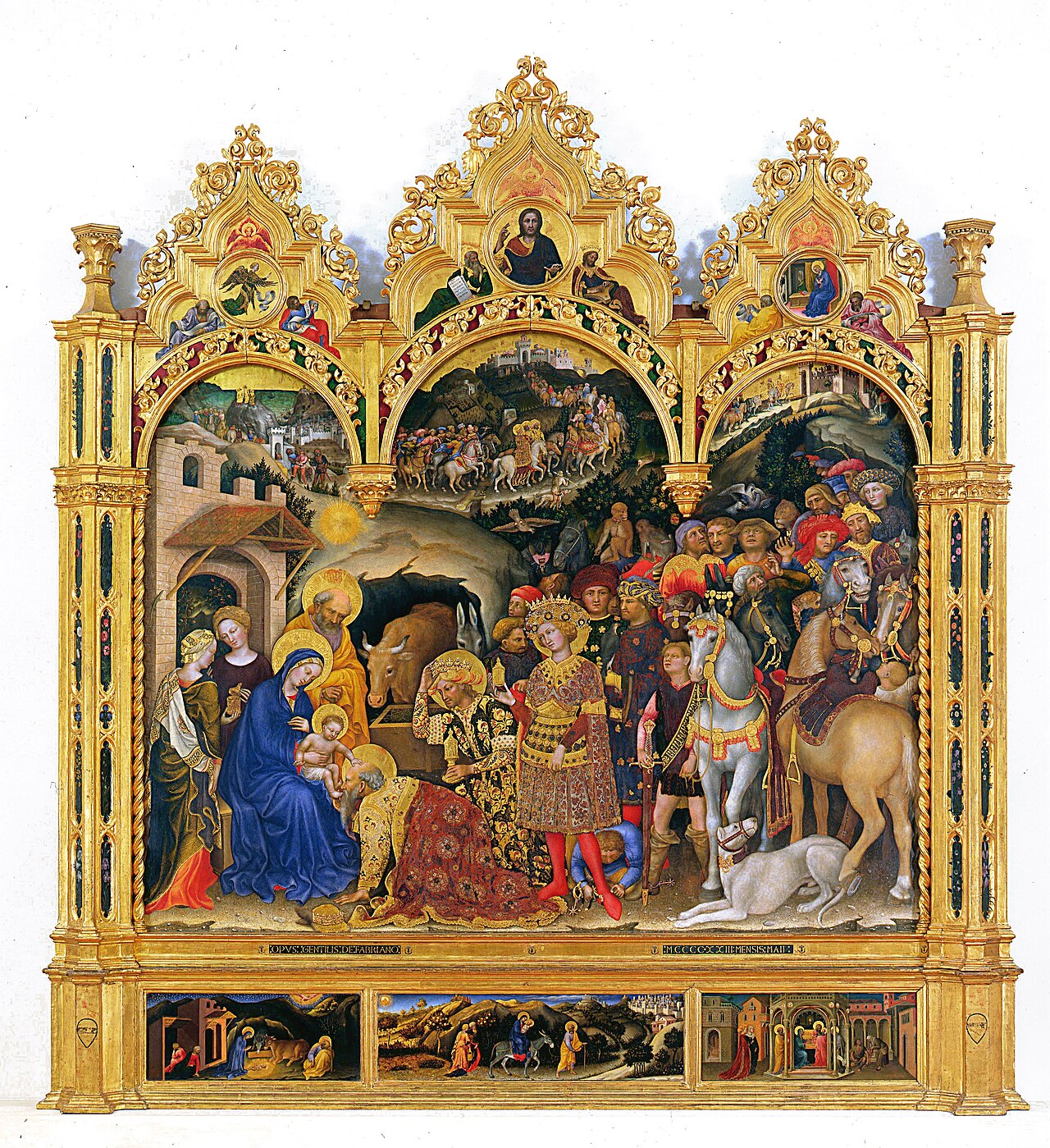
The artist was a non-Florentine, Gentile, from the town of Fabriano (which is in the Marches, to the west of Arezzo); and he signed and dated the work in May 1423.
It is still in its original highly elaborate frame, and can now be seen in the Uffizi in the same room as the Lorenzo Monaco—but it is nearly twice as big, six feet by almost nine.
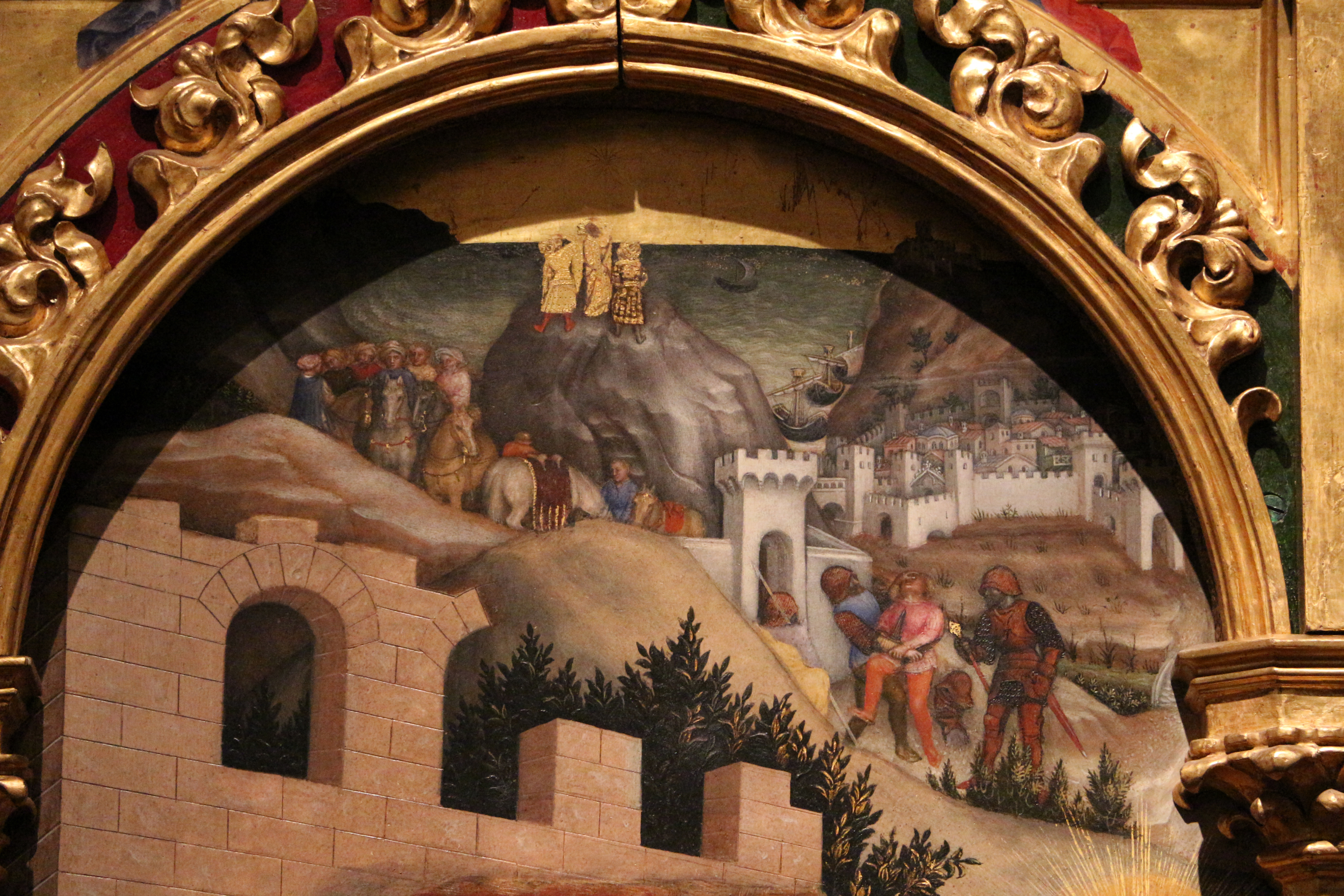
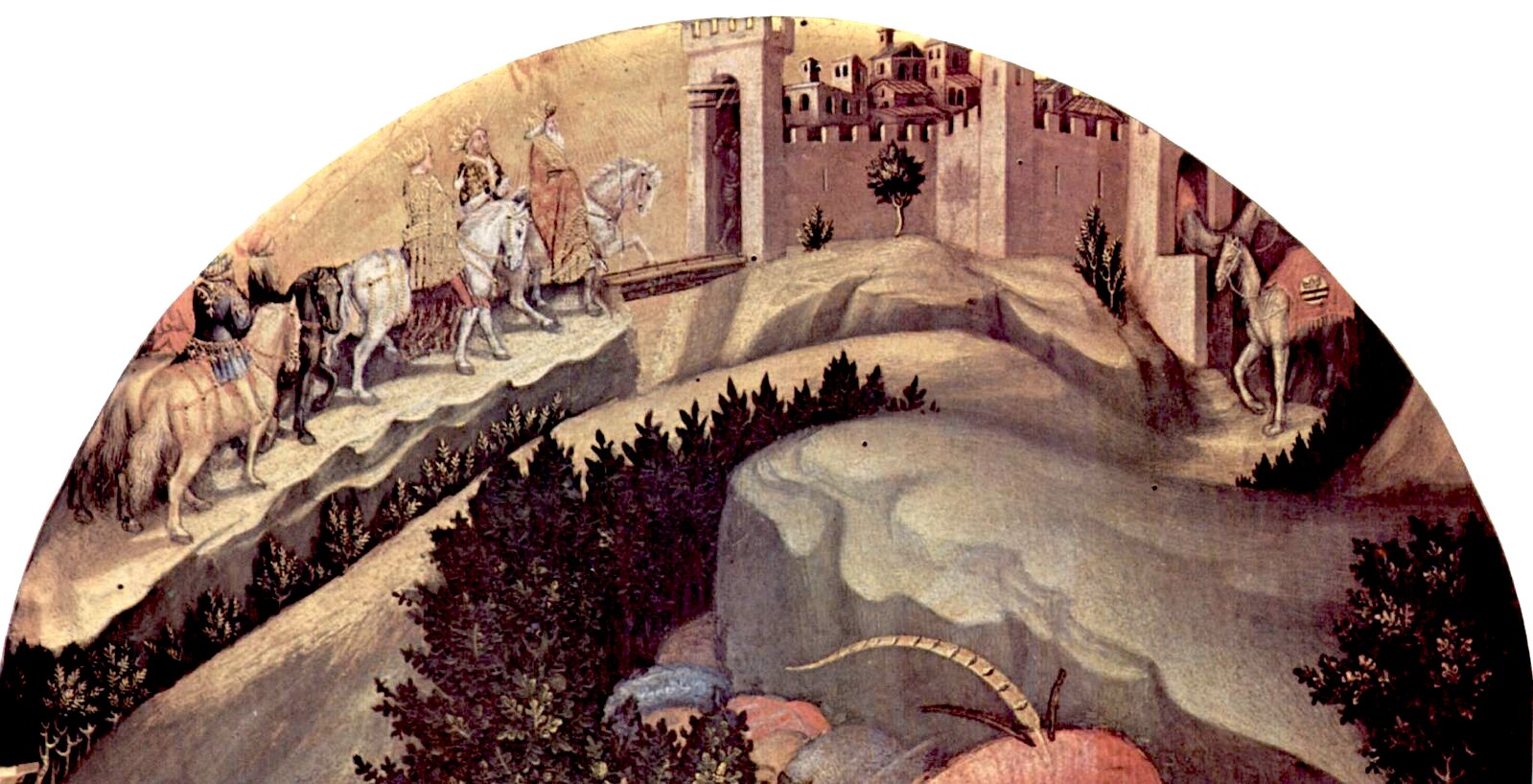
As in the Bartolo altarpiece, the story begins in the top left lunette, where you can see the ships that brought the Kings to the Holy Land and the start of their cavalcade.
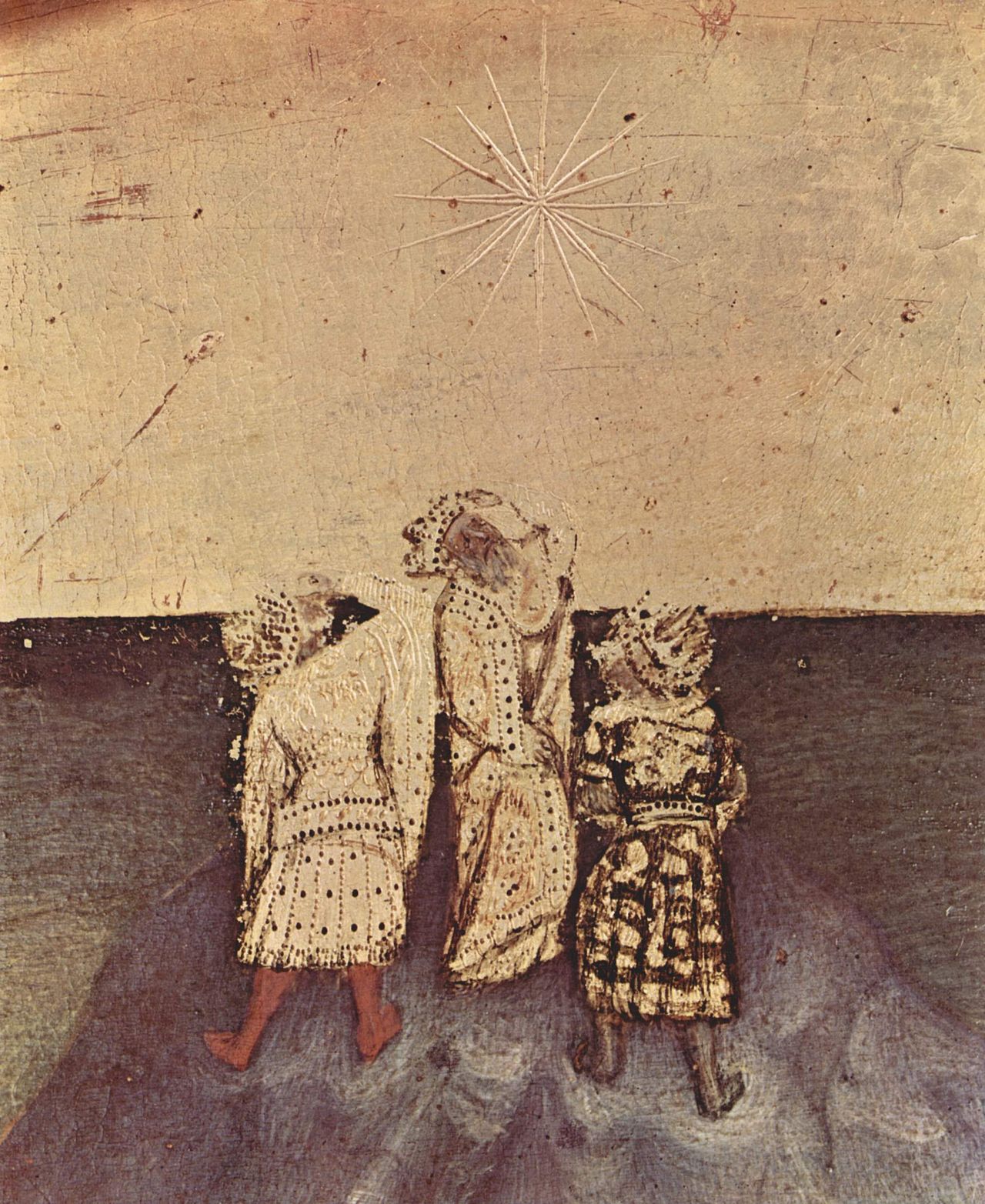
In between the moments of arrival and setting out, you can just make out the Three Kings standing on a mountain, looking up at the guiding star, and shading their eyes against its brilliance.
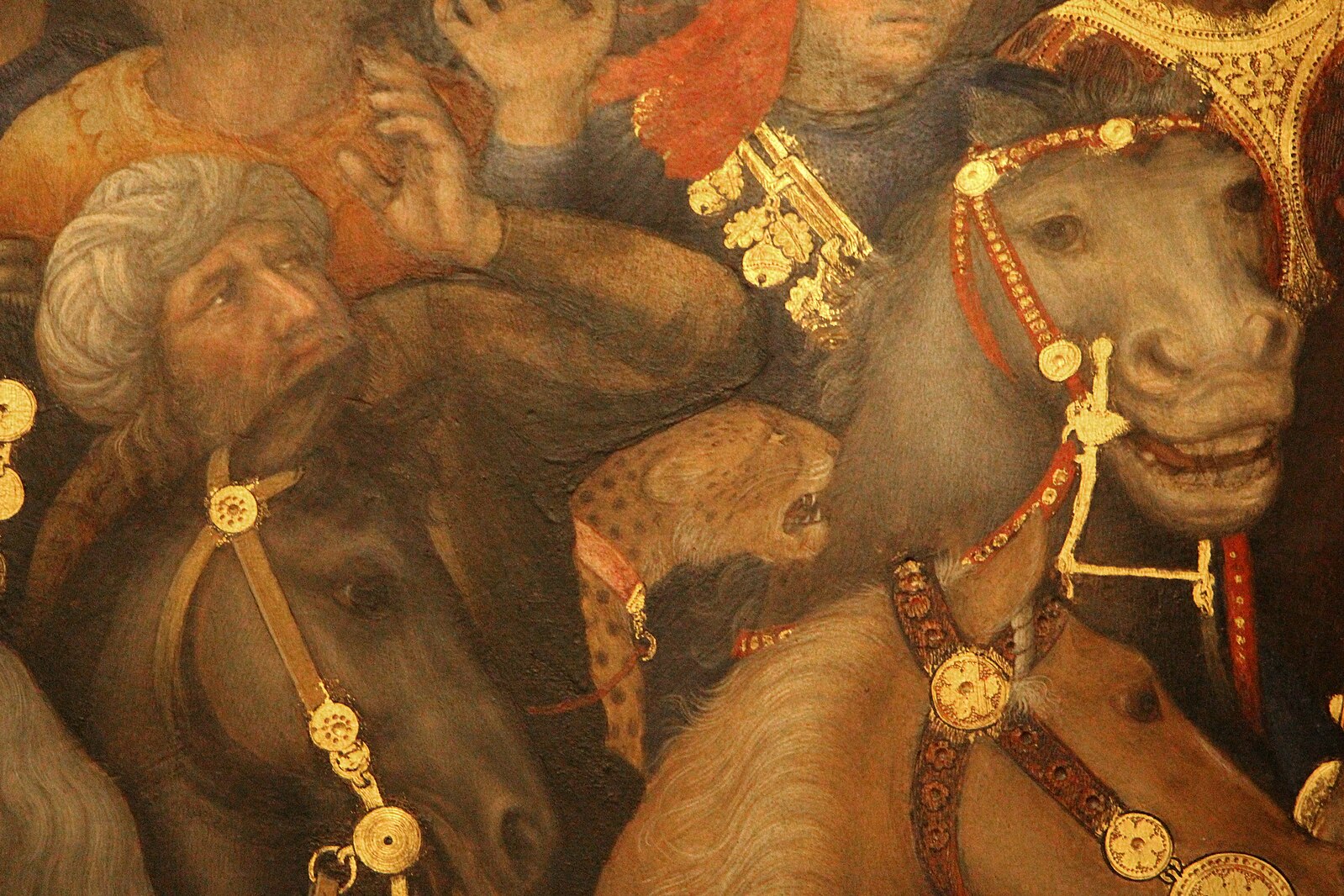
The cavalcade then winds its way across the central lunette, before climbing towards the city of Jerusalem on the skyline. The Kings are in the centre; and you should be able to see cheetahs riding on the saddles of the horses before them.
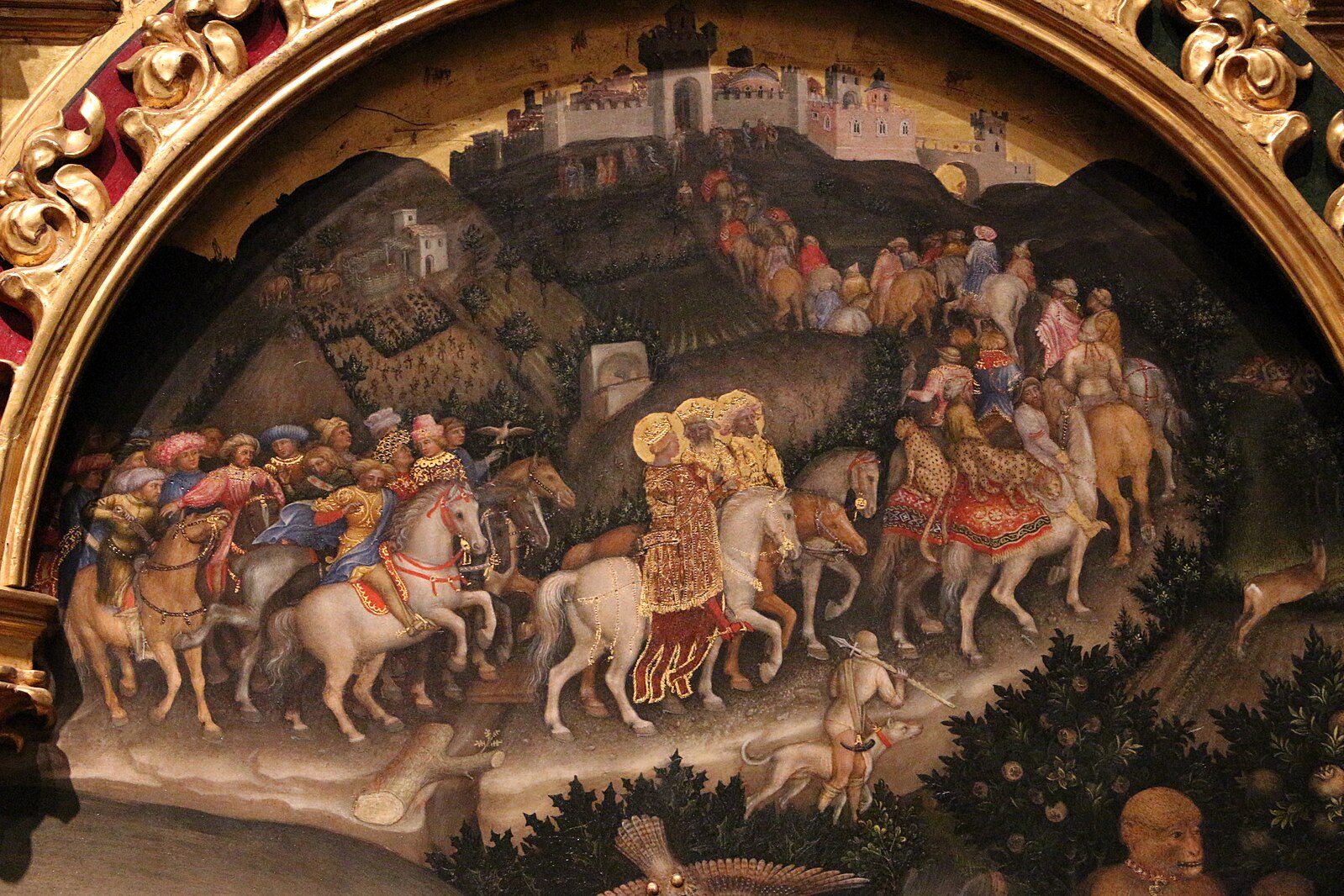
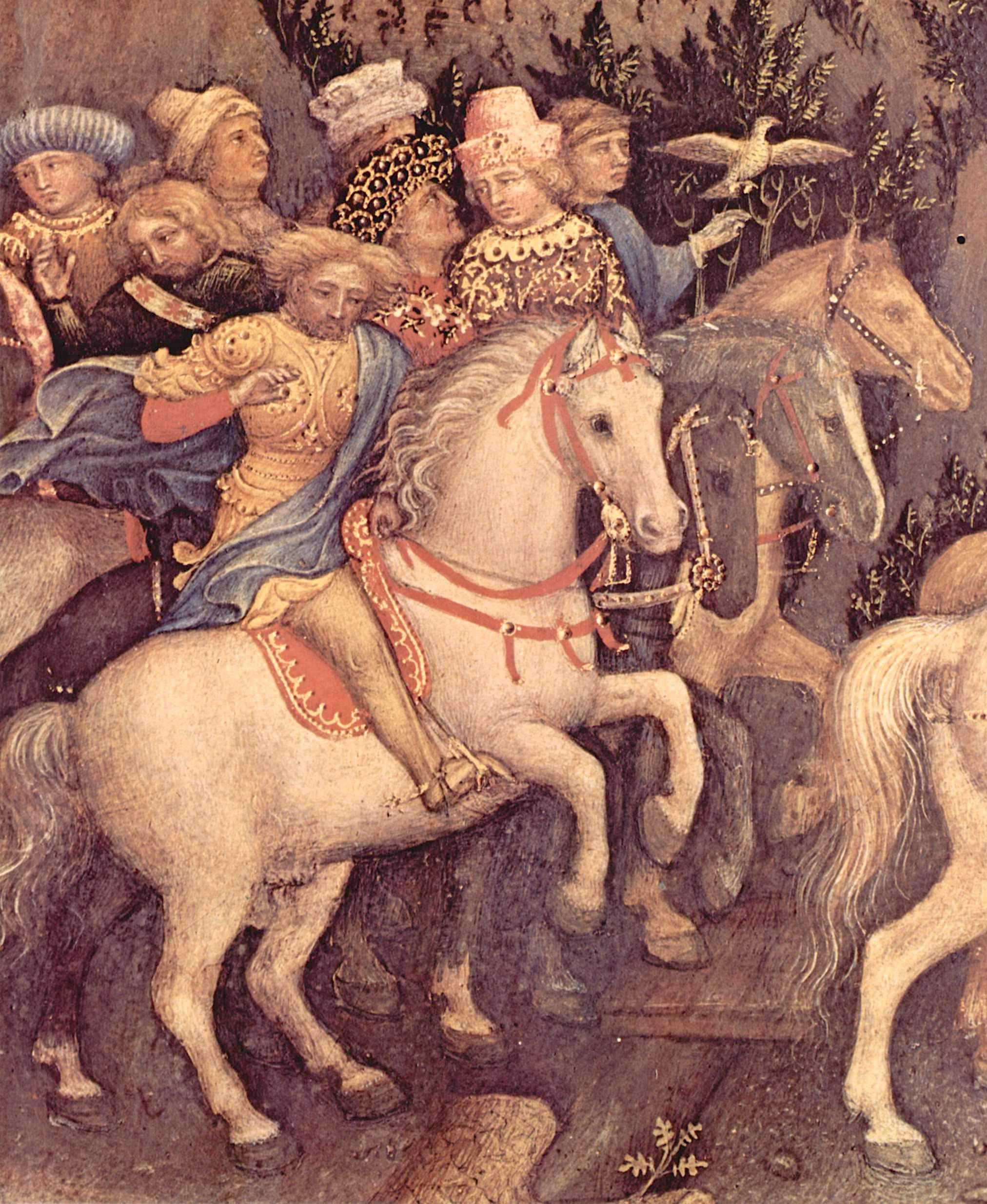
A close-up of the riders just behind the Kings allows us to enjoy the courtly costumes, and also the actions of a man loosing a falcon from his wrist, and a horse rearing up, apparently with sufficient suddenness to create a kind of wind, that ruffles the rider’s hair and sets his cape flying.
In the right-hand lunette, the Kings are seen at the very head of the column, with the unseen star flooding them with its golden brightness.
Then, with a sudden change of scale and density, the cavalcade is upon us.
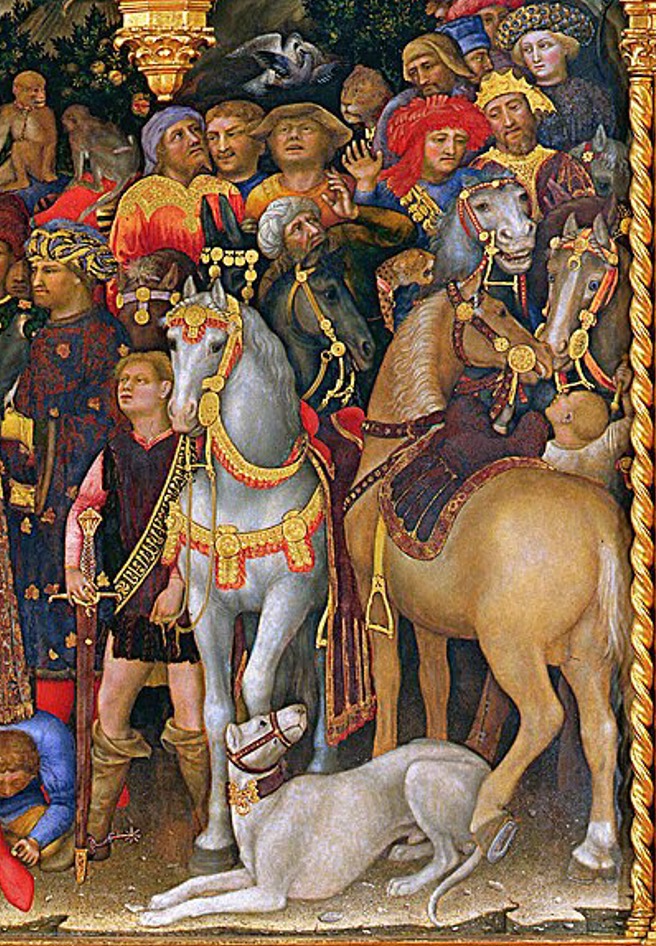
It has been winding its way up from a sunken road on the right, and now it is now halting and milling round, with horses going both ways, and the riders looking up and down and to the right and to the left. Then the eyes of the man in the turban and the eyes of the page (the one with the huge sword, and his hose ‘down-gyvèd’ round his ankles) direct your attention to the Presentation and Adoration itself.
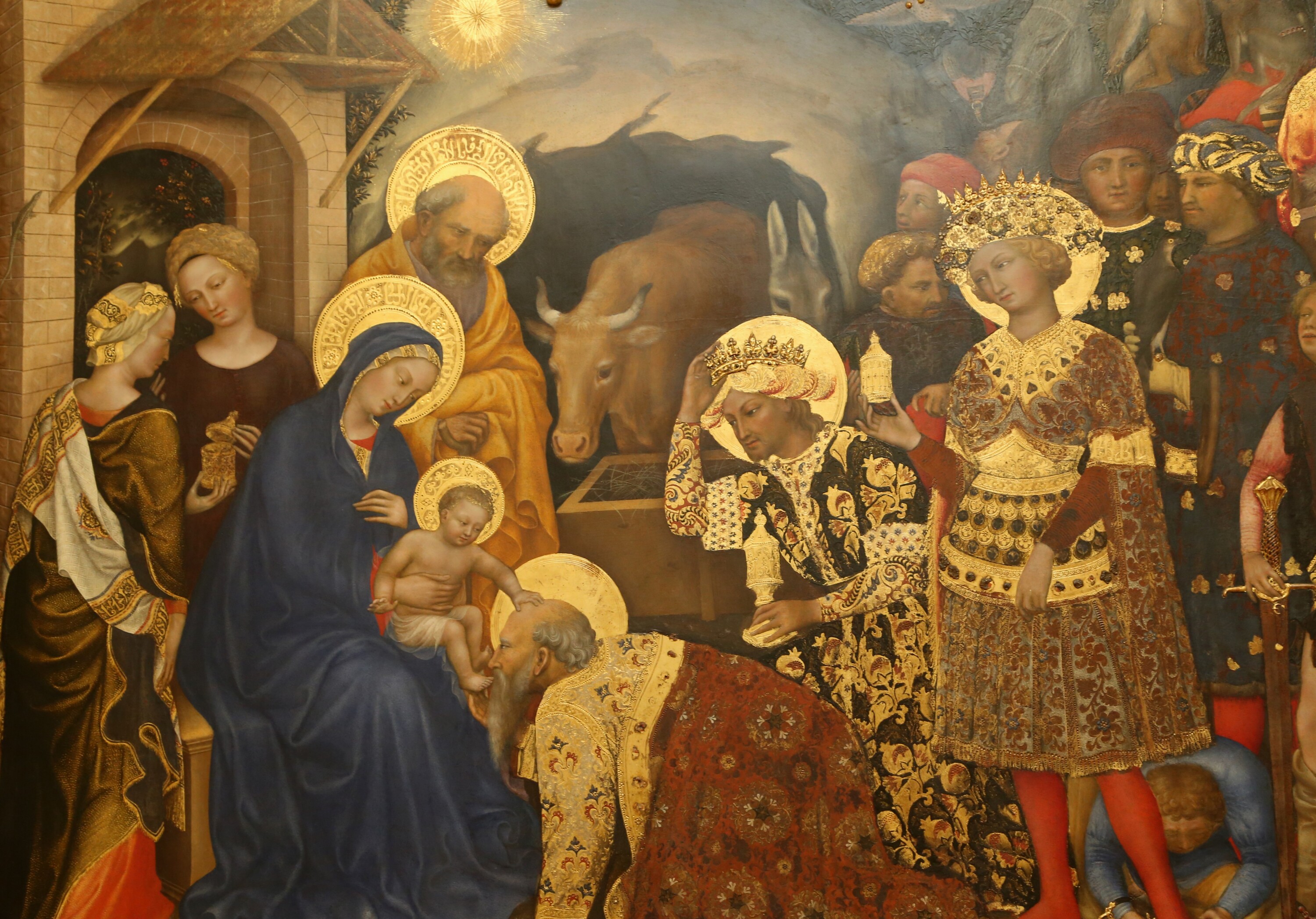
The Presentation takes place under the intense light of the star, which has come to a halt at the porch of the stable (but it is more like an inn or dwelling-house) which is next to the mouth of the cave (now quite separate, unlike in Duccio).
In the cave you can see the donkey and the ox, and the manger of a typical Nativity scene.
Enjoy!
We ought to dwell a little on the Adoration and the Presentation of Gifts, if only because they are going to be totally absent from the Medici Chapel.
The Three Kings are the most sumptuously dressed of all the members of the cavalcade, as you can confirm in the crown, hat and collar of the youngest King, who stands, rather too lackadaisically, with one finger in his belt, and his gift held nonchalantly between finger and thumb.
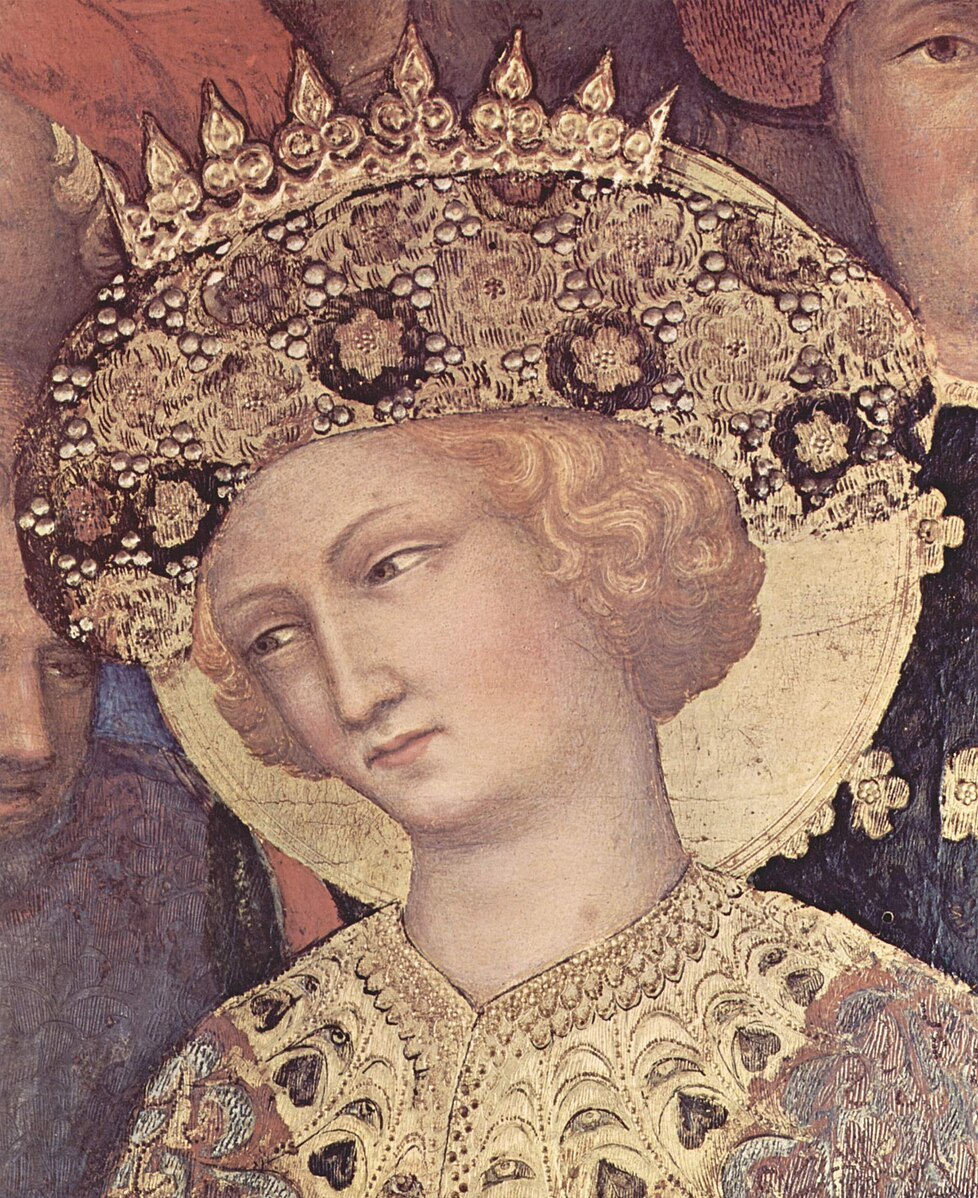
His attitude, however, acts as a foil to the middle-aged Balthasar, who is removing his crown and sinking to his knees.
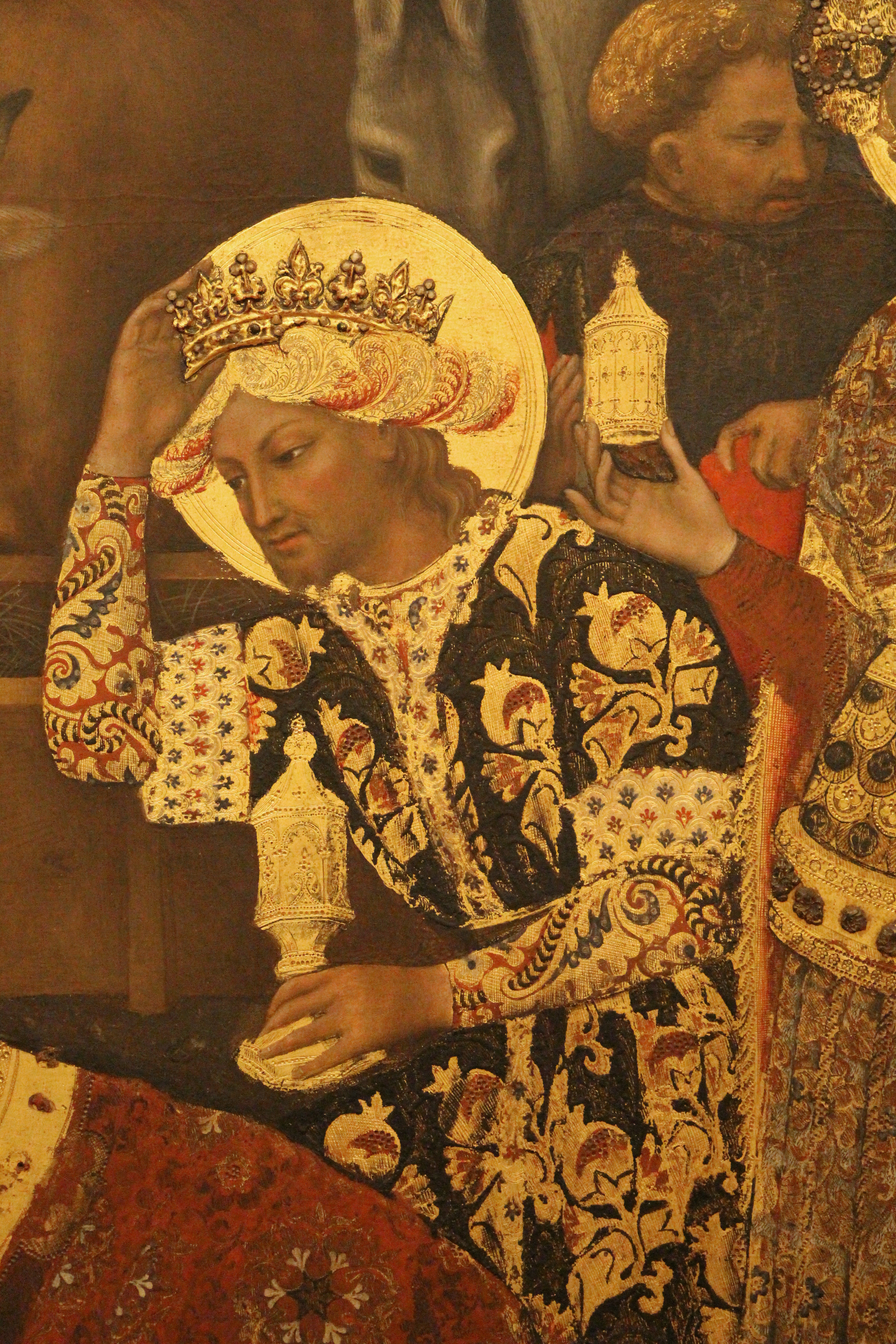
The sequence is completed by old Caspar, kissing the baby’s feet in homage.
We are of course intended to enjoy all the humanising touches—for example, the baby reaching to touch Caspar’s bald pate, rather than ‘blessing’ him.

But we should not neglect the things that Gentile shares with Benozzo, or which he actually suggested to Benozzo.
So, look again at the members of the Kings’ retinue, as they come to a halt behind, and notice that there are far more heads than in any version we have yet seen. Notice, too, that they include some vivid characterisations, especially in the juxtaposition of the noble and the rustic—a taste which is not incompatible with a love for splendid headgear, whether it take the form of an elaborate mazzocchio, in red, or that of an ornamental helmet.
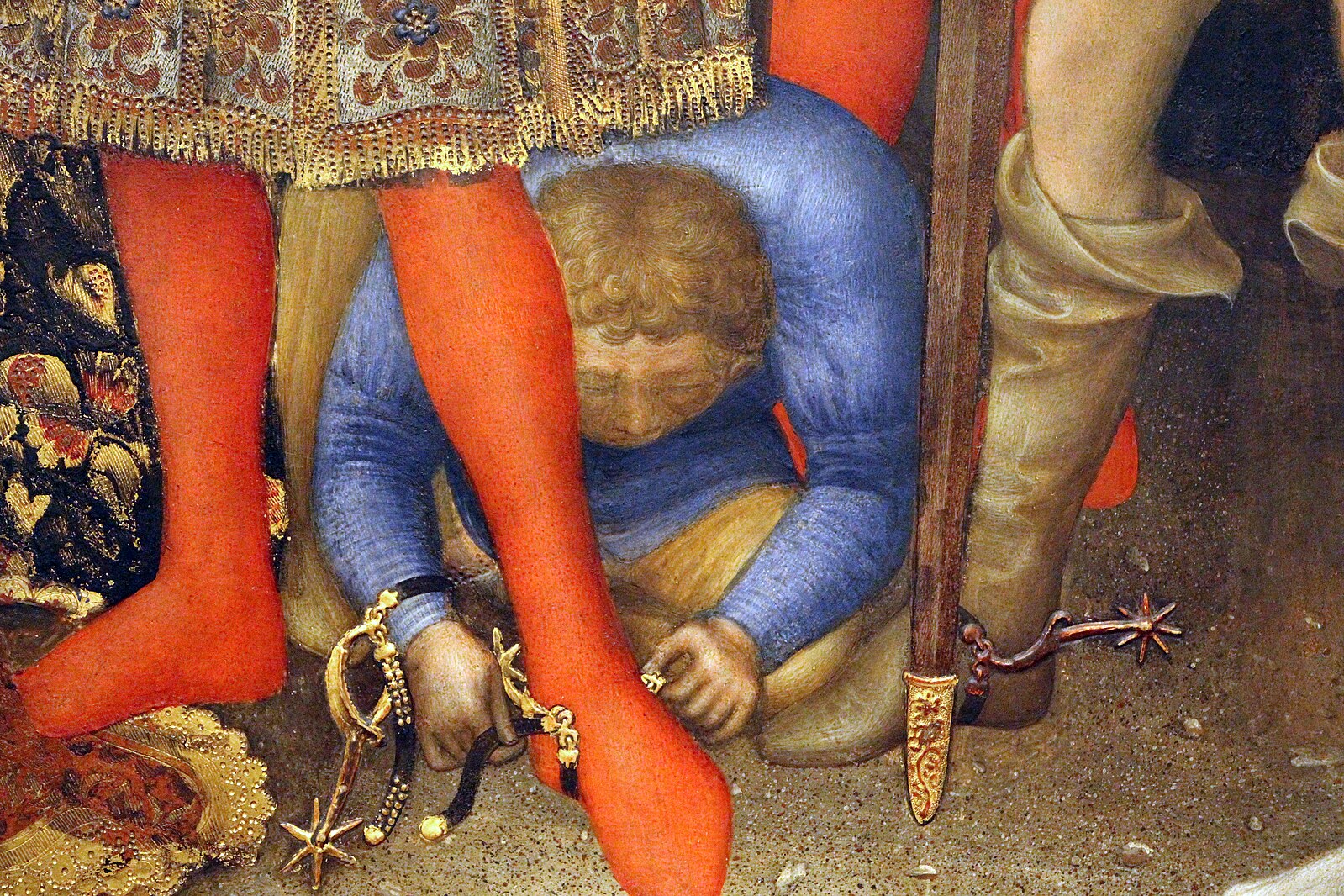
Most memorable of all, perhaps, are the squashed, foreshortened features of the groom who kneels behind the youngest King to adjust his spur.
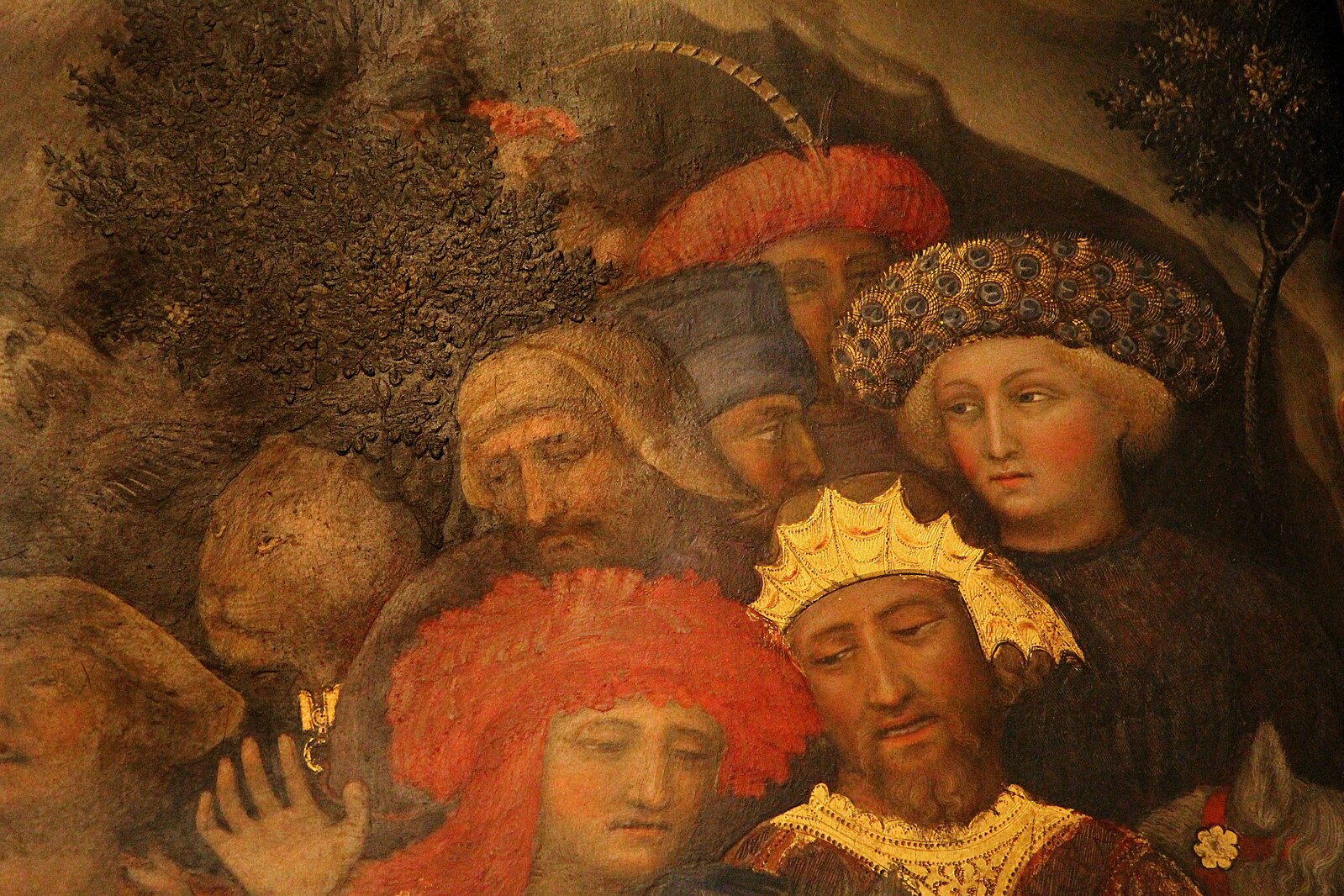
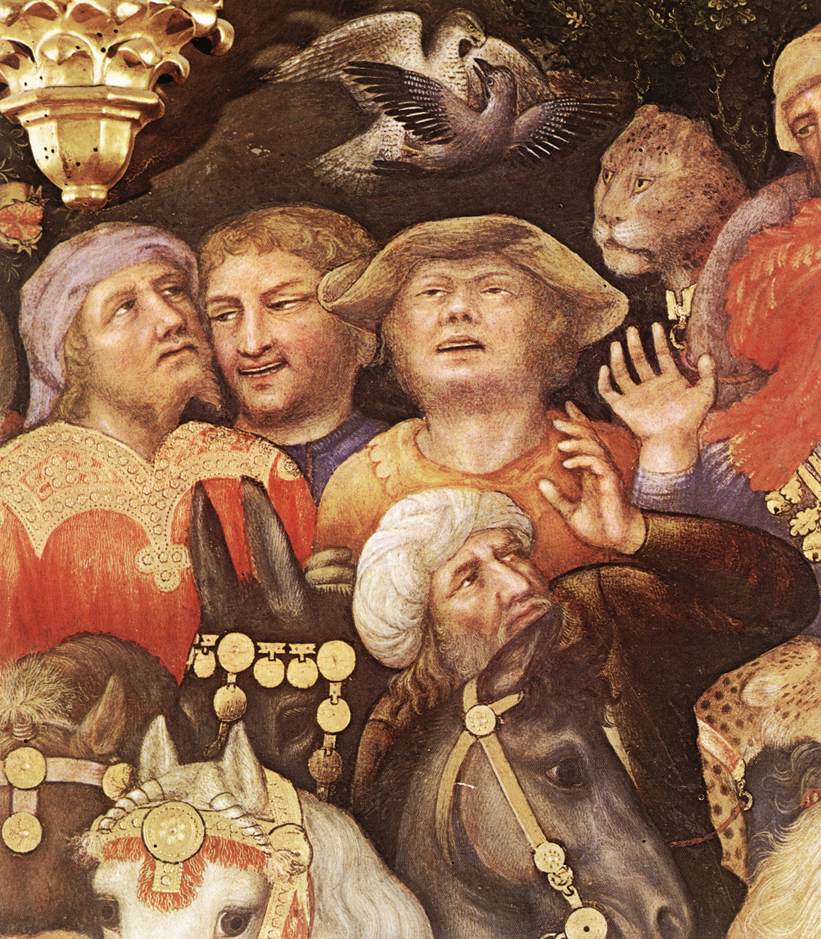
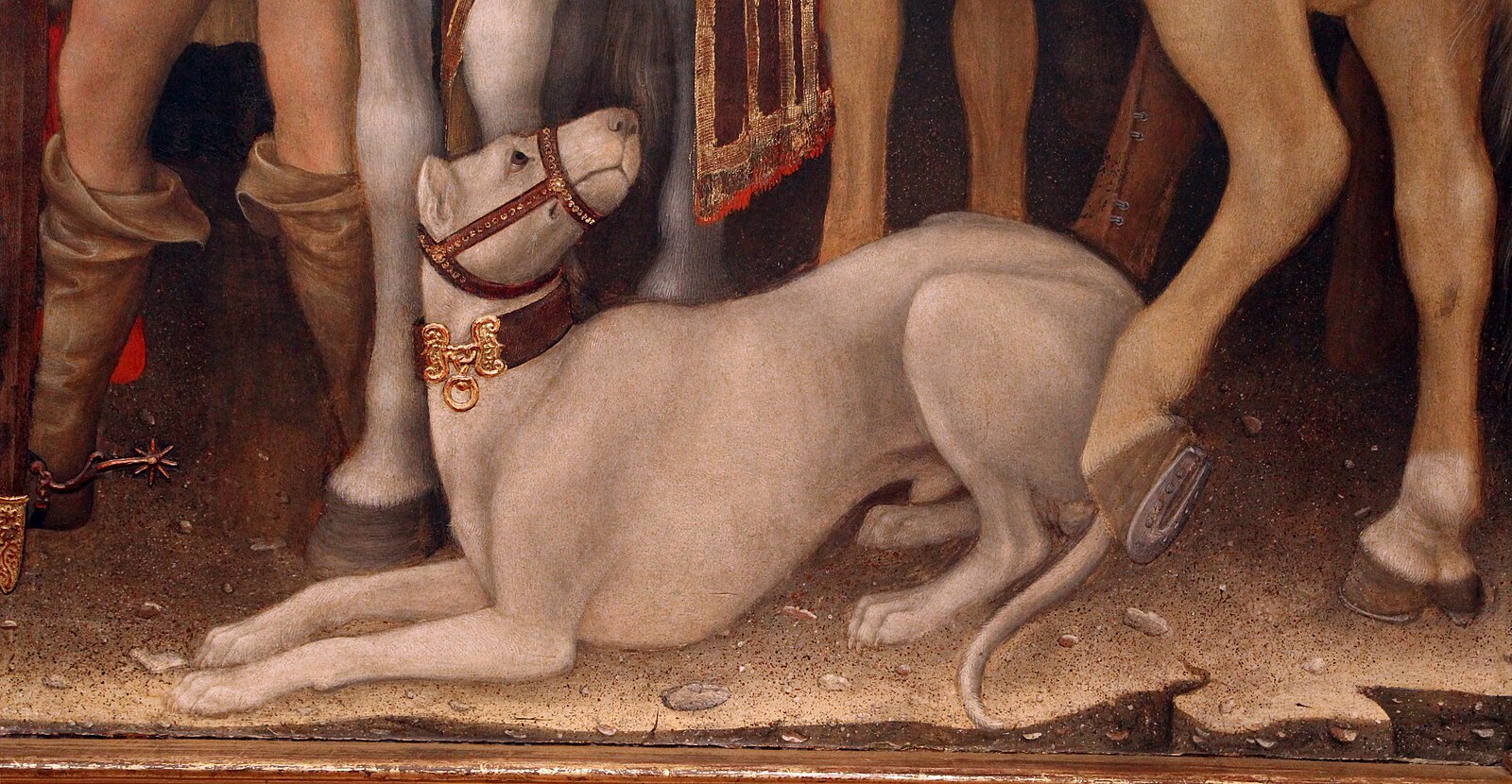
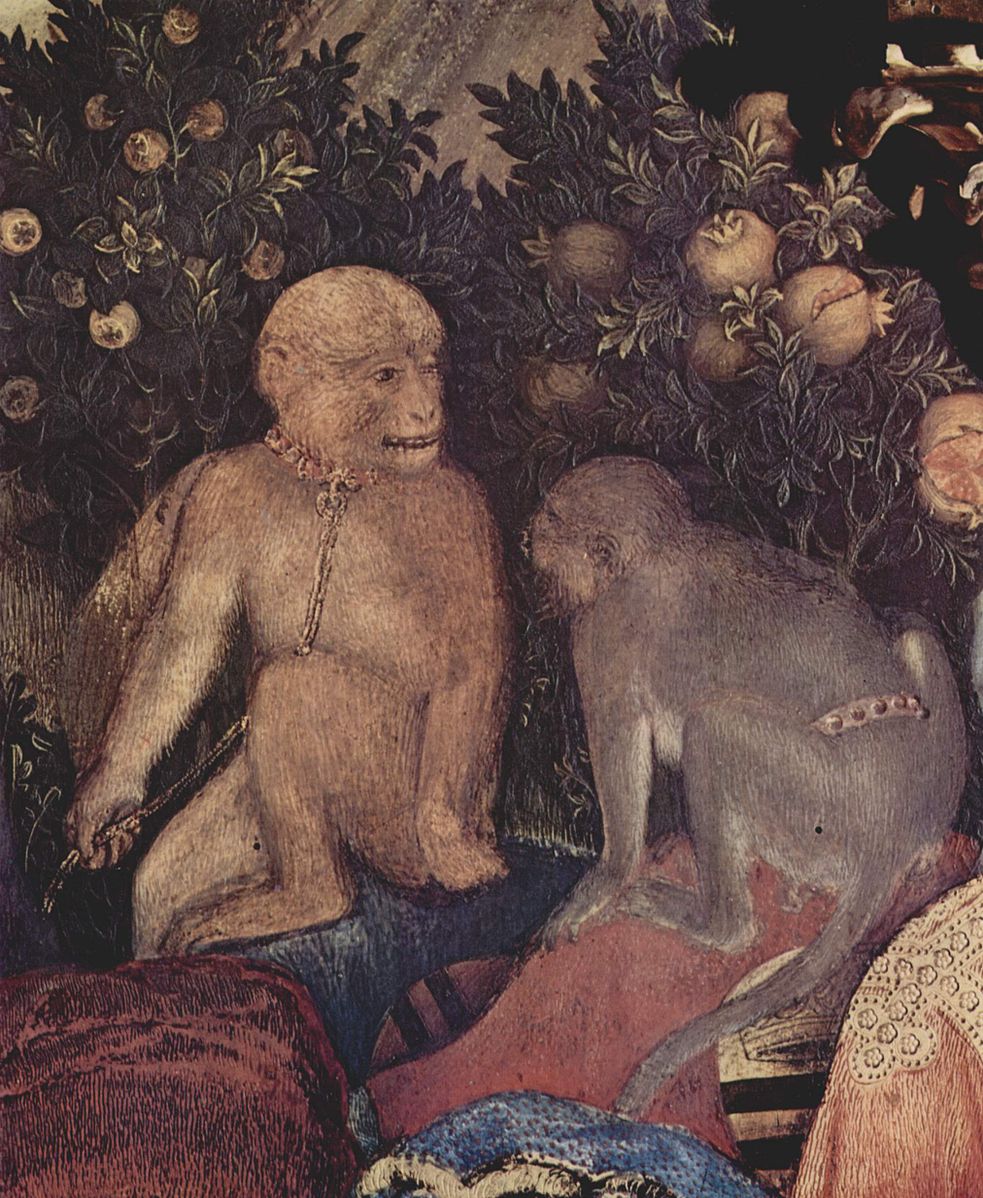
But one could certainly argue that it is the animals that carry the day: the aristocratic greyhound in the foreground with his golden clasp on the collar; the splendid studies of horses, especially the dun, seen from the rear; the rocking-horse heads and bridles; and, even more delightful (and even more of a tour de force) the two monkeys who are squatting on the camel and chattering to one another in front of the pomegranates, which are splitting open against the dark background of the leaves of the tree.
We may now leave the Wise Men in peace for a while, in order to absorb a few relevant facts about the Medici themselves.
The dominant figure in this period was Cosimo, who was born in 1389 and died in 1464 (which means he was of the same generation as Donatello and Brunelleschi).
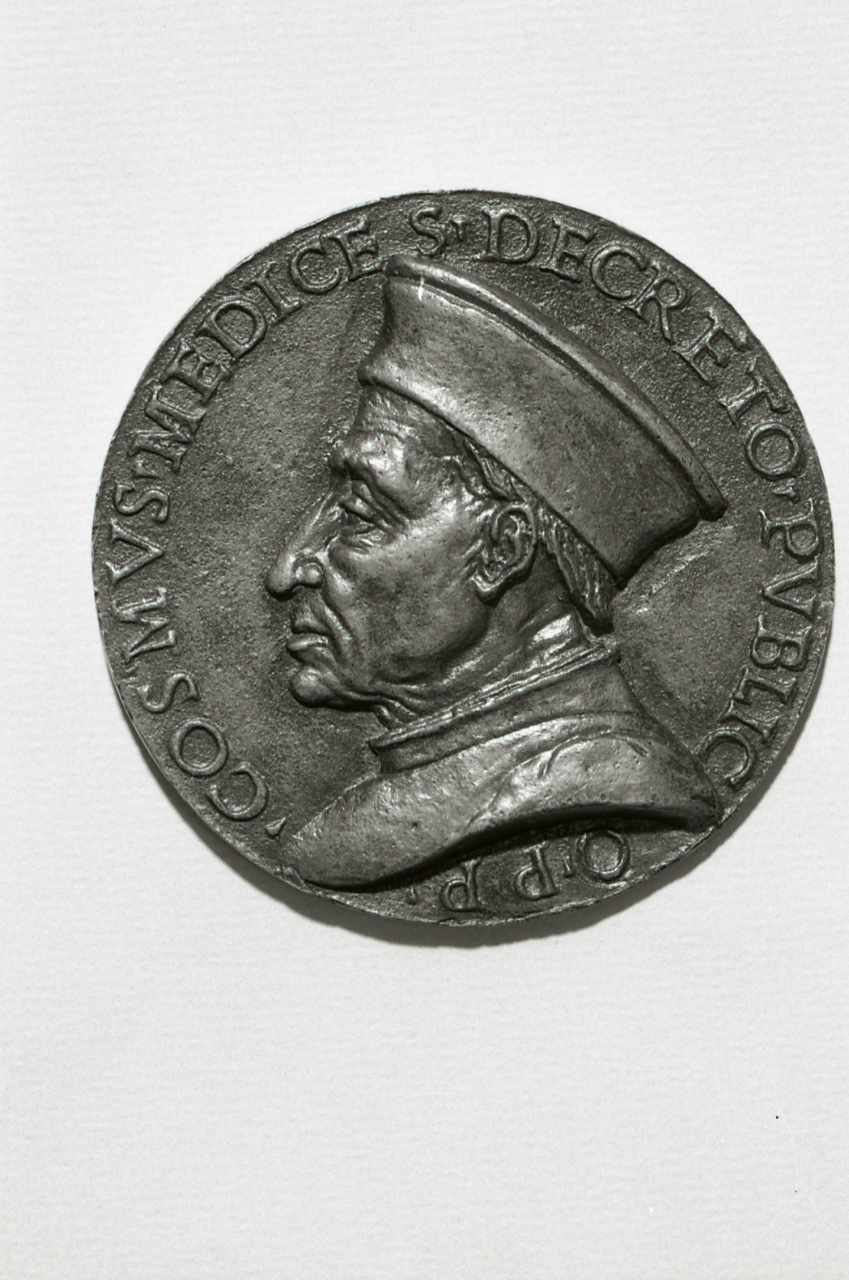
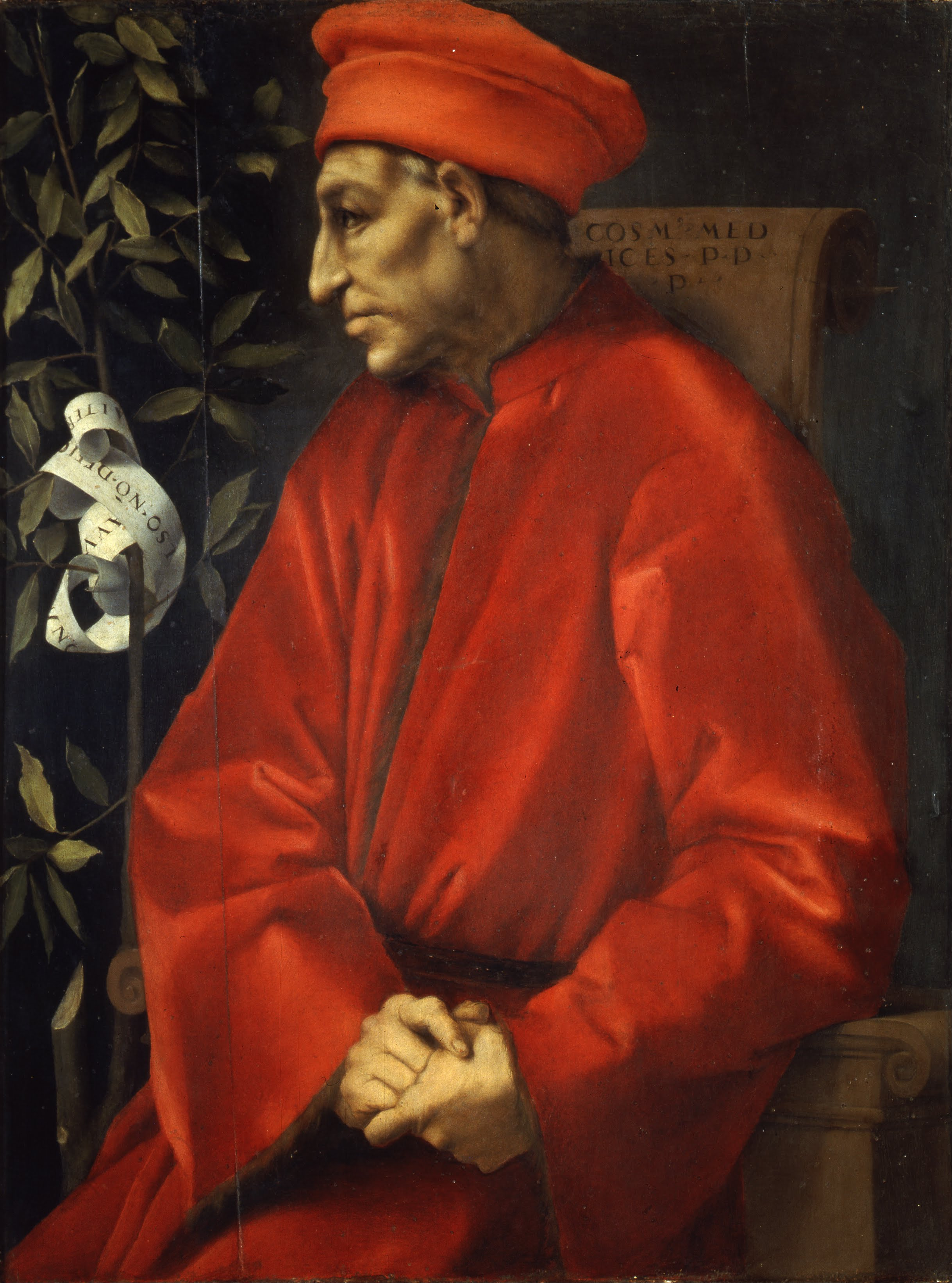
You see him here in a portrait medal which clearly served as the model for the posthumous portrait by Pontormo.
Cosimo was exiled in 1433, but returned to Florence only a year later; and this time, it was the leader of the Strozzi family who had to go into exile.
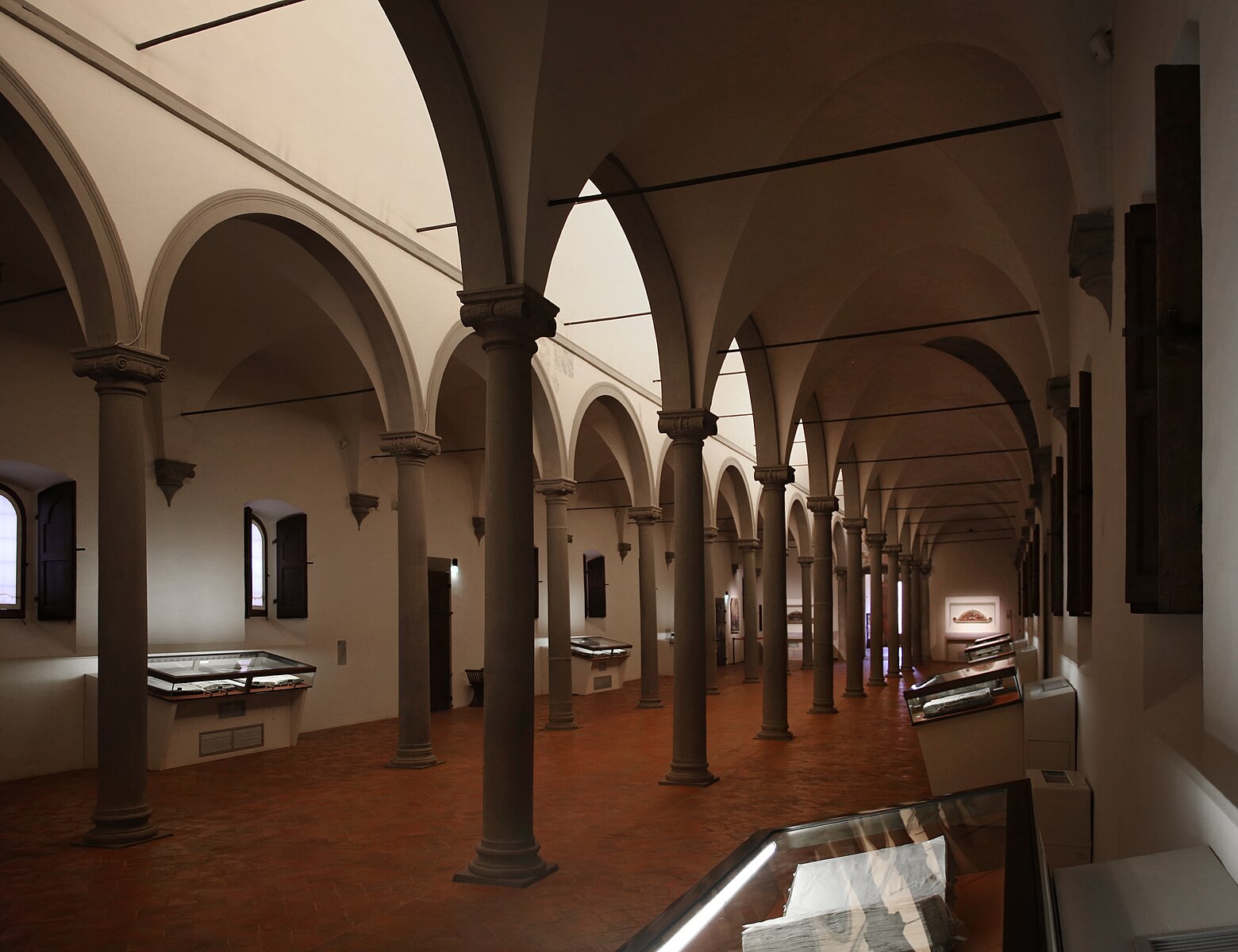
Cosimo continued the work of rebuilding the Church of San Lorenzo; he started work on the new family home; and he financed the new building for the Dominican Convent of St Mark, including the beautiful library by Michelozzo.
In foreign affairs, he was to achieve decisive influence in the whole peninsula.
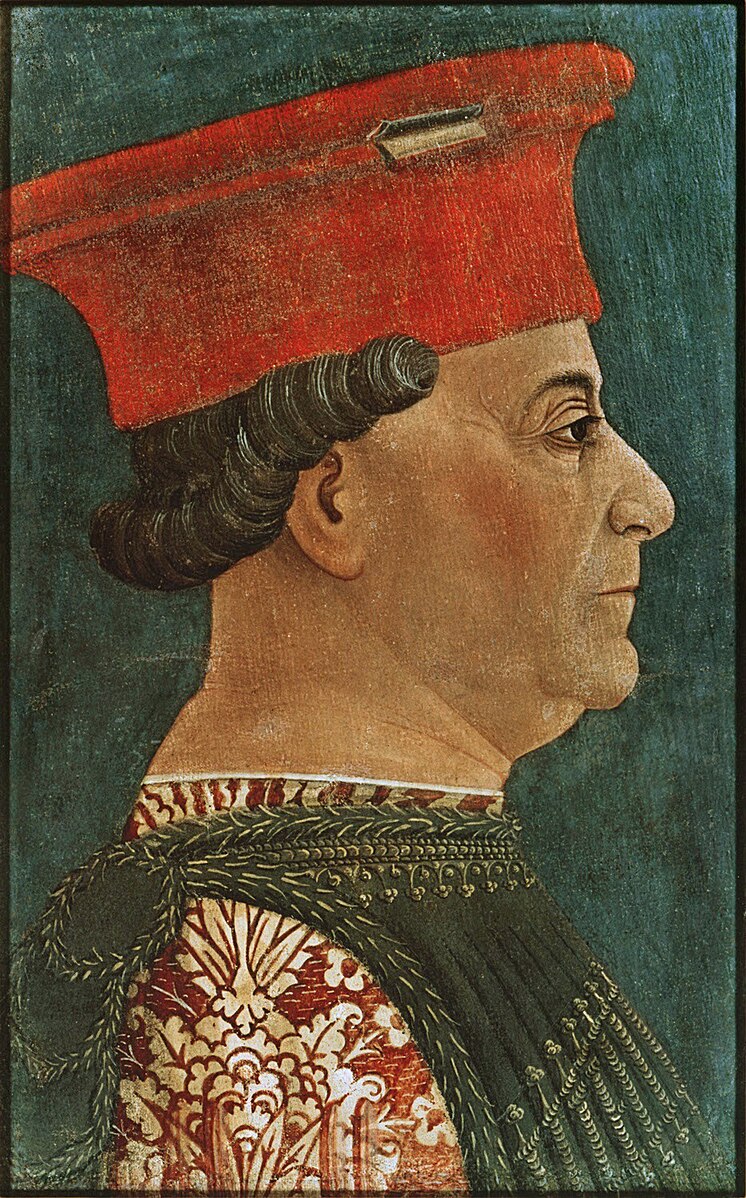
He backed his old friend Francesco Sforza, a mercenary general, who had seized power in Milan in the early 1450s (after the Milanese had thrown out the Visconti family) and had founded a republic there—the Ambrosian Republic.
Cosimo allied himself with Milan (the traditional enemy) against the Republic of Venice (the traditional ally) in order to halt the Venetian advance inland.
New boundaries were agreed at the Peace of Lodi in 1454 which were to remain virtually unchanged for the rest of the century.
In earlier decades, Cosimo had been involved in papal politics through his friend Pope Eugenius IV, a Venetian who had been elected in 1431 but who had been forced to abandon Rome soon afterwards.
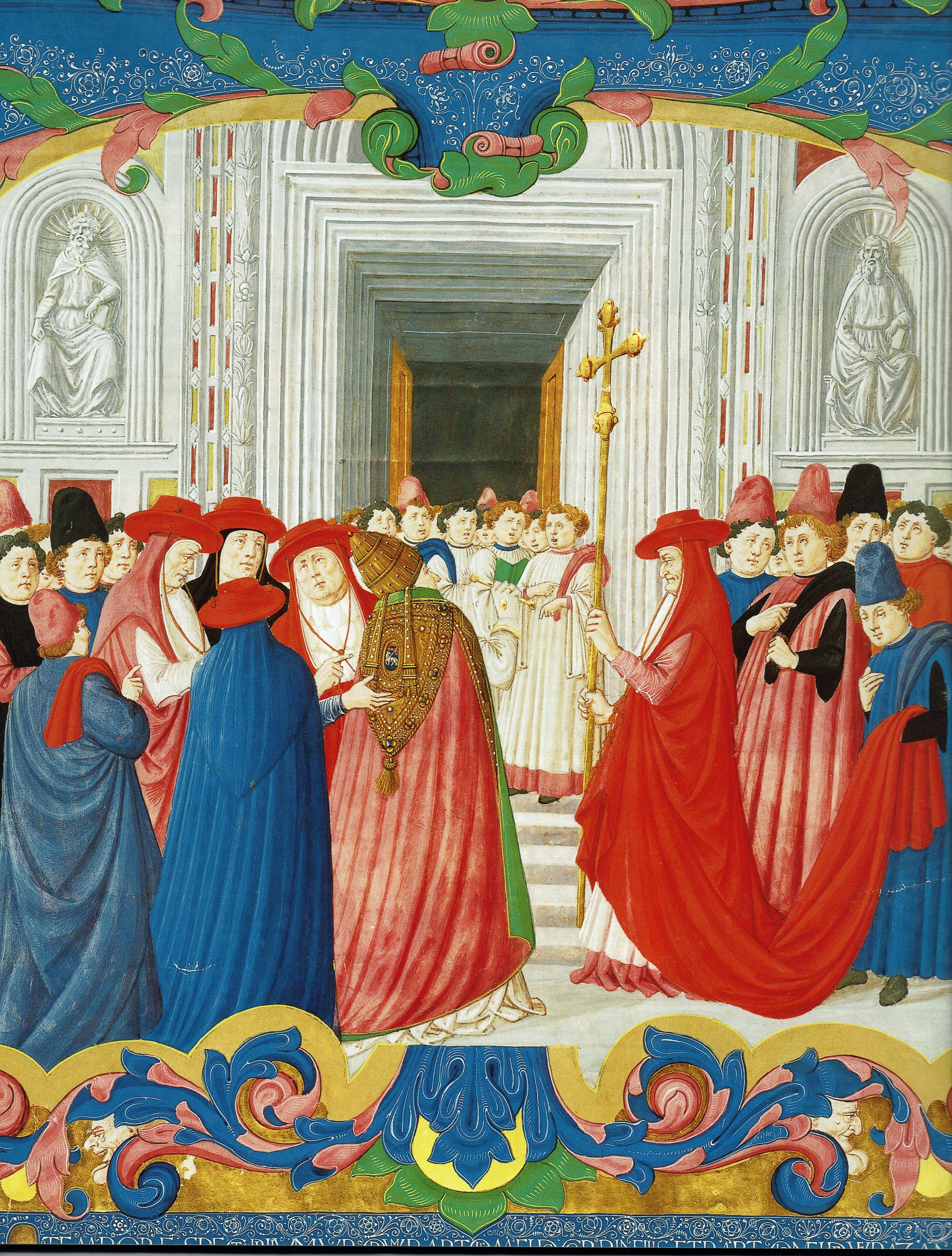
Eugenius established his court in Florence until 1433, while he struggled against the Council of Basel and the surviving anti-pope. He is pictured here, in front of Florence cathedral in 1439, during the proceedings of a ‘summit conference’ between the heads of the Eastern and Western Churches.
This ecumenical council had been convened in Ferrara in the preceding year but had run into financial difficulties which were resolved by Cosimo on condition that the delegates came to Florence, thus giving him and the city a considerable boost in prestige.
It was attended not only by Joseph, the Patriarch of Jerusalem, but by the Eastern Emperor himself, the Emperor of Constantinople, John Paleologus VIII, pictured here in a famous medal profile by Pisanello—the Emperor having come to Italy in a desperate attempt to find allies to help him to check the advance of the Turks.
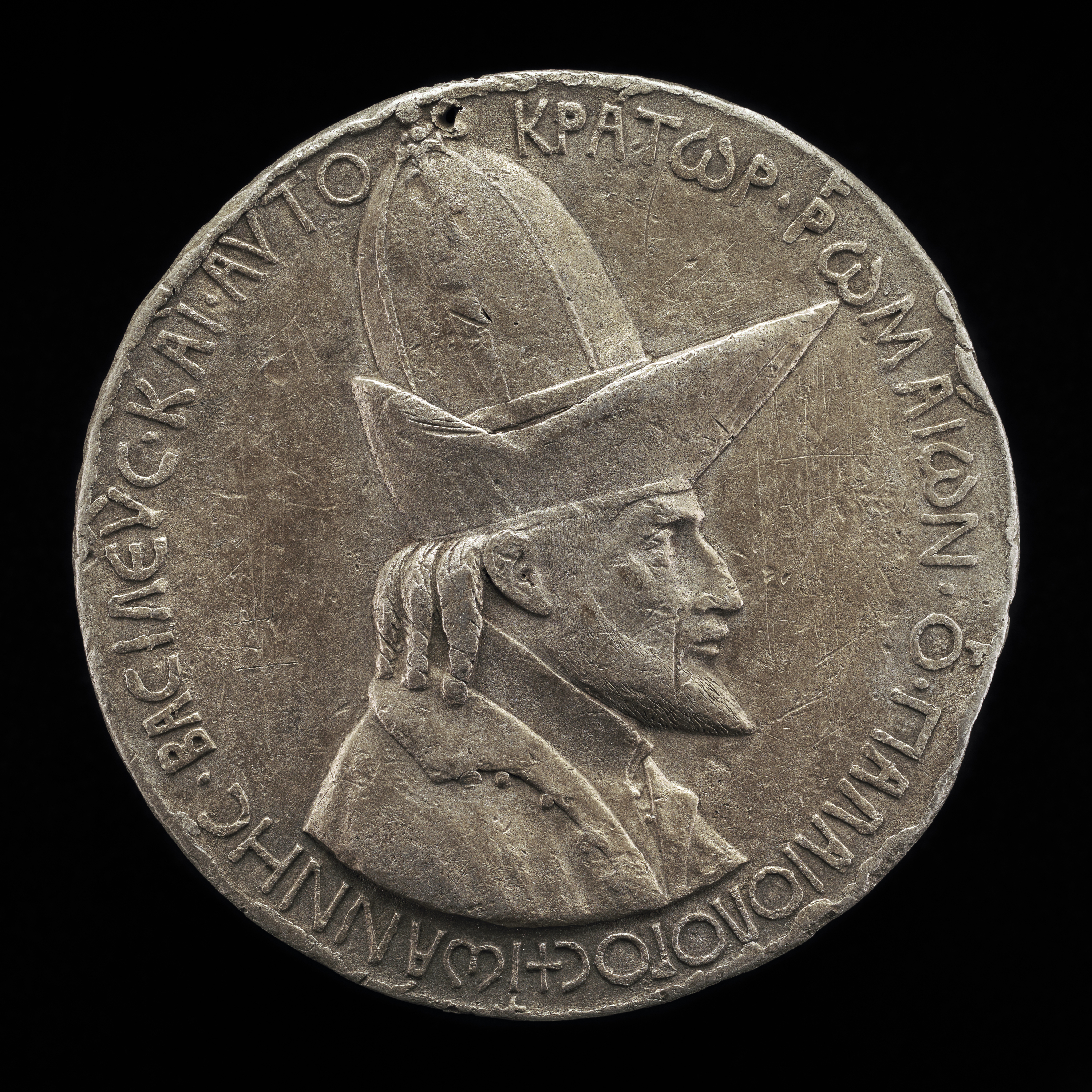
As you will soon see, the presence in Florence of this ‘King from the East’, at the head of an exotically attired retinue, remained fixed in the memory of the Medici family…
It is also worth remembering that the Medici were patrons of a confraternity which was dedicated to the name and the cult of the Three Wise Men; and we know that members of the family regularly took part in horseback processions through the streets of Florence on the feast of the Epiphany—all of which helps to explain the choice of subject for the frescos in the Medici private chapel.
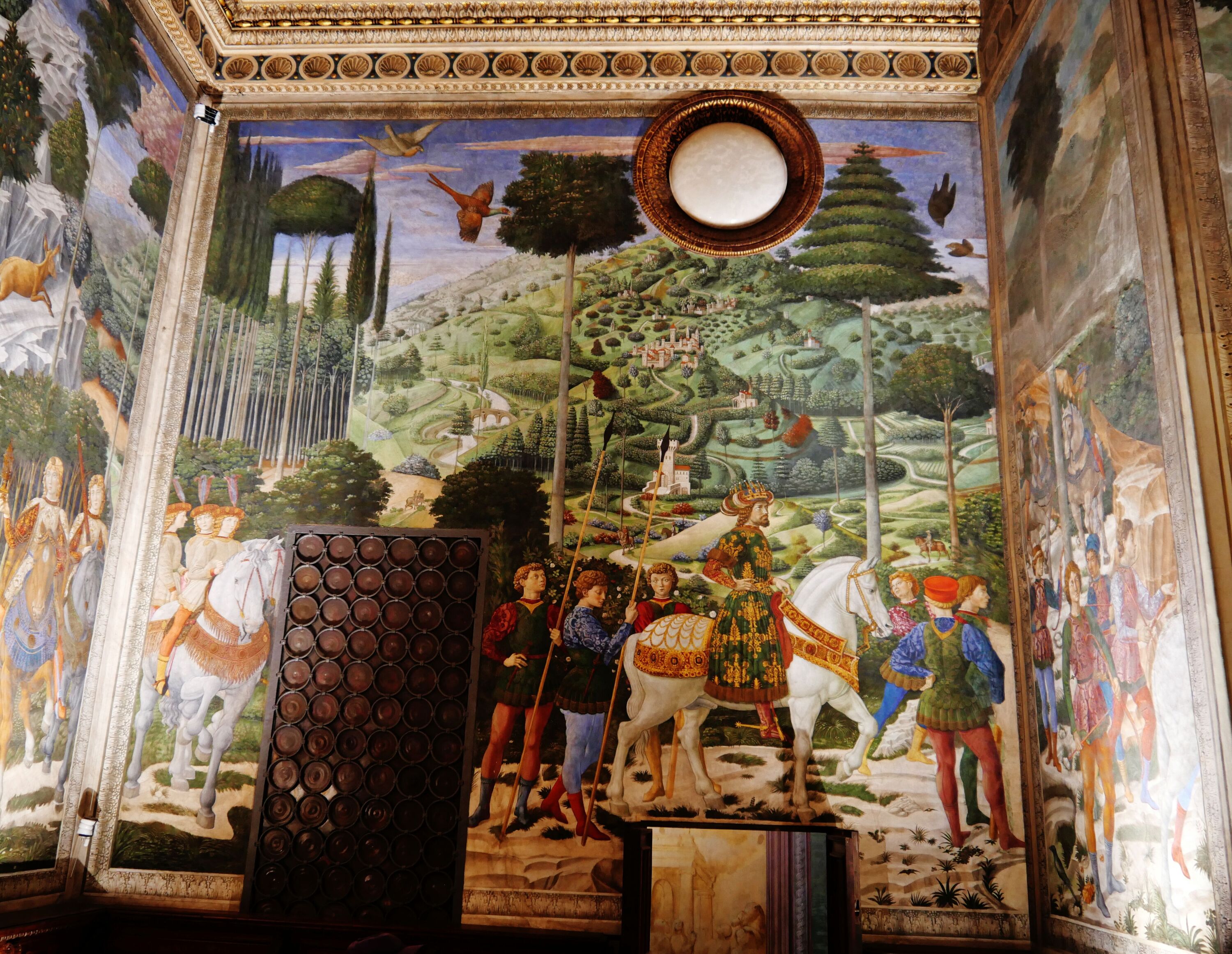
So, let us now return to the Palazzo Medici, climbing the stairs up to the first floor, and entering the chapel to look at the south and west walls and the little altar space.
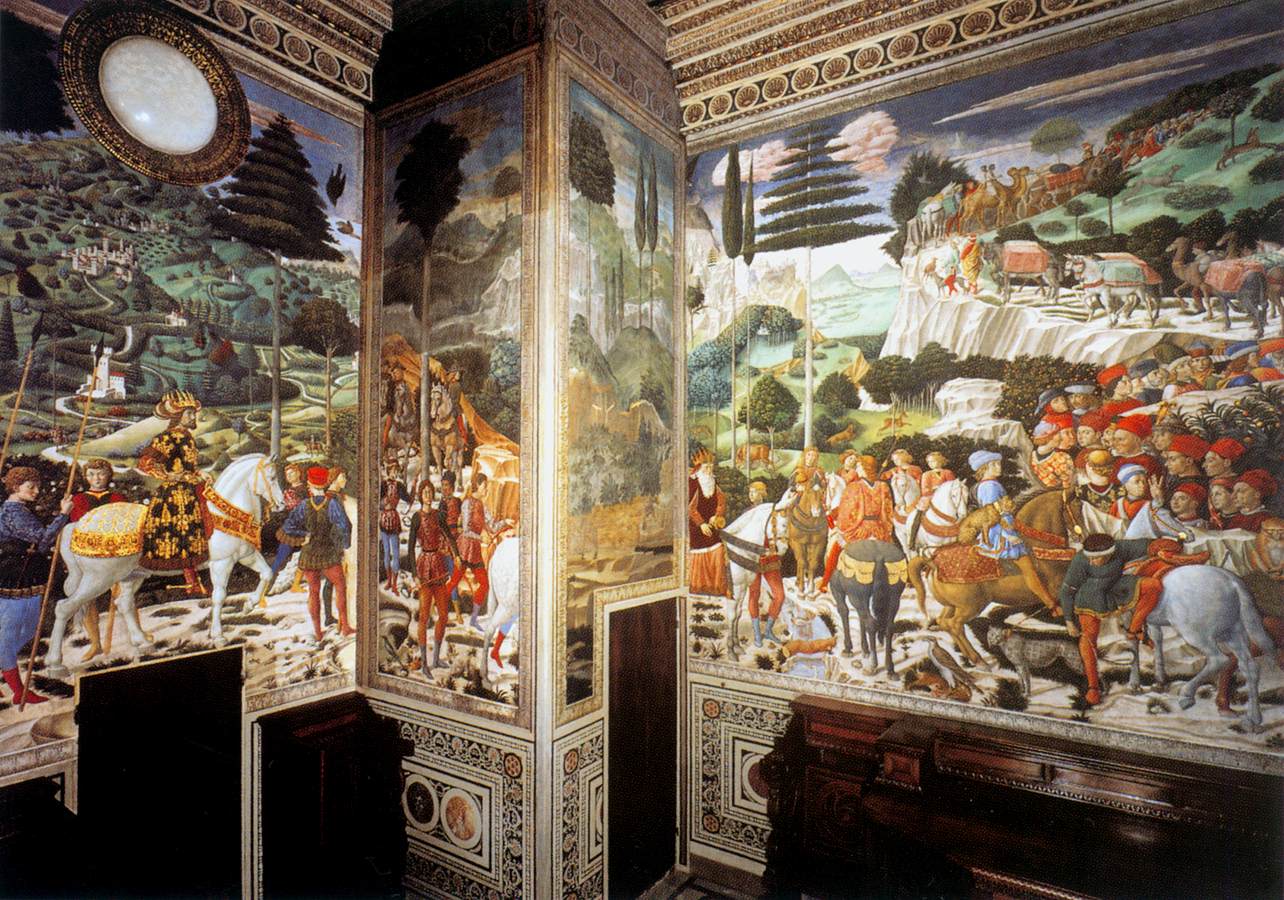
For the rest of this lecture, we shall simply be following the cavalcade of riders behind the Three Wise Men, as they come into the tiny chapel and ride round three of its sides, before riding out of the chapel again, without ever adoring the child or presenting their gifts.
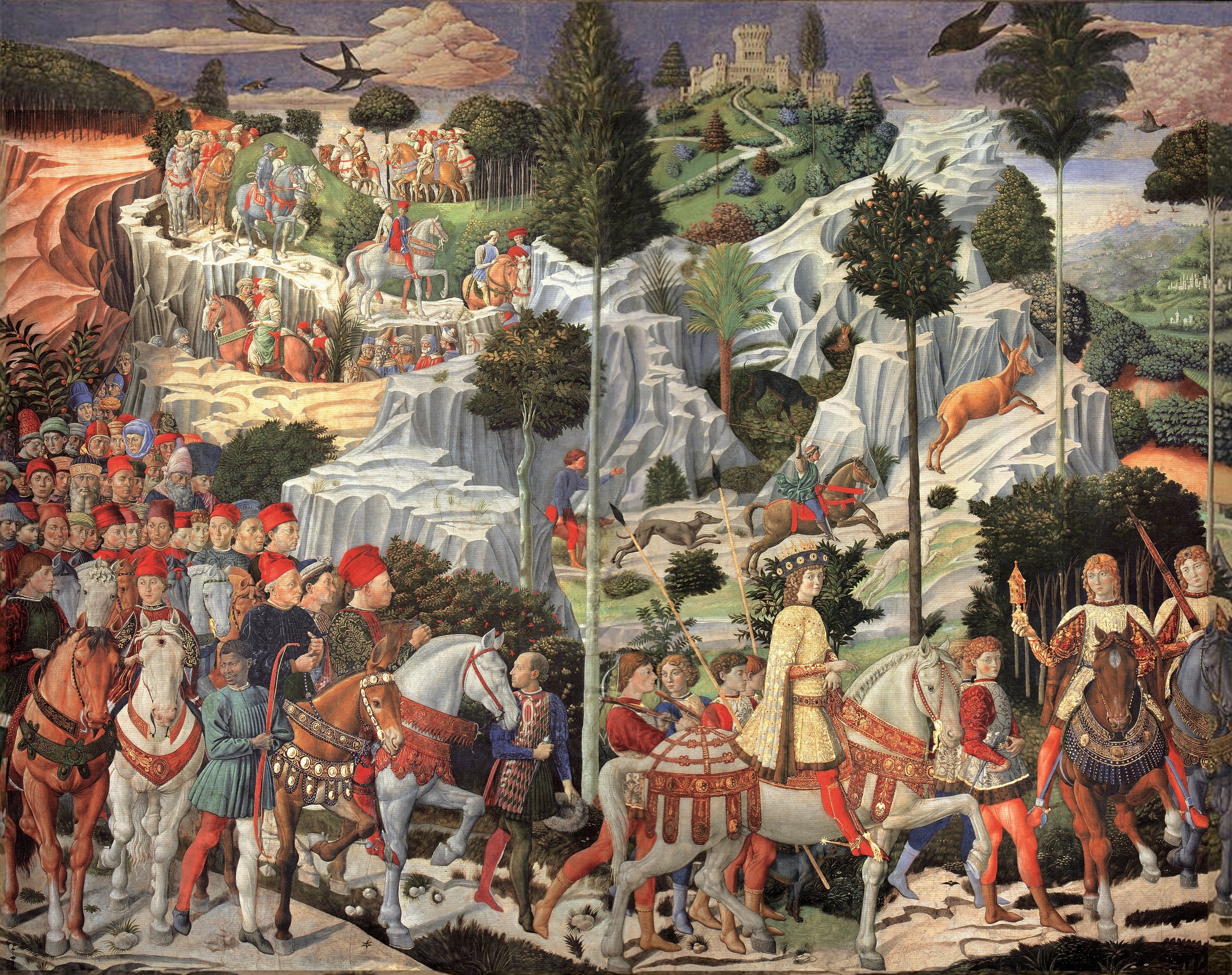
The procession begins on the wall to the right as you face the altar. It is about eighteen feet wide, and it is the most important of the three, as well as the least damaged.
The first impression you receive here is one that will be confirmed again and again in all the subsequent details.
There is an obvious, multiple debt to the tradition that culminated in Lorenzo Monaco and Gentile da Fabriano, in the way the hilly landscape rises to the top of the painted surface (as in a northern tapestry); in the stylisation of the rocks; and in the treatment of the close-packed faces. But there is also a greater naturalism in local details, and a much greater sense of pictorial depth.
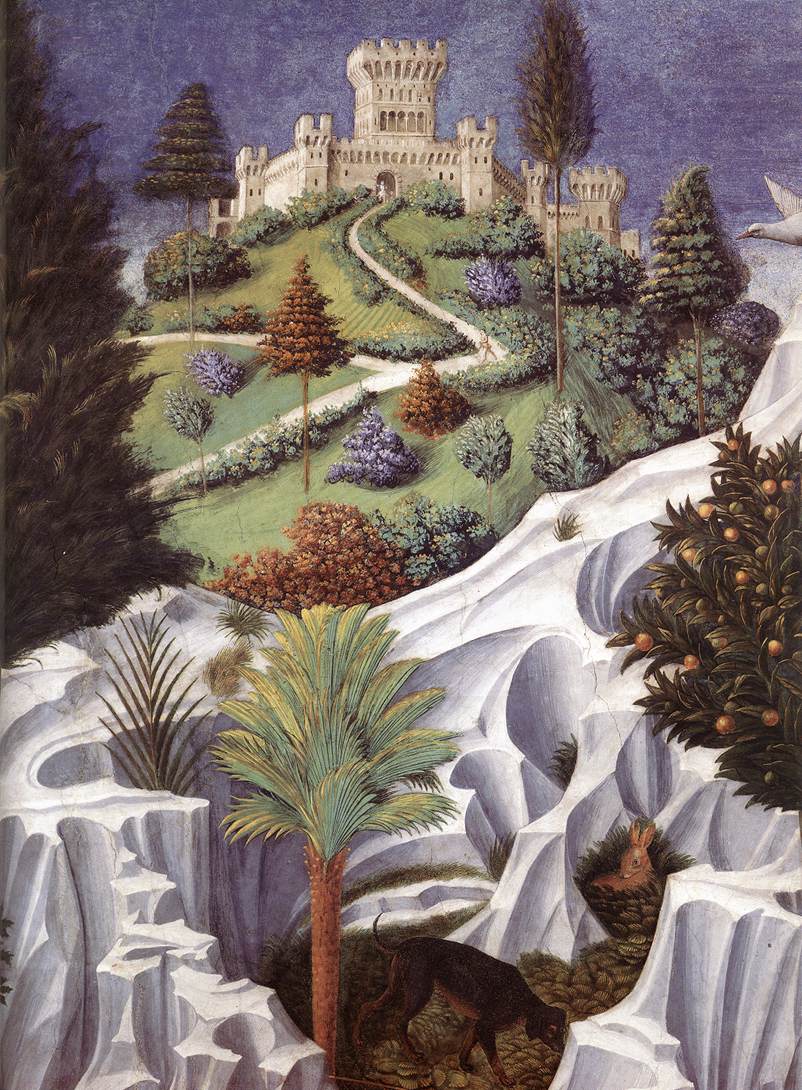
The procession has just set out on this final stage of its journey from a fortified manor house, set improbably high on a hill, like its medieval models, but in fact a splendid piece of perspective drawing, showing the sort of fortified country residence that the Medici were building for themselves in Tuscany.
From the castle, the horsemen ride down the winding lane close to highly stylised precipices.
The rocks look more like a ‘rock garden’ and are either too pink or too white to be real. The birds are far too big (at this distance, they would have to be pterodactyls!). And you can count the oranges on the tree in the first detail and distinguish every tree trunk in the distant copse on the right and in the forest on the left.
Yet the fifteen horses and horsemen are superb, the costumes are bright, and everything breathes the atmosphere of romance and fairyland.
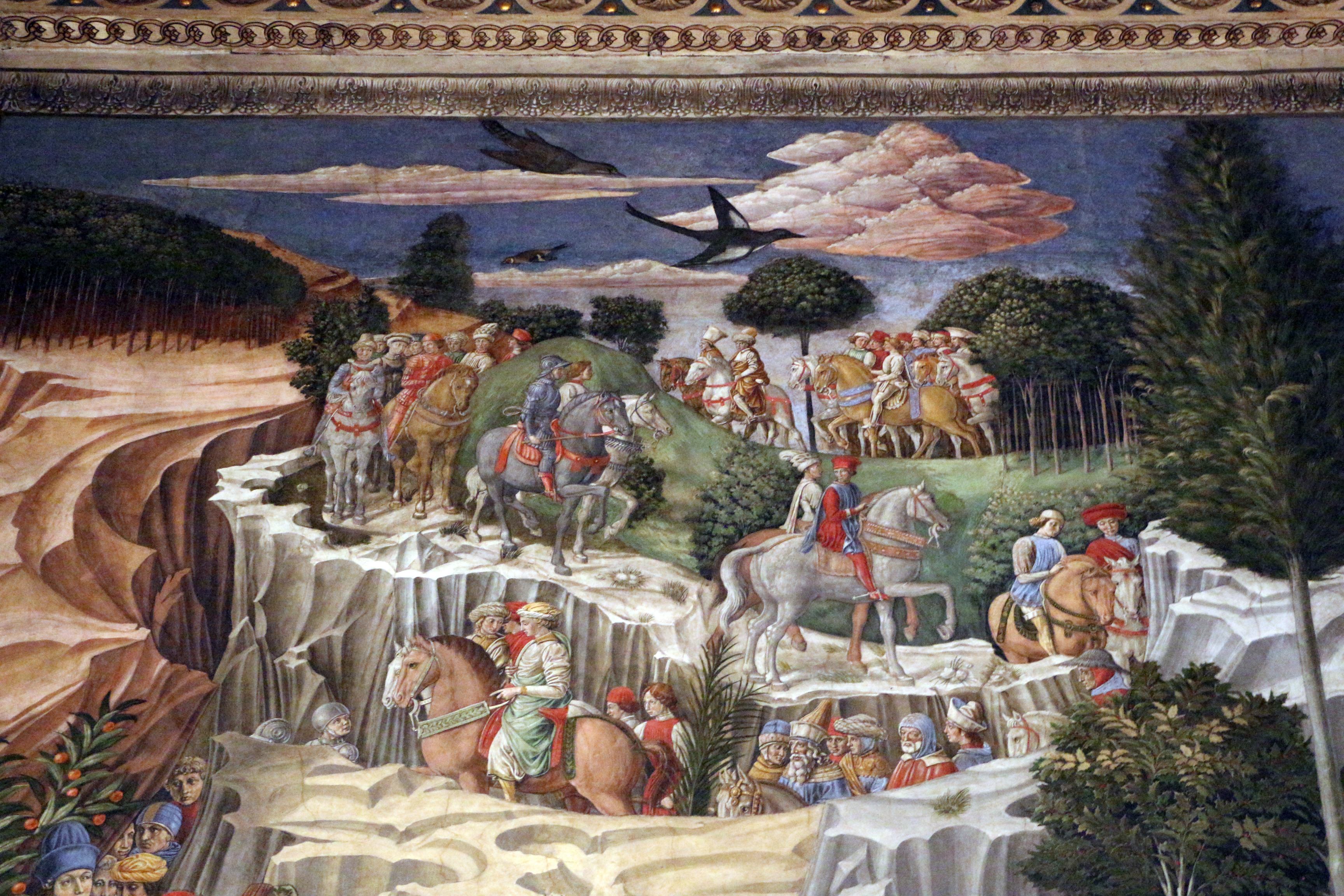
As we come down to the left of the fresco, however, where the riders are coming straight towards us, and are close enough to be recognisable, the interest shifts away from fairy tales towards the Medici family and towards politics; because, under those red hats, and riding on those superb horses are a number of obvious portraits.
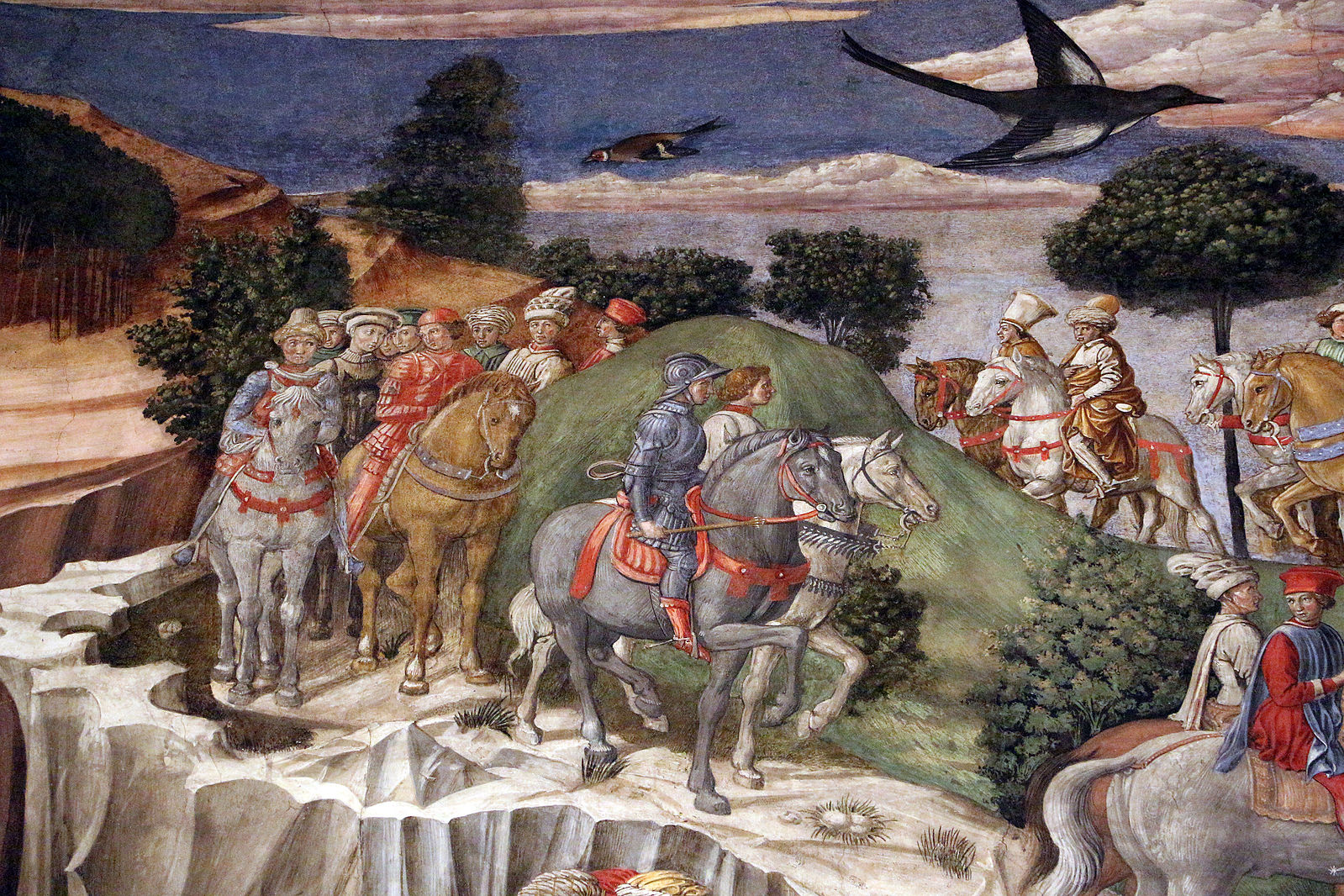
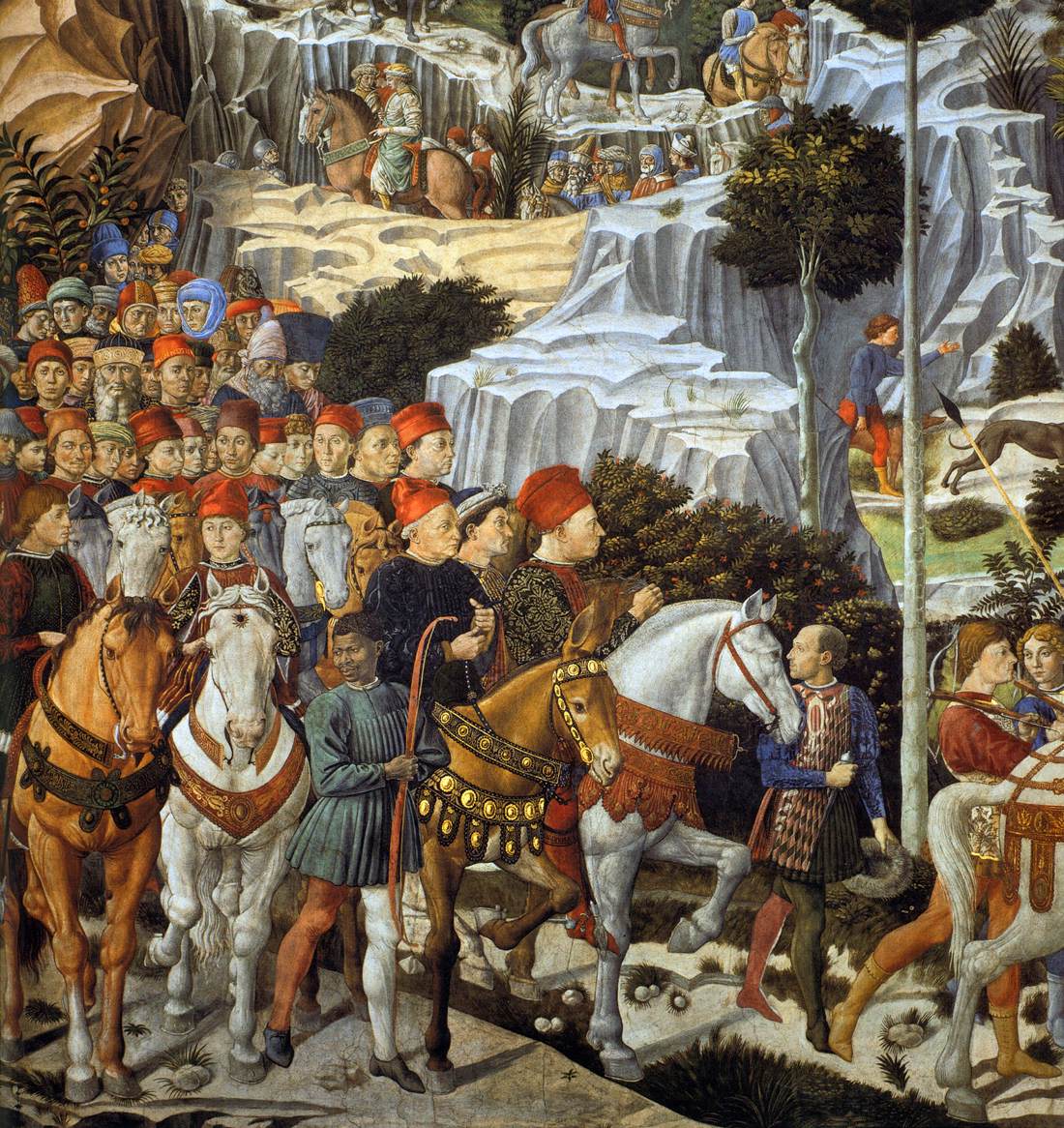
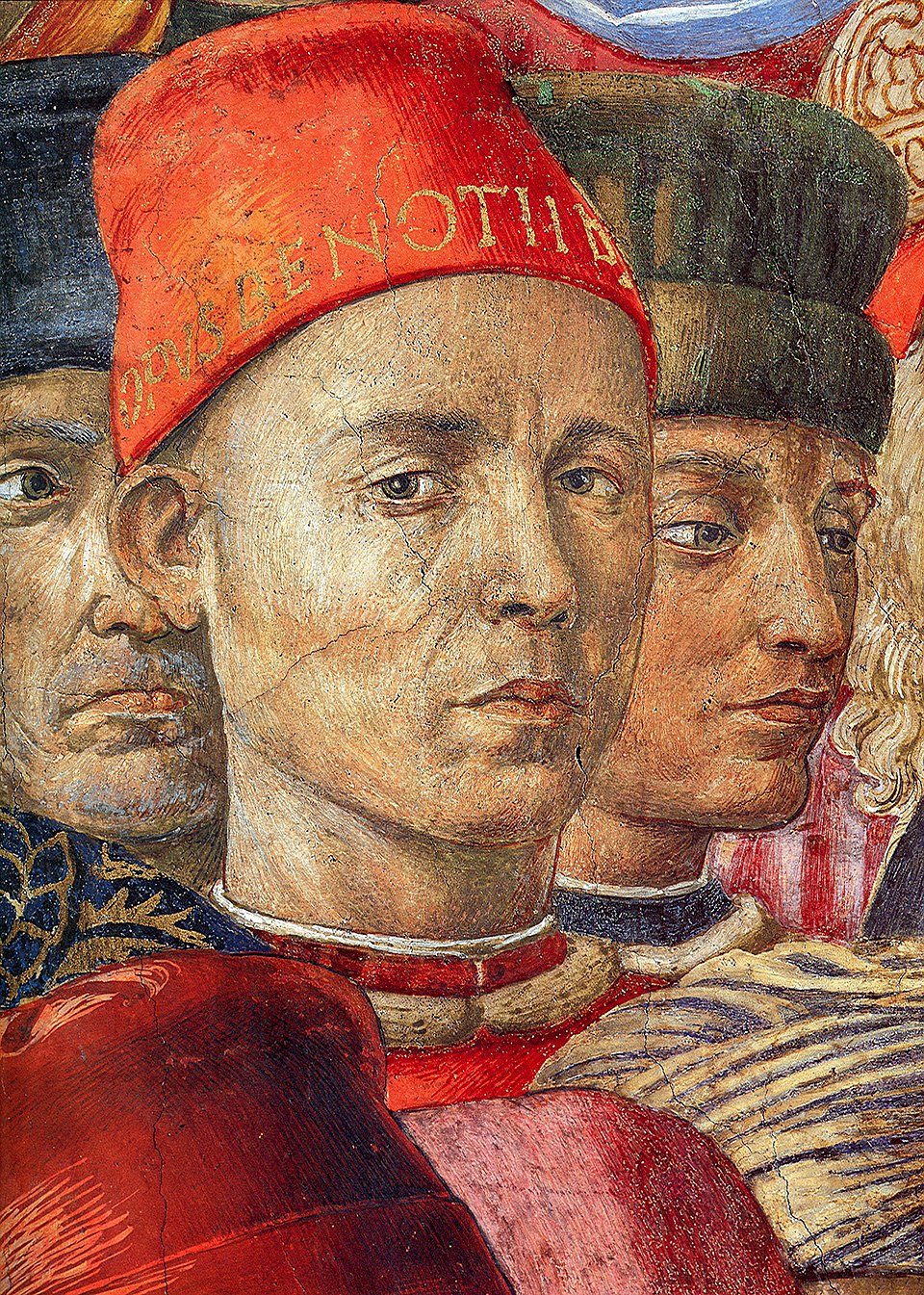
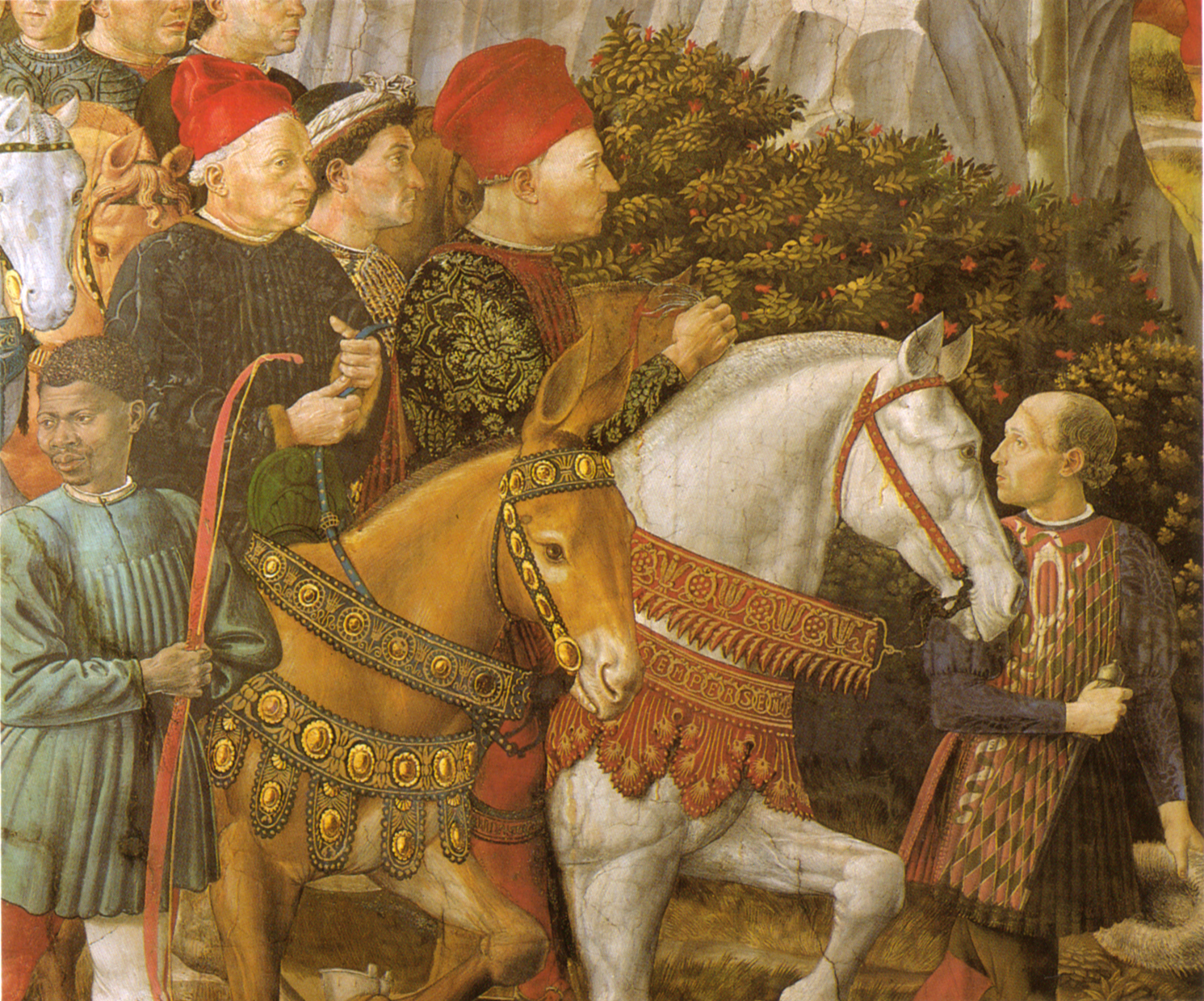
The first point to make about the portraits is that only one identification is certain beyond any possible dispute. The figure picked out in the first detail is definitely a self-portrait of the artist, because his name is written on his hat: Opus Benotii, ‘the work of Benozzo’.
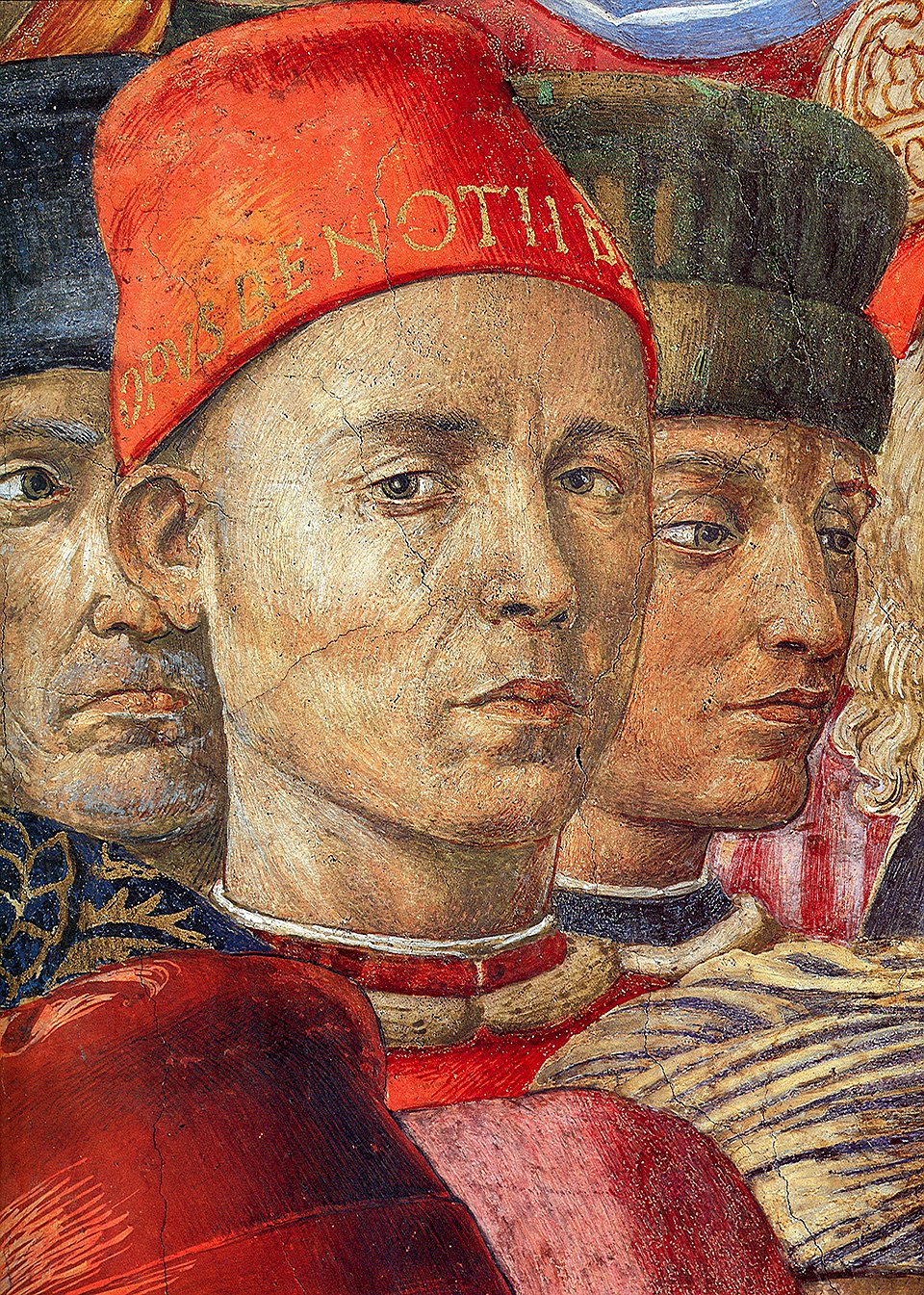
The two figures on the left must be important because of their position; and there is nothing wrong with the traditional view that they are the boy Duke of Pavia, Gian Galeazzo Sforza, son of Francesco (who had visited Florence in the recent past), and the extremely tough ruler of Rimini, Sigismondo Malatesta.
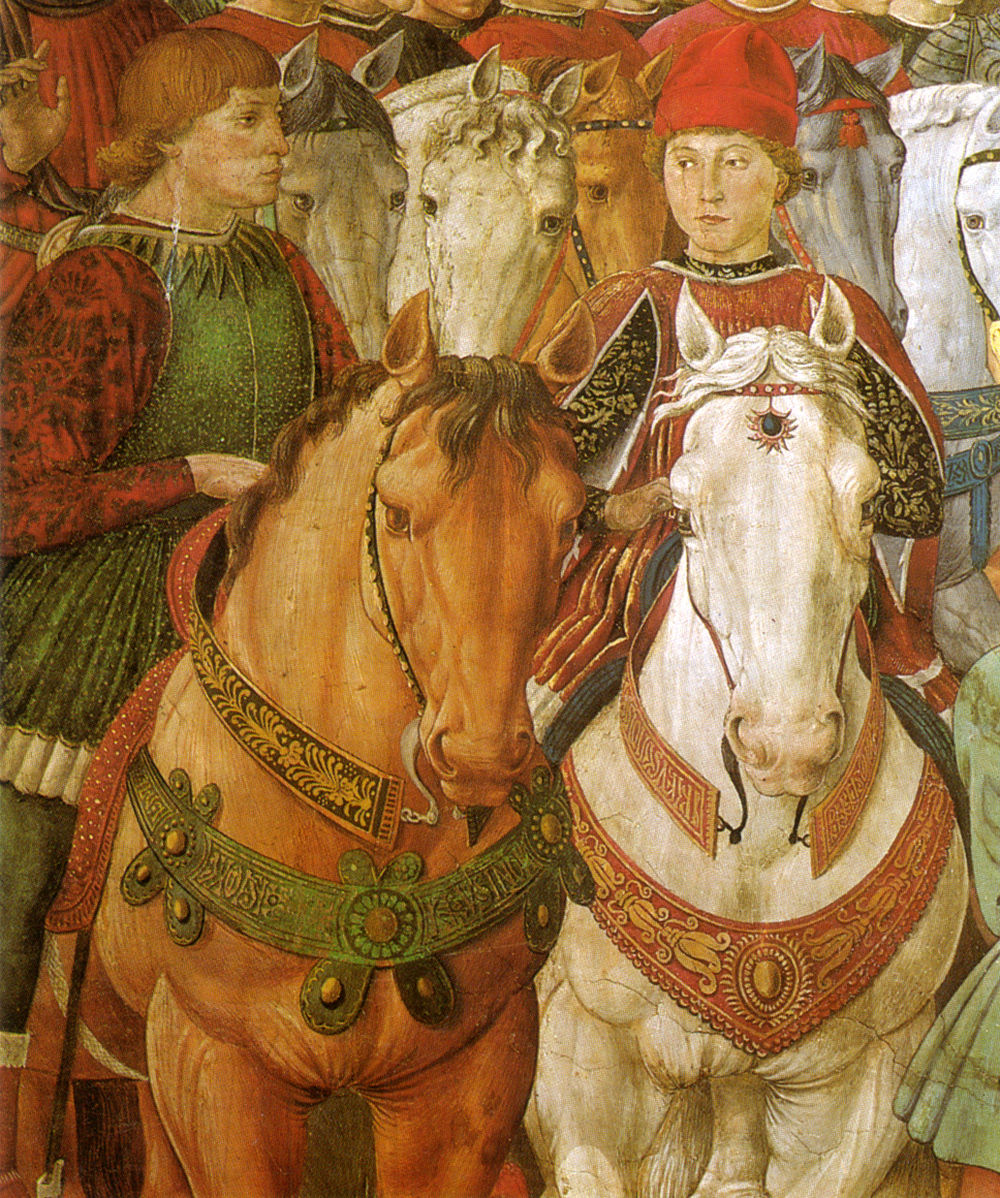
The next three riders must be Medici; even if one cannot be sure who they are.
Most observers have felt that the head on the left of this detail must be intended for Cosimo. The rider is plainly dressed, he is riding on a humble mule, and he is the right age. But it has to be conceded that he is very unlike the lean-featured, scrawny-necked figure we saw on the medal portrait.
The person with the strikingly Roman profile behind him could be Cosimo’s second son, Giovanni.
The leader is certainly his eldest son, Piero. His face is very like a surviving portrait bust; and if we look at the horse and groom rather than the rider, we can see not only the Medici device of the seven balls, but Piero’s personal motto—semper—on the horse’s harness and embroidered on the groom’s tunic.
Leaving on one side the identity of the riders, however, we must not forget to enjoy the lovely pattern formed by the legs of their knobbly-kneed horses and of their grooms, who wear hose of different colours for each leg.
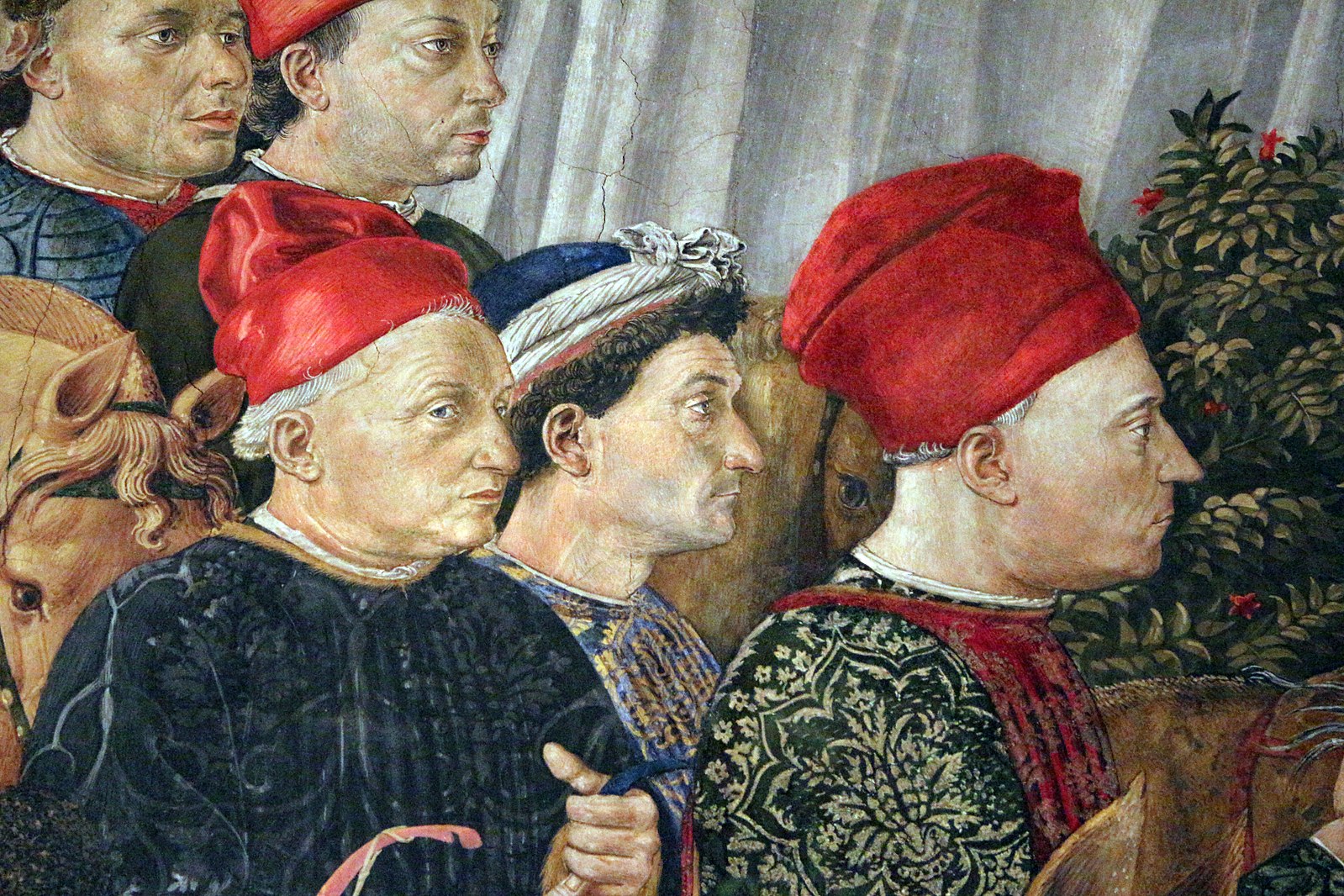
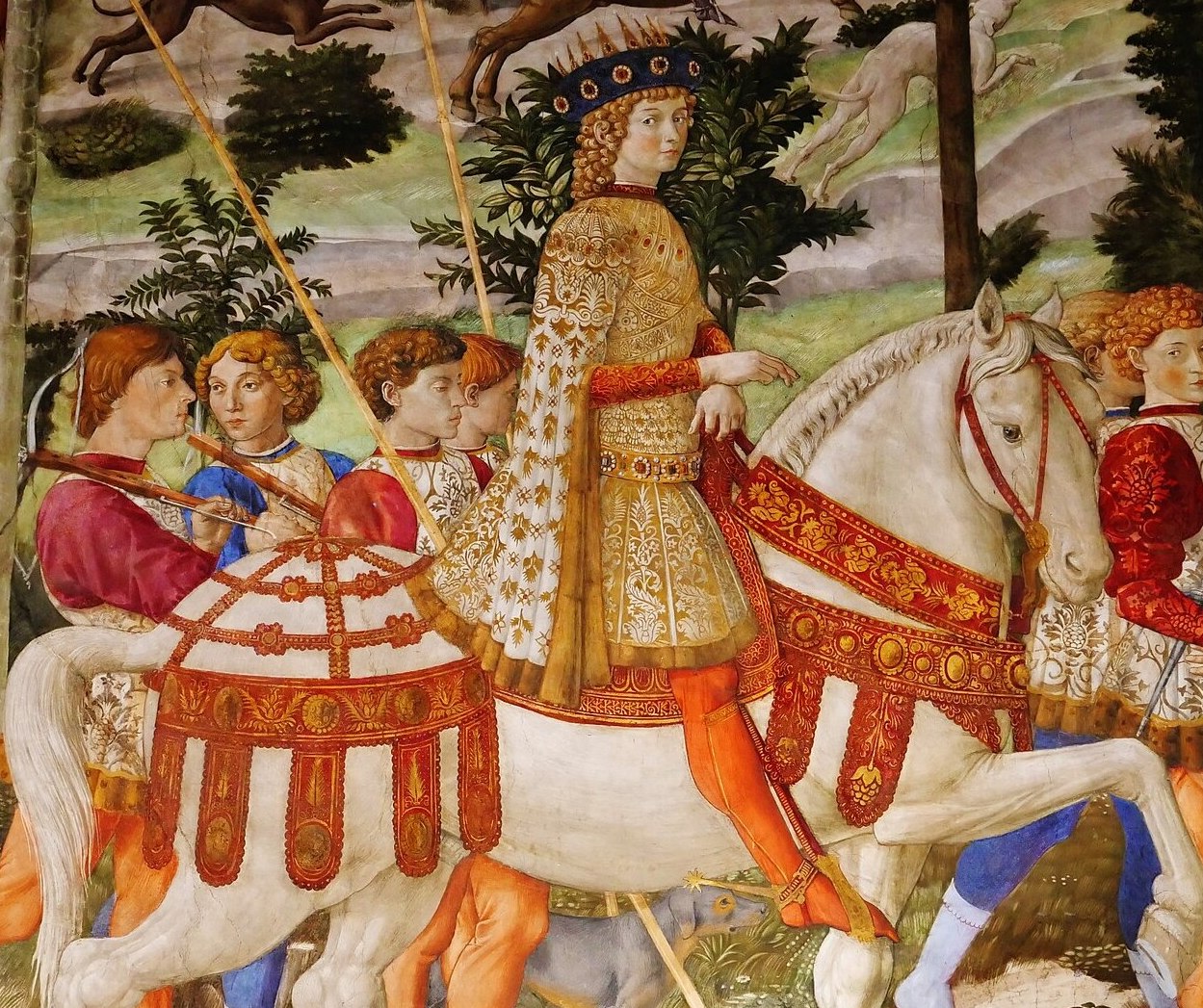
The dominant figure in the composition, at the head of the cavalcade, is the youngest King.
Once again, he must be a Medici, if only because we can the see the device of the seven balls all over the harness of his white steed.
His head is framed by a laurel; and he is considerably younger than the youngest of the three Kings, as they had been traditionally represented.
All this fits well with the traditional view that it is intended as a ‘representation’ of Lorenzo, who in 1459 would have been ten years old, and was at that point the rising hope of his house.
It cannot really be considered as a portrait, however, because the face is scarcely more particularised than those of the pages who accompany him. Hence, the pleasure of this foreground area is once again that of a ‘tapestry from fairyland’. Forgetting the Florentine politics and the Medici bank, we admire the crown-like hat, the curls (resembling those of a wig), the superbly embroidered robe, especially its sleeve, and the spur on the shoeless foot.
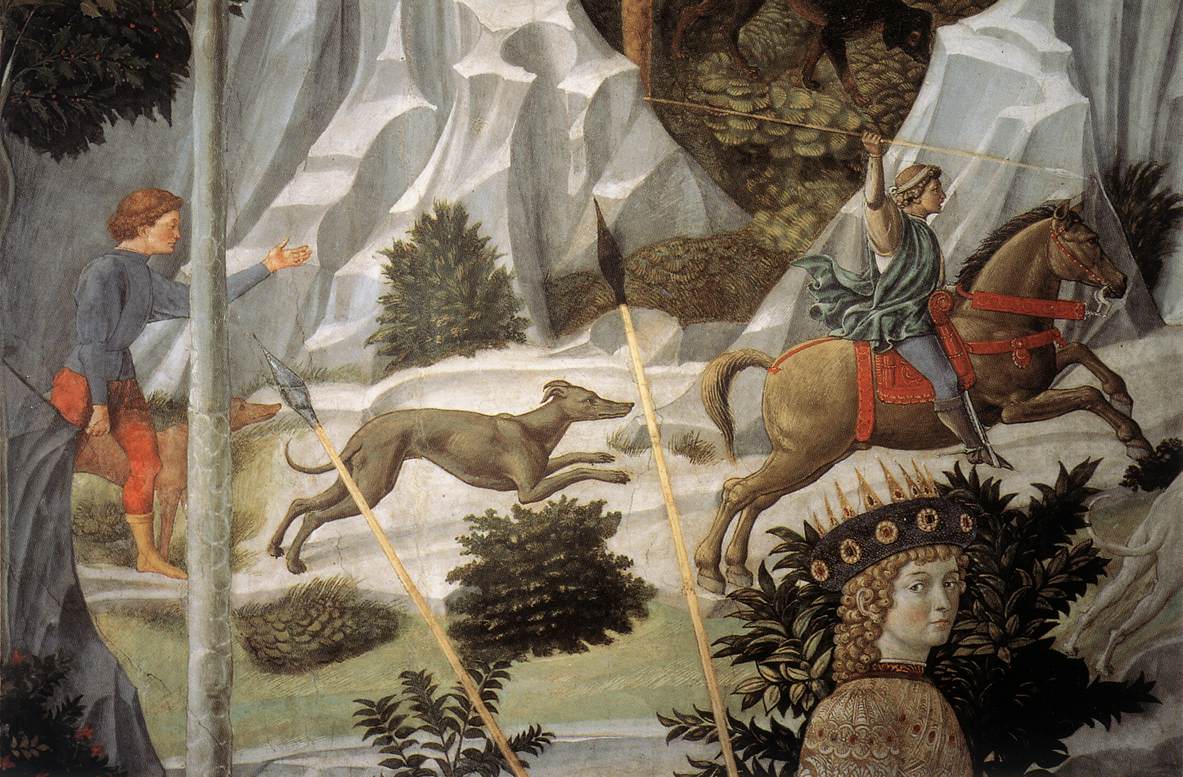
We should also look behind Lorenzo to the scenes of hunting, where a diminutive horseman with a javelin (rather too small in scale for the suggested distance), accompanied by two elongated greyhounds, is pursuing a stag with ass’s ears (who is also far too big—this indifference to relative scale being almost a deliberate archaism).
The composition on the east wall is closed by two squires who carry the young king’s gift for him, as well as his sword, and who are wheeling their splendidly caparisoned horses in order to change the direction of advance onto the south wall.
The photograph of the chapel shows how the two walls are linked to each other, even though the composition is cut off to the right not merely by the photographer, but by the builders in the seventeenth century, who put a new entrance in that corner.
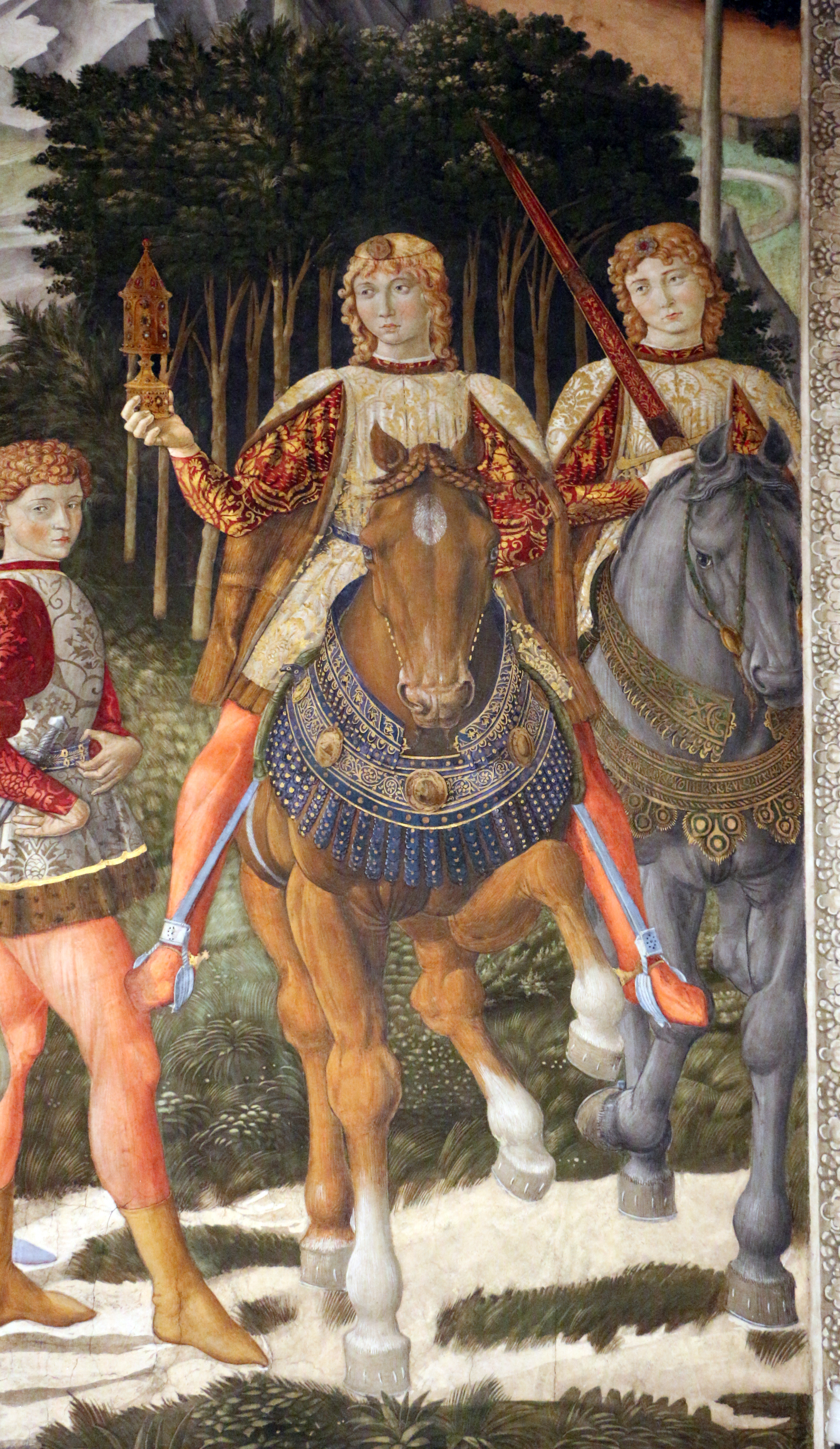
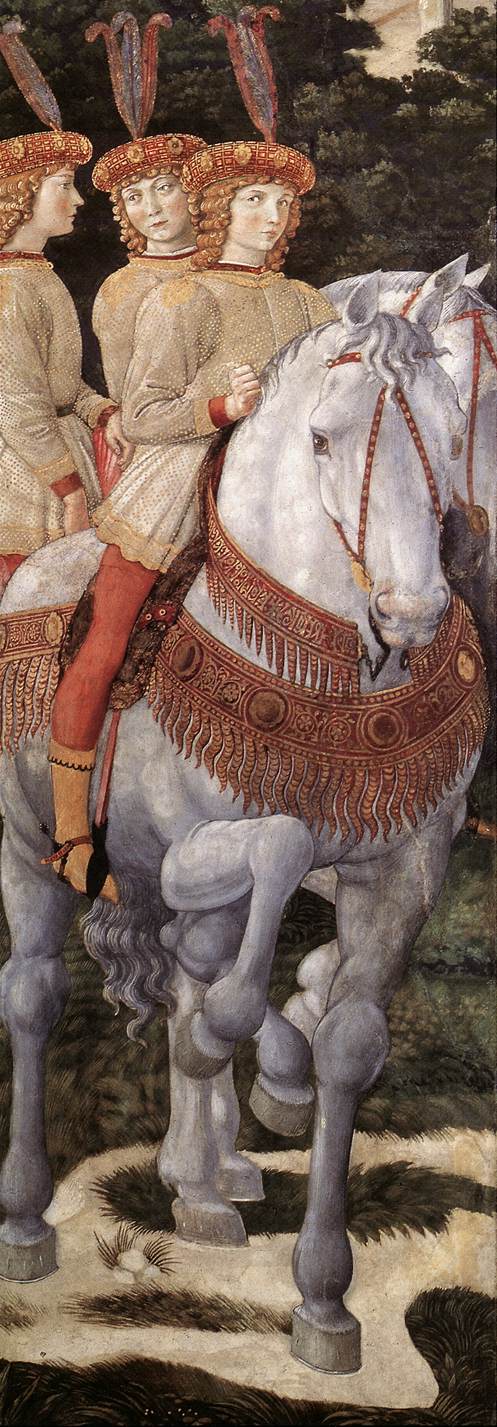
The two squires give way in the corner to the three charming figures you see here, who are certainly of the Medici household, since they have Cosimo’s personal device of ostrich feathers in their caps.
It was once believed they were intended as generic portraits of Lorenzo’s three sisters, Maria, Nannina, and Bianca.
It was a nice thought—but an impossible identification, since it is now clear that these are male pages.
Handsome they certainly are, though, in their brightly ‘dotted’ doublets and their red stockings.
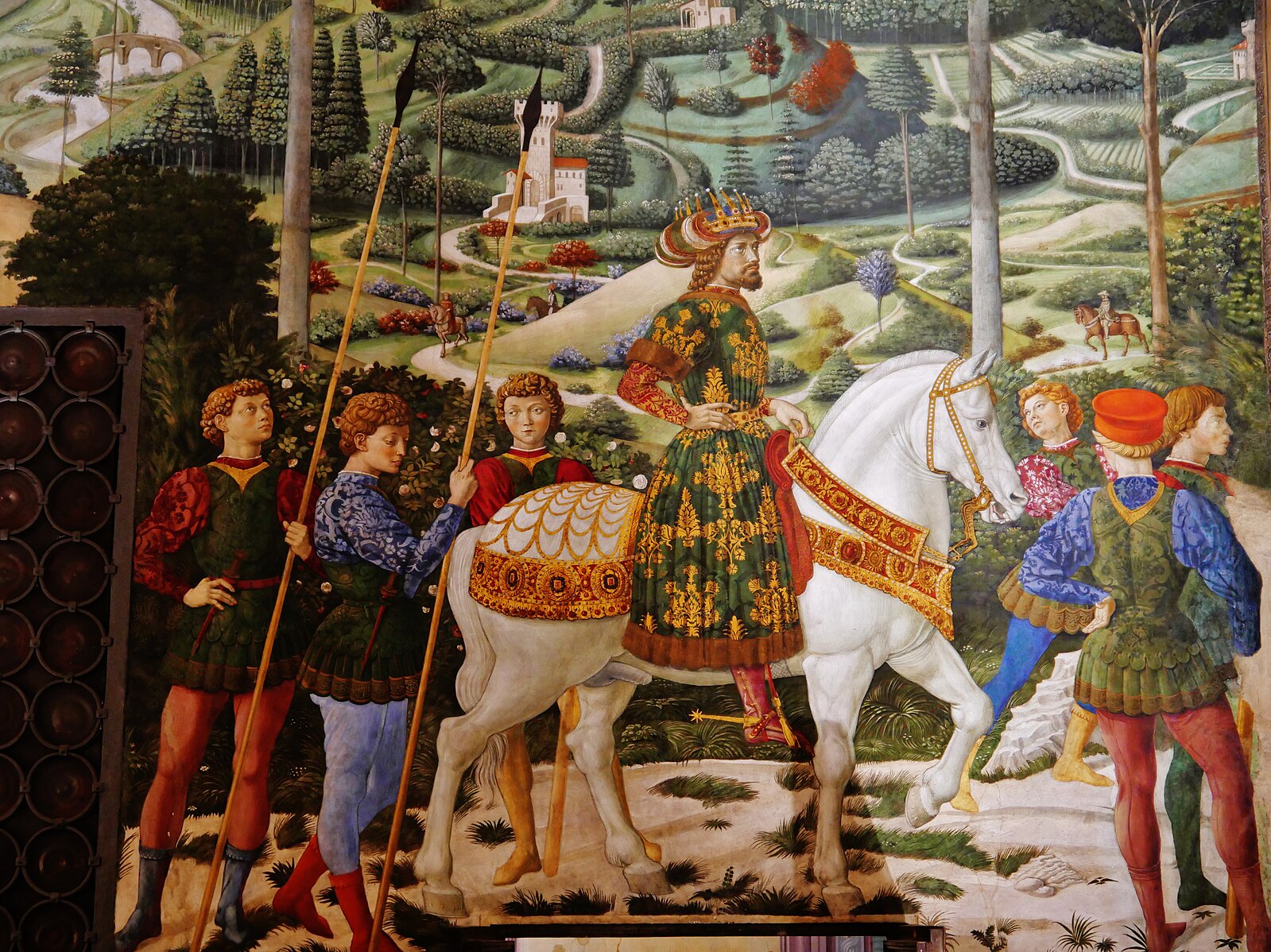
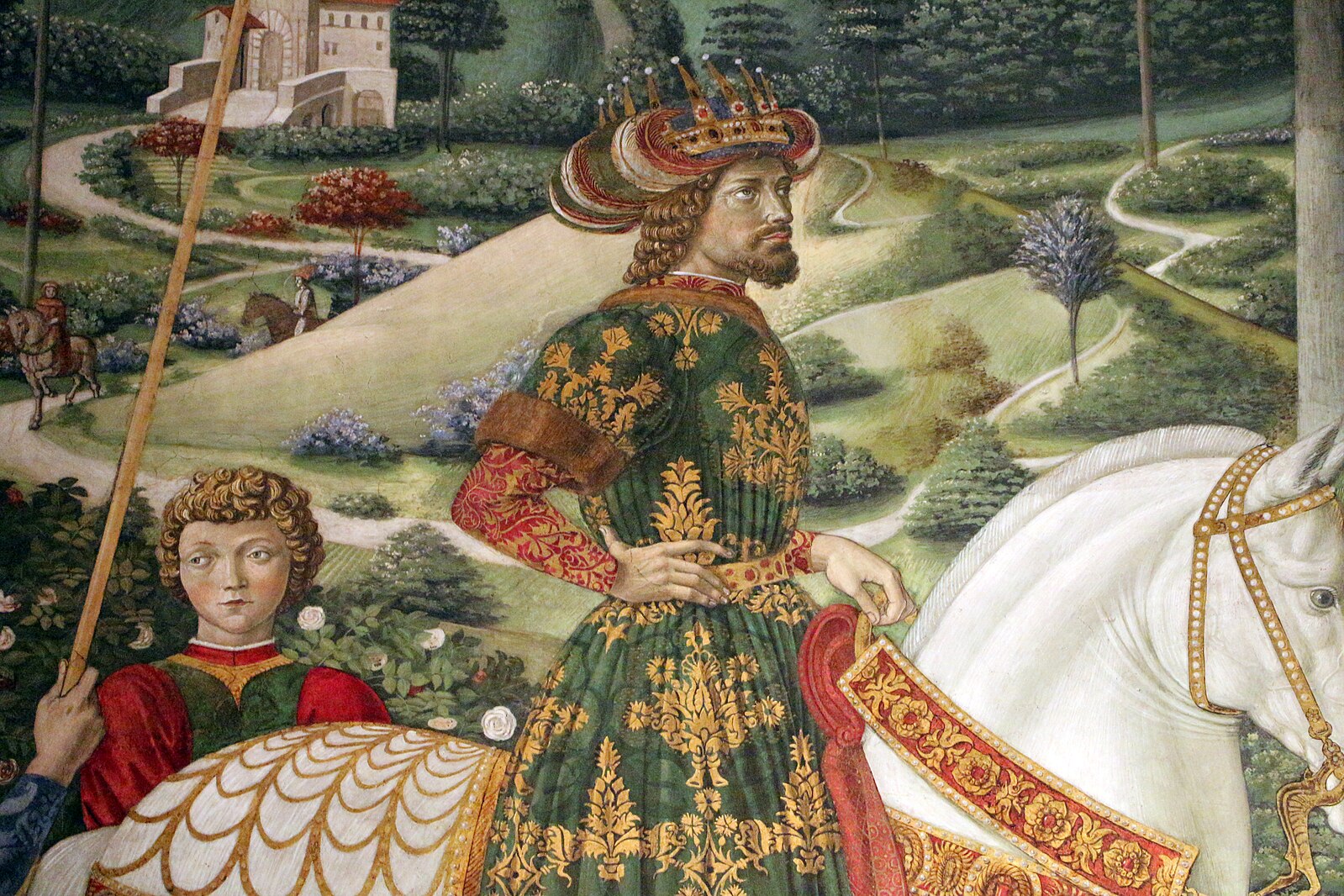
The centre of the south wall is dominated by the proud figure of the middle-aged king, one arm akimbo, flanked by his pensive grooms.
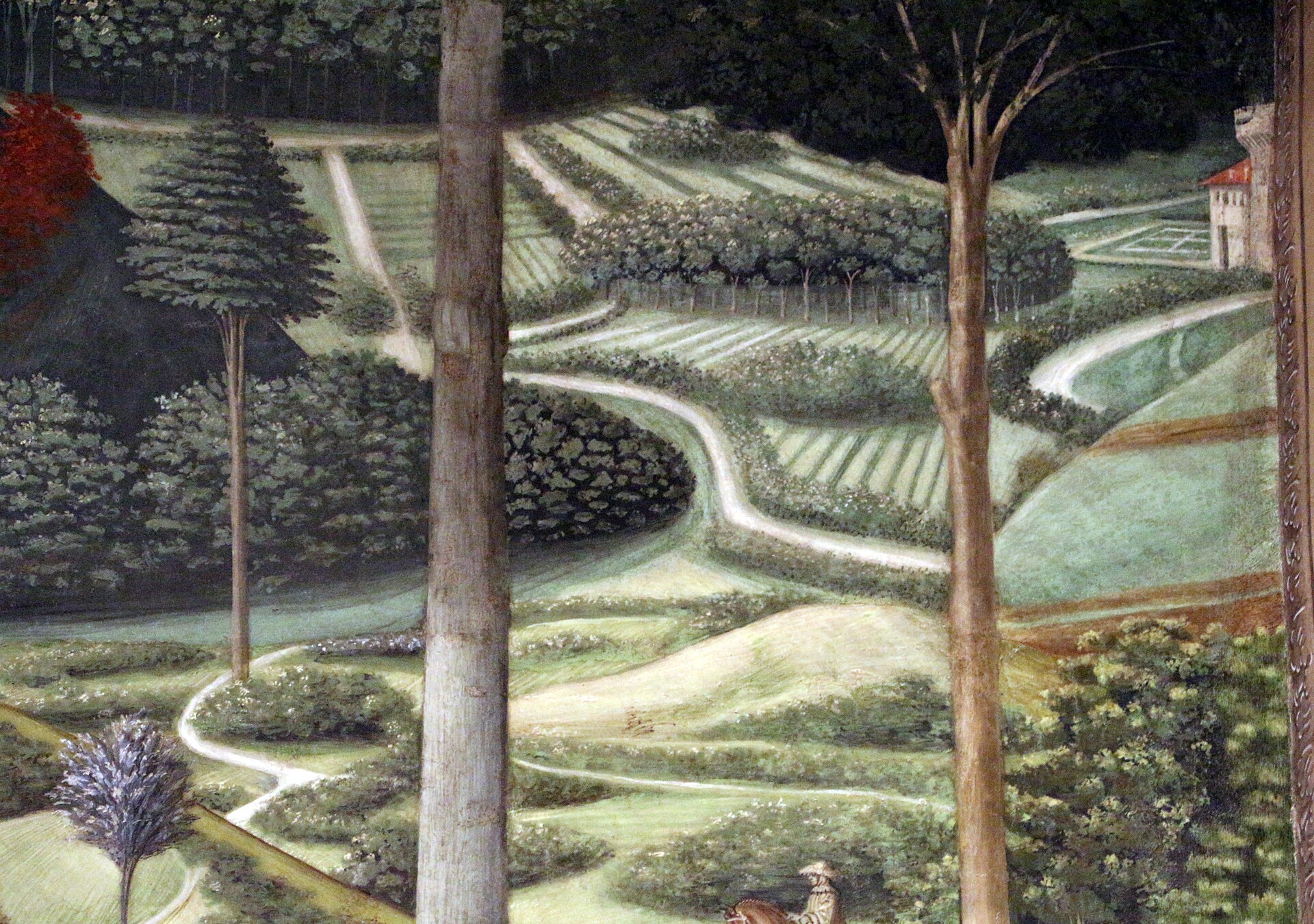
But let us begin with a glance at the landscape, which makes a pleasing contrast with the east wall by showing a deep valley in front of the mountain.
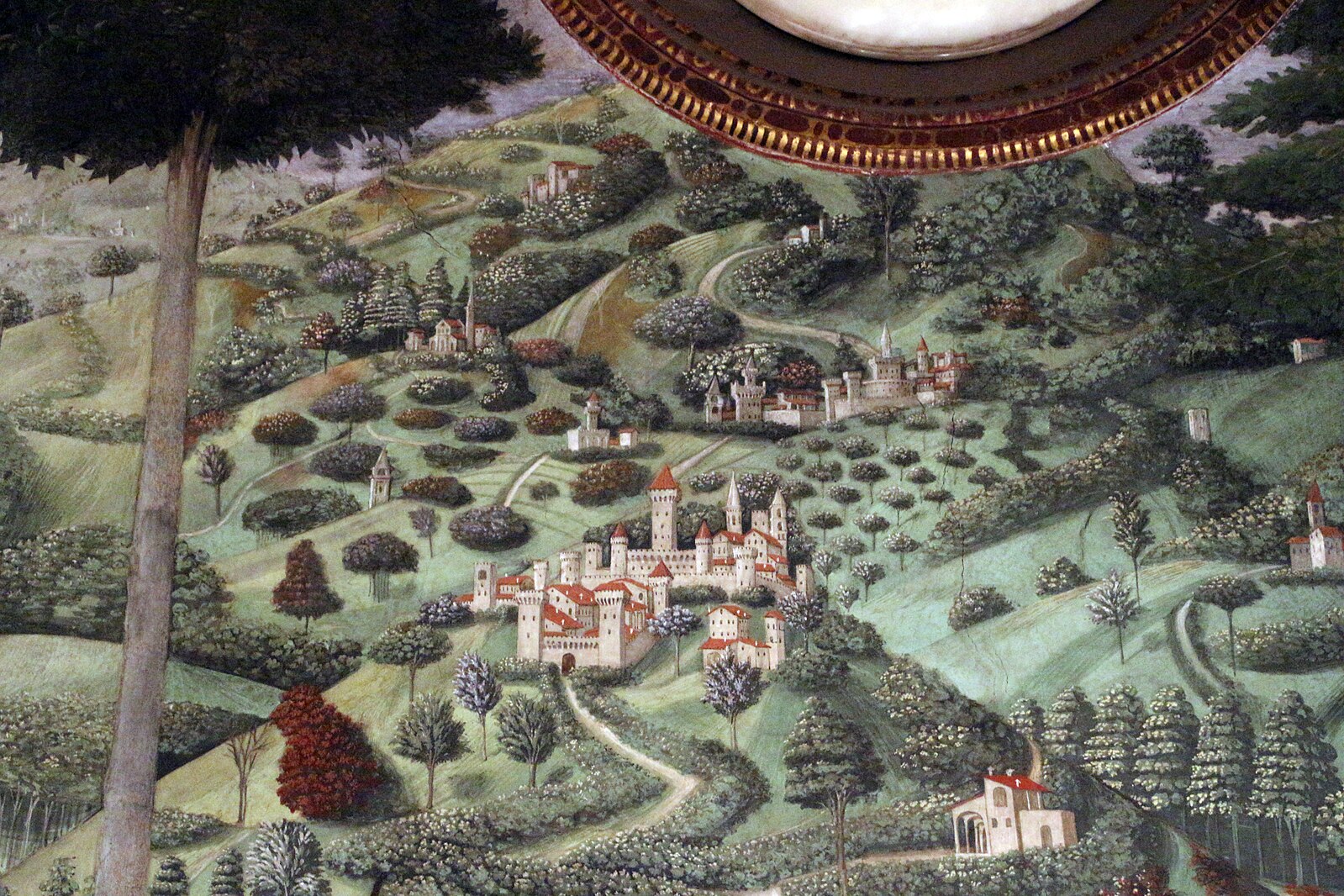
The three details offer a nice mixture of the naturalistic (a lovely stretch of Tuscan hillside), the stylised (with Forestry-Commission–style planting) and the poetic (the two turreted castles perching on their hills).

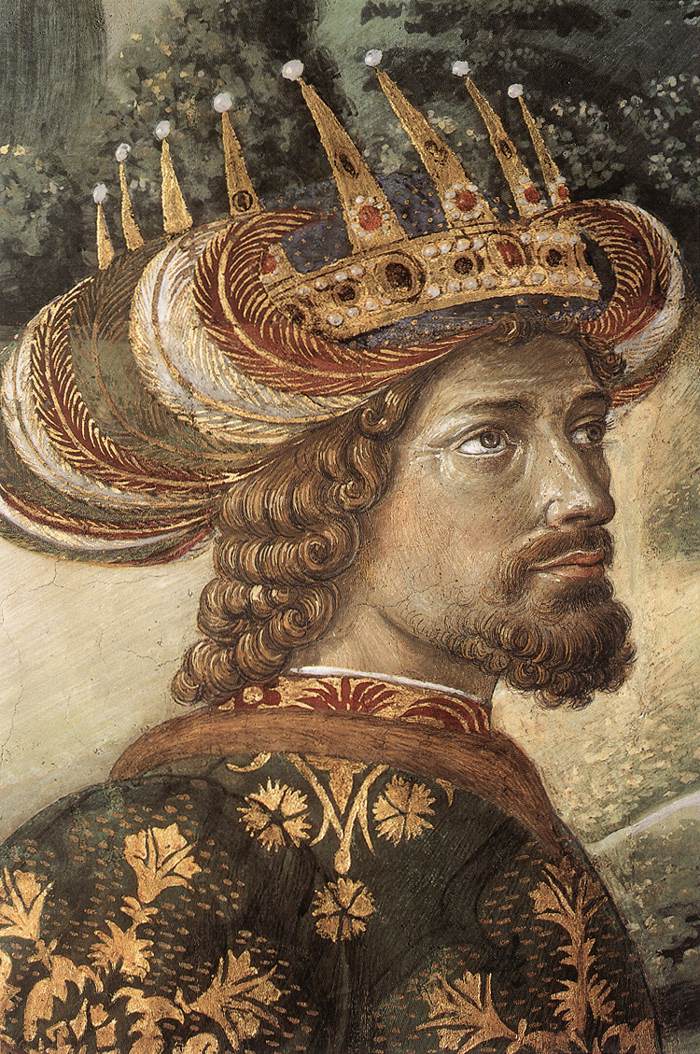
Now we may return to the foreground, enjoying the white palfrey and the splendour of the king’s robe, before focusing on his exotic turban-cum-crown, and on his face.
His features are usually said to recall those of John Paleologus, the Greek Emperor who came to Florence in 1439. (By the time Gozzoli painted these frescos, he had died; and his successor had been killed during the capture of Constantinople by the Turks in 1453.)
Look at Pisanello’s medal again and decide for yourself.
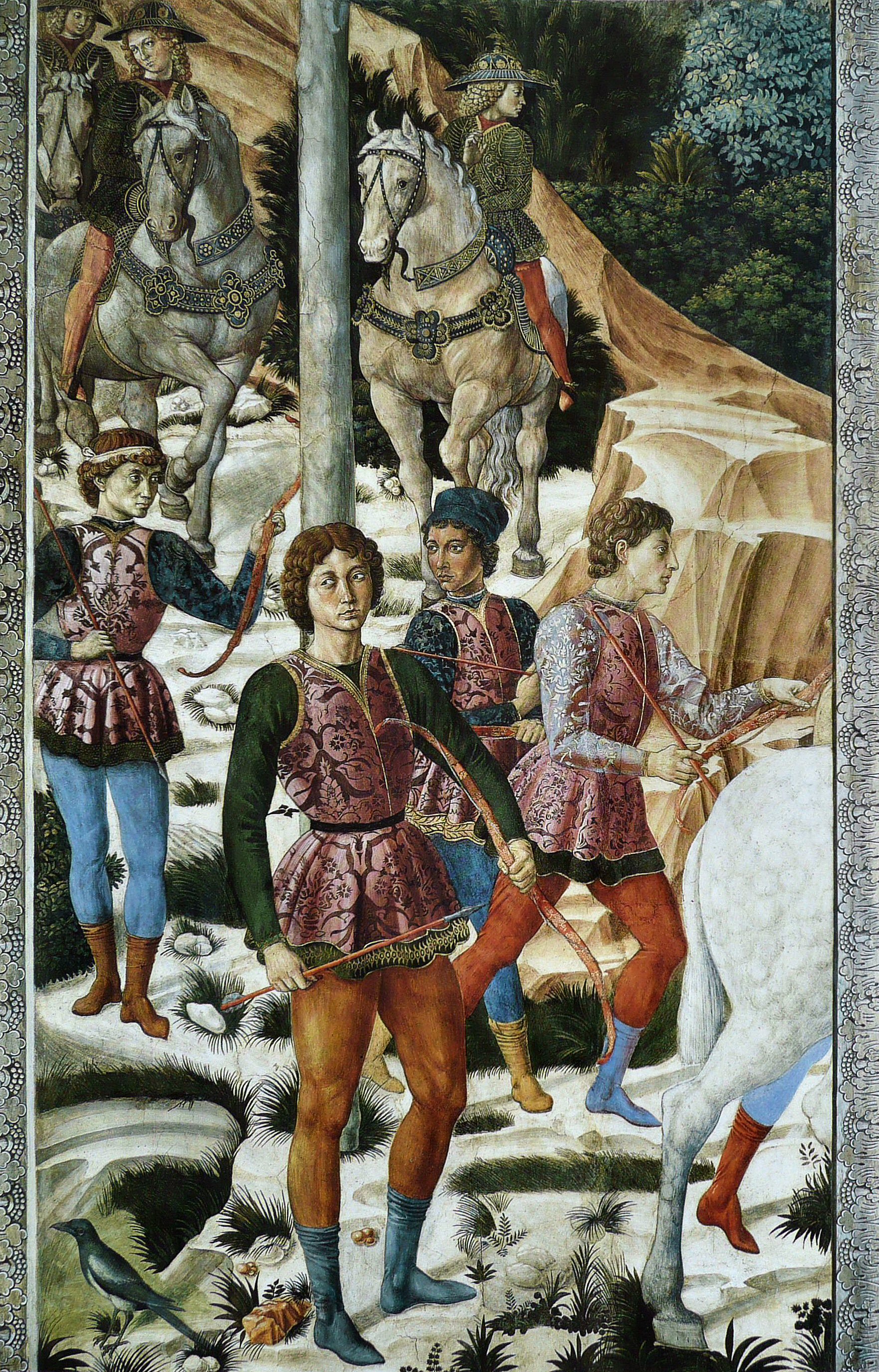
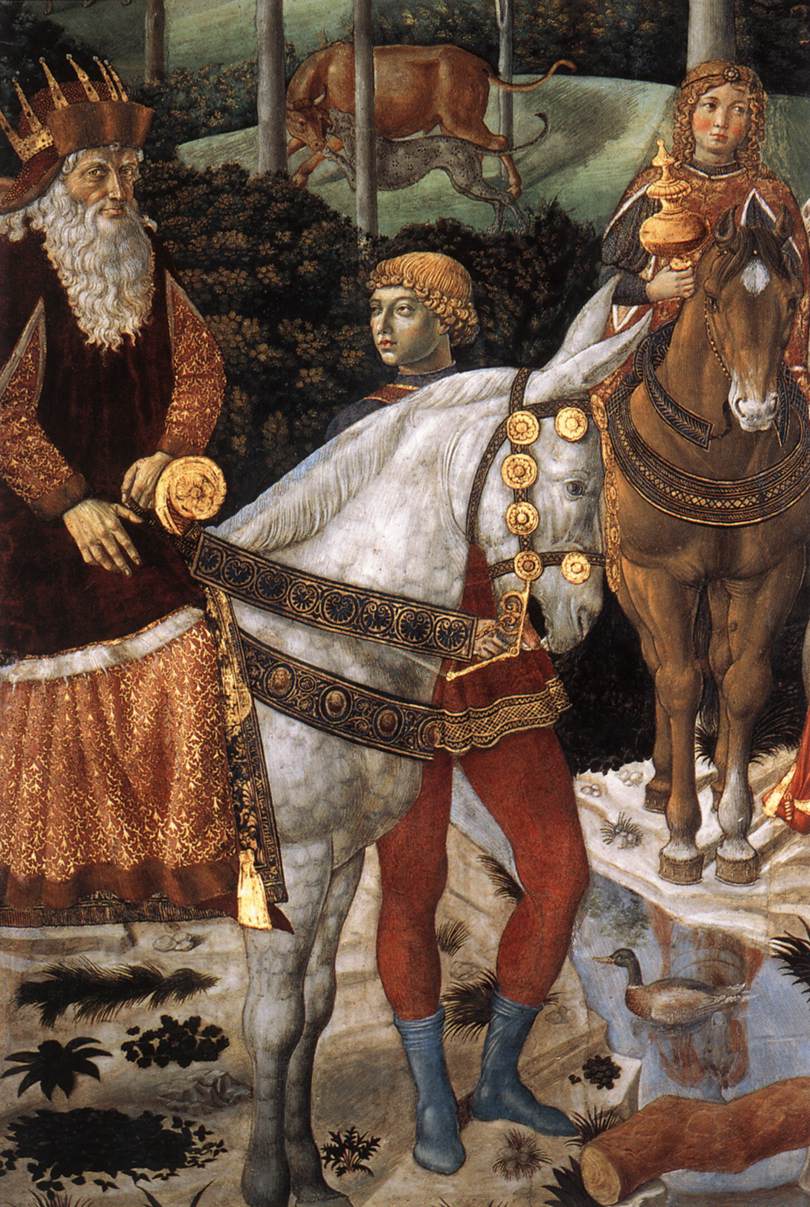
The carving out of a new entrance to the chapel not only spoilt the back wall, but almost ruined the left-hand wall, which is presented here in a montage which allows a better view than one can obtain while in the chapel.
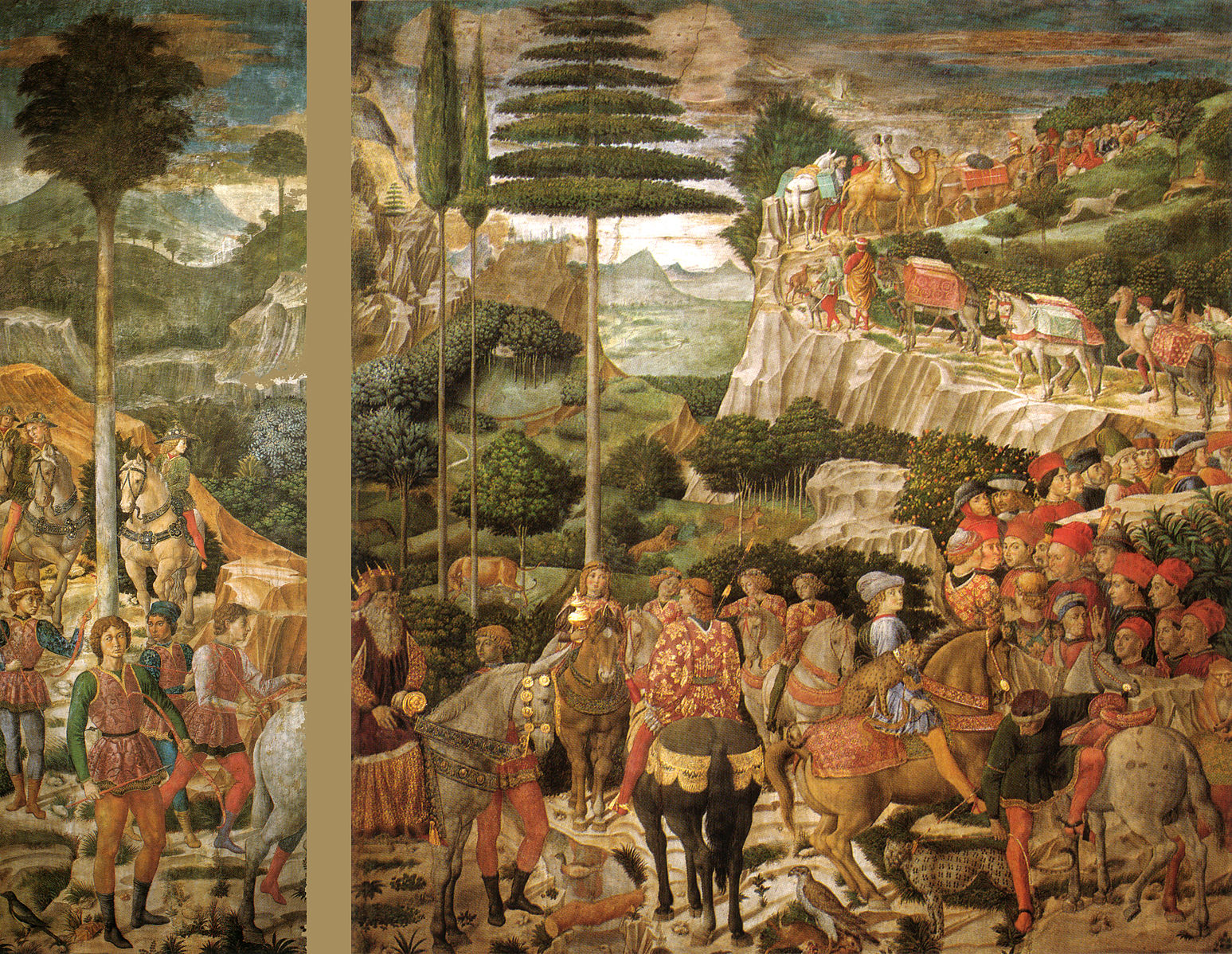
The corner is marked by a pair of young horsemen, wearing armour and helmets, who seem to be part of a military escort, maintaining an all-round lookout.
They are placed higher on a sloping road, while the level foreground is occupied by three archers, equally vigilant, standing stock-still, and a strikingly handsome groom, in mid-stride.
From the groom, we jump to the other side of this ‘most unkindest cut’ to find the eldest of the three Kings, white-bearded, soberly dressed, and sitting side-saddle on a mule.
This is now supposed to be an ideal portrait of Joseph, who had been the Patriarch of Jerusalem back in 1439.
The main (undamaged) section of the last fresco shows the vanguard of the regal procession, riding ahead of the three Kings.
The most important retainers have halted at the foot of the coming ascent—posing, as it were, for a photo op. In a moment, they will move off again behind the camels and mules of the baggage train on the edge of the precipice and a phalanx of foot soldiers who are vanishing on the skyline.
(Are they on the return journey, travelling ‘by another way’, as warned in their dream? Have they worshipped and given their gifts?)
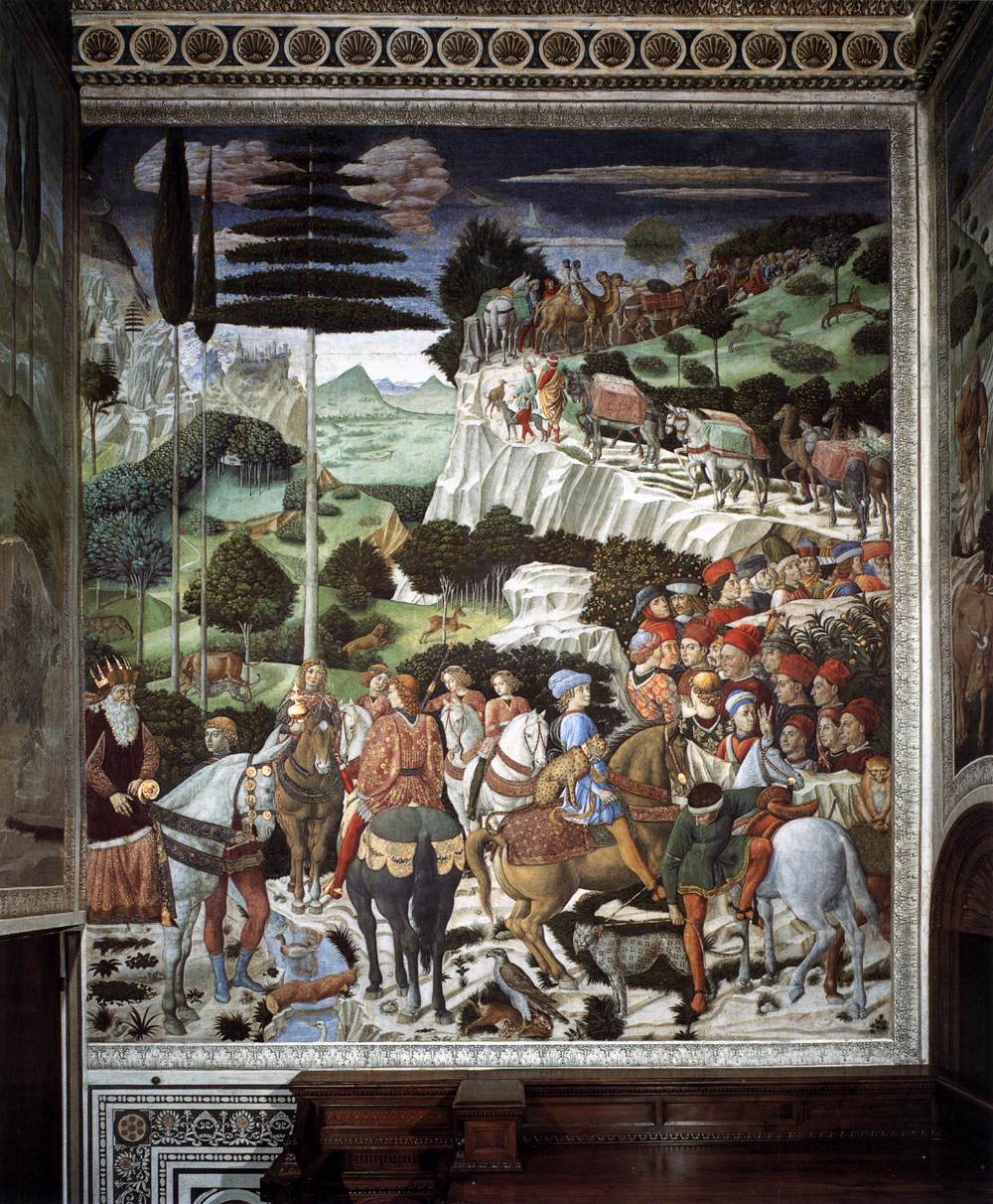
At the head of the procession rides a young boy, who is generally understood to be an idealised portrait of Lorenzo’s younger brother, Giuliano, who was born in 1453 (four years after Lorenzo).
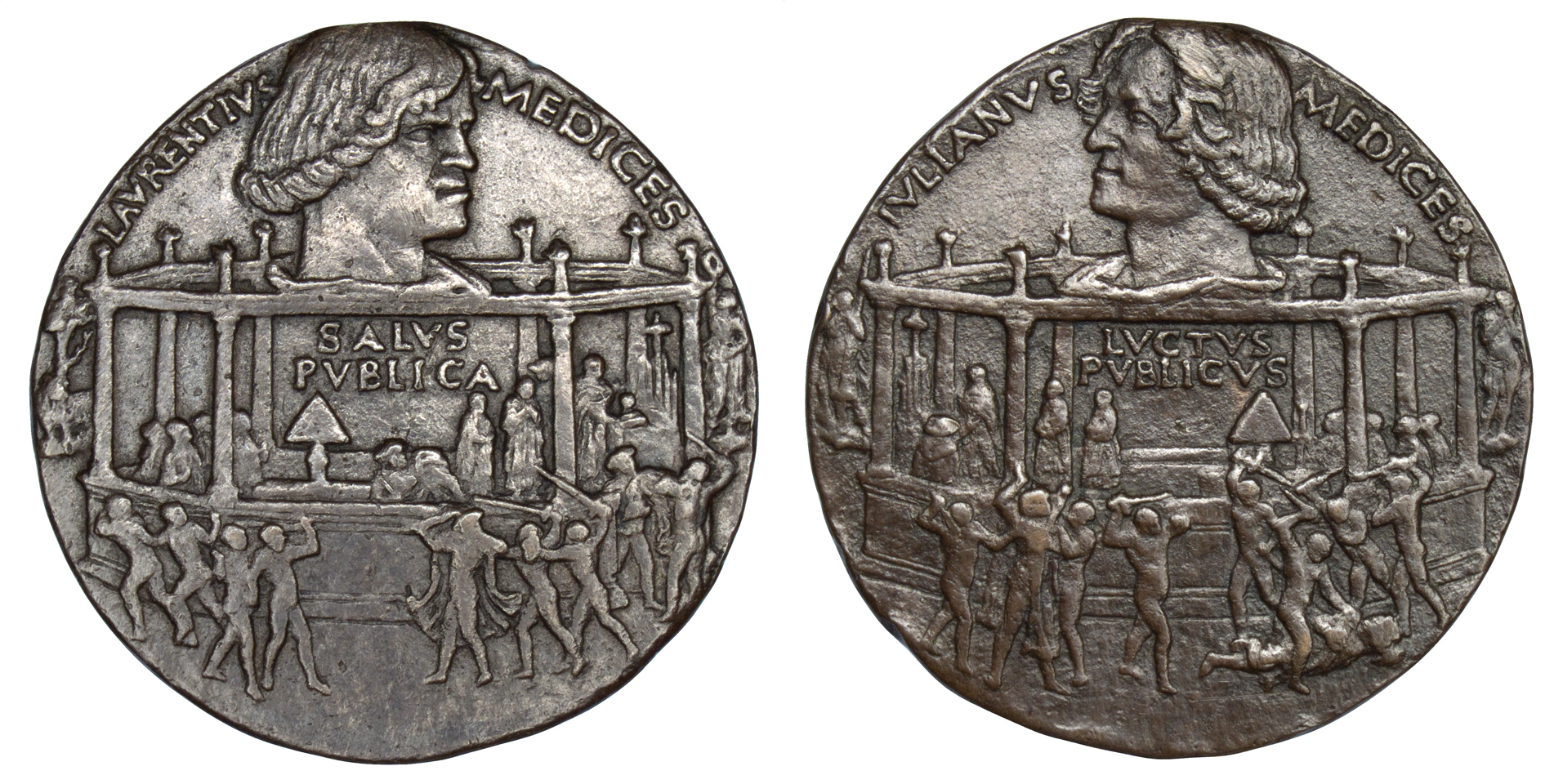
He was subsequently assassinated—during Mass, at the high altar of the Cathedral—in the infamous Pazzi conspiracy of April 1478 (in which his brother would be wounded but survive to take a bloody revenge). And it is chilling to compare the bright colours of the romanticised boy in the fresco with the sombre and realistic profile of Giuliano on the verso of the medal which commemorates the public grief (luctus publicus) at his murder.
But it would be wrong to finish this lecture of all lectures on a gloomy note.
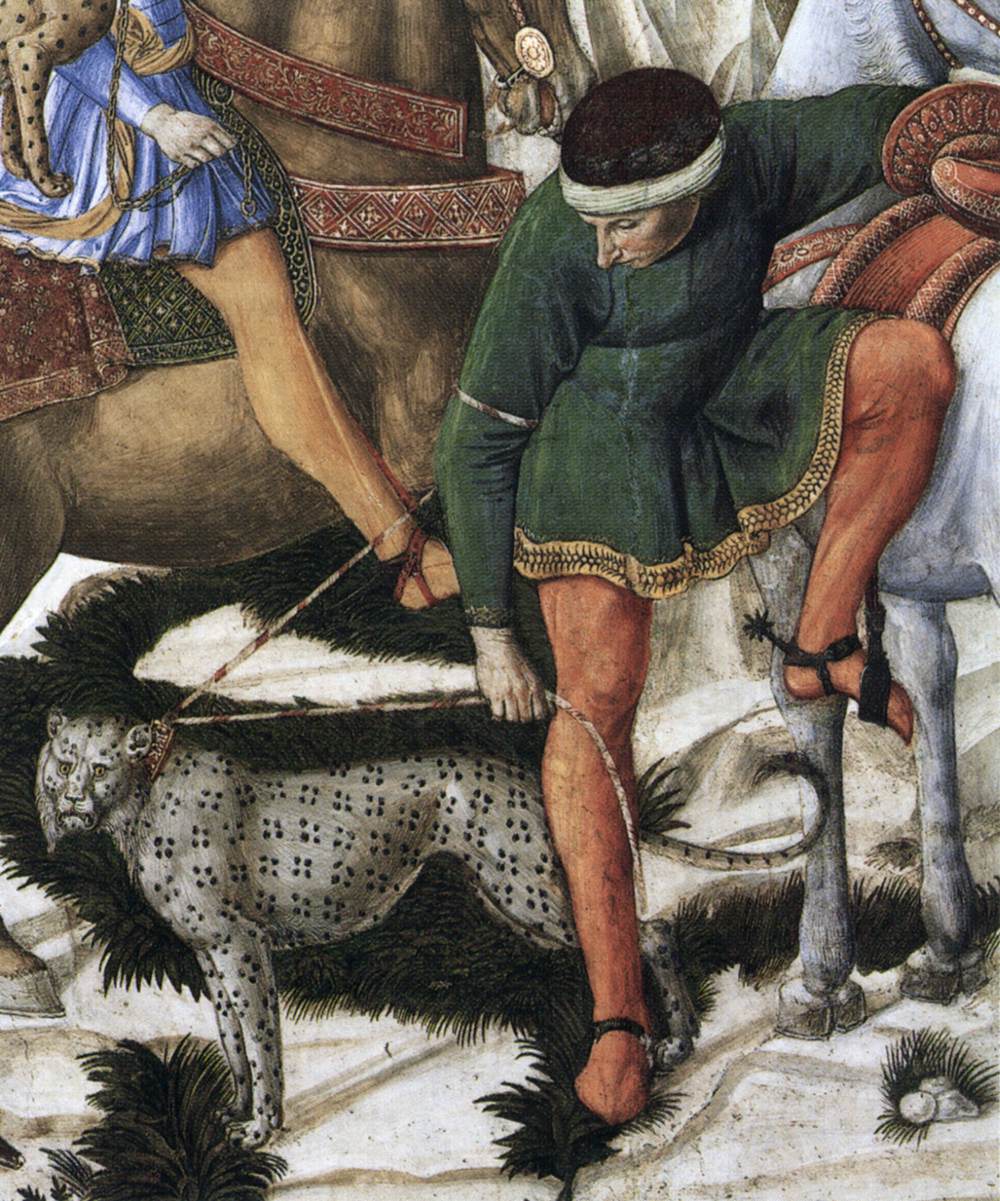
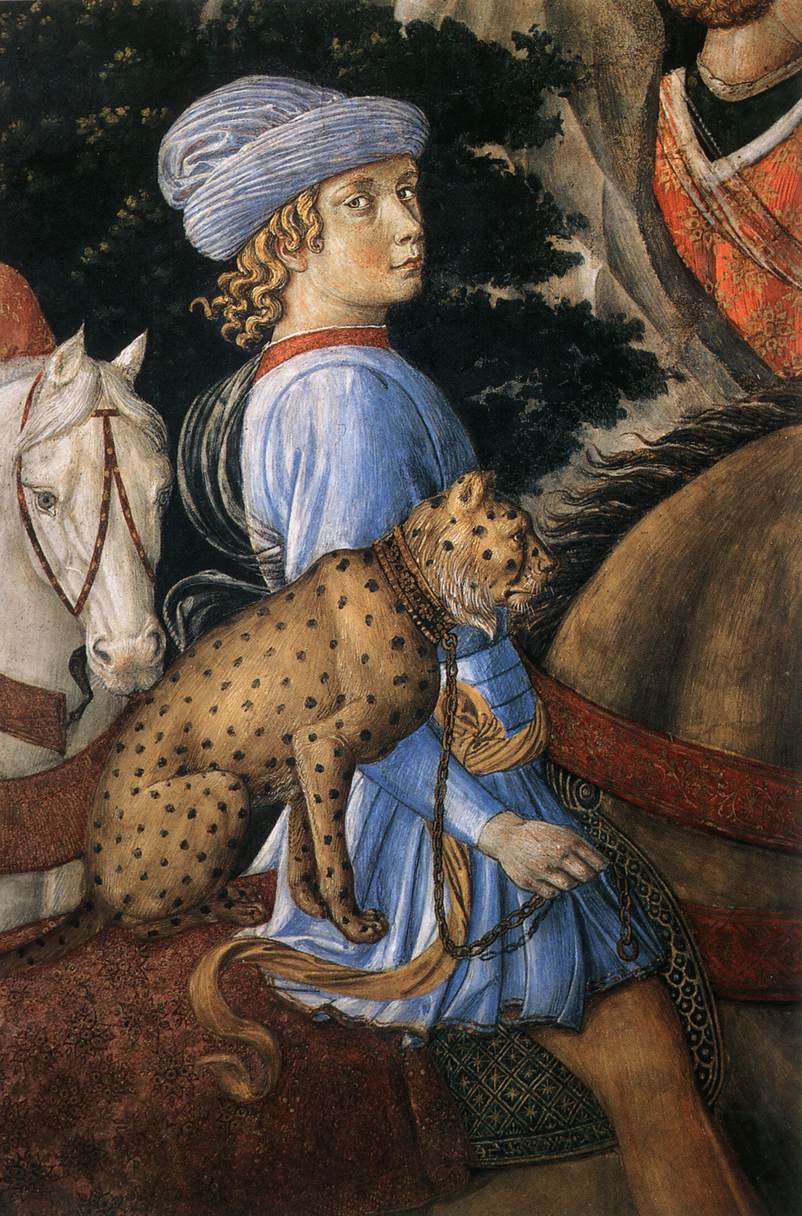
So, look more closely now at the calm face of the boy in blue, with his pet cheetah seated on his saddlebow, and his horse poised for a spring forward.
And look even more closely at the groom by his side, who is shown in one of the most interesting and complex poses of all the attendants in the whole cycle. His left foot is still in the stirrup of his own horse, as he braces himself against its flank and bends down to tighten his hold on the double leash restraining the hunting cheetah, while the cheetah itself seems to be looking enviously at a falcon which has already disembowelled its prey.
There could not be a better single example of the qualities that bring us into the Medici Chapel than this blend of realism and romance.