Adventures in Wonderland
“Explain all that,” said the Mock Turtle. “No, no! The adventures
first,” said the Gryphon in an impatient tone: “explanations take such a
dreadful time.”
—Alice in Wonderland, ch. 10
These richly illustrated lectures offer a fresh introduction to some of the greatest works by the greatest Italian artists: e.g. Michelangelo in Rome, Titian in Venice; and, before their time, Duccio in Siena and Giotto in Florence.
Everything is subordinate to the telling of a story. Your interest will be sustained and your emotions engaged as you follow a sacred or secular drama, unfolding scene by scene on the walls of a single chapel or stateroom which you will be able to visit in person.
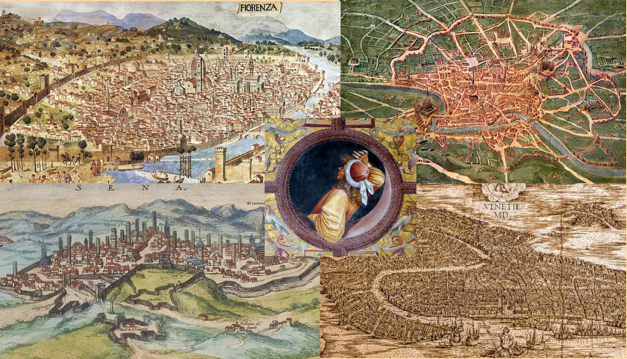
You will be taken on a magic carpet through space and time to four cultural centres and four different centuries. You are being offered ‘Safaris in Wonderland’. All the hotels have been booked; each day’s itinerary is planned; the guide is in attendance.
Choosing your First Safari
Another possible subtitle for the site is Tales from Four Cities, and the question immediately arises, ‘Where should I go first?’
There is no obvious answer. Rome in the High Renaissance could hardly be more different from Siena in the Middle Ages; and while Florence and Venice were both republics in their days of glory, the resemblances end there. As a result, the four series of lectures are remarkably diverse in character; and there is no ideal order in which to visit the cities or to enjoy the stories when you arrive.
Each lecture is self-contained and may be tackled in any order you choose. Hence, at this point, you might do worse than follow the Gryphon’s advice in the epigraph. Click on the city-names (below) to view the menus on offer; choose one of the twenty-six options on the spur of the moment; and get cracking on your first adventure…
Steady on, though. There are other factors to bear in mind. Each story belongs to its own century as well as to its own place on a wall; and it is important to acquire an awareness of relative dates. Within each series, the narratives are presented in chronological order, and the opening lecture is typically more introductory in character. It is not irrelevant, either, that the paintings from Siena are predominantly from the Middle Ages, while those from Florence are predominantly from the Early Renaissance. Similarly, Rome is mostly High Renaissance and Venice later still. All these considerations may affect your planning, but it remains true that only you can decide where best to make a start.
Before taking the plunge, however, please make yourself familiar with the ‘travel advice’ in the next section.
Practical Advice
All the logistics for your safari have been taken care of by the management team (call us Michela, Pat and Reuben), but you will have to do a certain amount of walking on cobbled paths in the sunshine when you arrive, so this section offers six essential tips and instructions about what to take with you and how to pack your metaphorical suitcase. (Please make allowances for the familiar and slightly peremptory tone…)
- The first simple instruction is a Golden Rule necessary for every trip. (It is the metaphorical equivalent of ‘Hold your book the right way up.’)
Set the browser window to Full Screen mode.
- Each lecture takes the form of a commentary on a carefully chosen sequence of images. There will always be an argument to follow as well as the plot of a story. So, keep up your momentum and aim to get to the end within a single, twenty-five-minute session. (You will be able return to any scene at your convenience and linger over the details at a later stage.)
Skim, where you feel inclined, but don’t skip.
- Each lecture is intended to display as a succession of double pages in a book. The placing of text and image in each spread is planned with the same care as in an illuminated manuscript. In most cases, you will find a commentary on the left facing the all-important picture on the right. But whatever the variations in layout, text and image are always an inseparable unit.
Don’t scroll to the next page; proceed by tapping your keyboard’s down arrow or clicking in the scroll bar.
- The technology underpinning the site is immensely sophisticated. It allows the material to be searched and consulted in many ways, and all the words and pictures should be legible on almost any device. It will be continuously updated and improved. But please remember that the site was originally conceived for leisurely use on a laptop computer with a screen-size of 13 inches or so.
Sit as though you were reading a novel and place your computer at the same kind of reading distance.
- One of the chief attractions of the site is that any image can be enlarged to its optimum size by clicking anywhere on its surface. The effect can be electrifying. (In this respect, the site is a miraculous improvement on any printed book.)
Position your hand so that you can enlarge an image or return to normal size as effortlessly as you make the change to the next slide.
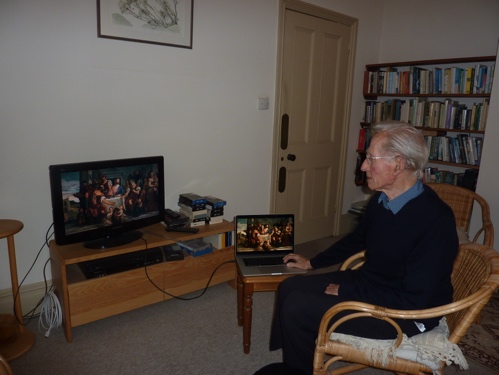
- Bear in mind, too, that modern technology allows you to mirror your display on a larger screen by connecting to a desktop monitor or television. The images become even more electrifying! (This has become the author’s preferred mode, as the photograph shows.)
Finally, here are two simple tips for troubleshooting if you should meet any problems when viewing the lectures in the way just described. In order:
Double check that Zoom is set to 100% and your window to Full Screen.
Reload the page.
Envoi
We will always be glad to receive feedback of any kind—in particular, suggestions for improvement. (Please note that all the maps will soon be redrawn by a single hand in uniform style, and that we are exploring ways of providing recordings of the text.)
Return to the home page and choose your first destination here and now.
Buon viaggio!
Patrick Boyde, Cambridge, August 2026