Handel’s Ariodante
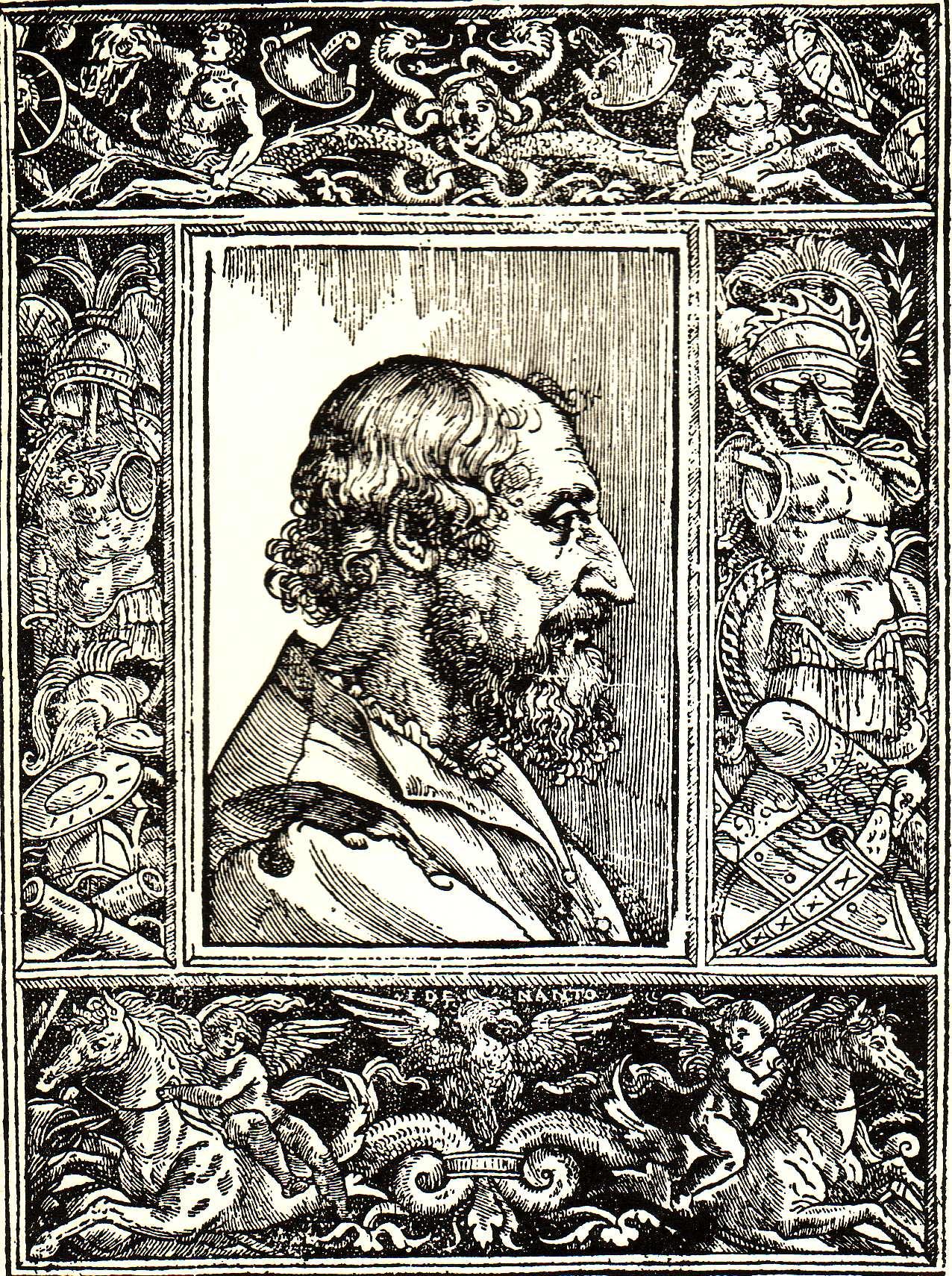
Ariosto was forty-two when he published the first edition of Orlando furioso, he was forty-seven at the time of the revised second edition, and still in his fifties when the third definitive edition appeared in 1532, not long before his death. It was an instant and enduring success all over Europe. If a young English nobleman in the eighteenth century took Italian lessons in preparation for his Grand Tour, it is more than likely that a tutor would have let him cut his teeth on the poem, knowing he would find it hard to put down.
Handel turned forty-seven in the year 1732. During the next three years, he composed no fewer than three operas to libretti derived from Orlando furioso—three of the very last, and three of the very best—Orlando (premiered 1733), Ariodante (January 1735), and Alcina (June 1735). Unlike the general public in London, Handel knew Italian very well, having spent three years in Italy as a young man; he had set a great many texts in the language, and set them very expressively and idiomatically. So, although he took his three libretti off the peg (they had been published up to twenty-five years earlier), it is at least possible that his choice was a conscious act of homage, perhaps following a re-reading of the Furioso when he was the same age as its author had been.
I do not want to labour that point, though, because at a deeper level, there is a real congeniality between the two—between Handel’s music of any period and Ariosto’s poem as a whole—which would exist whether or not Handel had ever read a word of the poem in the original.
Orlando furioso is a very long poem (40,000 lines) and you cannot understand the implication of its title unless you realise that it began life as the completion of another man’s equally long poem, left unfinished at its author’s death, the title of which was Orlando innamorato—Roland in Love. In its day, that had been a challenging title, for it told the audience that the author, Boiardo, was consciously trying to unite two literary traditions: the courtly romance, most closely associated with the court of King Arthur, and the chanson de geste, most closely associated with the court of Charlemagne. The romances had gone upmarket and become refined, idealising the emotions of love and appealing to a female audience. But the chansons, particularly in Italy, had gone downmarket, to the city square, and were concerned chiefly with fighting: at their lowest ebb, they were as full of joyous clichés as football reports in the popular press today.
Ariosto’s title was equally programmatic. He took the transformation of Roland into a courtly lover to its logical conclusion: just as the Arthurian knights Lancelot and Yvain had run mad for love, so now will Roland. But the adjective Ariosto chooses to describe his hero’s madness, furioso, rather than matto or impazzito, is also a pointer to an even greater ambition. He was consciously trying to write the perfect poem. In content, construction and style, he was trying to blend the best of Arthurian romance and the best of Carolingian epic with the best of classical poetry—Homer, Virgil, Ovid, and ancient tragedy. His title is by way of a homage to a play by Seneca, Hercules furens, and he duly appealed to Apollo for inspiration—or, rather, for a better set of tools: for the time being he will chip off rough flakes with his inept chisel, but if the god will grant him better instruments, fit for carving stone of this quality, he will labour until he has set down his beautiful images in a work of perfection:
Se instrumenti avrò mai da te migliori,
atti a sculpire in così degna pietra,
in queste belle imagini disegno
porre ogni mia fatica, ogni mio ingegno.
Levando intanto queste prime rudi
scaglie n’andrò con lo scarpello inetto:
forse ch’ancor con più solerti studi
poi ridurrò questo lavor perfetto.
(Orlando Furioso, III, 3–4)
Now, among the features of the medieval past that Ariosto was bringing ‘to perfection’ was the construction of what came to be called the ‘serial story’, which involved the ‘interlacing’ of a huge cast of characters in a plot with many strands. Merely outlining the adventures of Orlando himself, the eponymous hero, in order to show what the librettist of Handel’s first ‘Ariosto opera’, Orlando, had taken over, omitted and changed, would take a dozen pages. The task would be simpler in the case of Alcina, however, because the enchantress and her island form just one, more or less self-contained episode, and because most people would be generally familiar with the plot since is modelled on the events on Circe’s island in the Odyssey.
In the case of Ariodante, comparing the libretto with the poem is both easier and more challenging. It is easier, because the librettist was adapting a self-contained short story, coming early in the poem, only very loosely linked to the main strands in the plot, and containing two very strong scenes which catch the imagination and ought to transfer well to the stage: the preparations for the Tournament in Act 3 of Handel’s opera, and the sinister, nocturnal ‘play within a play’ in Act 2.iii. Similarly, everyone can relate immediately to the central figure of an innocent heroine unjustly accused of unchastity, if only because she reminds us of no fewer than four Shakespearian heroines, Desdemona, Imogen, Hermione and, of course, Hero, in Much Ado about Nothing, whose story is in fact an adaptation of this same episode in Orlando furisoso.iv
My task is made more challenging, though, since in Ariosto the chief interest of the story lies in the psychology of Ariodante and two other male protagonists, and even more, in the psychology of the heroine’s treacherous confidante, who tells most of the story in her own words. Also, about one tenth of the story (a hundred lines out of a thousand) is given over to Ariosto’s extremely enlightened reflections about sexual morality and the nature of justice—reflections inspired by a country like medieval Scotland, where, so Ariosto could believe, women could be condemned to death for fornication, and where Trial by Ordeal was still a possibility.
In the libretto, the centre of gravity has shifted towards the emotions, especially the plight and emotions of the heroine. The English translation of the libretto in 1735/6 specifically remarks: ‘the Foundation of this Story…taken from the fifth Book of Ariosto…is somewhat alter’d to give the greater force to the Passions of the Actors’. This is perhaps the best moment to explain that our libretto is a simplification of an existing libretto, written in 1708 by a minor poet called Antonio Salvi, and twice set to music by other composers before Handel. Salvi’s title, quite rightly, was not Ariodante, but Ginevra principessa di Scozia.
Let me sumarise, now, just how much from the Furioso does survive in the libretto. All six main characters are in the poem, and all have the same names. Ariodante is specifically an Italian knight who has made good in Scotland and won the heart of Ginevra, daughter of the King (who is unnamed). Ariodante has a brother called Lurcanio, a good man whose impetuosity, in both versions, precipitates the crisis. Ginevra has a lady-in-waiting called Dalinda, who has been seduced by the villain of the piece, Polinesso, Duke of Albany (in Ariosto, he is remarkably like Iachimo in Cymbeline), who wants to marry Ginevra not so much for love of her beauty as because she is the likely heiress to the throne. The only additional character in the libretto is that of the second tenor, Odoardo.
Turning now to the events in the story, the events at its heart—the unceremonious rejection of Polinesso by Ginevra, and his successful ‘staging’ of the famous scene at the bedroom window, where Dalinda disguises herself as her mistress in order to convince Ariodante (hidden in the garden) that Polinesso is Ginevra’s accepted lover—these are at the core of the story in the poem as well. So too is Ariodante’s despair at what he thinks he sees, his disappearance, and the report of his suicide, followed by Lurcanio’s denunciation of Ginevra; and also her condemnation (by her most unwilling father) to a Trial by Ordeal, such that her innocence or guilt will be established by the result of a joust to the death in a tournament. The final point in common is the appearance, on the day of the tournament itself, of an anonymous champion to fight on Ginevra’s behalf—a champion who will prove to be Ariodante.
It is clear, then that quite a lot of Ariosto’s story survives in the libretto, especially if you remember the degree of licence which writers of the period allowed themselves in adapting their sources, even when the story was as familiar to everyone as those of Oedipus and Phaedra. It is also true that some of the differences in the detail of the plotting are more or less inevitable in the drastic reduction required for the three short acts of an opera of a long episode in a narrative poem, where most of the story is told in flashback by one of the people involved, Dalinda, and, moreover told by her to one of the greatest paladins at the court of Charlemagne, Rinaldo, who will in consequence take upon himself the task of preventing the trial by ordeal and/or of killing the accuser.
Rinaldo, self-evidently, could not be included; and his exclusion led to some obvious, more or less ‘knock-on’ changes in the role of Ariodante. In the poem, Ariodante is little more than a naive, self-doubting idealist, who believes too easily, despairs too easily, attempts suicide and, despite his good intentions to make amends, arrives at the scene of the tournament after the action is over. In the opera, he becomes more active, and, to put it very simply, justifies his role as the eponymous hero by taking over the tasks performed by Rinaldo (at the Tournament, he turns up in good time, and, earlier, it was he who saved Dalinda from her attackers).
I have taken the trouble to clarify the libretto’s relation to its source; because if the opera inspires you to read some Ariosto, you could not do better than to start with the relevant cantos in Orlando furioso (namely, the end of canto 4, the whole of 5, and the beginning of 6: a total of 124 stanzas in octave rhyme), because the author is at the top of his form, and because the episode give a very fair idea of the whole poem (which is forty times as long).
For the second half of this lecture, I will focus on the resultant libretto in itself, looking at it, first, simply as a work for the stage (or, anachronistically, as a work for television or film), and finally as a vehicle for music (dramma per musica). There is not space here, though, to distinguish between the 1708 original and the cut-down revision of the text for Handel’s opera in 1735, where the dialogue was reduced by more than half, and quite a lot of changes made in the texts and distribution of the arias.
Salvi did an excellent job in recasting the material to form three unified acts, although I suppose that the third act simply had to end with the Tournament, and the second act had to contain the scene at the bedroom window overlooking the garden (where Ariodante sees Dalinda impersonating Ginevra and receiving Polinesso as her lover), which means therefore that, in the first act, Salvi more or less had to introduce the main characters, their personalities, and their relationships, by inventing short scenes of his own, all with direct representation, without narration, and certainly without use of flashback by Dalinda.
In its details, then, Act 1 is quite independent of its source in Ariosto’s poem; and its first scene unfolds miraculously well. Without a syllable of recitative, Ginevra’s first aria, just three lines of verse, immediately establishes her as a princess—innocent, feminine, deeply in love, happy. In a rapid exchange with Dalinda, her companion, it then emerges that her father approves of her lover (unlike most operatic fathers). When Polinesso bursts in to declare his passion for her, she rejects him out of hand in a second aria which establishes her as feisty and accustomed to be obeyed. She stalks off, as well she might, leaving Polinesso in the company of Dalinda, whose love for him is revealed through a consoling aria in which she alludes to the possibility of ‘other people’, perhaps, not being indifferent to him. After which it is natural, vraisemblable, for her to modestly withdraw, leaving him plausibly (vraisemblablement) alone on stage, where, there and then, he begins to formulate his wicked plan, going on to pat himself on the back (and to alienate the audience) in a cynical soliloquy in which he muses on the niceties of language which allow us to call ‘manly prudence’ in a toff what would be called ‘cheating’ in an ordinary working man.
The second scene of Act 1 is set outdoors—in what will later prove to be the fateful garden of the palace—and Salvi continues the good work. Like Ginevra, Ariodante launches immediately into an aria, just three lines again, communing with the stream and the breeze about his love (a cue for a lovely pastorale, which Handel will not miss). He is joined by Ginevra for a short duet—if only conventions had allowed more duets!—in which the pair pledge their troth. As she starts the reprise, they are interrupted by the king, who does not banish the young adventurer, but confirms him as heir to the throne, proposing, indeed, to hold their wedding on the following day—a situation that allows Ginevra to sing of her joy in a third aria.
And so the act goes on from strength to strength, the characters coming to life and the story getting underway all at the same time. Salvi and his unknown abbreviator in London (possibly Angelo Cori, or Paolo Rolli) were consummate professionals. (It compares very favourably indeed with the typical first act of a typical French tragedy). Of course, if you read the libretto with the poem alongside, it will seem scrappy, gabbled—even garbled. But you have remember to judge the words on the page as you would those of a screenplay for a film, or the script of a television adapation of a novel. A craftsman like Andrew Davies, who can strip nearly a thousand pages of Middlemarch down to six episodes for television, knows how to get a chapter of historical background into the costumes, a page of authorial analysis into the shifty expression of a listener, and a paragraph about a hero’s misgivings into a single line of hesitating dialogue; always keeping in mind how much information will be conveyed by the actors, thanks to close-up camera work, by a downward glance or the lift of an eyebrow. In short, the scriptwriter is doing his or her job best when they seem to have left everything to the actors and the director. A script-writer is, and should be, a facilitator.
The job of a good librettist is to provide opportunities for music. To quote again from the 1735 English wordbook: ‘the Foundation of this Story is somewhat alter’d…to give a more extensive Field of Variety to the Musick’. I am reminded of a passage in a poem by Rilke, on which I once gave a lecture, in which says he hates the ‘half-filled masks’ of actors in the ordinary theatre. He would rather have a puppet:
Ich will nicht diese halbgefüllten Masken,
lieber die Puppe. Die ist voll. Ich will
den Balg aushalten und den Draht und ihr
Gesicht aus Aussehen. Hier. Ich bin davor.
…
Ich bleibe dennoch. Es giebt immer Zuschaun.
(Rilke, Duineser Elegien IV, 26–29 & 36)
It is ‘full’ even though it is a lifeless skin (Balg), with a fixed expression on its face at the end of its wire. He is prepared to go on waiting until an angel will swoop down, seize the wire, and twitch the puppet to life:
Hab ich nicht recht…wenn mir zumut ist
zu warten vor der Puppenbühne, nein,
so völlig hinzuschauen, daß um mein Schauen
am Ende aufzuwiegen, dort als Spieler
ein Engel hinmuß, der die Bälge hochreißt.
Engel und Puppe: dann ist endlich Schauspiel!
(Ibid., 52–57)
** TOM. WE’LL COPY IN MY OWN TRANSLATION FROM THE PUBLISHED VERSION
Handel will be the ‘Engel…der die Bälge hochreisst’. That line could, of course, be applied to any opera in any period, but in Italian opera of the early 18th century, the musical conventions tied the librettist down even more tightly. The London patrons gave huge subventions, and the London public bought expensive tickets, in order that they might hear great virtuoso singers in individual arias designed to show off their voices and technique. A company of four to six highly paid singers would be assembled for a season, their pecking order being a matter of the utmost importance. If there were to be five arias for Signora Ancona, there would have to be four for Signora Bologna, four for Signor Domodossola, and three for Signor Empoli.
It was an important part of the librettist’s job to make sure the plot unfolded in such a way as to give the requisite number of opportunities for each singer (and, as I hinted, the London revisor of Ariodante had quite a bit of extra work to do in order to meet the particular needs of Handel’s cast). Most arias had to be in two contrasted sections, and it was almost impossible for these da capo arias to carry the action forward, given that the music—and the words—of the first section had to be repeated before the second, and repeated again—da capo—at the end of the second, at which point the singer had to leave the stage.
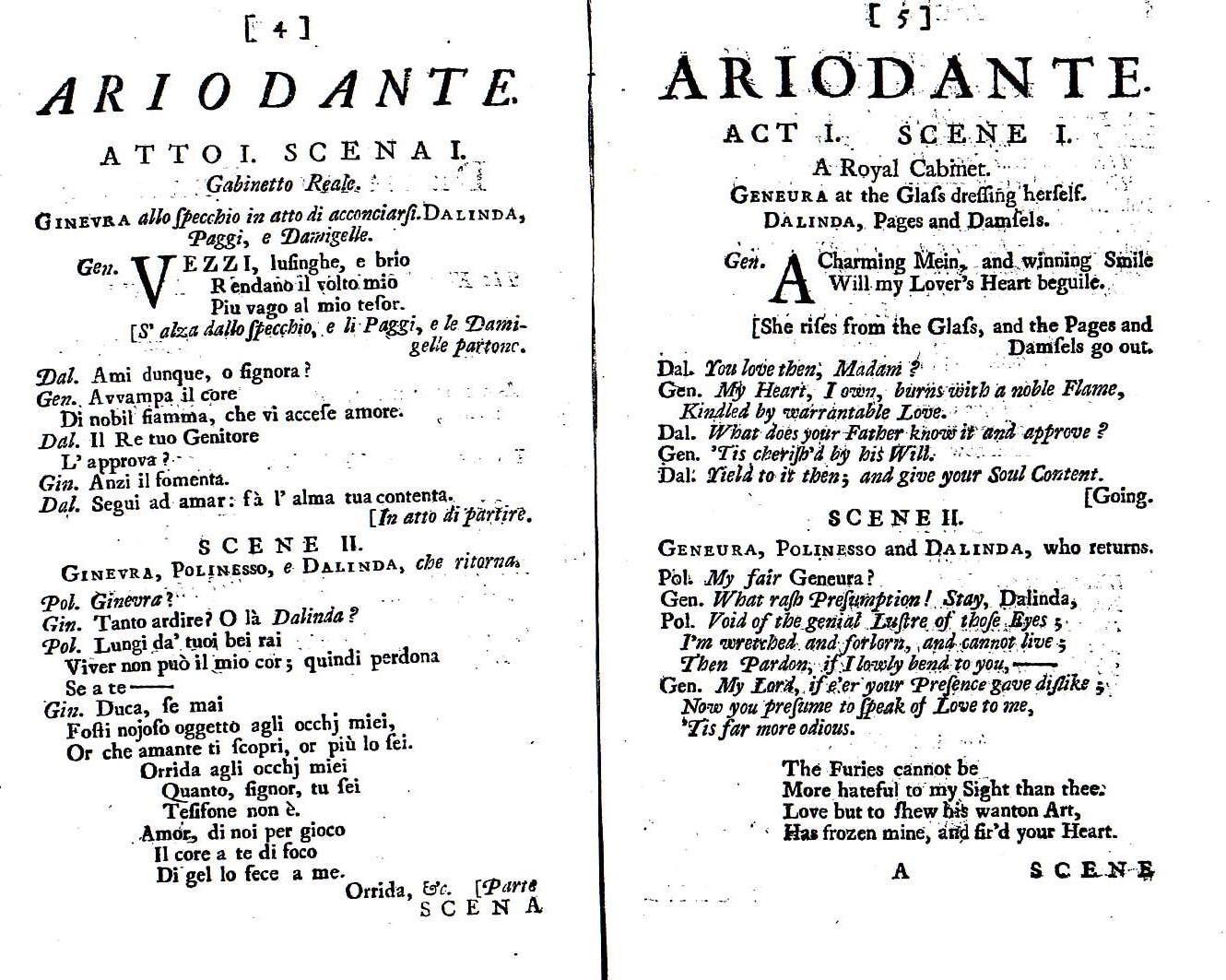
The texts of all arias were very brief, an average of three short lines per section, sometimes barely more than a haiku in length, as is the case in Ginevra’s opening cavatina:
Vezzi, lusinghe, e brio
rendano il volto mio
più vago al mio tesor.
(Ariodante, Act I, Scene 1)
It was no use choosing and organising words with great precision and subtlety, given that the composer allowed himself to repeat words within the same musical phrase, and to decorate individual syllables with runs and ornaments. In some cases, it is scarcely an exaggeration to say that all the librettist absolutely had to provide was just one emotive word in each section of an aria, in order to tell the composer roughly what kind of music was intended—an allegro or adagio; a tempo di gavotta or tempo di sarabanda—and in order to justify the modulation in the second melody:
Orrida e gli occhi miei,
quanto, Signor, tu sei
Tesifone non è!
Amor di noi per gioco
il core a te di foco
di gielo fece a me.
(Ibid., Act I, Scene 2)
In the opening arias for example—illustrated by Ginevra’s first da capo aria above—the key words are ‘Horrible’, ‘Fire’ and ‘Ice’; and similar examples occur later in the libretto:
Qui d’amor nel suo linguaggio
parla il rio, l’erbetta e’l faggio
al mio core innamorato.
(Ibid., Act I, Scene 5 [Ariodante’s first arioso])
Neghittosi or voi che fate?
Fulminate
cieli, omai sul capo all’empio!
(Ibid., Act III, Scene 2 [Dalinda’s aria (A)])
Given the structure of the Italian language, it was easy to provide singable syllables—each syllable beginning with a consonant and ending in a pure vowel—for the first two of the three lines, but it was not easy to provide a naturally strong, stressed syllable at the end of the last line, that is, at the end of each tiny strophe. You can usually tell whether or not a piece of Italian verse was written to be set to music by the presence, or absence, of the ‘truncated’ or ‘cut-off’ rhymes, rime tronche, lacking the normal unstressed final syllable:
Innamourati dispersi, gementi il core e l’augello,
languori del Giordanello in dolci bruttissimi versi:
…Caro mio ben
credimi almen!
Senza di te
languisce il cor.
Il tuo fedel
sospira ognor,
cessa crudel
tanto rigor.
(Guido Gozzano, L’amica di N S)
I have chosen as my example, not Ariodante, but the ‘dolci bruttissimi versi’ quoted a hundred years ago, with ironic affection, by the Turinese poet Gozzano, from an aria actually written about forty years after Ariodante; Giordanello (Giuseppe Giordani) was in London in the 1770s.
In theory, the librettists did have a chance to seize the initiative and dictate at least the time signature to the composer, because they could and did vary the length and, therefore, the character of the line of verse. On the one hand, they could choose lines of six, eight or ten syllables (which all have a dactylic rhythm in Italian versification), as in Ariodante’s first arioso, which we have already seen, or in Polinesso’s aria (A):
Coperta la frode
di lana servile
si fugge e detesta
e inganno s’appella.
(Ariodante, Act I, Scene 4)
Or, on the other hand, they could choose lines with five or seven syllables, where the rhythms are more flexible, but where the words are more likely to suggest either four beats to the bar, or a dotted 6/8:
Apri le luci e mira
gli ascosi altrui martiri,
v’è chi per te sospira,
e non l’intendi ancor.
(Ibid., Act I, Scene 4 [Dalinda (A)])Del Fato più inumano
il barbaro rigore,
mai così bell’ardore
estinguer possa in me.
(Ibid., Act I, Scene 5 [Ariodante and Gievra (a Due)])
I stress ‘in theory’, because in practice, no librettist could dictate to a composer like Handel, who could set any verbal rhythm to any musical shape. Let me summarise, then, with a parody the title of the film by François Truffault: Ne tirez pas sur le librettiste. The librettist was a dogsbody, and it was often a ‘dog’s life’—and yet, every dog has his day, and the scriptwriter had his moments of glory, at least on the nights of the performances (often very few).
The fact that not even an Italian audience could understand all the words meant that, from the very beginning of the history of opera, back in 1600, libretti had been published beforehand, elegantly, as plays in their own right. In England, the Italian texts were published with a facing verse translation, and the audience clearly did buy and follow the wordbook during performance.
The descriptive or novelistic parts of the play—stage directions, the evocative descriptions of the scenery, and in many cases description of spectacular stage effects, were given in full in the libretto. And, if an angel swoops down on your puppet (‘ein Engel, der die Bälge hochreisst’), if you are lucky enough for your words to be set by a great composer (‘Über uns hinüber spielt dann der Engel’)—then a very minor poet could gain a kind of immortality, if only as the singable syllables in his name: not ‘Do re mi Fa Sol La’, but ‘An-to-ni-o-Sal-Vi’.
NOTES
FIXME: What needs to be addressed in this lecture is the notes on this page, and everything in RED in the document (so I’ve not marked individual FIXMEs in the document)—Reuben.
Pat hasn’t looked at these yet.
- I have not included the image of the Raphael fresco, as in essay form that seems a better place to reproduce the passage from the poem. Similarly with the Fragonard image—its role is tangential, perhaps we could discuss how (if?) to illustrate the lecture/essay.
- Discuss how best, if at all, to speculate about Salvi’s abbreviator.
- I am unsure as to whether I have described ‘Polinesso’s aria (A)’ correctly in the body of the text.
- I’m of two minds as to whether the conclusion to the lecture works in a printed form; given the quotation of the apposite parts of Rilke’s elegy in-line, I have not included the final slide of lines 55–62, though it could be inserted as a postscript.
- I am slightly concerned that the abstract I have put together doesn’t fully capture the dialectical (trialectical?) relationship between librettist, composer and convention which you set out in the second half of the lecture.
- The list of Verbesserungen prefixed to the typescript of the lecture do not, I fear, give me enough to go on to make the necessary corrections/ameliorations myself. I have reproduced them below, in case you want to have them in mind as you read through my first draft:
- Albania = N. Scotland. Polinessso is ‘a Caledonian duke’.
- Antonio Salvi was a very well-known librettist, active in reform of opera in early 18thC.
- Ariodante’s first arioso CAN be called a cavatina, like Ginevra’s.
- Not a window but a door in the ruins.
- Ginevra in Act 2 has premonition, then hears of A’s death, then is accused and sentenced, then has her dreams.
- The director defended the subtlety of Dalinda (almost as though he had read Ariosto and was taking account of her psychology there).
- Mention Lurcanio X Dalinda in the list of changes.
- you must restore sentence near beginning about Roland being famous for indifference to women.