The Triumph of Poetry

The faces you are looking at are details from the frescos that Simone Martini painted in the Lower Church at Assisi around 1220, and they represent St Clare and St Martin. However, I am showing them here as a kind of virtual reality.
Simone later painted a miniature of Laura at some time in the 1340s, and although the portrait has not survived, I think we can be pretty certain that it looked something like the image above—if only because all of Simone’s women are remarkably similar, and all have more or less exactly the same mouth, no wider than the base of the nose. Similarly, if St Clare can ‘stand for’ Laura, the detail of St Martin can do duty for Petrarch as a young man. In fact, the image is particularly relevant because Petrarch tells us that he was inordinately proud of his flowing locks as a young man, and was intensely self-conscious about his premature baldness, of which we see signs in the receding temples.
Simone also painted a miniature, just under twelve inches high, as the frontispiece for Petrarch’s own copy of the commentary by Servius to the works of Virgil, which has survived. Reproduced below on the left, it too is an example of ‘virtual reality’: the shepherd with his sheep, the peasant farmer with his pruning knife and the knight with his lance ‘stand for’ the three works of Virgil, Eclogues, Georgics and Aeneid.
[FIXME: both left and right slide missing from carousel with paper placeholder in each case; find scan and insert both]
The figure on the right is Virgil himself, ‘reclining under the panoply of a broad-leafed beech’ (patulae recubans sub tegmine fagi), in an allusion to the opening of the Eclogues. But as I have already hinted, there are grounds for thinking that it may be intended as an idealised portrait of Petrarch, or at least to ‘stand for’ him.
In the context of this lecture, however, the most important figure in the picture may be that of Servius. He is the author of the commentary, but in ‘virtual reality’ he could stand for a portrait of me. His attitude captures how I see my own role: I am going to ‘draw back the veil’, show you the meaning of some of Petrarch’s poems, reveal their significance, and present to you Petrarch in his ‘true colours’, by making the case for his being the greatest lyric poet in Europe between Horace and Shakespeare.
I am not going to explore the ‘affinities’ between painting and poetry any further, however, in the ways I have been doing in related lectures; and while I shall go on using visual aids, this lecture will focus overwhelmingly on texts, not images. The main reason for this act of renunciation is that I think the art of painting took about one hundred years to ‘catch up’ with what Petrarch was doing in his portrait of Laura (as you will later see in some paintings by Pisanello and Botticelli), and about three hundred years before it could do anything remotely resembling Petrarch’s self-portrait. And so we must pass to him.
Mille trecento ventisette, a punto
su l’ora prima il dì sesto d’aprile,
nel laberinto intrai, né veggio ond’esca.
(211, 12–14)
Thirteen hundred and twenty seven, precisely
at the first hour, on the sixth day of April,
I entered the labyrinth; nor do I see where I may escape.
In the year 1327, when Petrarch was rising twenty-three, Good Friday fell on the sixth of April. Petrarch went to church in the city where he was living, Avignon, intending to fix his thoughts on his Saviour on this the anniversary of the crucifixion. However, his thoughts were inattentive and refused to be led to a better place. Instead his gaze fell on a young woman. Her name proved to be Laura—and the rest is history. It was—if we are to believe the poems, or suspend our disbelief in them—love at first sight, and love for always. His thoughts never did make the journey to that ‘better place’, and remained trapped in a ‘labyrinth’ (to use his own metaphor), from which they would never escape.
Era il giorno ch’al sol si scoloraro
per la pietà del suo fattore i rai;
quando i’ fui preso…
…onde i miei guai
nel comune dolor s’incominciaro.
(3, 1–3, 7–8)
It was the day that the sun’s rays grew dark / through pity for its Creator / when I was taken captive…and so my sufferings / began in the common grief.
Or volge, Signor mio, l’undecimo anno
ch’ i’ fui sommesso al dispietato giogo…
…reduci i pensier vaghi a miglior luogo:
rammenta lor come oggi fusti in croce.
(62, 9–10, 13–14)
Now, Lord, the eleventh year turns
since I was put under the pitiless yoke…Lead my straying thoughts to a better place,
remind them that today you were on the cross.
As you can see, all the ‘facts’ I have alluded to are given in Petrarch’s poems: his ‘sufferings’ began on the day of ‘common grief’, Good Friday, when there was an eclipse of the sun at the time of Christ’s death—his death ‘on the cross’,
as Petrarch specifies in a sonnet written on a Good Friday eleven years later.
I would like to dwell a little on the lines just quoted, because they provide some of the main themes of this whole lecture. Notice, first of all, the symmetry. The anniversary of his falling in love will always coincide with the crucifixion; his private sufferings, as a lover, with the common ‘grief’, the common ‘dolore’ of all Christendom. Then notice the opposition. Laura, from her very first appearance, is a rival to Christ; falling in love is being put under ‘a yoke’, a ‘pitiless’ yoke; the golden hair which he so often praises can also be seen as a snare, as the nets, the ‘toils’, set by the Devil. Notice the ‘labyrinth’ too, a much more satisfying and revealing image of his condition as a lover than the ‘nets’, or ‘chains’, or the ‘prison’ that he sometimes speaks of.
heu sortis iniquae
Natus homo in terris! Animalia cuncta quiescunt:
Irrequietus homo, perque omnes anxius annos
Ad mortem festinat iter.
(Africa, VI, 897–900)
How wretched is the lot to which man is born on earth; all living creatures are at rest; man is unquiet, and through all his years anxiously hastens on the journey to death.
Ecce, iam omnia tentavimus, et nusquam requies.
(Fam. I, i)
Lo, we have tried all things and nowhere peace.
Sentio tamen quia si centum adhuc annos viverem semper aliquid nescio quid deesset.
(Sen. XII, 1)
I feel that if I were to live for another hundred years, an indefinable something would always be lacking.
…sentio inexpletum quoddam in praecordiis meis semper.
(Secretum, II)
Always I feel something unfulfilled in my heart.
un lungo error in cieco laberinto
(224, 4)
A long straying in a blind labyrinth.
Petrarch is very far from being immobile in his bondage: he is homo irrequietus, who has ‘tried all things and nowhere found peace’, who feels ‘something unfulfilled in his innermost being always’. Whereas a Dante will travel in a straight line, through a series of new experiences and discoveries towards a final goal and a resolution, Petrarch is forever running round and round the same paths in the labyrinth, never in quite the same sequence, often making some new discoveries, but with no real hope of his finding a way out: that is why he called it a ‘long straying in a blind labyrinth’.
Above all, notice the most unusual insistence on the year, the month, the day and the hour. If Petrarch had spoken simply of Good Friday, he would have been at once in time and out of time. The Feasts and Festivals change, but recur year by year, always the same. They belong to the experience of Everyman; to liturgical time, or to cyclical time. But with that insistence on the particular date, Petrarch locates himself and his experiences in history, in linear time. What he describes and analyses in his poems is not simply the archetypal experience of any lover, and every lover. It is his experience, unique and unrepeatable, no sooner lived, than irrecoverably past and lost—except in so far as it can survive for a limited period of time in his memory.
S’al principio risponde il fine e ’l mezzo
del quartodecimo anno ch’io sospiro
(79, 1–2)Fuggir vorrei, ma gli amorosi rai,
che dì e notte ne la mente stanno,
resplendon sì ch’al quintodecimo anno
m’abbaglian più che ’l primo giorno assai,
(107, 5–8)Rimansi a dietro il sesto decimo anno
de’ miei sospiri, et io trapasso inanzi
verso l’estremo…
(118, 1–3)Dicesette anni à già rivolto il cielo
poi che ’mprima arsi…
(122, 1–2)e son già ardendo nel vigesimo anno.
(221, 8)sai che ’n mille trecento quarantotto,
il dì sesto d’aprile, in l’ora prima,
del corpo uscio quell’anima beata.
(336, 12–14)
You know that in thirteen hundred and forty eight,
on the sixth day of April, in the first hour,
that blessed soul departed from the body.
FIXME: Add translations for the other extracts?
I have collected these references to the passing of time from the Canzoniere—all built into the poems themselves, as you can see—because Petrarch’s sense of time is an essential ‘fourth dimension’ of the experiences he records. He is looking back to the beginning of his love after fourteen, fifteen, sixteen, seventeen years have passed, and then again after twenty—by this time we are in the year 1347. The labyrinth is the same, the prison is the same, but the prisoner is growing old—and knows he is growing old. Yet even linear time allows the formation of patterns.
![Figure 2: (P_Po_3) Petrarch’s copy of Virgil. [FIXME: or is this the holograph of the Triumph of Eternity intended for Fig 4? The hand is obviously hard at this size, but I can make out ‘Qual’ at the start of a line in the main body, suggesting it’s Italian…]](media/image2.jpeg)
Laura’s death occurred in 1348, which Petrarch recorded at the time in this note in his copy of Virgil. In a very late sonnet, quoted above, we are told that it fell on ‘the sixth of April at the first hour’, exactly twenty-one years after he had first set eyes on her—to the day and the hour, ‘the time and the hour’ he had always ‘praised’.
[FIXME: The slides with the ‘date passages’ appear to have also gone awol, and the relevant excerpts definitely need inserting here]
I pass now to another very important aspect of Petrarch’s awareness of time. Both his poems and his Latin works reveal an extraordinarily acute, even morbid, sense of the speed of time, the rush of time towards death:
Eraclitus ait: ‘in idem flumen bis descendimus et non descendimus’…Hominis autem etsi parumper occultior, nihil tamen moderatior fuga est. Fugit enim non fluminis tantum more, sed fulminis. Limus et umbra tenuis et fumus Euro volvente rarissimus; nullum tam breve momentum est quod non aliquid vitae detrahat…praecipites agimur, nec sentimus…
(Rerum memorandarum, III)
Heracleitus says: “We can and yet we cannot go down twice into the same river”. Man’s flight is less perceptible but no more restrained. It flies not like a river (flumen) but like lightning (fulmen). We are earth, a tenuous shadow, the finest dust in the swirling wind; there is no moment so brief that it does not subtract something from life; we are driven on headlong and yet unaware.
In his Italian poetry the theme finds expression in passages like the opening of this sonnet, written when he was in his fifties:
I dì miei più leggier che nesun cervo
fuggir come ombra, e non vider più bene
ch’un batter d’occhio e poche ore serene
ch’amare e dolci ne la mente servo.
Misero mondo. Instabile e protervo!
(319, 1–5)
My days, swifter than any deer,
fled like a shadow; and saw happiness no longer
than the twinkling of an eye, and but few calm hours,
which I store in the mind, at once bitter and sweet.
Wretched world, unstable and wanton!
However, it had already found dramatic expression in poems written before he was thirty-five:
Quanto più m’avvicino al giorno estremo
che l’umana miseria suol far breve,
più veggio il tempo andar veloce e leve
e ’l mio di lui sperar fallace e scemo.[^12]
(32, 1–4)
The nearer I draw to that final day
which makes human wretchedness of brief duration,
the more lightly and swiftly do I see time pass,
and the more deceptive and short-lived my hopes in it.
Petrarch certainly believed in personal immortality and in eternity. Only days before his death, he was at work on a poem entitled the Triumph of Eternity, shown below in a lovely fifteenth-century manuscript, and in his own rough draft:
![Figure 3: (P_Po_4) Fifteenth-century manuscript and holograph [FIXME: uncertain about slide, insert image later after discussion] of the* Triumph of Eternity](media/image3.jpeg)
In the poem he insists that Eternity means a perpetual present, of ‘today’, ‘now’, and ‘is’, to the exclusion of ‘has been’ and ‘will be’, ‘yesterday’ and ‘tomorrow’. The hills of worldly preoccupations that prevent us from seeing the truth will be flattened in front and behind—there will be nothing to remember, and nothing to hope for.
Quel che l’anima nostra preme e ’ngombra:
«dianzi», «adesso», «ier», «diman», «mattino» e «sera»
tutti in un punto passeran com’ ombra;
non avrà loco «fu» «sarà» né «era»,
ma «è» solo in presente, ed «ora» ed «oggi»
e sola eternità raccolta e ’ntera;
quasi spianati dietro e ‘nnanzi i poggi
ch’ occupavan la vista, non fia in cui
vostro sperare e rimembrar s’appoggi;
la qual varietà fa spesso altrui
vaneggiar sì che ’l viver pare un gioco,
pensando pur: «che sarò io? che fui?»
(Trionfo dell’Eternità, 64–75)
That which crushes and encumbers our soul,
“before”, “now”, “yesterday”, “tomorrow”, “morning” and “evening”
will all pass away at once like a shadow;
there will be no ‘has been’, ‘will be’ or ‘was’,
but ‘is’ in the present only, and ‘now’ and ‘today’,
and eternity alone, undivided and entire.
In front and behind, the hills will be levelled
that possessed your sight, and there will be nothing
on which your hoping and remembering may rest;
this variety it is that makes men so often
disquiet themselves in vain, so that life seems a game,
thinking always: “what will become of me? what was I?”
But what Petrarch feels and expresses in so many poems are the vain questions of the last line in this passage: ‘What will become of me? What was I?’ His own vivid experience of the present was simply that of a dividing line between past and future, between remorse for sins of commission and omission, and hope of salvation or fear of damnation; a dividing line that was never still, but always rushing towards the moment of his own personal extinction.
All these themes find their simplest and most beautiful expression in the opening of the sonnet, La vita fugge:
La vita fugge e non s’arresta un’ora,
e la morte vien dietro a gran giornate,
e le cose presenti e le passate
mi danno guerra, e le future ancora…
(272, 1–4)
Life flies, and never halts for a single hour,
and death comes behind with forced marches,
and things present and things past
assail me, and things future as well…
Since I wish to talk here about Petrarch’s poetry, I am going to say very little about his life and times as they are recorded outside his poems; but given that I want to lay such emphasis on the uniqueness and particularity of Petrarch’s experience, and on his own awareness of time, it would perhaps be amiss not to remind you of the main facts, and of the context in which he lived and worked. He was born on 20th July 1304, and died just two days before his allotted three score years and ten on 18th July 1374. His lifetime coincides, more or less, with the reigns of our Edward II and Edward III; conjuring to mind Bannockburn, the Black Prince, and the Black Death (which carried off Laura). He was forty years younger than Dante, the same age as Boccaccio, and forty years older than Geoffrey Chaucer, who was born in 1340. I mention Chaucer because it was he who made the first English translation of a Petrarch sonnet, which we shall glance at later on, and his Clerk’s Tale is a version of Petrarch’s Latin translation of the story of Griselda from the Decameron (it is curious and interesting that Chaucer never mentions Boccaccio by name).
In Petrarch’s lifetime, the Popes, French to a man, had moved the seat of the Papacy into Southern France, to Avignon. This explains why Petrarch’s father, a lawyer, should have moved from Arezzo, where Francesco was born, to the town of Carpentras, near Avignon, when the boy was only eight years old. It is important to remember that Petrarch grew up in Provence; and although he studied law in Bologna in the 1320s, his permanent residence was in Provence until he was nearly forty years old. He did not finally abandon his home there until 1353, when he was nearly fifty, having accepted in that year an offer of hospitality from the rulers of Milan, the Visconti. He remained in Milan from 1353 to 1361, and then spent his last twelve years between Pavia, Venice and Padua.
[FIXME: slides of drawing, and of fresco, both missing, in each case replaced by paper placeholder—find, scan and insert both.]
It was in Padua that he was drawn by Altichiero, who then twice used his drawing for the face of a bystander in two of his frescos in the Oratory of St George, the first of which is also reproduced above. You can still visit his country house near Padua at Arquà, and it is there that you will find his tomb.
So, what did Petrarch do, and how did he earn a living during those fifty years in Provence and twenty years in Northern Italy? The answer is that he was a scholar, a writer, and a man of letters of almost incredible industry and productivity. He took holy orders when he was twenty-six, and this enabled him to enjoy the income from various sinecures, which you should think of sympathetically as equivalent to the scholarships or fellowships that a modern Petrarch would receive from colleges or charitable foundations.

He wrote many Latin poems, including the Virgilian Eclogue pictured above, and an unfinished Virgilian epic, Africa, telling the story of Hannibal and Scipio. In Latin prose, he wrote biographies of famous men, a treatise in praise of the solitary life, a blistering invective against the universities of his day, and hundreds and hundreds of letters, to friends and eminent people, including epistles to great men of the past like Cicero and Virgil, and one addressed to us, ‘posterity’.
It was these Latin writings that brought him fame in his own time; and for which—so he tells us, although there is no independent record—he was crowned in 1341 as Poet laureate by the King of Naples, Robert. In the judgement of ‘posterity’, however, the chief reason for honouring his name remains his lyrics in Italian—366 in all, one for every day of a leap year—which he wrote and rewrote, and ordered and reordered, leaving a perfect fair copy of the final redaction of which almost a third is in his own hand. These are his Fragments of Vernacular Things, or Scattered Rhymes (as he called them), which make up the Book of Songs, or Canzoniere, as the collection came to be called.
I must also mention one other group of ‘short long poems’—written in Italian, in terza rima, like The Divine Comedy—which were composed at intervals from 1338 until his death, since it was these that suggested the title of my lecture. They are the ‘triumphs’. First, the Triumph of Love, describing the victories of Cupid over many famous men and women. Then the Triumph of Chastity (of Laura and others, over Love); and in this wooden panel in the National Gallery you will see that Cupid’s arrows are aimed at her in vain:
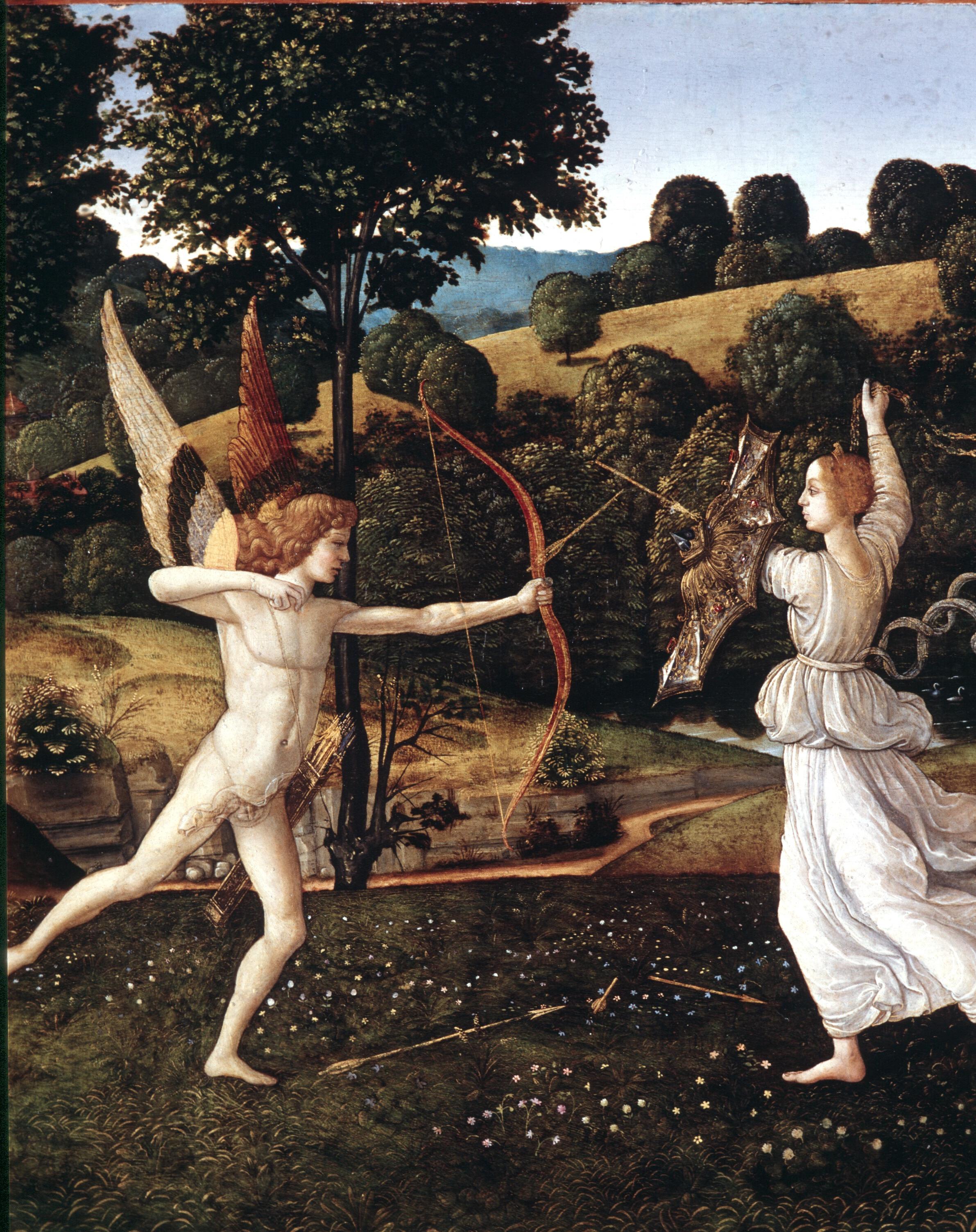
Then came the Triumph of Death (over Laura); then the Triumph of Fame (conquering Death); then the Triumph of Time (which obliterates all records, all ‘fame’); and, last, the Triumph of Eternity over Time—as it were, the Redemption of Time. You will see, though, that my title—the ‘Triumph of Poetry’—is my own invention; and I shall not talk about the real Triumphs any more, even though they were much admired in the Renaissance.
Instead, let us return to the Canzoniere, and begin to ask ourselves what his poetry means to us, and what it meant to him. We can give one important part of that answer immediately: poetry gives pleasure, instinctive pleasure, pleasure in sounds and intricate formal patterns enjoyed almost for their own sake. Petrarch tells us:
Siquidem, ab ipsa pueritia…ego libris Ciceronis incubui…Et in illa quidem aetate, nihil intelligere poteram, sola me verborum dulcedo quaedam et sonoritas detinebat.
(Sen. XV, 1)
*From my boyhood I poured over Cicero’s writings. At that age I could understand nothing but was held by a certain sweetness of the words alone, and by their sonority.
This is no bad way for us to come to his verse the first instance. More evidence of this instinctive pleasure comes from the drafts which have survived for some of the poems. Petrarch makes little jottings in the margins, short phrases in Latin such as: ‘Wait; put this another way; I don’t like this’. And then, when he hits upon the phrase he wants, he uses the formula that we still use in Cambridge to despatch University business: Hoc placet. Or once—and it is very revealing—‘I like this because it’s fuller in sound, hoc placet quia sonantior.
I shall go on to make more serious claims for Petrarch’s poetry, but I hope you will not forget Petrarch’s simple and intuitive satisfaction with the rhythm and sound that are right. It is abundantly clear, from these same ‘working’ manuscripts, that for Petrarch poetry was a craft, and that he deliberately drew, in a creative way, on his intimate knowledge of the classical Roman poets and of the more recent love poetry in Provençal and Italian. His drafts also show that almost all his most characteristic effects were ‘worked for’. His methods were in fact very close to those of a Renaissance artist. One can find analogies to a painter’s rapid preliminary sketches (involving borrowings or ‘imitations’ from earlier masters), a careful drawing, showing the fall of light and the modelling, long and patient brushwork on the canvas, layer by layer, glaze by glaze, to produce a superbly finished and durable product—including quite a number of pentimenti at the last moment.
One concrete example is the sestet of the sonnet Aspro core e selvaggio. A note on the first manuscript tells us that he wrote it at three o’clock on September 21st, 1350:
1350, septembris 21, martis hora 3…propter unum quod legi Paduae in cantilena Arnaldi Danielis: «Aman, preian, s’afranca cors ufecs».
21 September 1350, Tueday, 3 am…inspired by a line in a canzone by Arnaut Daniel that I read in Padua: ‘By loving and entreating a proud heart is tamed’.
Notice the precision, and remember also that Laura had been dead for two years by then. He tells us he wrote it ‘because of a line’ he had admired in a poem by Arnaut Daniel, ‘Aman, preian, s’afranca cors ufecs’, which translates as ‘by loving and entreaty a proud heart is tamed’. Now a proposition like that must clearly come at the end of a poem, so Petrarch composed the octet of the sonnet on the theme of his lady’s cruel heart (‘aspro core’), and these first eight lines came out almost without corrections. What gave him trouble was the passage from the opening to the conclusion, even though he clearly had it in mind from the outset to use the example of drops of soft water wearing away hard stones in the course of time. We have five ‘first attempts’:
- sol una speme mi fa viver quando / poco umor vidi romper pietre salde
- penso ch’io vidi già continuando
- penso che già per importuna piova / poco umor vidi romper pietre vive e salde
- Speranza mi fa viver…
- Vivo sol di speranza ripensando / che già per lunga e per continua prova / poco umor vidi romper pietre salde
Eventually he got the transition right, or at least to his satisfaction, but only at the sixth attempt:
Vivo sol di speranza, rimembrando
che poco umor già per continua prova
consumar vidi marmi e pietre salde:
non è sì duro cor che lagrimando,
pregando amando, talor non si smova,
né sì freddo voler, che non si scalde.
I live by hope alone, remembering
that I have seen a little water by unremitting trial
wear away marble and the hardest stones.
No heart is so hard, that it will never yield
to tears, love, and entreaty;
no will is so cold that it will not grow warm.
More importantly, you can see how he has transformed Arnaut’s line in the final tercet, where I have italicised the words that correspond to his model. First, he has expanded and broken it down into a pair of similar propositions—‘non è sì duro cor’, ‘né sì freddo voler’—thus producing his usual asymmetrical balance or equilibrium. Then to Arnaut’s two gerunds, loving and entreating (‘amando, pregando’), he has added a crucial third, weeping (‘lagrimando’), which makes it far more Petrarchan and gives a far more satisfying climax. Petrarch had a great deal to say about the practice of literary ‘imitation’, or what has come to be called ‘intertextuality’. He insisted that it was good and necessary, provided always that you took over the idea, and not the actual words, and that you aimed at a family likeness, as between father and son, rather than a complete identity. One should work like the bee, and from the nectar and pollen of many flowers, make one’s own honey. This otherwise unremarkable sonnet is just one example of that process of ‘mellification’, as I like to call it; the ‘honey-making’ which is one of the secrets of his poetry.

I move on now to another important aspect, to the figure of Laura. In the absence of that portrait by Simone, I show you here two heads by Pisanello, a portrait from the life, and an imaginary blonde Isotta in a badly damaged fresco, which were painted in the first half of the next century, but in a style that I myself find very close to the spirit of Petrarch’s poetry.
Petrarch certainly accepted what rhetoricians had laid down for centuries, that poetry is concerned with either praise or blame. In the Canzoniere, there is relatively little ‘blame’ or ‘vituperation’, and what there is, is mostly of a political kind, attacking either the corruption of the Papal Court at Avignon, or the degeneracy of the rulers of Italy. But, of course, there are a great many poems of praise: praise for the beloved, praise of Laura. As you read these poems, you will be struck by the fact that her virtues and attributes are very generic. Nevertheless, you will find that her personality is remarkably consistent; and Petrarch is particular in that, at least, for all her qualities are ‘anchored’ or ‘rooted’ in her name, which is the badge of her individuality and at the same time the clue to her nature, on the principle that nomina sunt consequentia rerum.
Among the many reasons why Petrarch’s imitators necessarily fell short of their master and model, was that their ladies inevitably had different names, that were less suggestive. For example, Boiardo, author of the best canzoniere in the fifteenth century, had to make do with Antonia Caprara, whose name he spelled out in this acrostic sonnet:
Angelica vagheza in cui natura
Ne mostra ciò che bel puote operare,
Tal che a sì chiara luce acomperare
Ogni stella del ciel parebe oscura,
Non si può aconciamente anima dura
In grazïosa vista colorare;
A voi una umiltà ne li ochi appare,
Che di pietade ogn’alma rassicura.
A che mostrare adunqua che le pene
Per voi portate sian portate in vano,
Ridendo el foco ch’el mio cor disface?
Alma ligiadra, tropo disconvene
Risposta dura a un visto tanto umano:
Aiuto adunque, o morte, qual vi piace.
[FIXME: reference needed to which work of Boiardo]*
A Laura by any other name, however, does not smell as sweet; and Petrarch will spin endless variations around that magic name. Laura is ‘l’aura’, the breeze, emblem of the spirit, of breath, of speech, of life itself; or she is ‘l’aurora’, the dawn, symbol of new life, renewal, new hope; or she is the ‘golden one’, ‘l’aurea’. Switching genders, she is gold, ‘l’auro’, emblem of all that is noble and precious; or else she is ‘il lauro’, the bay tree or laurel, evergreen, immortal, whose leaves were used to crown both conquerors and poets.
This last meaning recalls the myth of Daphne, the chaste nymph, loved and literally pursued by Apollo, and transformed into the laurel to save her from his lust. If Laura becomes Daphne, then Petrarch becomes a new Apollo, or else a rival to Apollo in his love. He praises and celebrates her too by drawing on other classical myths. Laura is Diana, the chaste huntress (and he becomes, implicitly, Actaeon); or Laura is represented as Flora, the bringer of spring and flowers; or else (and especially after her death), Laura is linked with Eurydice, so that Petrarch becomes Orpheus, ‘triumphing’ by his poetry even over death and the underworld.
In order to illustrate poetry as pure praise, we can look at the second part of the following sonnet:
Amor ed io sì pien di meraviglia,
come chi mai cosa incredibil vide,
miriam costei quand’ ella parla o ride,
che sol se stessa e nulla altra simiglia.
…
Qual miracolo è quel, quando tra l’erba
quasi un fior siede! ovver quand’ella preme
col suo candido seno un verde cespo!
Qual dolcezza è ne la stagione acerba
vederla ir sola coi pensier suoi inseme,
tessendo un cerchio a l’oro terso e crespo!
(160, 1–4, 9–14)
Love and I, both so full of wonder,
like those who have seen something beyond belief,
gaze on her when she speaks and smiles,
resembling no-one but herself. … What a miracle it is when she sits on the grass,
herself like a flower, or when she presses
her white breast against a green spray.
What sweetness it is in springtime
to see her walk alone with her thoughts
weaving a circlet for her pure and rippling gold.*
This sonnet is rather unusual, however, in that we are being asked to imagine Petrarch as being there, in the actual presence of Laura. Far more often, the Laura whom he celebrates is the image in his mind. It is the lover’s ‘privilege’ (as he puts it with an allusion to Virgil’s Dido), that he can ‘see’ and hear the beloved even in her absence:
…insigni quodam et vulgato amantium privilegio
– ‘absentem absens auditque videtque’.
(Fam. XII, 4, quoting Aeneid IV, 83)Dico che perché io miri
mille cose diverse attento e fiso,
sol una donna veggio e ’l suo bel viso
(127, 12–14)
I say that, although I look
at a thousand things, attentively intent,
I see only a woman, and her beautiful face.
Indeed, it is more than a privilege; often that mental image is so powerful and obsessive that it interposes itself between the brain and the eye, between the mind and the external reality of the countryside—a stream, the grass, a tree, or the clouds—as you can read in these famous lines from the canzone Di pensier in pensier:
I’ l’ò più volte (or chi fia che mi ’l creda?)
ne l’acqua chiara e sopra l’erba verde
veduto viva, e nel troncon d’un faggio,
e ’n bianca nube,…
(129, 40–43)
Many times (and who will believe me?),
I have seen her alive in clear water,
and on the green grass, and in a beech trunk,
and in a white cloud…
Perhaps most love poets would be content with that kind of ‘poetry’ and that kind of ‘triumph’: with the figure of the beloved set free from the particular, and taken in her unchanging essence into the mind, there to be further idealised, linked with myths, transformed into a many-sided symbol, and given, if not immortality, at least a monumentum aere perennius. Perhaps even to be made ‘sacred’—‘consecrata’, as Petrarch himself says in these two passages:
e se mie rime alcuna cosa ponno,
consecrata fra i nobili intelletti
fia del tuo nome qui memoria eterna.
(327, 12–14)
and if my rhymes have any power,
the eternal memory of your name
will be consecrated here among noble minds.
L’atto soave e ’l parlar saggio umile
che movea d’alto loco, e ’l dolce sguardo
che piagava il mio core (ancor l’accenna),
sono spariti, e s’ al seguir son tardo,
forse avverrà che ’l bel nome gentile
consecrerò con questa stanca penna.
(297, 9–14)
Her graceful bearing, her wise and humble speech
that came from heaven, and the sweet gaze
that wounded my heart (the wound is still there),
these have vanished; and if I am slow to follow,
perhaps it will come to pass that I shall consecrate
her beautiful and noble name with this weary pen.
‘Eternal memory of her name will be consecrated’—perhaps he will live long enough ‘to consecrate her noble name with his weary pen’. But Petrarch could not rest content with creating a devotional image, and then contemplating and worshipping it. That acute sense of the passage of time made him all too aware that Laura was a ‘cosa bella mortal’, ‘che passa e non dura’, because ‘nothing here below can give delight and endure’ (‘nulla qua giù diletta e dura’):
questa, aspettata al regno delli dei,
cosa bella mortal passa e non dura
(248, 7–8)
…this beautiful mortal creature, awaited in the kingdom
of the gods, must pass, and not endure.
Or cognosco io che mia fera ventura
vuol che vivendo e lagrimando impari
come nulla qua giù diletta e dura!
(311, 12–14)
Now I recognise that my cruel fate
> wants me to learn, by living and weeping,
> that nothing here on earth can give delight and endure.
His most famous celebration of Laura’s hair, golden, lifted and ruffled by the breeze (‘l’aura’) is a re-evocation of a beauty that has now passed away, as he reluctantly concedes in the penultimate line. And so we come to realise that the past tense of the opening verb, Erano, refers a past beyond recall: ‘Time has transfixed the flourish set on youth’:
Erano i capei d’oro a l’aura sparsi
che ’n mille dolci nodi gli avolgea…
…
uno spirto celeste, un vivo sole
fu quel ch’ i’ vidi, e se non fosse or tale,
piaga per allentar d’arco non sana.
(90, 1–2, 12–14)
Her golden hair was spread to the breeze
which curled it in a thousand sweet knots …
what I saw was a celestial spirit, a living sun:
and even if she is no longer what she was
a wound does not heal because the bow has slackened.
From Petrarch’s achievement in his portrait of Laura, half way between Duccio’s Mary and Botticelli’s Venus, with her golden hair tossed by Zephyrus, I pass now to what I regard as Petrarch’s greatest achievement as a poet, a series of self-portraits, for which the only artist who comes to mind, anachronistically, is Rembrandt. It is well known that Rembrandt painted himself obsessively all through his life, from when he was a young man until not long before his death, as in these wonderful works, both in our National Gallery:

This is a grand comparison to make, and there are some obvious objections to consider, which would require me to make to some very necessary qualifications, and in their fullest form, would take a great deal of time and space to set forth. Instead, I offer the images above as hidden persuaders, while I make five simple points.
First, it is undoubtedly true that Petrarch’s portrait is largely that of a lover, any lover or any unrequited lover, with all his absurdities, his mood swings, contradictions, and his almost masochistic delight in the torments of love; and the proof of this lies in the fact that all the main features of the portrait, together with the paradoxical images and the antithetical constructions that he used in modelling the image, were imitated by his followers all over Europe for the next three centuries. Yet—and this is my second point—unlike his imitators, and unlike most of the Petrarchists, Petrarch endured the death of his beloved; and his self-portrait includes the experience of bereavement and mourning.
Third, as we saw at the very beginning, even when Laura was alive, Petrarch had seen her as in some sense a rival to Christ. He had recognised that his cult of her, virtuous as she was, was in some sense idolatrous, leading him to eternal damnation. In other words, unlike his imitators, his self portrait is a highly critical one, full of self-reproach and self accusation, very close in tone to St Augustine’s Confessions, which was among the books he carried around with him and read most. This is made clear from the very first sonnet of the collection, in which he speaks of his ‘shame’ and ‘remorse’, and concedes that all earthly pleasures are no more than a ‘brief dream’:
Ma ben veggio or sì come al popol tutto
favola fui gran tempo, onde sovente
di me medesmo meco mi vergogno;
e del mio vaneggiar vergogna è ’l frutto
e ’l pentersi, e ’l conoscer chiaramente
che quanto piace al mondo è breve sogno.
(1, 9–14)
But now I see clearly that I have long been
the butt of common talk, and so I often
feel shame for myself within me;
and shame is the fruit of my empty words,
and repentance, and the clear knowledge
that whatever this world loves is a brief dream.
Fourth, the portrait Petrarch paints is not just of a man torn between divided loyalties, but of a man as explorer of his own nature, as an honest and unsparing critic of himself:
Quel ch’i’ fo veggio, e non m’inganna il vero
mal conosciuto…
(264, 91–2)
I see what I am doing, and I am not deceived
by an imperfect grasp of the truth…
ch’i’ conosco il mio fallo e non lo scuso
(364, 14)
I know my fault, and do not excuse it.
If you were to ask me what were the most significant features of his style, I would answer that it is not antithesis, the paradoxical similes or the oxymorons; but the little parentheses, (‘ah, che spero’), the sudden changes of perspective marked by a switch from the present tense to the past, and the self-corrections as he tries one word and then seemingly gropes for a more accurate term.
Fifth and finally, most of the objections I am considering are answered in a short paragraph by the Italian poet Ungaretti, when he was asked to say what poetry is. His words seem to fit Petrarch like a glove:
‘Poetry is certainly indefinable; but yet we know that it must satisfy two conditions. It must spring from an intensely felt personal experience, and it must carry the unmistakable signs of the author’s individuality in its expression; but it must also possess those qualities of anonymity by which it is poetry, by virtue of which it is accessible to every human being.’
So, while I admit that the self-portrait is idealised and rather generic, I still want to insist on its particularity, on its being a portrait of Franciscus, born in 1304, falling in love in 1327, losing his beloved in 1348; obsessively aware of being this man, alive and conscious at this moment, which, even as he is aware of it, has passed for ever, except in so far as it can survive, with other privileged moments, in the Memory.

Perhaps the best way to reassert the uniqueness and individuality of the portrait, will be to consider his sense of place, and its relation to that dominant sense of time. If you think back to that sonnet in praise of Laura, you will remember that the countryside, the background, was no more than a hint of an idealised landscape. Yet the fact remains that for Petrarch it was a specific landscape, and there are quite a number of poems where he introduces proper names, and describes particular features, to indicate that he is writing about Avignon and the countryside of Provence—especially the ‘closed valley’, Valle Chiusa, or Vaucluse, through which runs the river Sorga, or Sorgue. Below we have his own sketch of his country retreat at the foot of a page in his copy of Pliny; as well as a contemporary photograph of his house, which you can visit in Vaucluse as a Petrarch museum.

However, my point is not to demonstrate that Petrarch’s poetry has a sense of place. What I want to get at is that, for Petrarch, space or place exists in what I have called ‘cyclical time’: the countryside changes from week to week, and season to season, but not from year to year. When he returns, alone, to the changeless landscape—which is so closely associated with the figure of Laura in his mind that the figure and the background merge and become one, and Laura is the landscape, and the landscape is Laura—then the familiar scene can summon up the image of her, although she is absent, and renew the feelings of love and longing.
That is, at least, the simplest situation. But if the return is a real return, that is, if sufficient time has elapsed for him to think of it as a ‘return’, then the sameness of the landscape, existing in cyclical time, will summon up memories rather than associations, and these memories will sharpen his awareness of the changes that have come about in him, and in Laura, both of whom exist in linear time.
Petrarch’s experience is, if you like, the opposite of the paradox propounded by Heraclitus, which we touched on earlier: ‘you cannot cross the same river twice’. The usual reason given is, of course, that the water is never the same water; but Petrarch cannot cross the river twice because he is no longer the same person. Thus when he returned to Vaucluse in the 1340s after a prolonged absence, or, far more poignantly, when he returned in the 1350s after Laura’s death, and when he chose to make these returns not just the occasion of poetry, but the actual substance of his poems, he created a new kind of poetry—a new kind of meditation, which we can perhaps call ‘On revisiting scenes of childhood or of love’:
Valle, che de’ lamenti miei se’ piena,
fiume, che spesso del mio pianger cresci,
…
dolce sentier, che sì amaro riesci,
colle che mi piacesti, or mi rincresci,
ov’ancor per usanza Amor mi mena;
ben riconosco in voi l’usate forme,
non, lasso, in me, che da sì lieta vita
son fatto albergo d’infinita doglia.
Quinci vedea ’l mio bene, e per queste orme
torno a vedere ond’al ciel nuda è gita
lasciando in terra la sua bella spoglia.
(301, 1–2, 6–14)
Valley, full of my laments,
river, often swelling with my tears, /…/ sweet path, with so bitter an end,
hill, that I loved and now find hateful,
where love still leads me as he was wont to do:
In you I recognise your accustomed forms,
but not, alas, in me, who from so joyful a life
have become the dwelling of infinite grief.
Here I would see my love, and along these traces
I return to see whence she ascended into heaven,
leaving her beautiful vesture on earth.
In this sonnet, he apostrophises the constituent parts of the landscape, the valley, the river, the path and the hill, and says that he recognises the accustomed forms in them, but not in himself. He is a changed man, given over to the grief of bereavement. And there is of course no need for a return, or for a particular place or scene: an anniversary will stir the same emotions (as we saw at the beginning),
or they may simply arise at any moment when he thinks of Laura, and especially of her death. So, to the polarities of Liberty and Bondage, Spirit and Flesh, we must add the most add the most distinctively Petrarchan of them all—Then and Now, Past and Present, Remembering and Fearing.
This tension is not only distinctively Petrarchan: for me at least, it is the generating power and the subject matter of nearly all his greatest poems. It is in these poems of recollection and meditation that all the separate aspects of his personality and art I have been talking about come together in harmony. I happen to have spoken at different moments of Petrarch the self-conscious artist, and Petrarch the self-conscious man and moralist; but in these memory poems, the perfectionist’s quest for the words that are right aesthetically coincides with the perfectionist’s quest for the words that are true to the experience; and the words that catch the memory also ‘fix’ it in the poem, which can recreate the essence of the experience for each generation of readers. The artist and the man are one.
A poem which is an act of self-laceration is also the means by which the wounds are healed. A confession of weakness and sin, when made in a Petrarch sonnet, is also the rite of absolution and forgiveness. Intellectually and emotionally, Petrarch was not capable of believing in the possibility of the ‘Redemption’ of Time—or in the ‘Finding’ of Lost Time. No doubt you may be thinking of Proust and of Eliot’s Four Quartets, but the case is utterly different. Petrarch’s last poem (at which we glanced earlier), the Triumph of Eternity, is a fascinating document, but it is a great disappointment as a poem.
The only way in which he could in any sense ‘triumph’ over time was in his art; and not simply in the sense that his poems are so good that we go on reading them 600 years after his death, proving that he has ‘cheated’ time, but in the sense that the tensions and the anguish aroused in him by his awareness of his transience and coming extinction, were stilled in the serenity and beauty of the finished poem.
Something like this was in my in mind when I decided to call this lecture ‘The Triumph of Poetry’; and I would like draw all the themes together now by taking you through three late sonnets that meet all these conditions. I will say a few introductory words about each before giving the text to be read aloud, in the hope that by so doing, you will be ‘held by a certain sweetness’, quaedam dulcedo, as Petrarch was by the rhythms of Cicero.
In the first sonnet, Petrarch is in his fifties, looking back to his forties, and to what was already a complex situation, for even then he was aware that his youthful passion was cooling, and that his relationship with Laura was changing, as she became more confident and less inhibited. The time of life was near when love is compatible with chastity, when society would allow the two middle-aged lovers to sit together, apart, and to converse freely.
Death chose just that moment of hope to strike; and Petrarch recalls the time and the hope with a blend of bitterness and sweetness that is the hallmark of his personality and poetry—ending with a quotation from one of the psalms:
Tutta la mia fiorita e verde etade
passava, e ’ntepidir sentia già ’l foco
ch’arse il mio core, ed era giunto al loco
ove scende la vita ch’al fin cade;
già incominciava a prender securtade
la mia cara nemica a poco a poco
de’ suoi sospetti e rivolgeva in gioco
mie pene acerbe sua dolce onestade;
presso era ’l tempo dove Amor si scontra
con Castitate, ed agli amanti è dato
sedersi inseme e dir che lor incontra.
Morte ebbe invidia al mio felice stato,
anzi a la speme, e feglisi a l’incontra
a mezza via come nemico armato.
(315)
All my green vigour and the flush of youth
was passing, already I could feel the fire grow cold
that burnt my heart, and I had reached the point
where life descends, sinking towards the end.
Already, little by little,
my dear enemy was beginning to feel safe
from what she had feared, and in her sweet goodness
she would tease my cruel torments.
The time was near when Love and Chastity
are reconciled, and lovers are allowed
to sit together and tell what has befallen them.
Death felt envy for my happy state,
or rather for the hope: and moved against it,
in mid-course, like an armed enemy.
In the second, beginning with the emblematic first word, ‘ripensando’, he offers a most beautiful, elegiac evocation of Laura’s beauty in superbly irregular phrases, which seem totally spontaneous, contrasting the ‘then’ and the ‘now’ effortlessly in the switch from the past tense of ‘addolciva’ to the present of ‘accora’. The memory stirs grief—how can he go on living, after such a loss? The answer is that life is possible only because the idealised image of Laura comes to him in his dreams—a new and infinitely sympathetic Laura, who hears out the long story of his sorrows, and returns to heaven at dawn with her eyes and cheeks moist. The last lines offer a marvellous fusion of Laura, self-pity, and love of the classics (you may note the almost symbolic ‘Greek accusative’ in the last line—‘umida li occhi’):
Ripensando a quel ch’oggi il cielo onora
soave sguardo, al chinar l’aurea testa,
al volto, a quella angelica modesta
voce, che m’addolciva ed or m’accora,
gran meraviglia ò com’io viva ancora:
né vivrei già, se chi tra bella e onesta
qual fu più lasciò in dubbio, non sì presta
fusse al mio scampo là verso l’aurora.
O che dolci accoglienze e caste e pie!
e come intentamente ascolta e nota
la lunga istoria de le pene mie!
Poi che ’l dì chiaro par che la percota
tornarsi al ciel, che sa tutte le vie,
umida li occhi e l’una e l’altra gota.[^31]
(343)
Whenever I recall that sweet glance which now
graces heaven, the inclination of her golden head,
her face, her modest, angelic voice
that gave such sweetness then, and now such pain,
I marvel greatly that I am living still:
nor would I be alive, if she, who left in doubt
whether she were more beautiful or more good,
were not so swift to my deliverance, towards dawn.
Ah! how sweet, how chaste, how reverent are those greetings!
And how intently does she hear and note
the long history of my sufferings!
When the brightness of day seems to touch her,
she returns to heaven (for she knows all the paths),
her eyes moist, and both cheeks as well.
With the third and last sonnet, we find ourselves back where we started—with dates and numbers. Petrarch reviews thirty-one years of loving –twenty-one plus ten—and condemns them all! All those years were time ill-spent, and the reflection and the meditation lead to an act of prayer and a confession: ‘I recognise my fault and do not excuse it’.
Tennemi Amor anni ventuno ardendo
lieto nel foco e nel duol pien di speme;
poi che Madonna e ’l mio cor seco inseme
saliro al cielo, dieci altri anni piangendo;
omai son stanco e mia vita reprendo
di tanto error, che di vertute il seme
à quasi spento, e le mie parti estreme,
alto Dio, a te devotamente rendo,
pentito e tristo de’ miei sì spesi anni:
che spender si deveano in miglior uso,
in cercar pace ed in fuggir affanni.
Signor che ’n questo carcer m’ài rinchiuso,
tràmene salvo da li eterni danni,
ch’i’ conosco ’l mio fallo e non lo scuso.
(364)
For twenty-one years Love held me, burning,
rejoicing in the fire, and in suffering full of hope;
then, when my lady together with my heart ascended
into heaven, he held me ten years more, weeping.
Now I am weary, and I blame myself
for having strayed so long, almost extinguishing
the spark of virtue; and reverently I commit
my last days to you, O God on high,
sadly repenting of the misspent years
which should have been put to better use,
in seeking peace and avoiding afflictions.
Lord, you who shut me in this prison,
set me free, safe from eternal damnation,
for I know my fault, and do not excuse.
These three sonnets offer a distillation of all I have been trying to say about Petrarch’s poetry—as exceptionally beautiful in sound, the product of supreme craftmanship, a consecration of the beloved, the record of an obsession with time and death, a distinctive concern with memory and the art of poetry as ways of ‘triumphing’ time and death, the whole being a subtle self-portrait, which is simultaneously an act of confession and of absolution.
FIXME: Deal with the following:
TOM
THE LECTURE IS COMPLETE AS GIVEN AT THE END OF P. 33. WHAT YOU HAVE FROM HERE TO THE END, IS FROM AN EARLIER DRAFT THAT WAS CLEARLY GOING TO BE TOO LONG.
I’D LIKE TO KEEP AS AN APPENDIX THE PART THAT CONNECTS WITH CHAUCER’S TRANSLATION
[it is at this point that an awkward break in the source text occurs, and I have attempted to edit what follows as well and coherently as possible, excising material that appears to be a repetition. I hope the seams are mostly invisible, and that what is left may be of some use even as it recapitulates some of what has gone before]
Yet a limitation of his self-analysis is that Petrarch is only too willing to present many of the contradictions or tensions as aspects of a struggle between the senses and the intellect, reason and the will, duty and inclination, or between the willing spirit and the weak flesh—that is, between better and worse:
vissi di speme] or vivo pur di pianto
(332, 39)
regnano i sensi, e la ragion è morta
(211, 7)
e chi discerne è vinto da chi vole
(141, 8)
non per elezïon, ma per destino
(247, 14)
lo spirto è pronto, ma la carne è stanca
(208, 14)
e veggio il meglio, et al peggior* m’appiglio
(264, 136)
The truth was, I believe, that the real conflict was between two opposing sets of values, this-worldly and other-worldly values, both of which attracted him emotionally and instinctively, although he found the intellectual advantage lay with the other world. His failure was not a culpable failure to act, but a reasonable reluctance to make a definitive choice between them, to commit himself once and for all—and to repeat, the real limitation, and the real danger of his analyses, was simply that he always conducted them in these dualist terms, and they could so easily peter out into a facile series of antitheses and oxymorons.
Yet I have not come all this way to express reservations, and in any case you recognise these limitations only when you try to paraphrase and to itemise the main features of the portrait in bad prose. What you learn, or re-learn, is that the poetry is the indispensable medium for the portrait—and not just the resources of rhythm and music and metaphor, but all the subtleties of inflection, of internal pause and overrun, hesitations, self-corrections, parentheses and afterthoughts.
If you want proof, you have only to read Petrarch’s letters—intimate letters many of them, which wrestle with the same problems, but when compared with the poems, their Latin prose is like a black and white photograph, or like a good engraving of a Rembrandt self-portrait. Conversely, I would also argue that the success of the poetry depends on the excellence of the self portrait; on the fact that the speaker is not the lover of convention, but a whole man, a moral being, an individual, and one who speaks out of the fullness of his own heart.
To underscore just how important the self-portrait is to the poems, one may look to the work of his imitators, even his talented imitators. They take up the images, the antitheses and the oxymorons, but they do not present themselves, critically and completely, which was the lesson they ought to have learnt.
One sonnet here will serve to give substance to what I have been saying—all the main themes and all the main polarities are present, perhaps in excessive density. But I choose it for the very special reason, that it was the first of Petrarch’s sonnets to be put into English, and that by no less a poet than Chaucer.
In music, this was the time of the Ars Nova, whose most famous exponent, Philippe de Vitry, was a personal friend; and of the poet and composer, Guillaume de Machaut. In Italian art, the first fifty years of the fourteenth century belong to Giotto, whom Petrarch admired, and also to Simone Martini, who became a personal friend. Petrarch himself travelled widely, and in later life was entrusted with various official embassies. He collected manuscripts, and himself made a couple of notable finds, the most famous being Cicero’s long lost letters to Atticus and Brutus, discovered in Verona in 1345. He commissioned the first modern translation of Homer (into Latin of course), and helped give the first impetus to the study of Greek in the West. He left his library to the Republic of Venice, and if his last will and testament had been respected and enforced, this collection would have been the nucleus of the first great public library of modern times.
Hence there are many reasons for honouring his name, and yet the curious thing is that when you came to set down the main features of this portrait, point by point—in the form of notes for a lecture, for example—it seems for less rich and less personal than you thought. The reason for this is that almost all his attempts at self analysis tend to show him as caught between two opposing forces. Hope alternates with weeping, and he presents himself as irresolute, torn, indecisive—unable to renounce Laura or forfeit eternity, unable to justify the pleasure he finds in being unhappy. Even when the essential goodness of his love for Laura is not called in question, his unrequited love brings him little joy and much suffering, with the oxymoronic complication that, for Petrarch, even that suffering is sweet, and he finds a dark pleasure (atra voluptas) in his tears.
He seeks solitude to escape from Laura’s influence, knowing full well that such solitude will be crowded by images of her, which will renew and redouble his yearning. He longs to be delivered from his chains, his bondage, his prison, but when Laura dies, he will find his liberty both ‘amara’ and ‘triste’, and in any case his love persists after her death, and he remains in the labyrinth. To delve fully into
the nuances of this self portrait of the lover—which, as I implied, is far more important than praise of the beloved—would take vastly more time and space, and thus I offer the sonnet S’Amor non è as the best known statement of these contradictions, documenting the divisions in his mind and containing most of the images and syntactic forms in which they find expression:
S’Amor non è, che dunque è ch’io sento?
ma s’egli è amor, per Dio, che cosa e quale?
se bona, ond’è l’effetto aspro mortale?
se ria, ond’è si dolce ogni tormento?
S’a mia voglia ardo, ondè ’l pianto e lamento?
s’a mal mio grado, il lamentar che vale?
O viva morte, o dilettoso male,
come puoi tanto in me, s’io nol consento?
E s’io ’l consento, a gran torto mi doglio.
Fra sì contrari venti in frale barca
mi trovo in alto mar senza governo:
sì lieve di saver, d’error sì carca,
ch’ i’ medesmo non so quel ch’io mi voglio,
e tremo a mezza state, ardendo il verno.
(132)
Chaucer’s translation:
If no love is, O God, what fele I so?
And if love is, what thing and which is he?
If love be good, from whennes cometh my woo?
If it be wikke, a wonder thynketh me…
And if that at myn owen lust I brenne,
From whennes cometh my waillynge and my pleynte?
If harm agree me, wherto pleyne I thenne?
I noot, ne whi unwery that I feynte.
O quike deth, O swete harm so queynte,
How may of the in me swich quantite,
But if that I consente that it be?
And if that I consente, I wrongfully
Compleyne, iwis. Thus possed
FIXME: add missing lines?
Indeed, no hostile critic has ever been quite so rude about the contradictions in his cult of Laura, or the absurdities of his play on her name, or his passion for classical precedents and examples, as Petrarch himself is in the work called simply My Secret. We believe him when he writes ‘I can see what I’m doing and am not deceived by an imperfect grasp of the truth’; he shows us his self-inflicted wounds and his faults, or—to revert to ‘painting’ and ‘portrait’ language—he certainly puts the ‘warts’ in. But, on the other hand, he is not completely honest, and the warts are in ‘soft focus’. They do not disfigure—and of course the complete portrait is very far from being an exact likeness. It is an interpretation, retouched and repainted with immense care and vigilance—partly, as I have suggested, to suppress what he was really ashamed of, but mostly in order to banish the irrelevant, the merely contingent or circumstantial. In other words the portrait that Petrarch offers is not simply a portrait of himself, but of homo sapiens. Humans are caught between the ideal and the real. We are all uncertain, wavering, self pitying, self-justifying, we are all recidivists; our self awareness is at once our crowning glory and our greatest torment.
It is an ‘exemplary’ portrait, and Petrarch has carefully selected his details, and used a language that is suggestive rather than sharp-edged and precise, in order to achieve—paradox again—that intensely personal anonymity, which Ungaretti claimed to be essential to all poetry. While I do not find Petrarch a ‘modern’ man, I certainly find no difficulty in recognising myself and my fellows in that exemplary portrait; no difficulty in entering into, and living vicariously in, the mind and the sensibility which the poems enshrine.
He took very seriously the command of the Delphic Sibyl—know thyself—and he used his lyric poems in a way no one had done before him, to conduct a process of self-exploration and self-laceration, so that the whole collection becomes, like Augustine’s, a book of Confessions. And in that exploration, all the contradictions or polarities I have spoken about are translated into linguistic and metrical forms, where they become the opposing but balancing thrusts, by which the poet, no less than the architect, achieves an equipoise and perfect harmony of form, in which we no longer feel the tensions as tensions.
NOTES FOR PAT AND MYSELF
- I have put the English translations, where offered in the slides, in the footnotes—however they are not available in every case.
- Editorially I am not entirely sure what to do with the short biography/history that is brought in ca. p. 11. Perhaps we can discuss?
- The slides of the papal palace at Avignon have also been moved elsewhere (with paper fillers in the carousel); as these are less essential I have edited them out, rather than putting in a blank space to fill later.
- I have left out the fresco of Robert of Naples so as not to overload the printers with images! So too the images of MSS that accompany the introduction of his 366 Italian poems; and the Pollaiulo Daphne and detail from Botticelli’s Primavera too (again, high quality scans are available of these if we wish to reinsert them).
- Plates of Duccio’s Mary and Botticelli’s Venus left out; a slide of the former is present, but of the latter lacking (with no placeholder to suggest it has been moved elsewhere).
- I am slightly dissatisfied with the way in which I have edited the section where a fuller discussion of the Rembrandt-Petrarch comparison is avoided—do tell me what you think would be best.
- There is a transition in the source document, “So, Another limitation of his self-analysis is that Petrarch is only too willing”, which seems rather abrupt, and appears to mark a transition into fragmentary expansions, or preliminaries, for the essay that has gone before. Similarly the slides of Giotto and Martini mentioned therein are missing from the carousel; missing too is a slide, presumably given the context of the passage of the Secretum where Petrarch talks of his atra voluptas, though I have not inserted this at this point. As mentioned in the body of the text, I have edited the bulk of this material, while leaving that which was clearly incorporated into the main body. The only one of these bozzetti that I have excluded but could be reintroduced is the suggestion that Petrarch is distinguished from his imitators by his Stoic moralism, which affords a brief opportunity to discuss Kenelm Foster’s ‘Beatrice or Medusa’ - this could serve to enlarge an otherwise slightly short second point, of the five towards the conclusion.
- There seems to be much I could still add to the list of keyword; but perhaps most useful would be a numbered list of the Canzoniere discussed in the lecture—I could extract these if you think that would be sensible.
–
Leftover table of meanings for Laura, drawn up for the chapter but unused:
| LAURA | l’aura l’aurora l’aurea l’auro il lauro |
the breeze the dawn the golden (-haired) gold the bay, laurel |
SECOND DRAFT TO DO LIST
- The slides of Simone’s frontispiece still need to be found, scanned and inserted.
- Translations for some passages are missing—what do we want to do about this?
- Discuss what to do with Fig. 3 and Fig. 4, and with the ‘date passages’. Fig. 7 caption.
- Boiardo caption, Fig. 10 caption.
- What to trim from the part post p. 33 into an appendix.