Tintoretto: La Scuola di San Rocco
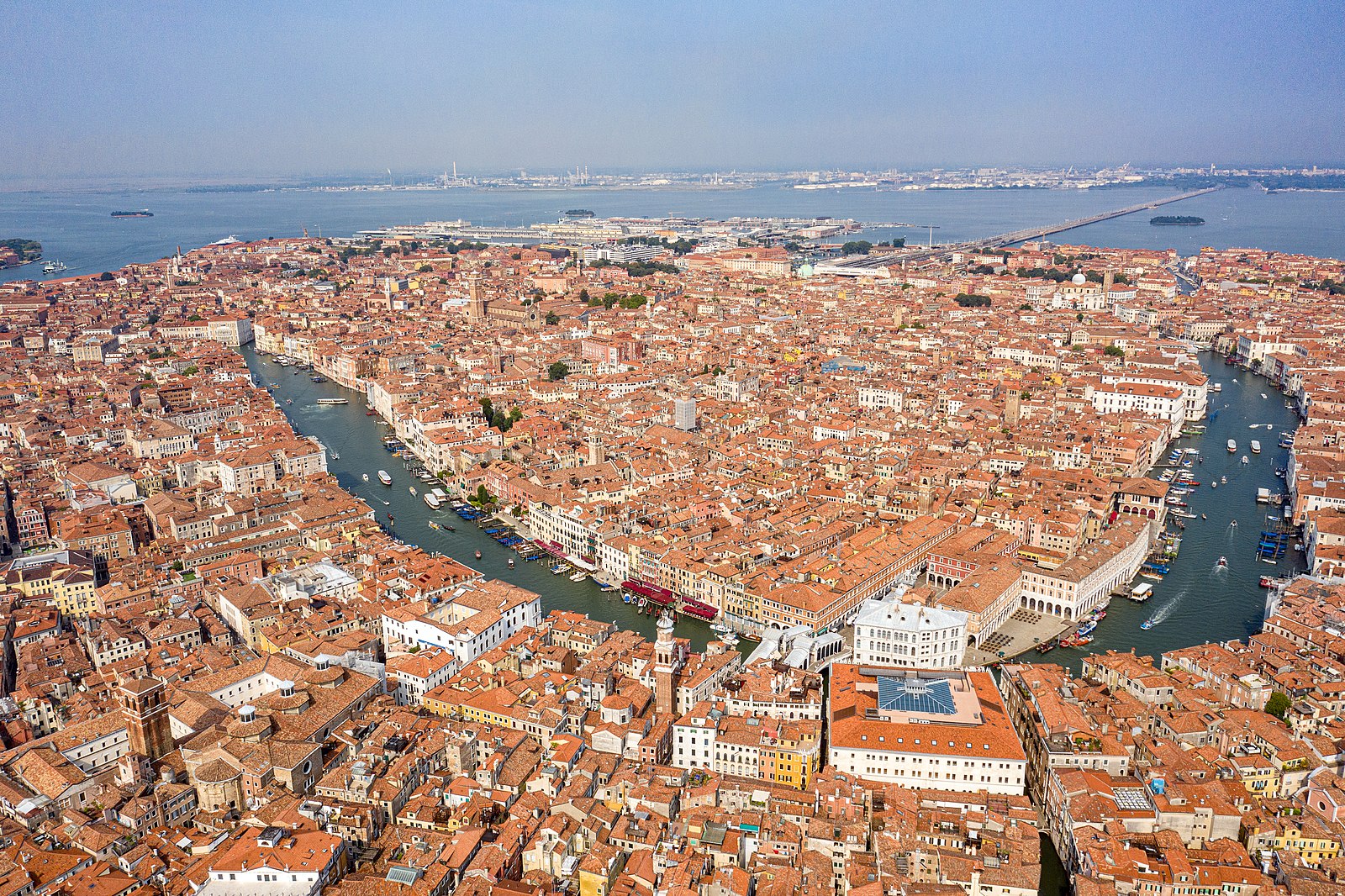
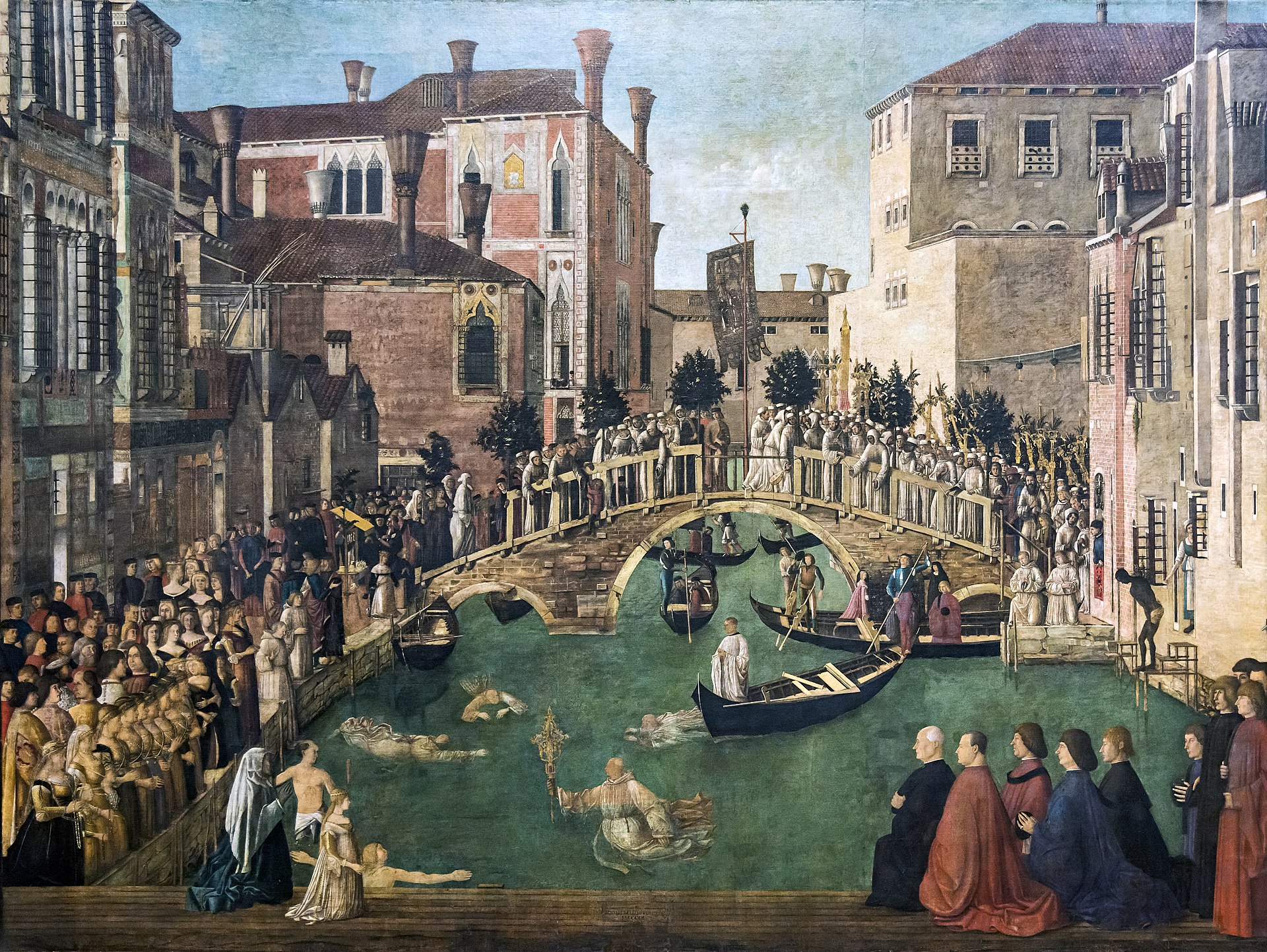
We have come back to Venice to look at perhaps the most famous of all the cycles of paintings done for one of the Venetian Schools, those friendly societies or Confraternities whose membership and activities I described in the lecture devoted to the canvasses by Gentile Bellini and Carpaccio.
The School we are concerned with today was founded as late as 1478, and it was dedicated in particular to the relief of victims of the Plague.
Epidemics of the Bubonic Plague had affected Europe both before and after the notorious Black Death in the middle of the fourteenth century, and some of these later visitations were devastating. As a seaport, with 170,000–180,000 inhabitants, trading with the East, Venice was particularly vulnerable: in 1575–7, for instance, an epidemic was to kill nearly one third of the entire population, that is, some 50,000 people.
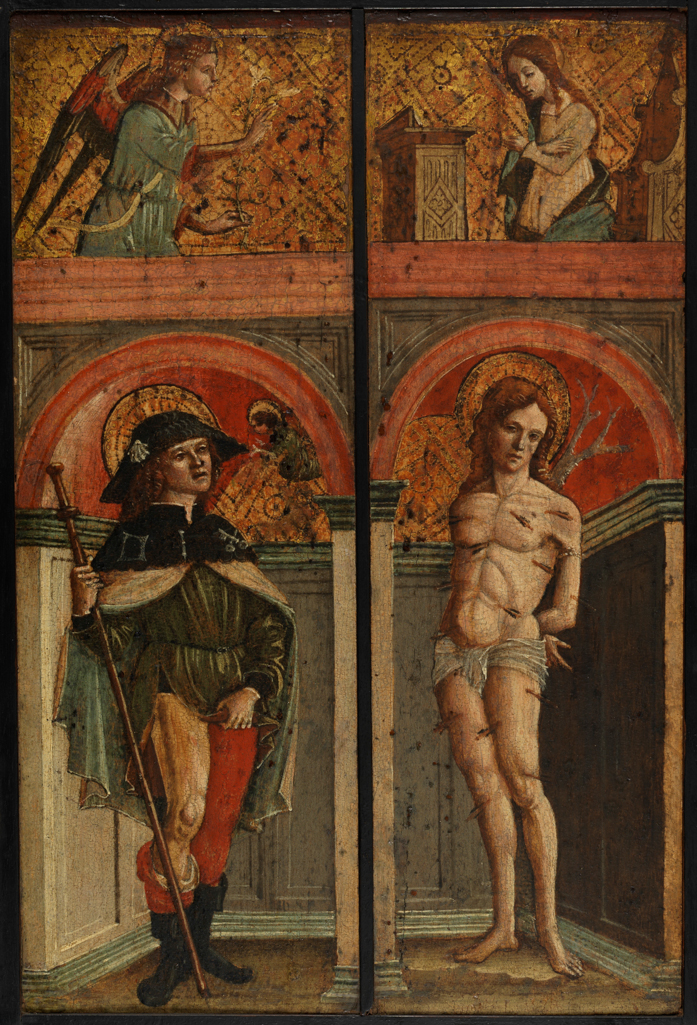
Given this objective, the new School was dedicated, almost inevitably, to the recent French saint, Roche, known in Italian as Rocco (whom you see here alongside Saint Sebastian), who had contracted the Plague while on a pilgrimage, and who was thought to help and heal victims of the pestilence. He had died in 1327 (just a few years after Dante) and was buried in Montpellier. (The scallop shell on his hat indicates that he was on a pilgrimage to Santiago de Compostela.)
From there, his cult spread through the Mediterranean cities, and (as you can see in the little panel from the Fitzwilliam Museum) he is usually shown dressed as a pilgrim, and he usually points to a large black boil on his thigh, which was where the Plague often first appeared.
The new School, dedicated to Rocco, was founded in 1478, but its enormous success and prestige can be dated to the year 1485, when some Venetians went to Montpellier and simply stole the body of the saint, bringing it back to Venice amid great civic ceremonies and rejoicing.
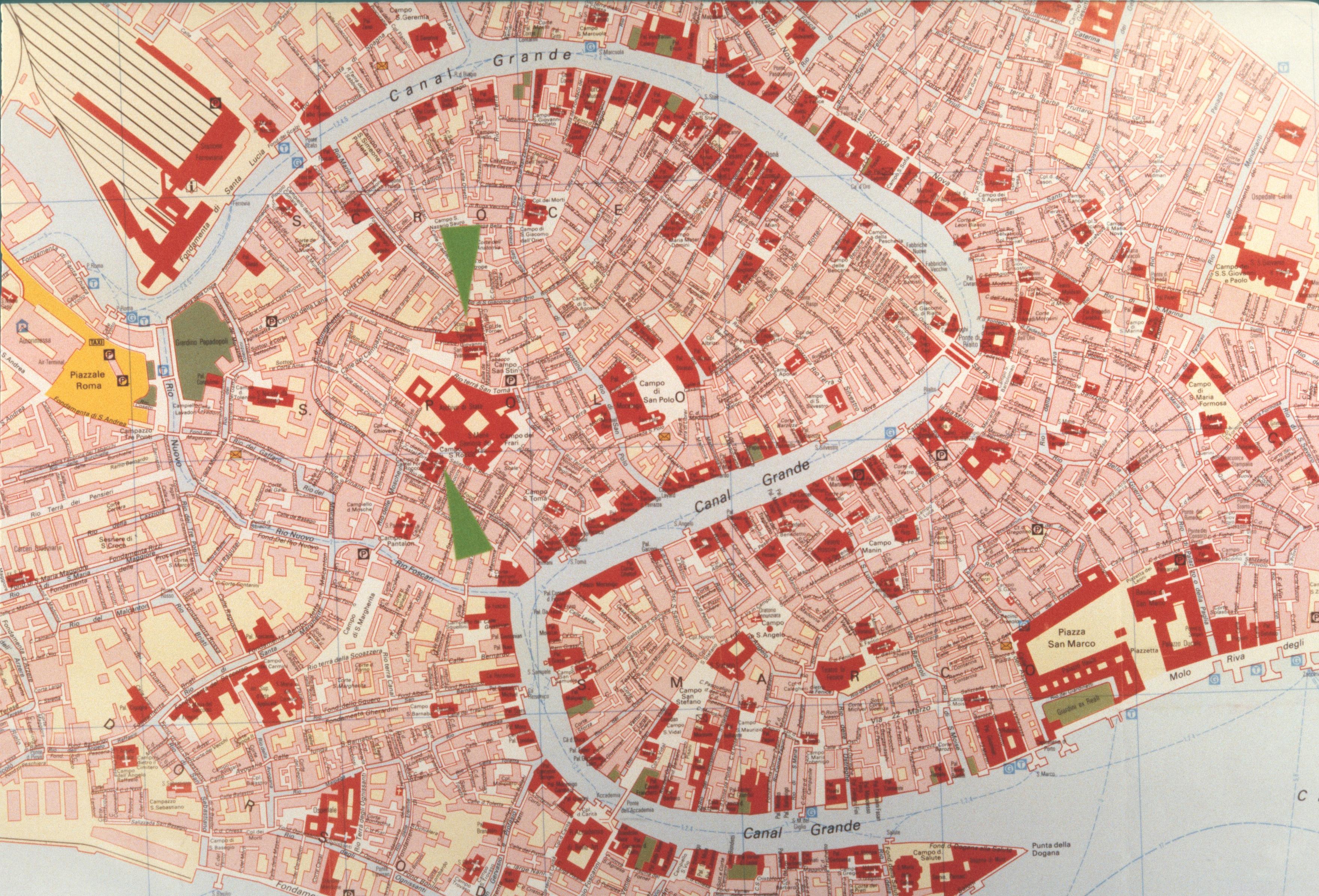
Four years later, the confraternity was already recognised as a major school, a ‘Scuola Grande’. They were given a site just south of the church and major school of St John, where the canvasses by Carpaccio and Gentile Bellini used to hang, and very close to the huge Dominican church of S. Maria de’ Frari.
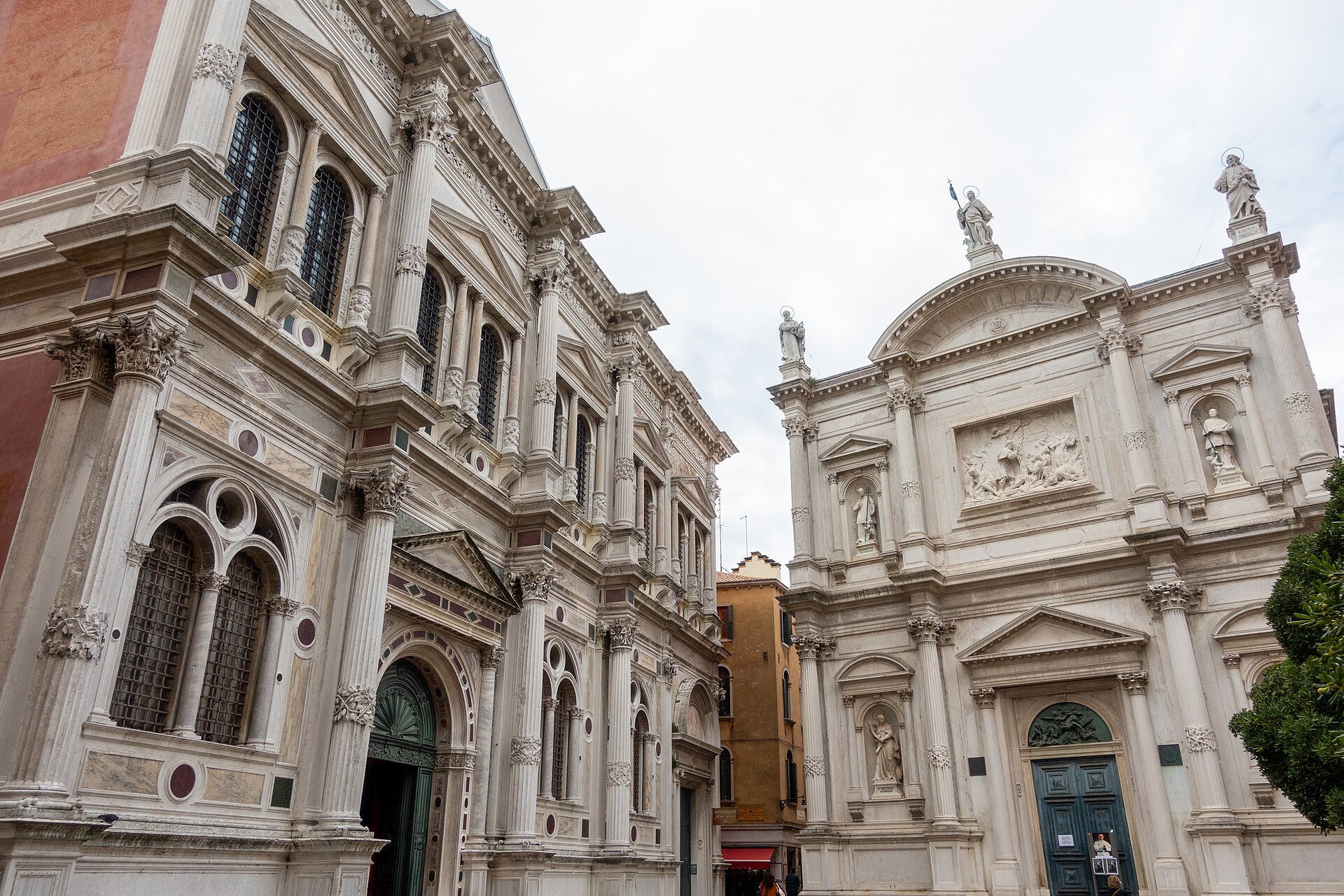
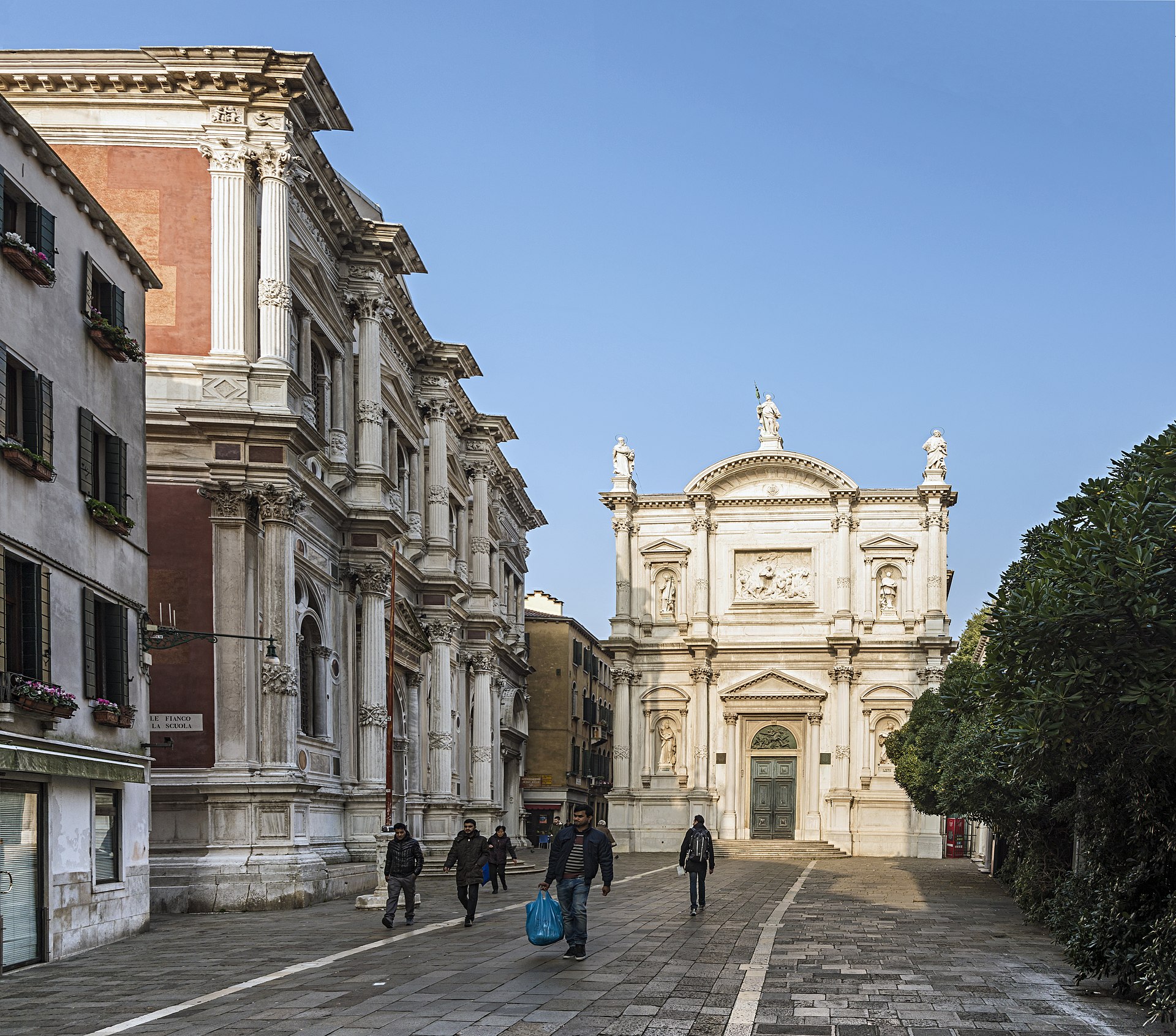
By 1548, the School had finished a new church, dedicated to Rocco, and also their headquarters building, which together dominate a tiny square, as you can see from these photographs (the façade of the church dates from much later).
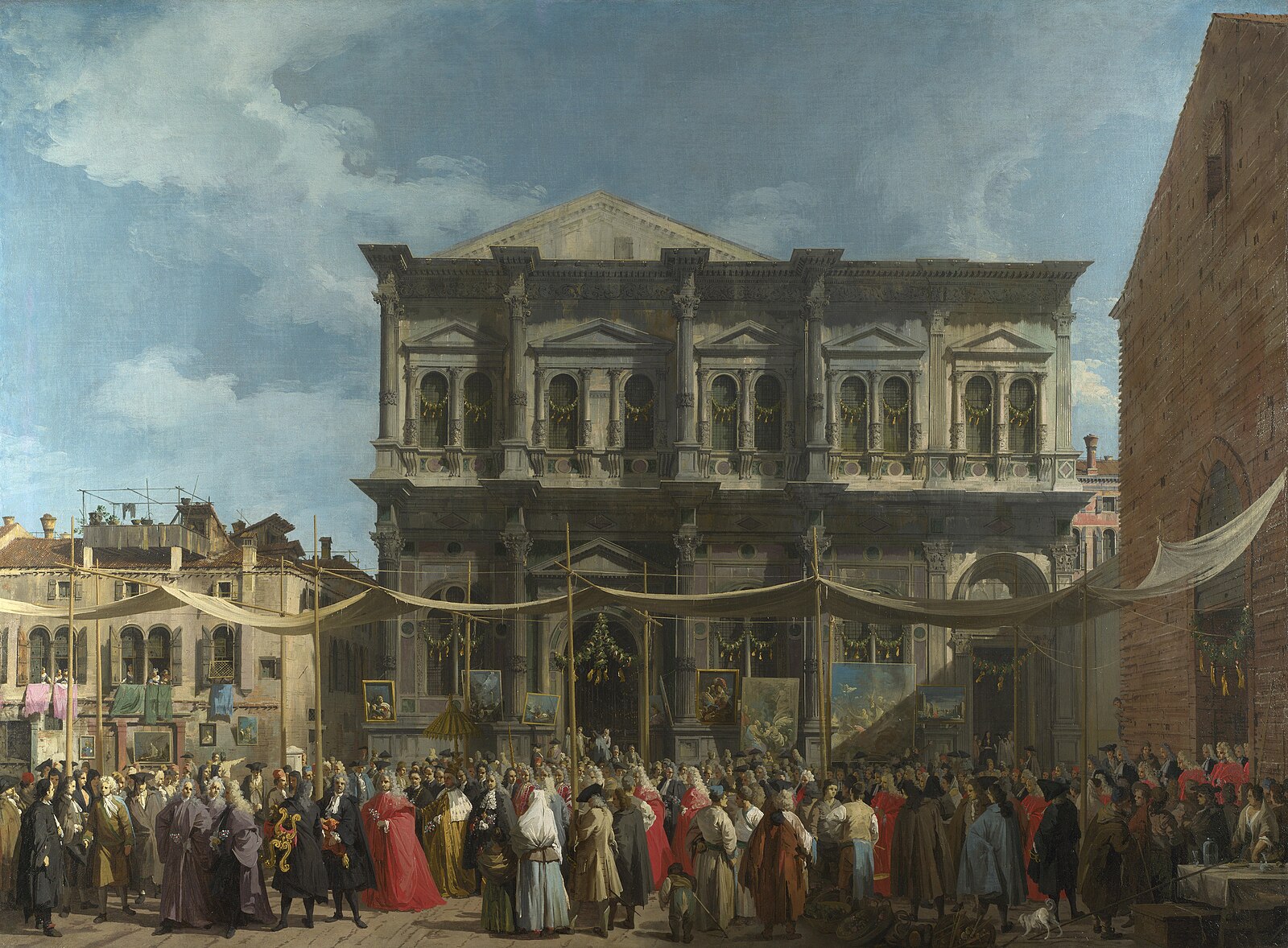
Their headquarters was a very grand building indeed, as we can see even better in the painting by Canaletto.
The ground-floor room measures almost fifty yards by nearly twenty, and there is a superb staircase leading up to the Sala Grande on the first floor (which is of the same size), and to the smaller committee room, or Sala dell’Albergo, opening out in the area over the entrance.
The canvasses that were commissioned to decorate these three rooms were, in the event, all entrusted to one man, Jacopo Robusti, born in 1519.
This self-portrait shows him at the age of thirty, when the building of the School was nearing completion.
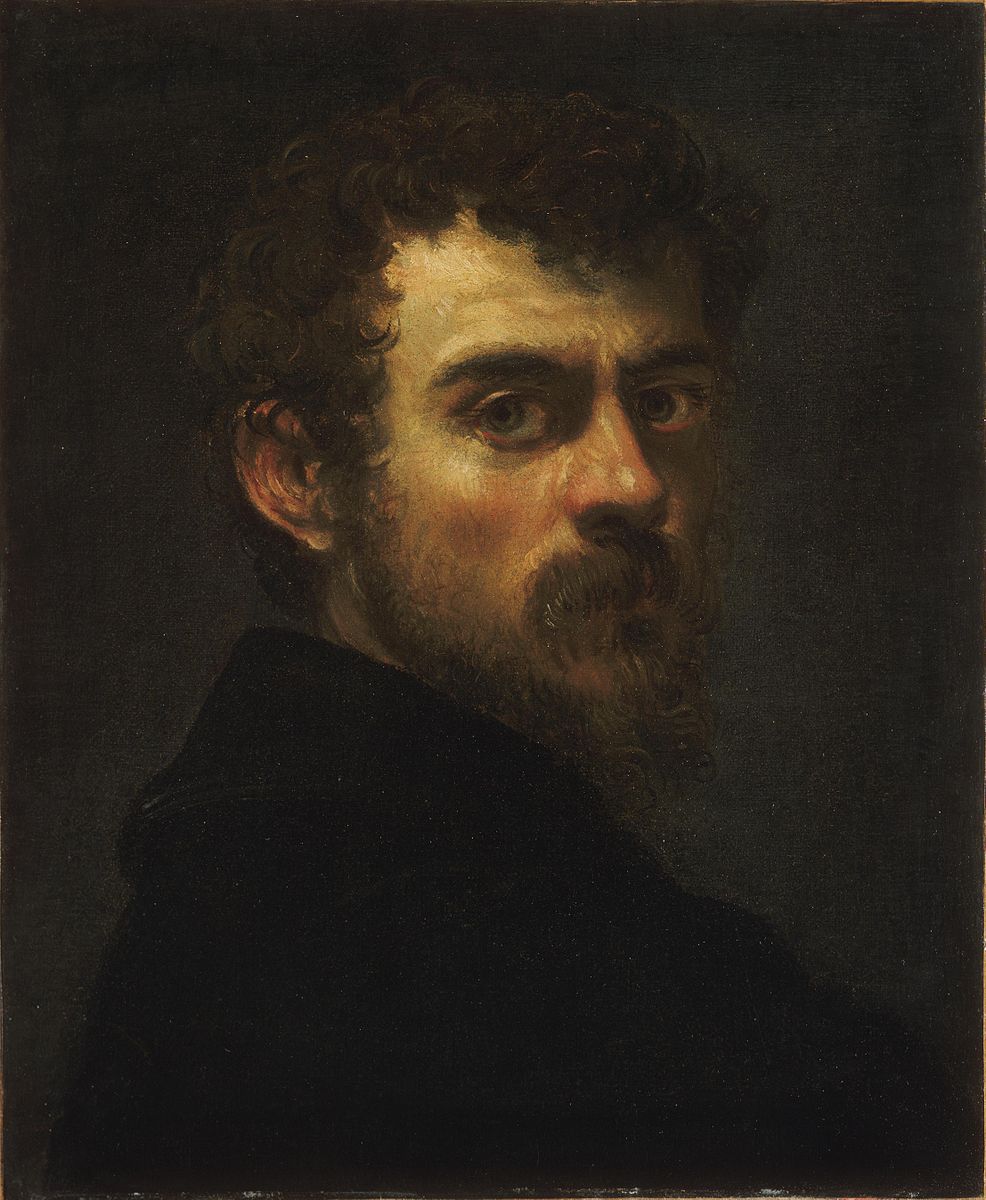
He was the son of a dyer; in Italian, ‘tintore’, and therefore known as ‘little dyer’—Tintoretto.
He was a local boy made good; and, since no one is a prophet in his own country, he had to overcome some initial resistance to his appointment by using a certain amount of sharp practice.
He executed the paintings for the ceiling and walls of the Sala dell’Albergo in the mid-1560s, when he was about forty-five.
More than a decade later (between 1576 and 1581, when he would have been around sixty), he was commissioned to provide huge areas of canvas for the ceiling and walls of the Sala Grande. Finally, he painted ten canvasses for the ground floor between 1583 and 1587—by which time he was nearly seventy, and must have resembled this not unaffectionate caricature.
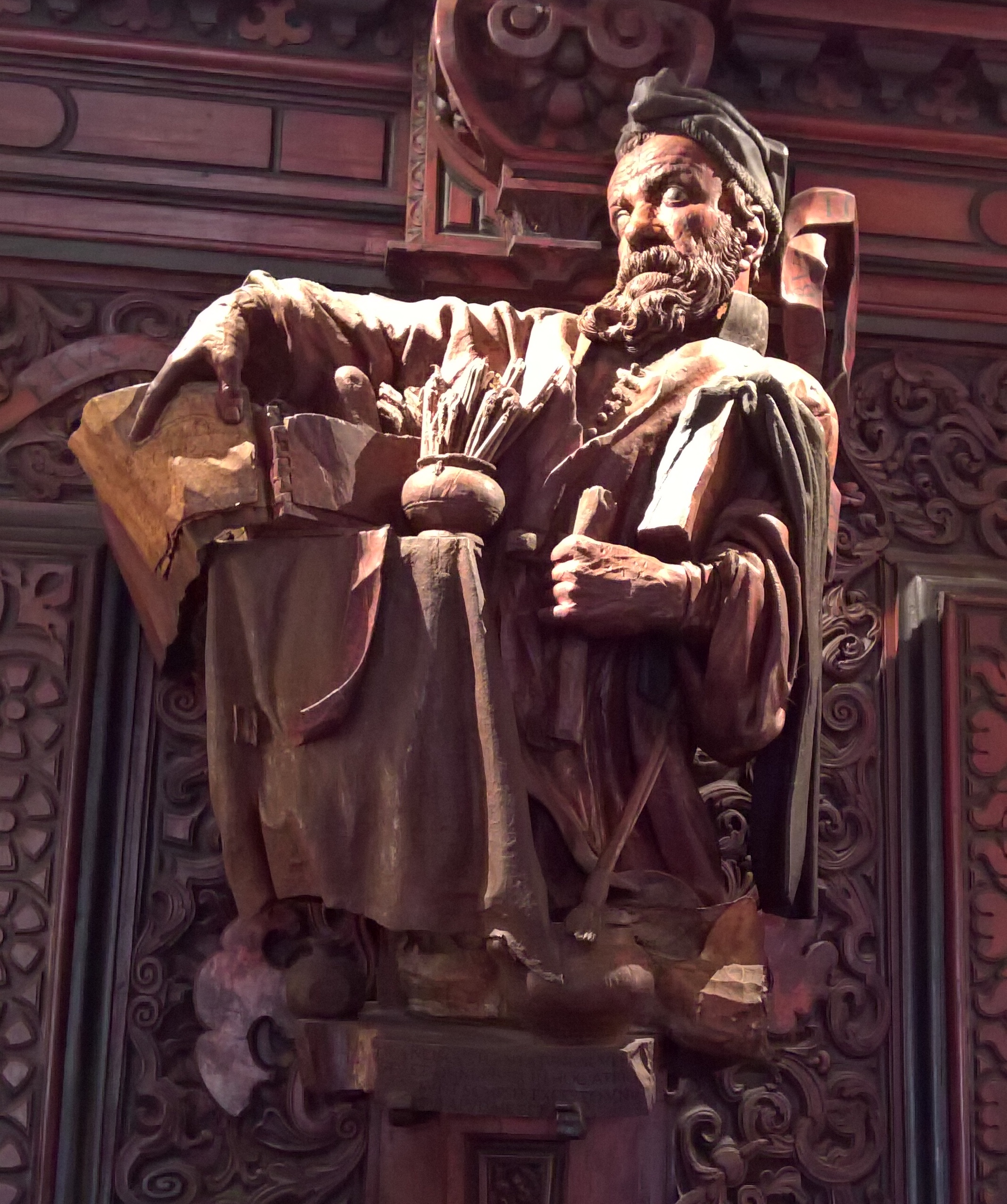
At the half-way point—1577—he won for himself a contract unique in the history of Venetian art, whereby he received an annual pension for life of 100 ducats, on condition that he would finish all the needed canvasses at the rate of three per year.
San Rocco was Tintoretto’s own School, to which he was deeply and passionately committed; and in those three sets of canvasses he tackled virtually all the main subjects in Christian art, rethinking them comprehensively, moving his compositions further and further away from realism, geometrical perspective, the ‘archaeological’ reconstruction of a glorious past, and a Venetian warmth of colour—all the qualities we found in Mantegna, Carpaccio and Titian—towards a visionary, hallucinatory, phantasmagorical style that would record not the natural, but the presence or the intrusion of the supernatural.
The results were such that Eric Newton could compare this detail from The Adoration of the Magi on the ground-floor (painted when Tintoretto was nearly seventy), not simply with El Greco—that is no more than an art historian’s commonplace—but with Henry Moore.
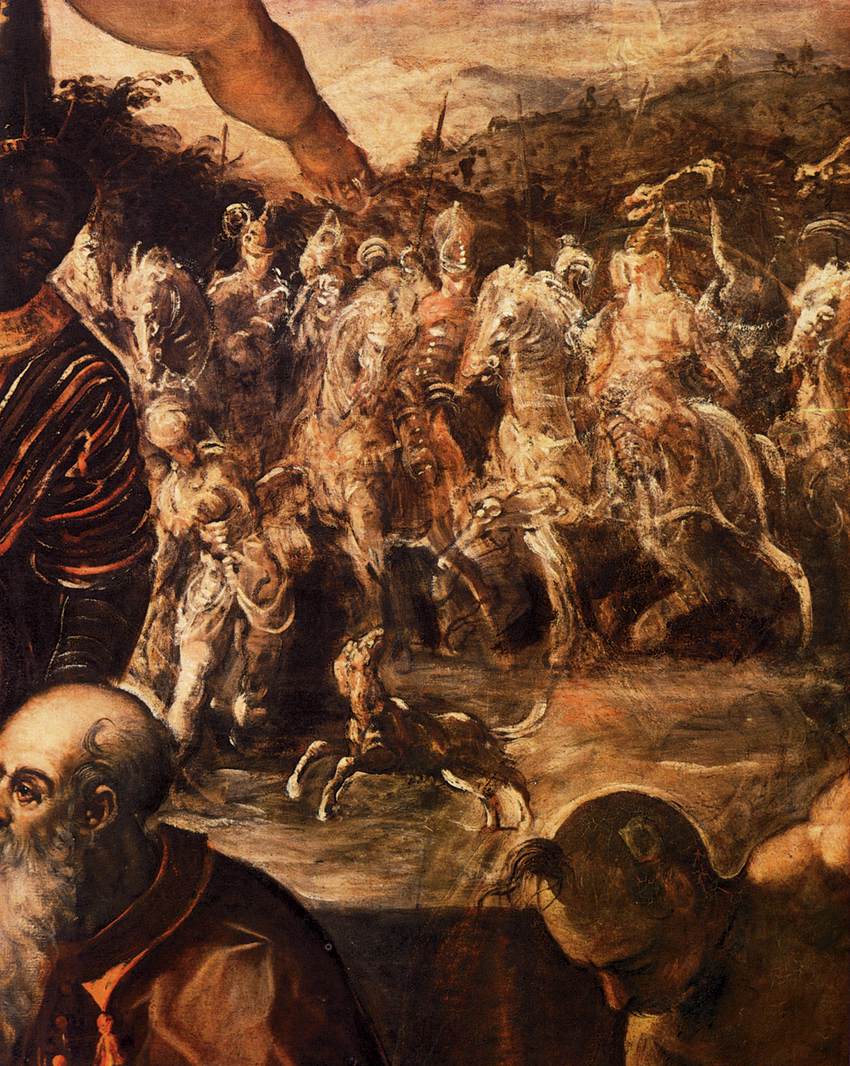
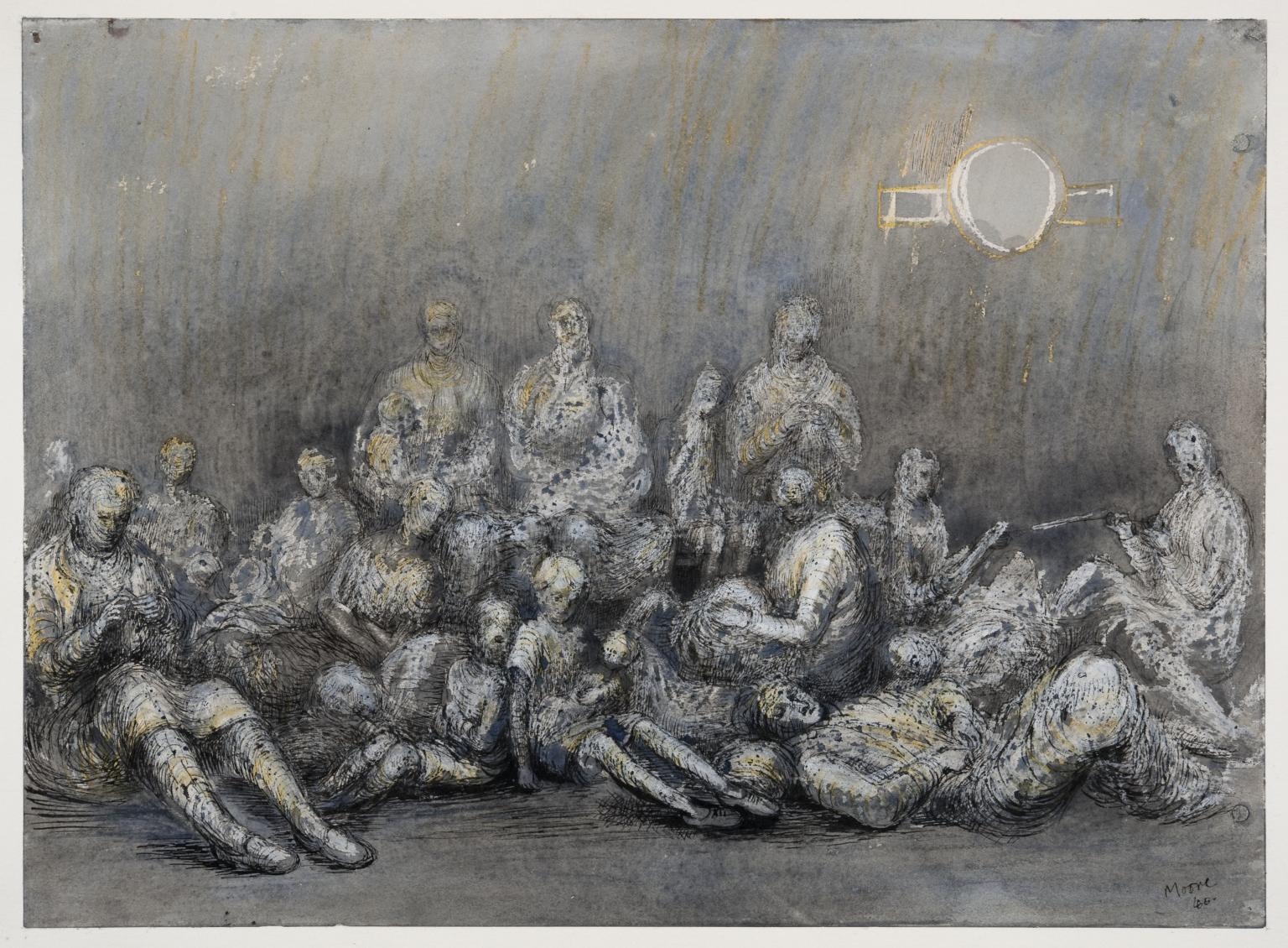
We have no fewer than twenty large canvasses to examine in this lecture—all from the second cycle, that for the Sala Grande—so there is no time for a leisurely look at the general evolution of Italian painting in the fifty years between 1525, when Titian delivered the last of his paintings for the ‘Camerino’ of Duke Alfonso, and 1575, when Tintoretto began work on the Sala Grande.
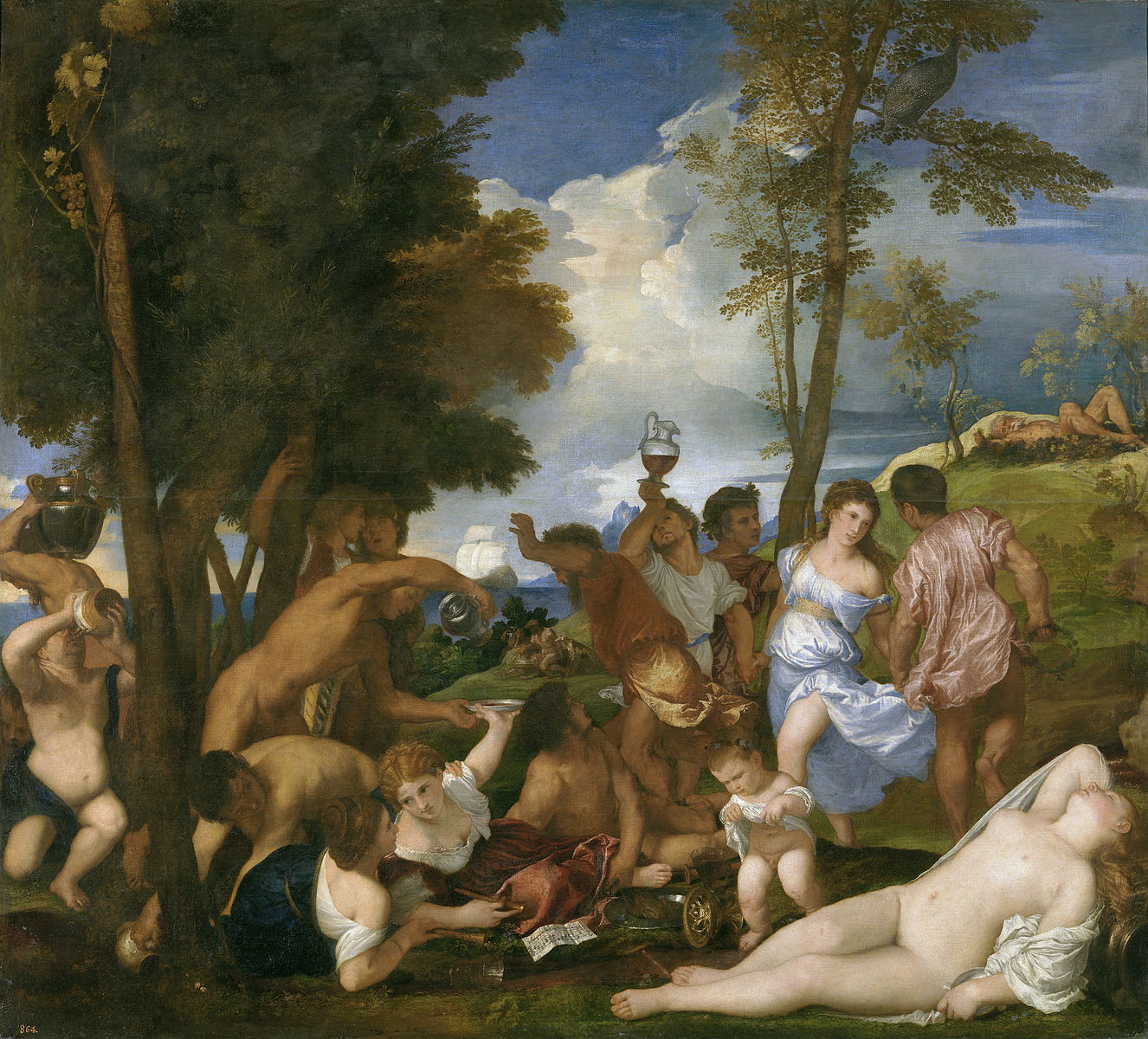
But however personal and idiosyncratic Tintoretto’s style was to become, its elements were shared with a whole generation; and we ought to pause briefly to pick out the main trajectory of those fifty years, by looking at a couple of major influences and three or four of Tintoretto’s earlier paintings.
Born in 1519, when Titian was already at work for Ferrara, Tintoretto trained for a short time in Titian’s workshop. But his generation was to be greatly influenced by important new trends in central Italian art in the 1520s and 1530s—by what was then called ‘the style’—‘la maniera’—and is now called ‘Mannerism’.
This was a movement which had many and diverse adherents, but they were all in some way deeply indebted to Michelangelo and especially to the frescos on the ceiling and on the altar wall of the Sistine Chapel.
The debt consists in the preference for sharp, acid colours and in the unclassical, elongated proportions of the figures, who are frequently posed with violent torsions of the body—such that they often seem to be, as Lewis Carroll said, ‘reeling, writhing, and fainting in coils’—and also in a preference for strenuous, difficult, restless and disturbing compositions.
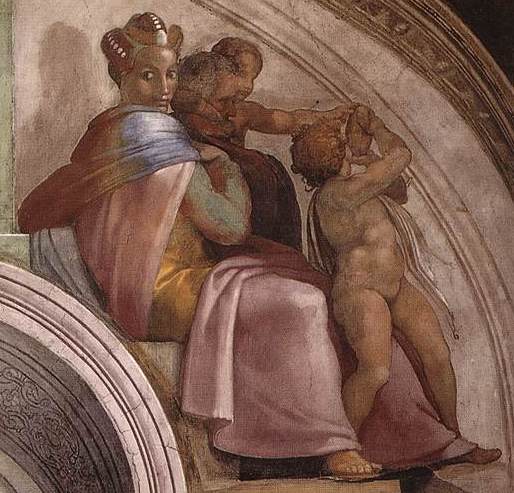
These features can be seen, in a relatively restrained form, in this family group by Michelangelo (one of the Ancestors of Christ in the lunettes of the Sistine Chapel, c. 1510).
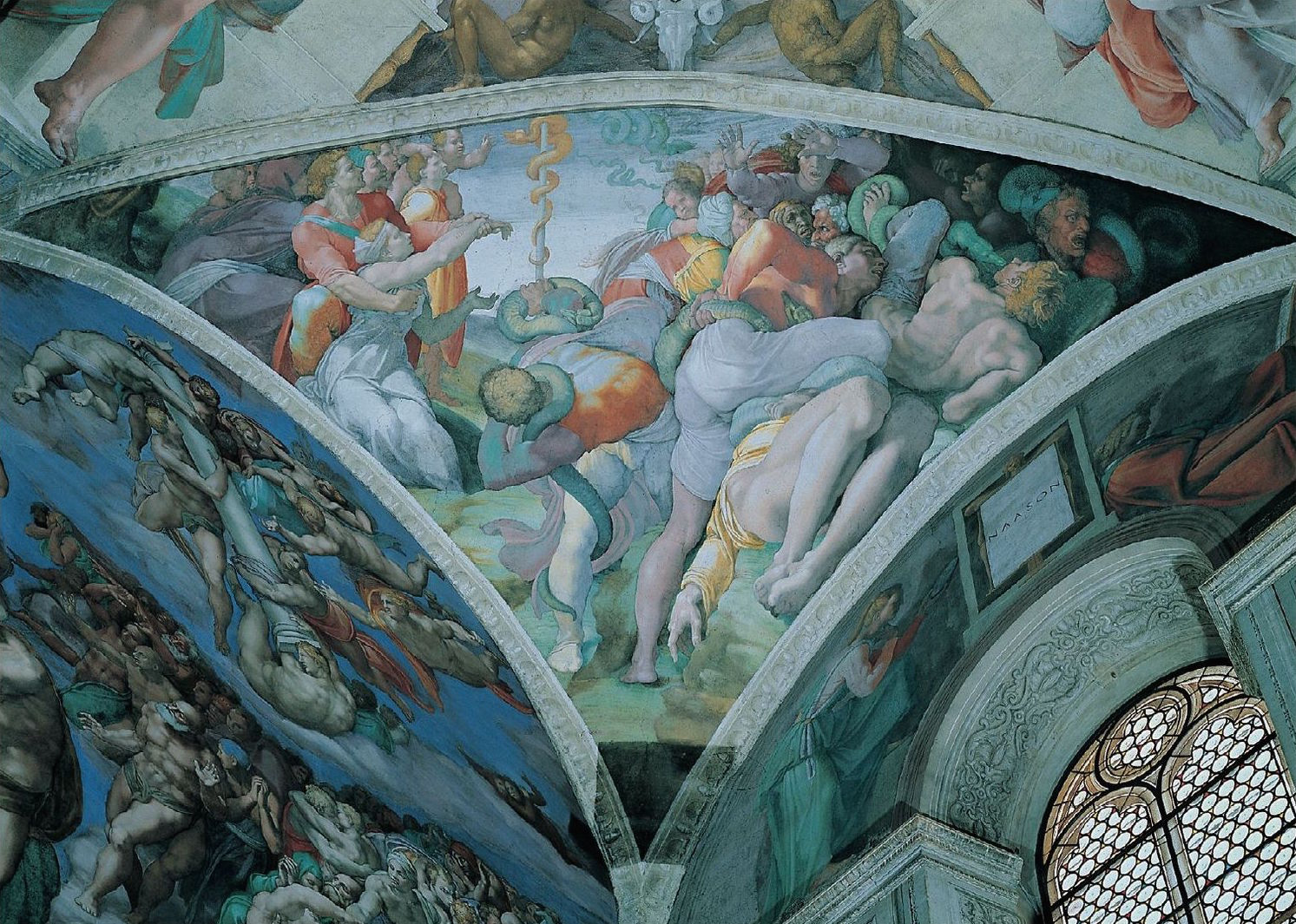
The same features recur more dramatically, only a couple of years later, in this corner-pendentive near the altar wall.
(It is relevant to know that this shows the Israelites being tormented by a plague of snakes until such time as they were delivered when Moses raised a ‘Brazen Serpent’ on a pole—usually, in Christian art, a T-shaped cross, with reference to the Crucifixion.)
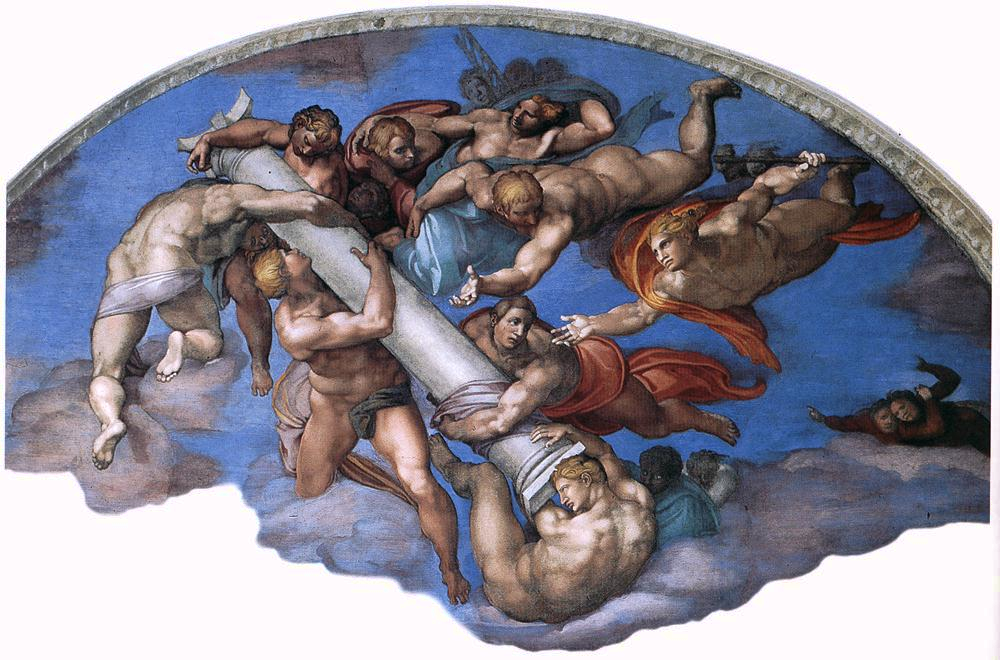
The pendentive dates from c. 1512; and it lies alongside the lunettes of the Last Judgement, painted more than 20 years later, in 1536, where the angels carrying the column are a perfect example of Michelangelo’s art at its most Mannerist.
The frescos in the Sistine Chapel, then, were the single most important source of the new trends; and you will have heard that Tintoretto dreamed of combining Titian’s colour with Michelangelo’s power of drawing—his ‘disegno’.
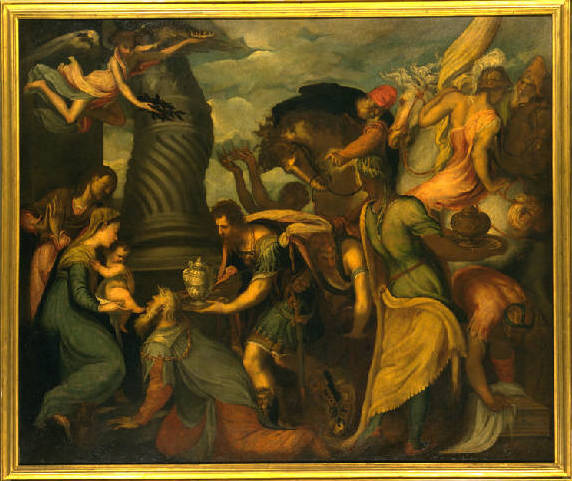
As a single example of the ‘mediators’ between Michelangelo and Tintoretto, we may glance at the astonishing Adoration of the Magi (dating from 1545) by Andrea Schiavone, from whom Tintoretto is known to have learned a good deal (and who competed against him for the first San Rocco contract).
Taking his cue from the spirals on the column, Schiavone twists virtually every one of his figures—be they horses, humans or angels—into fantastic shapes. Even the infant Jesus, experimentally touching the beard of the oldest king with his right foot, is not immune.
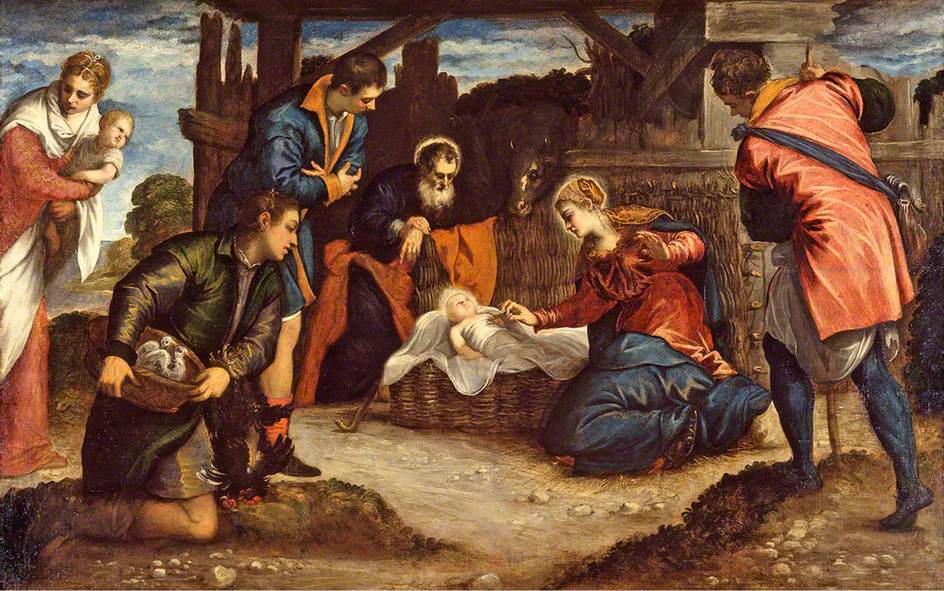
Tintoretto’s early paintings are nothing like as restless as this, as you can confirm by a glance at his Adoration of the Shepherds, dated 1542–44, now in the Fitzwilliam Museum, which measures about five and a half feet by nine.
Nevertheless, if you look closely at the twist of the baby in the maid’s arms, at the ardour of the shepherd in olive-green, the almost balletic gesture of Mary, and the supernatural light emanating from the Christ-child, you will recognise the roots of many of the canvasses in the School of San Rocco.
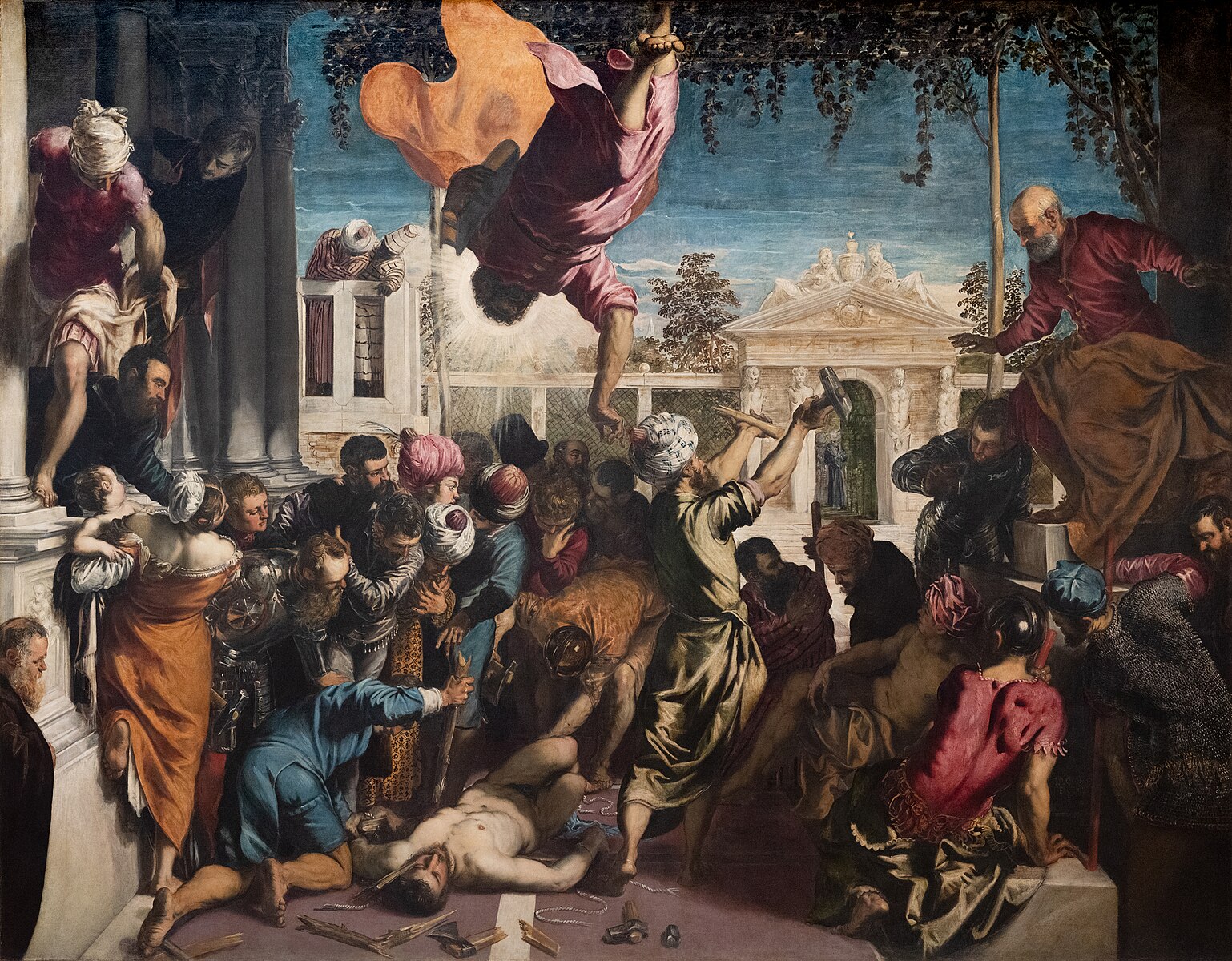
A new intensity in Tintoretto’s art is to be found in a much bigger canvas, nearly fourteen feet high by eighteen wide, which he painted for the major school of St Mark in 1548, when he was twenty-nine.
It illustrates the tale, from the Golden Legend, of how the saint (flying in like Superman, or, rather, like Michelangelo’s Jehovah) rescued a slave who was being beaten to death, smashing to smithereens on the ground the mallets of his torturers (one of whom is seen here in full swing).
There is still respect for the rules of textbook perspective in the construction of the ‘stage-set’, the Venetian colour is still intense, and there is evident concern for symmetry in the grouping of the figures. But this is a painting from the middle of the century, as you can tell from the poses of the dozen or so onlookers, who spring up in amazement with outspread arms, or recoil while remaining seated, or twist with a baby in arm, or bend forward, swinging the left arm across the body.
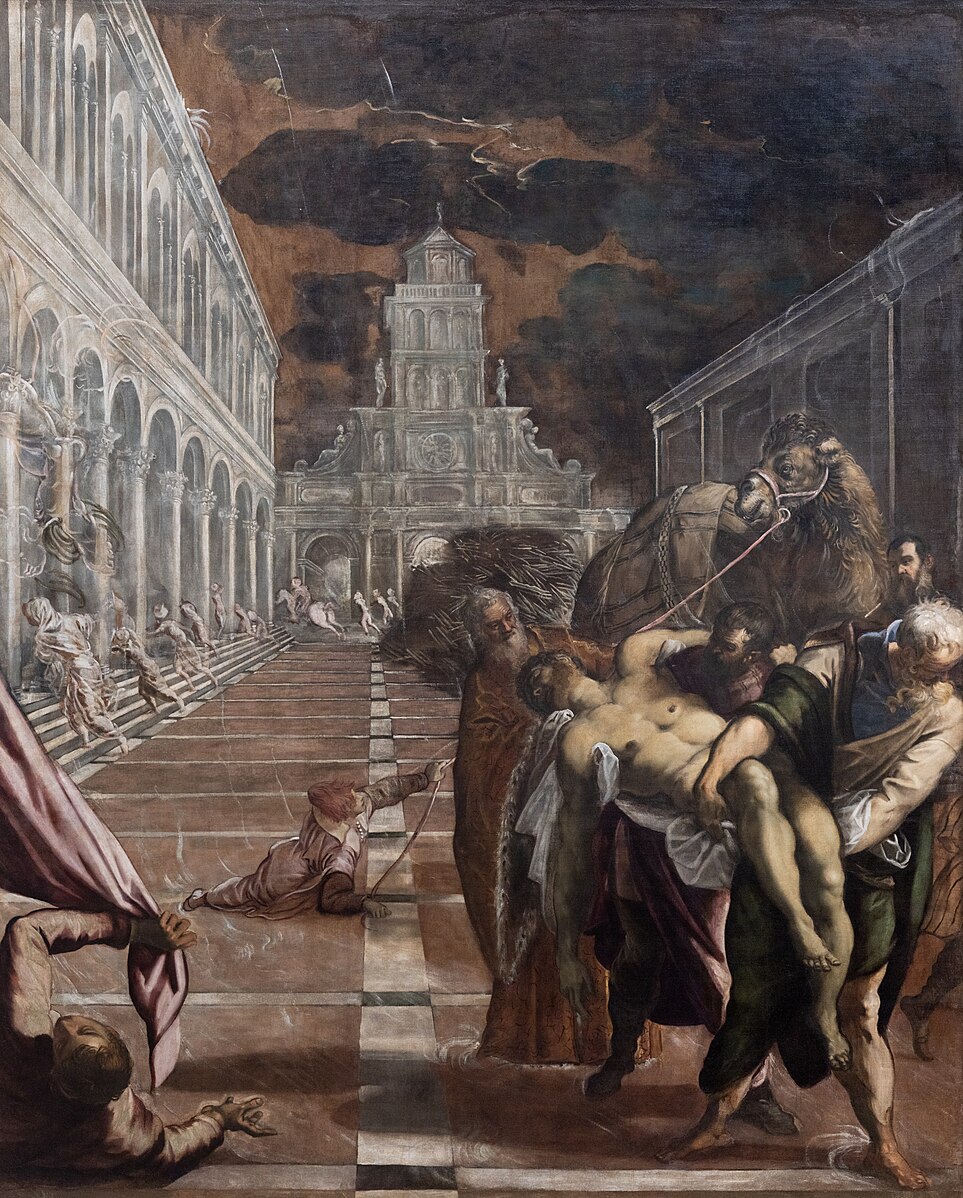
Fourteen years later, when Tintoretto returned to the School of St Mark in the early 1560s, he painted this large canvas (thirteen feet by ten) which shows how the body of Mark was brought to Venice by certain ‘grave-robbers’ (how else to describe them?) who had stolen it from the saint’s tomb in Alexandria (hence the camel).
It is incredibly more advanced than The Miracle of the Slave and quite staggeringly theatrical: not only in the fleeing, flickering, spectral figures but in the dramatic representation of the colonnade in steep perspective, and in the dark shadows contrasting with the celestial radiance emanating from the saint’s body or with the flashes of lightning seen against the storm clouds in the dark red sky.
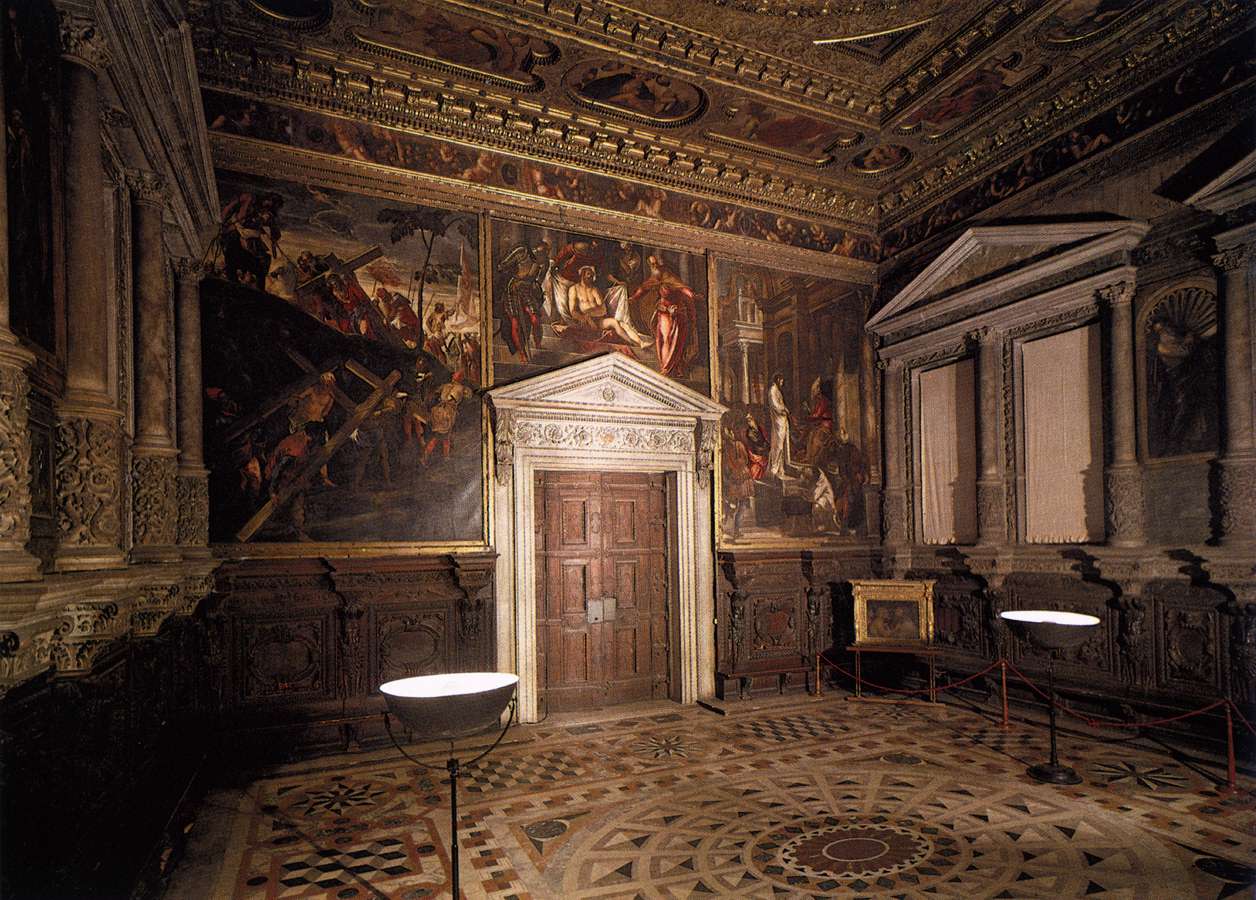
The painting was delivered by 1566, at which time Tintoretto had begun his work for the Scuola di San Rocco, in the smaller room, the Sala dell’Albergo. And as the final item in this preliminary survey, we must take a slightly calmer look at the marvellous image of Christ before Pontius Pilate to the right of the door in that room (its position clearly seen in the photograph).
The canvas was painted in 1567 and stands fully seventeen feet high.
The vanishing point for the perspective is well outside the painting, to the left, with the result that the lofty, classical architecture of the Roman governor’s palace opens up a bold composition on the diagonal, with the dark heads of a crowd, baying for blood, seen in the left background.
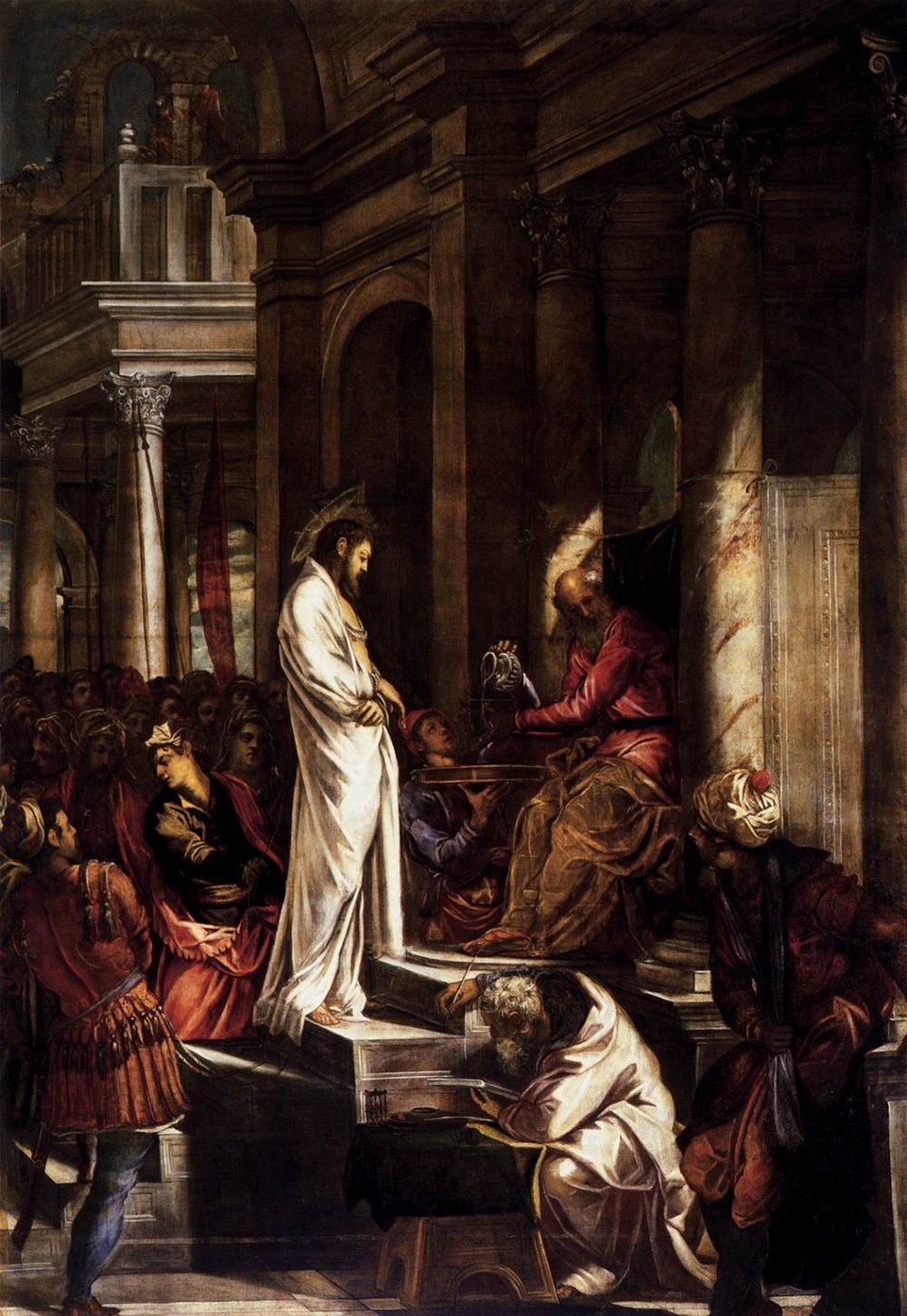
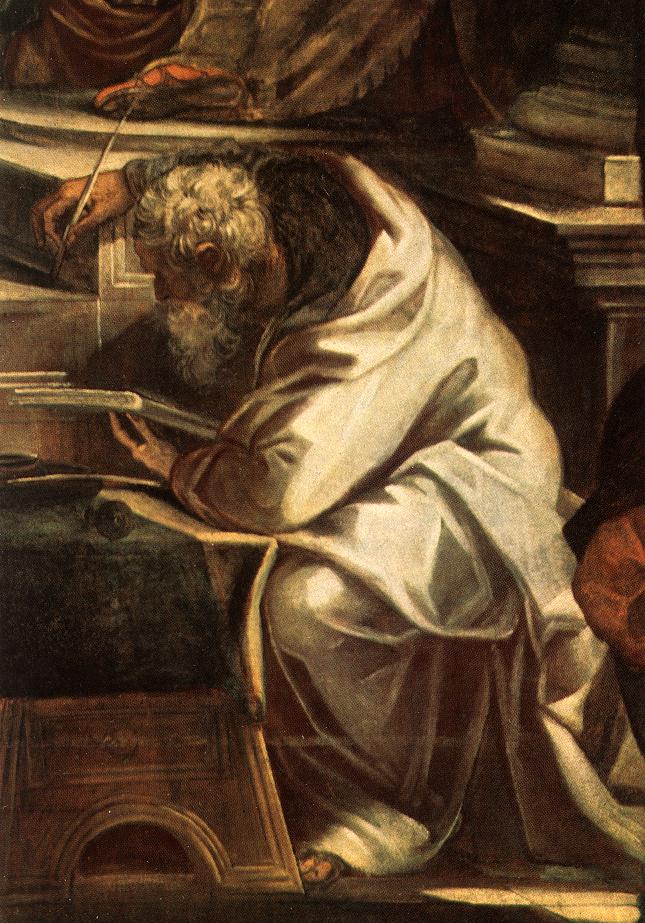
Pilate twists and looks away as he washes his hands, the turbaned figure starts up, the young man recoils, and the old shorthand writer almost steals the show, as he crouches with his right arm raised to record the verdict.
But it is Jesus we remember: stock-still, elongated and pencil-thin, almost like a candle in his white robe, caught by the light flooding in between the columns—the mood of the whole painting depending greatly on the contrast between deep shadow and bright patches of sky, or of light reflected from different surfaces: from polychrome marble, a turban, a robe, or a woman’s face.
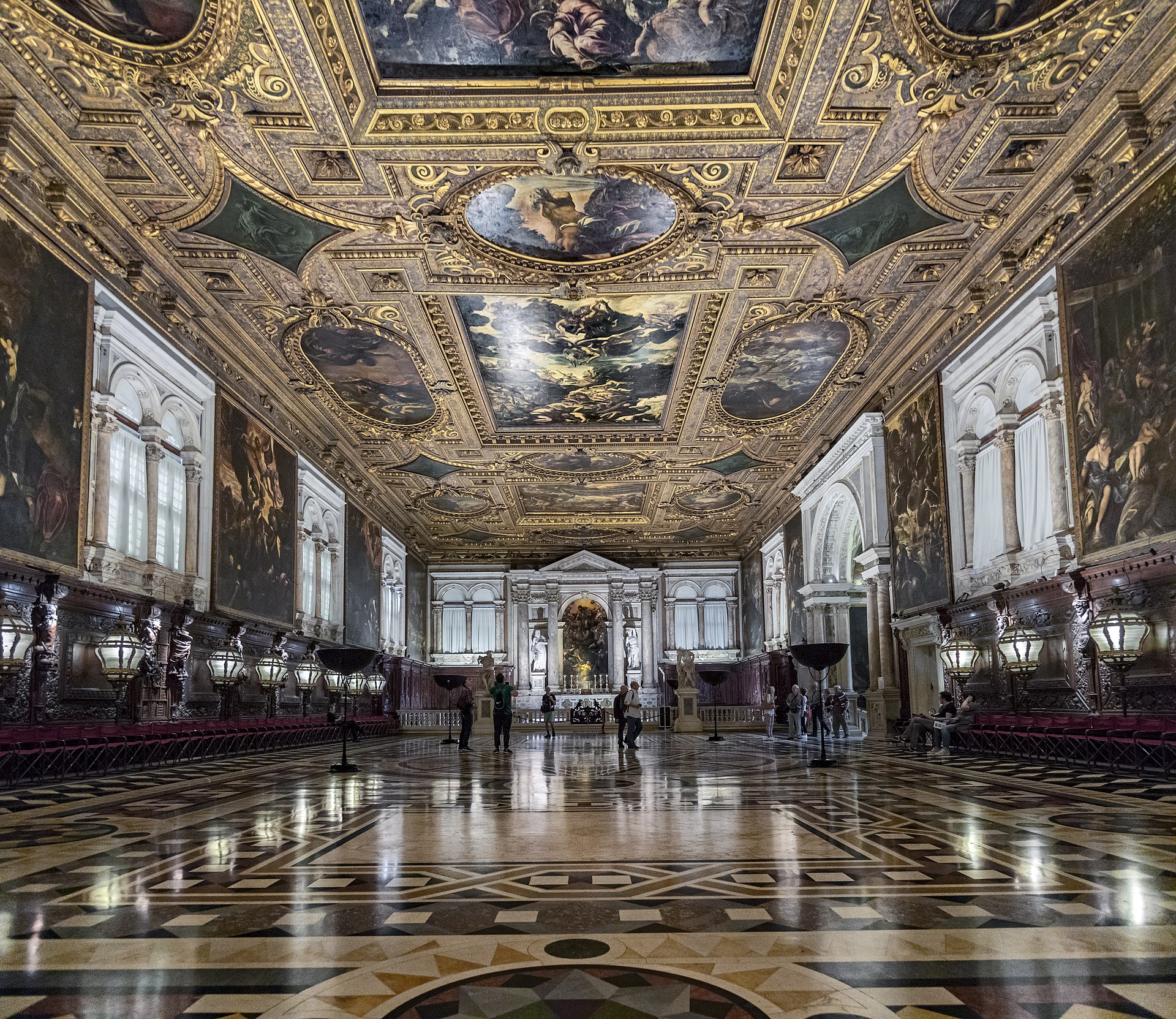
This rapid survey should have given you some idea of what to expect from the artist who would reappear in the School of San Rocco in 1575, when the guardians took the decision to decorate the ceiling of the Sala Grande, a decision which would be extended to the walls in 1577 in accordance with the special long-term contract mentioned earlier.
The scheme of the decorations was very ambitious, as you can infer even from a superficial glance at this diagram of the layout of the pictures.
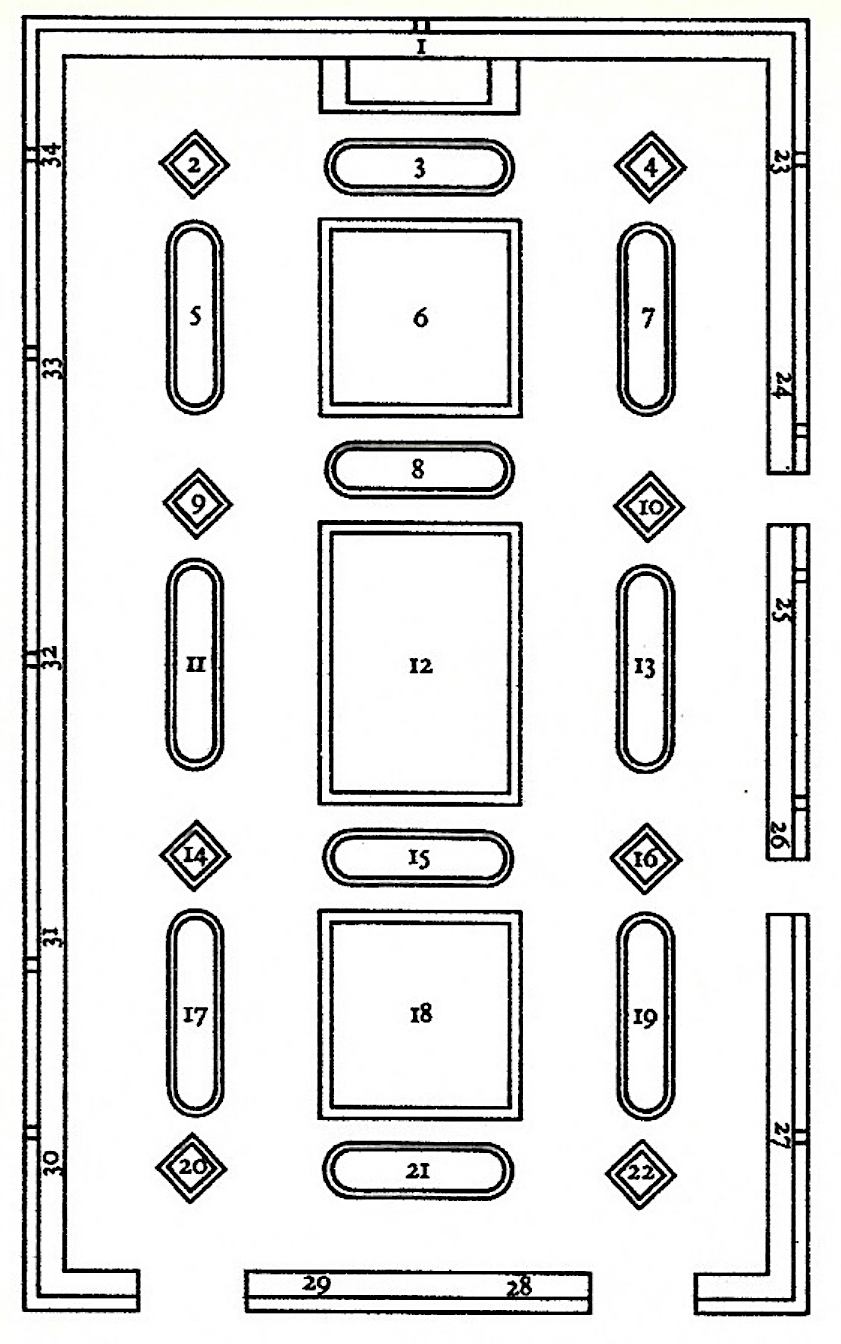
There have been—and still are—disagreements about the nature of the underlying conceptual plan and the degree to which it is coherent, or the degree to which the plan was intended from the outset.
But there should not really be any difficulty in grasping the guiding principle, which is that scenes from the New Testament are paired with one or more episodes from the Old Testament—episodes which had been interpreted for many centuries as prefigurations or ‘types’ of a later event in the Life and Passion of the Saviour.
The Sistine Chapel had been characteristic of hundreds of churches inasmuch as Old Testament stories concerning Moses were placed upon the left wall as you face the altar (the south, the Epistle side), while the corresponding New Testament story was placed opposite, on the right wall (the north, the Gospel side).
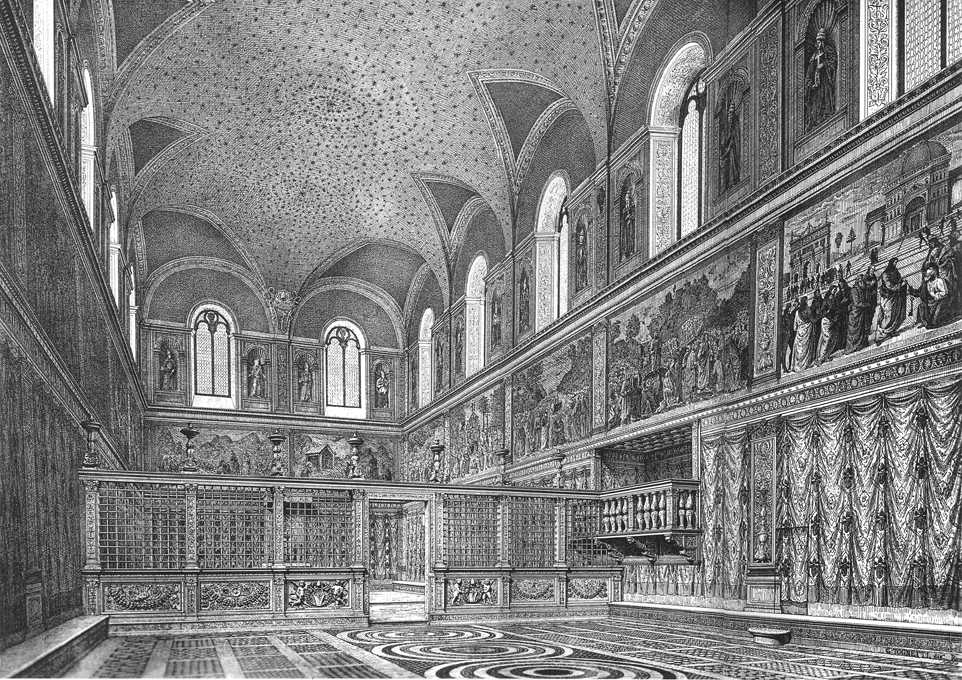
Other arrangements were possible—in stained-glass windows, for example—and the only innovation in the Sala Grande is that the New Testament stories are on the walls, while the Old Testament stories are placed on the ceiling in the vicinity of the episode which they were thought to ‘foreshadow’ or ‘typify’.
So far, so good—but if you begin your walk-round with the Adoration of the Shepherds—letter (b) in this alternative diagram of the layout—you will come first to the Baptism (d), exactly as in the Sistine Chapel; but you will then find the Resurrection (f), followed by the Agony in the Garden (h), coming before the Last Supper (k).
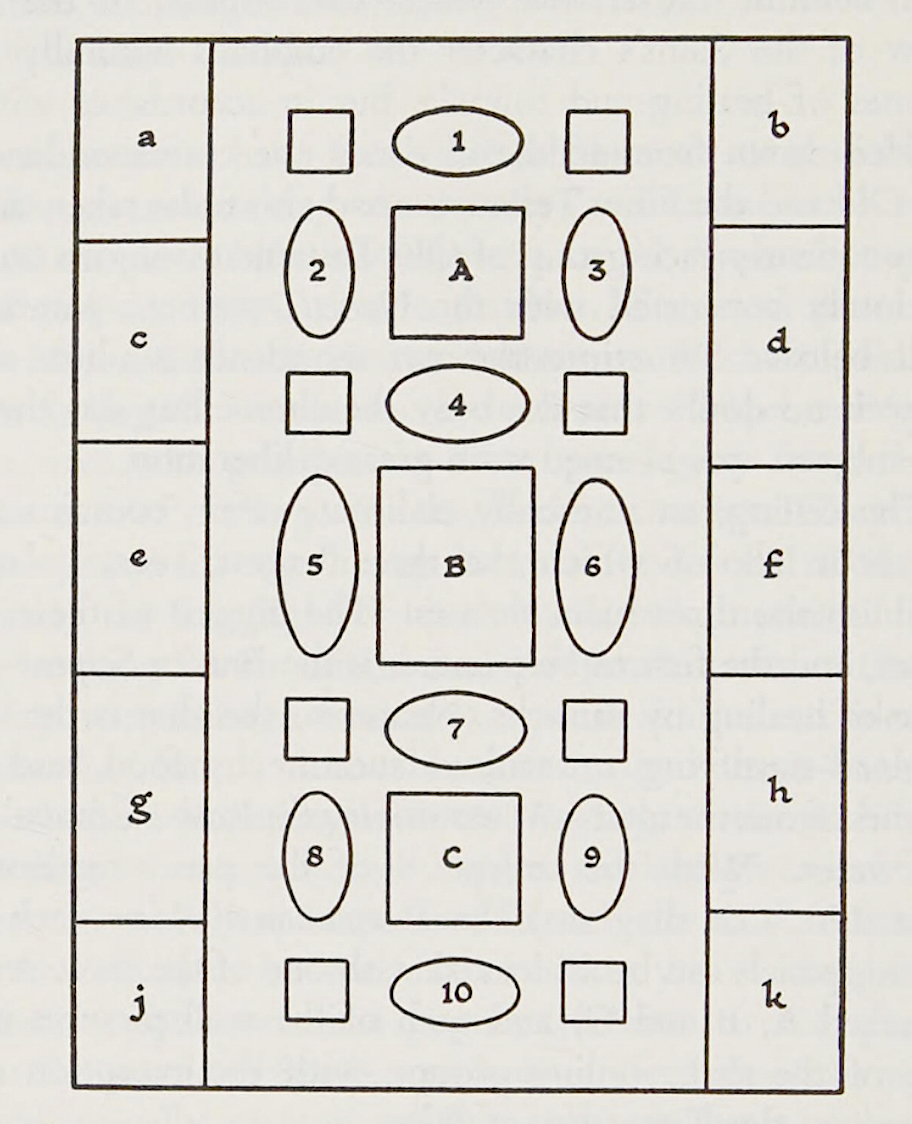
Hence it is obvious that the sequence of the narrative in the gospels has been abandoned in favour of some other criterion; and this proves to be a three-fold division, reflecting or determining the subjects of the three main canvasses in the centre of the ceiling, which are, in order:
- Moses striking Water from the Rock,
- Moses erecting the Brazen Serpent,
- Moses supervising the collection of the Celestial Manna.
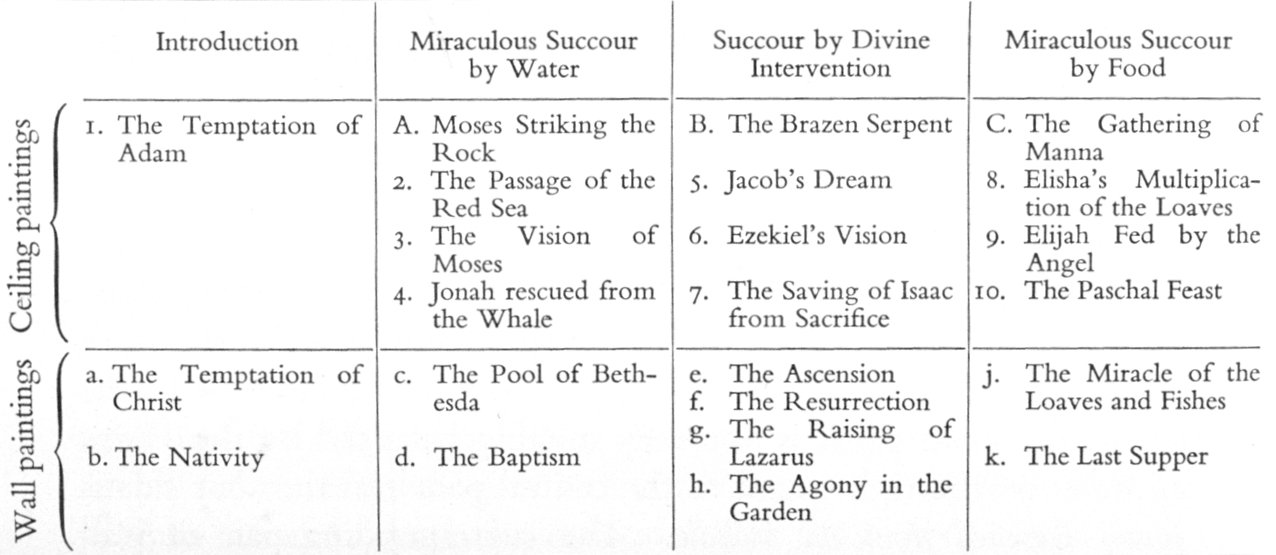
For Eric Newton (writing in 1952—and for other scholars, before and since), the three-fold division reflects the three activities of the School of San Rocco as a charitable organisation. Hence, after an ‘Introduction’ (1a, b), we have ‘Succour by Water’ on the walls and ceilings, ‘Succour by Divine Intervention’ across the central band, and ‘Succour by Food’ on the walls and the ceilings next to the altar.
Guido Perocco, however (writing in 1979 and summarising work done in the sixties and seventies), believed that the paintings should be read—as would be normal—retreating from the altar, and in accordance with the sequence of Holy Week.
‘Succour by bread’ refers to the consecrated host—the body of Christ, Corpus Christi, the ‘consubstantial’ bread—and would be the subject appropriate to Maundy Thursday, the day of the Last Supper.
The central themes are those associated with Good Friday and Easter Day: not simply ‘divine intervention’, but the Crucifixion, seen as a triumph, because followed by Christ’s Resurrection and Ascension—in short, the Crucifixion interpreted not as humiliation and defeat but as the means of our resurrection and union with God the Father, which are made possible by the sacrifice of the Son.
Thus, the canvasses in the third group are not concerned with water to wash off dirt or to quench a bodily thirst, but with water as the symbol of Grace, flowing from the wound in Christ’s side to cleanse the taint of Original Sin and the stain of all the sins we commit after baptism; or water as the means to quench the very special thirst of the Woman of Samaria.
The difficulty with Perocco’s strictly sequential interpretation is that the four New Testament narratives in the final section are all taken from the earliest part of the Gospel narratives.
So I am going to suggest that the ‘middle’ section of the Sala Grande—the canvasses you begin to see as you climb the stairs, both on the ceiling above and on the opposite wall—is ‘central’ in every sense of the word, since nothing else makes sense unless Christ was crucified and unless he rose from the dead.
The spiritual bread and the spiritual water evoked in the other main sections are complementary to each other—like food and drink, or like two branches growing out from the same trunk. Hence, there is no ideal order of presentation; and I am merely following a personal inclination in this lecture by choosing to examine the ‘branches’ before the ‘trunk’, that is, by beginning with Bread, continuing with Water, and finishing with Atonement.
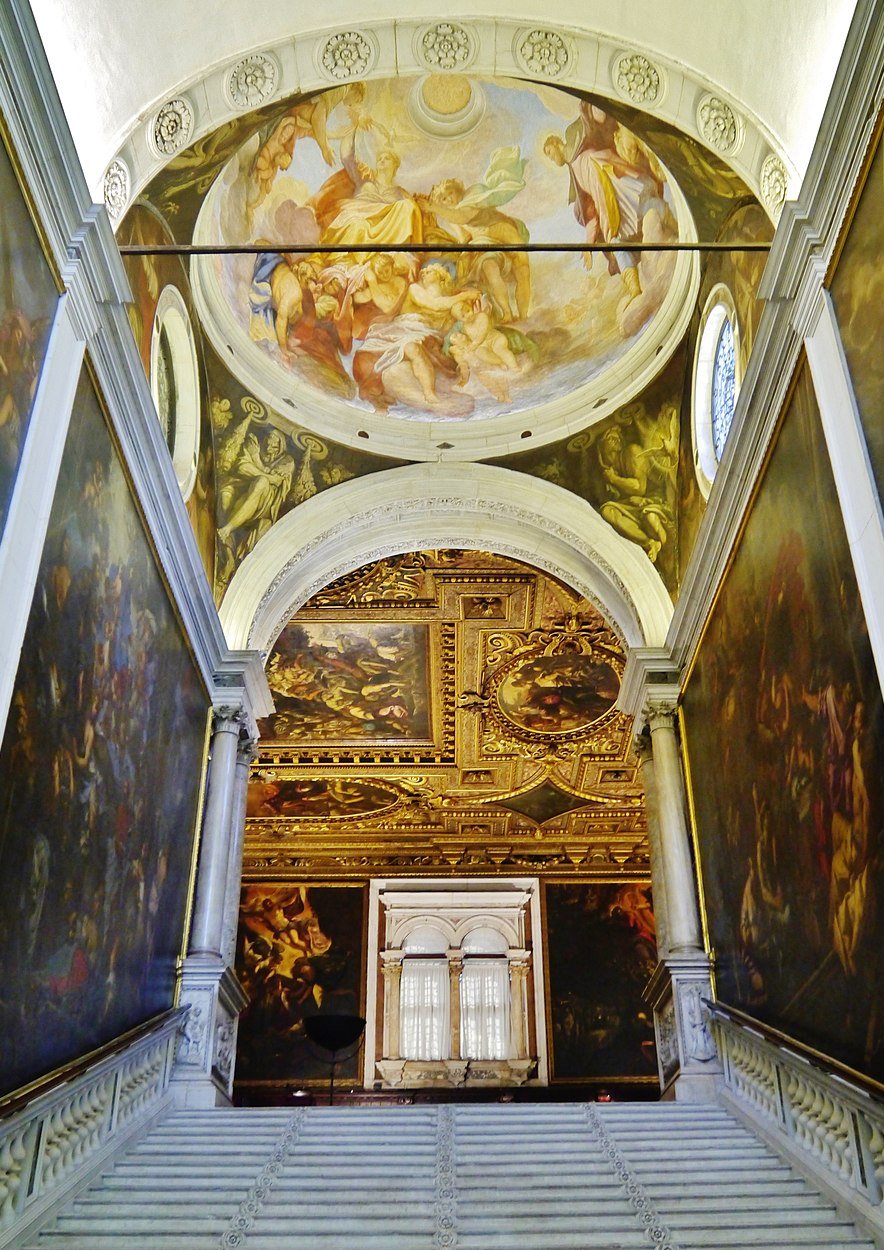
Let us now climb one of the two staircases up from the ground-floor, which unite at the half-landing and emerge into the vast Sala Grande; and let us begin our visit by going down to the altar and looking at the first canvas on the left-hand wall.
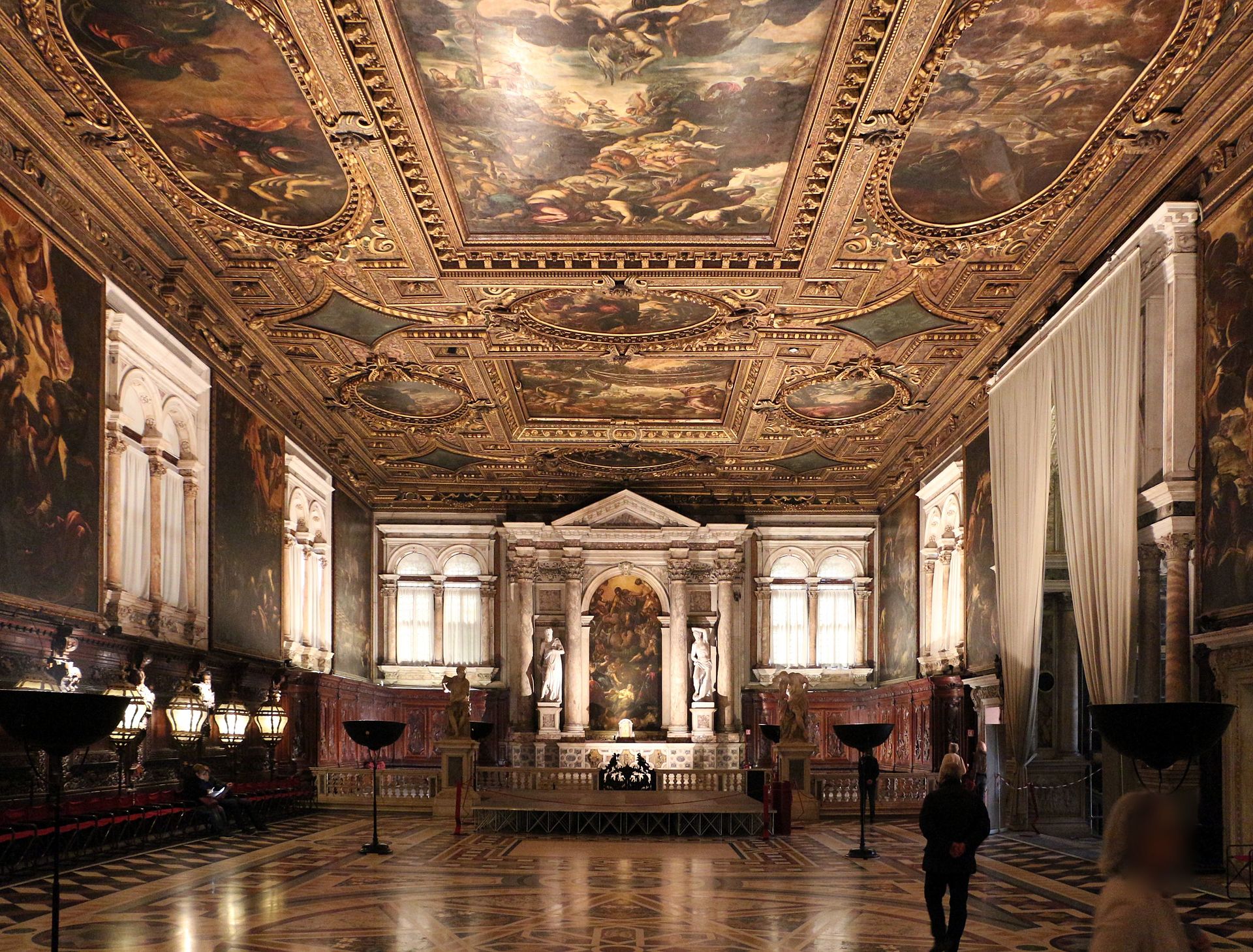
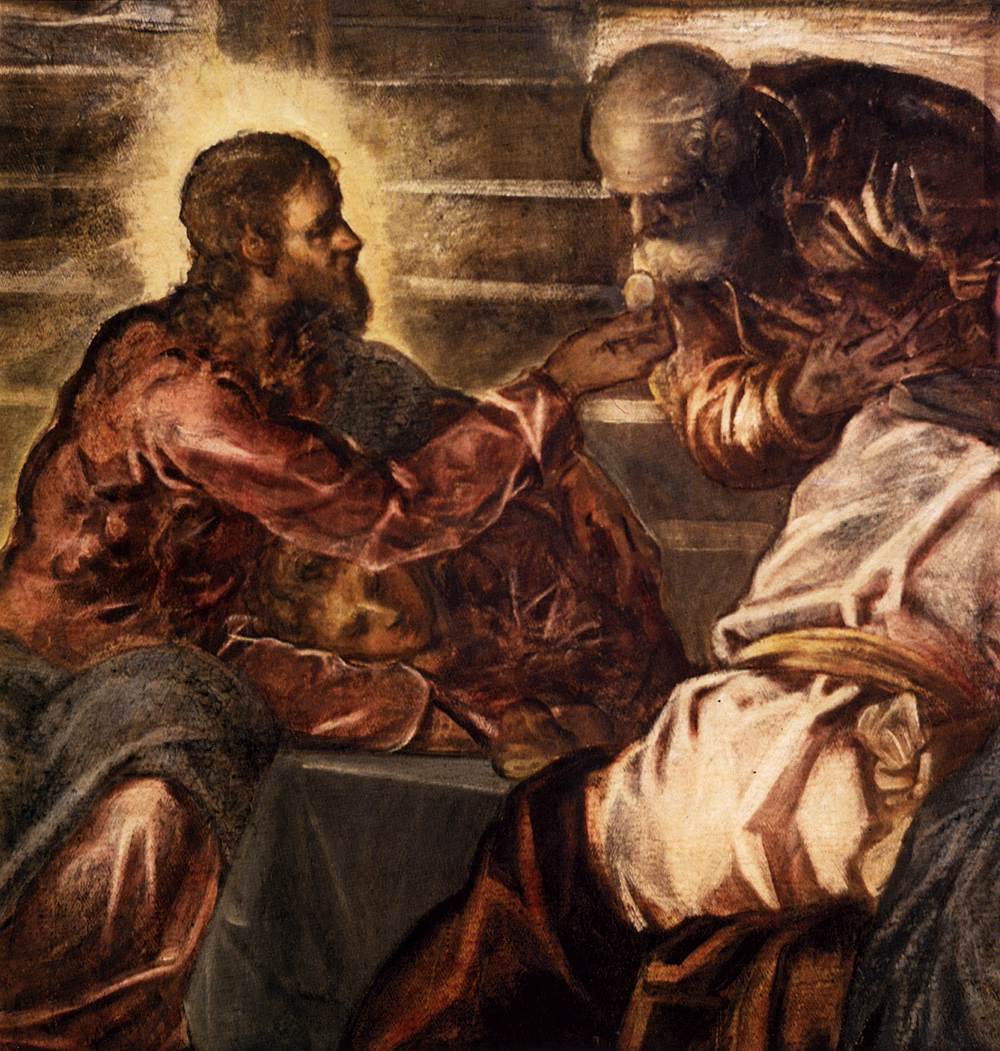
This is one of the most memorable images in the room—The Last Supper, painted when Tintoretto was about sixty years old.
Its lower edge hangs about a foot above our heads and it stretches up fully seventeen and a half feet. Within the picture, the horizon is set very high, so that you hardly notice the ceiling of the room, and the vanishing point is very close to the left side, so that the one visible wall and the tiles on the floor open up the space along a diagonal, just as happened in Christ before Pilate, fifteen years earlier.
The pictorial light sweeps in from the right again (from the unseen window beyond the fireplace) and also from the direction of the real light in the window on the altar wall, so that it catches the maid on the right of the steps in the foreground (she is almost in our space), next to the dog which directs attention upwards and inwards, these steps being the lowest of the three ‘levels’ in the stage ‘set’.
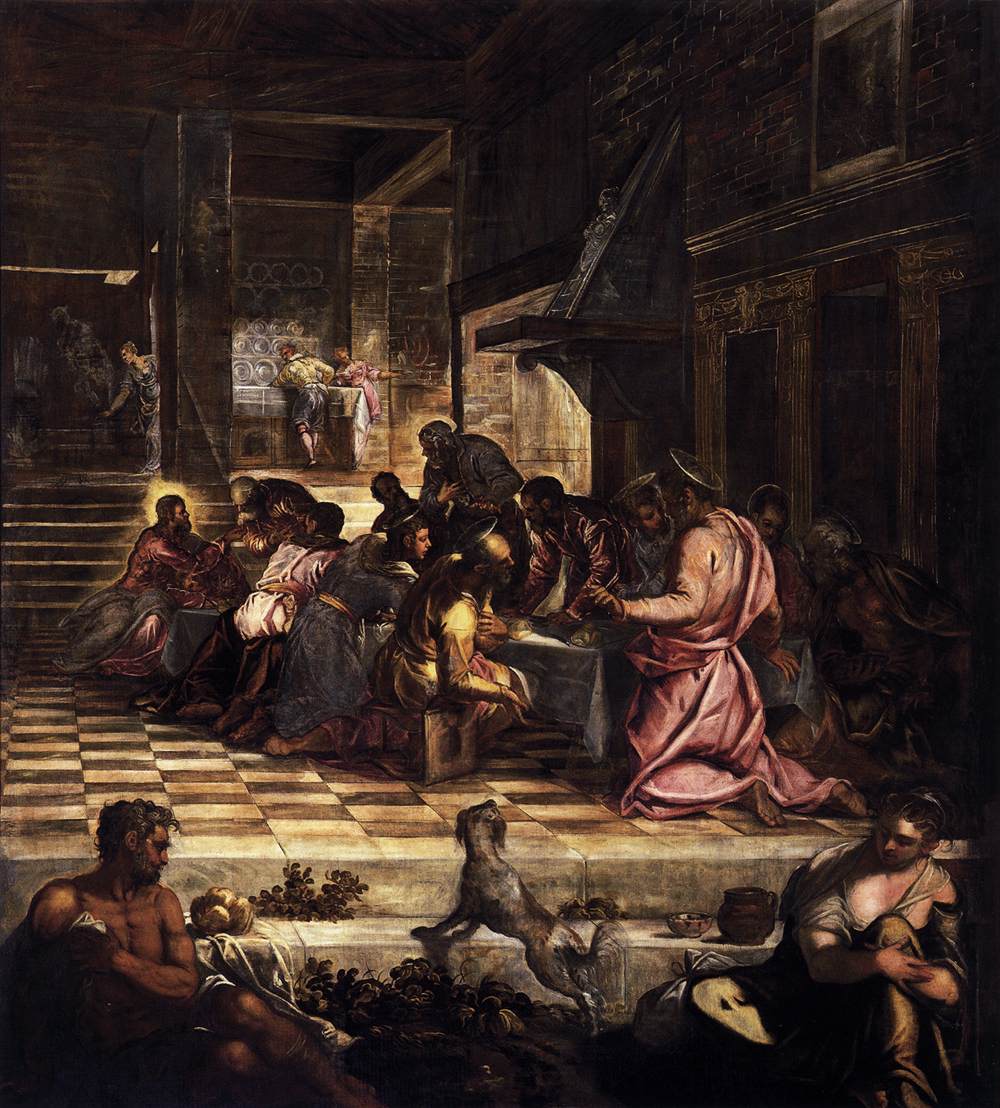
Despite its pilasters, the interior of the inn is as contemporary and local as Pilate’s palace had been classical.
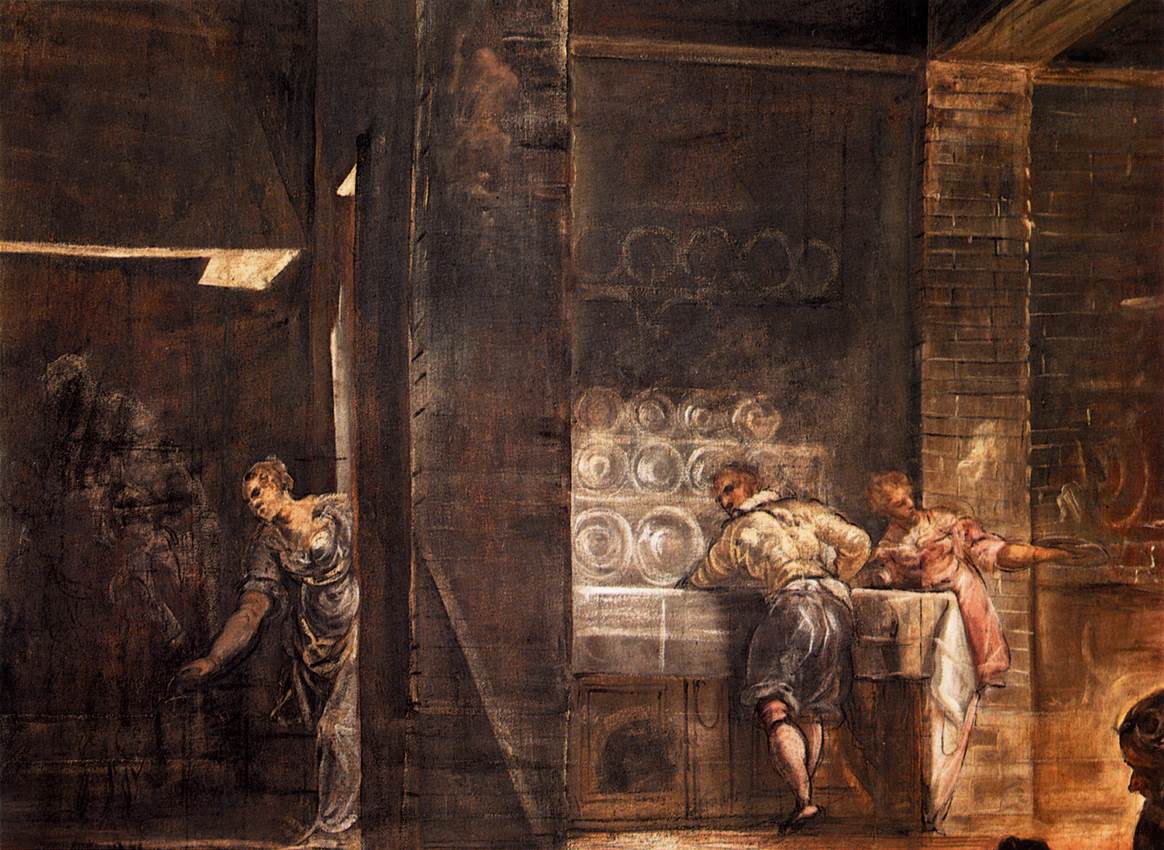
Focus on the unplastered brick, the metal hood over the fireplace, the plain workaday tiles, and servants reaching up for plates above the sideboard at the very back of the room.
But, of course, we do not really register such details at first.
Our eye goes to the figures at the table (it, too, being set on the diagonal), and to the human figures diminishing in size with unnatural ‘speed’—from the giant, kneeling at this end of the table, gesticulating and twisting to set up a wonderful pattern of folds, to the balding disciple next to him on a bench, or from the figure in deep shadow, on the other side, to the standing man.
Or again, we can follow the gaze of the apostle in white (half-way down the near side of the table) to the minute but dominating figure of Christ at the apex of the cone of figures, very close to the vanishing point of the perspective, his face emitting celestial light, as he says to Simon Peter: “Take, eat, this is my body.”
(Notice that Jesus does not ‘break bread’ but is offering the ‘wafer’ or ‘host’ which the faithful take during the Eucharist, that is, during Holy Communion—the deliberate anachronism pointing up the meaning of the scene and making sense of the loaf of bread in the foreground.)
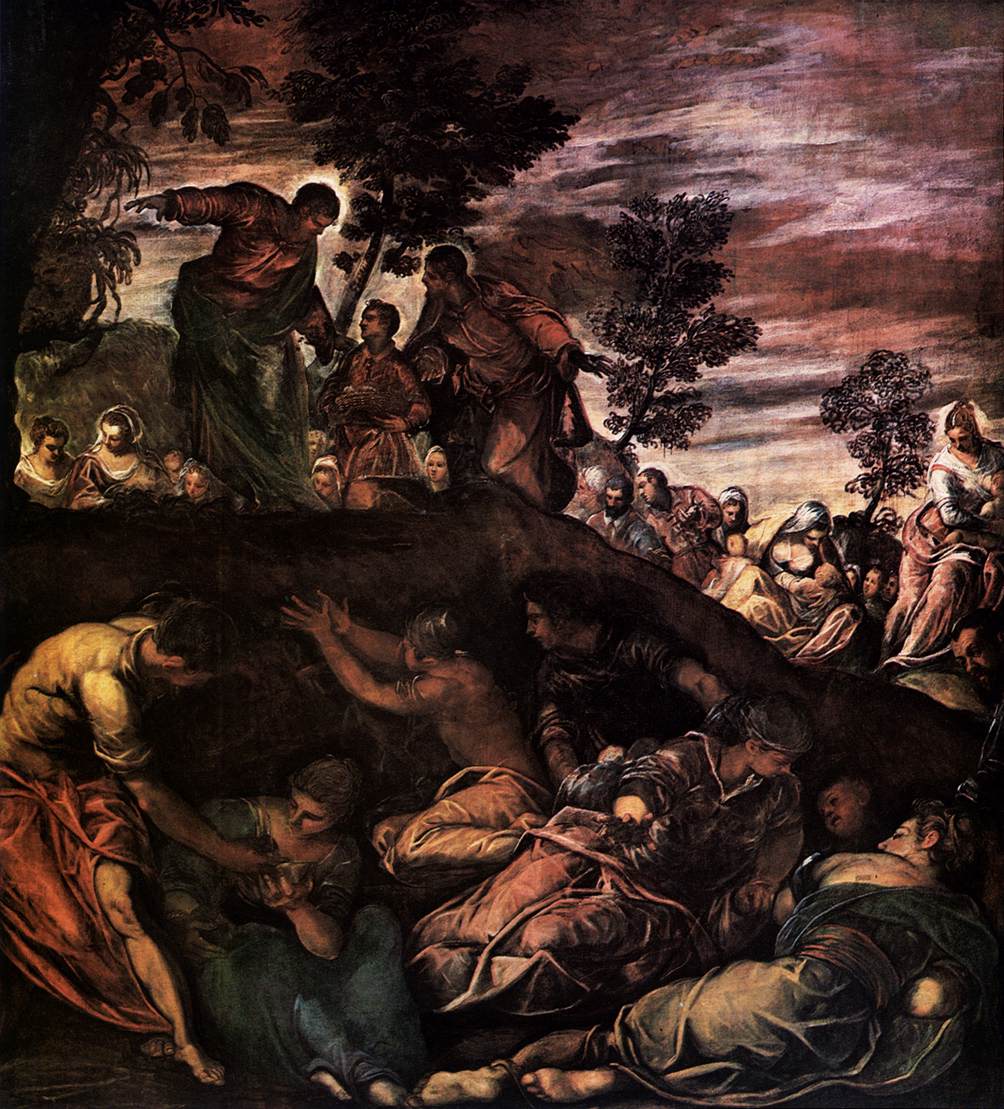
Immediately opposite, on the right-hand wall, just six inches less in each dimension, we find a miracle that prefigures the Last Supper within the Gospel narrative itself (rather than in the Old Testament). It is the Feeding of the Multitude (as told in the Gospel of St John, Chapter 6), when Jesus fed five thousand people with just two fish and five barley loaves.
The composition does not yield a particularly memorable image, but notice that it uses a favourite form, that is, a ‘split-level’ construction involving a diagonal slope.
Thus, the hill provides a dark background for the six lower figures, who are very close to us as spectators, and very Mannerist—sprawling in exhaustion and hunger, remonstrating with outstretched fingers, reaching up for the bread, or handing it down to a companion in need.
Yet the same hill provides a ‘platform’ for the boy with a basket, who is welcomed by Andrew (who discovered him), and is then sent to distribute his bread and fish by Jesus with a balancing sweep of the arm—these figures being silhouetted, like the seated women and children and the skeletal trees, against the dramatic yellows, reds and greys of the sky.
The whole picture has an extraordinary tonality.
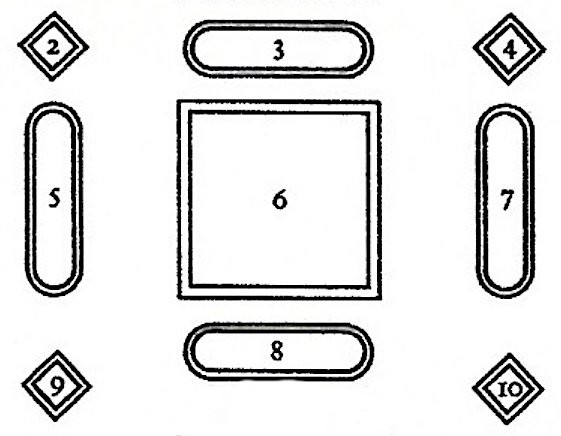
The time has come to mentally tip your heads back to study the Old Testament prefigurations of these scenes on the ceiling above.
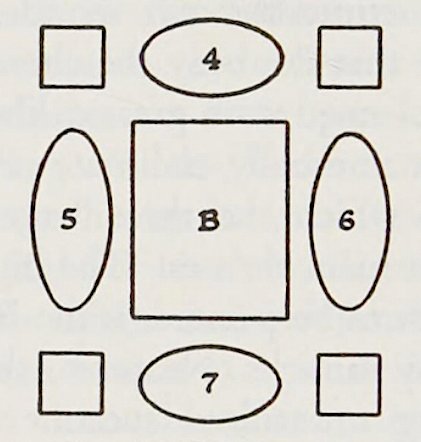
The relative positions of the canvasses are shown in the diagram; and the pattern they form is really quite simple: a rectangle, surrounded by four ovals, with a separate lozenge at each corner.
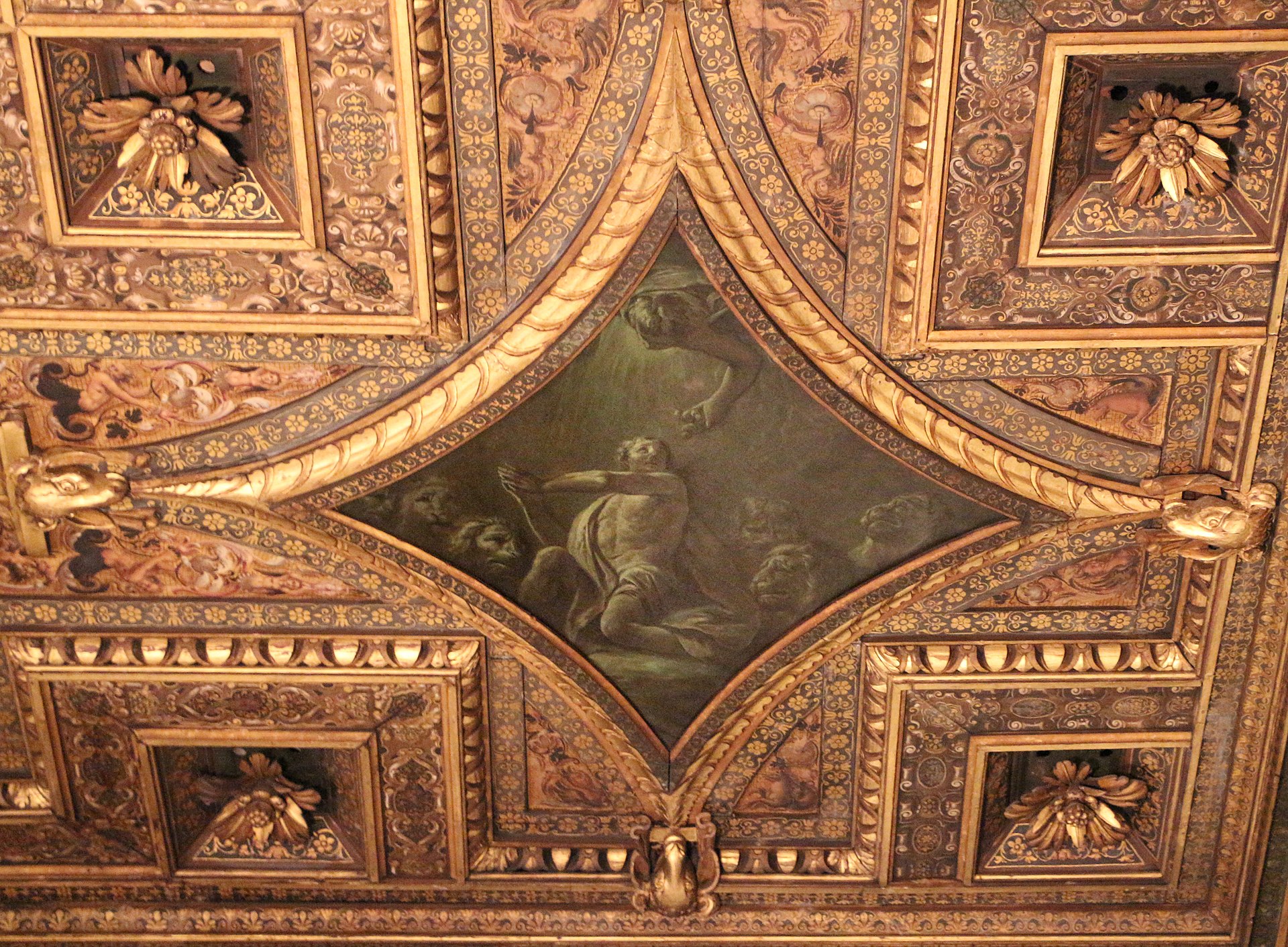
I will simplify the exposition still further by ignoring the lozenges (one of which is shown here) on the grounds that they were almost completely repainted during an eighteenth-century restoration.
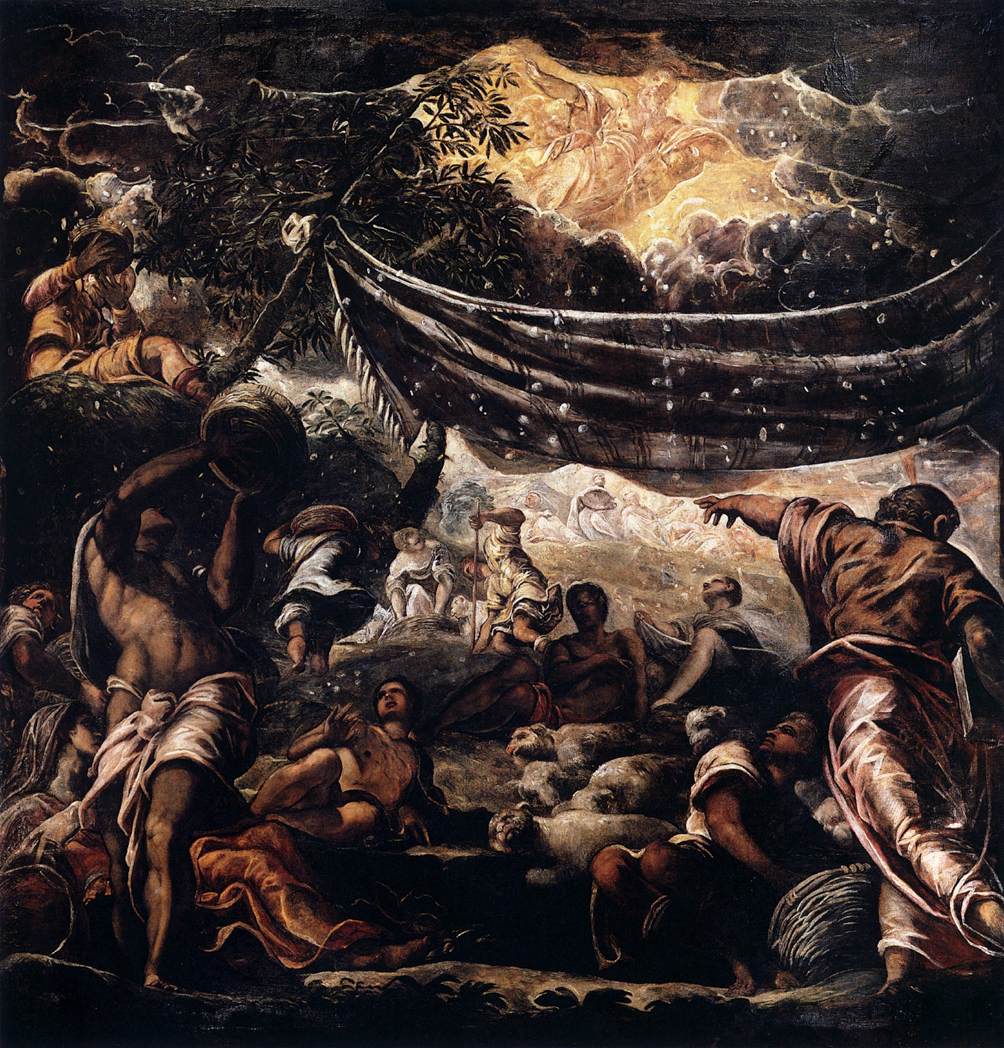
We may begin with the first of the three large-scale scenes involving Moses, the one in the rectangle, which measures about seventeen feet by sixteen.
It is perhaps the least successful, artistically, of the ceiling rectangles; and you must use your imagination sympathetically to enter into its mood and meaning, remembering all the time that the painting is intended to be seen above your head, with the ceiling of the Sala apparently opening up to reveal the ‘sky’ and ‘heaven’ (Italian uses the same word for both: cielo).
You are standing, then, at the bottom of a mountain in the wilderness between Sinai and Ephraim, looking up the slope to see the Israelites who have escaped from bondage in Egypt with their flocks.
Your eye must go up and up, until you see (Exodus 17) ‘a glory of the Lord appear in a cloud’.
As so often in Christian art, the picture represents several moments in the Bible narrative simultaneously; but it will be enough if you follow the upward thrust of Moses’s arm, as he promises that the Lord will ‘rain bread from heaven’, and then visualise the fulfilment of the promise as the flake-like manna comes floating down from God, to be collected by the other standing figure in the foreground.
There is no space here to explain the significance of the ‘awning’; but it is important to grasp that the flakes of manna are painted to resemble the consecrated wafer or host that we saw in the Last Supper, reinforcing the typological link between the canvasses.
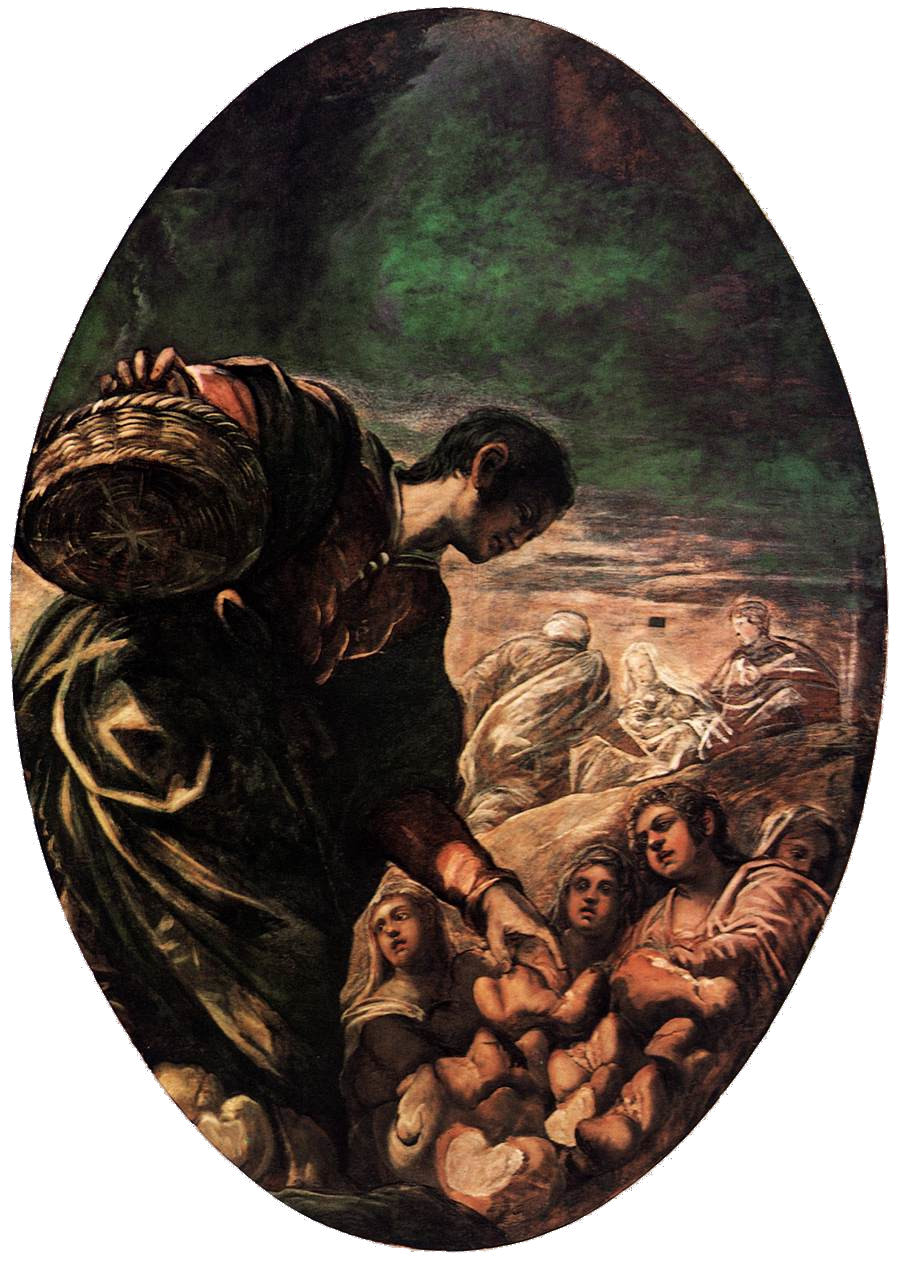
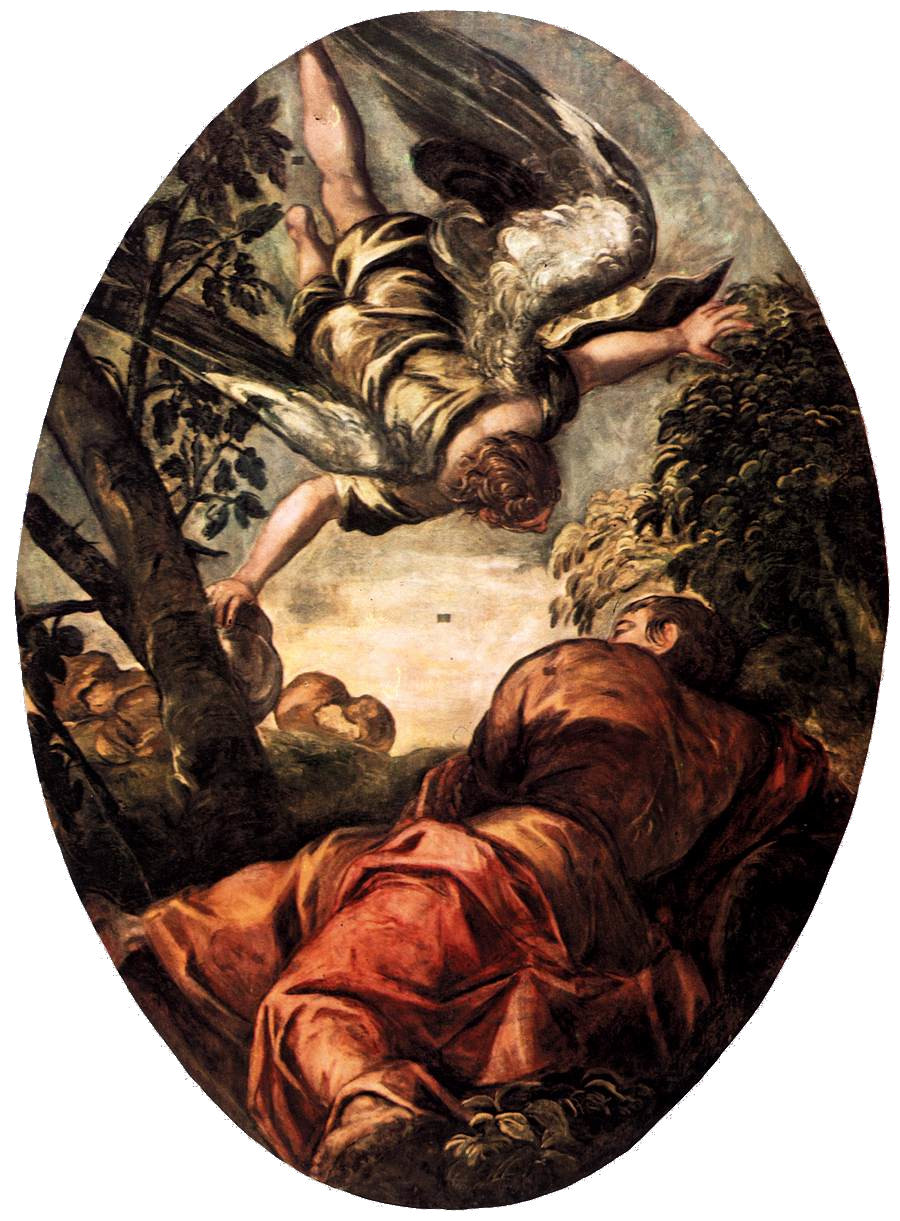
To the left and the right of The Manna, you will see two ovals, twelve feet long, designed to be read longitudinally.
On the right, an angel plunges down from heaven, bringing (I, Kings 19), ‘a cake baked on hot stones, and a jar of water’ to the prophet Elijah, who had fled from Jezebel into the wilderness ‘and laid down under a broom tree saying: “Lord, take away my life, for I am no better than my fathers.”’
On the other side, we see his disciple Elisha, who (according to II Kings 5) anticipated the Feeding of the Multitude, by feeding a hundred men with twenty loaves of barley (these being painted good and big, as is the loaf-shaped cake).
The Lord gives to the Prophet; the Prophet gives to the rest of mankind.
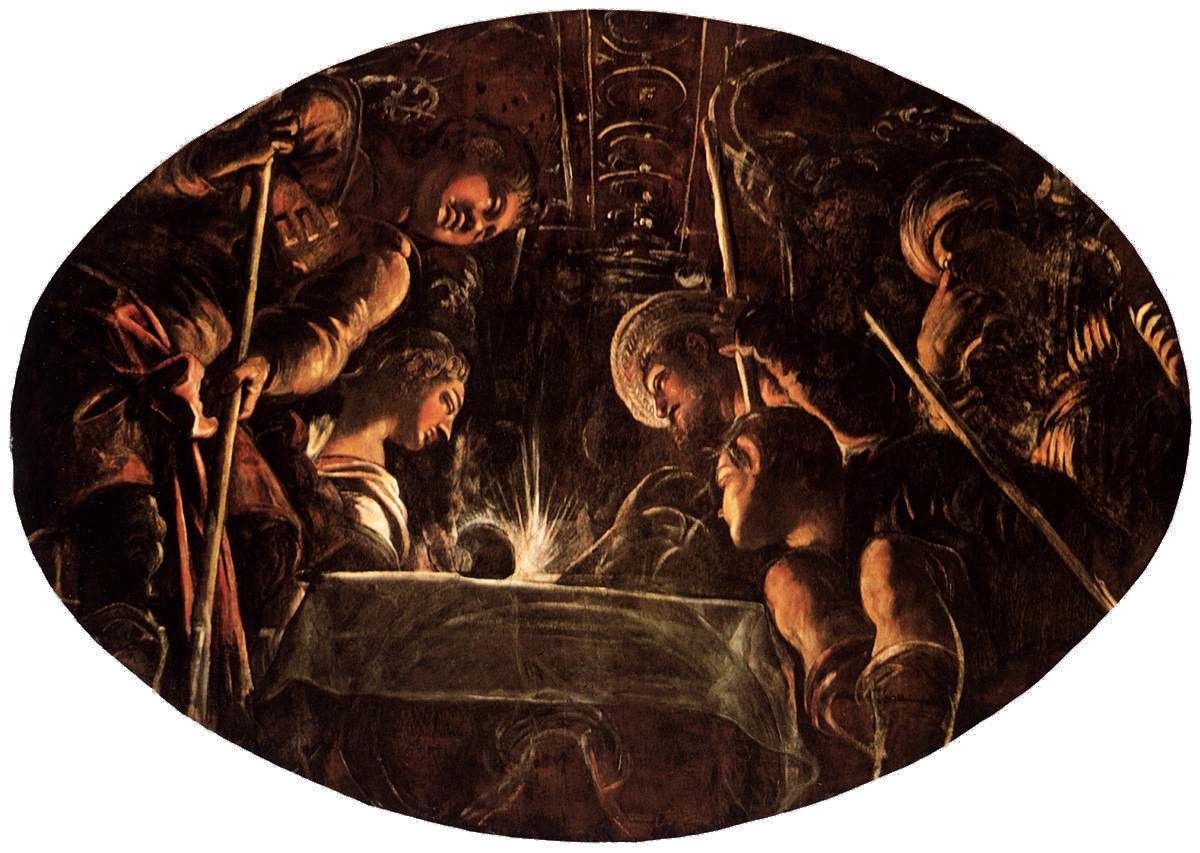
Finally in this section of the ceiling, we must look at the oval presented horizontally, and therefore twelve feet wide, between the altar wall and the Manna.
It represents the Jewish Passover—either the original event in Egypt (as described in Exodus 12), when the angel of the Lord killed the first-born in every Egyptian home but ‘passed over’ the Israelites, or the annual feast observed ever afterwards in the same form—the feast which Christ was celebrating with his apostles in what Christians call the ‘Last Supper’, which in turn was regarded as a prefiguration of the Christian Holy Meal, the Eucharist.
So, in a dazzling feat of foreshortening from below (again: this is a ceiling painting), in a panelled room lit by candles—a study in brown and yellow—we see a family of Jews about to eat the Paschal Lamb, exactly as Moses prescribed: ‘In this manner you shall eat it: your loins girded, your sandals on your feet, your staff in your hand; and you shall eat in haste.
At this point, you might like to pause and refresh your memory of the schemes and diagrams of the whole room (figs. 25, 27, 28), because I am going to break away from a strictly sequential presentation and walk you down the room to the end furthest away from the altar to examine the canvasses which are grouped round a colossal rectangle, showing Moses Drawing Water from the Rock.
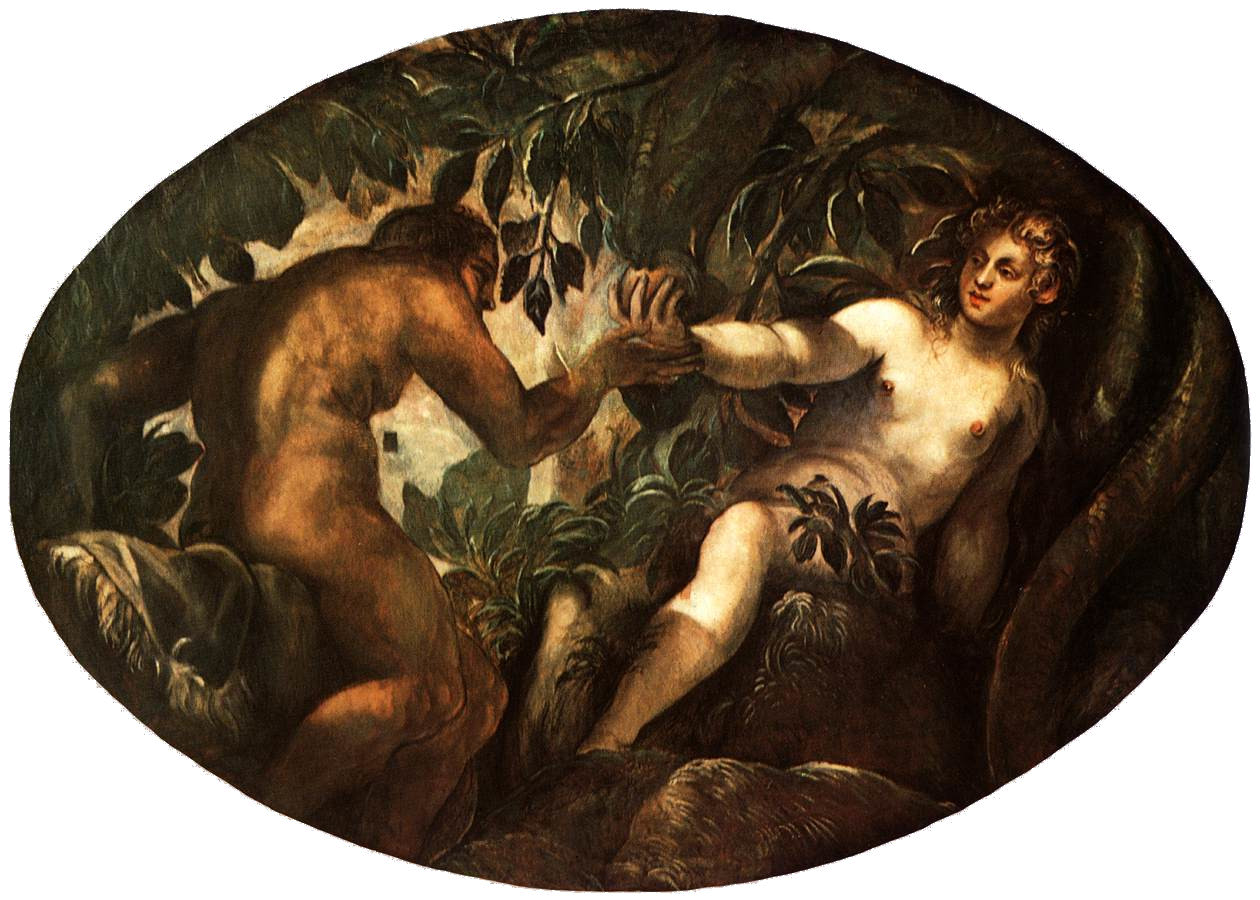
We shall begin with the horizontal oval furthest away from the altar, again twelve feet wide, which depicts the beginning of the history of Man considered as a free, moral agent—The Temptation (and, implicitly, The Fall).
It links up, by way of contrast, with the two ovals we have just looked at (Elijah and Elisha), because the ‘luminous’ figure of Eve (standing out against the dark green foliage of the Tree of Knowledge) is holding out to Adam a fruit that he has been forbidden to eat by God, instead of ‘a cake baked on hot stones’ of which God has invited him to partake.
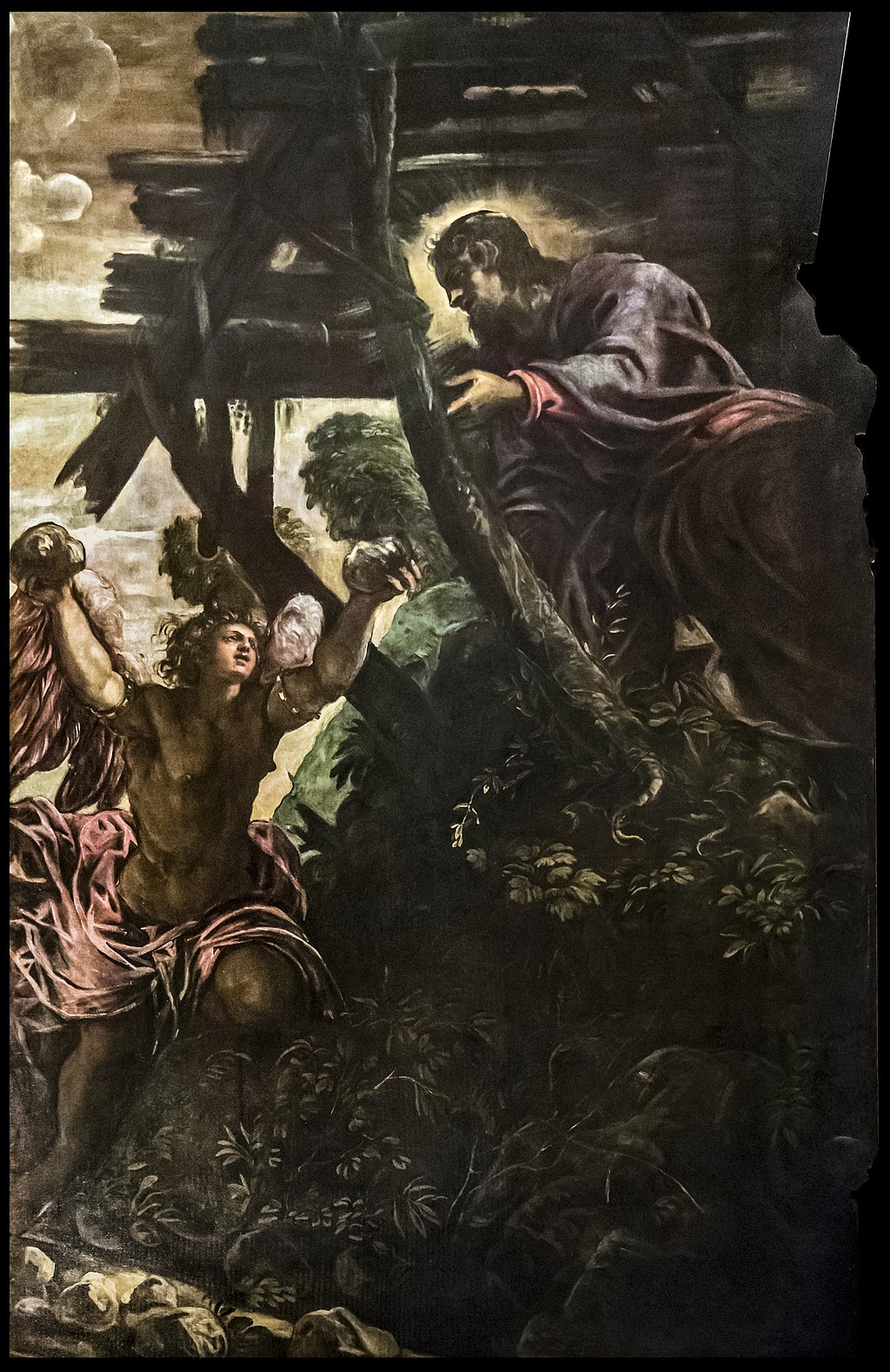
This scene is paired, typologically, with the New Testament wall canvas immediately underneath which is placed to your right as you face the altar. It stands a massive seventeen and a half feet high, but only eleven across, and it represents the Temptation of Christ by Satan.
Jesus is fasting in the Wilderness. He has made himself a primitive shelter, Robinson Crusoe style, by adding broken-off ‘horizontals’ to the ‘uprights’ offered by two curving tree-trunks.
According to the Gospel of St Matthew, Chapter 4, he had been without food for forty days; ‘and afterward, he was hungry’. The Devil appears and ‘tempts’ him—that is, ‘puts him to the trial—for the first of three times, by saying: ‘If you are the son of God, command these stones to become loaves of bread’. But Jesus, unlike Adam, refuses the challenge with the words: ‘Man liveth not by bread alone.’
Again, we have dark green foliage; again, a contrast of shadow and sky; and again, the exploitation of the diagonal for the ‘bursting in’ of a supernatural being.
But this is a fallen angel, beautiful but damned. And Satan flies up from the depths of the underworld, rather than down from heaven, as did the angel who succoured Elijah in the Wilderness.
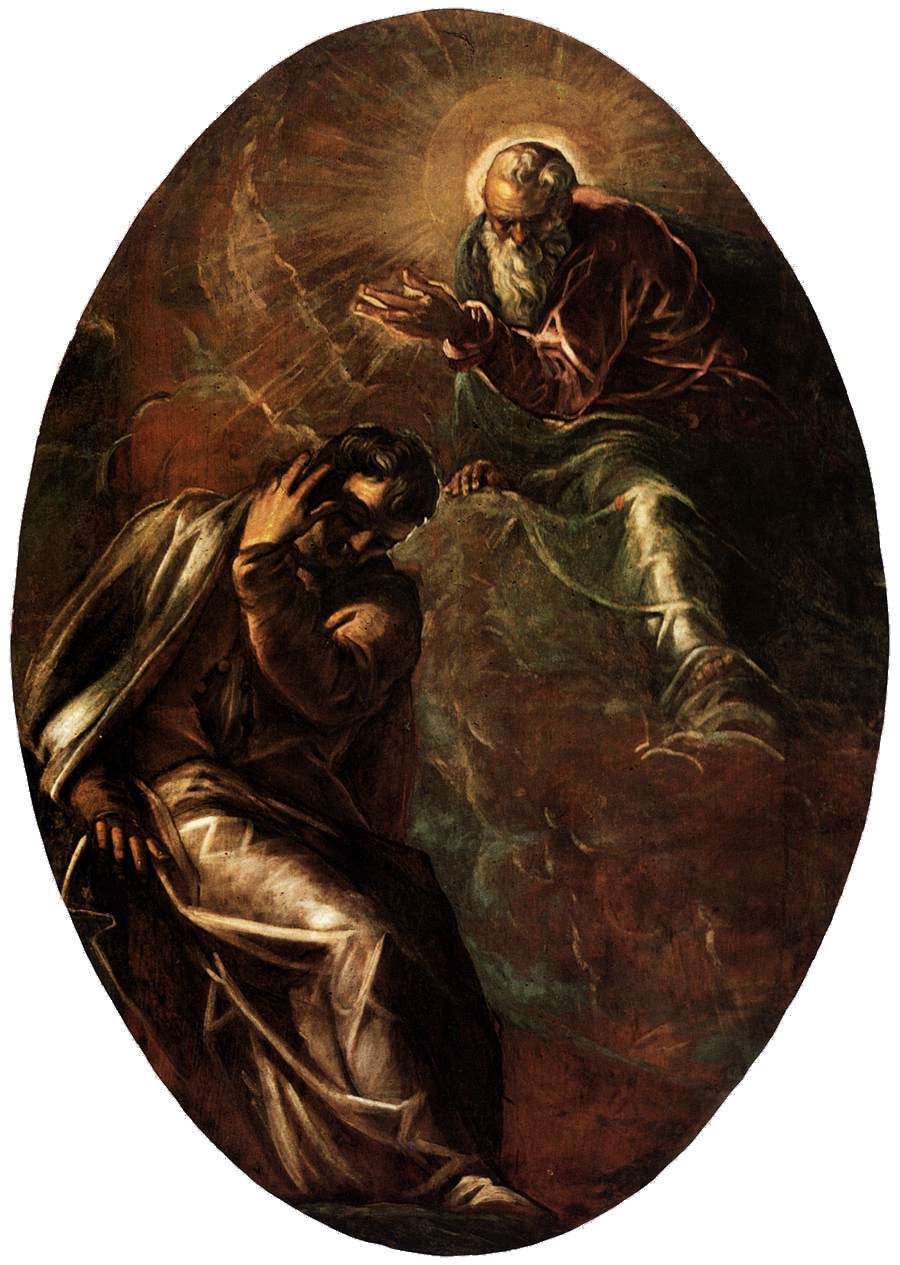
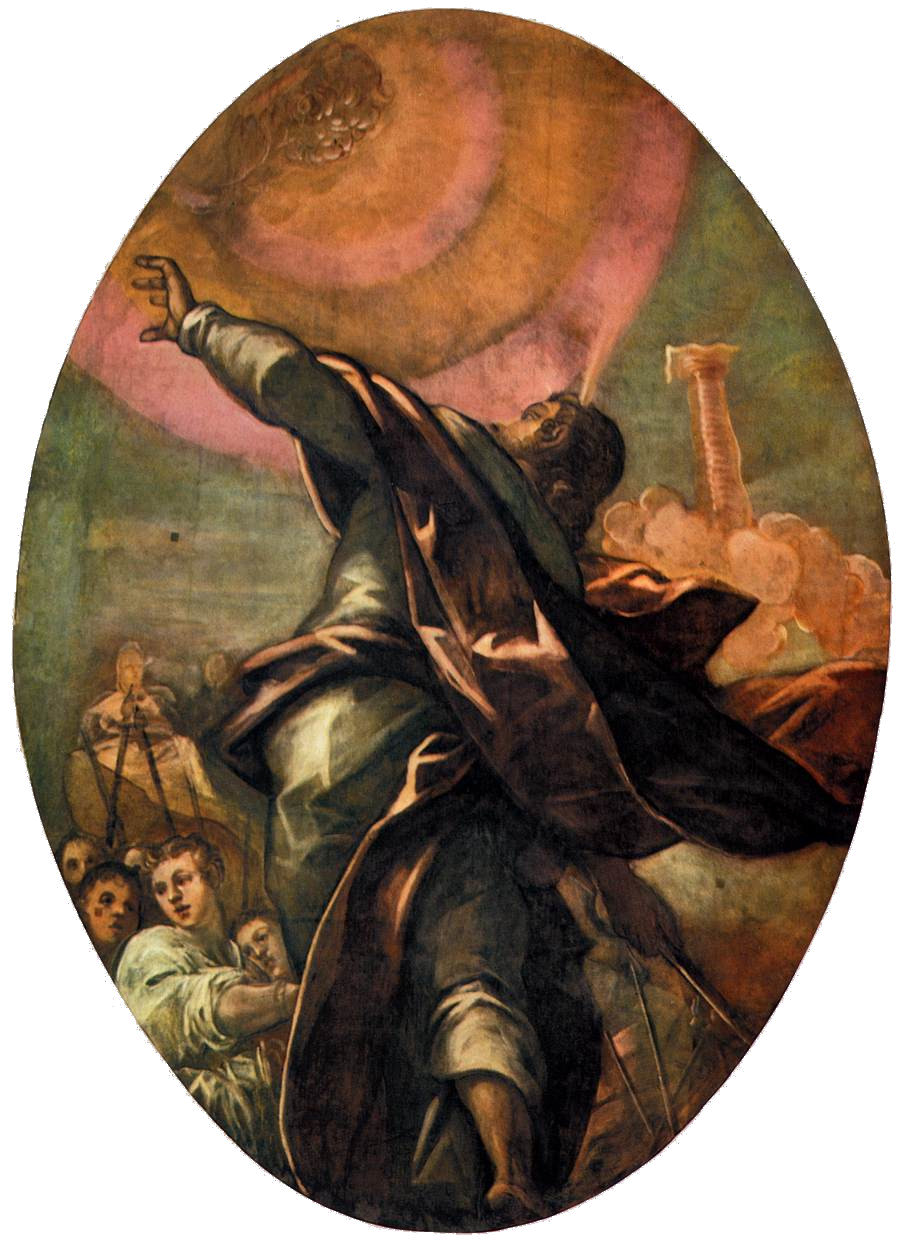
The two longitudinal ovals on the ceiling depict crucial episodes from the life of Moses, in which he emerges as leader of the Chosen People and therefore as a ‘type’ of Christ the Saviour of Mankind.
On the left, you see the moment (Exodus 3) when he received his charge. Moses has killed an Egyptian, run away from his kinsmen, married a Midianite, and is tending the sheep of his father-in-law on Mount Horeb. There the Lord appeared to him, ‘in a bush that burned and was not consumed’ and entrusted the reluctant Moses with the task of leading his people out of slavery into the Promised Land. We read that: ‘Moses hid his face, for he was afraid to look at God.’
The oval on the right shows us Moses active in his role as leader; and you can make out a few of his followers, to the bottom left. He is not actually crossing the Red Sea, but he is being guided towards that sea on a nocturnal march (as we are told in Exodus 14) by what is variously translated as a ‘pillar of cloud’, or a ‘column of fire’.
You can see the pillar or column seemingly balanced on a cloud. You can also see a ‘fiery radiance’ from the Angel of the Lord, who is said to have ‘gone before the host of Israel’. And we must accept the clue offered by the dividers in Moses’s right hand to interpret the imperious gesture of his left hand as one of separating the waters of the Red Sea to allow the Israelites to cross on dry land out of Egypt into the wilderness and ultimately to the Promised Land.
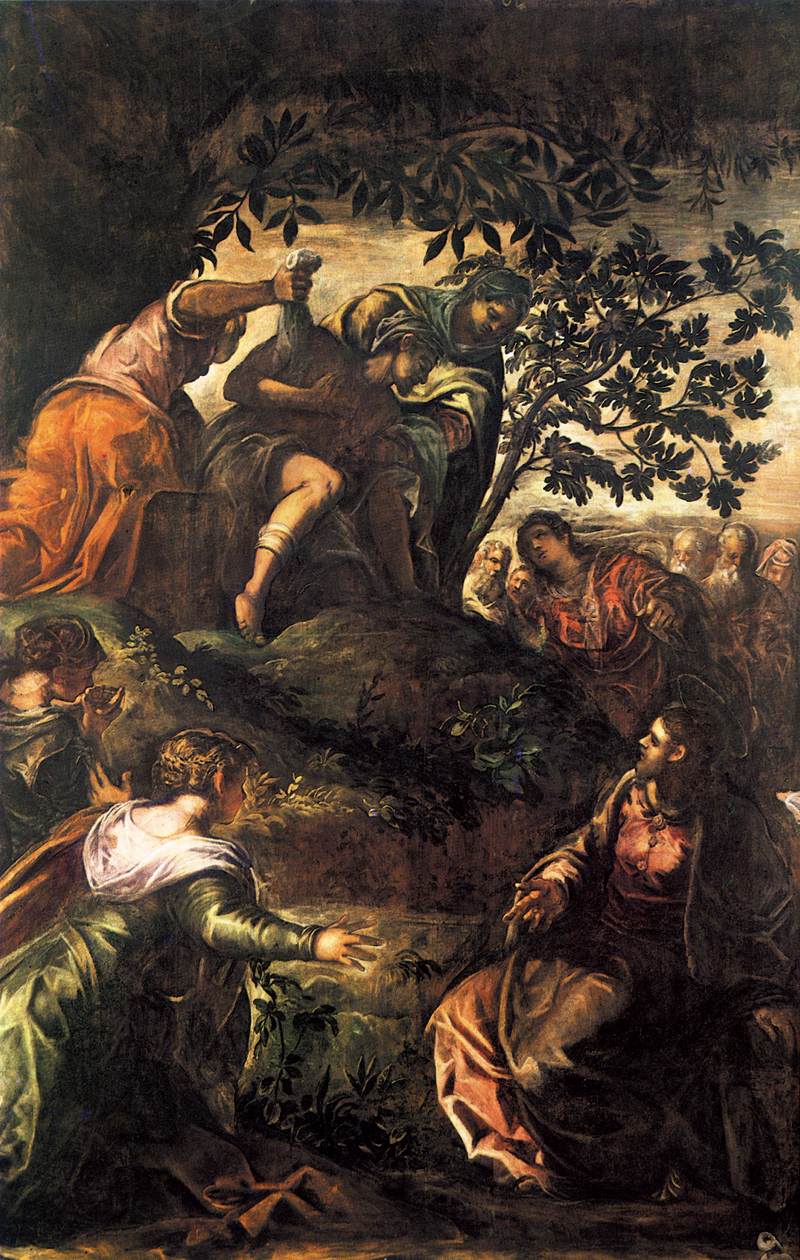
We can stay with Moses, and stay looking at the ceiling, while we go forward three chapters in Exodus to Chapter 17, which tells the story illustrated in the glorious rectangle lying between the two ovals—fully eighteen feet by fourteen.
The episode occurs immediately after the story of the Manna, and hence we are already in the Wilderness on the far side of the Red Sea. As so often, the Israelites are on the point of mutiny, this time because they are suffering from thirst. So, ‘the Lord said to Moses: “Take in your hand the rod with which you struck the Nile. Behold, I shall stand before you on the rock, and you shall strike the rock, and water shall come out of it that the people may drink.” And Moses did so in the sight of the elders of the people of Israel.’
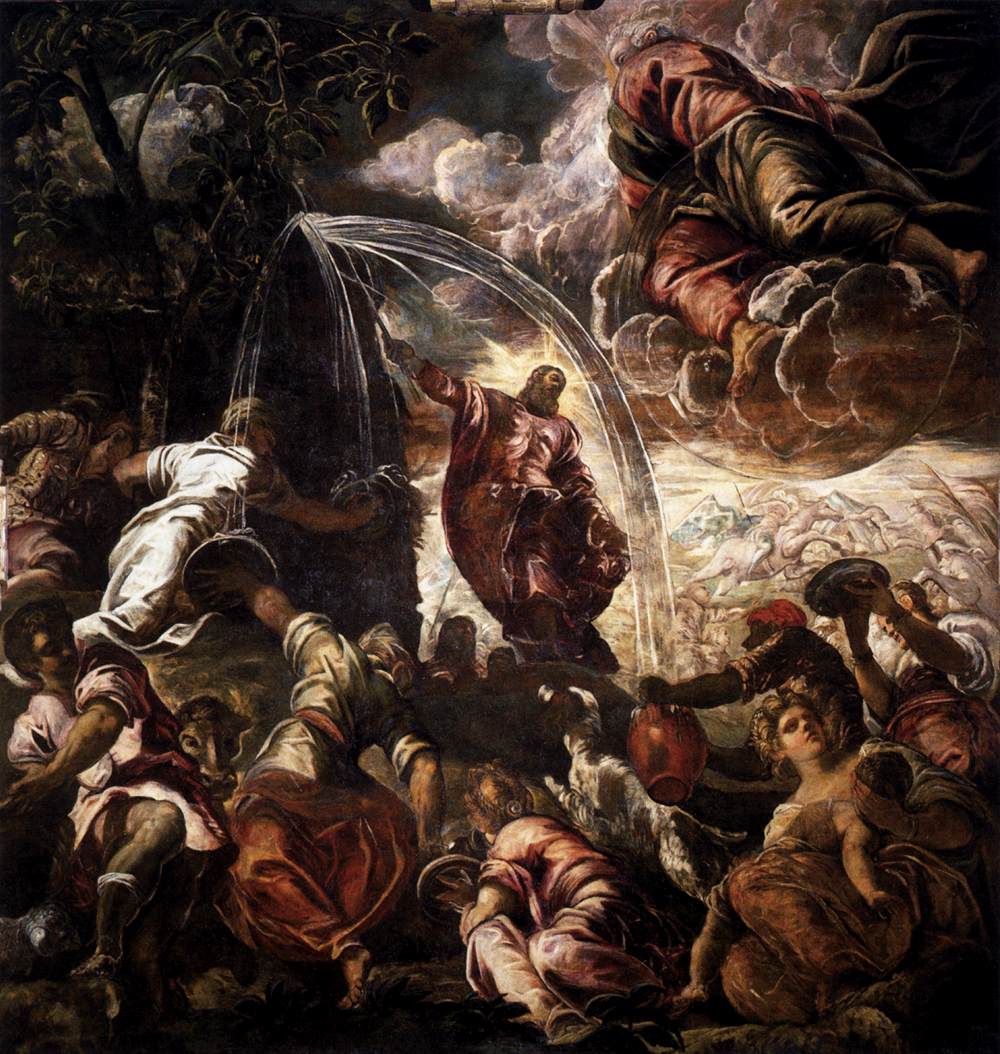
Keep looking but try now to imagine yourself as being in the Sala, craning your neck backwards, looking high above your head at the dark rock face, with the usual dark foliage at the summit—staring up to where the ceiling should ‘dissolve’ to show the open sky, or the opening of heaven.
Again, there is a two-way movement of ascent (Jehovah is returning to heaven after ‘standing before Moses’), followed by a movement of descent, as water spurts out from the rock, which Moses has struck with his rod, down to the women below (all in the most mannered of poses), who are catching the water in pitchers.
Having abandoned any intention of presenting the sequence of paintings strictly in the order demanded by the argument of the decorative scheme, I shall make a virtue of necessity and remain at this end of the Sala Grande to look at the three remaining scenes from the New Testament.
We begin again, so to speak, at the left end of the left-hand wall—furthest from the altar—with The Adoration of the Shepherds (the shepherds being those to whom the angels first brought the ‘tidings of great joy’, who were the first to worship Jesus, and with whom the poorer members of the School could most easily identify).
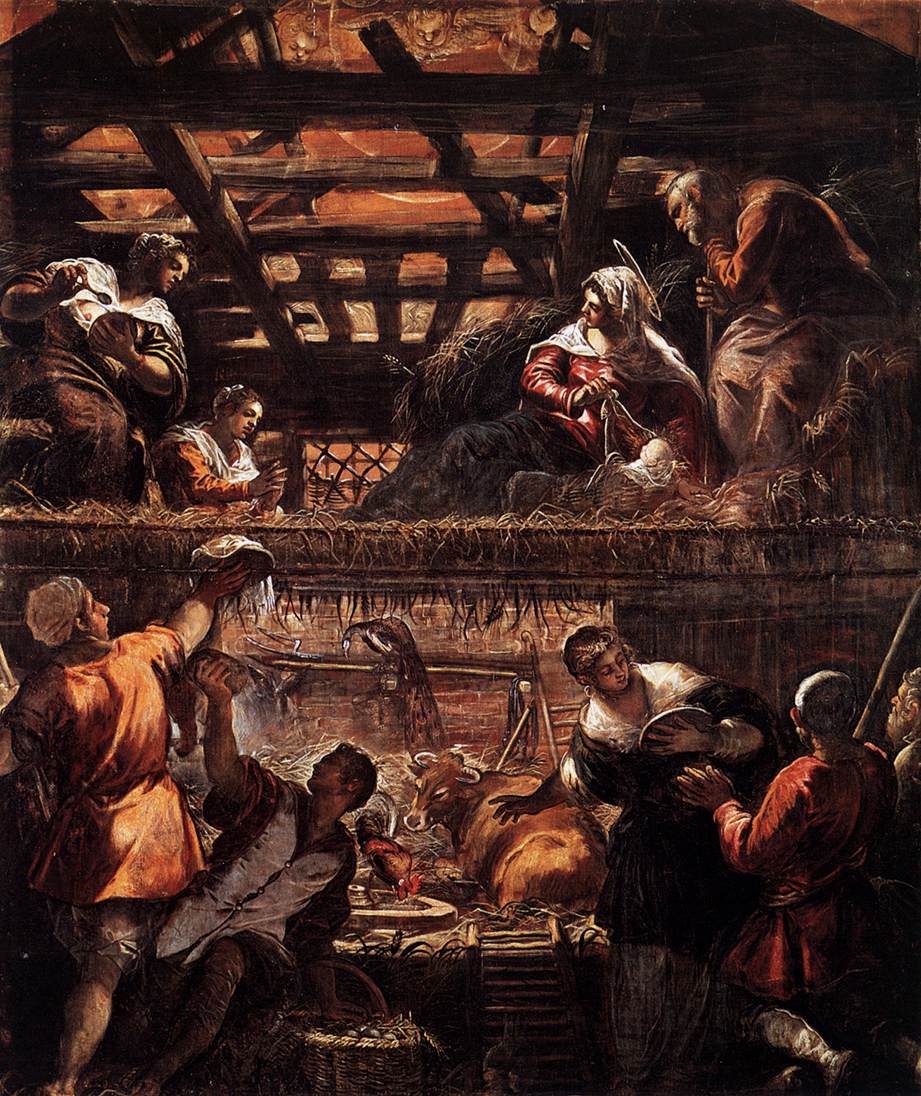
Once again, the great height of the canvas—seventeen and a half feet—encouraged Tintoretto to adopt one of his trademark ‘split-level’ compositions. (Remember, though, that what you see here must have been a pretty faithful representation of a northern Italian farmhouse, with the animals on the ground floor and the Holy Family up in the hayloft, under the broad beams of the roof.)
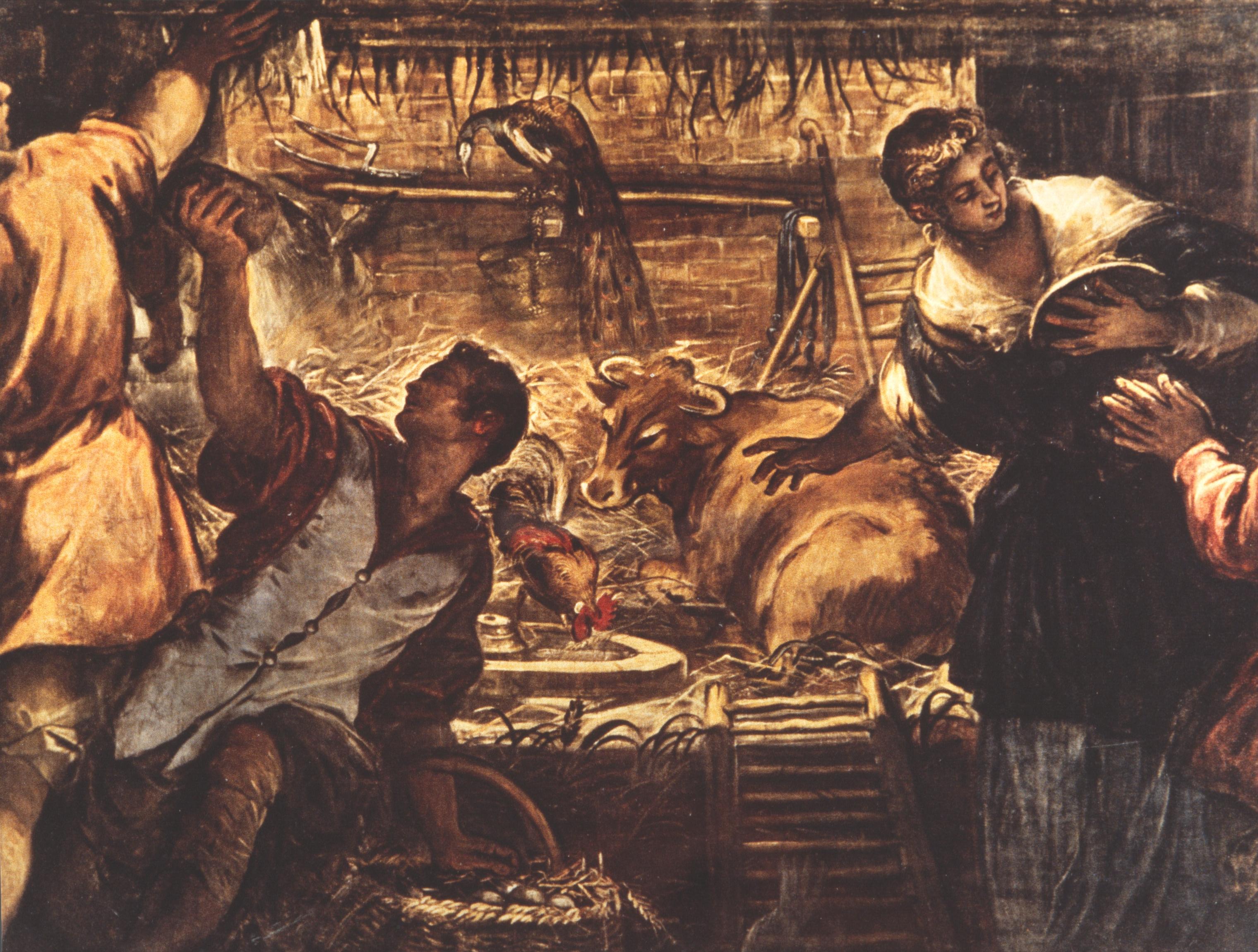
This is as irresistible as The Last Supper in its contrasts of light and deep shadow and its touches of realism—I am thinking of the wicker basket and the eggs, the cock picking up grain next to the wheel, the pitchfork in the rack, and even the symbolic peacock (who is a debt to tradition, no less than the ox, but is so dark and so bedraggled as to be perfectly in keeping with the stable).
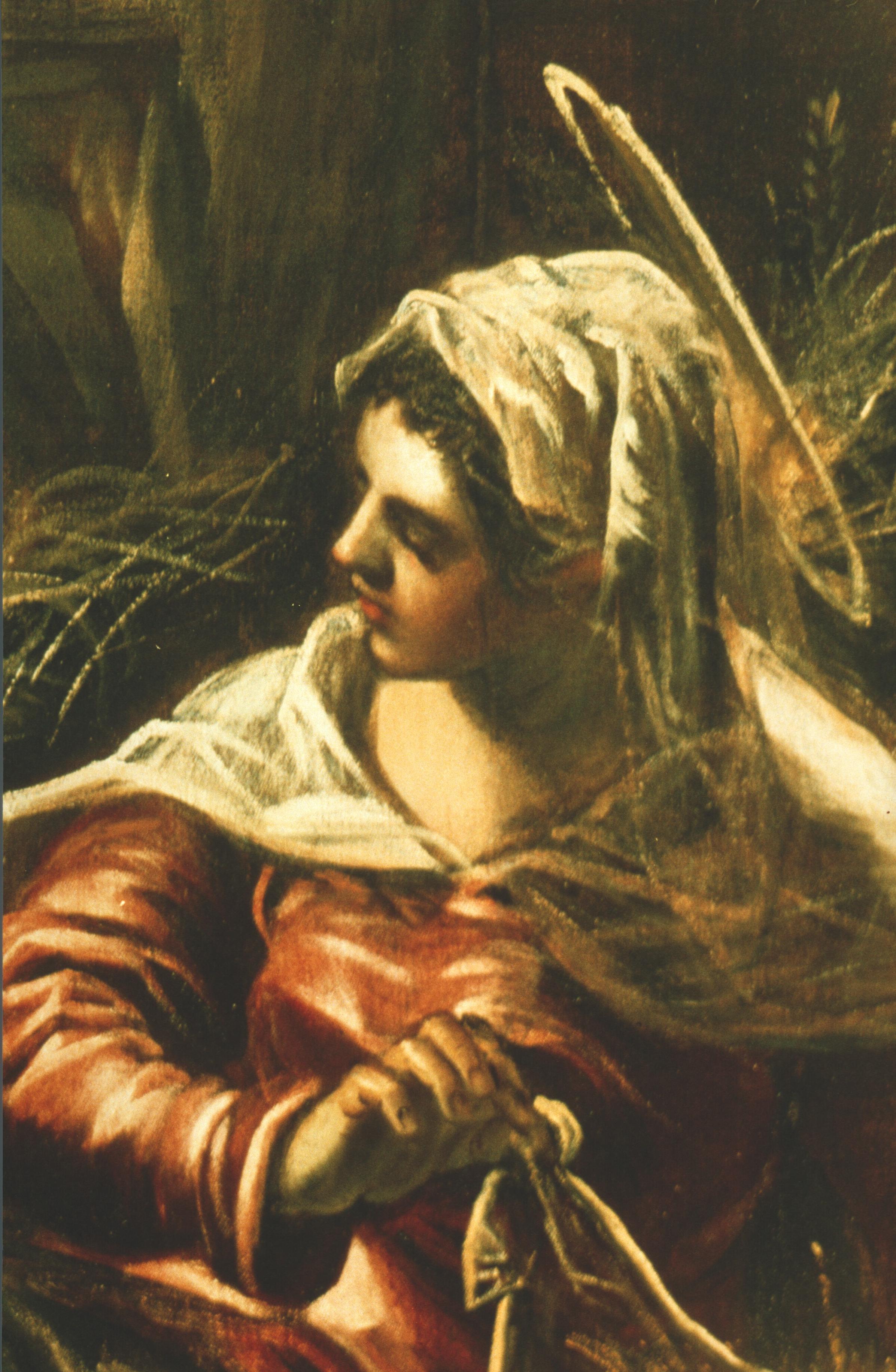
We are meant to feast our eyes on the archetypal Tintoretto maid-servant, gesturing inwards, in front of the two elder shepherds (with their contrasts of highlight and deep shadow); the élan of the two younger shepherds (one reaching up and round with a gift of a chicken, the other stretching up to the higher level with his hat, and so guiding our eye to the two midwives, who are another debt to tradition); the cherubs peeping down in a flood of pink light (repeating the message of ‘Peace on Earth’); old Joseph, resting his chin on his staff; and perhaps the most expressive Mary that Tintoretto ever painted, lifting the veil to reveal the ‘brightness’ of the baby.
Alongside The Adoration of the Shepherds (which is ‘the first beginning’ of our Redemption), we have the ‘second beginning’—the start of Jesus’s adult mission—and the first full statement of the ‘Water theme’ in this Baptism, which is almost exactly the same size as the Adoration.
The River Jordan is flowing towards us, on the diagonal, forming a little bay on the near bank, thanks to the huge black rock. This provides a dark background or frame to the young man, who is re-robing after the ceremony, to the mother, who is suckling a very large child, and—a very rare figure in this cycle—to a member of the Scuola in contemporary dress.
In the fiery sky, the theatrical clouds part to reveal the Dove, symbolising the Holy Spirit, who descends from the Father, saying: ‘This is my beloved Son, in whom I am well pleased.’
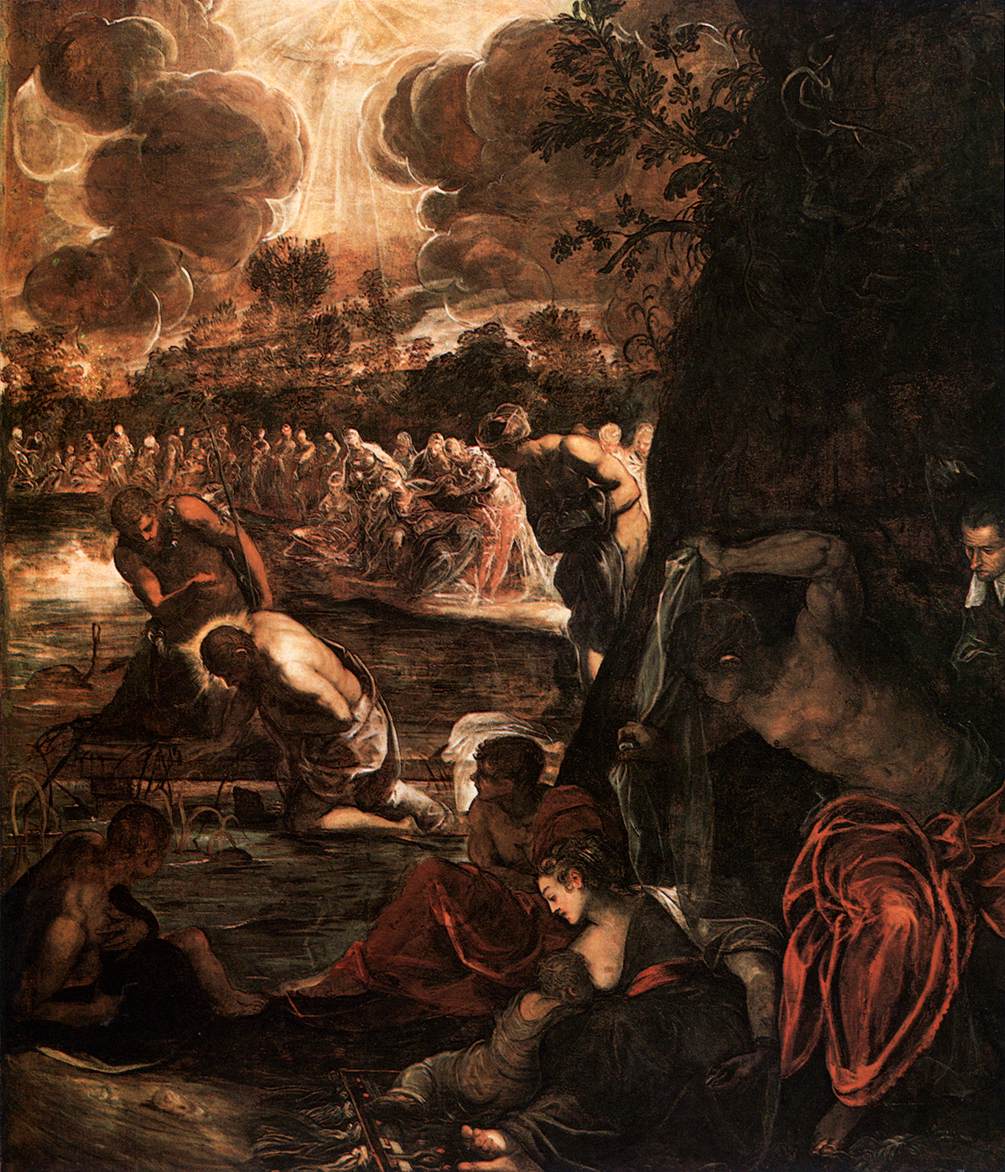
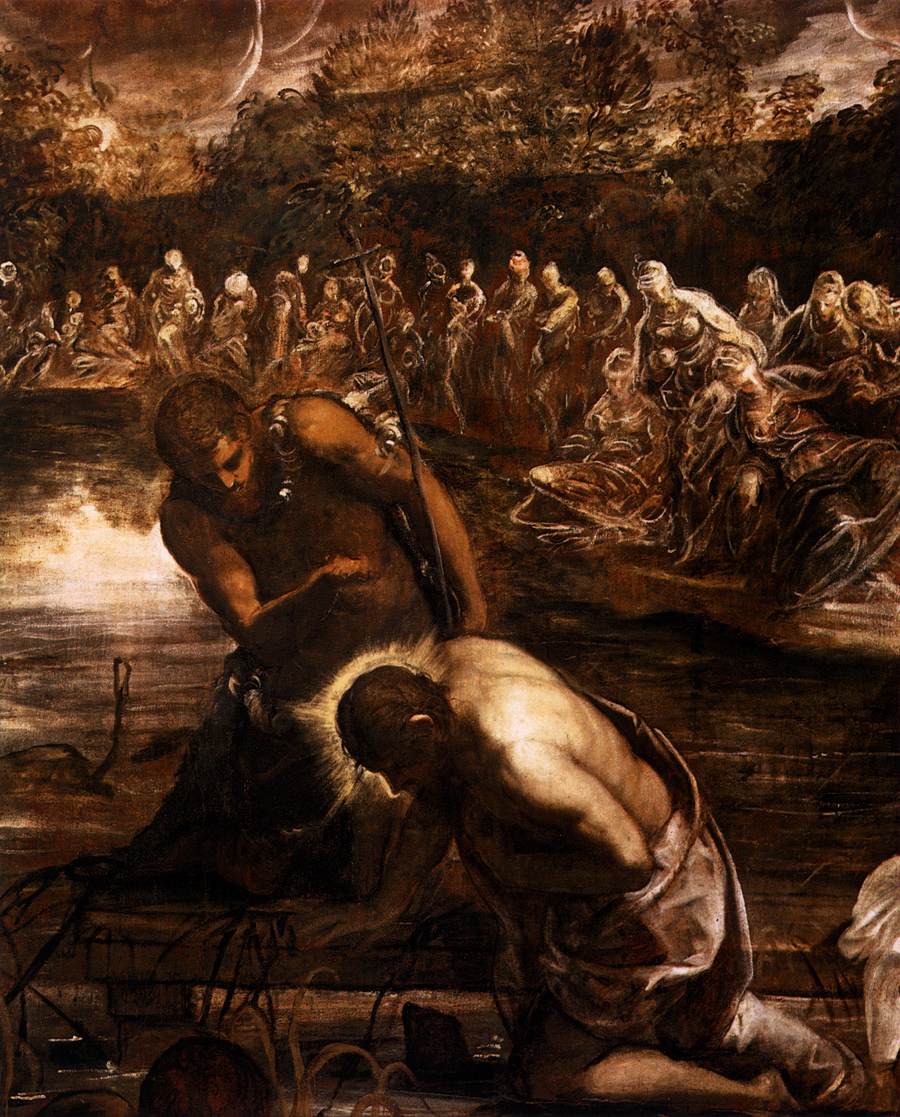
Meanwhile, the far bank of the river is lined with wraith-like candidates for Baptism (showing some of Tintoretto’s most daring and most dazzling brush-work in yellow on grey, to yield an effect totally unlike our normal conception of Renaissance art).
Jesus kneels on a sort of pontoon (it is typical of Tintoretto that he should pay attention to such details within such an unrealistic setting) to receive baptism from his cousin John.
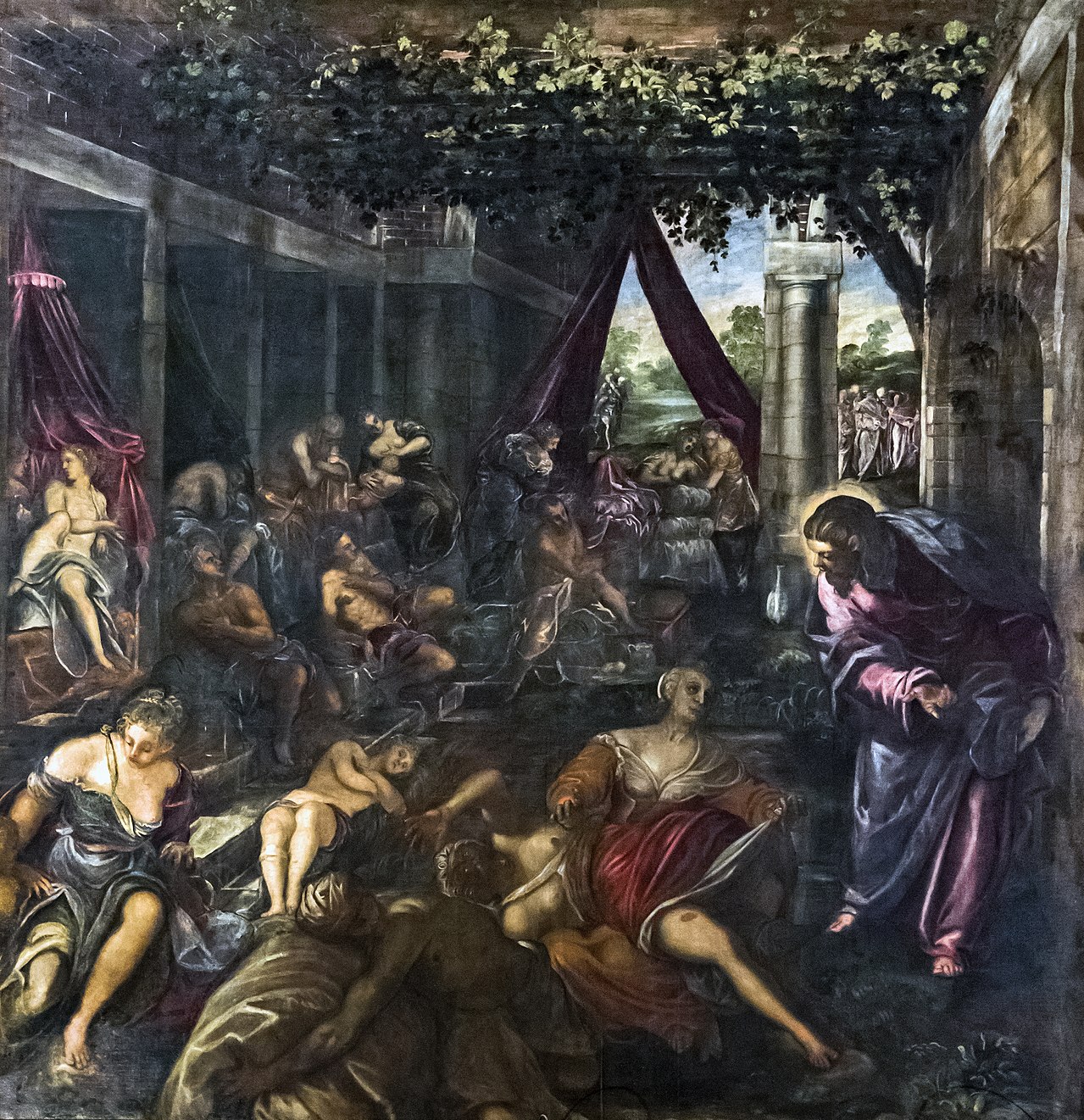
Exactly opposite, on the right-hand wall, hangs the canvas devoted to the episode of the Pool of Bethesda or Piscina Probatica, as it is told in the Gospel of St John, Chapter 5.
It is the most repainted of all the canvasses in the room, but since I am trying to make clear the argument of the whole cycle, we ought to dwell on it for a moment, bearing in mind that it would have been painted only a few years after the devastating return of the plague in 1575–77.
The vanishing point of the perspective system is above Christ’s head (as it so often is). It is placed high so that we register the pool of healing water in the ground rather than the lovely vine-clad pergola above, and it is placed well to the right, so that space opens up again on the diagonal, and we can see all five of the porticoes (specified in the gospel text) which have become ‘changing rooms’ for the multitude of ‘blind, lame and paralysed’.
We may note, too, the touch of contemporary realism as the mother points out to Jesus the plague-boil on her daughter’s leg. But notice that, in the story, Jesus is not talking to her. His words are addressed to the very dark man in the foreground, who had been ill (we are told) for thirty-eight years, and had been waiting there for a long time because no-one ‘would put him into the pool when the waters were troubled’. Jesus told him: ‘Rise, take up thy pallet, and walk’ (and you should be able to see that he is indeed taking up his pallet).
We have now dealt with the theme of Bread (at the altar end) and the theme of Water (at the far end), and the time has come to examine the central block, which I described as being at the heart of the whole conceptual scheme.
As this detail from an earlier diagram and the photograph of the ceiling help to remind you, it consists of nine paintings.
Four Old Testament ovals on the ceiling (4–7), supported on the walls by four New Testament rectangles (not shown in the diagram), surround the Old Testament rectangle (B) in the epicentre of the ceiling and the argument.
It is the biggest of all the canvasses in the Sala Grande (fully twenty-six feet by seventeen) and it was the first to be painted.
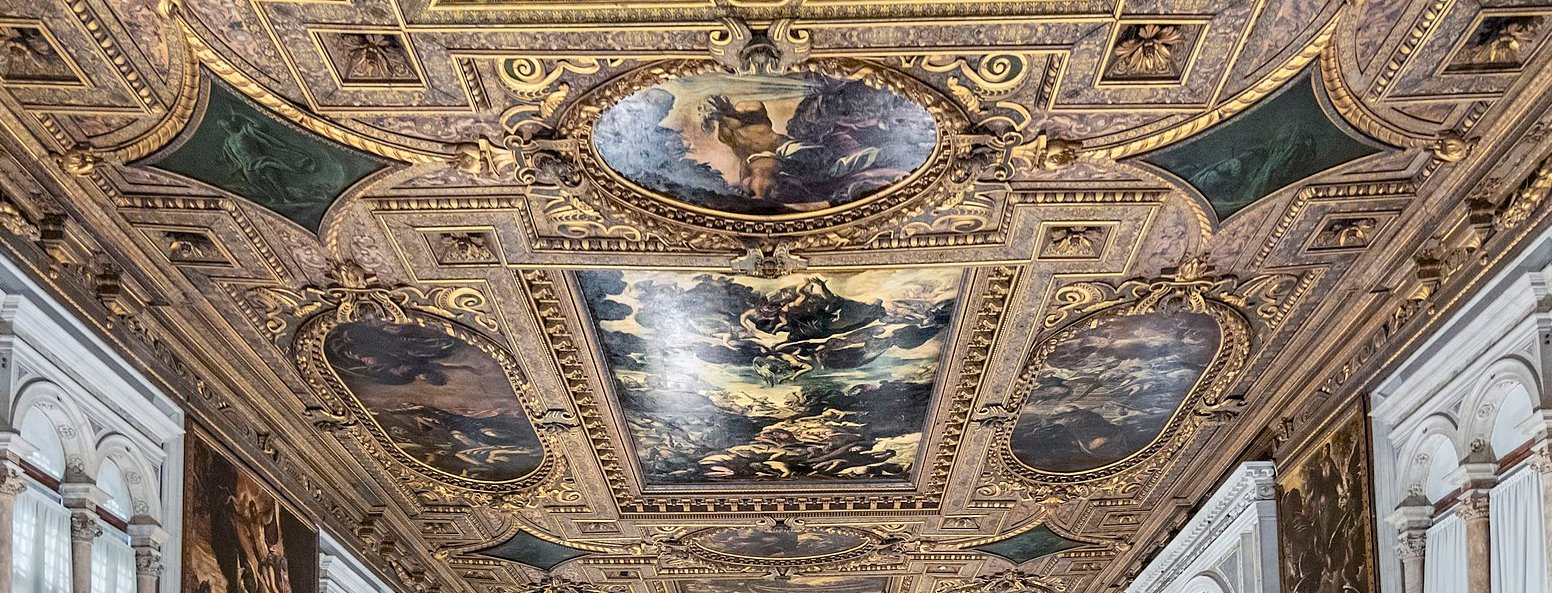
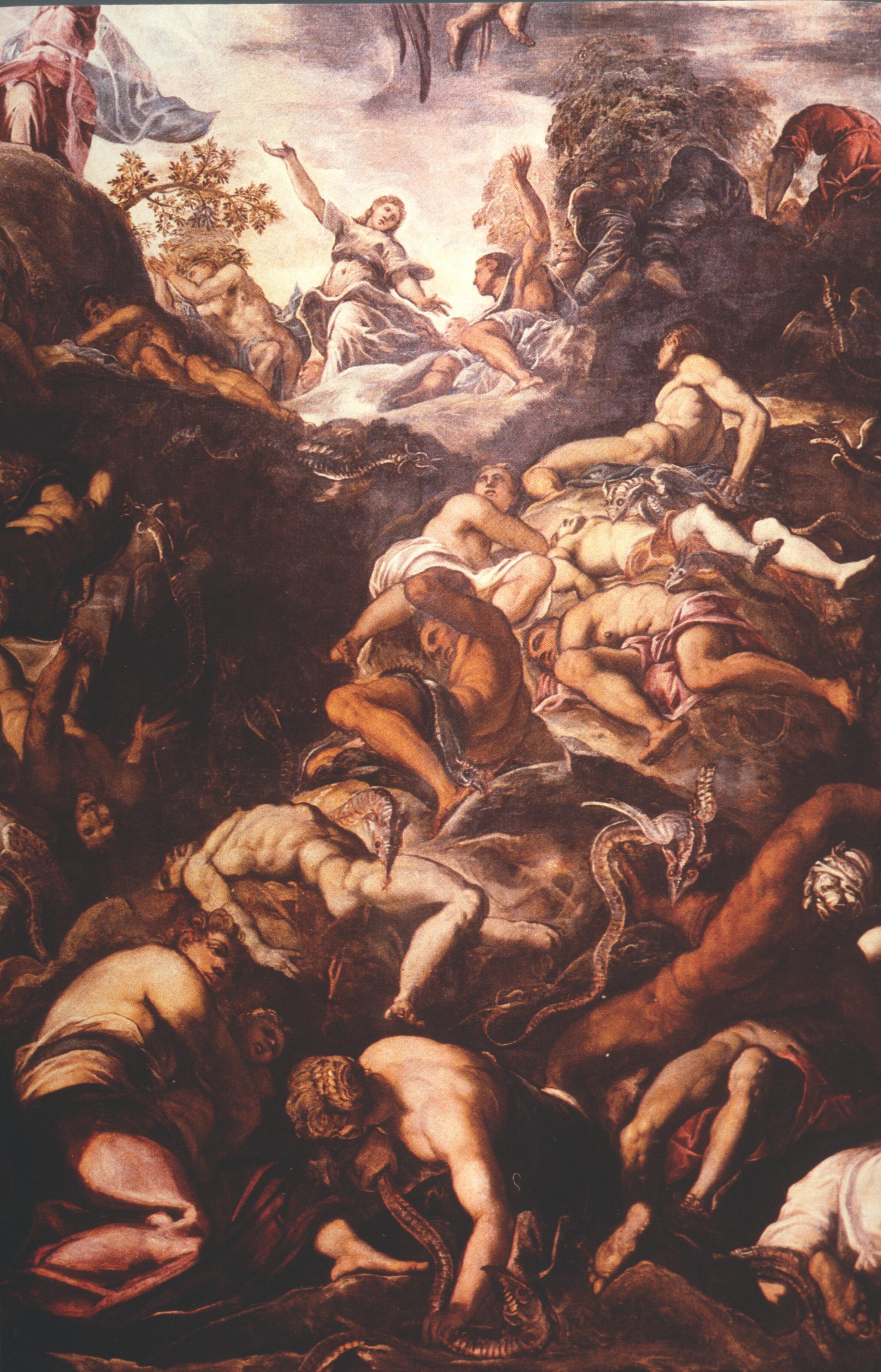
It shows Moses raising the Brazen Serpent, which had a special significance in 1576 because it was a healing miracle, but had always been significant in Christian art because the episode was universally interpreted (on the authority of the Gospel of St John (3:14)) as a prefiguration of the Crucifixion, which was the condition for the ‘healing’ of all mankind from sin.
Take a moment to imagine yourself standing in the Sala Grande. Tip your head back, look up, and keep on looking until your neck hurts too much. Tintoretto is here at his frenetic best, trying to outdo Michelangelo in his most Mannerist images in the Sistine Chapel in Rome.
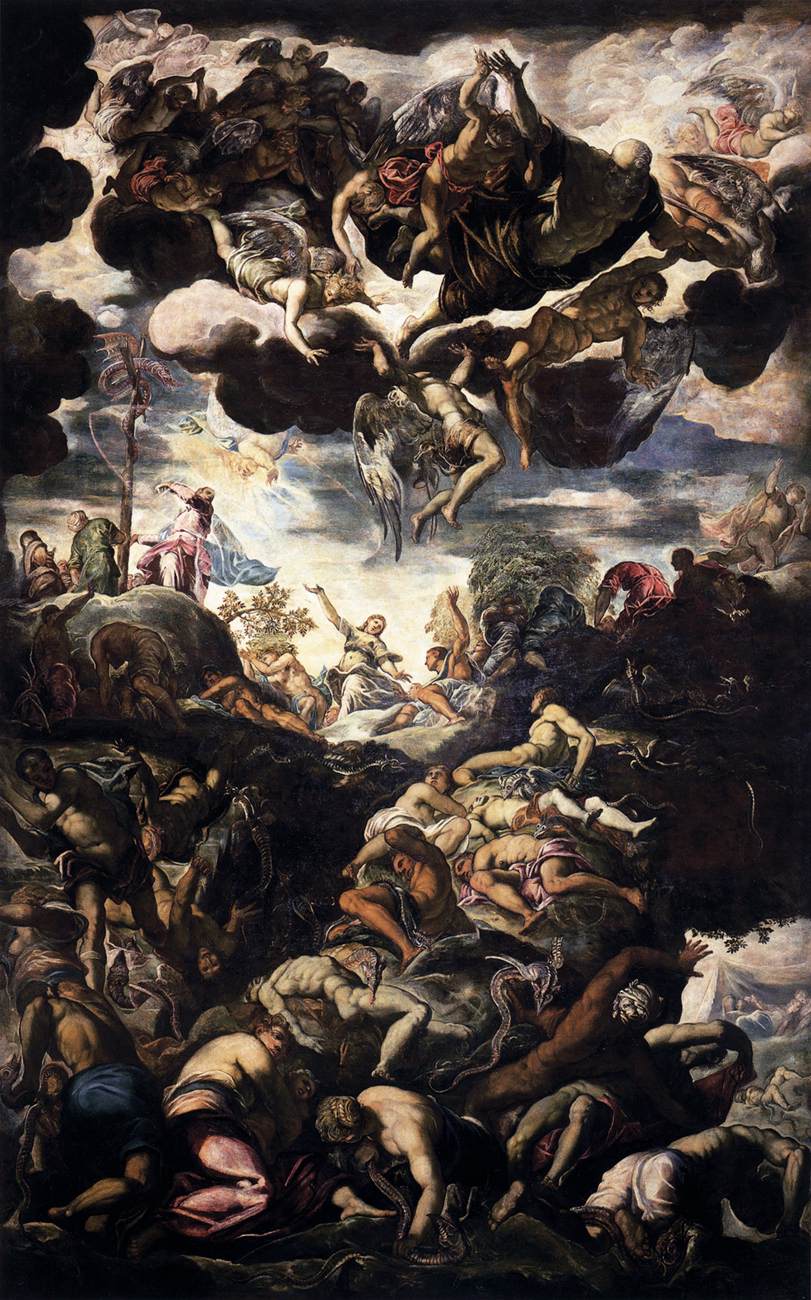
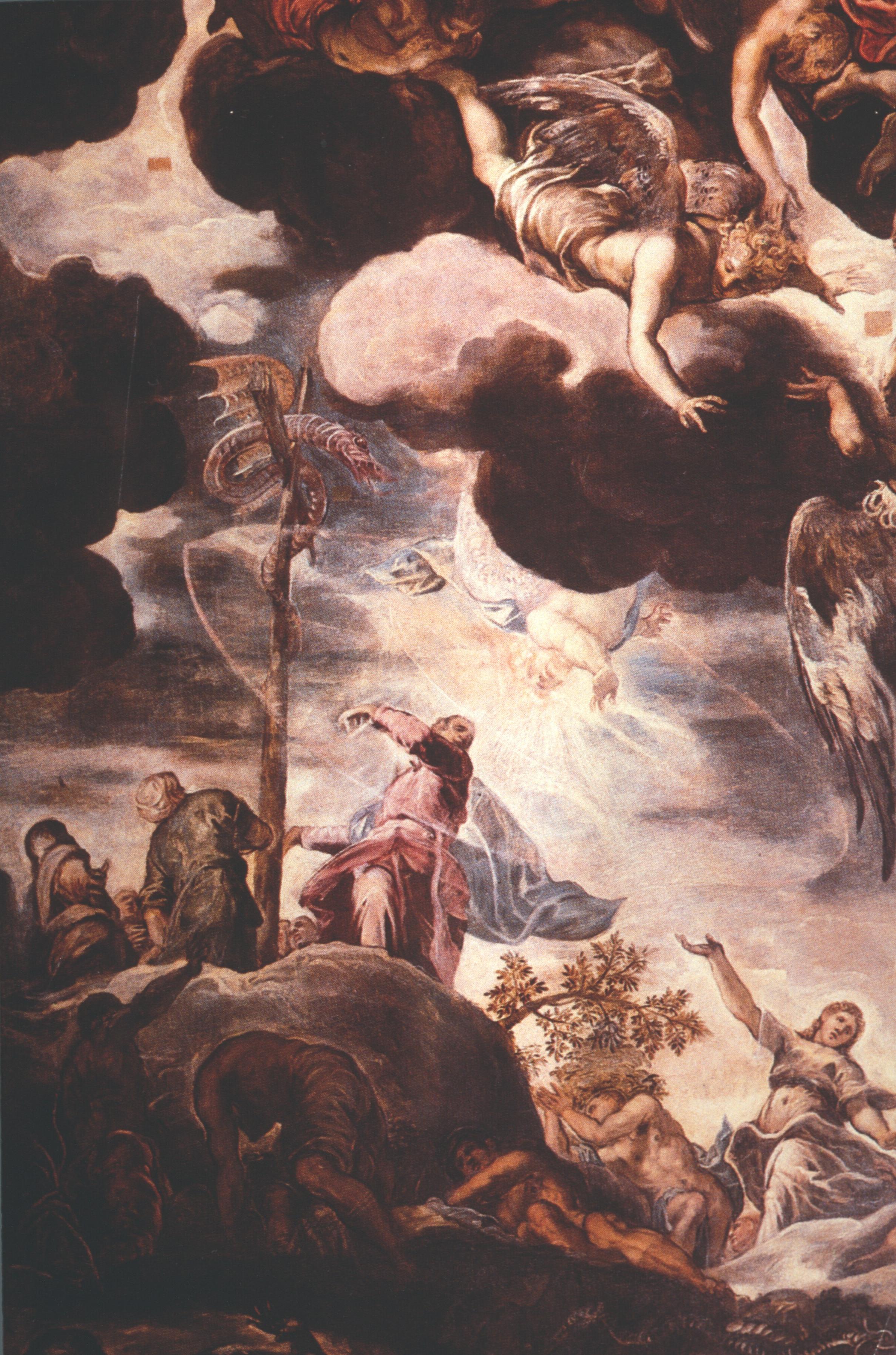
Moses, a tiny figure, but the centre of attention, silhouetted against the dramatic burst of radiance in the darkly dramatic sky, is both touching and gesturing towards the graven image of a bronze Serpent coiled round a Cross (whose proportions are close to those of a capital T (Tau) in the Greek alphabet), at the summit of a mountain.
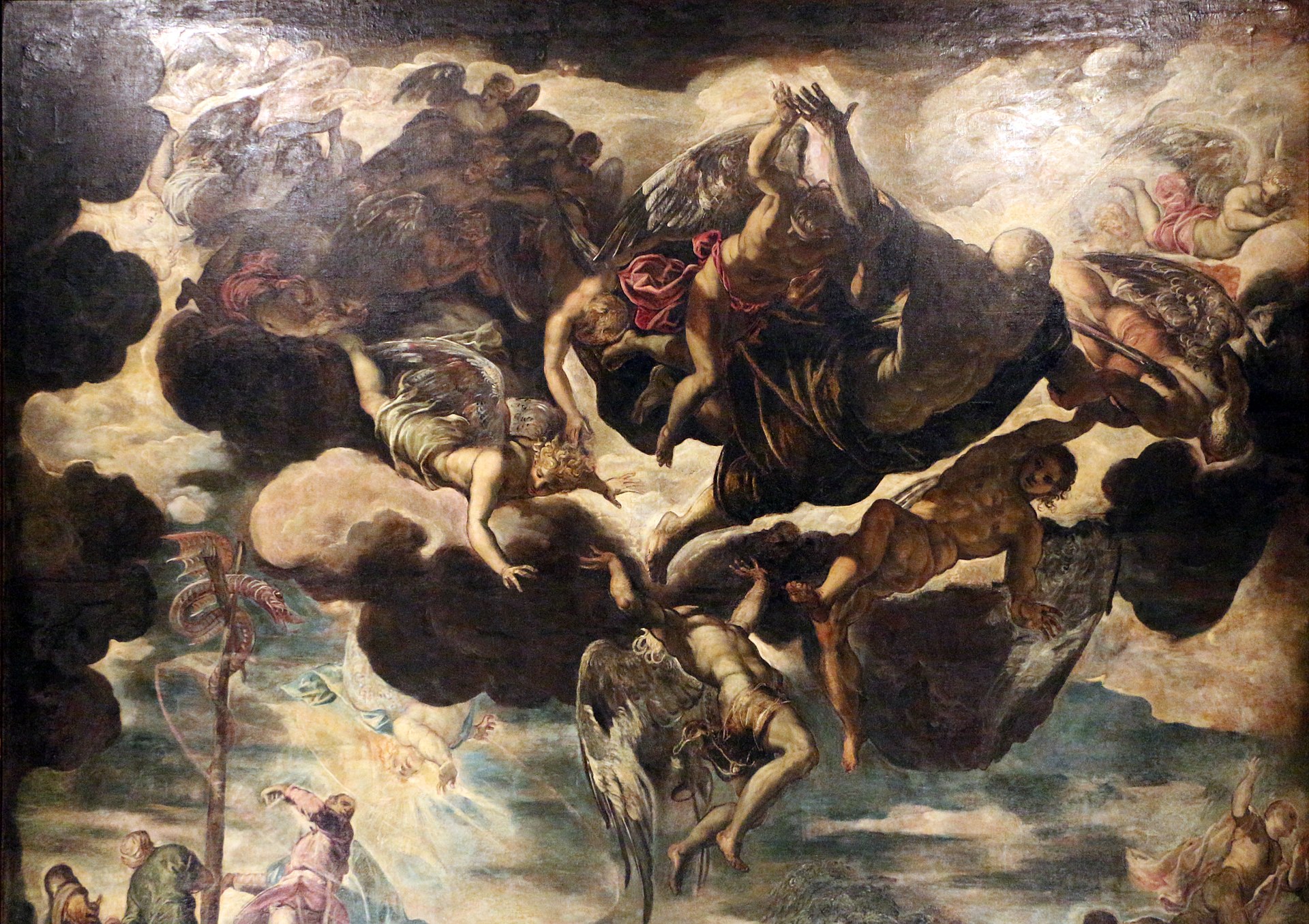
High above, and huge, Jehovah returns to heaven, among a turbulent throng of angels, his arms thrown wide (like a Latin cross) in a gesture of benediction.
On the ascending spur of the mountain, the victims of the pestilence writhe in despair, no less fantastically than the snakes which are tormenting them.
But at the brightly lit crest of the mountain, those ‘who look at the serpent’—those who turn their thoughts to the Redeemer on the Cross—are expressing hope, joy, and thanksgiving.
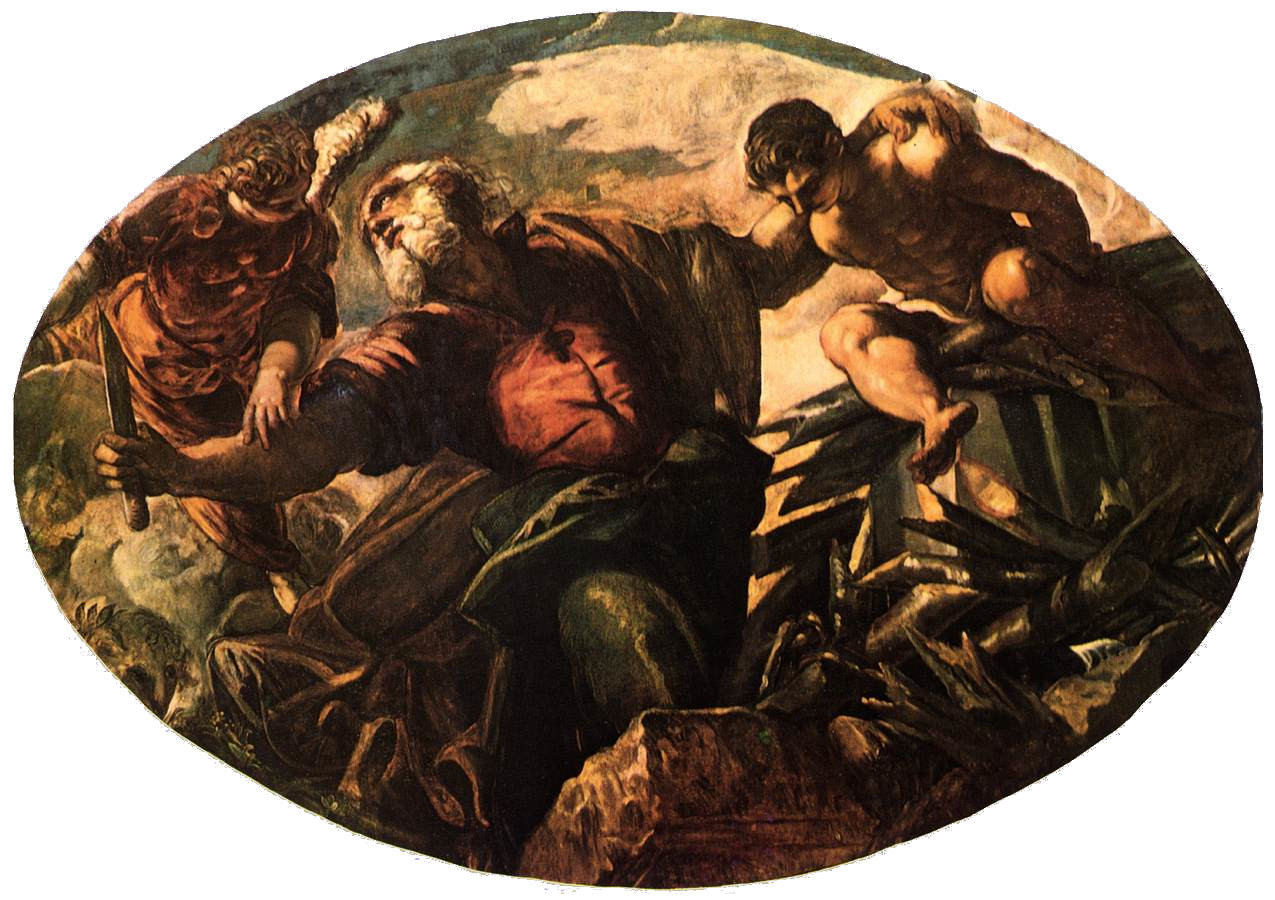
Between the giant central rectangle and the altar—still on the ceiling—you will find this horizontal oval, twelve feet across, showing Abraham preparing to sacrifice his only son, Isaac, but being checked in the very act by the Angel of the Lord.
This scene was, once again, universally interpreted as a ‘type’ of the Crucifixion. And it is important to keep the typological reference in mind, because the Sala Grande itself does not contain a representation of the Crucifixion (it dominates the smaller Sala dell’Albergo alongside).
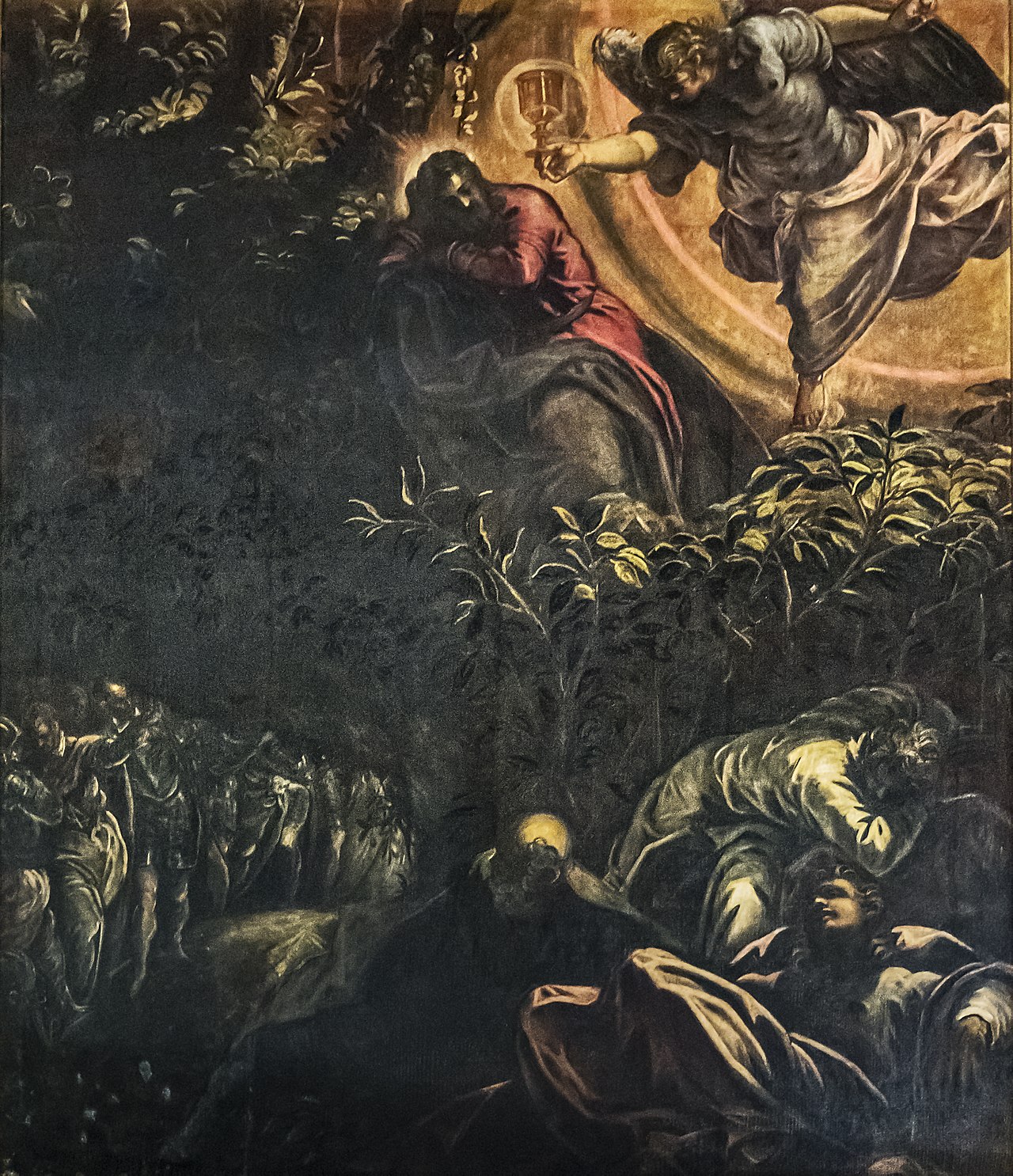
There is, however, an allusion to the time of the Crucifixion on the wall below, in the Agony in the Garden, another seventeen-footer.
(This also contains a thematic link to Abraham’s sacrifice, because Jesus had first prayed that ‘this cup’ should be taken from him, but then, like Abraham, declared himself ready to do his Father’s work.)
The canvas is one of Tintoretto’s most surreal compositions in its splashes of light contrasting with deep shadow, in the vast area of dark foliage, and in the complex poses of the sleeping figures of James, John and Peter—not to mention the sinister, spectral soldiers, led by the treacherous Judas, who are approaching to arrest Jesus.
However, the emphasis in this central area of the Sala Grande falls not on trial, doubt, betrayal and death, but on Triumph and Resurrection.
The large rectangular canvas on the right-hand wall directly opposite the Agony in the Garden shows Jesus as being able to raise others from the dead, because the central figure on the upper level of the composition is Lazarus, who is being released from his grave clothes—Lazarus who has been resurrected by Jesus, in answer to the supplication of Mary his sister, seen with outspread arms in the foreground.
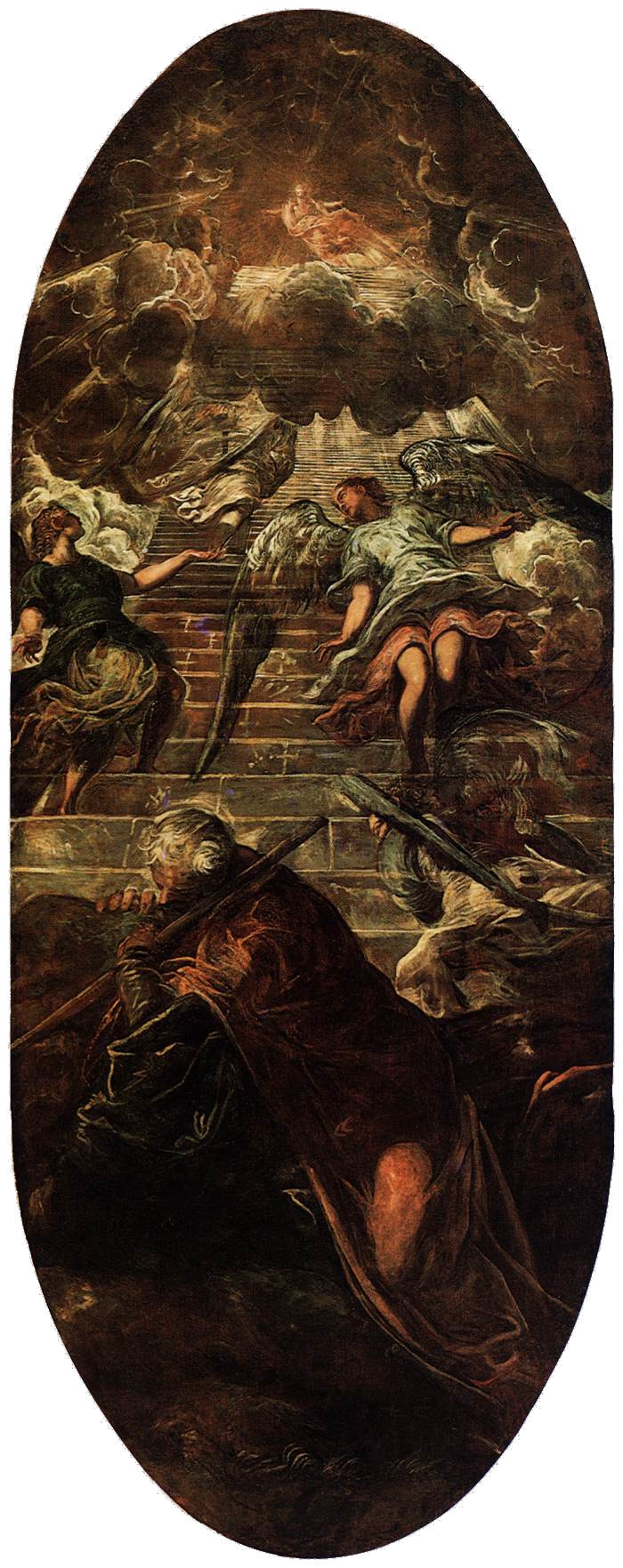
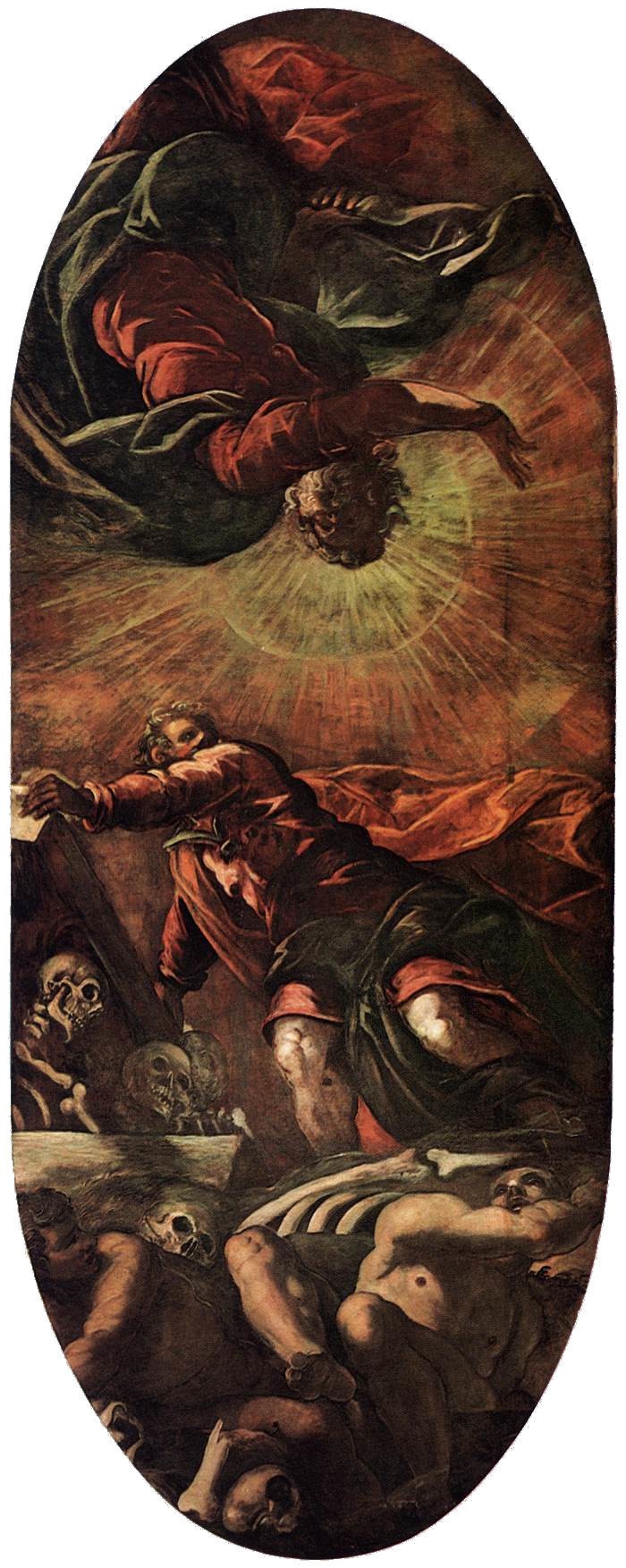
The two longitudinal ovals on the ceiling, flanking the Brazen Serpent to the left and the right, are Old Testament visionary prefigurations of Christ’s ‘re-opening’ of Heaven to humankind through the Atonement of the Crucifixion, and of the General Resurrection of the Dead on the Last Day.
On the left, Jacob rests his sleeping head on his hands while he dreams (Genesis, Chapter 28) of a ladder reaching up to heaven and of angels going up and down. (Remember, again, that the painting is designed to be seen above your head. It is a very tall ladder indeed.)
The right-hand oval shows the prophet Ezekiel, who is granted a vision (as related in Chapter 37 of his own book) of a valley of ‘dry bones’ which are being re-clothed in flesh and raised from the dead.
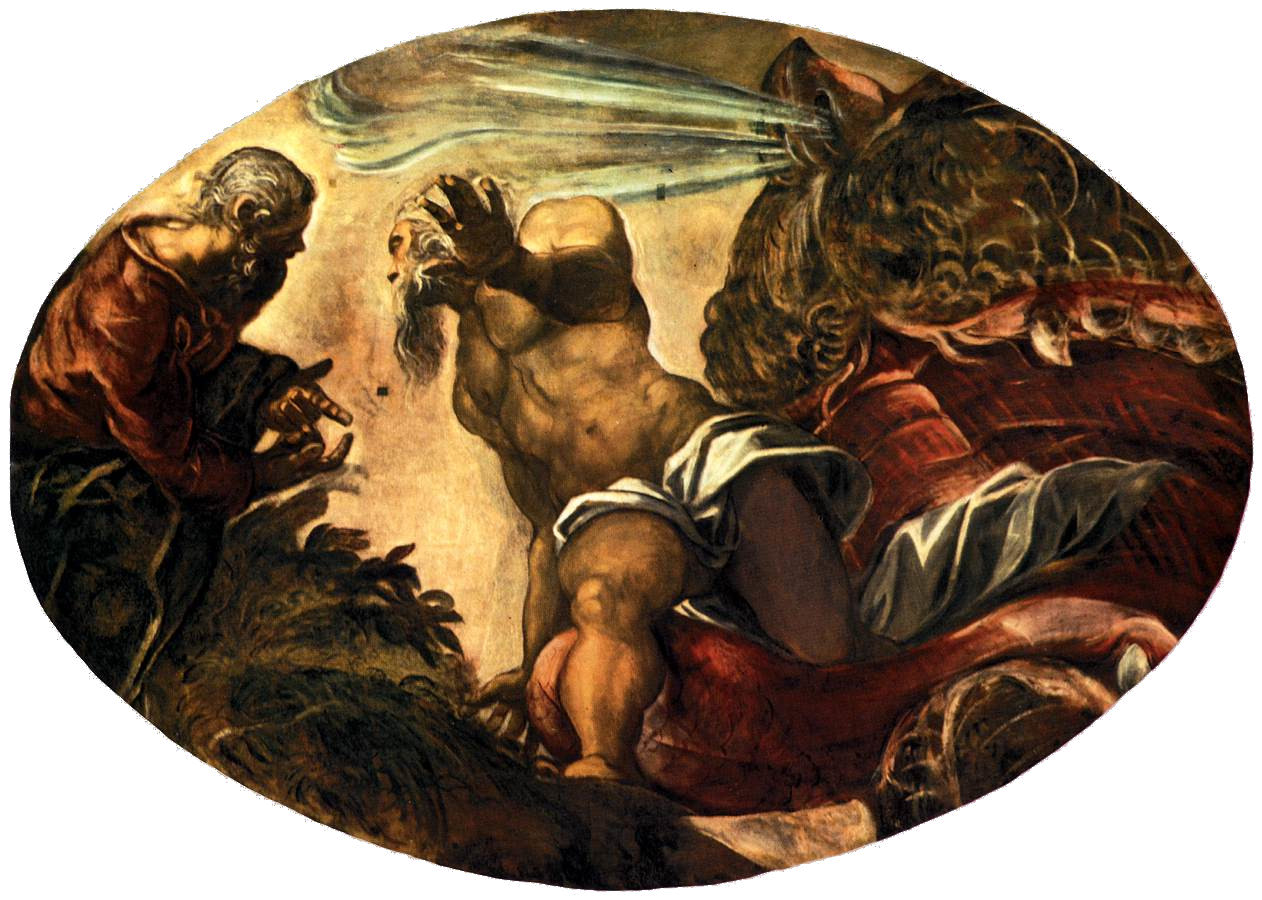
The last horizontal oval, meanwhile, shows Jonah, who at the Lord’s command is cast out from the mouth of the ‘great fish’ after spending three days in its belly—an event that was universally interpreted (following the authority of the Gospels,) as a ‘type’ of the Resurrection of Christ, who rose from the dead after three days in the ‘pit’.
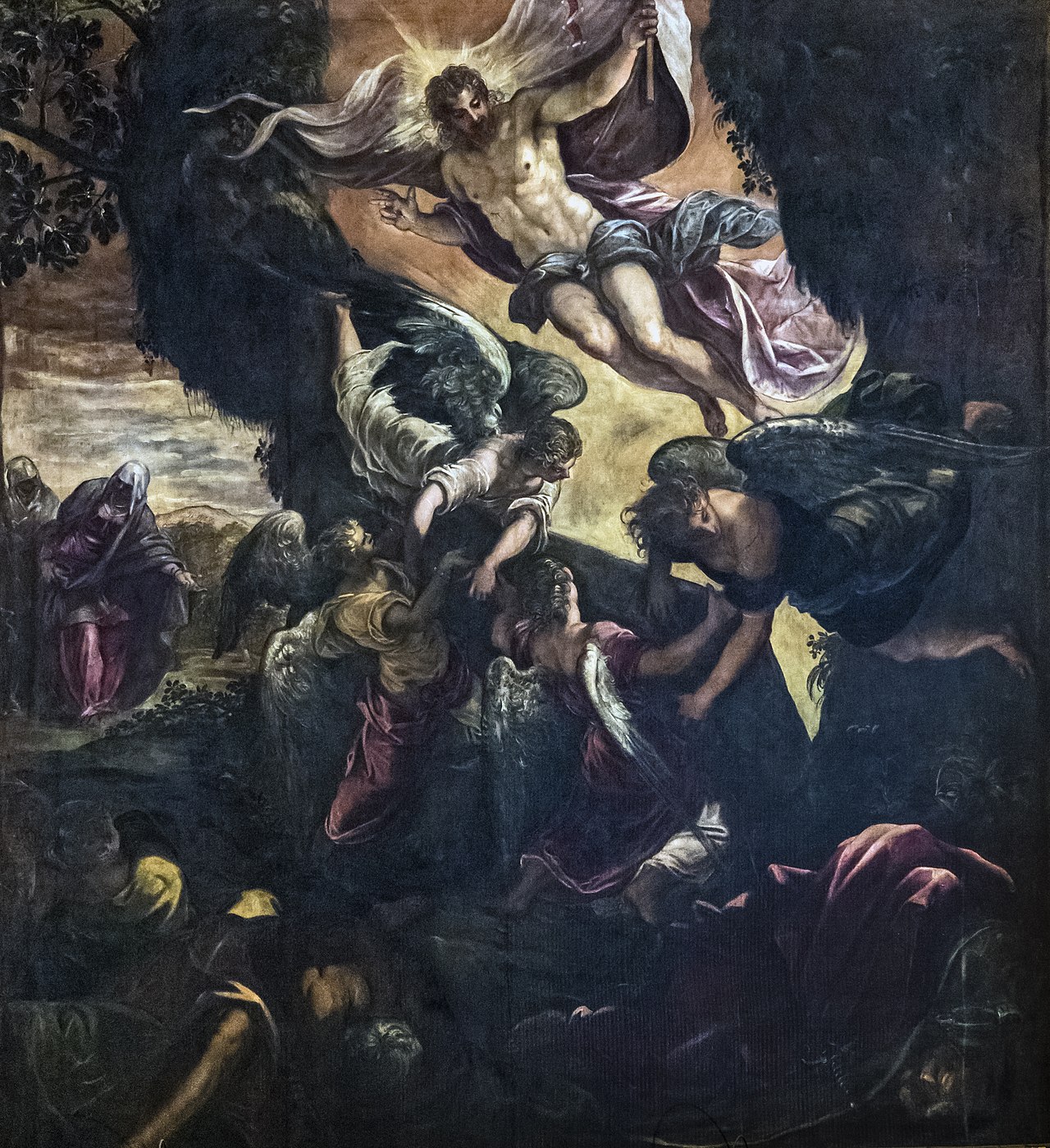
All that remains, then, are the fulfilments of these prefigurations, which lie opposite each other in the centre of the walls, with the result that as you come up the stairs you will find the Resurrection of Christ opposite you, and, as you leave, you will see his Ascension.
The lower half of the Resurrection is dominated, most unusually, by the four energetic angels who have been sent to move the massive stone away from the mouth of the sepulchre; while the usually prominent sleeping guards are almost lost in the gloom, because our eyes are being dazzled, in the upper half, by the radiance of the corpus gloriosum of the Saviour.
This is emphatically the ‘Risen Body’ of Christ—‘raised from the dead’—but in Tintoretto’s vision, it is also the ‘Rising Body’ of Christ, because the feeling of ascent seems stronger here than in the final painting on the opposite wall.
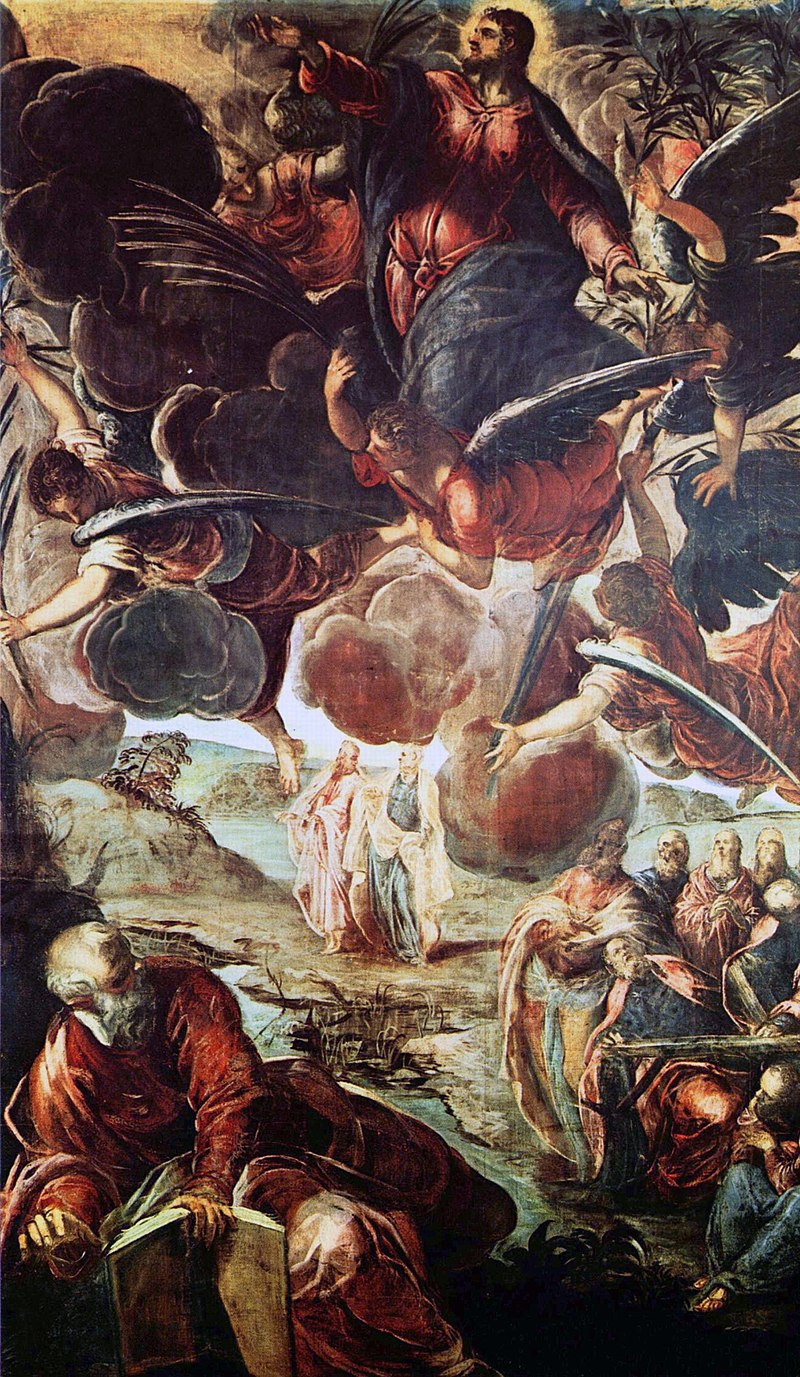
The gigantic, fully clothed figure of Christ in the Ascension—borne among the clouds by five angels holding palms of victory and olive-branches of peace—seems to be travelling sideways, rather than upwards, in an image suggestive of the Second Coming of Christ on the Day of Judgement to ‘judge the living and the dead’.
(Similarly, the huge apostle in the foreground, with his book, makes one think more of St John, writing his Revelation, than of St Luke, considered as the author of the Acts of the Apostles (where the Ascension is recorded at the beginning of Chapter 1). But Christ’s right palm gestures towards heaven, and the weirdly stylised thunderclouds could hardly be described as ‘clouds of glory’.)
This is vintage Tintoretto; and this is the image which the artist wanted you to retain as you leave the Sala Grande.