Veronese: Love and Marriage (San Sebastiano and Villa Barbaro)
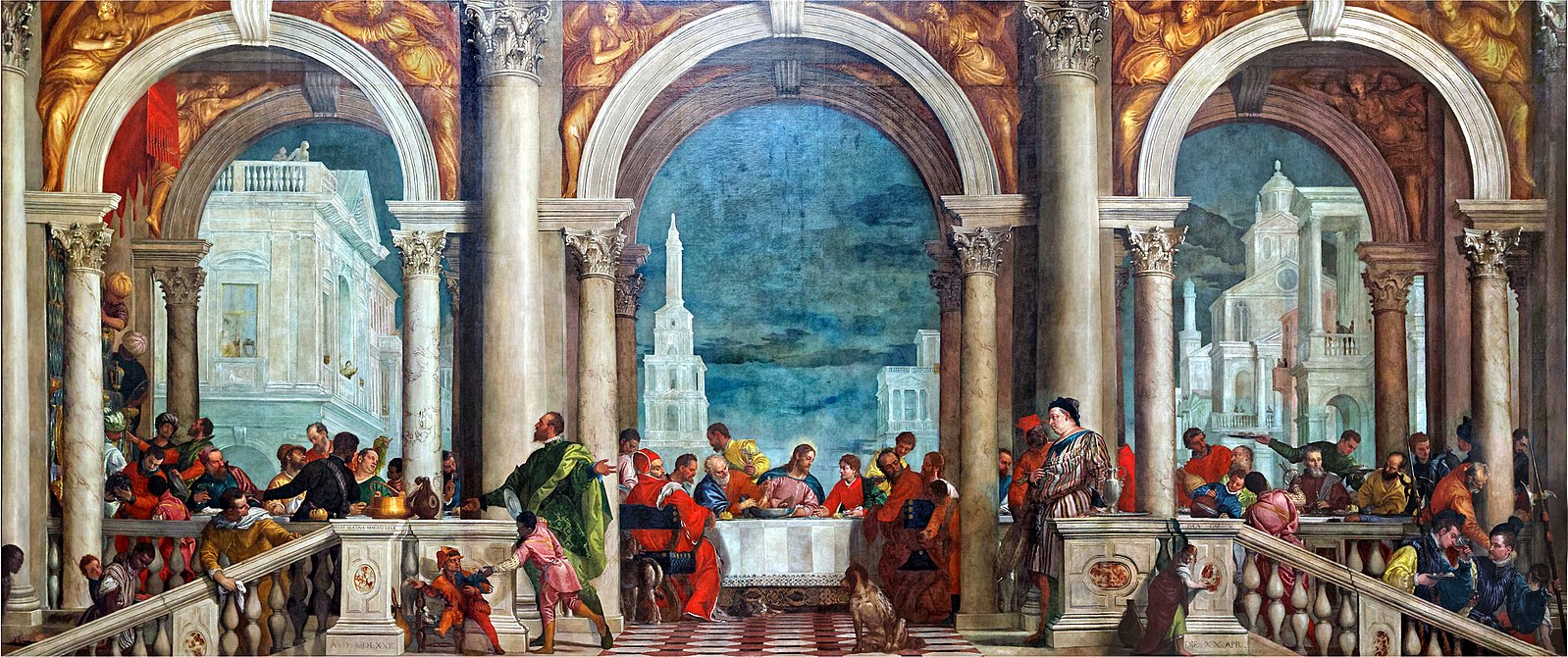
In this lecture we shall be looking at three brief cycles which (with a little bit of latitude), may all be described as dealing with Love and Marriage. One was for a church in Venice, one for an aristocratic villa in the Veneto, and one for the imperial court in Vienna. They were painted between 1555 and 1575, that is, in the same decades as Tintoretto’s canvasses for the Scuola di San Marco and the Scuola di San Rocco.
However, they offer something very different from the art of Tintoretto: not the dramatic vision of a man who saw supernatural beings and supernatural light bursting into the everyday world of a stable or an inn; but an art that is essentially secular even when the subject is nominally sacred. The colossal canvas on the cover page (forty-two feet wide) began life as a Last Supper, intended for the refectory of a convent.
We shall be dealing with an artist (the sprightly figure in the foreground is probably a self-portrait) who was summoned before the Inquisition in 1573 because this particular painting seemed inappropriately ‘worldly’ but wriggled out of the charge by simply changing its title. The Last Supper became Feast in the House of Levi.
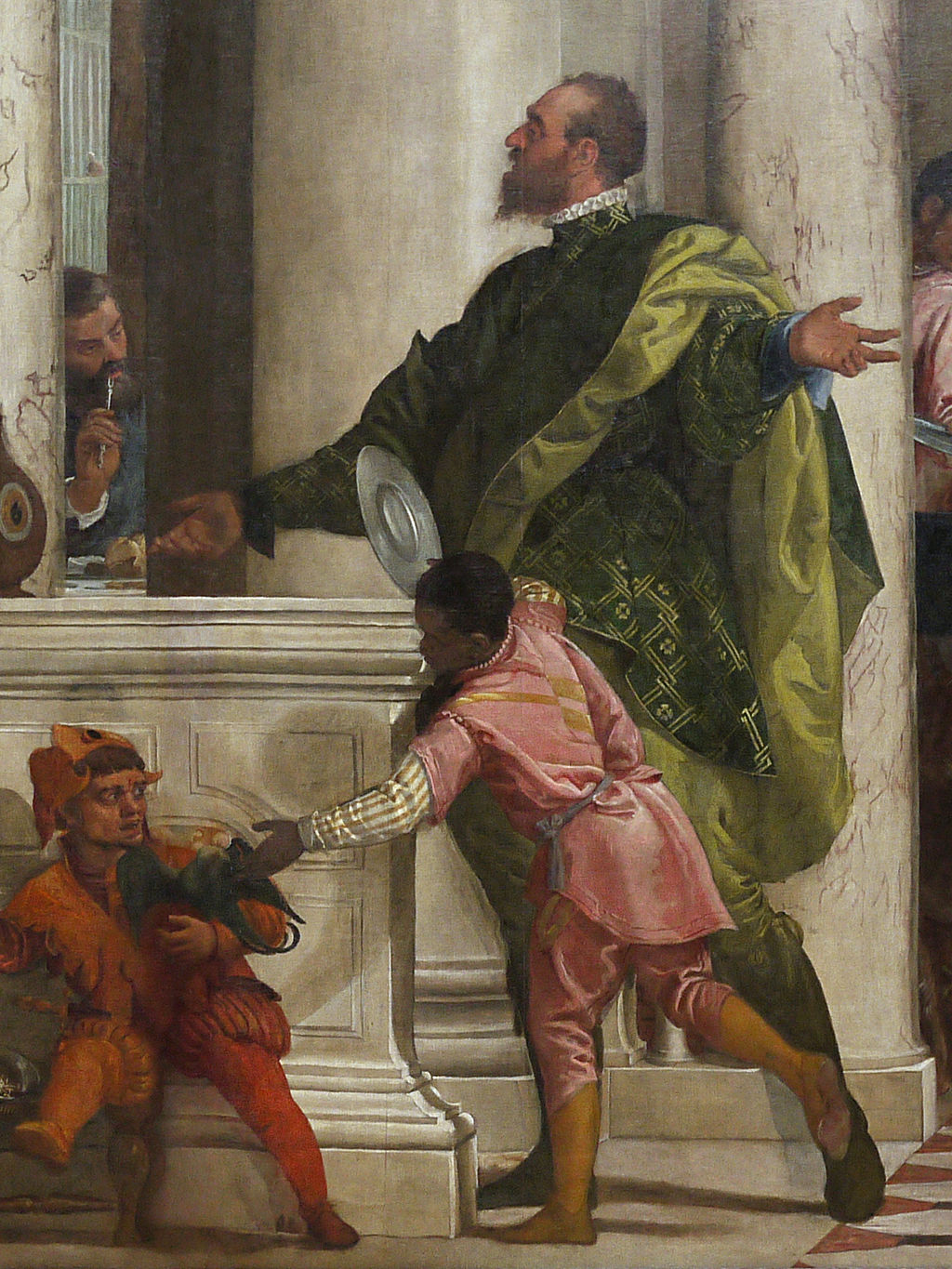
He had been painting similar festivities for over fifteen years.
Nominally, they were biblical feasts. For example, the scene in this painting—fourteen feet across—is the Supper at Emmaus, which was the occasion when the Risen Christ first appeared to two of his disciples, the moment when the history of Christianity as a world-religion began.
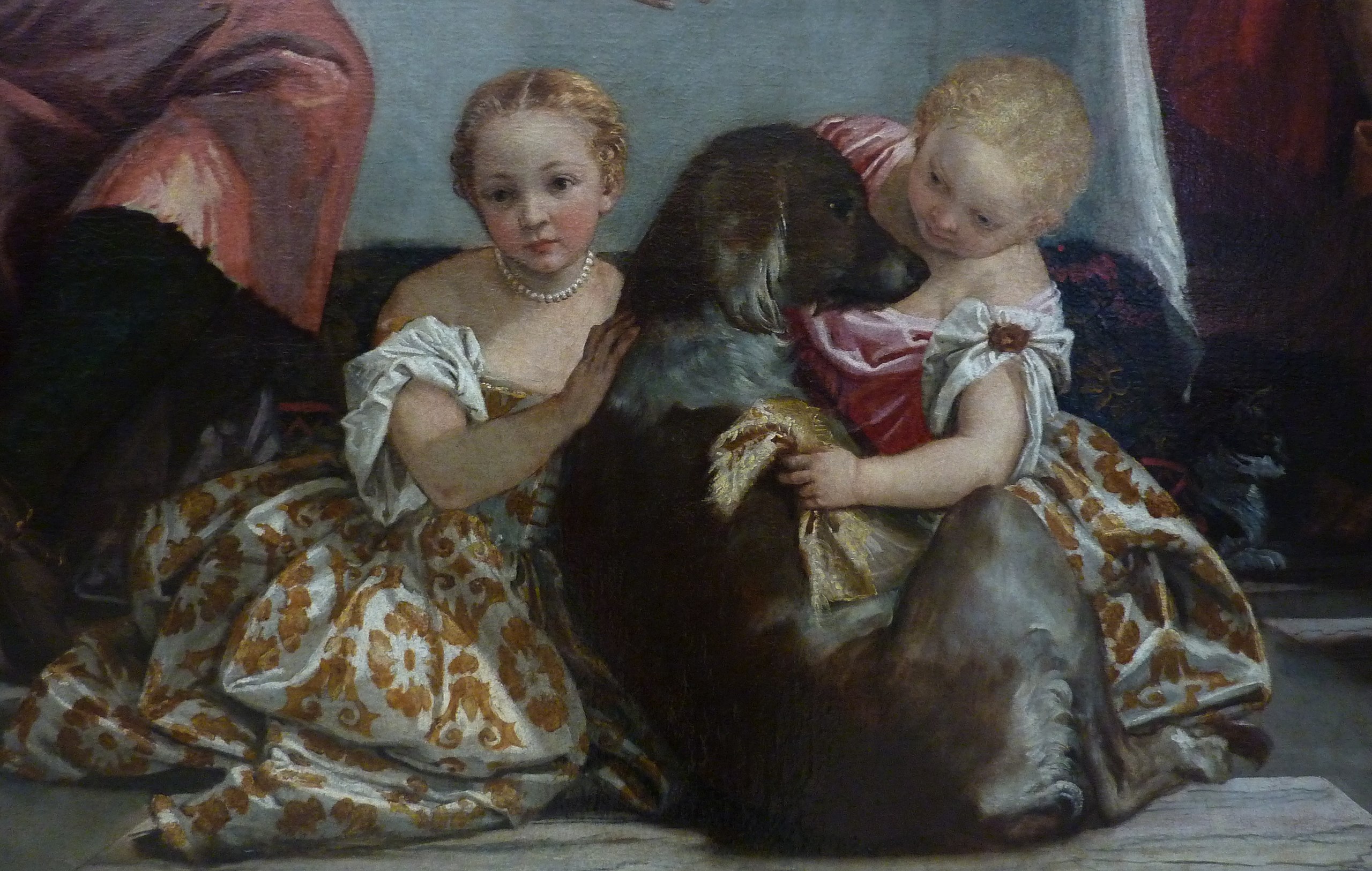
But as you can see, the biblical narrative is not much more than a pretext to portray the family and friends of the man who commissioned the painting. Dressed in contemporary costumes, they stand against a background of classical architecture, while the foreground is filled with children and dogs, for both of whom Veronese had a special love and insight. The detail is totally enchanting.
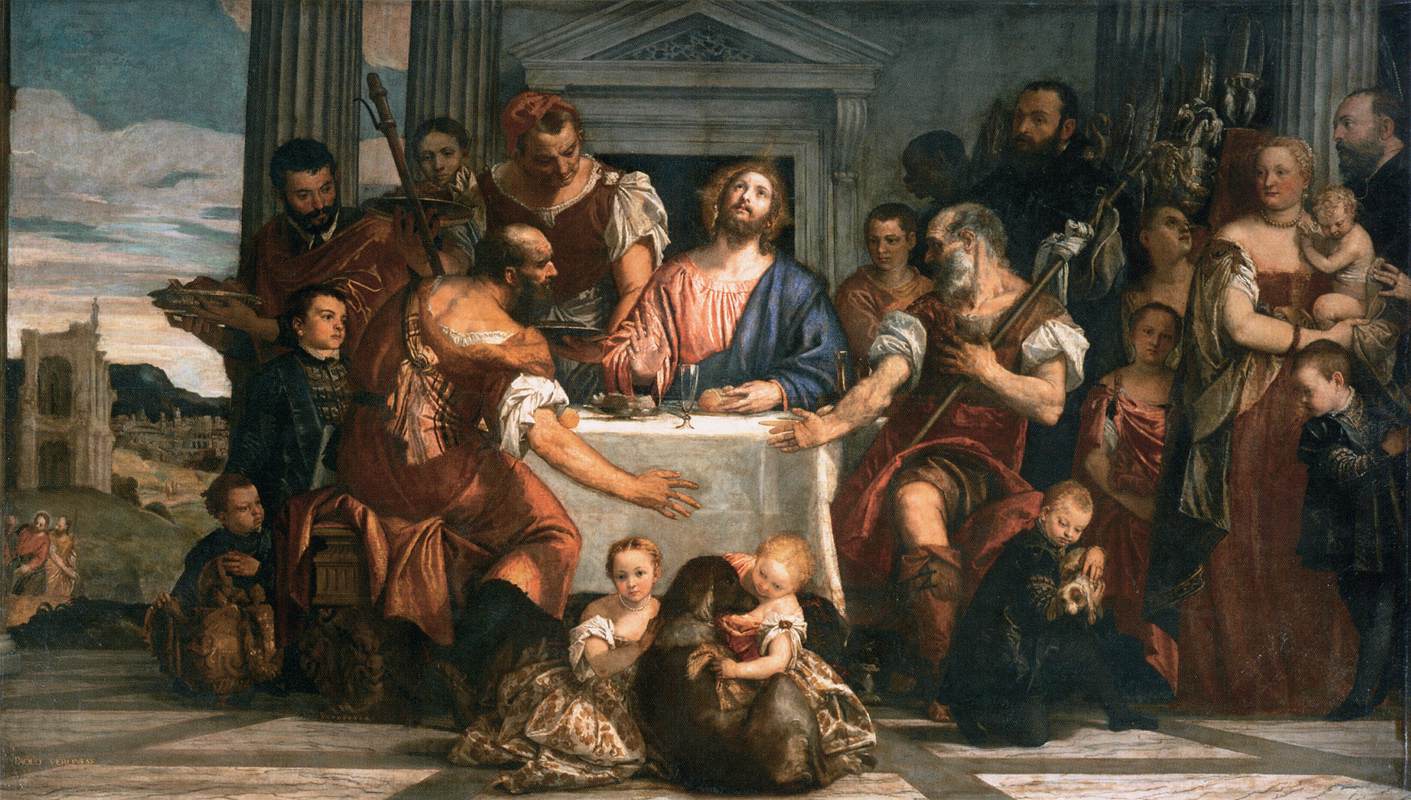
The Supper at Emmaus is now in the Louvre, which is also home to perhaps his best-known painting, The Wedding at Cana, which was painted four years later in 1562–63.
(It measures more than thirty feet across.)
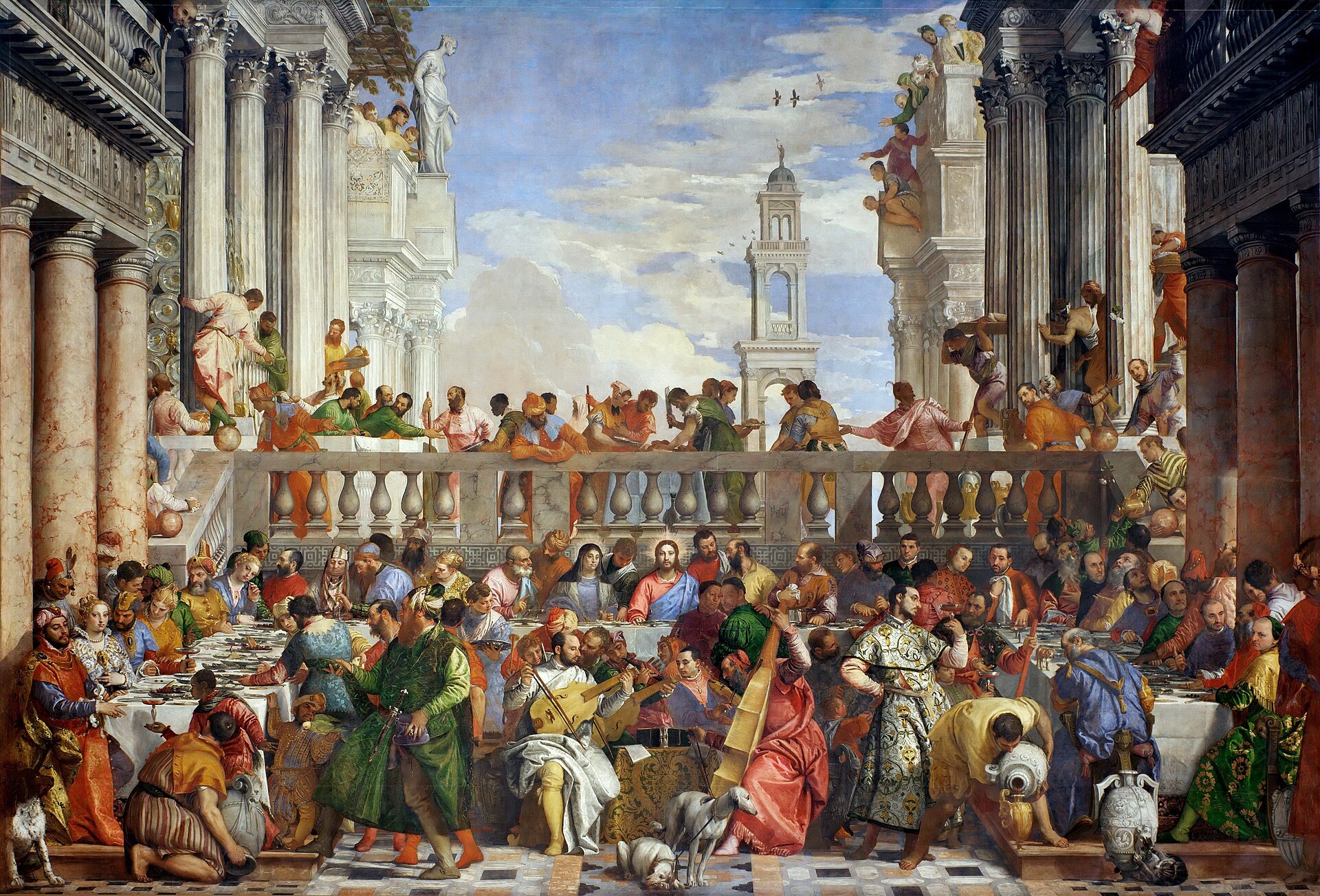
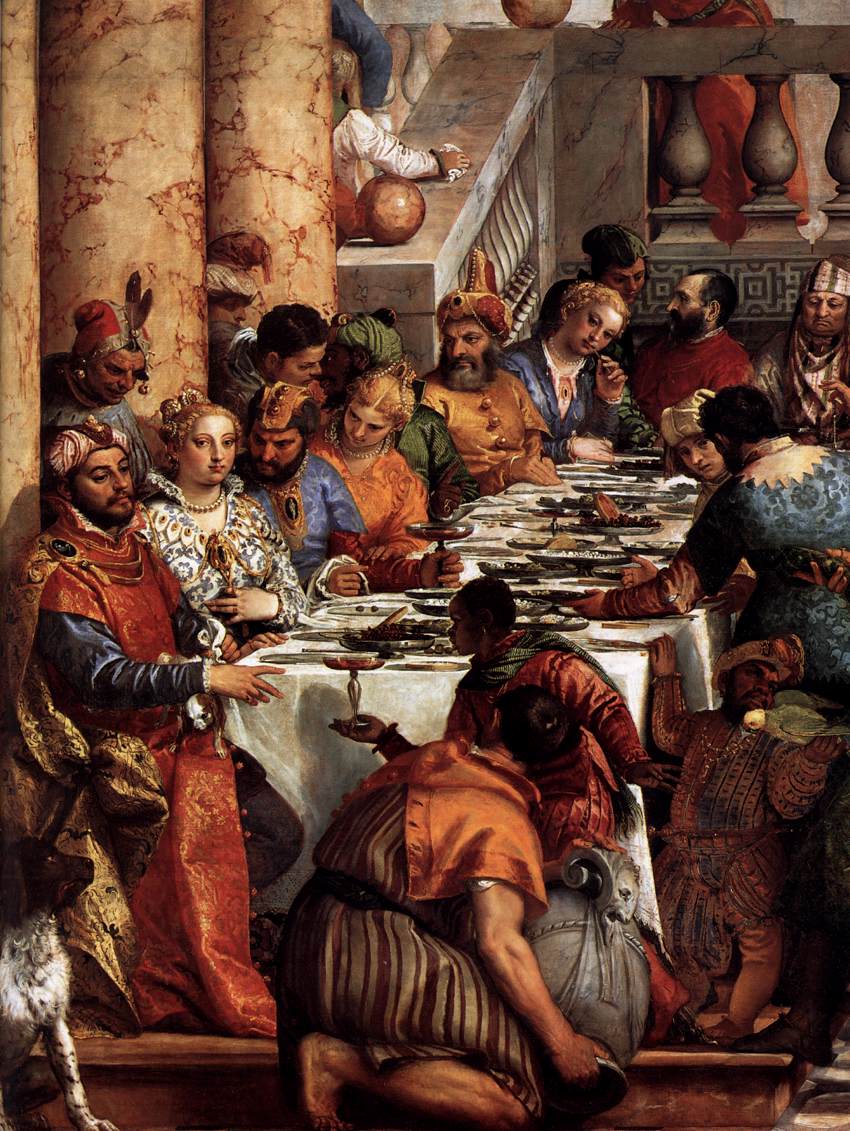
Jesus and his mother are seated in the centre, but our eyes swerve towards the fashionably dressed bridegroom and bride on the extreme left, seated with their guests at the damask-covered table, groaning with food.
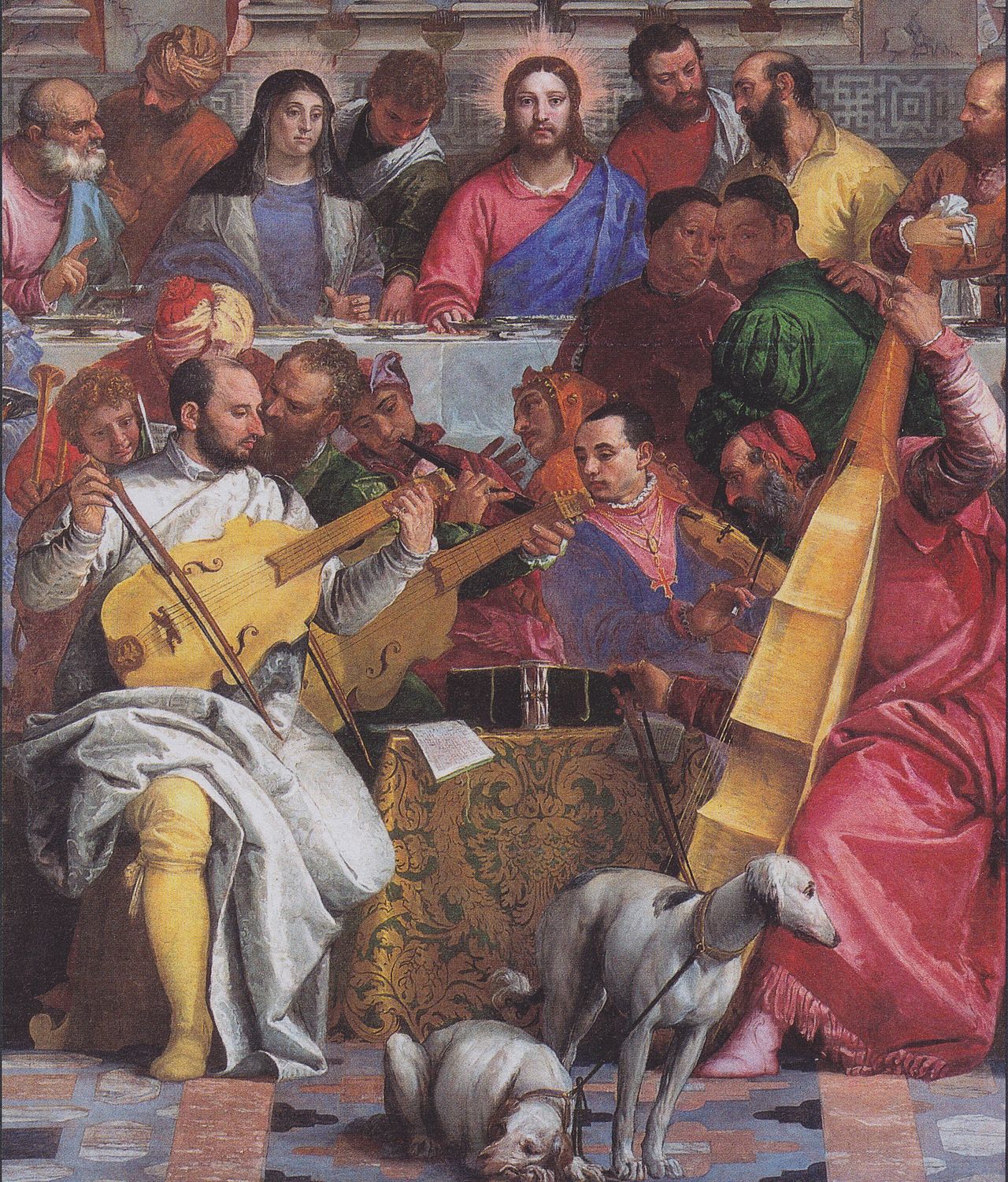
If we do look at the centre, our eyes go to the group of musicians, in the very middle of the foreground, where there is another self-portrait—since you can see the artist himself playing the tenor viol, facing Titian, in profile, who is playing the violone (not to mention the listening greyhounds).
Our artist’s portrayal of the wealth and confidence of the Venetian nobility has come to determine our view of the culture of sixteenth-century Venice to such an extent that it is something of a shock to recognise that his surname is identical with the capital of Sardinia—Cágliari—and that the name by which he was usually known means ‘the man from Verona’—Paolo da Verona, or Paolo Veronese.
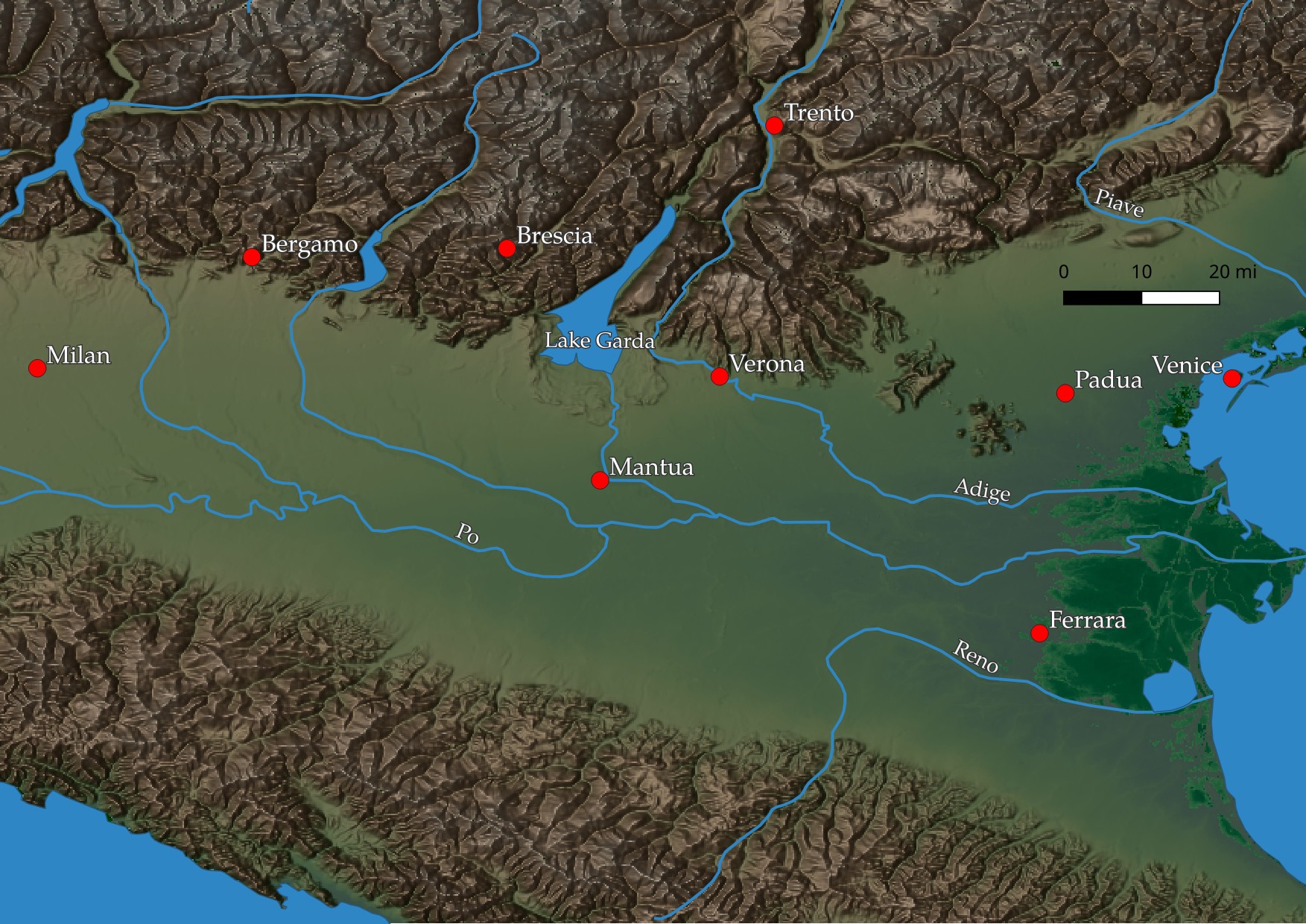
His hometown, as you can see in the map, lies a good 70–75 miles to the west of Venice. It had been the centre of an important state back in the fourteenth century when Dante was a refugee there; and it remained prosperous and independent in spirit after it came under Venetian rule at the beginning of the fifteenth century.
Notice, too, that Verona is relatively close to Mantua, which is a mere thirty miles to the south, and that it is no farther from Parma and Modena than it is from Venice.
And before leaving the map, locate the positions of Vicenza (which was home to the architect Palladio), and of Treviso (which is the nearest city to the Villa Barbaro which contains the second cycle of paintings in this lecture).
I stress these relative positions and distances to prepare you for the fact that the man who has come to epitomise Venice was formed under non-Venetian influences.
Paolo was born in 1528, which makes him ten years younger than Tintoretto and forty years younger than Titian. He was the son of a minor sculptor, Gabriele da Verona, and the nephew of a local painter, Badile, from whom he learnt the rudiments of his craft.
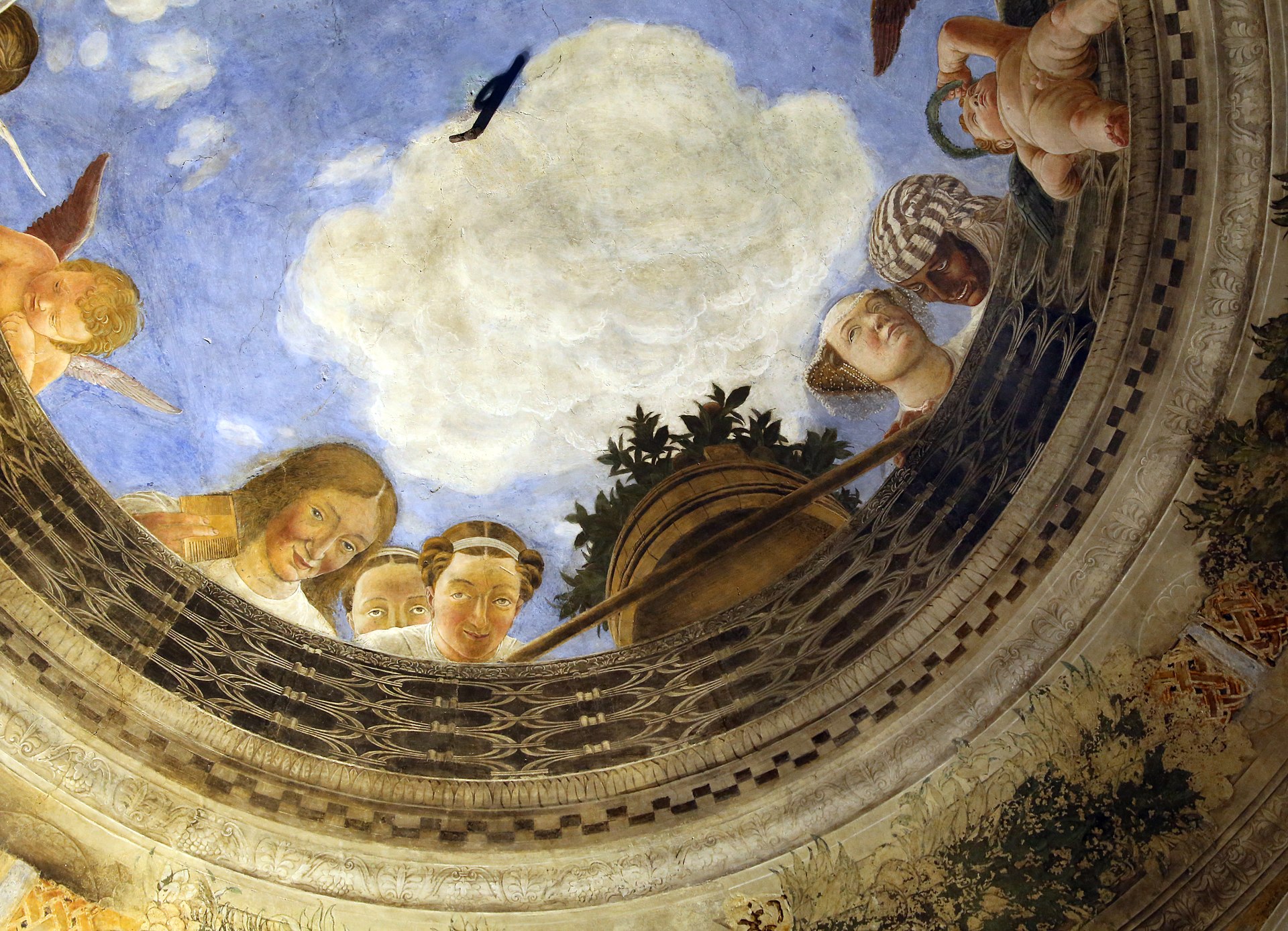
He certainly spent time in Mantua, where he knew the Triumph of Caesar and the Camera degli Sposi by Mantegna, who had been the first great master of bold foreshortenings and of perspective constructions for use in ceiling-paintings (as in this detail) in which the vanishing point is above the viewer’s head and hence the orthogonals seem to converge ‘from the bottom upwards’ (di sotto in su, as the Italians say).
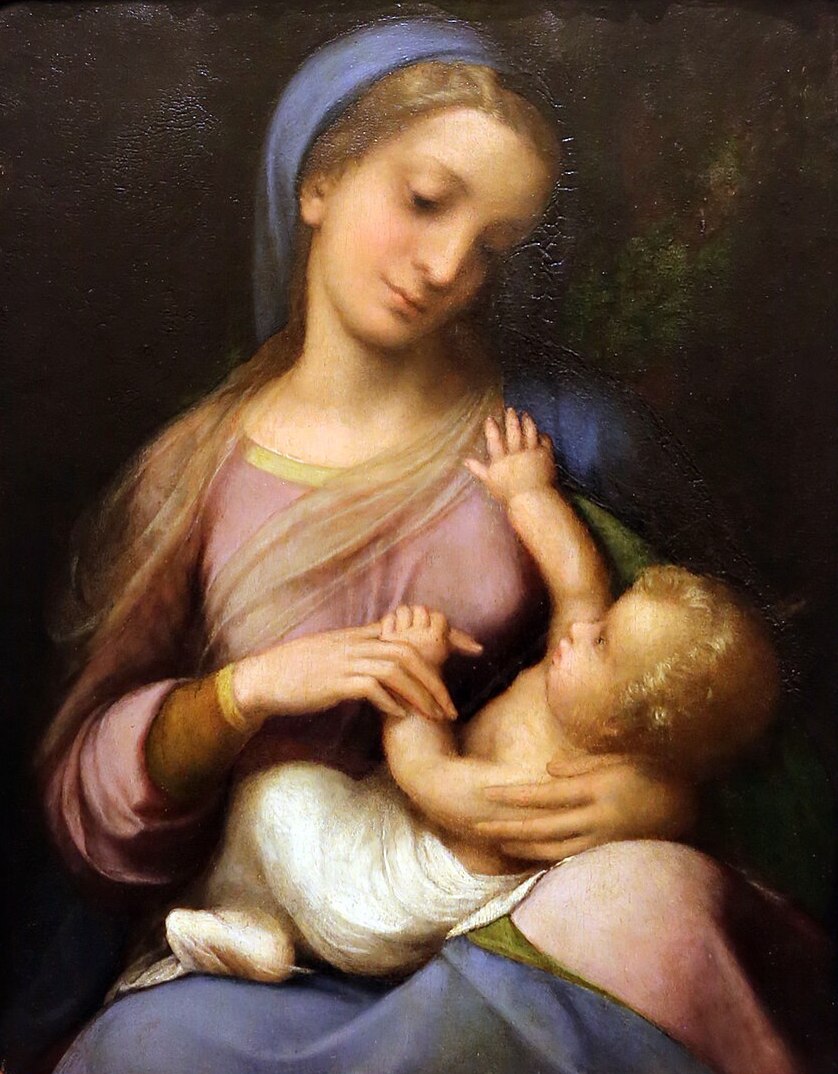
Accompany Veronese in spirit to Parma and enjoy the gentle mood, the pastel colours, the soft skin, the diaphanous veils and ‘smoky’ outlines in this tiny panel from 1517 by Antonio Allegri, always known as Correggio, whose art seems to stand at the antipodes to that of Mantegna.
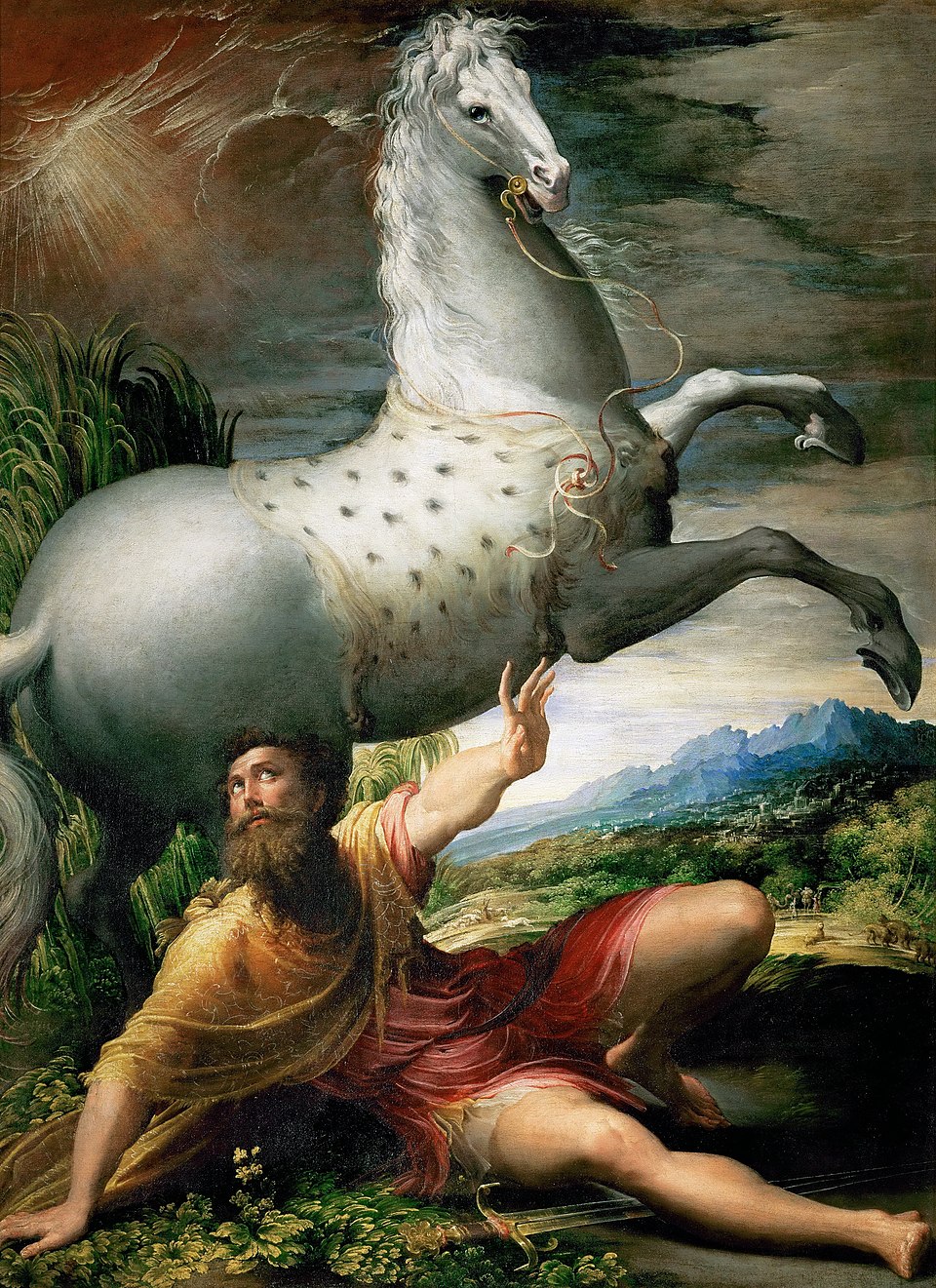
The young Veronese was also influenced by Niccolò dell’Abate (1512–71), an artist from Modena, who was to become famous at the French royal court.
(There are reasons for asking you to remember Niccolò’s painting of the Conversion of St Paul, dating from the year 1551, which is notable in part for its cool, non-Venetian colours, but mostly for the long-necked, Mannerist stallion, rearing up in response to the burst of divine light in the sky to display its tiny head—and almost human expression—and the horseshoes on its implausibly short forelegs.)
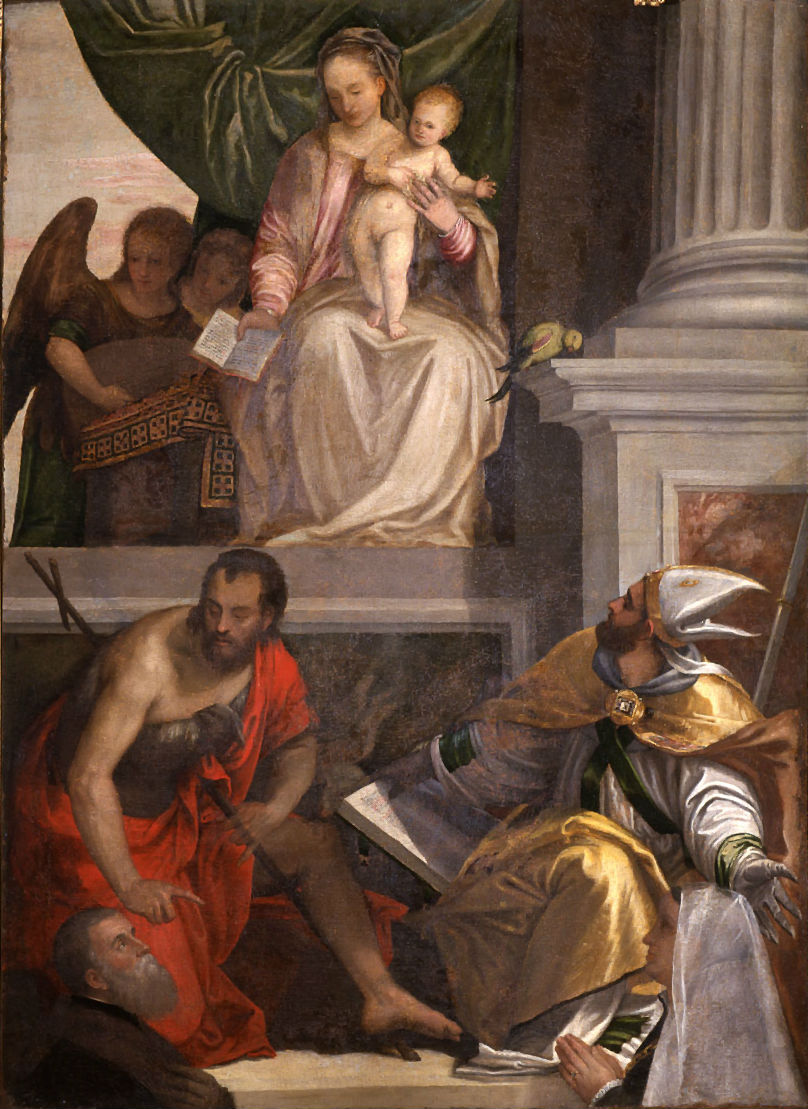
Paolo was a precocious youth, and his earliest certain surviving work is this altarpiece (on canvas, seven feet by six), painted in 1548, when he was just twenty. It was done for the family chapel of the Bevilacqua family in a church in his native Verona and is now located in the museum there.
The surface is a little abraded, but you can immediately see the influence of Correggio—in the type of the Madonna, the range of pastel shades, the sfumato of the two angels and the soft focus in rendering the polychrome marble panels.
Notice the complex, agitated pose of St Louis of Toulouse, who is holding a book, looking up and to the right while gesturing to the left; and notice how the very low viewpoint makes the classical column seem to lean over.
Even from this one picture, you can get an idea of how deeply the young Paolo’s colours, composition and figure-style were indebted to Mannerism and the artists of the Po valley.
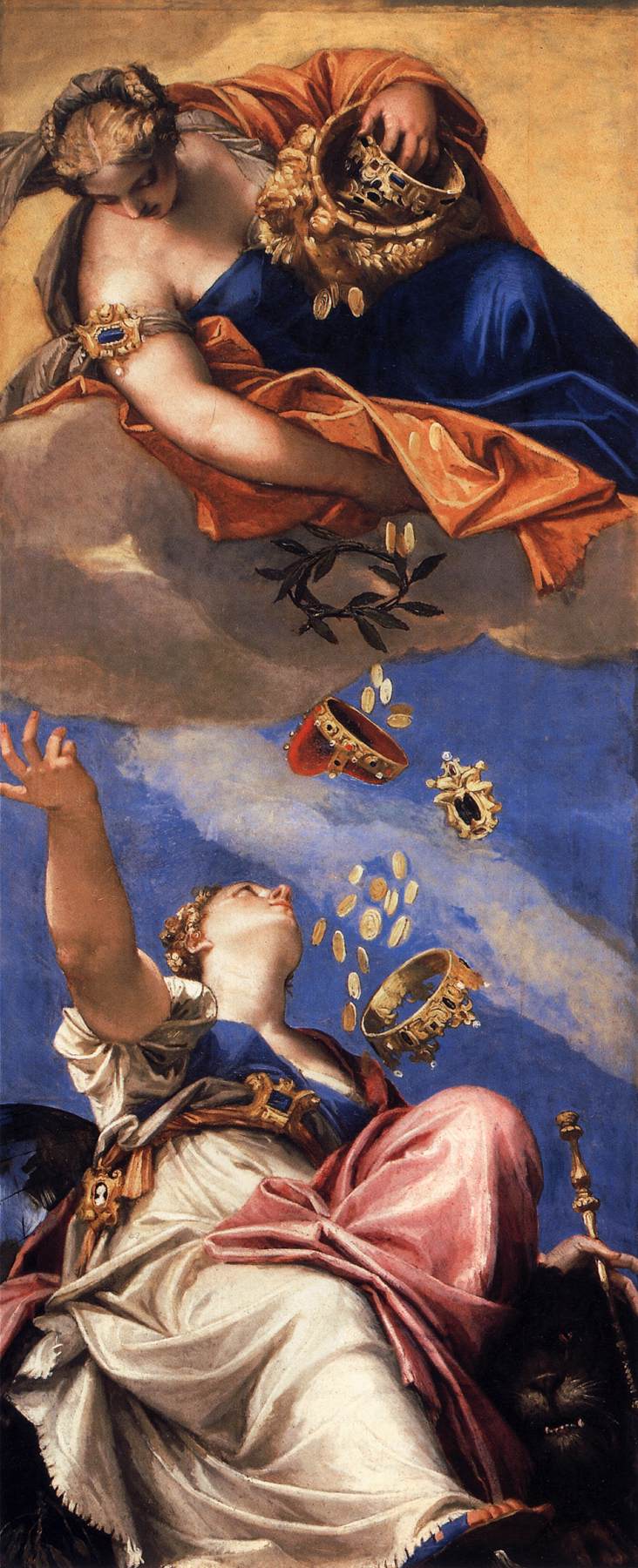
We know that Paolo executed some frescos on secular themes for two noble families who possessed villas in the neighbourhood of Treviso in 1551 and 1552; but let us follow him without further delay to the city of his adoption, Venice, where in 1553 and 1554 he was hired to do some small paintings for the ceiling of the Chamber where the Council of Ten met.
The canvas is only about four and a half feet high. It shows the goddess Juno, balanced in the clouds high above a personification of the Republic of Venice, who is seated on the lion of St Mark and receiving from the goddess three crowns, a laurel wreath, and coins in profusion.
So, even in his first, small-scale, allegorical composition for the city, Paolo is rejoicing in the themes of Venetian power, glory, and wealth; and he has already found his ideal woman (both Juno and Venice being variants, in proportion and colouring, on a type that will recur throughout his career).
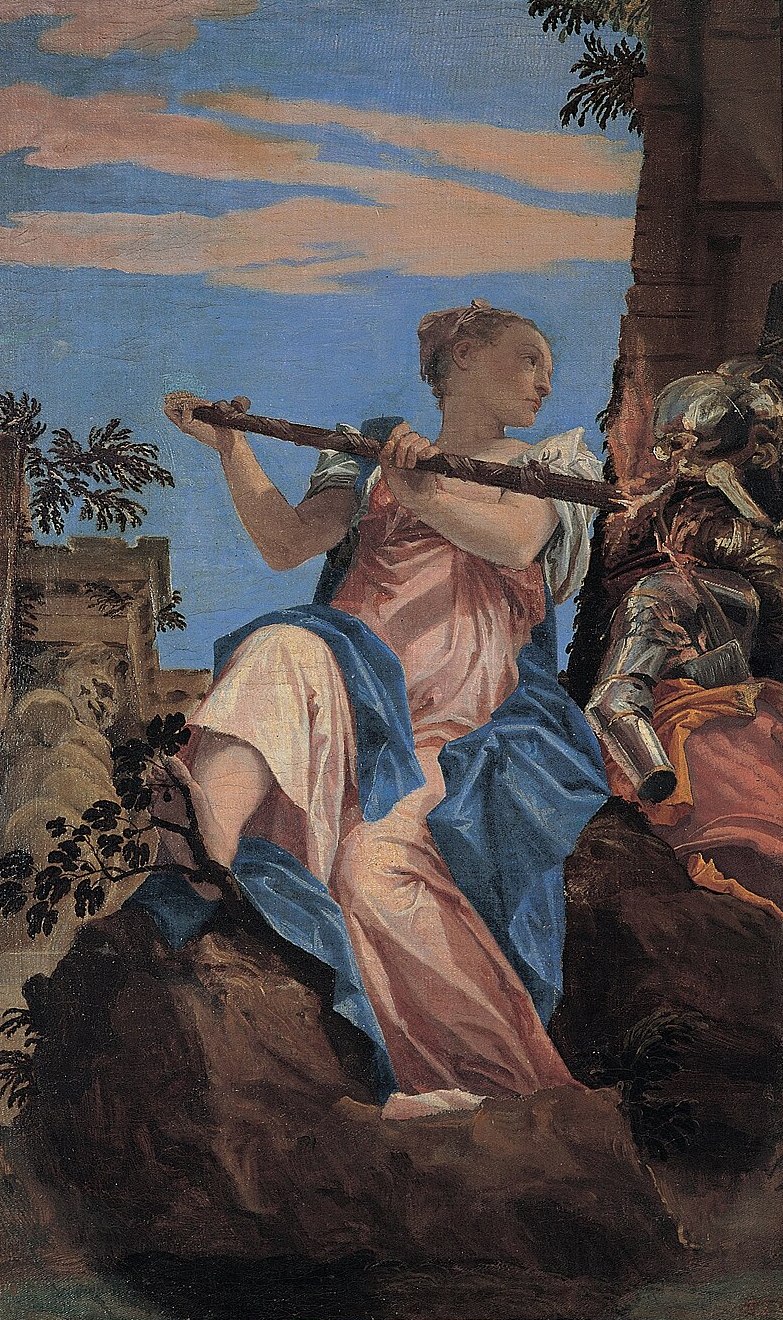
One last example (probably from the same years, now in Rome, and just three and a half feet high).
It is another personification–allegory, again intended for a ceiling, in which the figure of Peace (or Strength) presses her foot against a branch, and uses a long torch to set fire to a suit of armour.
Paolo is by now in his late twenties, and you will register immediately the brilliant colours, the pale skies and the mastery of foreshortening ‘from the bottom upwards’ which will characterise the art of his maturity.
Paolo made his home in Venice from 1555 until his death at the age of sixty in 1588.
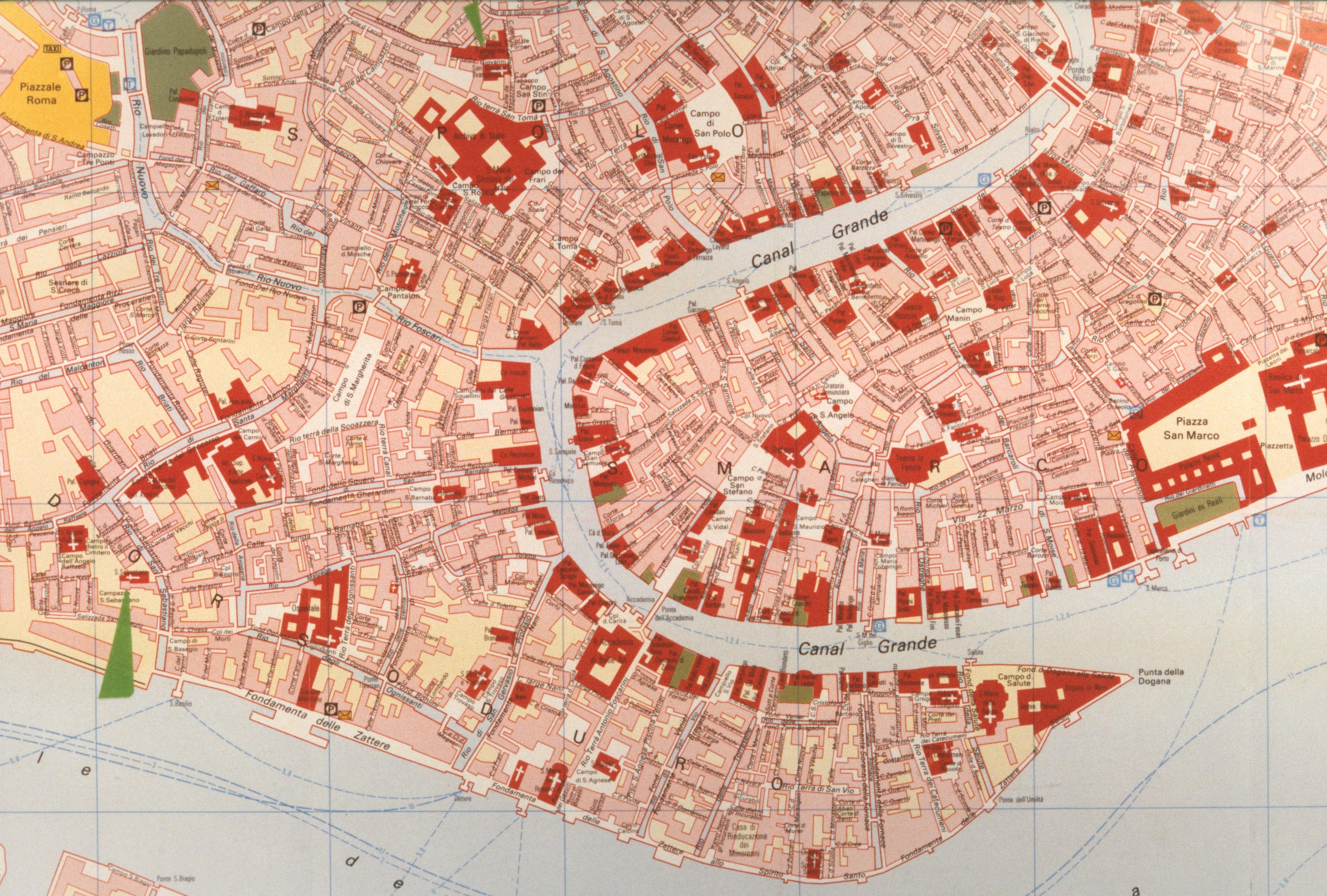
He lived towards the west of the city, near the small-to-medium sized church of San Sebastiano, whose position is marked by the green arrow on the bottom of the map.
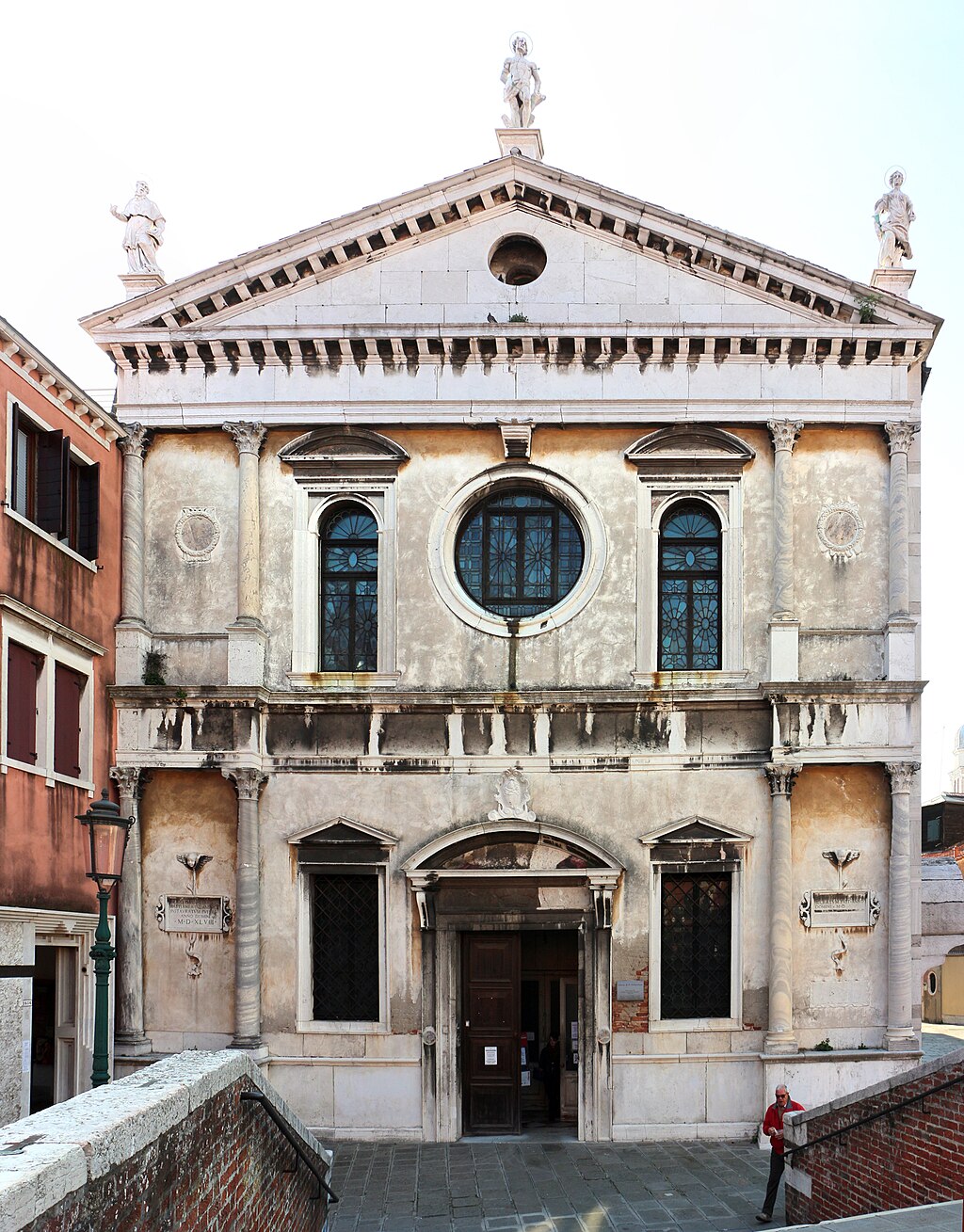
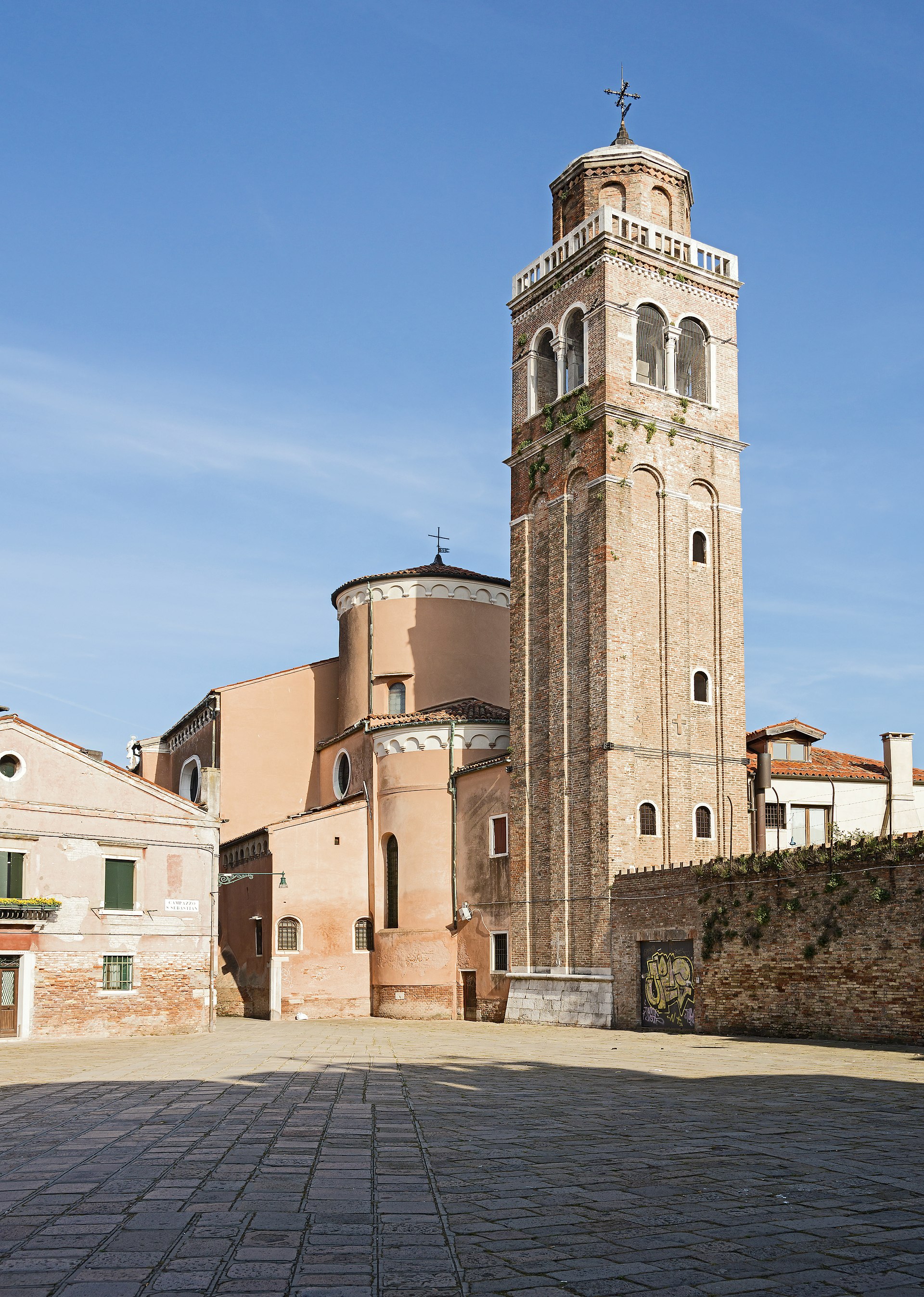
The church belonged to an order of friars, the Gerolomini, who lived in clausura in the adjacent convent; and the Prior was a fellow Veronese and friend of the artist. Thus, it is no surprise that Paolo’s first commission as a resident was for this very church.
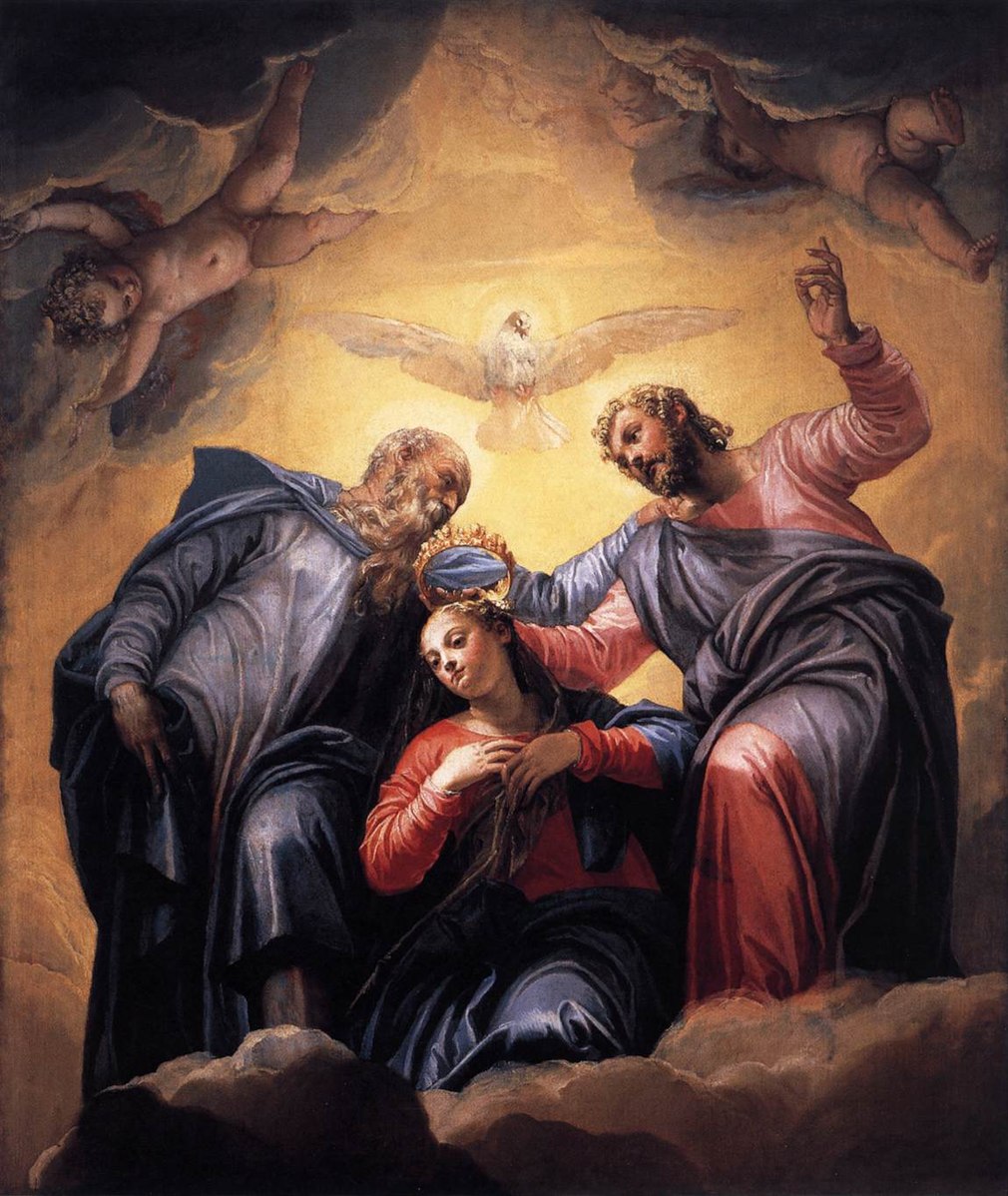
He began work in the sacristy of the church in 1555. Once again, he was commissioned to provide canvasses to decorate the ceiling, and he obliged with several small Old Testament scenes arranged around this Coronation of the Virgin (which measures just over six feet by just over five).
The figures are heftier now, but the poses are mannered, the palette is still close to Correggio, and the mastery of di sotto in su is no less assured.
Over the next decade, Paolo covered virtually every available surface in the church, adapting his style to the setting.
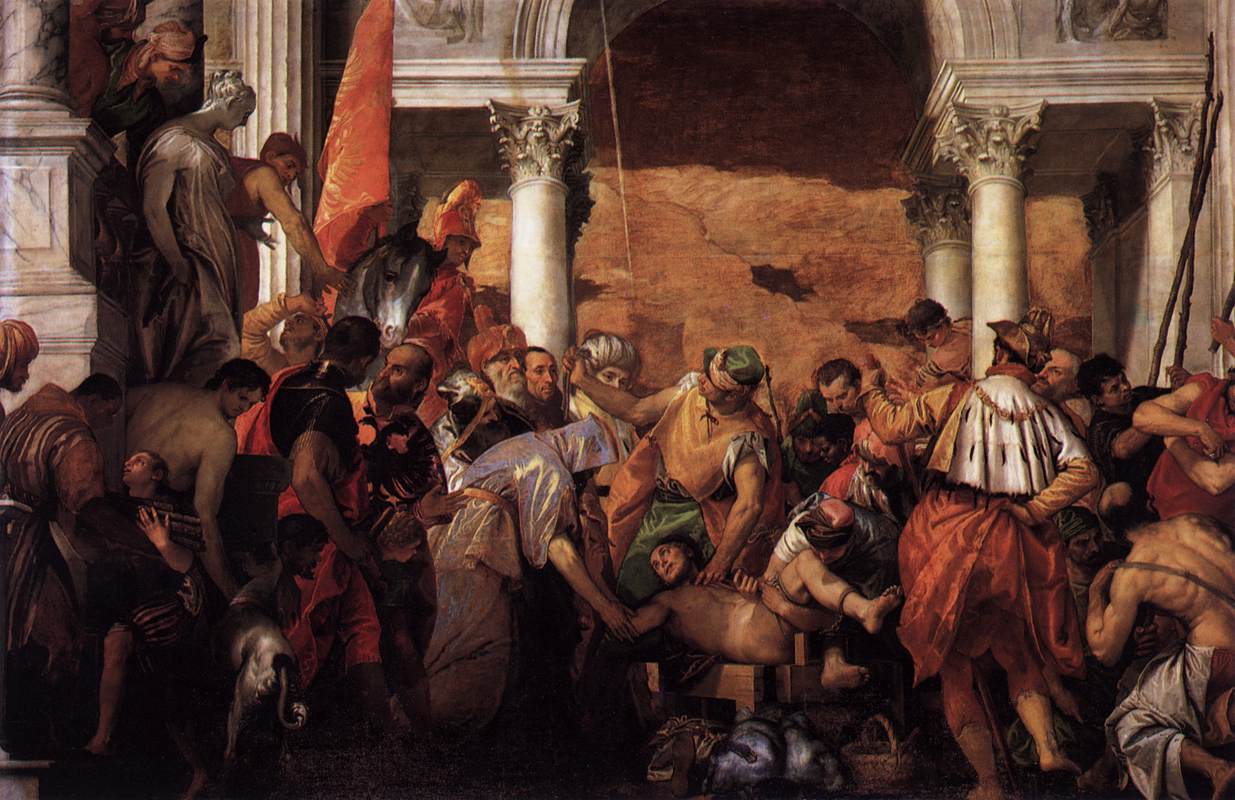
In the chancel, for example, the two large frescos of the martyrdom of Sebastian are very much in the grand manner (notice the Roman architecture, the statue of a goddess, an officer on horseback, executioners, and bystanders in rich contemporary costume, all seen against a flaming sky).
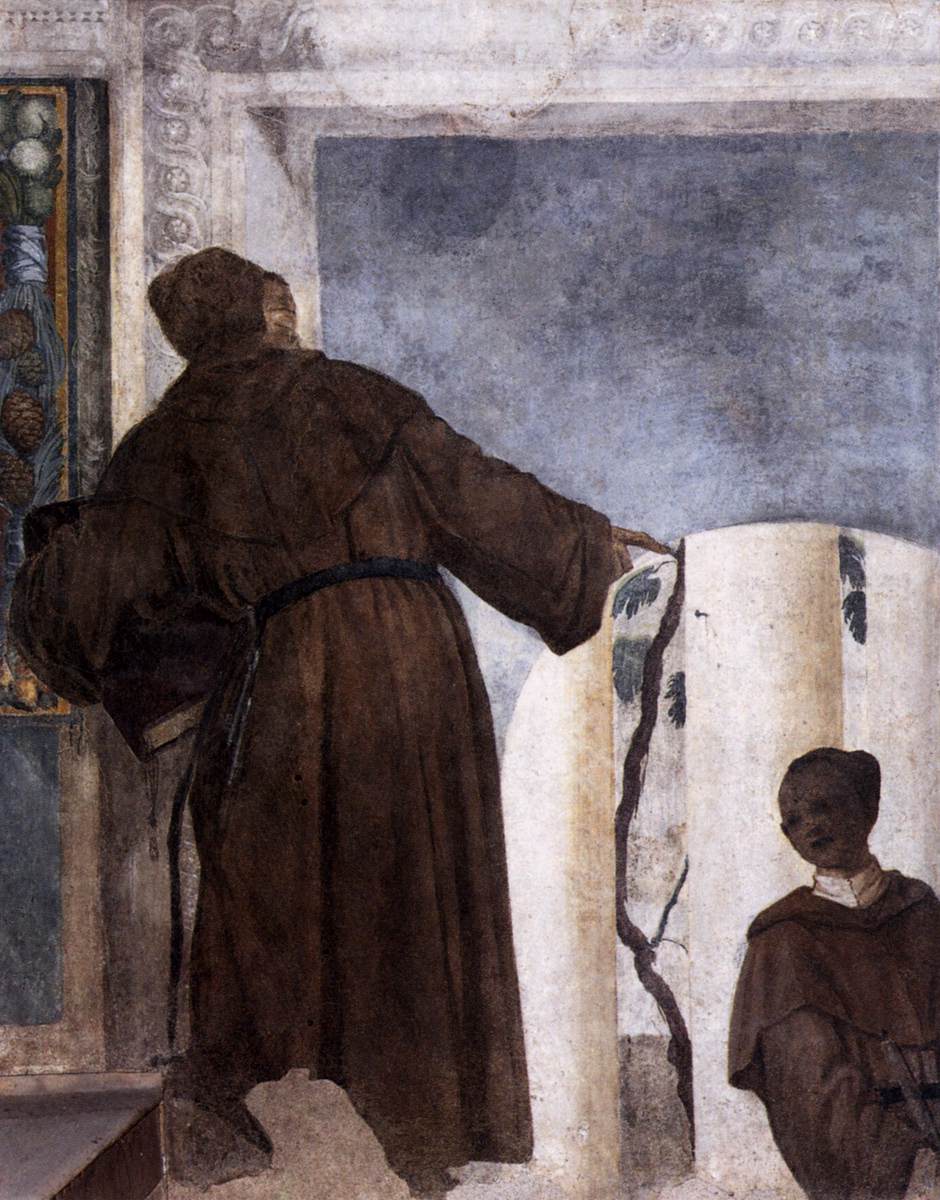
But in the domestic quarters of the monks, he indulged himself in affectionate trompe l’oeil frescos (such as this one of a monk returning to his cell), which were to become his trademark.
This was Veronese’s Church, in the same sense that San Rocco was Tintoretto’s Scuola.
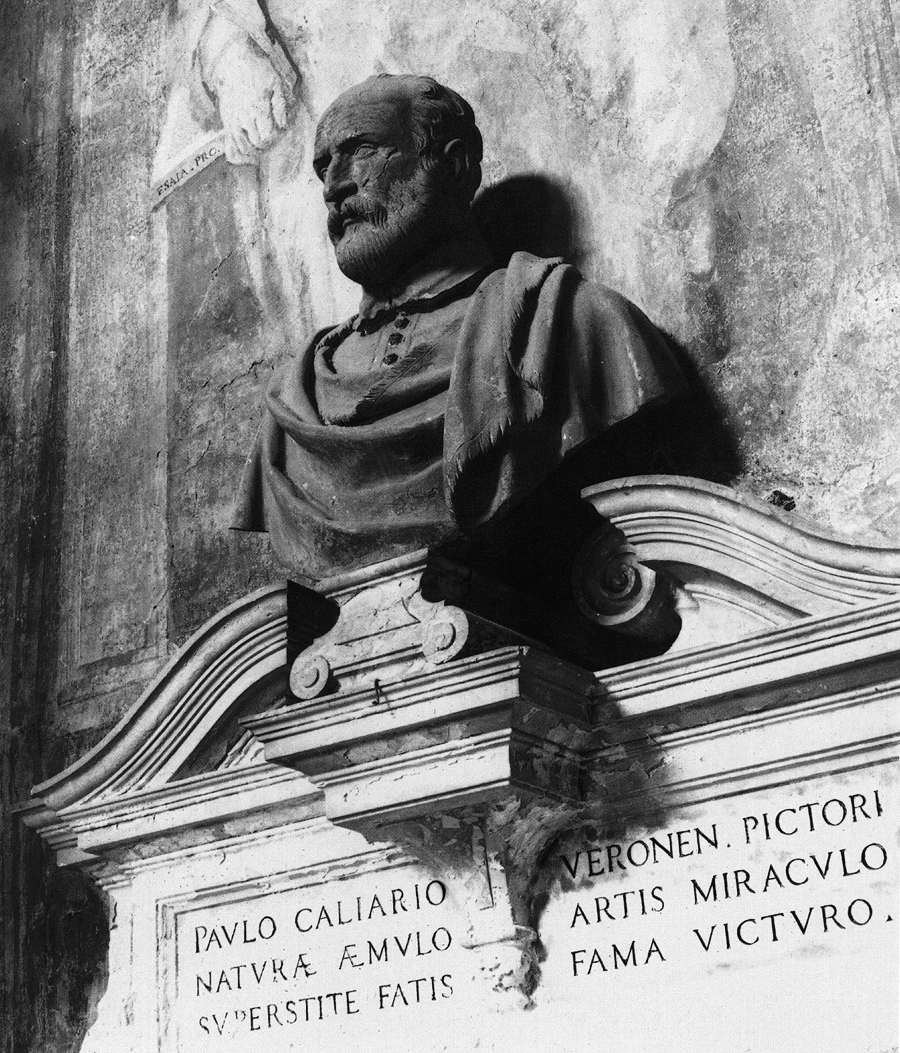
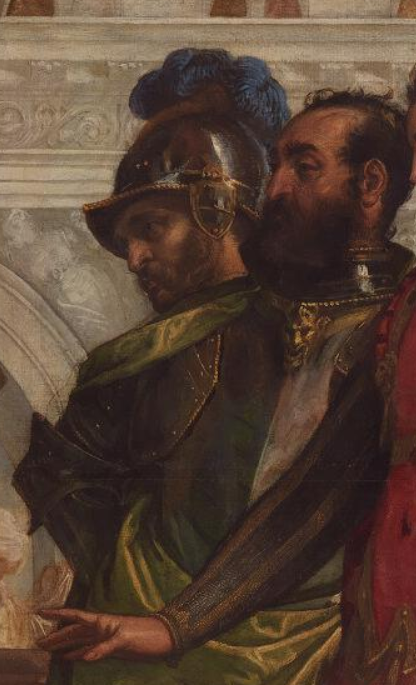
It is here that he is buried, and here we find the bust on his funerary monument, which serves as the main evidence for the presumed self-portraits in his paintings.
By common consent, Paolo’s finest achievement in the Church of San Sebastiano were the three large canvasses, in superb frames, that he executed for the ceiling of the nave in 1556 and 1557, when he would have been coming up to thirty years of age.
They illustrate three key moments in the Old Testament Book of Esther, so I have ventured to call them a ‘narrative cycle’. And as you will see, the story fits quite comfortably into a lecture on the subject of ‘Love and Marriage’, because it deals with a king who divorced his first queen and elevated to the throne a maiden from an ethnic minority…
The first of the three canvasses lies immediately over your head as you enter the church and it measures a generous sixteen and a half feet by eleven.
The story comes from the end of Chapter 1 in the Book of Esther (which, I remind you, is a splendid oriental fairy-tale, worthy to be included in The Arabian Nights). The king, Ahasuerus, is said to reign over 127 provinces, stretching from India to Ethiopia. After three years on the throne, he has given a first banquet for the nobles and the governors of these 127 provinces which lasts no less than 180 days; and this is followed by a second banquet, the last phase of which is illustrated here, lasting ‘seven days, in the court of the garden of the king’s palace’.
As you look at the picture here on screen, please keep in mind that you should be seeing it high above your head, and that the fictive building you are looking at is the underside of a horizontal cornice, which has been foreshortened from below, di sotto in su. (I should add that the description in the Bible of the splendid setting in the garden specifically mentions ‘marble pillars’.)
‘On the seventh day’, we read, ‘when the heart of the king was merry with wine’, he commanded that his queen, the beautiful Vashti, should be brought into his presence.
She refused to come. So, the king, after due deliberation with his nobles, divorced her by a decree that was sent ‘to every province in its own script and to every people in his own language’, a decree which insisted: ‘that every man should be lord in his own house’.
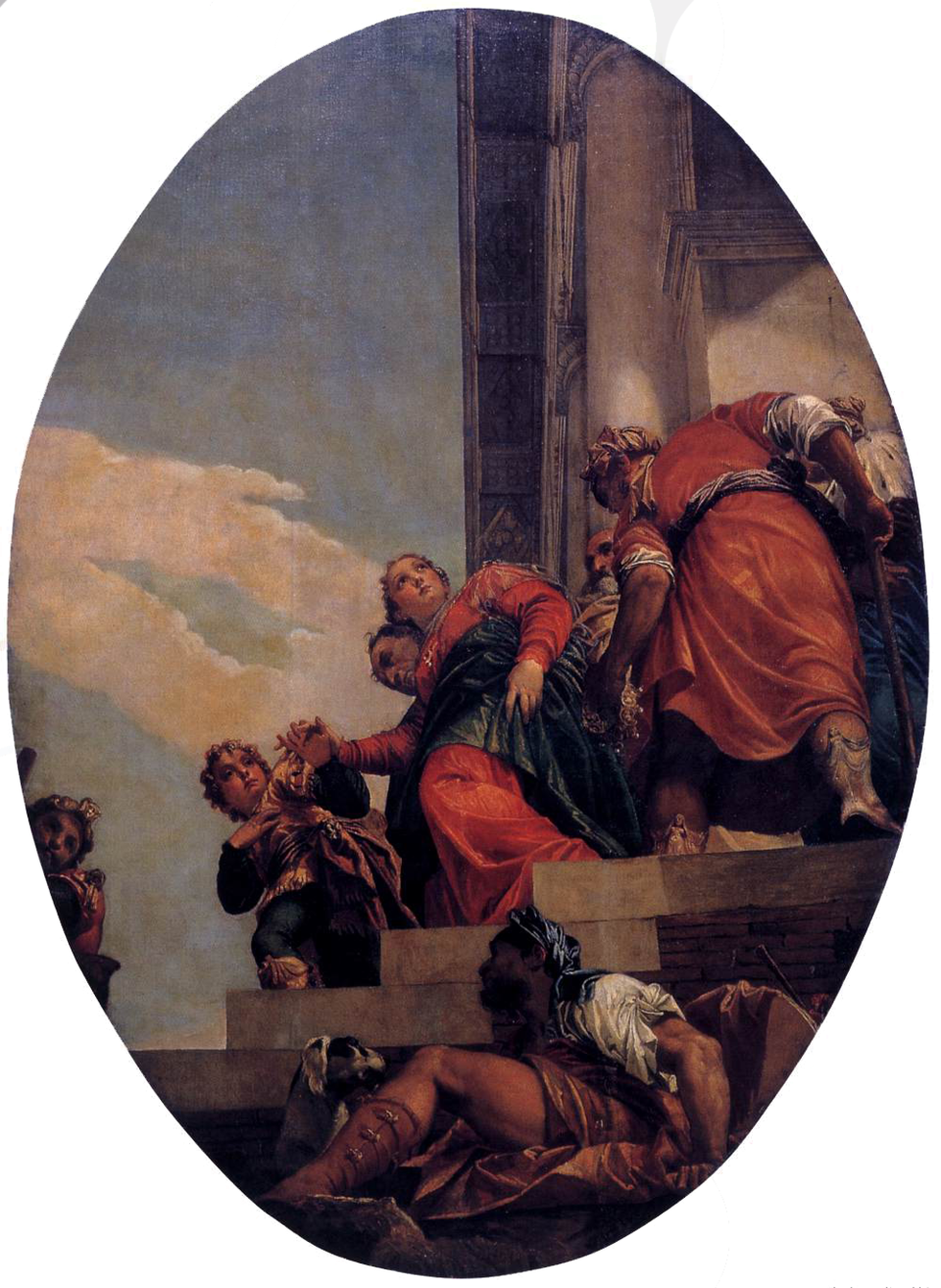
I should explain that a court eunuch (turbaned, almost completely hiding the king on his throne) has plucked the crown from the head of Queen Vashti; and she is being led down the steps by another eunuch (you can just see his face), while she holds her son by the hand.
The figure crouching with his dog at the foot of the throne is the true hero of the tale.
This crouching figure is Mordecai, a Jew, a descendant of the Jews who were carried off generations earlier by King Nebuchadnezzar; and he is uncle and guardian to the beautiful Esther.
When the king announces a kind of beauty competition to find a new queen, Mordecai conveys his ward to the palace with the other contenders for a twelve-month period of beautification (I said it was a fairy tale); and every day he used to pass ‘in front of the court of the harem, to learn how Esther was and how she fared’.
Esther was eventually taken to the king for inspection; and ‘she found grace and favour in his sight more than all the virgins, so that he set the royal crown on her head and made her queen instead of Vashti’.
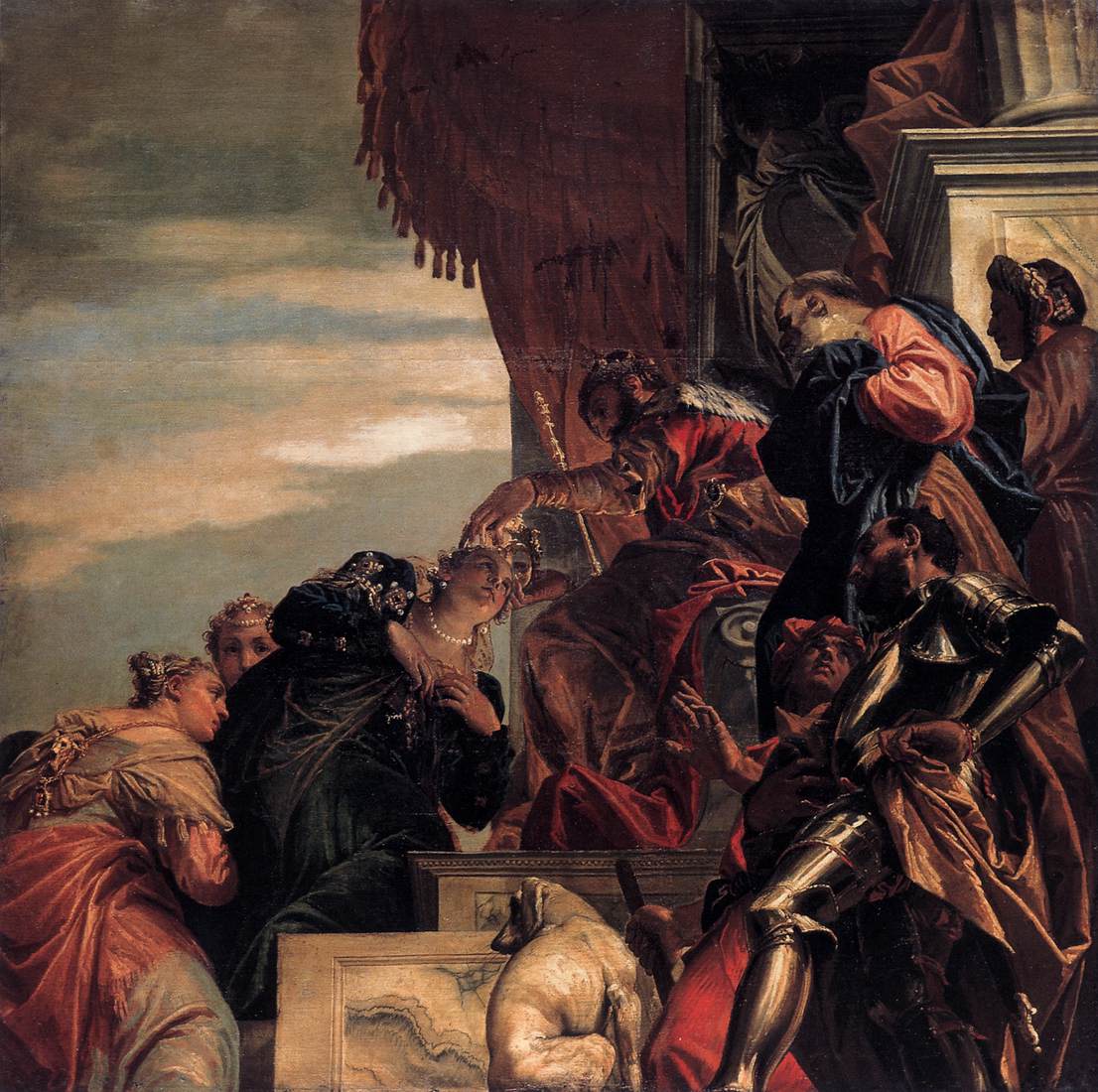
So here, in the rectangular canvas in the centre of the ceiling we are again shown the royal throne, with its splendid canopy, again seen di sotto in su, in another ‘subject’s-eye view’.
The king, with his gold sceptre, is in the act of crowning Esther, who is kneeling at his feet, inclining her head, her arms submissively folded, attended by two rather overawed companions.
(The absolute power of the Eastern monarch is a vital theme in the story, by the way, because to appear before him uncommanded meant certain death.)
All this happens in Chapter 2, which ends with a seemingly irrelevant but later significant episode, in which Mordecai, always ‘sitting at the king’s gate’, gets wind of a plot to murder the king, and discovers the plot to Esther, as a result of which the conspirators are hanged on the gallows.
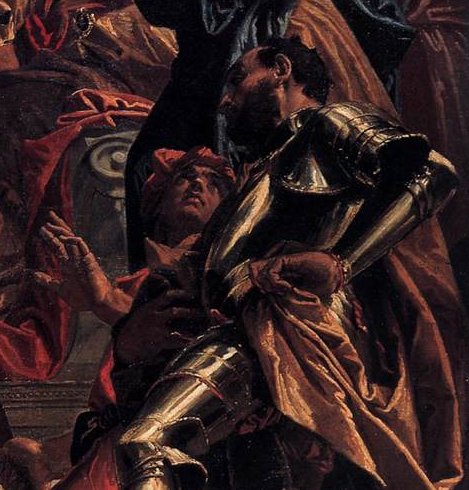
The man at the foot of the throne (scowling, his arms akimbo, wearing armour and talking to a dwarf) is clearly meant to be the villain of the tale, Haman, who (as we are told in Chapter 3) became chief minister to the king, and became obsessed with the fact that Mordecai, and Mordecai alone, refused to bow down before him and ‘do obeisance’.
The central part of the Book of Esther deals with the confrontation between these two—Mordecai and Haman. Haman himself conceived a new plot to murder all the Jews in all the 127 provinces. Mordecai again discovered the plot and persuaded Esther to intervene to save her people, which she duly did, appearing before the king, uninvited, at the risk of her life, in a much-painted scene (which Veronese must surely have had in the back of his mind when composing the second canvas).
Without explaining her intentions, she invited Haman and the king to a banquet at her palace on the following day. Haman construed the invitation as a mark of great personal favour; and, hoping to anticipate his revenge, gave orders for a gallows be erected to hang Mordecai. But the king had a restless night; and while reading the Chronicles of his reign, he was reminded of Mordecai’s role in frustrating the earlier plot and realised that Mordecai had not been rewarded in any way. He therefore resolved ‘to honour him’.
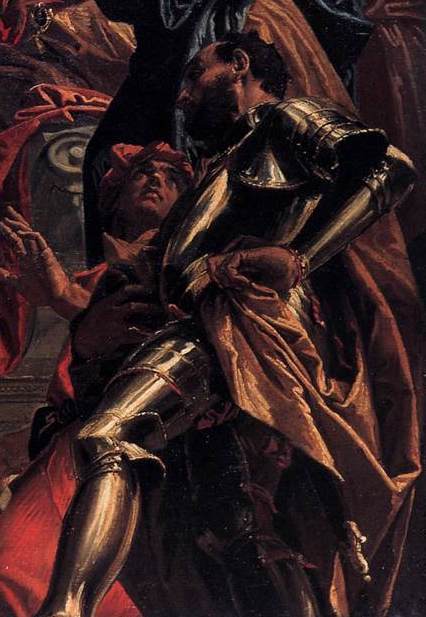
It is at this very moment that Haman appears at the palace. The king asks him, apparently in the abstract, “What should be done to a man whom the king delights to honour?”
Haman is sure that he himself is the man, and he lays it on pretty thick:
For the man whom the king delights to honour, let royal robes be brought which the king has worn, and the horse which the king has ridden; and let the robes and the horse be handed over to one of the most noble princes; let him array the man whom the king delights to honour, and let him conduct the man on horseback through the open square of the city, proclaiming before him: ‘Thus shall it be done to the man whom the king delights to honour.’
Then the king said to Haman: ‘Make haste, take the robes and the horse, as you have said, and do so to Mordecai the Jew, who sits at the king’s gate.’
So, the subject of the third canvas (another oval, lying nearer the altar), is the Triumph of Mordecai.
In yet another subject’s-eye view, we are shown ‘the open square of the city’, with a spiralling column supporting a balcony with a dozen spectators.
We see Haman, still in black armour, himself ‘one of the king’s most noble princes’, who is ‘conducting’ Mordecai ‘on a horse which the king has ridden, in royal robes which the king has worn’. (Veronese throws in a banner for good measure.)
Haman is proclaiming—no doubt between his teeth: ‘Thus shall it be done to the man whom the king delights to honour’; and needless to say, it is Haman who will be hanged on the gallows he had prepared for Mordecai.
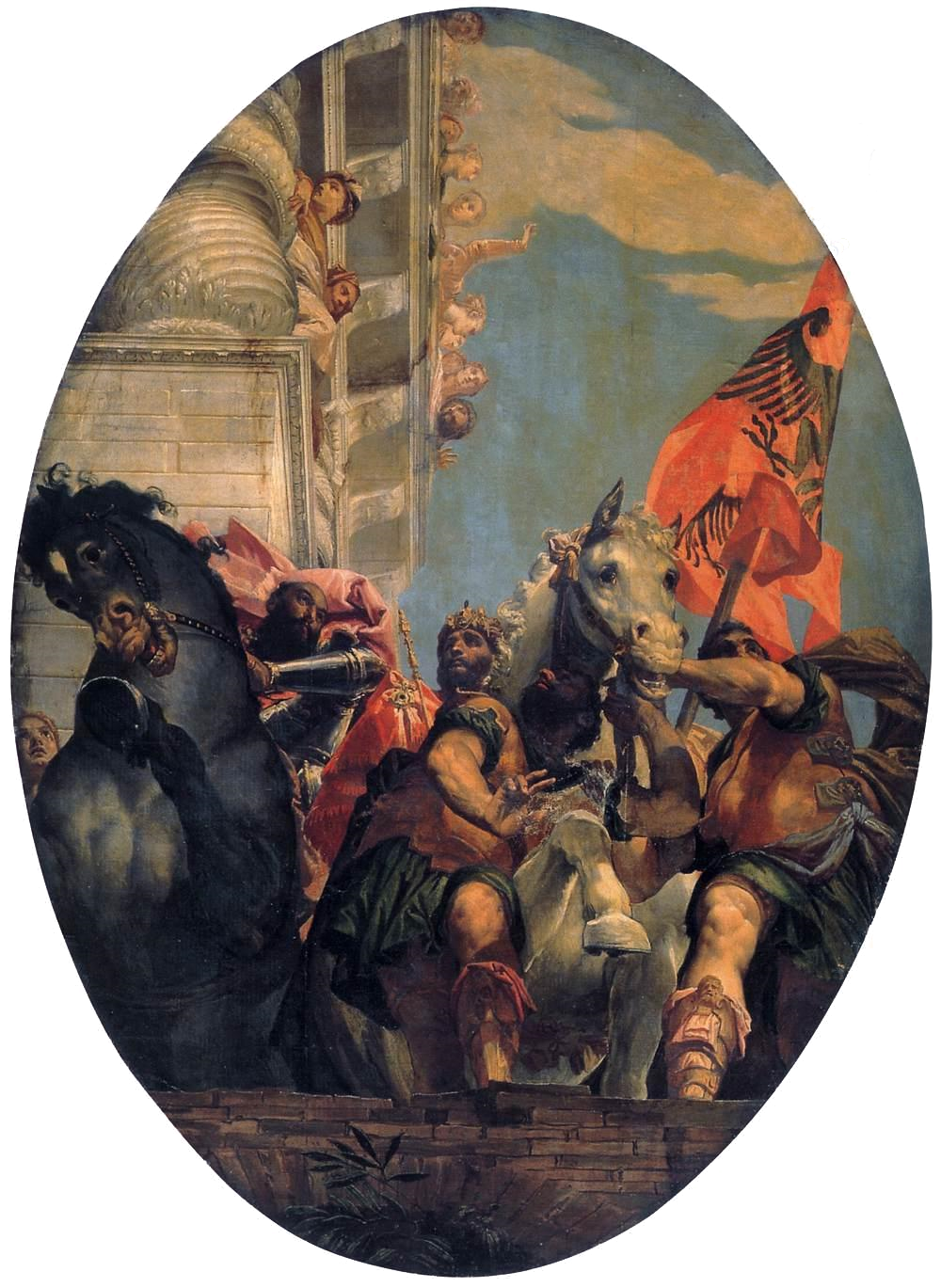
The details to retain here are those of the two horses (remembering all the time that you are seeing them above your head).
Both are on the verge of a precipice, of disaster and death; but Mordecai’s white horse is restrained, held back, whereas Haman’s black horse is rearing and threatening to plunge over.
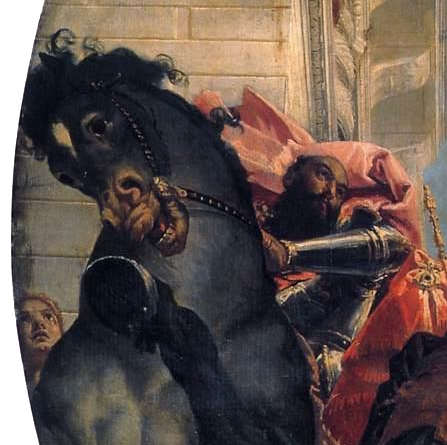
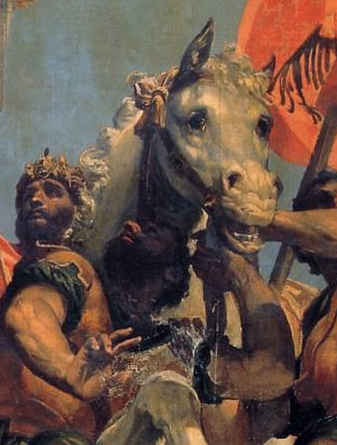
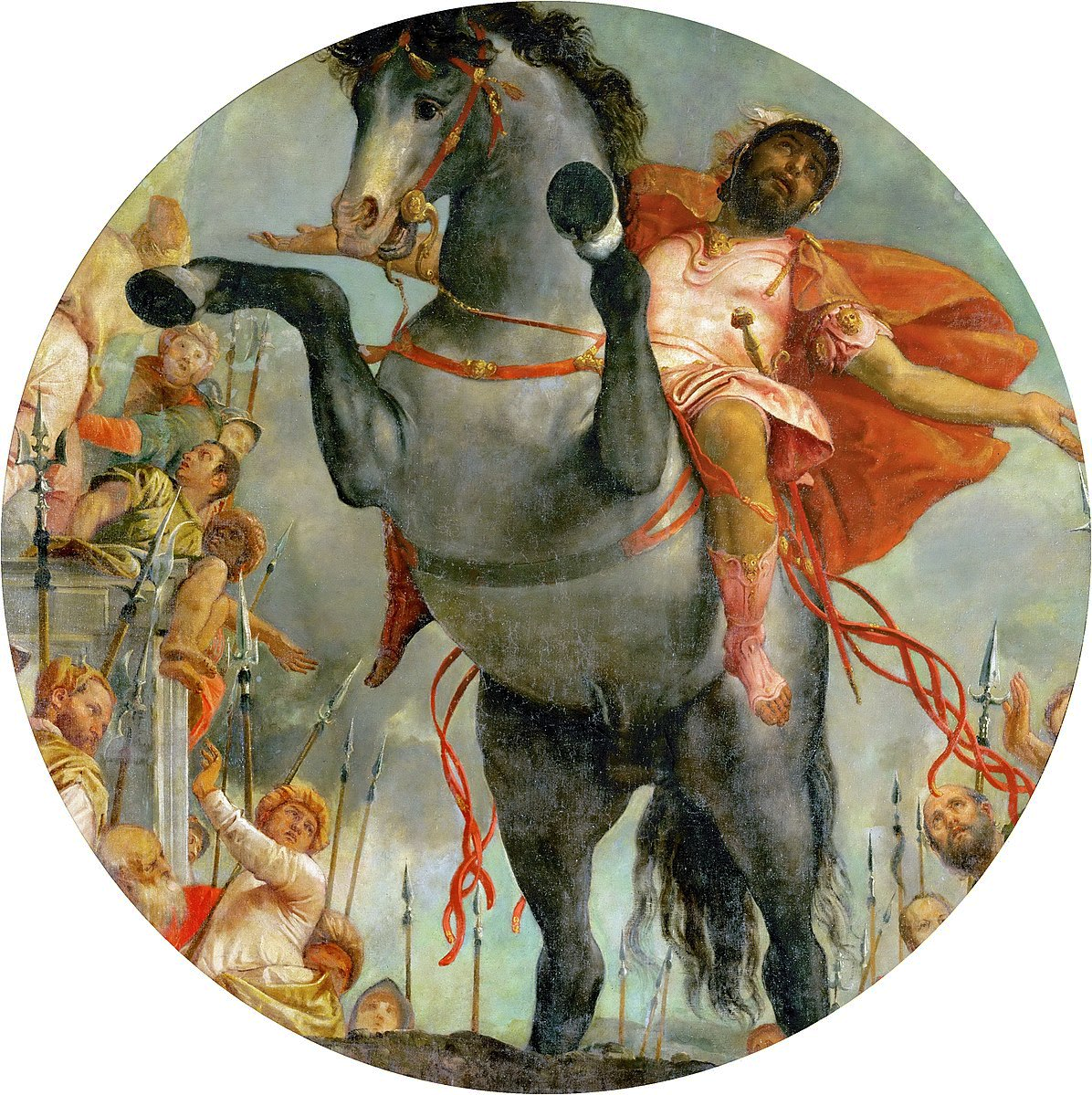
It is worth noting that Veronese is remembering an early painting of his own, a tondo for a ceiling in which the very Mannerist horse of the Roman knight Marcus Curtius is being deliberately spurred on by his rider so that both will fall into a chasm that has opened in the middle of the Roman Forum.
You may perhaps recall the stallion in Niccolò dell’Abate’s Conversion of Saint Paul…
So much then for the Church of San Sebastiano.
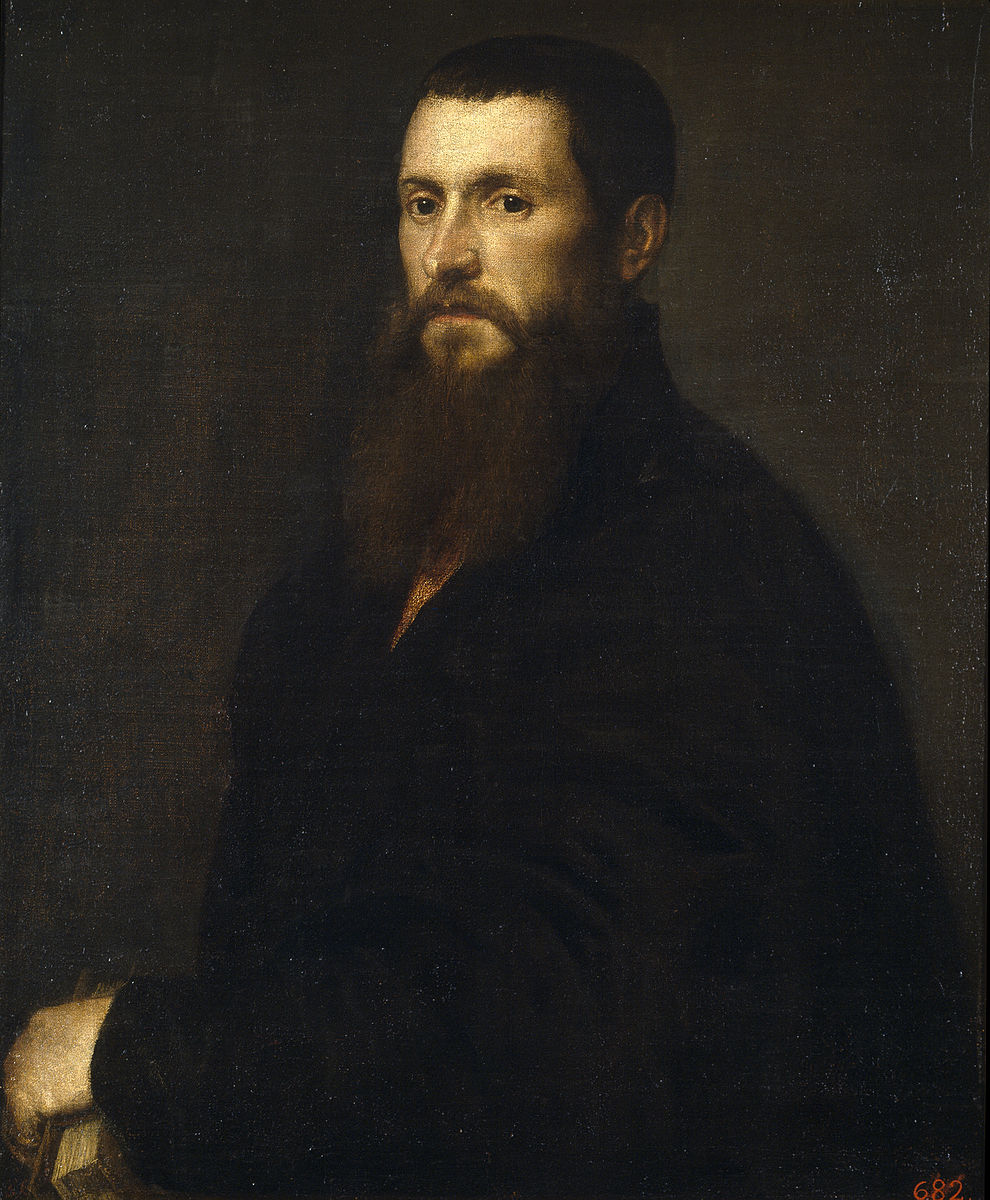
The immediate success of these Esther canvasses, together with Paolo’s earlier reputation as a fresco painter of secular subjects, brought him to the attention of Daniele Barbaro, whom you see here in portraits by Titian (from about 1545) and Veronese (late 1550s).
Daniele had been born in 1514 of a well-known noble family. He had received an excellent humanist education at the University of Padua, and he had written several commentaries on the works of Aristotle.
Noble status carried civic obligations; and he served the Republic as a diplomat, being ambassador in England at the court of Edward VI from 1548 to 1551. He became a bishop, and then patriarch-elect of Aquileia (more of which in the final lecture); and it was in this capacity that he attended the Council of Trent, which met at intervals over a period of eighteen years from 1545 to 1563, and set in motion what has come to be called the ‘Counter Reformation’.
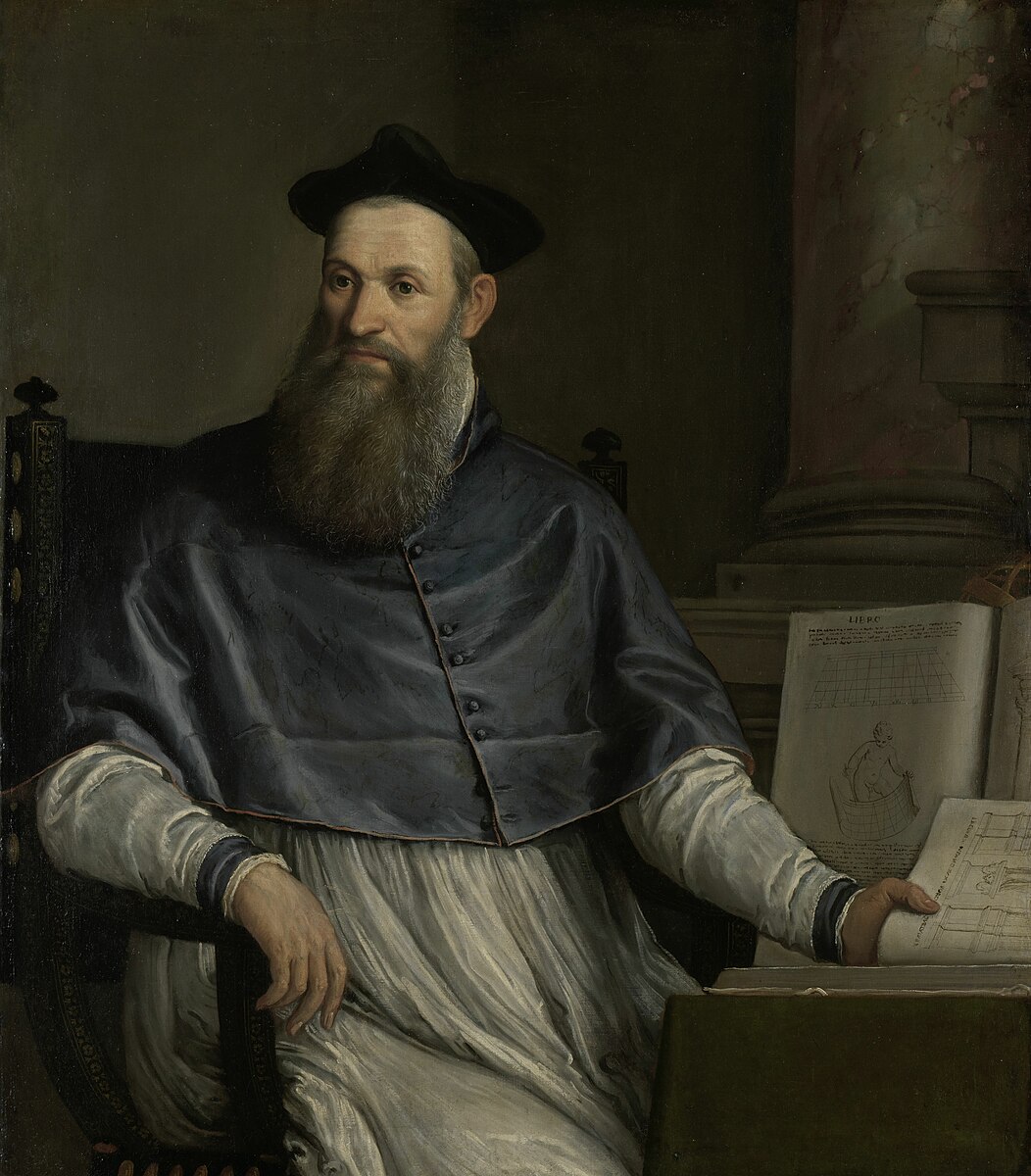
Daniele’s private passion, however, was classical architecture and the art of perspective.
In the mid 1560s he would publish his own treatise on perspective and his own translation (with commentary) of De Architectura by the Roman architect Vitruvius, in an edition with engravings by Palladio—this is the book he is holding in the portrait by Veronese.
Our second narrative cycle is the fruit of an earlier collaboration between these three great men—Palladio (b. 1508), Barbaro (b. 1514) and Veronese (b. 1528)—so it is only fair to add a few words about the architect.
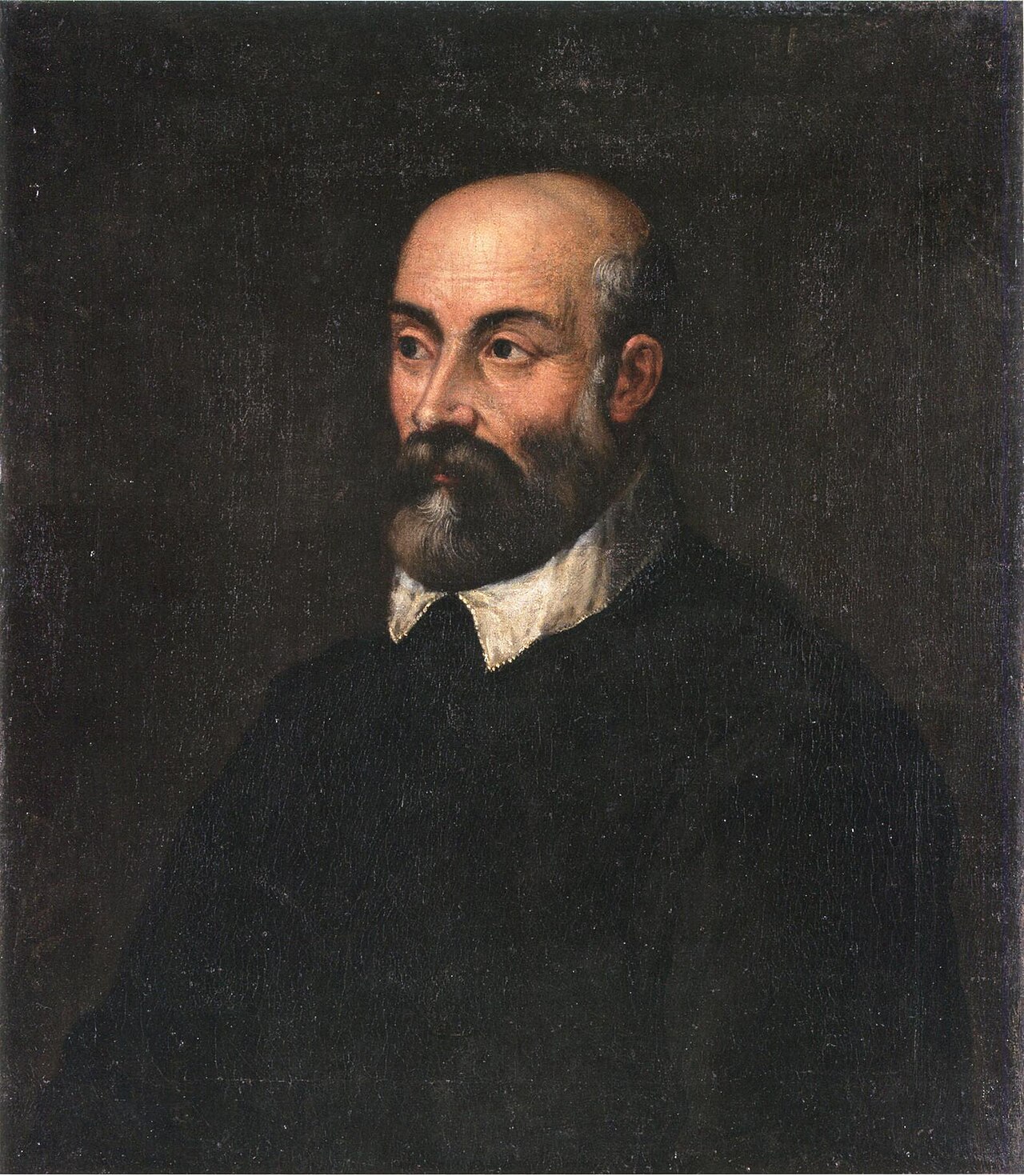
Born in Padua, he was christened Andrea Pietro della Gondola and had a tough practical life as a builder before he was taken up at the age of 30 by a well-known humanist called Tríssino, with whom he worked on a measured survey and catalogue of classical buildings in Rome. (It was Trissino who bestowed on him the sobriquet Palladio, meaning ‘devotee of the goddess Pallas Athene’.)
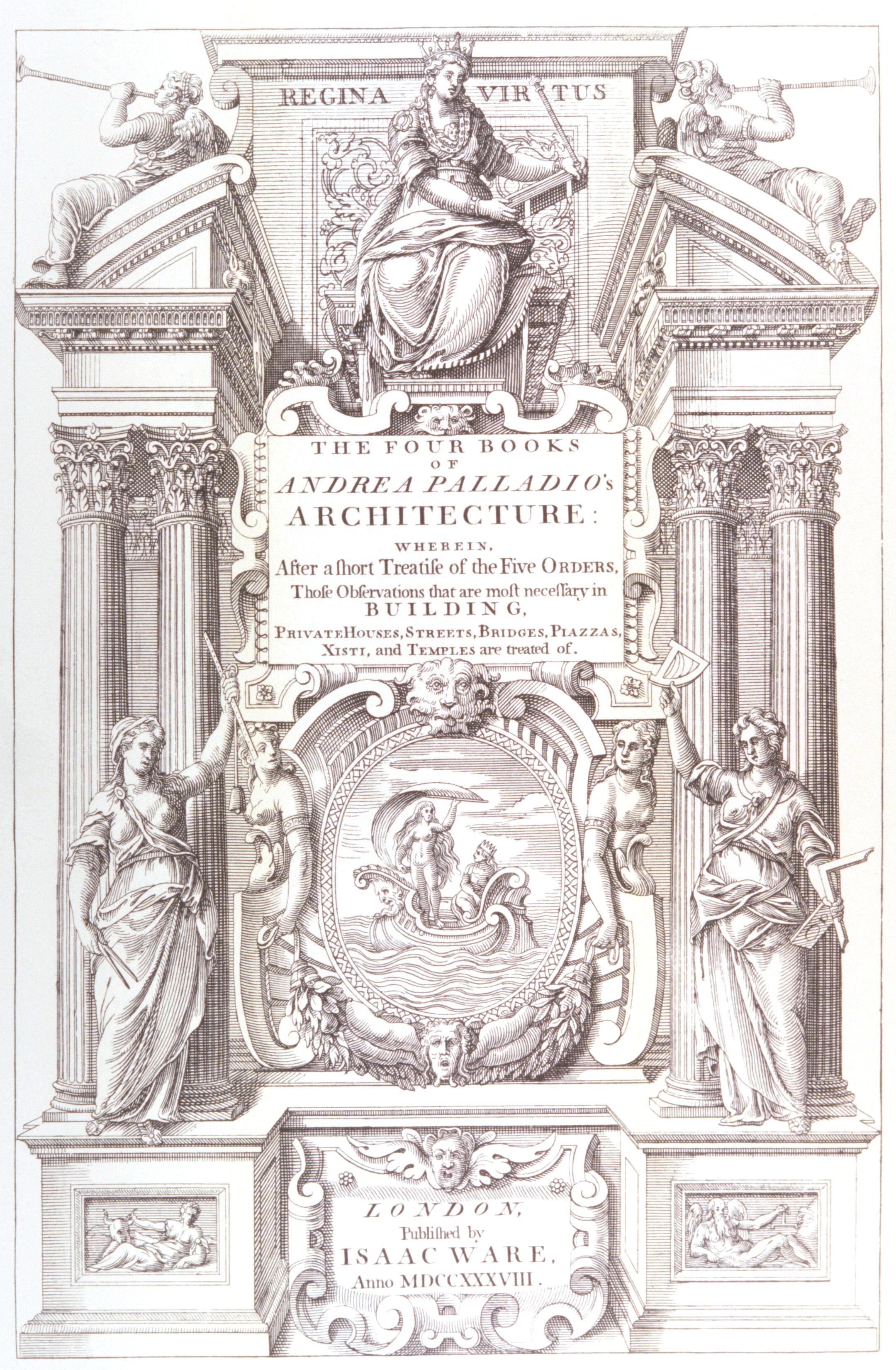
Palladio would later (1570) publish his own Four Books of Architecture, illustrated with engravings of a quality you can judge from the frontispiece of an English translation 150 years later (which is also evidence of his enduring fame throughout Western Europe).
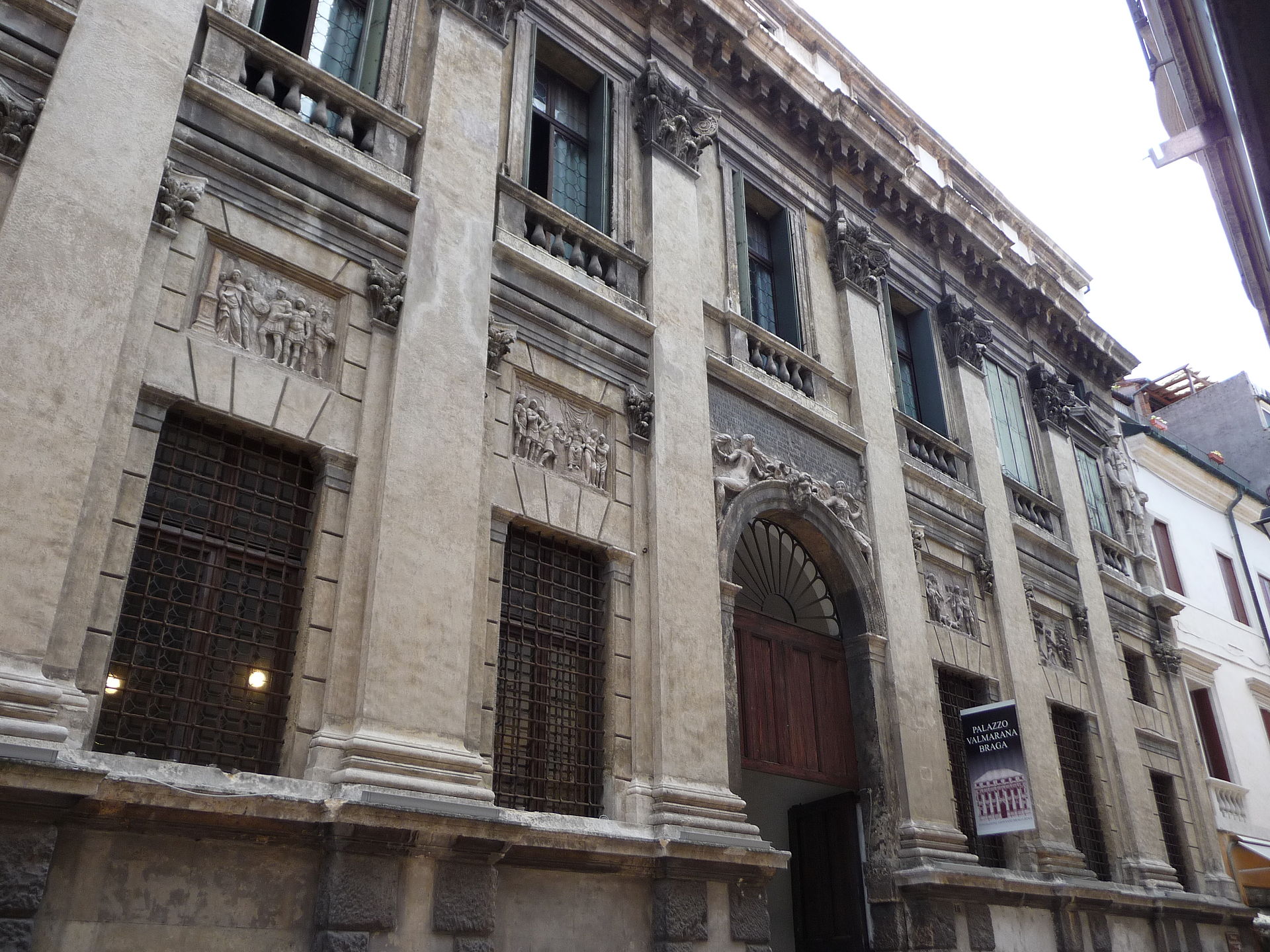
Throughout the 1550s, Palladio designed town palaces for his native Vicenza and splendid villas for the nobility in the surrounding countryside.
And so to our story.
Daniele Barbaro—the connoisseur of architecture and of painted architecture—had a brother called Marcantonio, who was married with three sons.
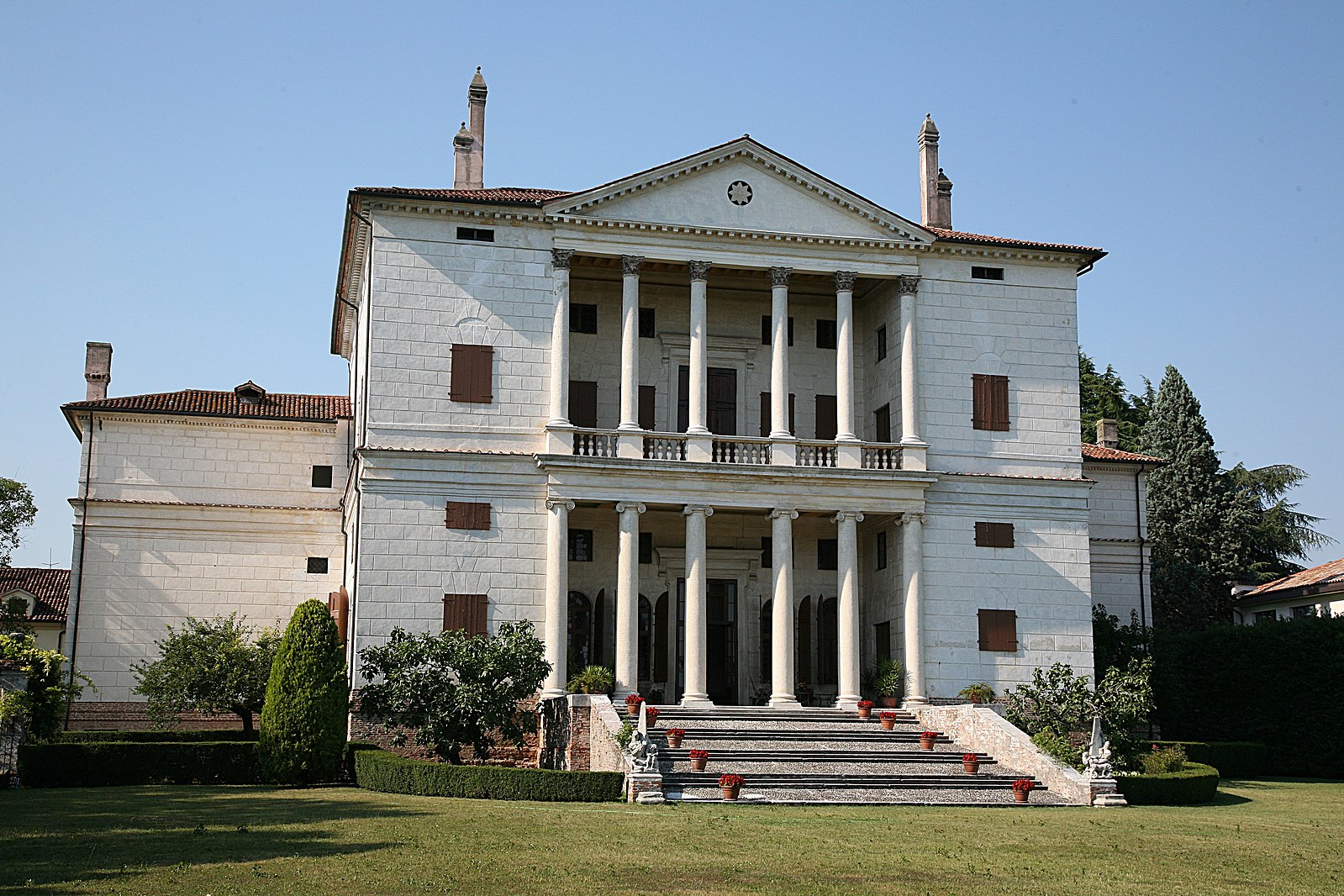
In the late 1550s Daniele and Marcantonio got together to commission from Palladio a new villa, in the province of Treviso, near the village of Masér, about thirty miles north-west of Venice, and thirty miles north-east of Vicenza.
The building was completed by 1559; and although the dates are not certain, it seems likely that Paolo executed his frescos there in two summer seasons—1559 and 1560, or possibly 1560 and 1561—when he was in his early thirties.
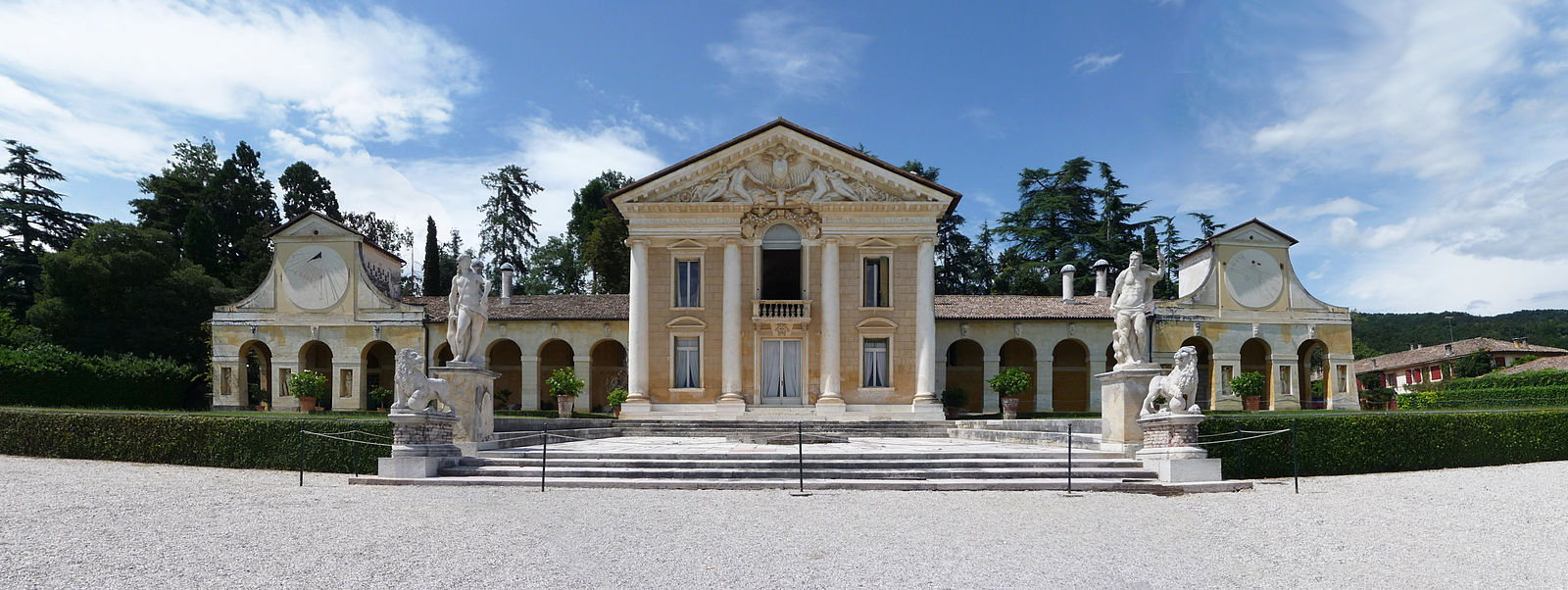
As you will see, even at the most cursory glance, the villa is typical of its architect in the classical proportions and detail of the projecting central building (based on a temple façade), and in the perfect symmetry of the two low wings, which end in elaborate dovecots ornamented with large sundials.
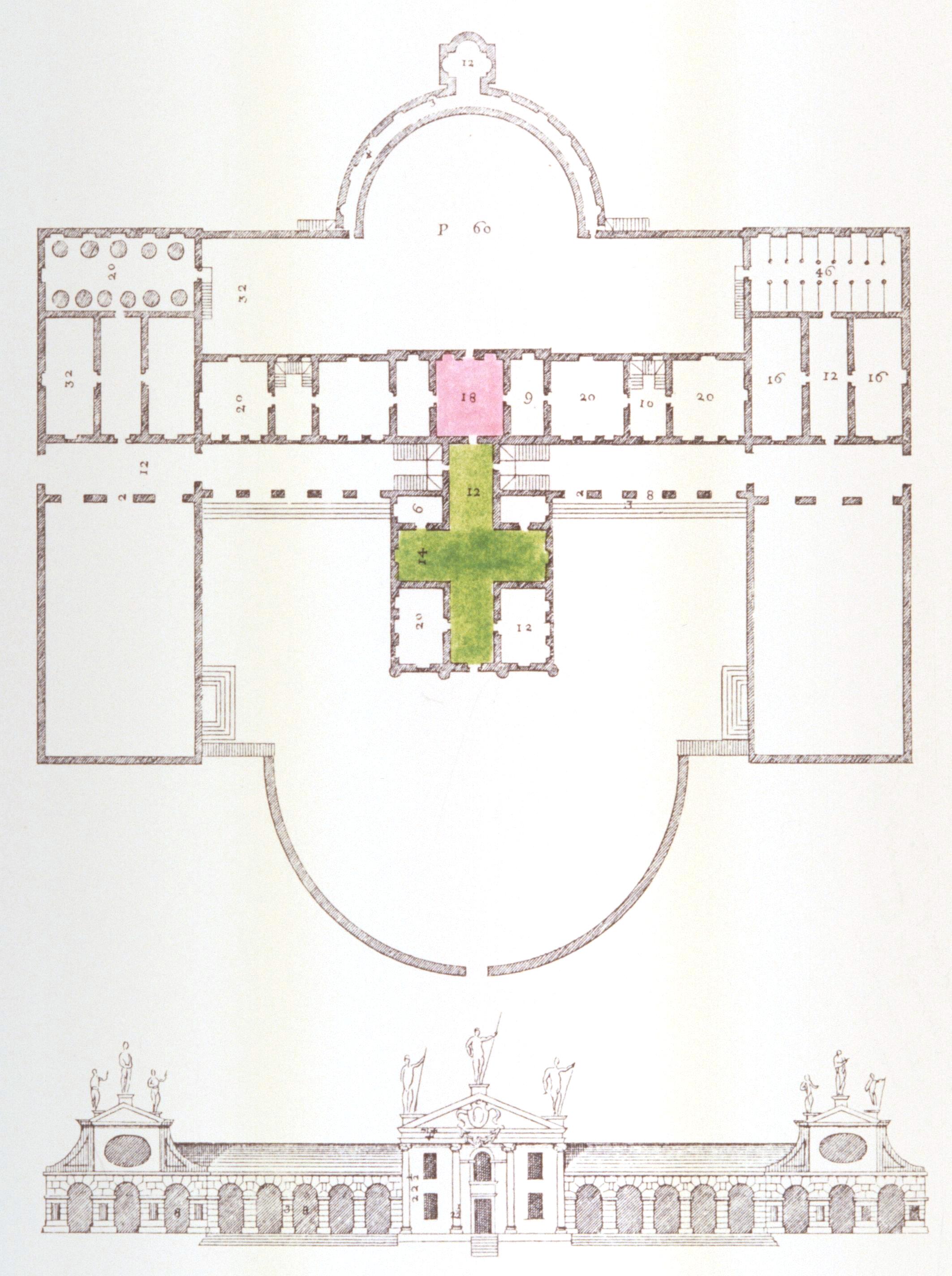
Your immediate impression will be confirmed by the plan (which was published in Palladio’s Second Book). Register the simple central block, projecting well forward, and the symmetrical arcades to the east and the west.
The single most important ceremonial room is hand-coloured in pink on the plan and takes its name from the subject of Paolo’s frescos on its vault.
It is the ‘Room of Olympus’.
As a guest of honour, you would be conducted there through the cross-shaped vestibule (coloured green).
This is the ‘Sala a Crociera’, which was also frescoed by Paolo.
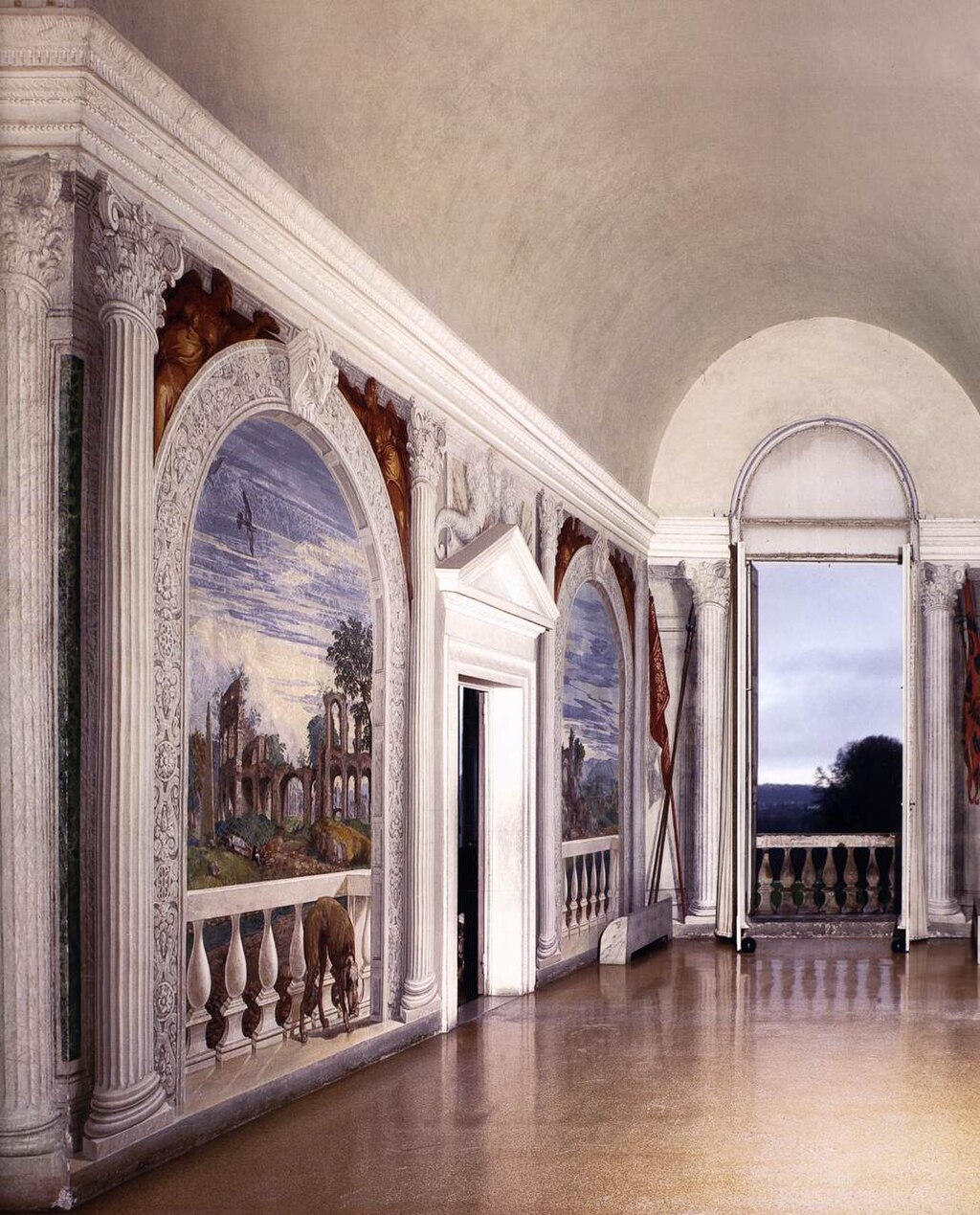
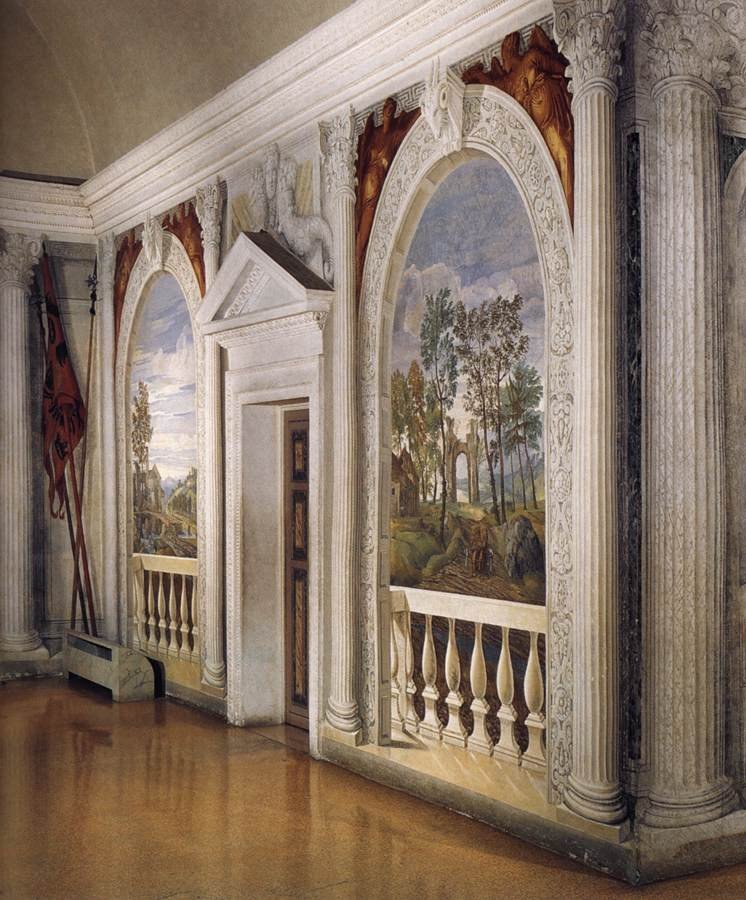
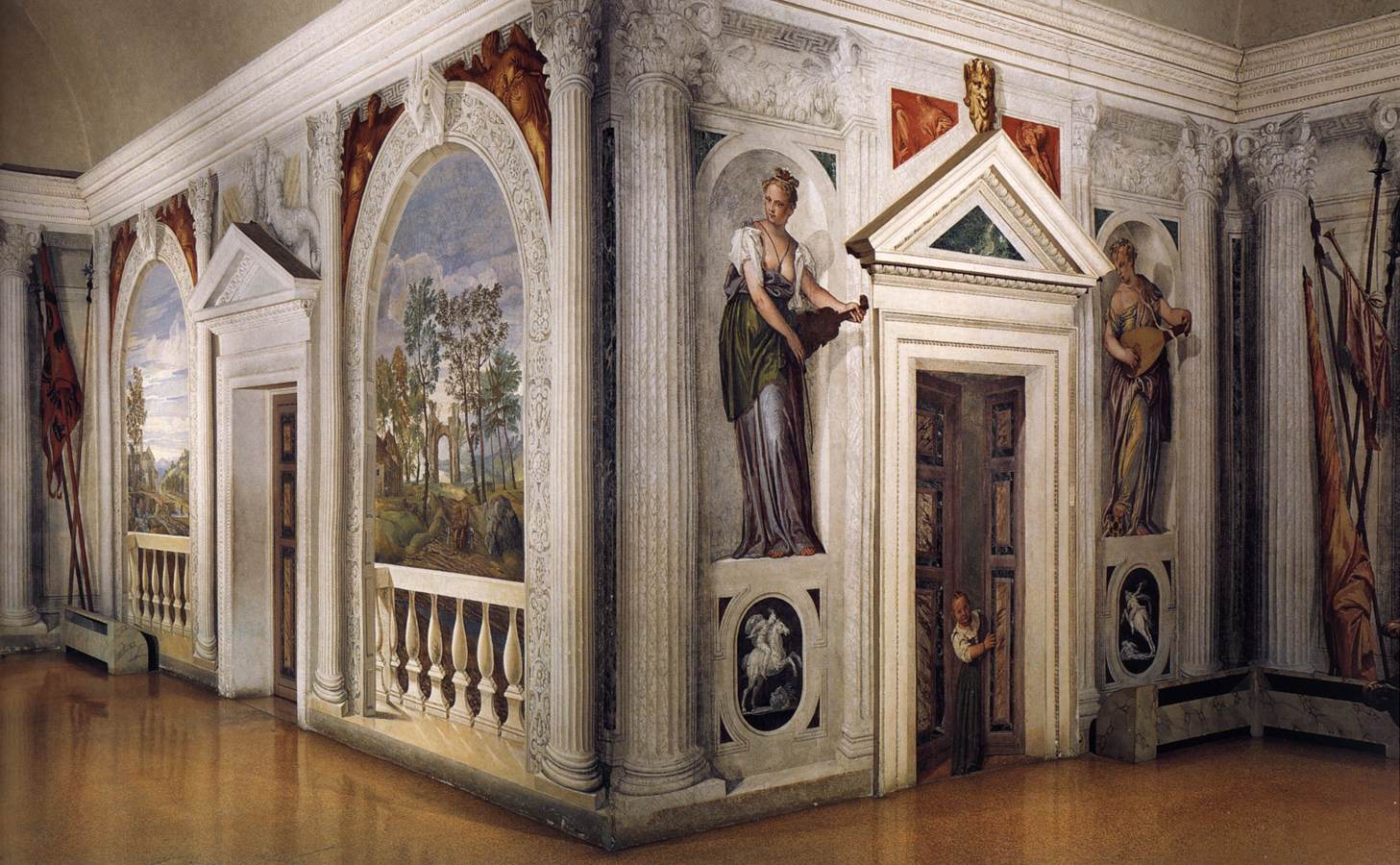
Mentally step down from your carriage in front of the villa, go up the steps, and walk into the Sala a Crociera (which is about seventy feet deep on the longer axis), letting your eyes glide over the walls, where Paolo’s frescos offer pleasant vistas beyond a balustrade.
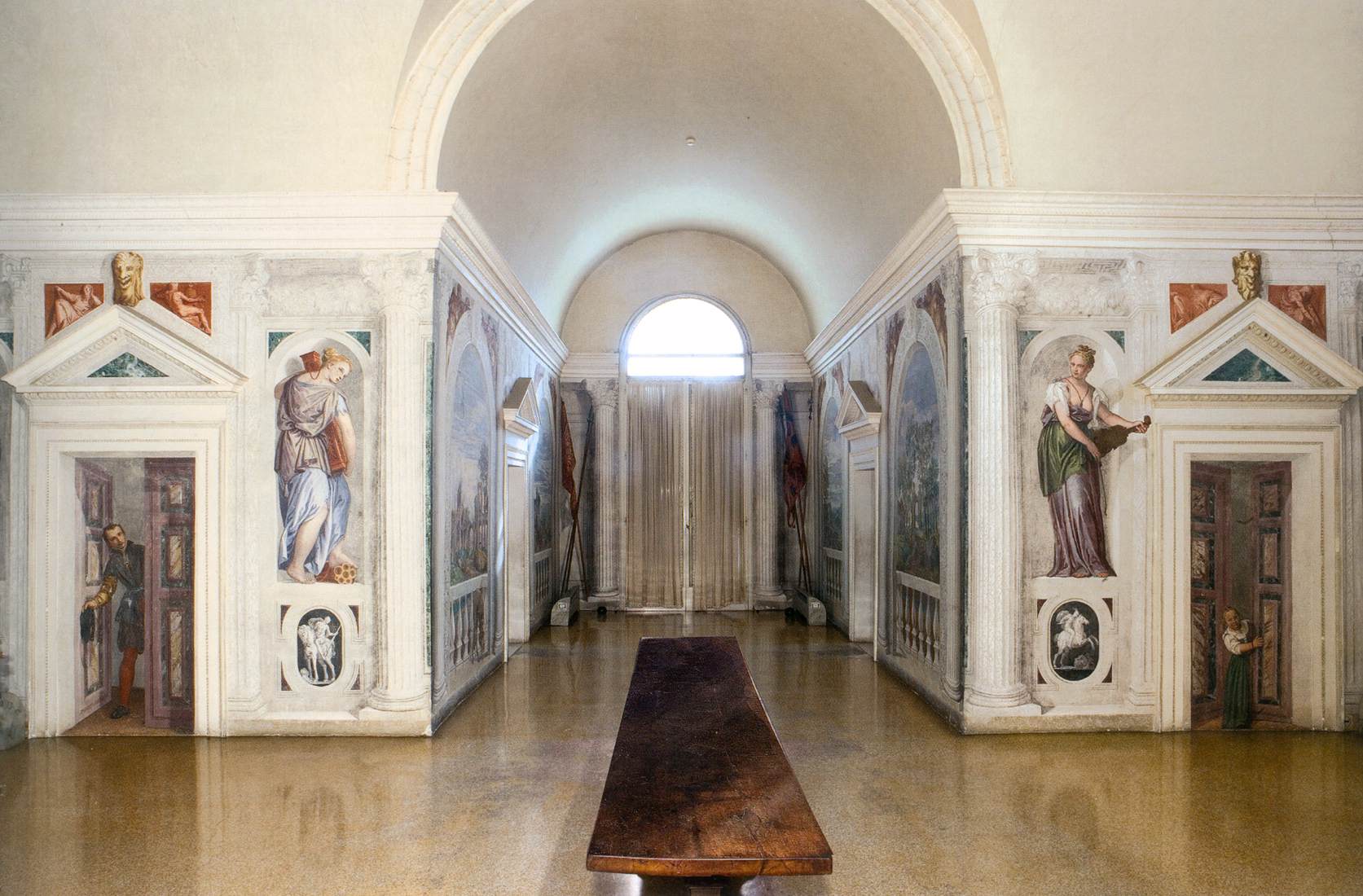
As you come to the centre of the Cross, you will be met by this glorious piece of pictorial deception (trompe l’oeil).
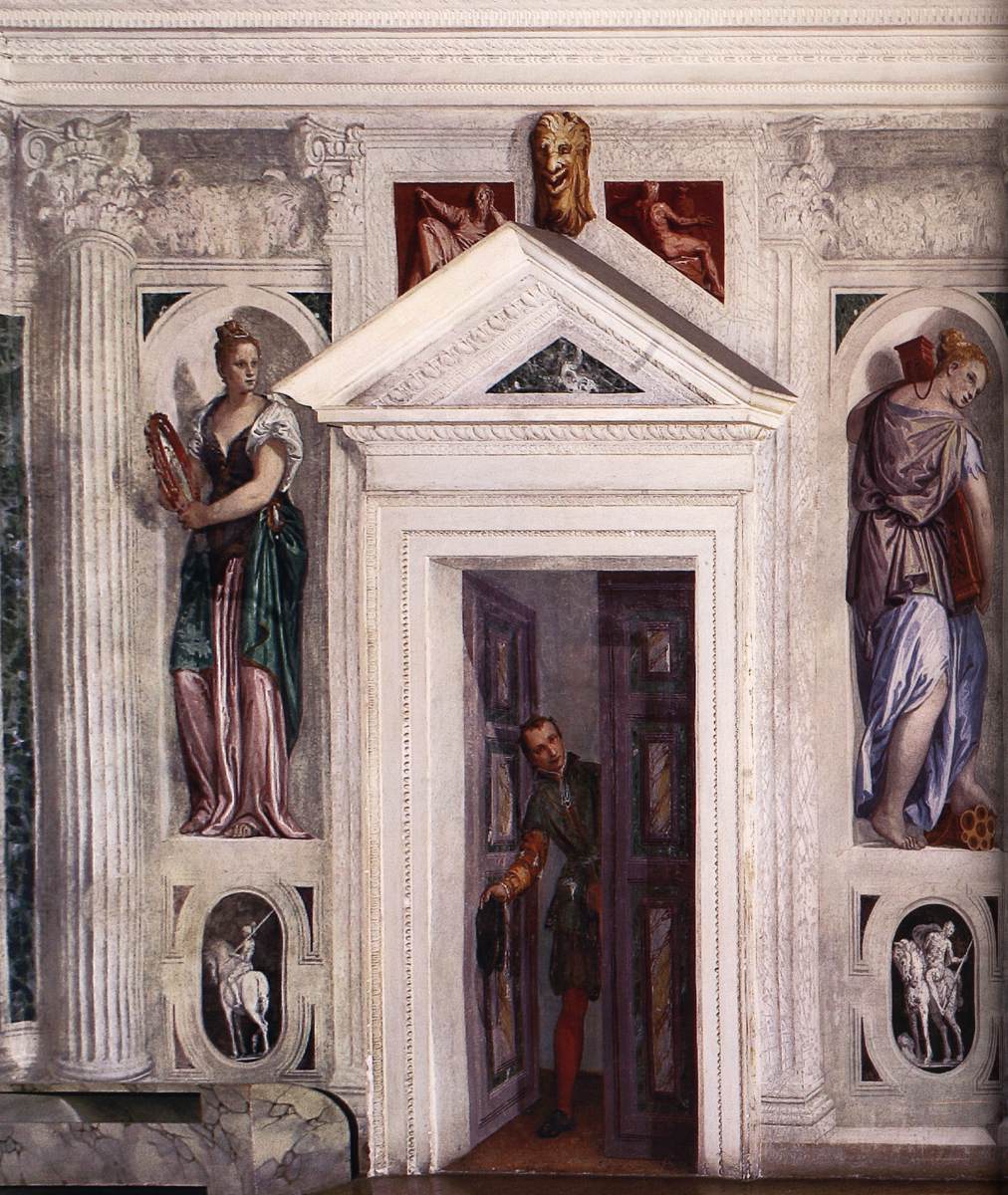
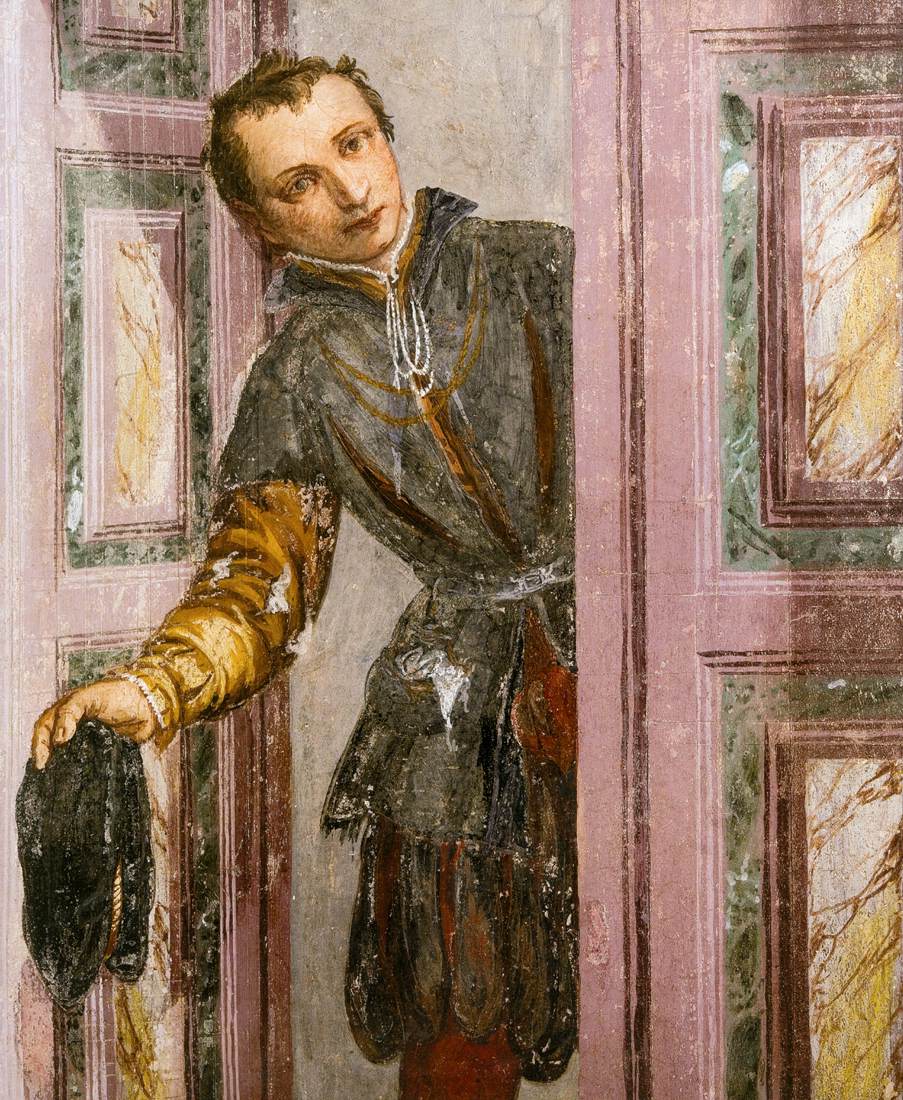
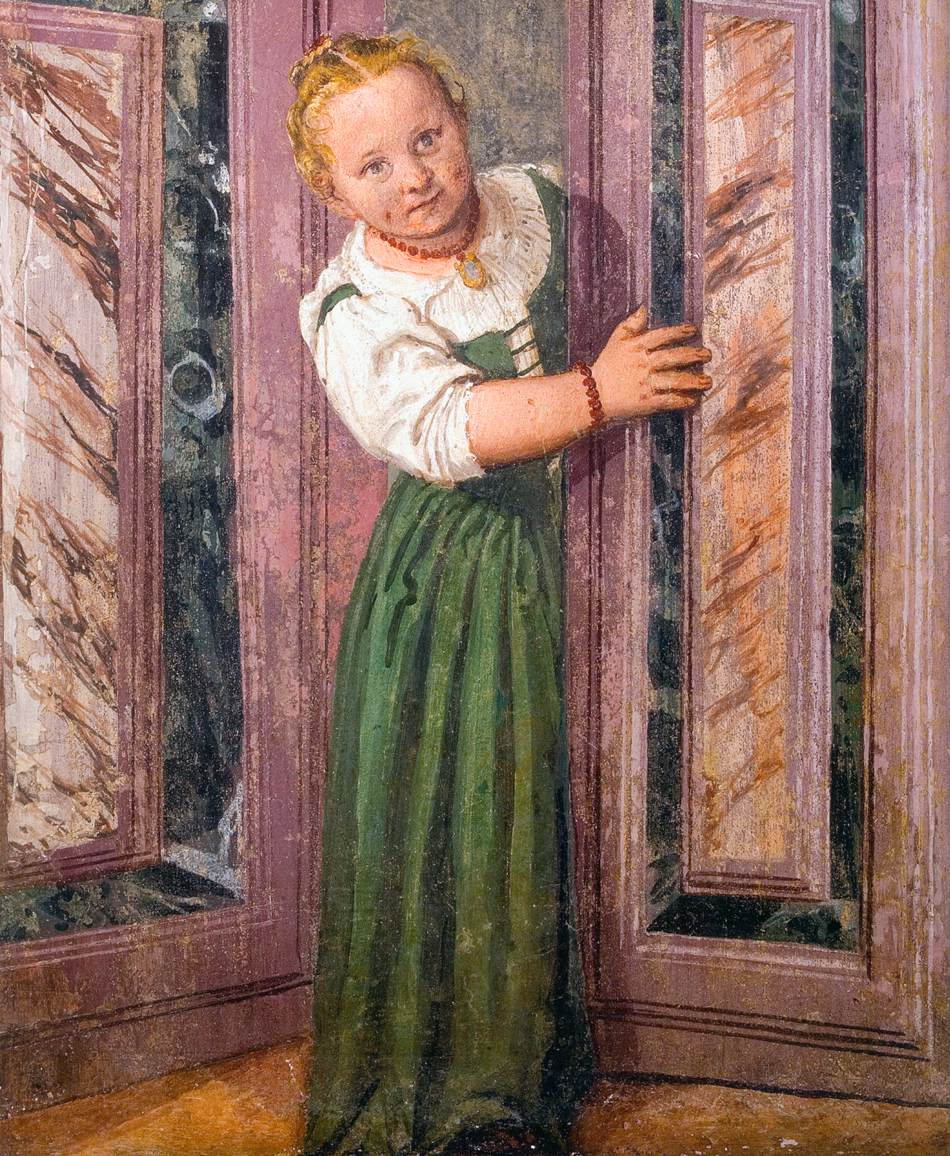
Statues of muses stand on either side of marble-framed doors, which are held half open by a page on the left and a little girl on the right who are peeping out at the visitors.
Everything is make-believe. So just enjoy Veronese’s humanity in the following whole-page details, without further commentary.
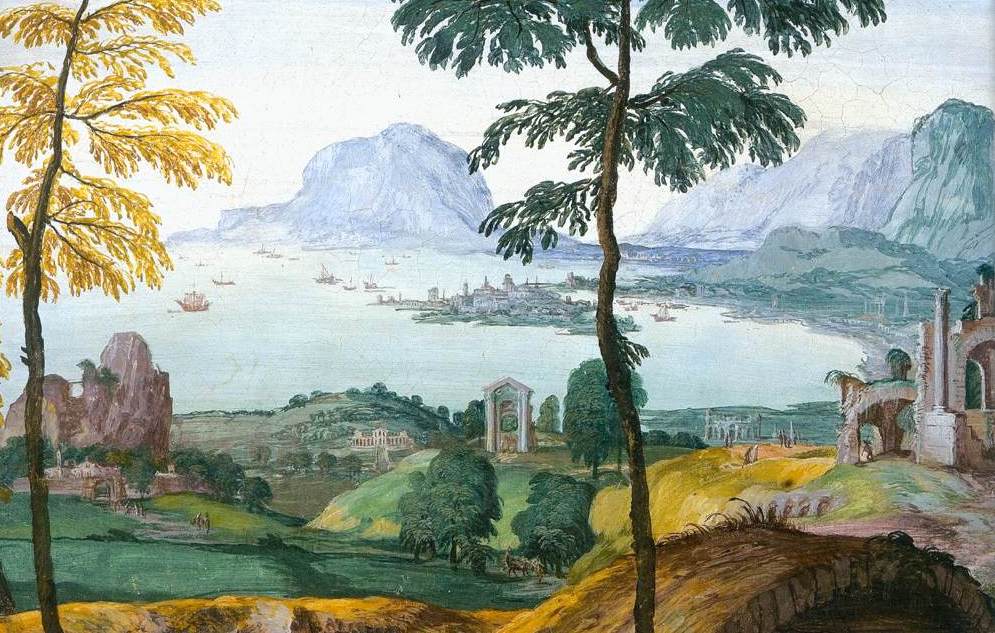
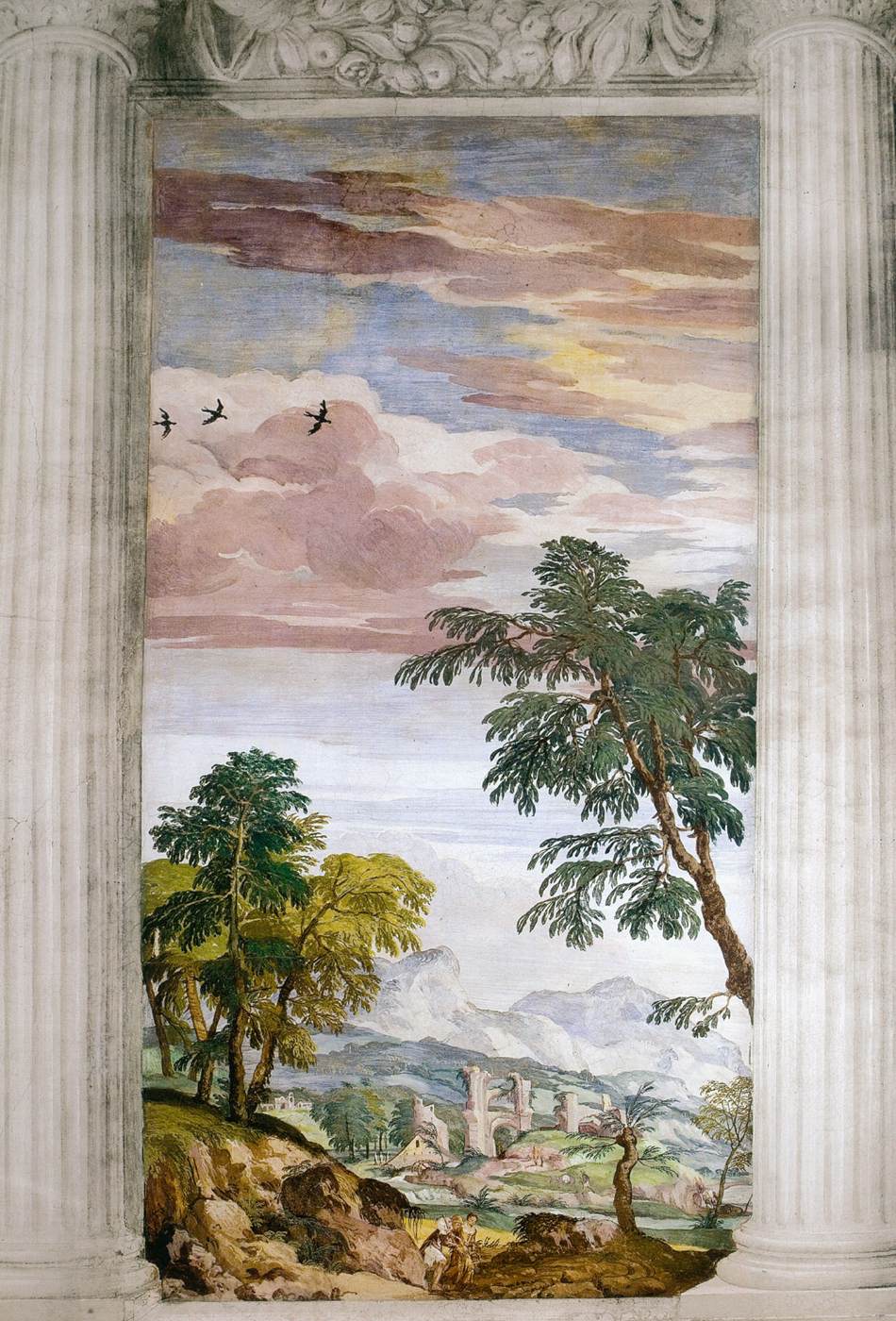
There are many fictive landscapes in the villa, set between fictive marble columns, opening prospects to delight the eyes of the family and household in this country retreat during the ‘heat of the sun’ or the ‘furious winter’s rages’ (Maser is not far from the foothills of the Alps).
Cumulatively, they are intended as a celebration of Nature (the poetry of the Georgics, rather than the Aeneid); and art historians point out that they are among the earliest paintings to depict the countryside for its own sake, virtually without human figures, rather than as a background to a narrative or as a record of rural activities in the twelve months of the year.
So, pause again to enjoy an inland vista towards distant mountains under a cloudy sky, and a coastal detail, where we are looking down a gentle slope studded with classical ruins, to a village on a promontory in a bay closed by gigantic isolated rocks, blue in the distant haze.
But we have come to see human beings interacting with classical divinities, so let us proceed to the main, ceremonial room, the ‘Room of Olympus’.
As we make our way there, our eye will be tantalised by another trompe l’oeil figure, apparently entering the villa through a door at the end of a succession of rooms in the east wing. (In the photo, it is very difficult indeed to distinguish between fiction and reality.)
He is clearly a gentleman, not a servant; and he is returning from the hunt, smartly dressed in a doublet and high collar, with an alpine hat tilted at a rakish angle, his hunting horn slung on his hip, his boar-spear in his hand, and two dogs (a greyhound and a bloodhound) at his feet.
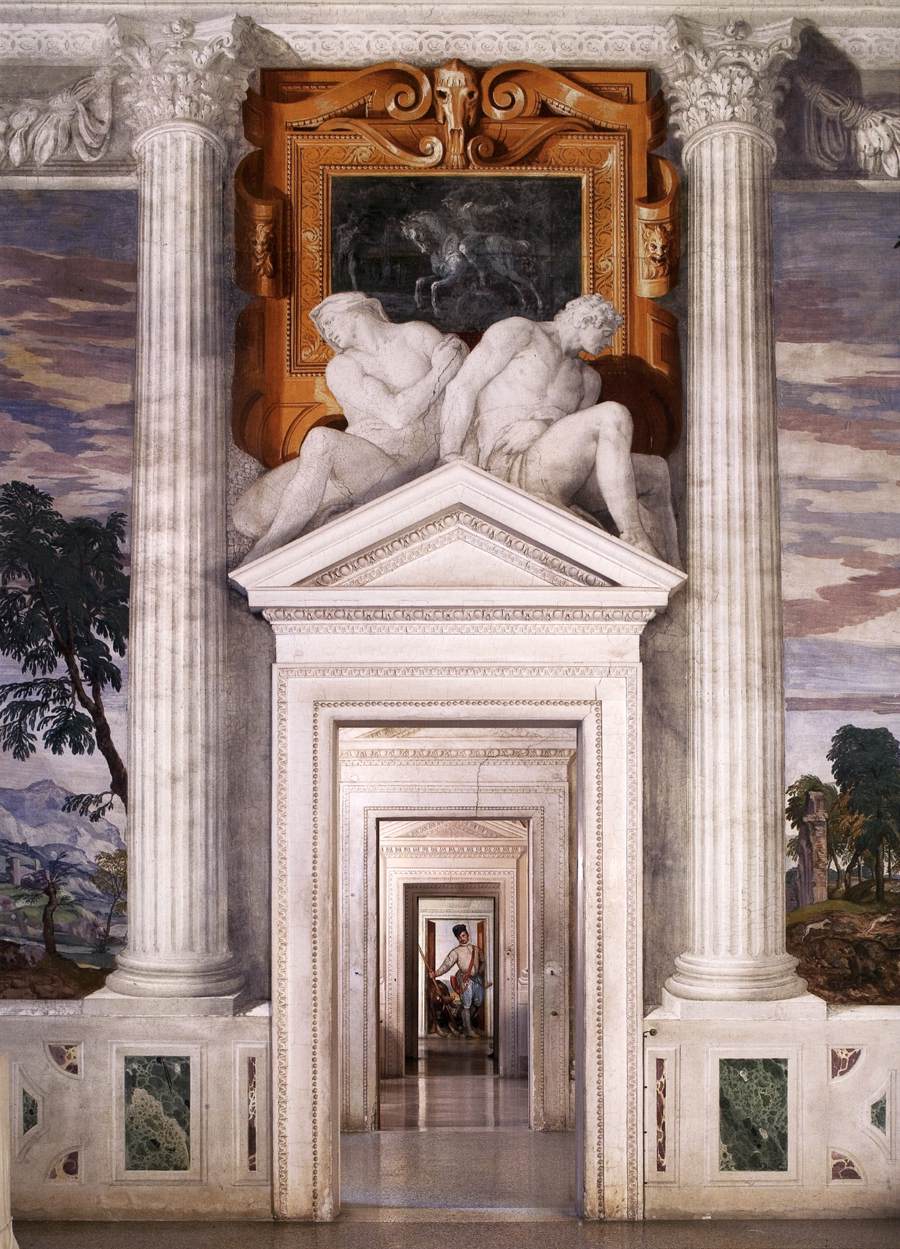
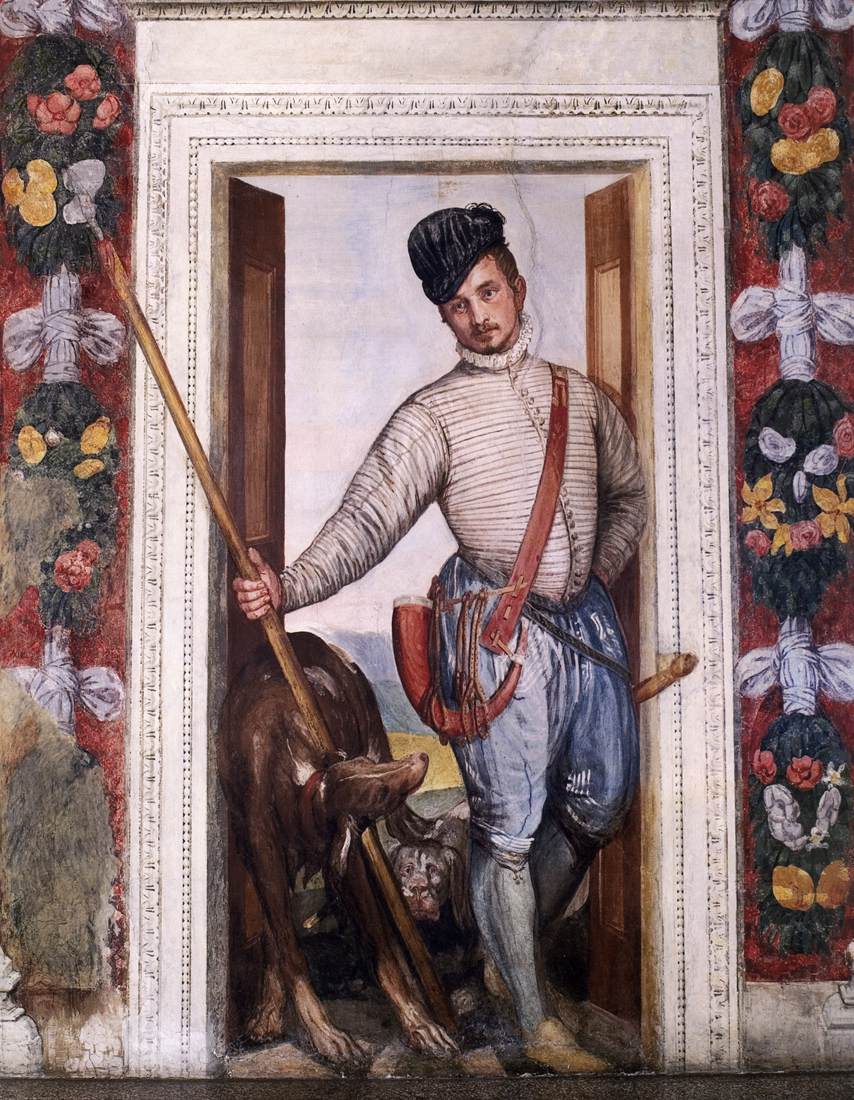
We have now arrived in the Sala d’Olimpo in order to see the Olympian gods in the lunettes and the vault above our heads, but—being only human—it is likely we will be distracted yet again by other humans in the room, this time by members of Marcantonio’s family, looking down at us from the balconies.
(The black-and-white photo helps us grasp the visual relationships between the three components.)
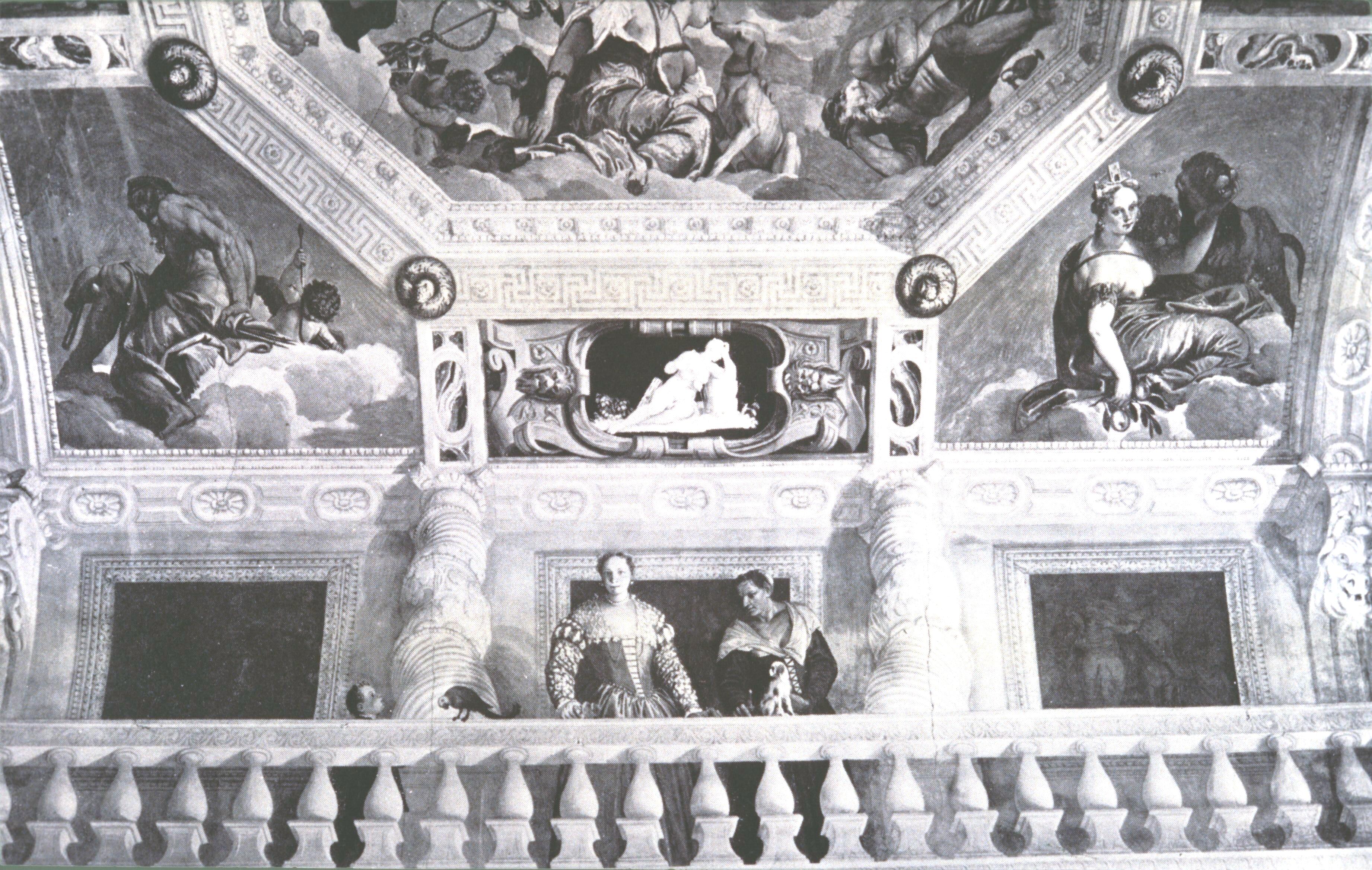
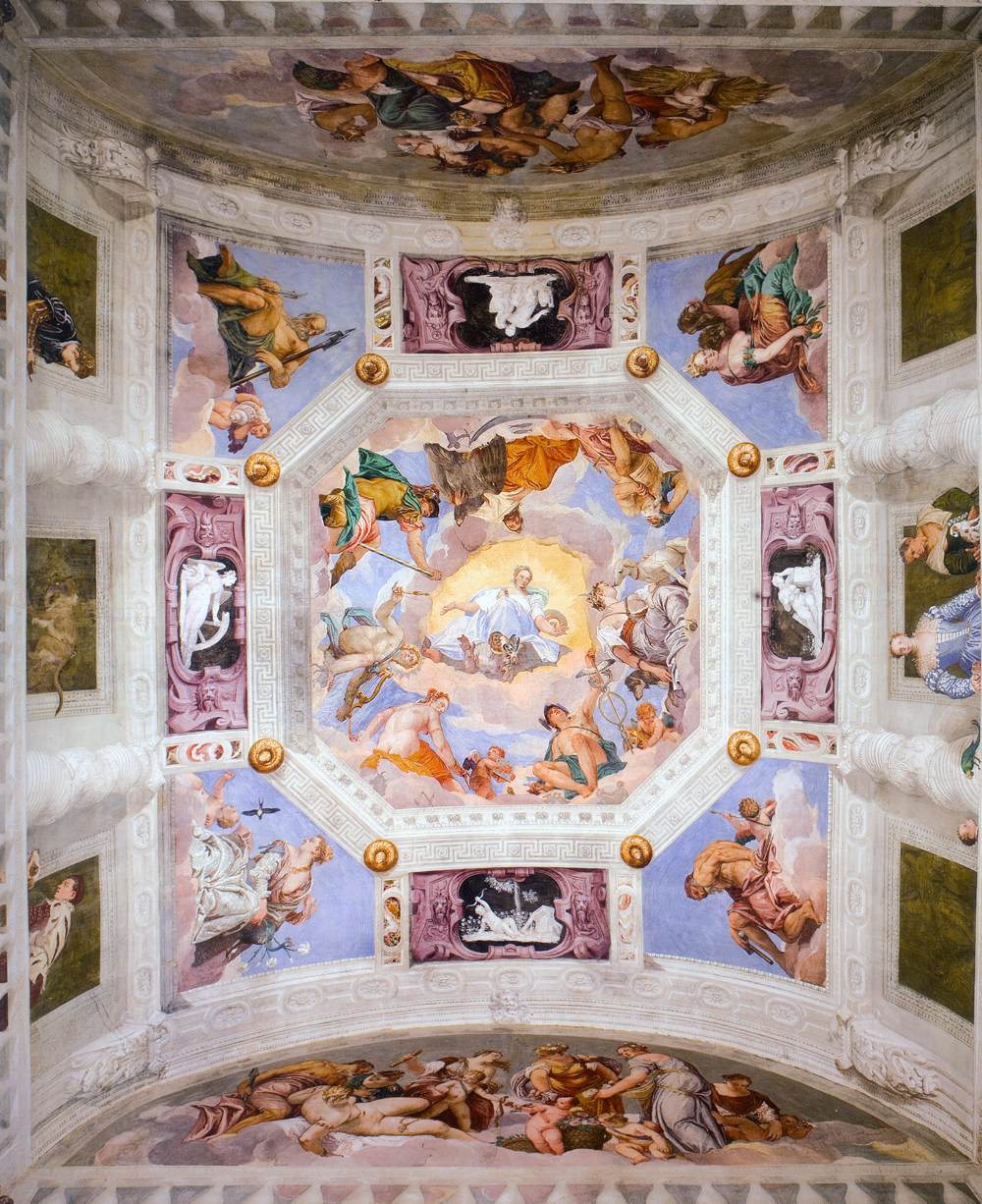
Here we see Marcantonio’s wife, Caterina, still youthful though a mother of three sons, plump, wearing a striking dress (with expensive lace over her shoulders) that matches her blue eyes and blonde hair.
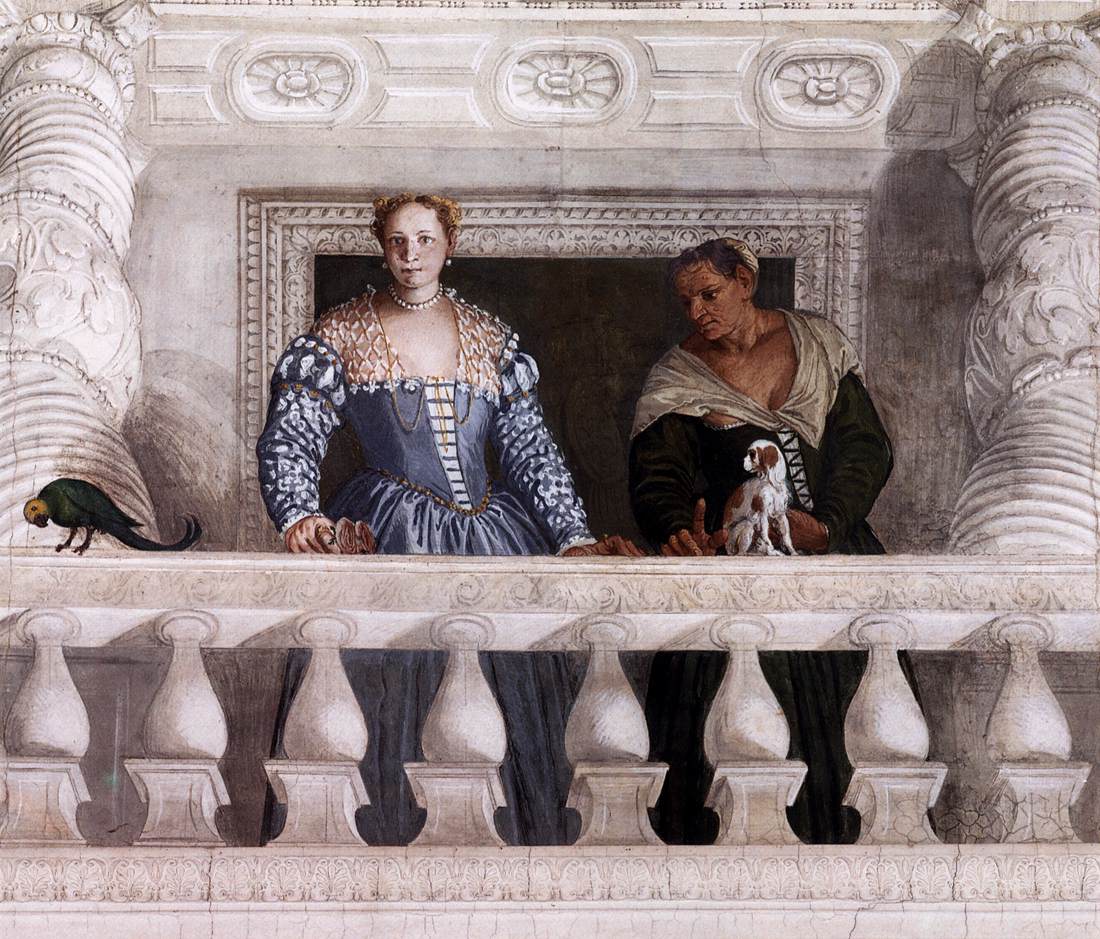
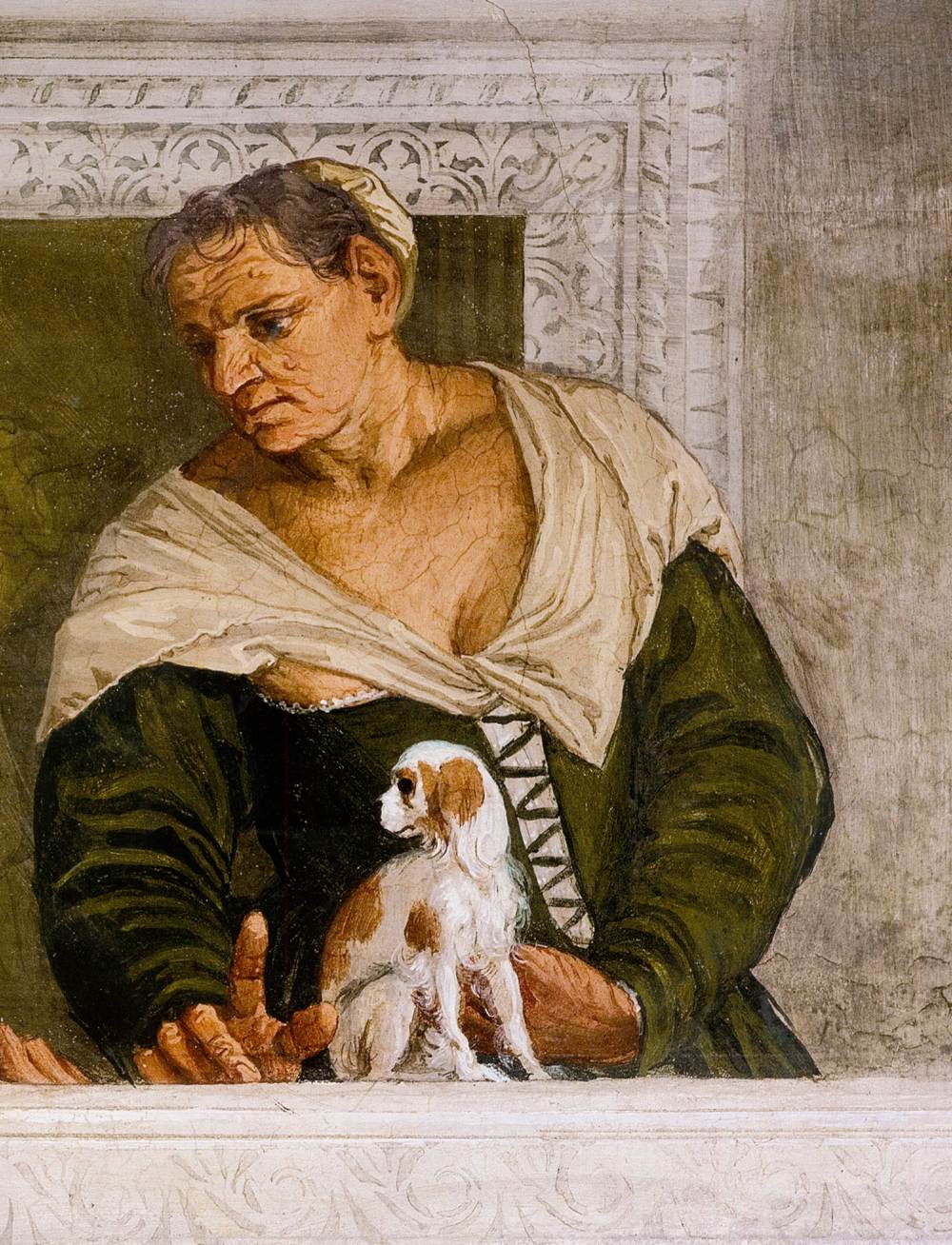
She is attended by the much older nurse (strongly characterised), who holds up her forefinger to restrain the lapdog from taking undue interest in the parrot.
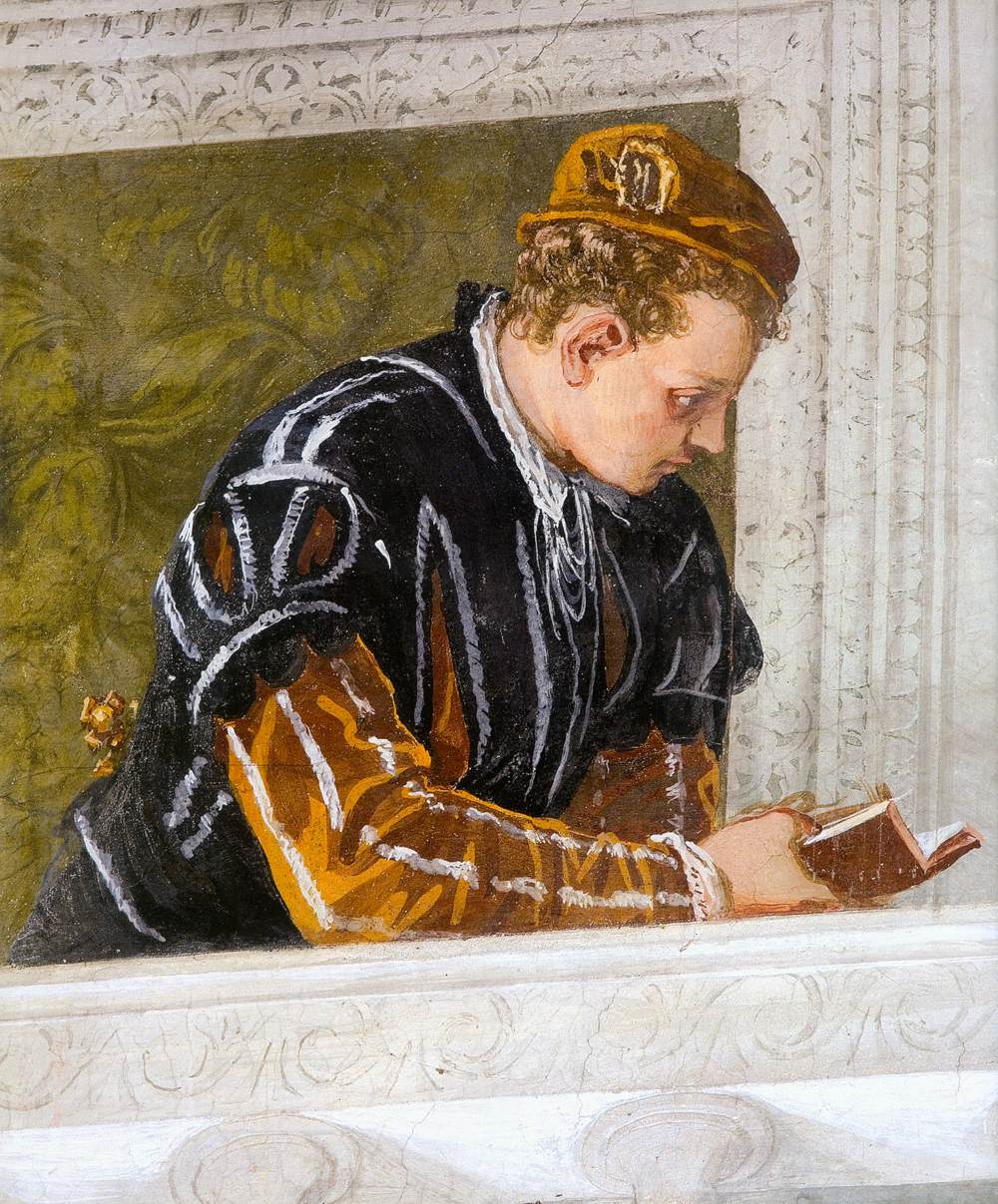
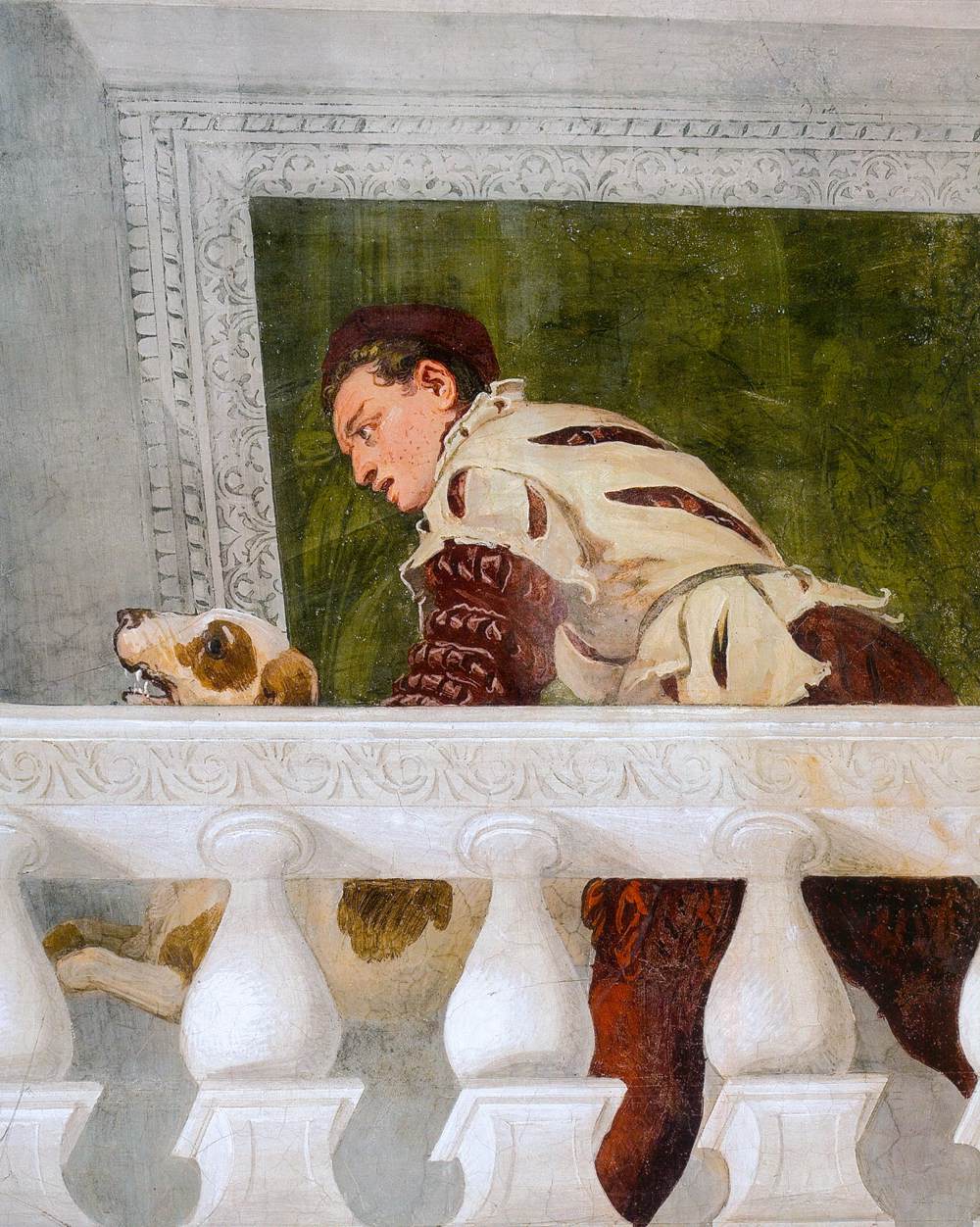
On the opposite balcony, we see the two elder sons of the marriage, one of whom is intently reading an octavo volume (possibly containing Petrarch’s Canzoniere) while the other is holding back his dog (a bigger dog who is straining after a pet monkey).
We believe in this family!
We have now reached the summit, both literally and symbolically.
High above the servants and their terrestrial masters, we are gazing up at the celestial world of the classical gods who represent the universal power of the heavens.
This is the illusionistic ceiling of the Room of Olympus—in reality, a simple barrel vault which Veronese (in yet another homage to Mantegna’s Camera degli Sposi) has transformed into an octagonal cupola.
In the very centre of the composition, an allegorical female opens her arms in a gesture of welcome.
She has been interpreted variously. Since she is seated on a Ram (Aries), she may stand for Spring and Rebirth at the beginning of the astronomical year. She may be Divine Wisdom or Providence. And there are also good reasons for understanding her as the ninth Muse, Thalia, personifying Celestial Harmony.
Perched in the clouds around her, within the eight sides of the octagon, are seven gods and goddesses—and please take a moment to notice with what apparent ease Veronese has solved the pictorial problem of getting seven to go into eight. (As always, the painter’s craft lies in concealing all signs of his craft: ars est celare artem.)
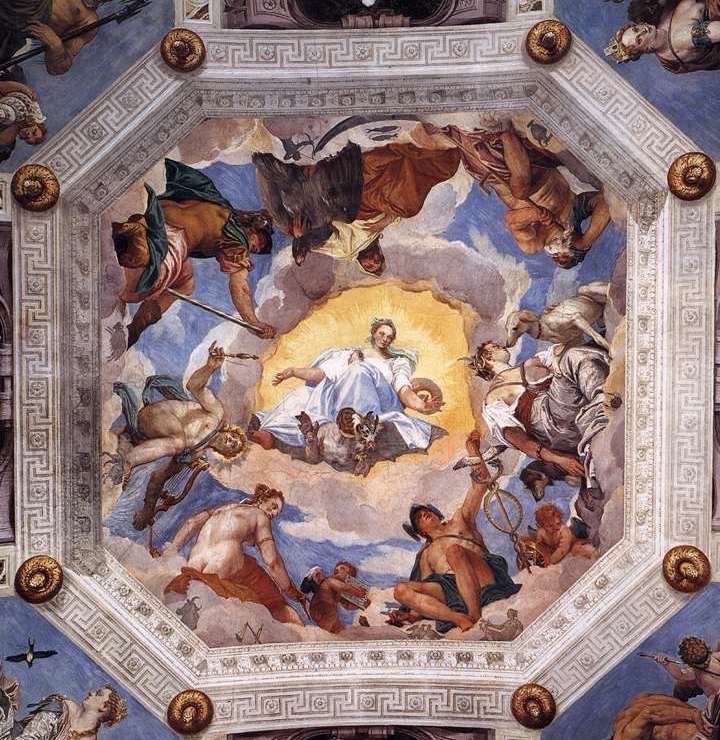
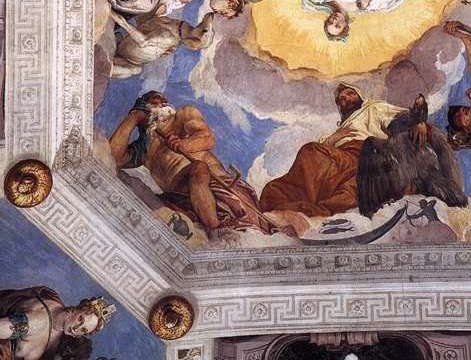
These are the seven gods and goddesses who had been identified with the seven planets of the Ptolemaic universe; and they are arranged in the astronomical sequence of their presumed distance from our earth at the centre.
Saturn is the furthest away, suitably melancholic. Alongside him, Jupiter sits back, regally, with his left arm affectionately round the neck of his iconic eagle.
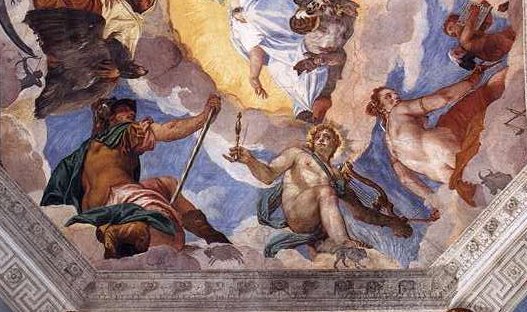
Change your position in the room to identify Mars, in a body-hugging bronze breastplate, holding his sword at a suggestive angle. Next to him is an almost naked Apollo with a crossbow bolt and lyre (the sun is a planet in Ptolemaic astronomy); and Venus, with Cupid, who is holding up a sheet of music, the ‘food of love’.
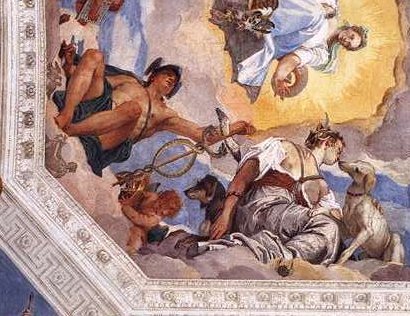
Move round again to enjoy the two innermost planets or gods—Mercury with an exceptionally large caduceus, and, most charming of all, the Moon, pictured as Diana the Huntress, who is being rather ‘soppy’ with one of her two hounds.
These celestial powers, presided over by Providence or Harmony, were thought to ‘rain down’ their ‘skyey influences’ on the four Elements—Earth, Water, Air and Fire—of which all minerals, plants, animals and men were thought to be compounded.
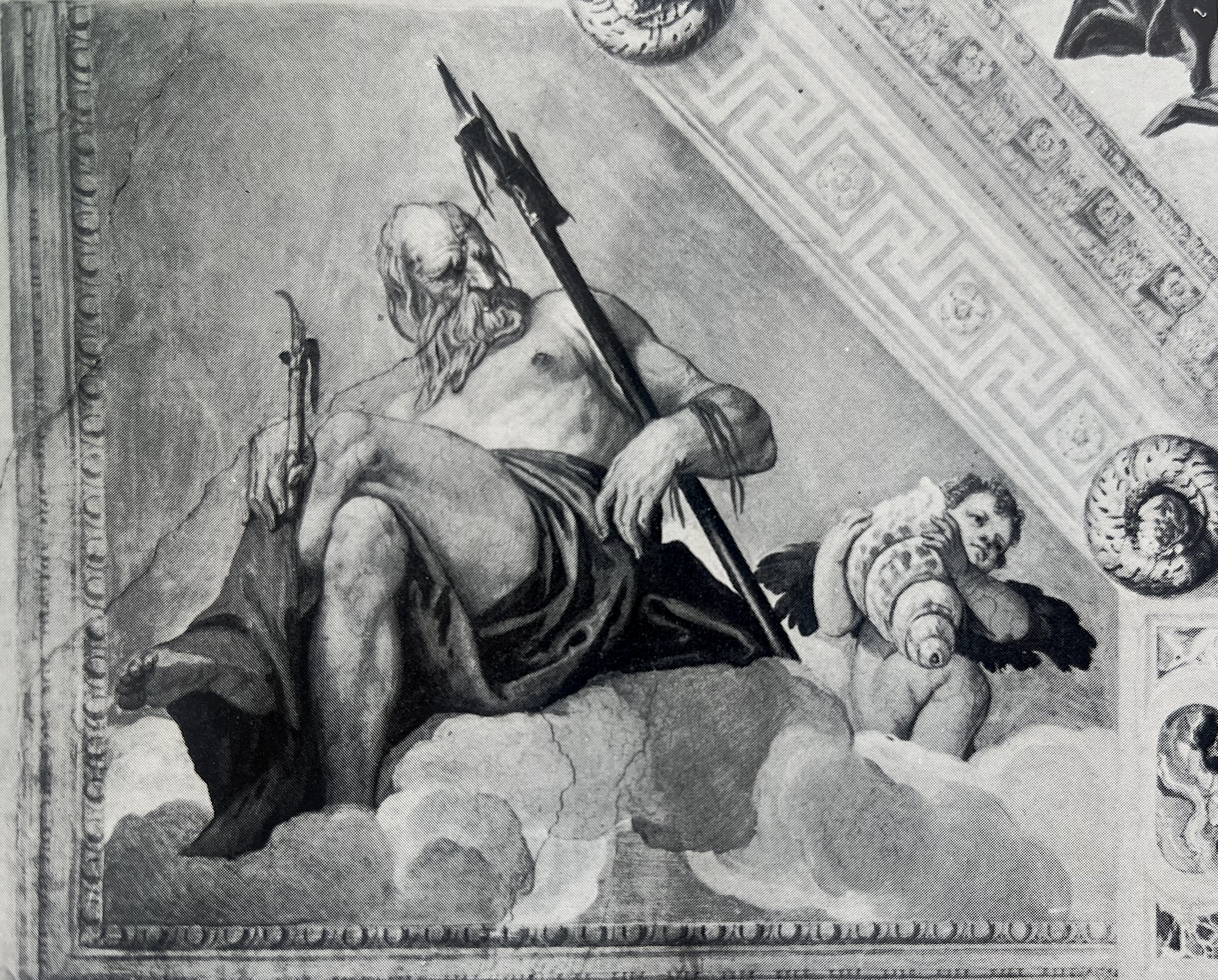
These are duly figured in the corners as four more Olympians, respectively Cybele, Neptune, Juno and Vulcan.
(I show you just one of them, in black and white.
Neptune has a rather quizzingly grumpy expression and is negligently posed: one leg is slung over the other, his right hand clutches a pike-head, while his left arm is relaxed, as he holds his trident at a rakish angle. He is flanked by a Triton, a marine deity, clutching a rather phallic conch.)
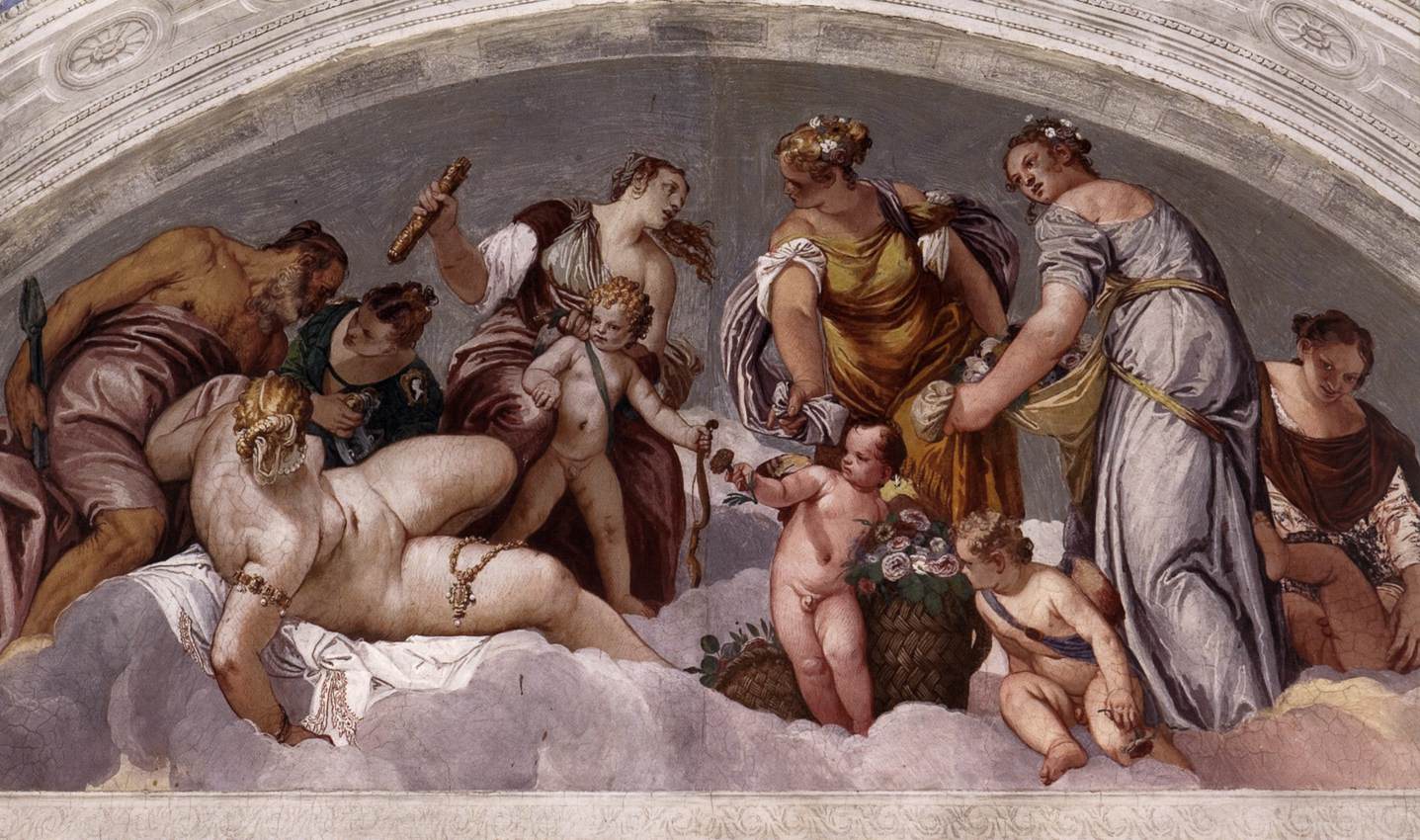
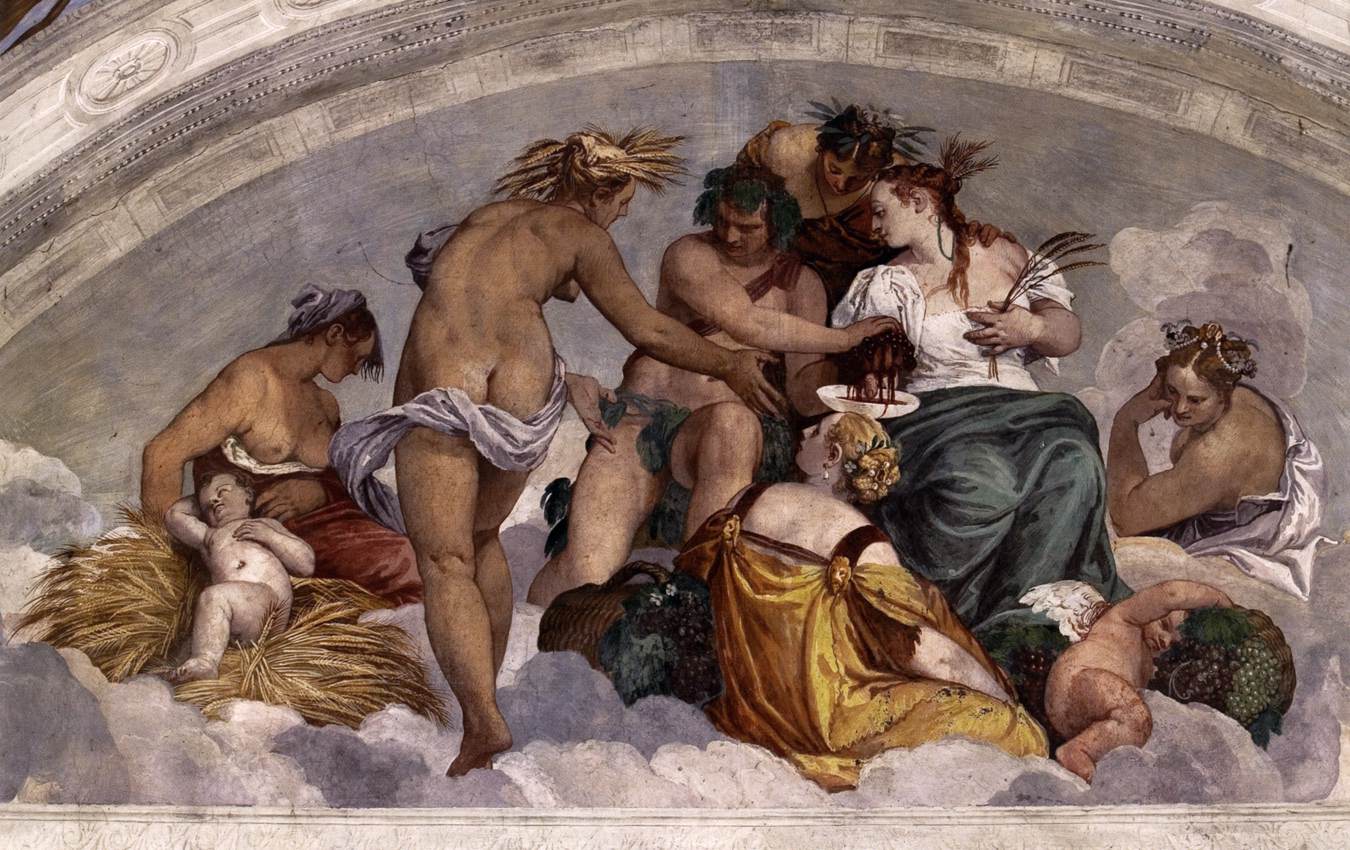
The lunettes in the same room are mythological representations of Spring and Autumn in which Bacchus and Venus play prominent roles, preparing us for our visit to La stanza di Bacco and La stanza dell’amore coniugale—two nearby rooms with equally sumptuous decorations, but of a more intimate nature
The first lunette shows the goddess of love (naked except for her jewels), reclining on a sheet spread on a cloud. Her pose is simultaneously voluptuous and ‘obstetrical’, since she has apparently just given birth to Cupid, who stands (already a three-year old, brandishing his bow) ready to join his siblings, under the watchful eyes of three comely midwives and her husband, Vulcan, solicitously crouching behind her.
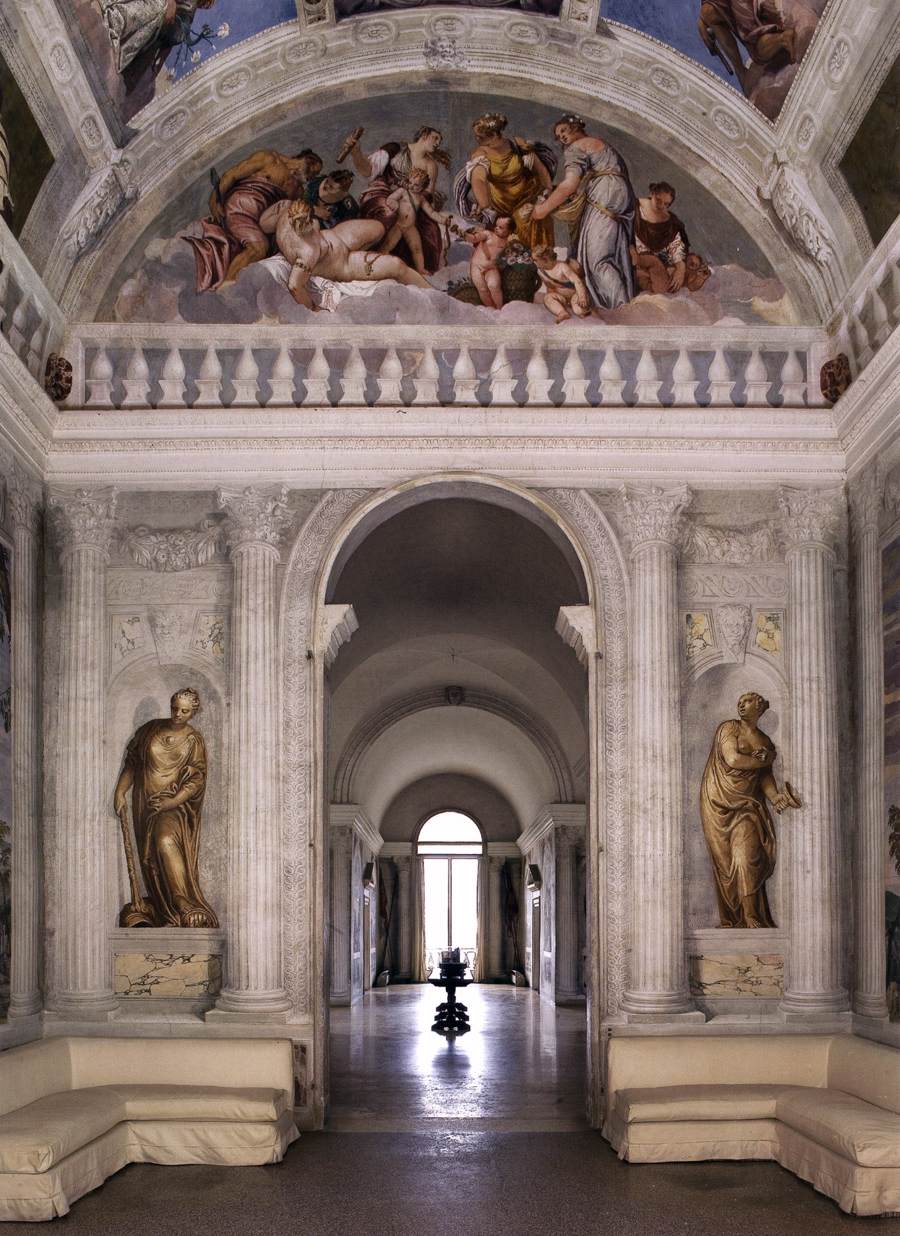
Suitably prepared by the lunettes, we now make our way to Marcantonio’s private room—his Studiolo—known as La stanza di Bacco.
What you see here is the South wall—and you should return to this splendid image if you want to revise the recurrent features that unite the fictive decorations in La sala a Crociera and the corridors.
(Your list should include: simulated medallions above and below, simulated polychrome marble panels, simulated statues of the Muses, each with a different musical instrument, and simulated stucco cornices and marble columns, framing painted landscapes).
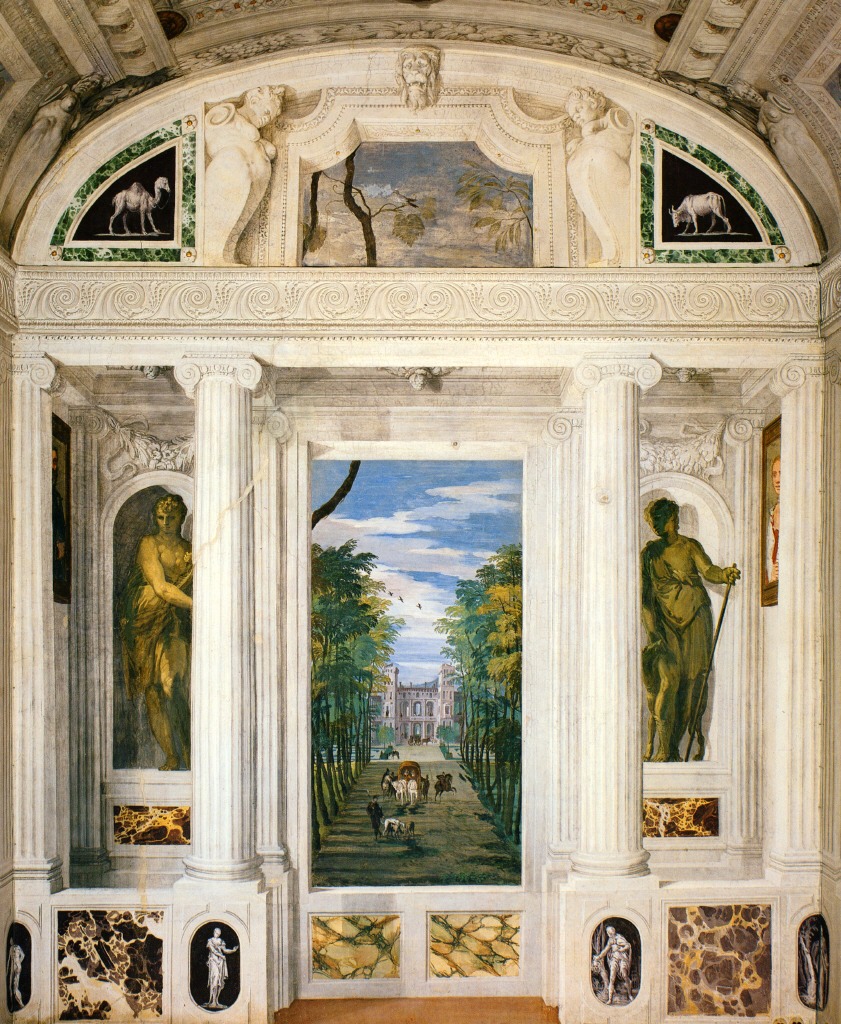
The uppermost panel on the south wall shows some vine-leaves and vine tendrils and serves to guide your eyes to the area of ceiling above it, which has been painted to simulate a vine-covered pergola in a wonderfully simple example of perspective di sotto in su.
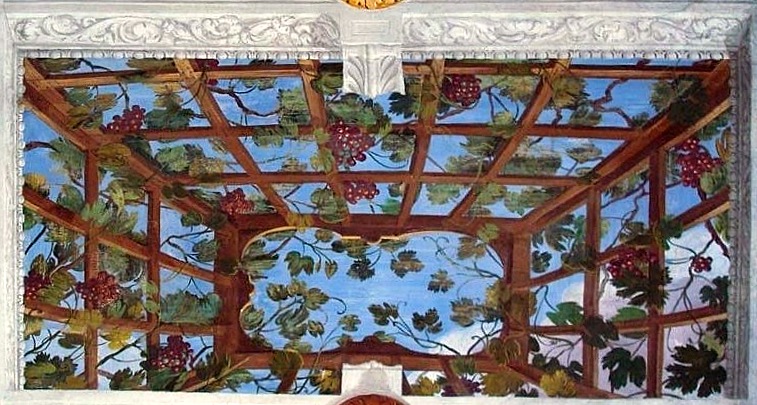
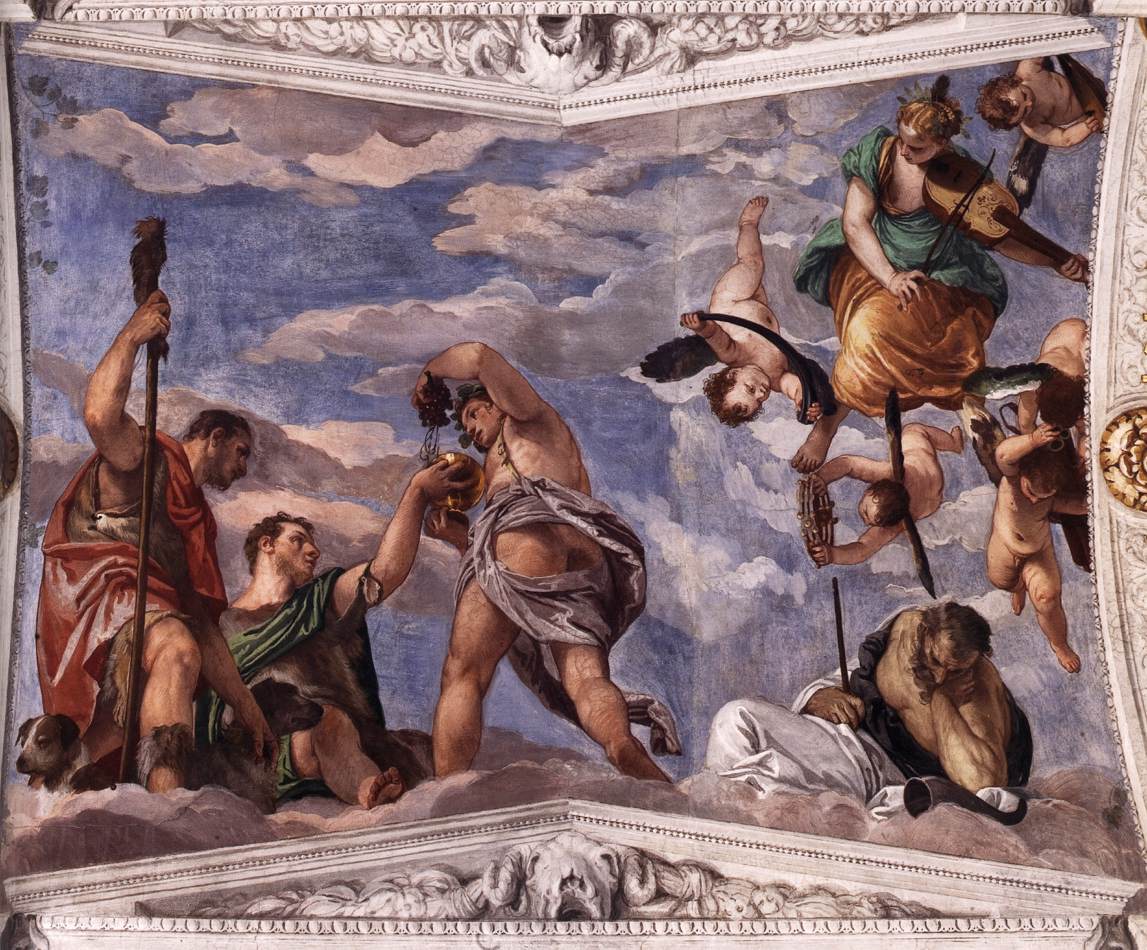
The vine, in turn, prepares us for the subject of the mythological scene in the centre of the ceiling, which gives the room its name.
Bacchus is vigorously pouring red wine into a flat cup held out to him by the informally dressed nobleman, who is refreshing himself on return from a hunt (notice the two hounds and the virile huntsman with a boar-spear).
An older man is sleeping off the effects of the wine he has drunk from the empty cup at his elbow; and a viola-player, escorted by three flying cupids, is playing a celestial serenade in the clouds.
‘If music be the food of love, play on.’
Bacchus—laetitiae dator, the giver of joy—is making the gift of wine to gladden the hearts of mankind in general and, specifically, to kindle sexual desire within the bonds of matrimony.
In context, the picture might be given as its epigraph a line from the Aeneid, where Dido prays: ‘May Bacchus be present, the giver of joy, and also good Juno’:
Adsit laetitiae Bacchus dator, et bona Juno.
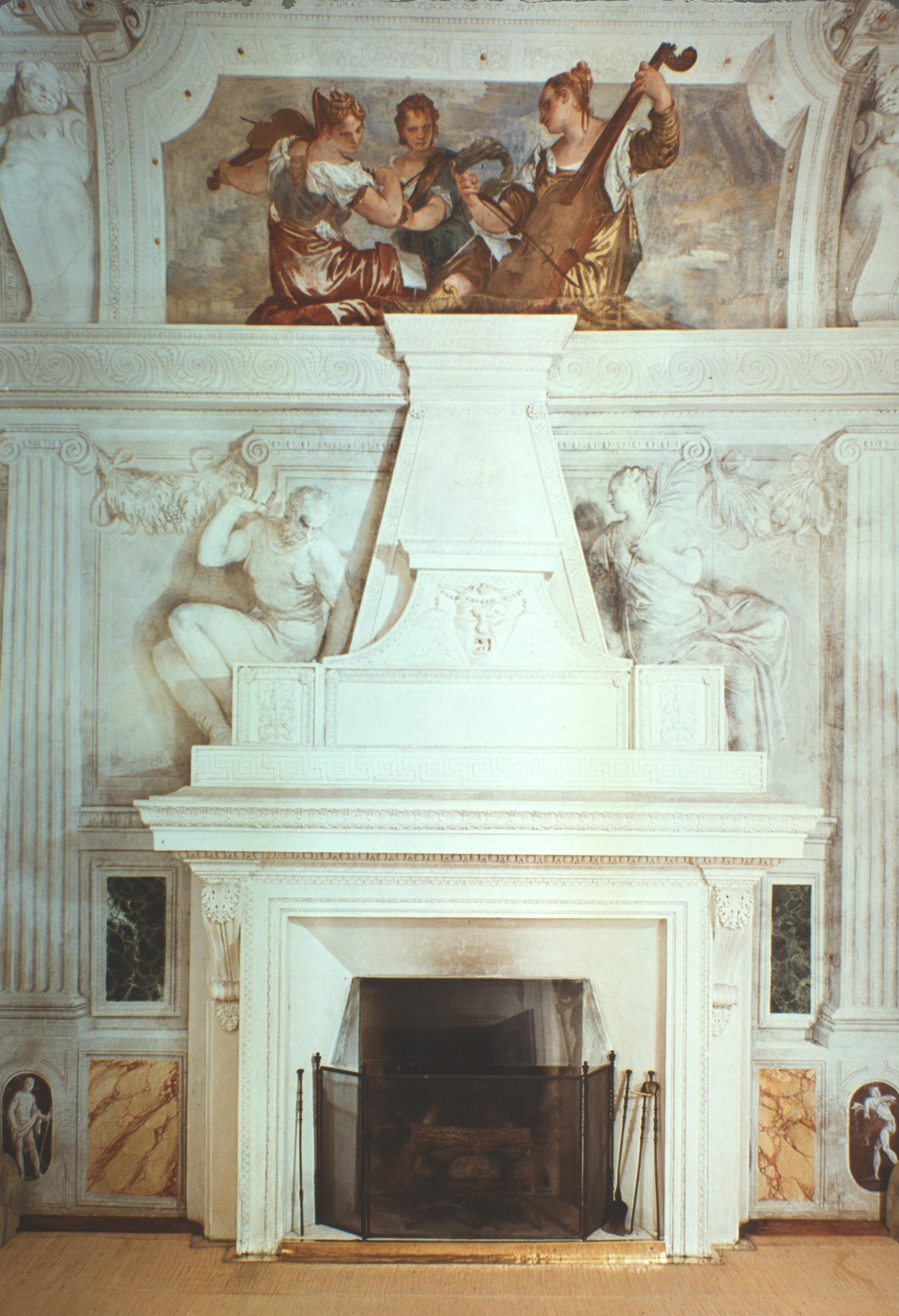
It would not require much imagination to visualise Marcantonio, having rested from the hunt and restored his powers with wine, rising to enter the Room of Conjugal Love, an almost identical chamber—warmed by a real fireplace, under a fictive chimney-piece which is as elaborate in its proportions as the marble tomb of a prince.
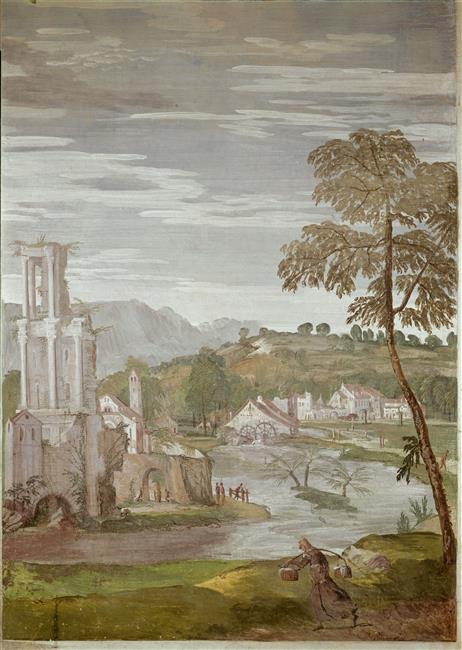
In this room, too, there are landscapes at eye-level, such as the one you see in this detail.
It is nothing like so exotic as the poetic evocations of mountains or sea we glanced at earlier. (Notice the façade of a Christian village church with a bell tower behind the marble ruin, a peasant with a yoke carrying two buckets of water, and the wheels of a working mill in the millrace of the river, which divides here and continues its course into the hidden valley.)
Perhaps this was more to the taste of Caterina, Marcantonio’s wife.
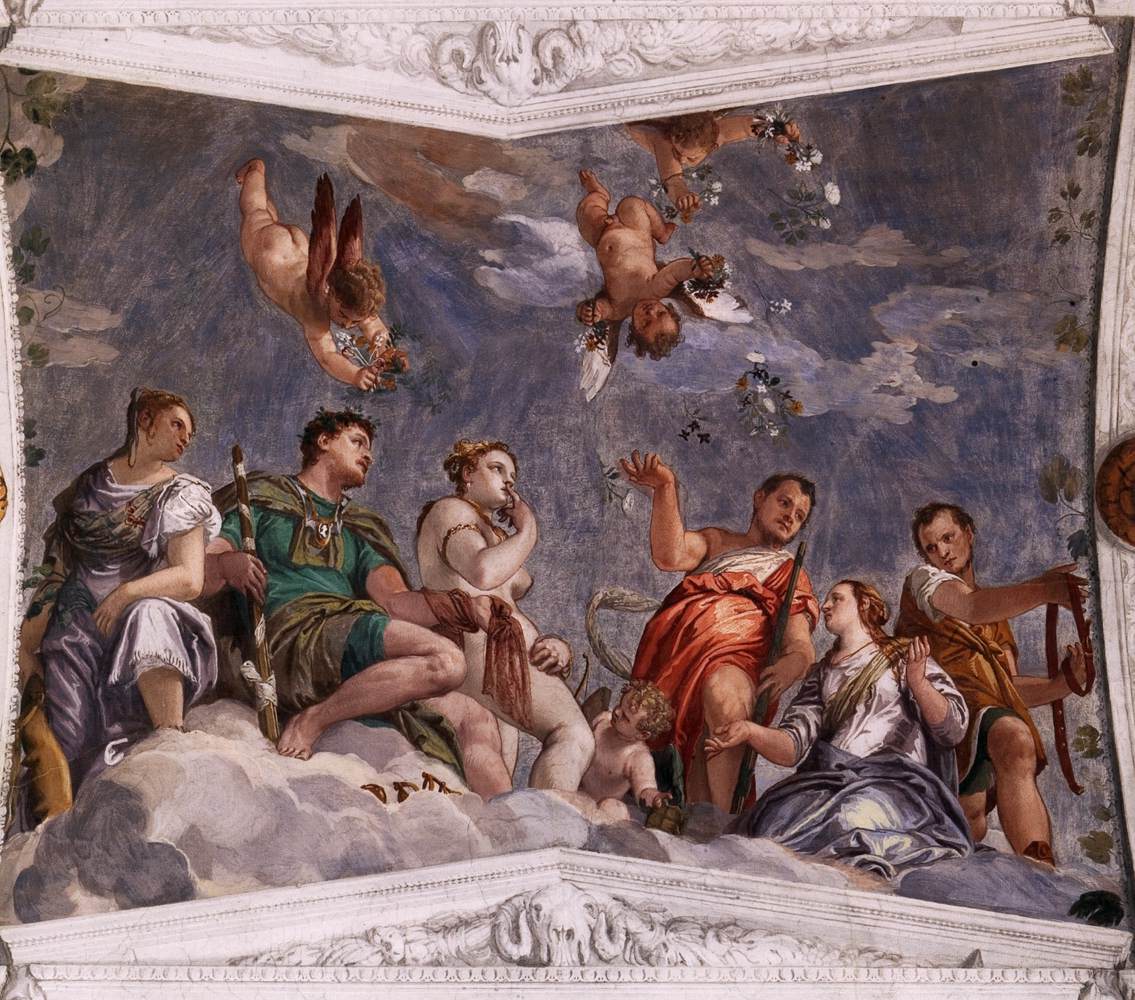
But, if she were looking up at the ceiling from the matrimonial bed, she would be required to focus on a classicising scene, whose import might not have been so congenial.
It shows a female defendant or suppliant, kneeling between two male officers (one holding a staff and making a gesture of accusation, the other wielding a leather belt), before a male judge (holding the fasces, the Roman symbol of authority to inflict punishment).
Two other women are present (next to the judge), but one of them is putting her fingers to her lips, as if to counsel the wife not to disturb the matrimonial peace. Inscribed over the fireplace is the Pythagorean dictum: ignem gladio ne percutias (‘Don’t stoke the fire with a sword’).
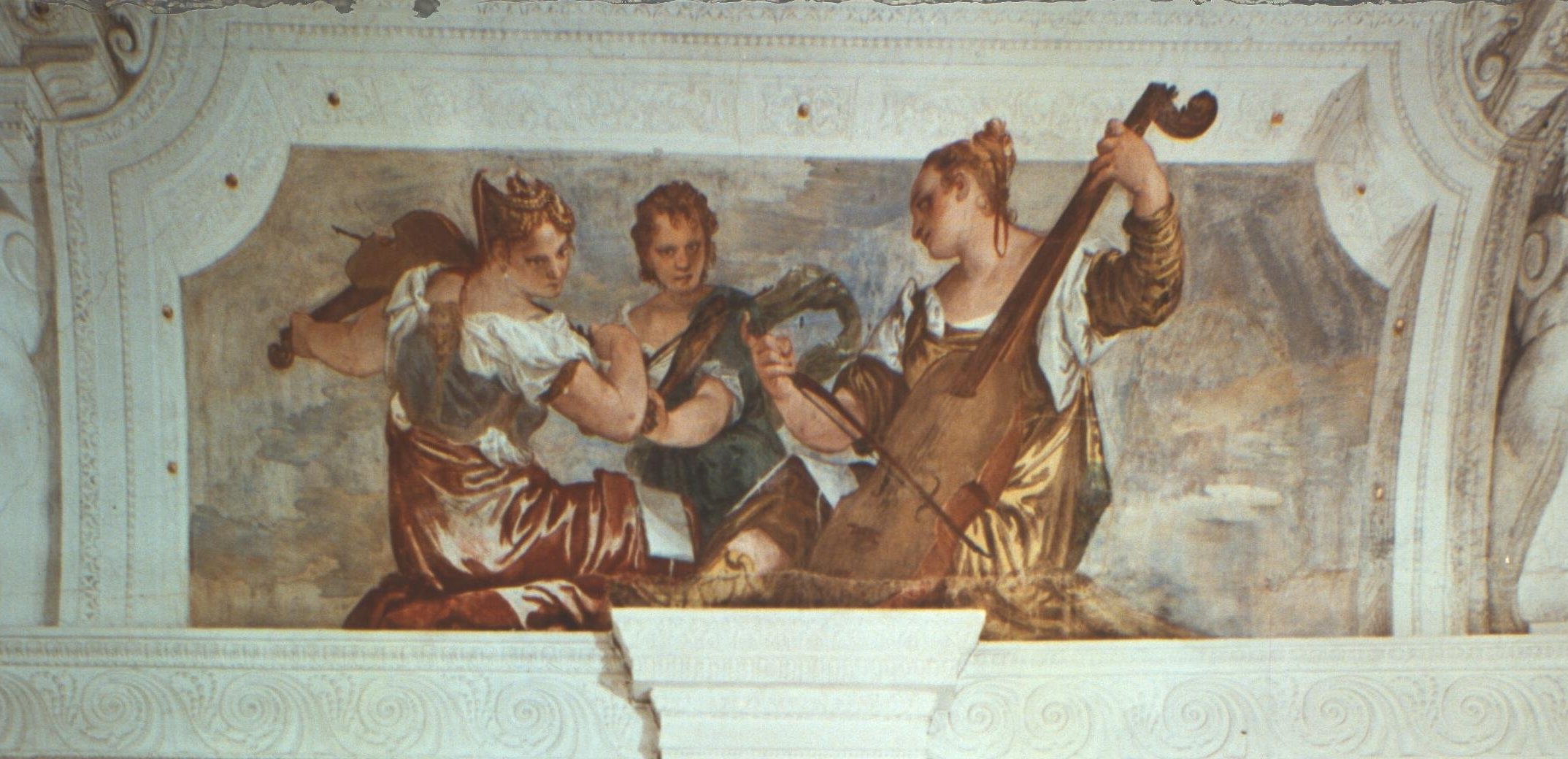
It is to be hoped, then, that Caterina concentrated rather on the implications of the Cupids in the sky, who are raining down petals of reconciliation and harmony onto the bed below, in a message which is in perfect concord with that conveyed by the trio of viol-players over the fireplace: Celestial Harmony, Domestic Harmony, Love in Marriage—‘three themes in one, which wondrous scope affords’.
We may now leave the Palladian villa in the Veneto and head off in the direction of the imperial court in Vienna some 340 miles away, in pursuit of a third ‘mini cycle’ by Veronese devoted to Love and Marriage.
It is plausible but still unproven that they were commissioned by the Emperor Rudolf in the mid 1570s.
They were seen in Venice by Van Dyck in the early years of the seventeenth century. Later, they formed part of the collection of the exiled Queen of Sweden in Rome (which is also 340 miles from the Villa Barbaro). In the eighteenth century they had been acquired by the Dukes of Orleans. Auctioned after the French Revolution, they are now in the National Gallery in London.
It is a fascinating provenance; but all that matters for our present purposes is that the four canvasses are certainly by Veronese in his maturity, certainly intended to be displayed high on four walls in the private chamber of a noble patron (perhaps at the ‘turn’ of the ceiling, not as you see them here), and certainly related thematically to the paintings in the Sala di Olimpo, the Sala di Bacco and the Sala dell’amore coniugale.
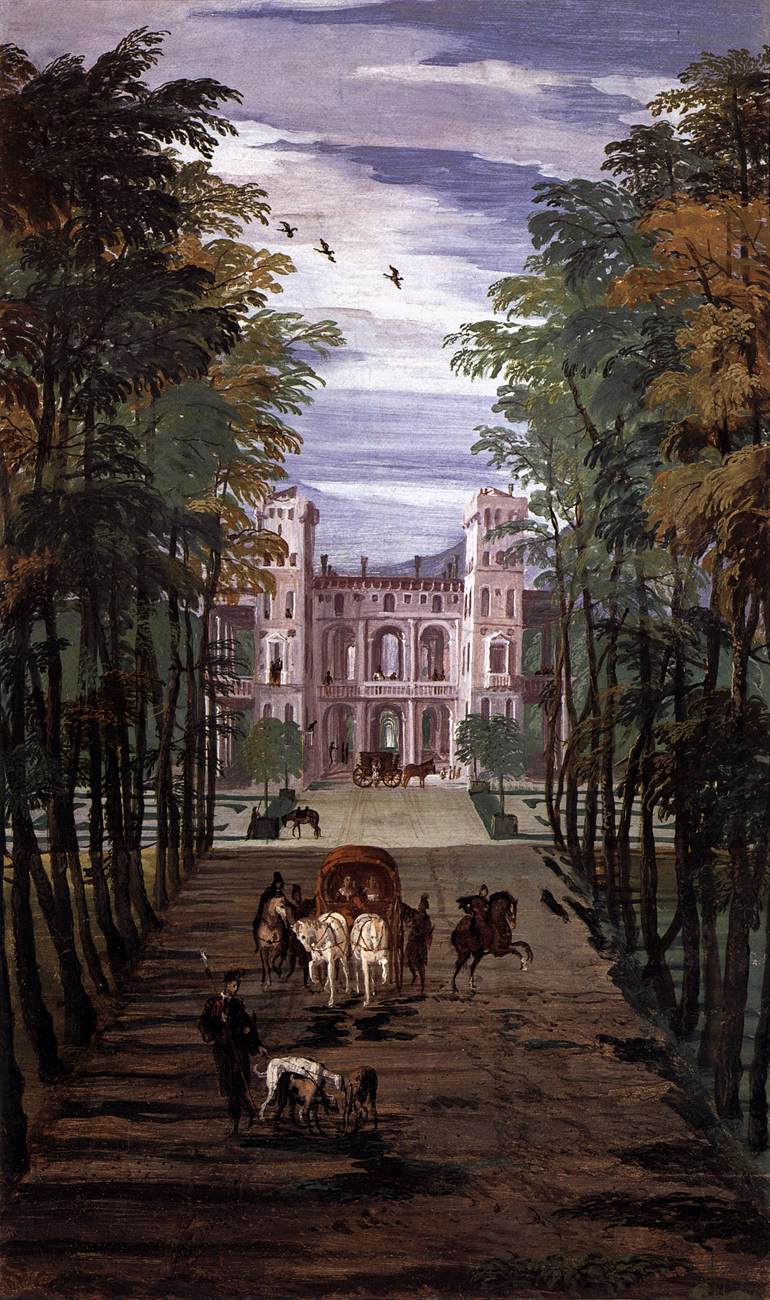
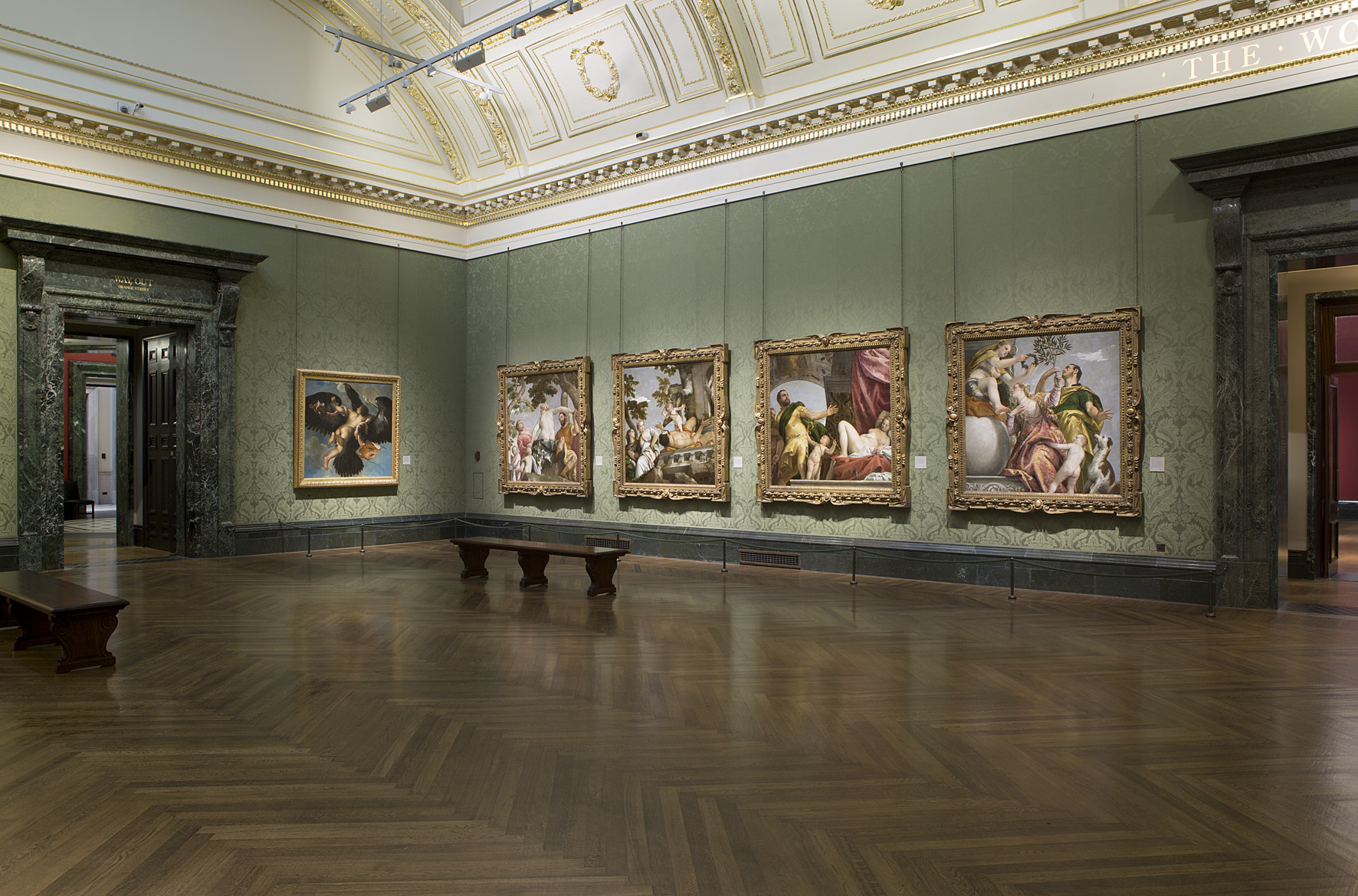
Two characters appear in each of the four scenes: Cupid, symbolising sexual desire as a fact of life, morally neutral, to be judged good or bad according to the circumstances; and a bearded man, therefore mature, old enough to know his own mind and be responsible for his actions.
I shall assume that the man is intended to be the same in each painting, and that we are being shown an Éducation sentimentale, four stages in the ‘Education of the Passions’. If it does constitute a ‘narrative cycle’, then what you see here must represent the earliest phase; and there is some internal evidence to suggest that it would have been hung to the west, or, if you prefer, to the left, of some unknown central decoration. (Light falls from the right here; but in the fourth painting, it will fall from the left.)
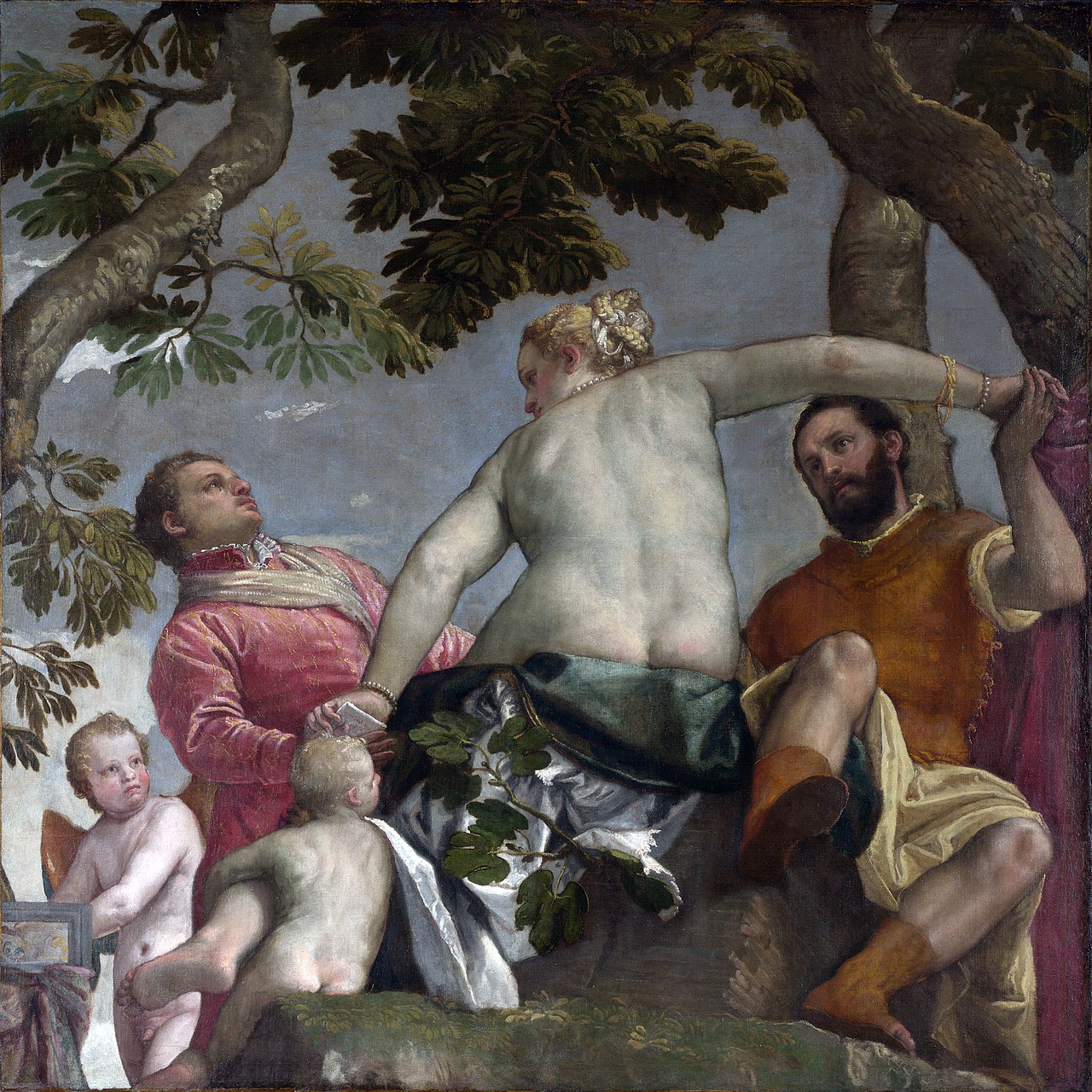
What is going on?
Under the pinnate leaves of a tree with twisting boughs, our hero, lightly dressed—dressed for pleasure—in a yellow chemise under an orange doublet, is smitten by the charms (all of which he can see) of the gorgeous blonde woman whose hand he is holding.
She is naked to the waist and wears pearls in her hair, round her neck and on her arms. Her left calf is lovingly embraced by one Cupid, while another is playing amorous music on the spinet. All of this suggests that she is ‘no better than she should be’, or, at least, that she represents a ‘daughter of Venus’ in the astrological sense, that is, a woman arousing and feeling sexual desire.
The moral of the first chapter—from the point of view of our hero—is that such a woman, whether her affections are won by love or by money, is just as fickle or inconstant as he is himself, when he is drawn to her by sexual appetite. The whole point of the picture is that she is holding our hero’s hand while passing a note to another admirer—young, beardless, still with his coat on, still in the ‘antechamber’ of love, so to speak. His gaze seems more ardent than that of our worldly and experienced hero; and it is his gaze that she returns.
The words on the note she is passing have been deciphered and filled out to yield the sentence: ‘Who possesses me?’ (However, one cannot be sure of this reading, which may have been influenced by the received title of the painting, which is Unfaithfulness.)
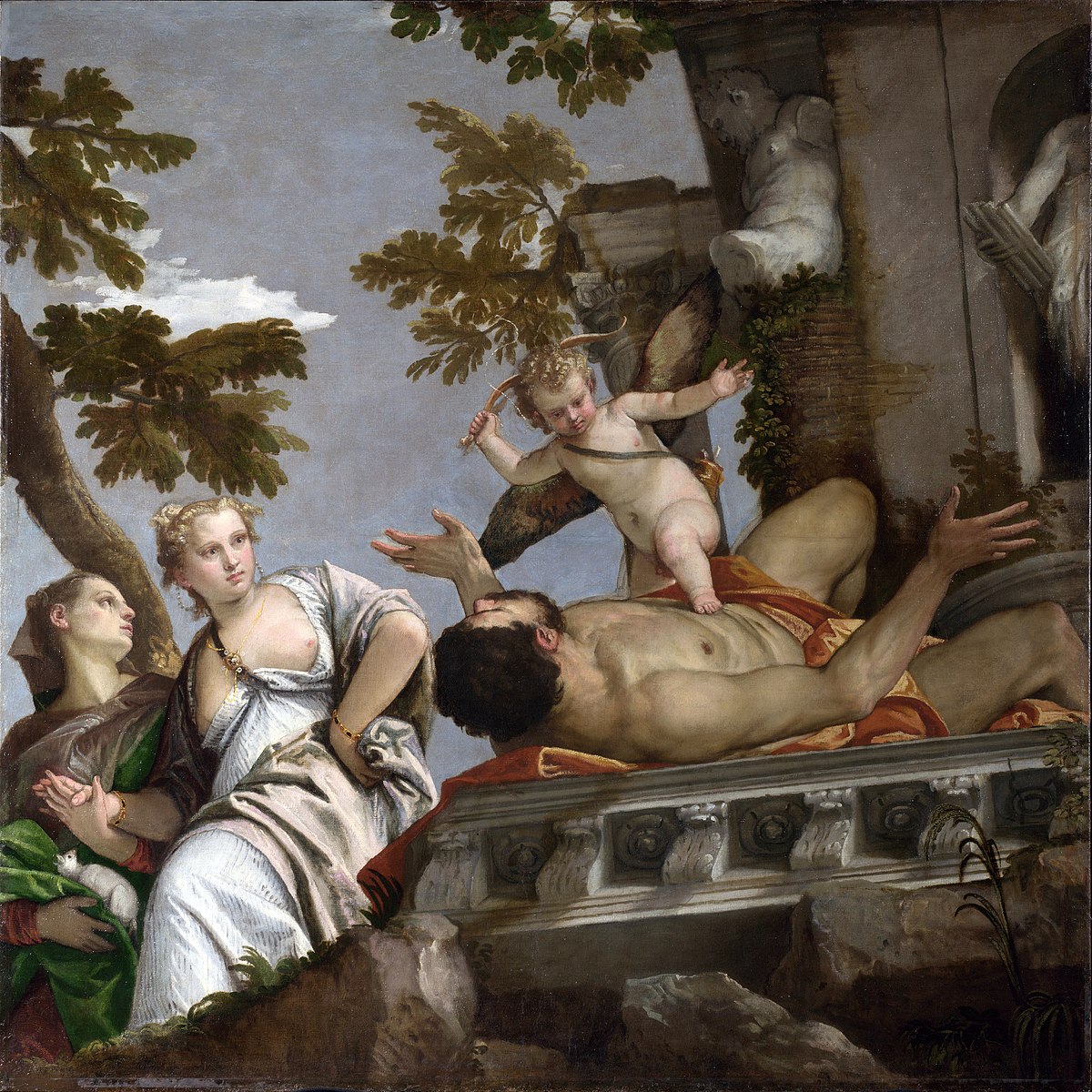
The next painting would represent the second stage in the ‘Éducation’; and it may have been intended to hang at the top of the hypothetical central decoration. (The light still falls from the right but is now more behind the viewer.)
Wearing no more than a loincloth now (his powerful body being a tour de force of draftsmanship), our hero lies on what would seem to be the base of a classical temple.
This temple or shrine is dedicated to deities symbolising our animal nature, because the armless and legless statue is a Herm, while the other (half concealed) is clasping the pipes of Pan at a suggestive angle. The man is certainly being beaten by Cupid, who is using his bow as a rod; and it is more likely that the beating expresses the torments of unrequited passion rather than a punishment for unbridled desire.
The traditional title for the picture (going back to 1727) is Scorn. This suggests that the man’s suffering or punishment is caused by the shapely woman, who inflames his lust with the display of her white bosom and provocatively placed elbow, but who is clasping the hand of her chaperone—her conscience—the figure who is primly dressed with a high collar and is clutching a white ermine, which is an emblem of chastity.
The man is being ‘scorned’—rebuffed—and that too is part of a Sentimental Education.
The third scene is intended to make a contrast with the first two; and may well have been placed to the right of the hypothetical central ornament. (Light still falls from the right but from very high: look at the hero’s knee). It may also have been in a kind of ‘Chinese box’ relationship to the room for which it was originally intended (since it shows a bedchamber with a fresco on the vault).
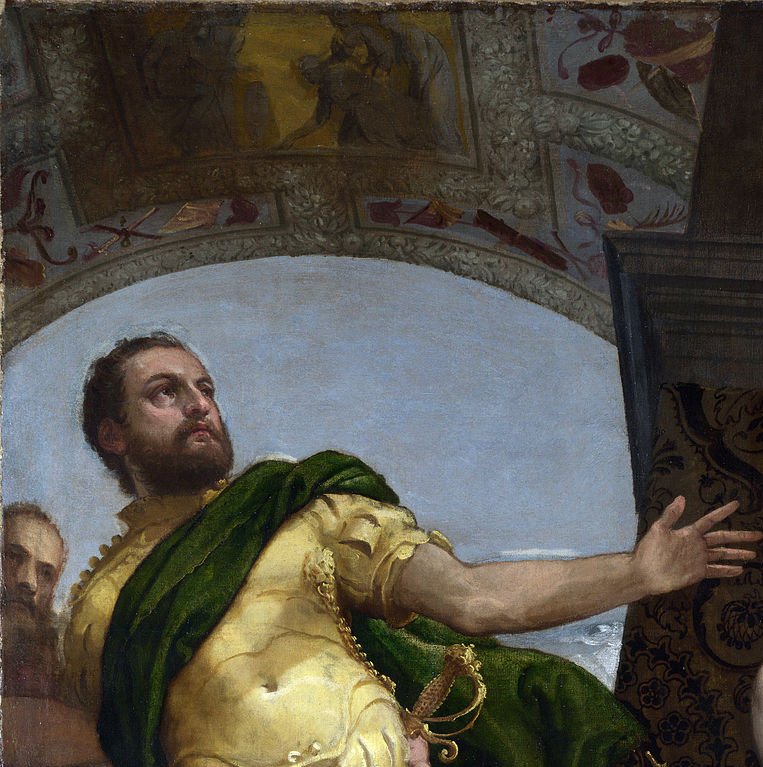
This time it is a woman who reclines, while our hero stands to one side, fully dressed for outdoors, wearing a green cloak over a yellow tunic. He is accompanied by an older companion of the same sex.
The woman has drifted off into a tipsy sleep (not deeply, as her hand is loosely clutching the bedcover), without removing her necklace and a bracelet. She is naked, desirable and vulnerable—like Lotis in Bellini’s painting for Duke Alfonso’s Studiolo. And Cupid (arrow in hand) seems to be urging our hero to seize his opportunity just as Priapus tried to do in Ferrara.
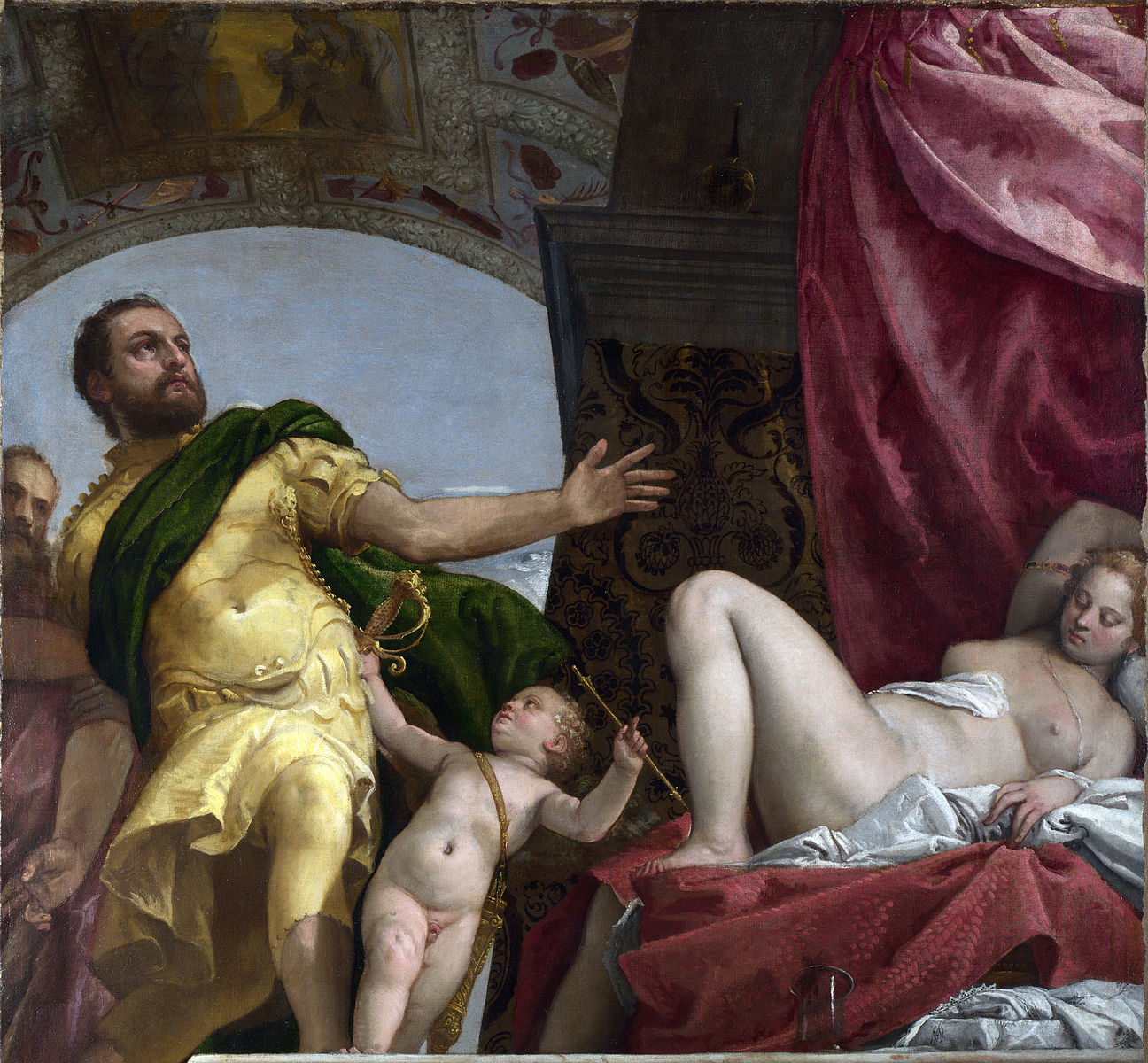
However, the man looks up and away, listens to his elder companion, and seemingly turns his mind to one of the most famous classical examples of ‘Continence’ or Self Denial, set by the Roman general, Scipio.
(This is supposedly the subject represented in the ceiling fresco, partially visible within the painting.)
His gesture is one of renunciation. He has sexual appetite and finds the girl ‘appetising’; but he is able to discipline and control his desire.
The traditional title is Respect.
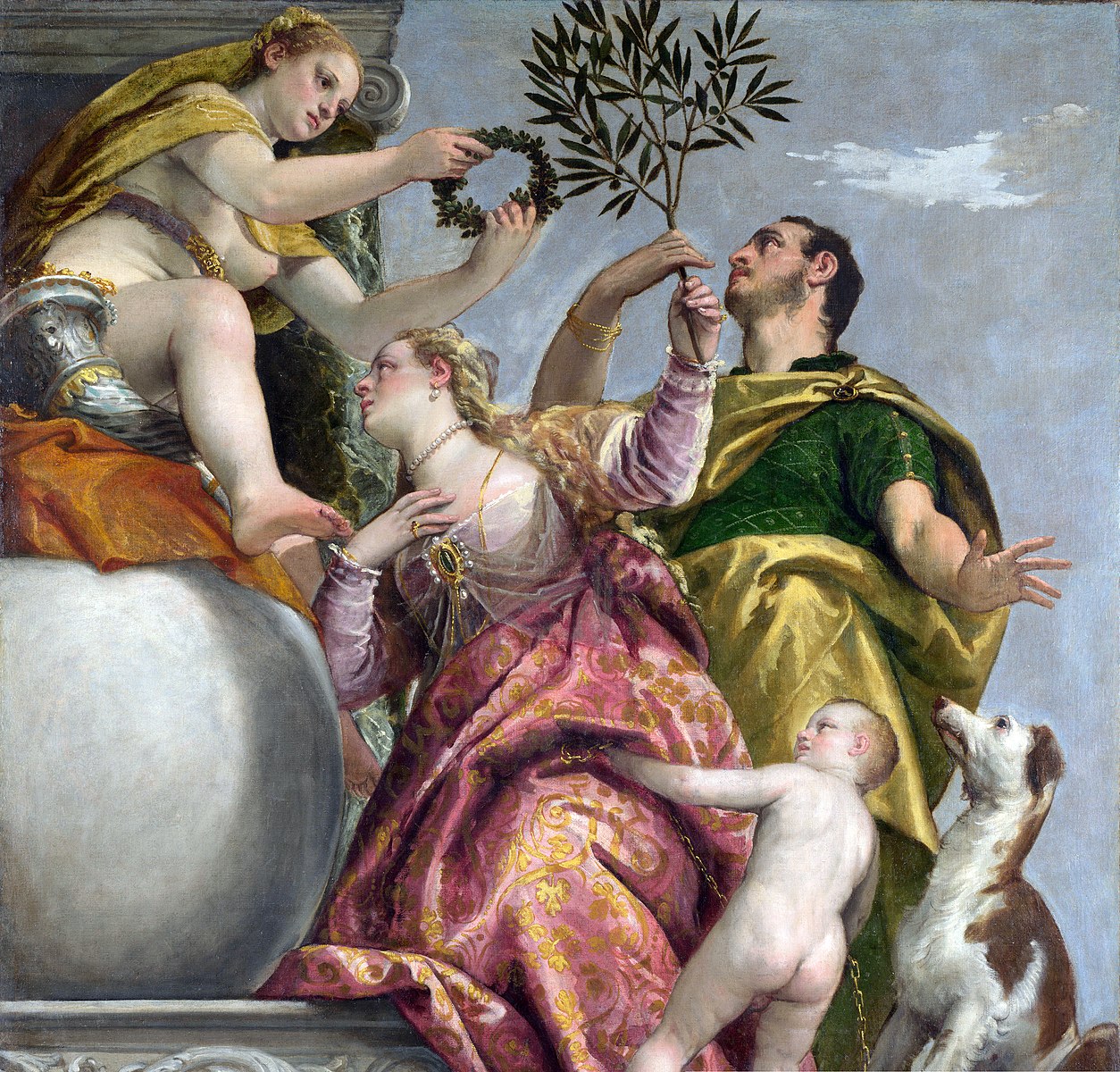
The received title for the fourth and last canvas is Happy Union; and there is no serious disagreement about the meaning. (It may have been placed at the ‘bottom’ of the original layout. For the first time, the light falls unambiguously from the left.)
Both man and woman are clothed. Our hero—dressed in yellow over green this time—is accompanied by a dog, symbolising fidelity. He does not hold his lady’s hand (as he had done with the girl in the first scene), but both are clasping an olive-branch as a symbol of Peace and Harmony.
The fortunate bride resembles her rivals in her colouring and generous proportions. She is expensively dressed in a handsome pink brocade, and she sports a necklace of pearls, a ring on her finger, and an earring above a very handsome brooch. Her hair flows freely down. But the under-robe covers her arms and breast, and she is not lascivious.
Cupid is placing a golden chain about her, and she is to be crowned by a full-breasted personification of Good Fortune or Fecundity (notice the cornucopia).
If the four paintings do indeed add up to a story about ‘Love and Marriage’, then the last words of our fairytale must undoubtedly be: ‘They lived happily ever after.’