Gentile Bellini: The School of St John, and Carpaccio: The Life of St George
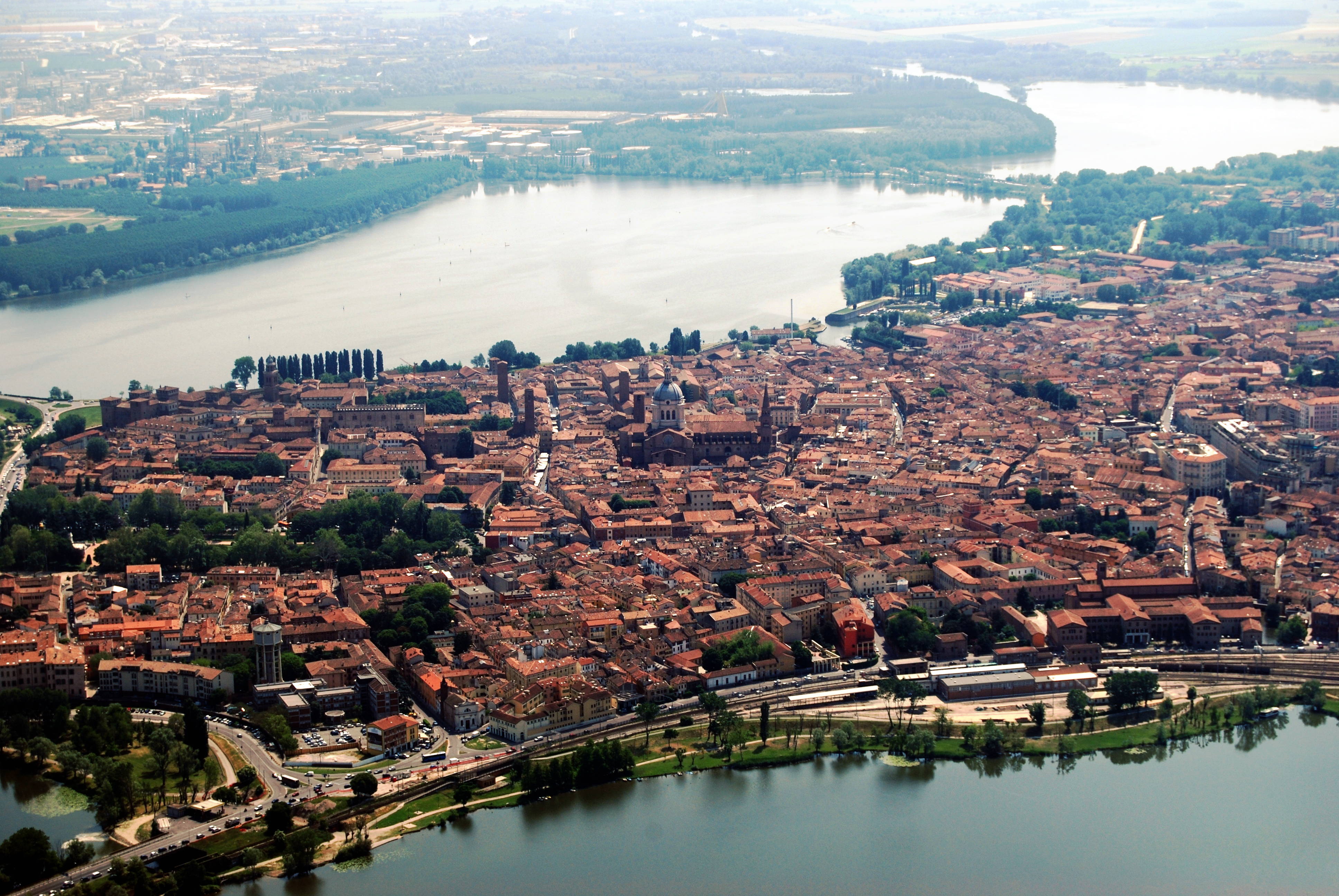
As you can see, Mantegna’s Mantua and Carpaccio’s Venice were both surrounded by a tidy stretch of water.
From every other point of view, however, they were very different.
The inland city of Mantua had only about 25,000 inhabitants in 1500, and the little Marquisate was ruled by members of one family, the Gonzagas, for about three hundred years from 1330 to 1630.
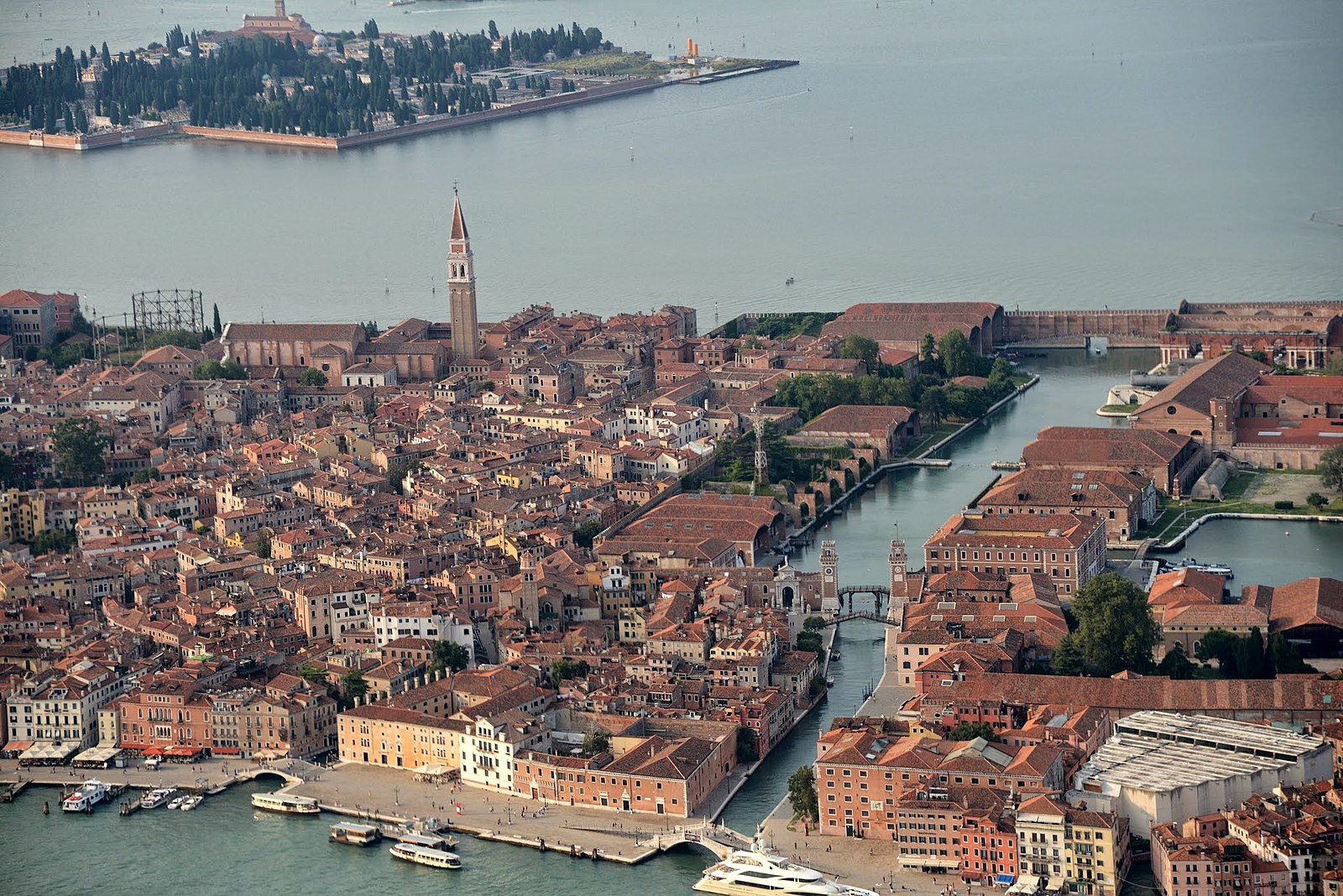
The maritime city of Venice had as many as 110,000 inhabitants at this time. It was extremely wealthy, thanks to a virtual monopoly in luxury trade with the East; and in order to protect its trade routes, it possessed a kind of ‘ribbon-empire’, extending down the coast of Dalmatia, and taking in the islands of Rhodes, and, from 1489, Cyprus (whence, I remind you, the plot of Shakespeare’s Othello, the Moor of Venice).
In the early fifteenth century, the Lion of St Mark had ‘stepped ashore’ (as they said euphemistically), and Venice extended her rule over the vast area of the hinterland which is coloured red on the political map.
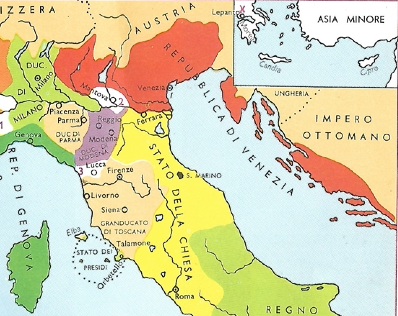
Far from having a hereditary ruler, Venice was a republic, in which the political power—and membership of the various Councils—was spread among the two hundred families who constituted the noble class. Even more strikingly than any other medieval or early modern city, Venice consisted of a complex series of interlocking and overlapping communities and corporations.
Certain areas of the city were dominated by people of one ethnic origin, as the place-names still tell us: for example, the Giudecca, the island where the Jews lived; and, next to the palace of the elected Head of State, the Riva degli Schiavoni (Slavs), with, at right angles to it, the Rio dei Greci (Greeks), where we shall find the School of the Dalmatians.
There were many associations based on trade or profession—the Guilds.
To these we must add the so called ‘Companies’ of Nobles. And, of course, there were a great many religious communities in the countless churches and convents.
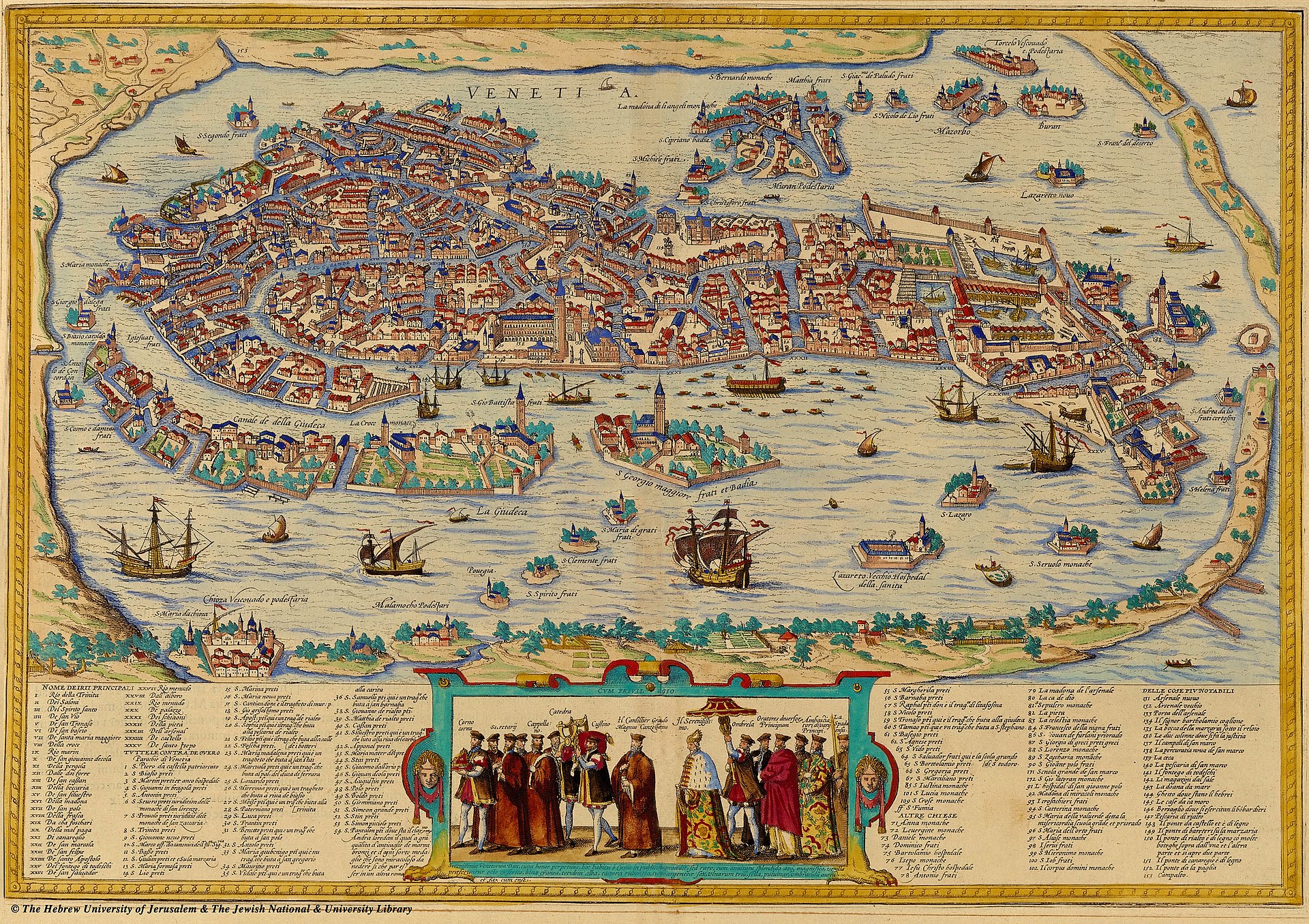
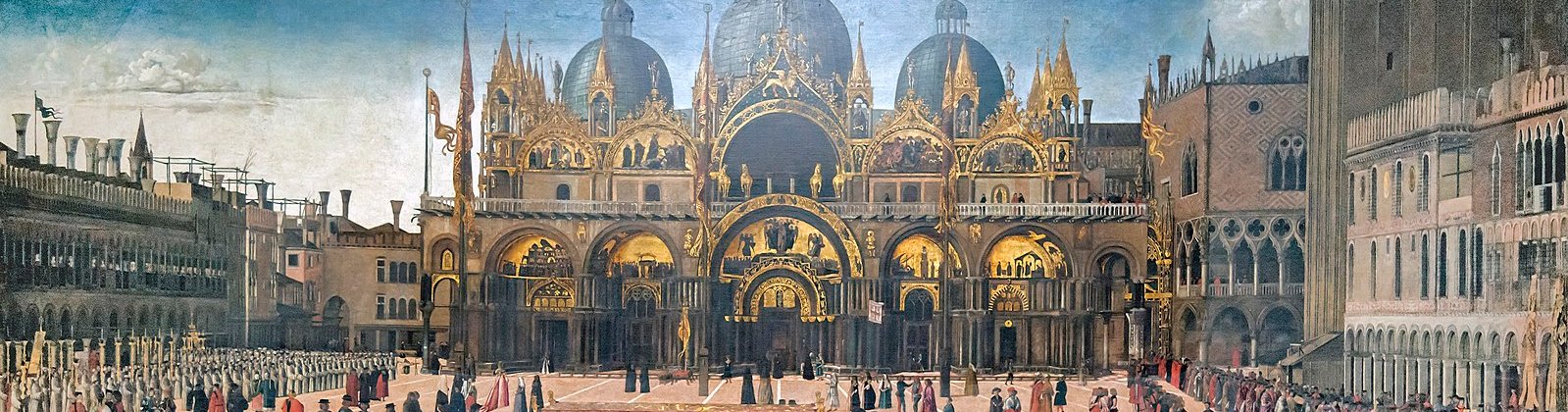
This is a good moment to remind you that Church and State (or Church and Society), were very closely bound up at all levels of activity; a feature which is nicely symbolised in the fact that St Mark’s, the great Church of the Republic’s patron saint—it was not a ‘Cathedral’ at this time—lies between the Palace of the Doge to the right, and the central administration or ‘Procuratie’ to the left.
The detail from Gentile Bellini’s famous canvas of 1496 is eloquent.
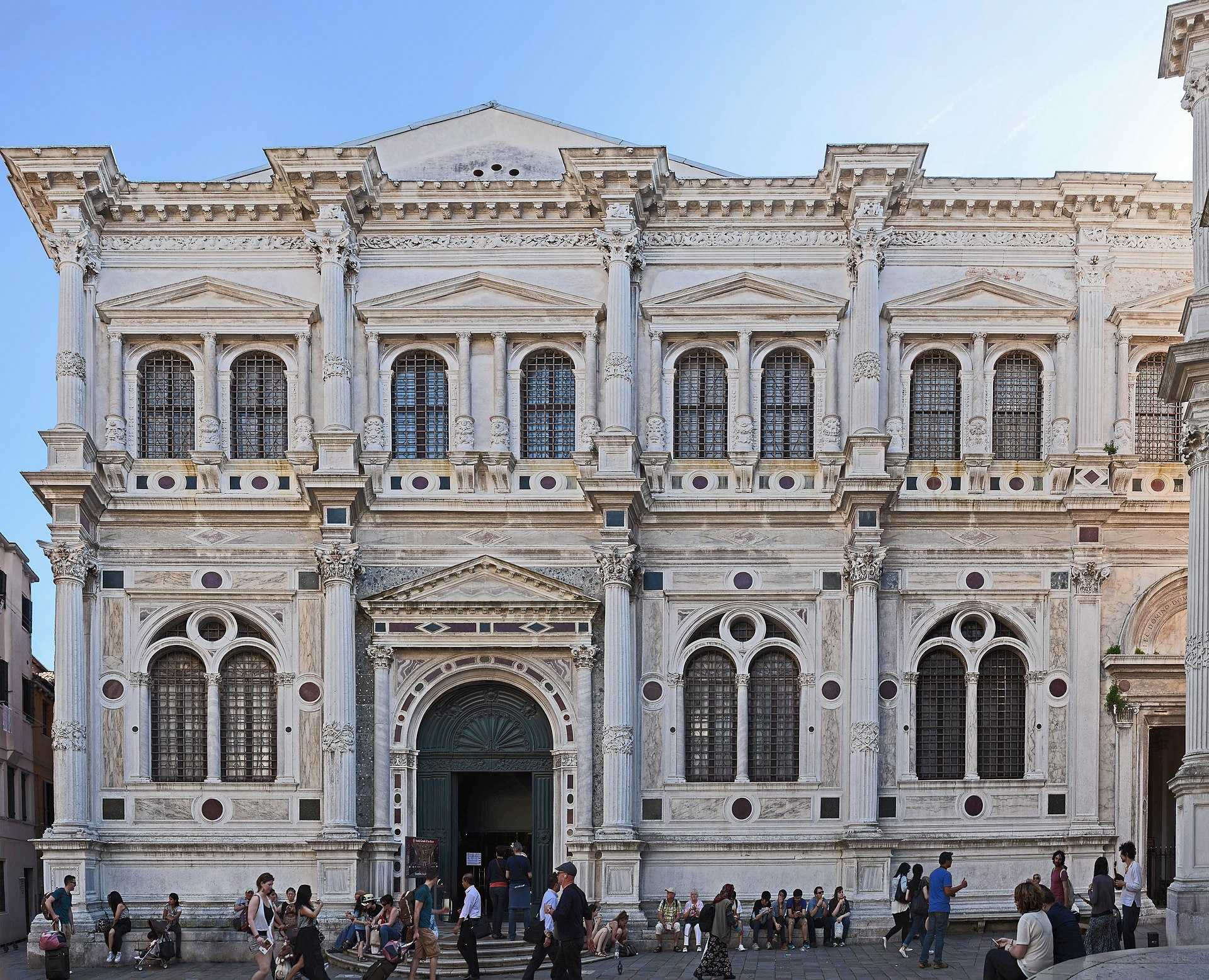
The most characteristic of all the ‘societies-within-a-society’ were the ‘Confraternities’ or ‘Friendly Societies’, which, in Venice, were called ‘Schools’—‘Scuole’.
These were formed by laymen for a mixture of purposes (inseparable, but varying in relative importance from one Scuola to another): religious worship and religious instruction, and the provision of dignified funerals and charitable help for members and their families who were ruined or fell ill, or to those who were widowed or left as orphans. They also gave charitable help to the community at large: to the sick, the old, paupers and the prison population.
There were more than two hundred of these Schools in Venice, and it has been estimated that around two-thirds of the male population belonged to one or other of them; the choice depending on their wealth, their profession, their class, and the area where they lived.
The point of telling you of all this is that some of the ‘Scuole’—especially the six ‘major’ schools, known as ‘Scuole Grandi’—became patrons of the Arts, particularly in times of prosperity. They hired architects to build or to rebuild their headquarters or the church with which they were associated; and they hired painters to decorate the walls of these buildings, in rivalry with each other, with the State, and with the ecclesiastical establishment.
In this lecture we shall be looking at no less than three relatively small-scale cycles of canvasses commissioned by three Venetian Schools from various artists, including Gentile Bellini and Vittore Carpaccio, and dated between 1490 and 1505. And the next lecture is devoted to another longer narrative by Carpaccio, from the same period, illustrating the life and martyrdom of St Ursula, the patron saint of the pertinent School.
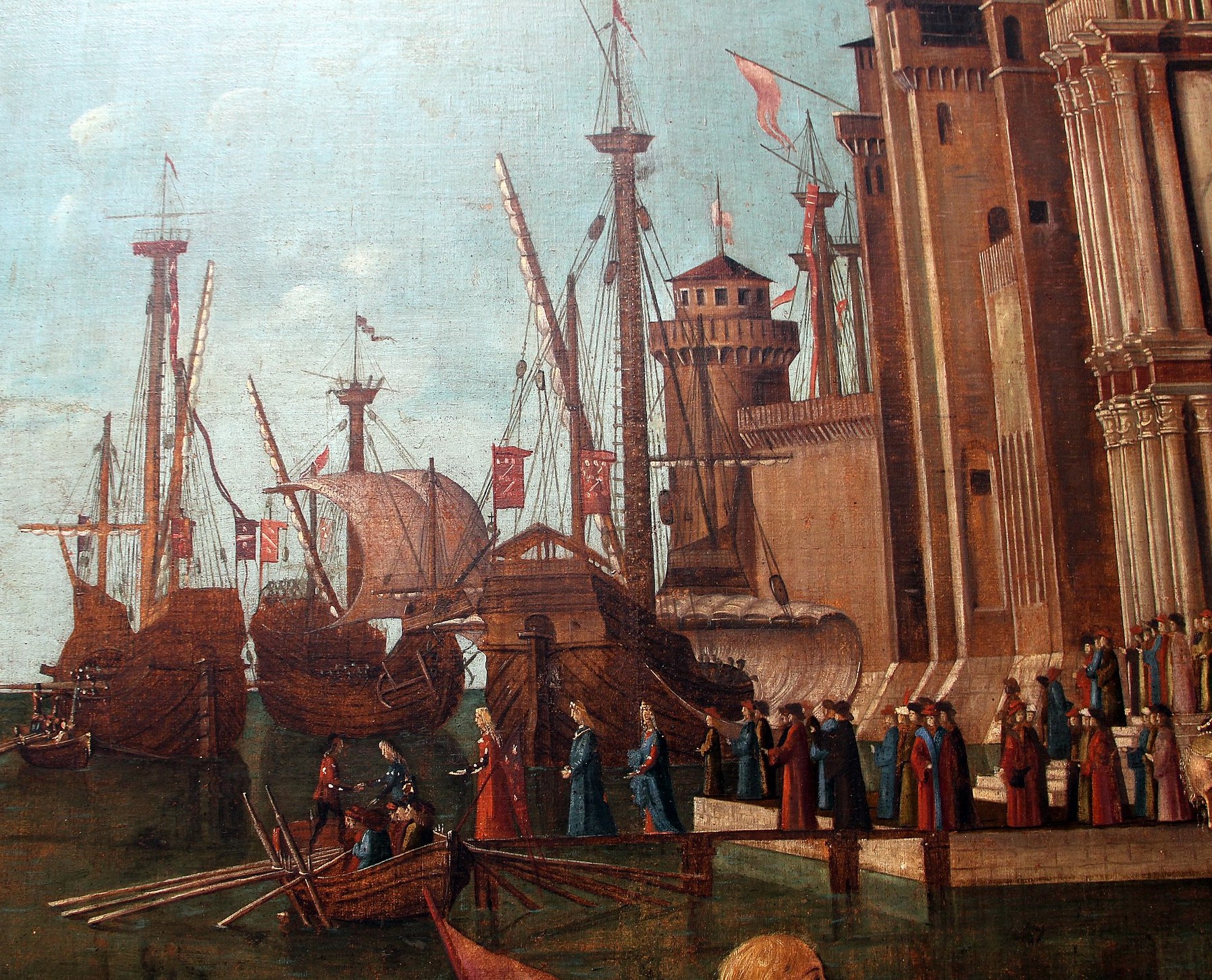
(I anticipate the artistic pleasures of the next lecture by showing a lovely detail from Carpaccio’s Ursula cycle to document the fact that the city of Venice was first and foremost a port.)
The first cycle of canvases was commissioned by one of the major Schools (St John the Evangelist), who chose to represent and celebrate some miracles which had been worked by a sacred relic in their possession—miracles which had happened in Venice (some of them within living memory) to members of the School.
As a result, the paintings give a fascinating glimpse of daily life in the social world in which they came into being.
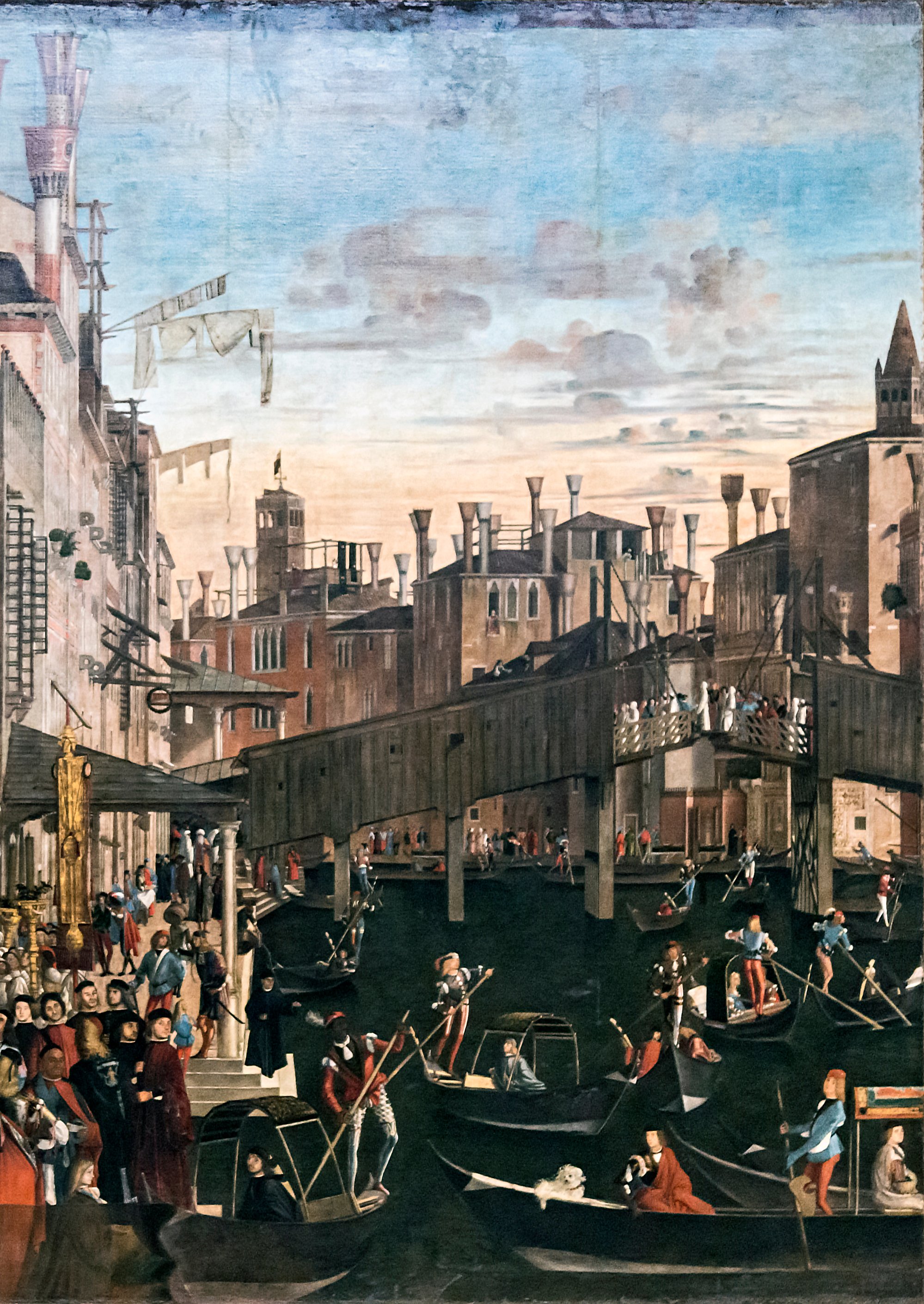
(Again, I anticipate a detail of a canvas by Carpaccio to reinforce the point.)
The Church of St John the Evangelist stands on the west bank of the Grand Canal.
The nearby Confraternity of St John—behind the church—had been founded as a community of Flagellants back in 1261.
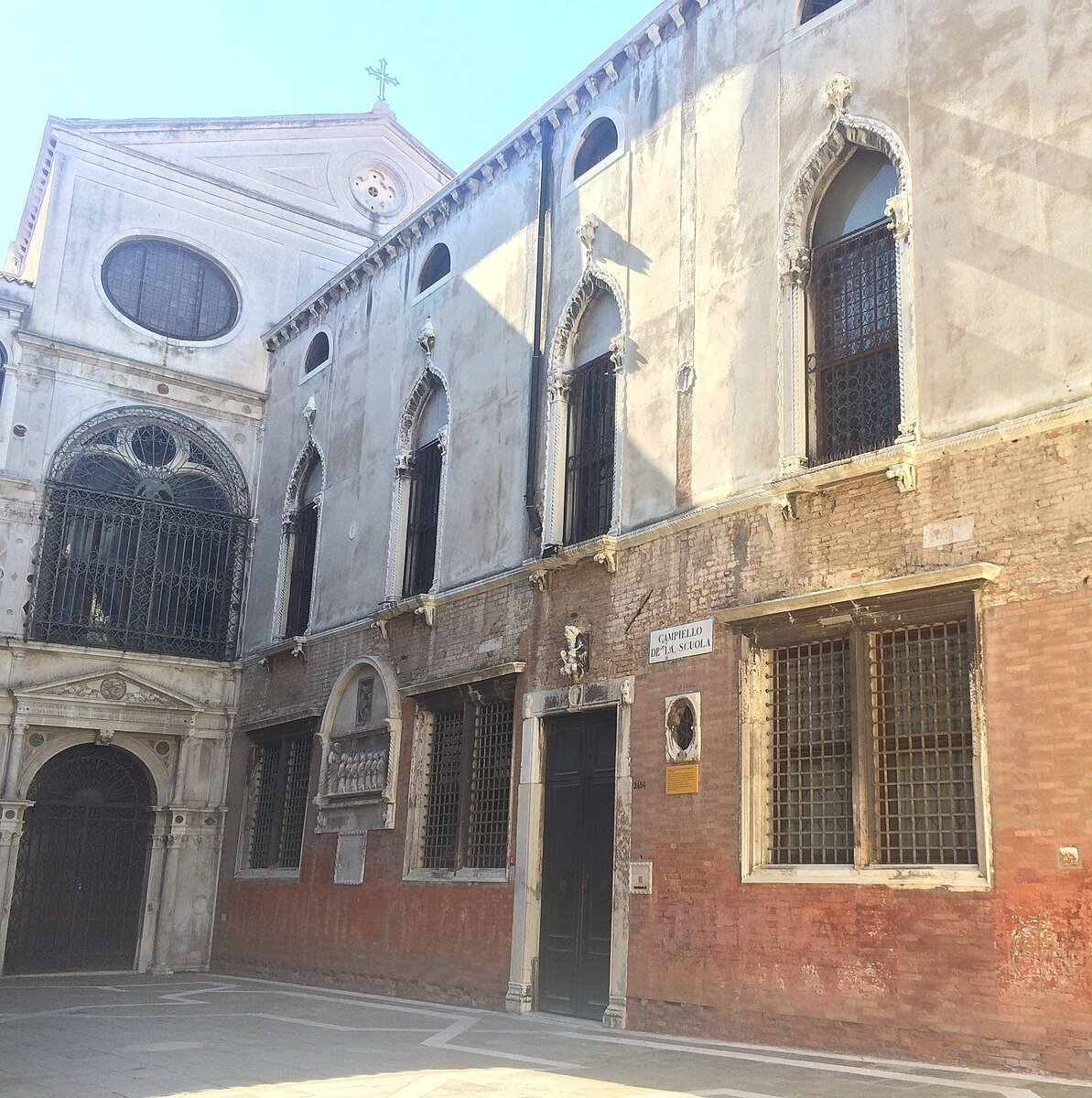
In the 1340s, the Confraternity had rebuilt an alms-house as their headquarters in the neighbourhood of the church.
It obtained the cause of its future prestige in the year 1369, when the Grand Chancellor of the King of Cyprus made a gift of a precious relic—a piece of the True Cross, that is, a fragment of the cross on which Jesus was crucified.
(If you would like to discover more about the Legend of the True Cross, you might refer to the fifth lecture in the series devoted to Florence on this site).
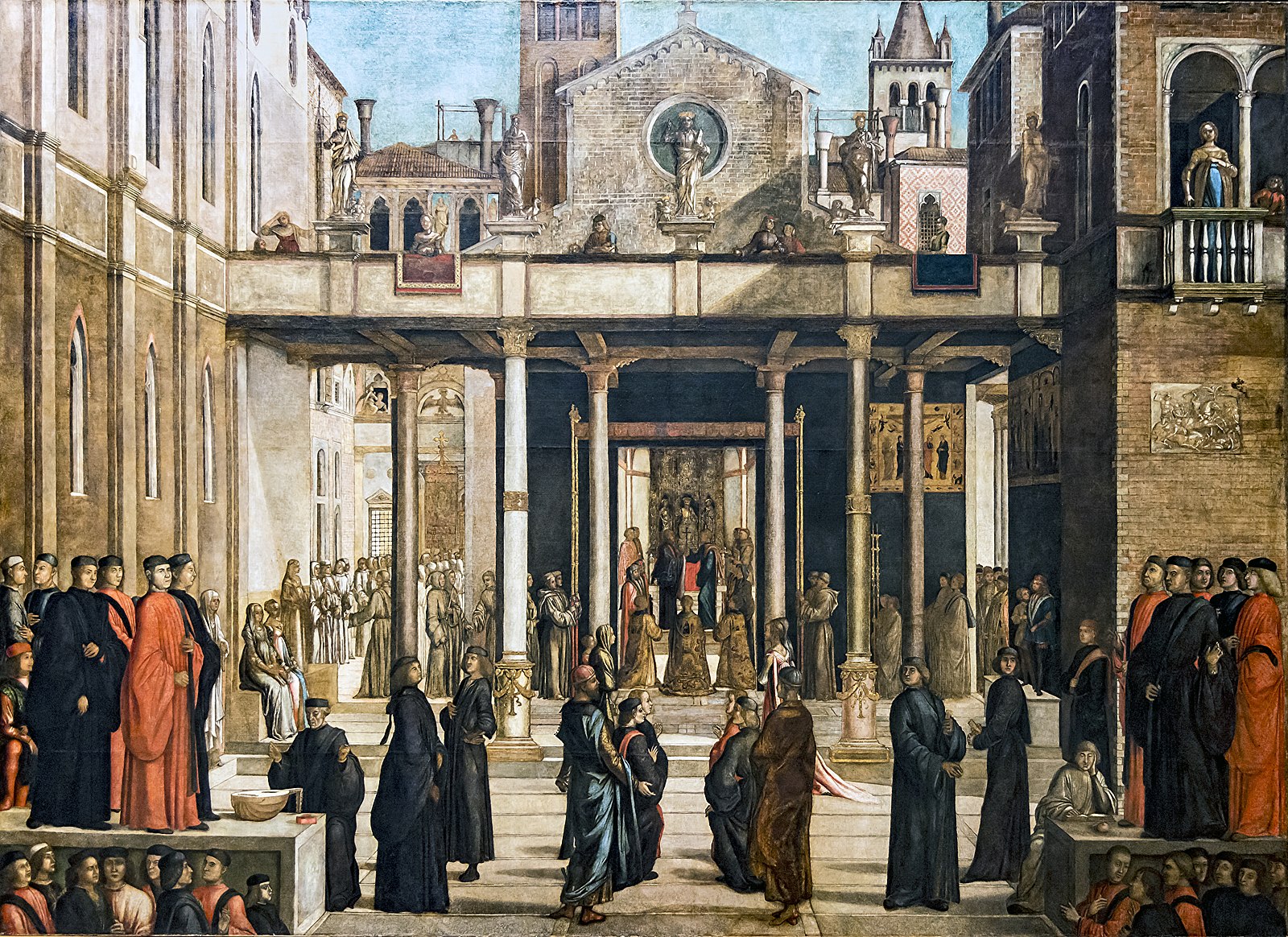
(Again, I anticipate—for its documentary value—a canvas from the cycle we shall be studying, because Lazzaro Bastiani here supplies us with a very detailed representation of the church and the community in the late fifteenth century—nominally, on the day 130 years earlier when the precious relic was received.)
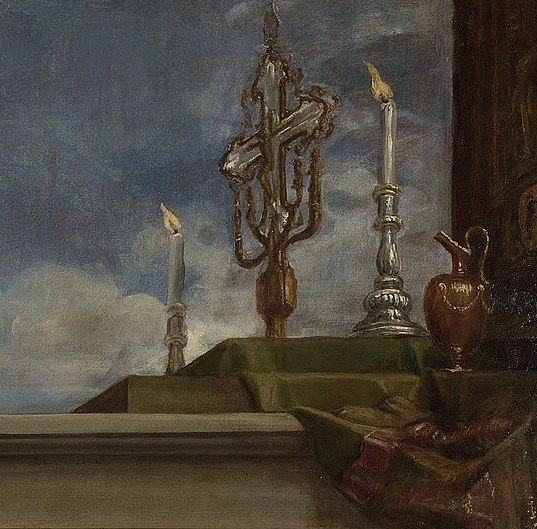
To house the precious fragment, the Confraternity commissioned a reliquary of crystal and silver made in the form of a cross.
(It is this reliquary which you are looking at in a detail from a canvas by Titian which hangs in the National Gallery. You will see the whole painting later on.)
The other canvasses in our cycle all represent miracles that were attributed to the reliquary and its fragment of the True Cross.
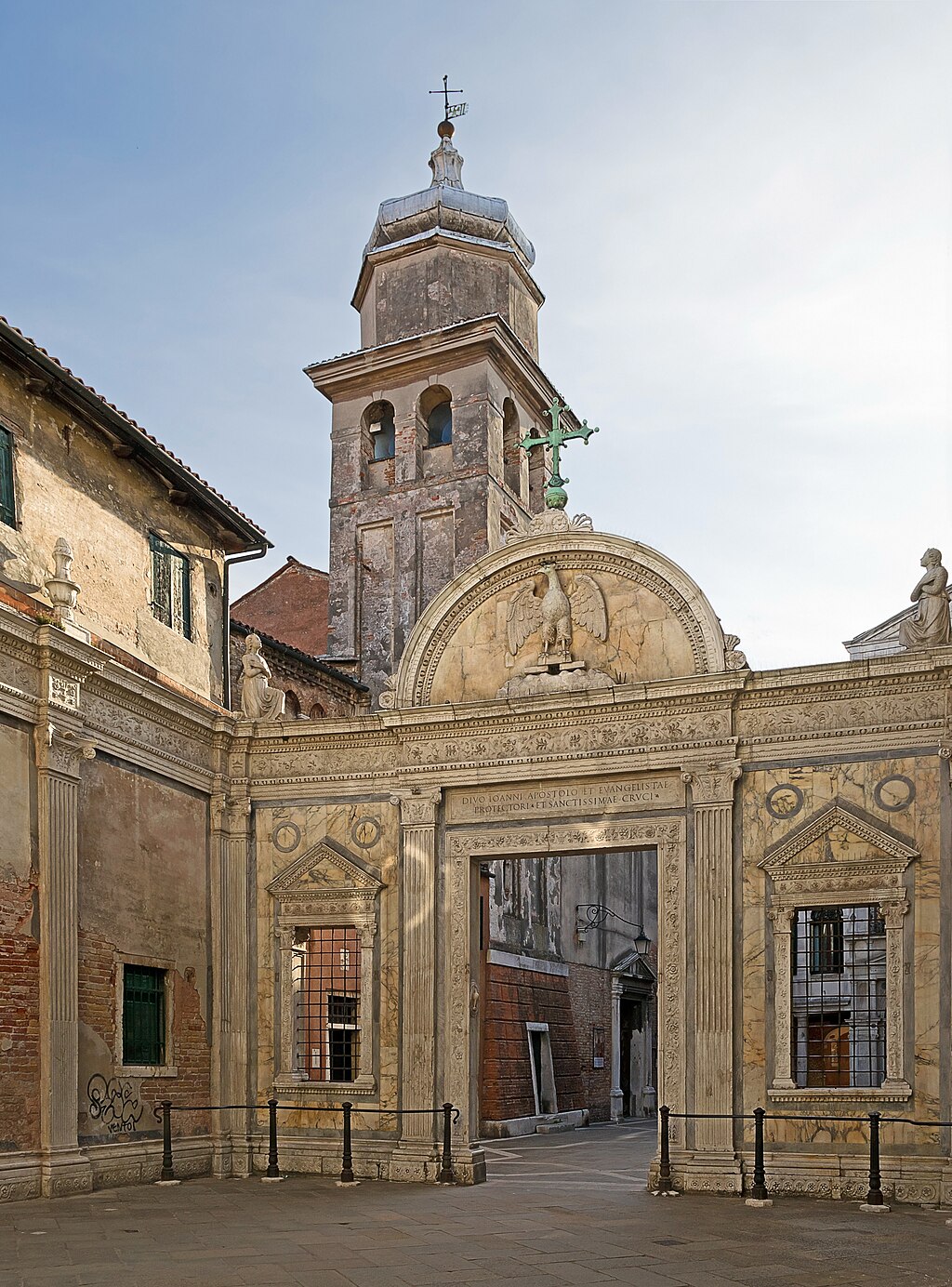
During the fifteenth century, the Confraternity became wealthy and prestigious: in short, it became one of the major Schools.
In the thirty years between 1480 and 1510, they built a new gate to their courtyard, and a new portal to their entrance. They then followed these works with a new ceremonial staircase that led up to the two principal rooms on the first floor; one of them being the main meeting room (always known, in every School, as the Sala dell’Albergo), the other being a much smaller committee room and sanctuary, measuring about forty-five feet by twenty-five feet.
It was in the smaller room that they kept their reliquary, which is why it was known as the ‘Room of the Cross’, Sala della Croce.
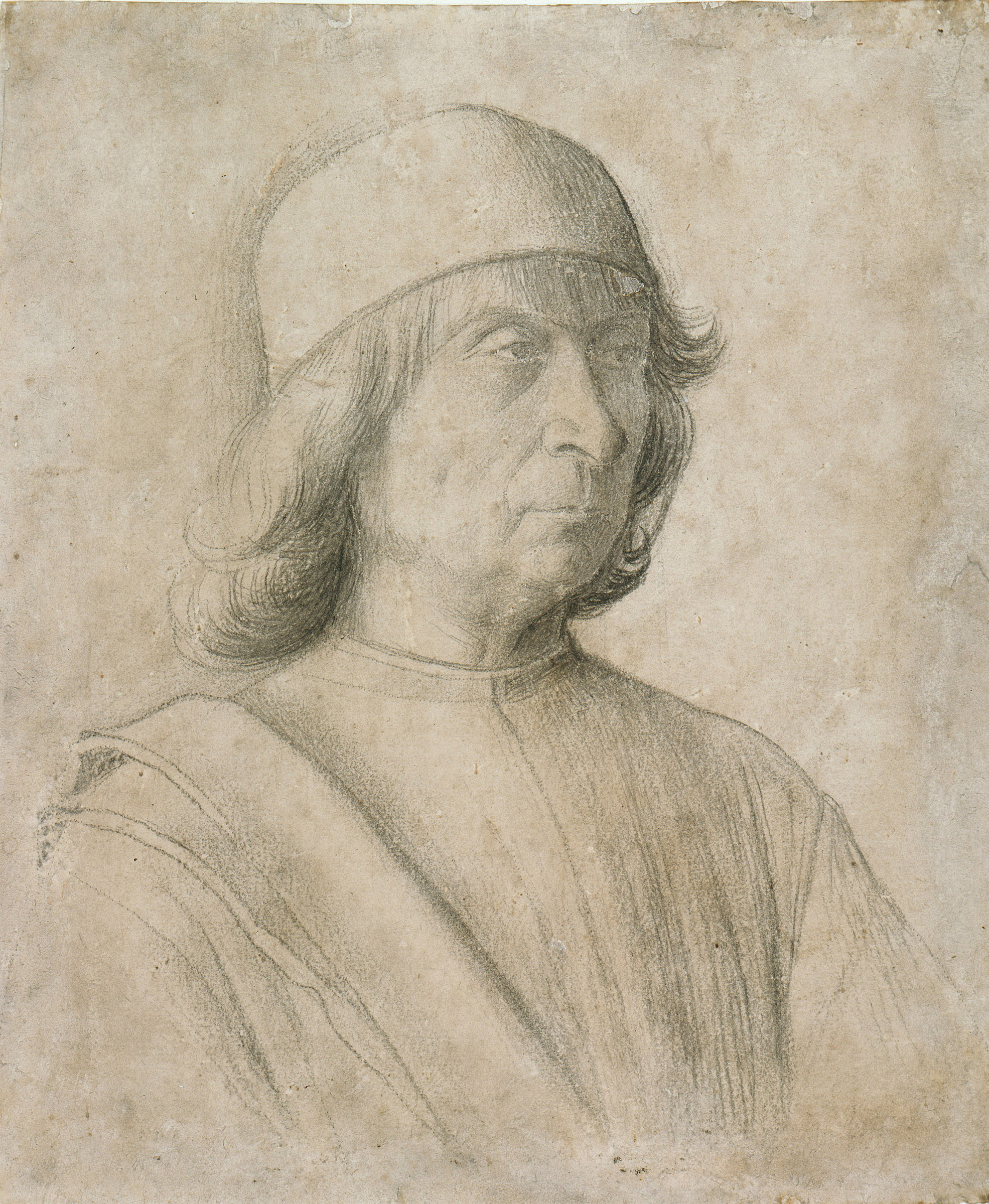
Apart from making these structural alterations, they had the larger room sumptuously redecorated; and in 1494 they placed an order for the eight canvasses which make up our cycle to be placed in the smaller ‘Room of the Cross’, giving the commission to Gentile Bellini, whose father had been a member of the Confraternity, and who was by then about sixty years old.
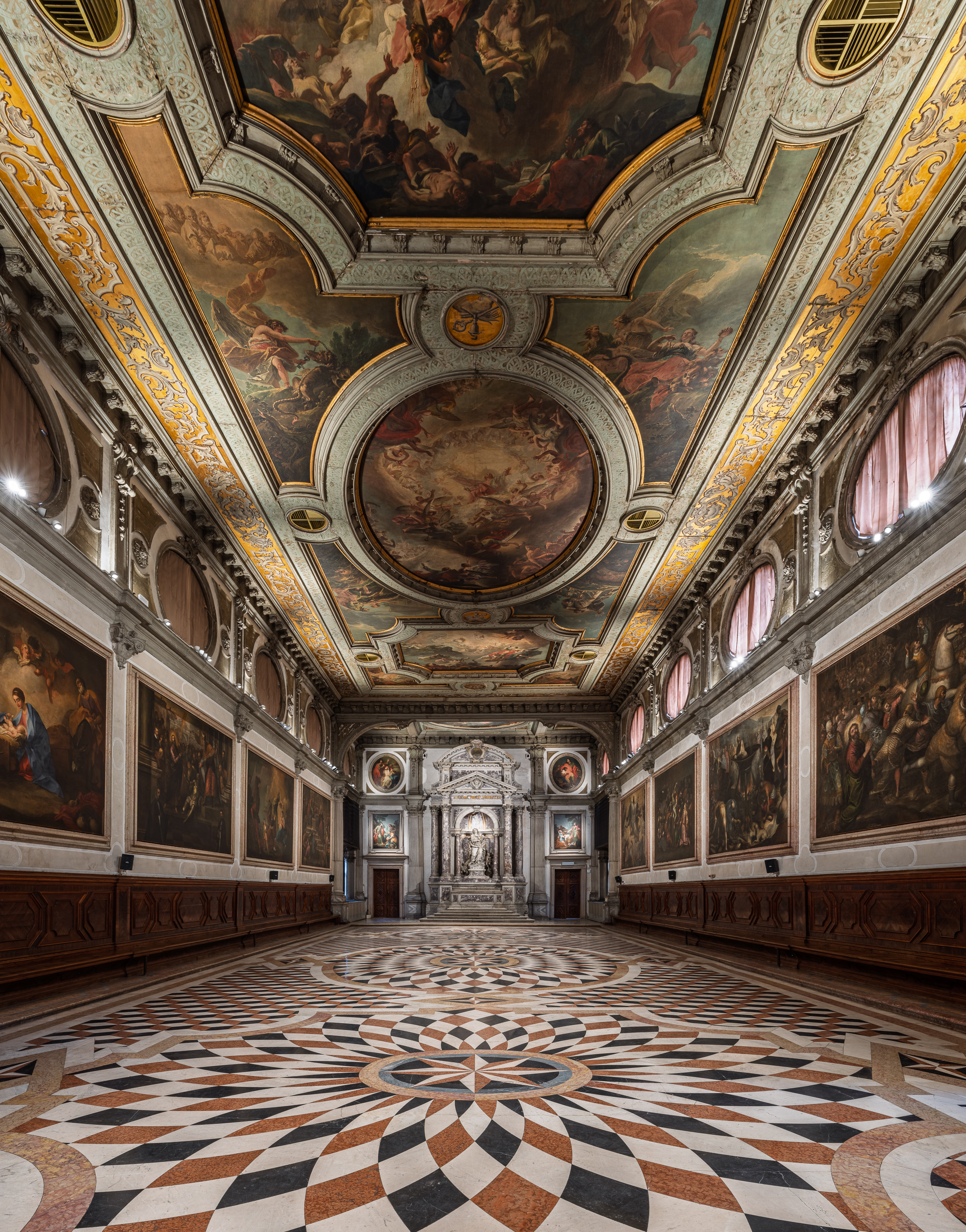
Gentile, as was common practice, painted three of the canvasses himself, and subcontracted the other five to other younger artists (we shall look at one by Bastiani, and one by Giovanni Mansueti).
However, Gentile clearly imposed certain conditions or conventions on his collaborators in order to unify the pictures. The vanishing point of the perspective is always placed about halfway up the canvas; and, more importantly, the artist is ‘viewing’ the scene as if he were looking through a window on a first floor, some fifteen to twenty feet above the ground, so that we are always looking down on standing figures.
The canvasses are no longer in the room for which they were intended, but they are at least all together, in a room of the right size, in the Accademia, where they were taken in the year 1806, when Napoleon closed all the Schools down. (The Accademia, I note in passing, is only half a mile away.)
The miracles attributed to the Holy Cross were all local, and they took place within about ten minutes’ walk of the Scuola itself (one in the square outside the Church of San Lio, another on St Mark’s Square, another in the Rio di San Lorenzo, and another next to the Rialto).
It is this ‘local-ness’ that makes even the lesser paintings in the cycle so fascinating.
The first canvas in the series, by the minor artist Lazzaro Bastiani, does not represent a miracle—as we noted earlier—but the condition sine qua non, that is, the ceremony, back in the year 1369, when the precious relic was entrusted to the Church of St John.
Since there is no story, I need say no more than that the picture is about twelve feet high by nearly sixteen wide, and that it is now correctly placed in the room in the Accademia, in the sense that it lies to the centre-right on one of the longer walls, even though it would have originally hung to the right of the altar.
The first of the miracles took place in the Campo di San Lio, in front of the Church of that saint. The canvas measures about ten feet by fourteen, and is by another minor artist, called Giovanni Mansueti. It was hung alongside the Bastiani.
The year is 1474—that is, only about twenty-five years before the canvas was painted; and I stress the date because the miracle may strike you as decidedly odd.
The relic, inside the cross-shaped reliquary, was to have been carried to the Campo San Lio, for the funeral of one of the brethren. But this brother had been guilty of some irreverent remarks about the relic; and so, when the brethren tried to pick up the reliquary, it became too heavy for them to carry, and they had to find another cross in its place.
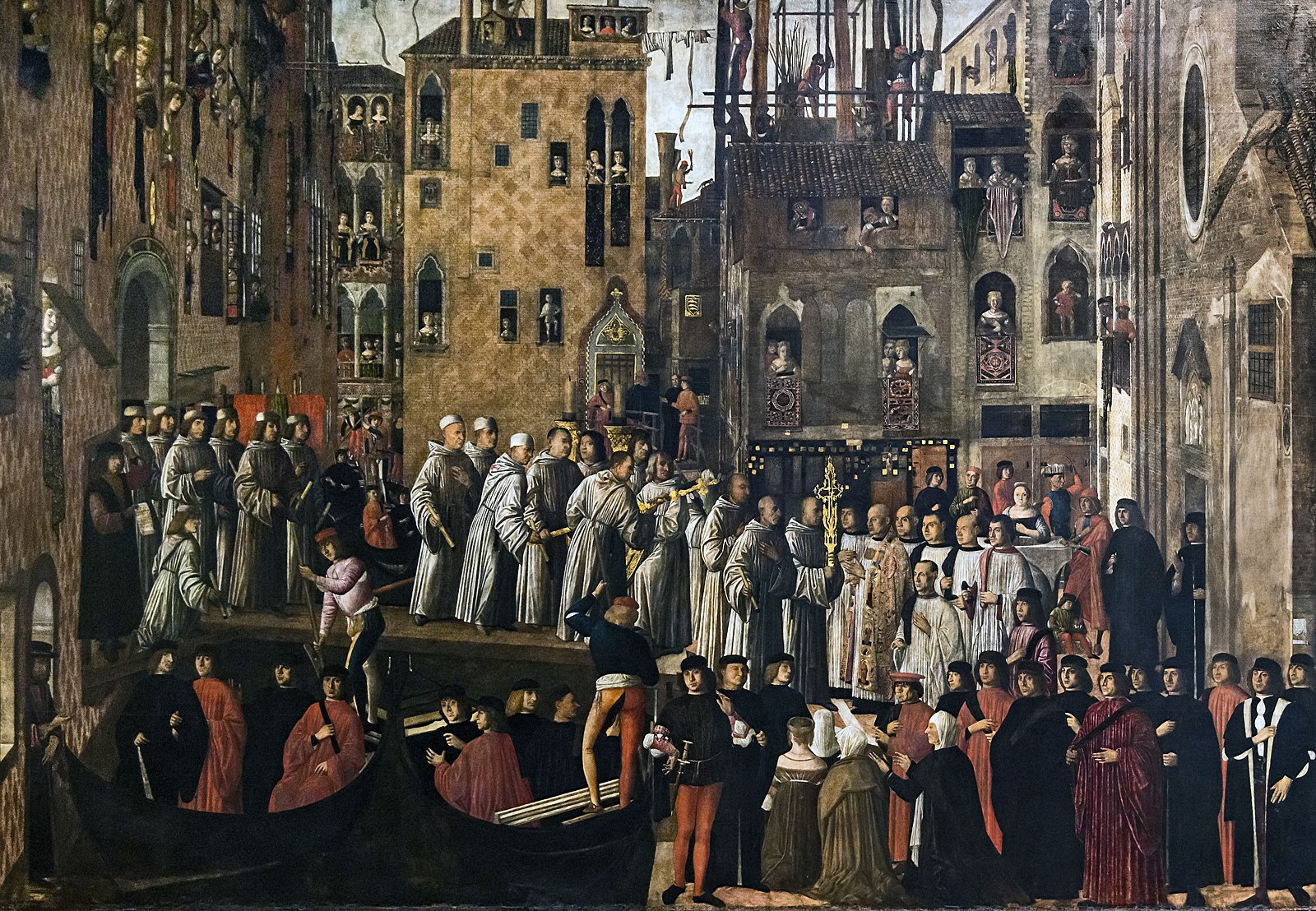
Alas, or thank goodness, Mansueti does not show the miracle—the breaking of the normal rule—but the norm itself.
A procession of the ‘confratelli’, wearing the white robes of their School, carry the substitute-cross over the bridge to the Campo, where the family kneel beside the coffin, below us, while other mourners are arriving either on foot, or by one of the two gondolas.
The perspective of this scene is rather primitive for a painting dating from about 1500, because Mansueti has ignored two of the most simple of all Alberti’s rules: namely, that there should be a common scale for buildings and for human figures, and that figures diminish in proportion not to their importance but to their relative distance from the picture plane As a result, there is simply not enough space to contain the procession and the spectators.
Nevertheless, Mansueti has clearly rendered the brickwork of the Palazzo very carefully indeed; and his representation of the windows, the hangings, and the costumes is so breathtakingly detailed that the painting will be well worth your close attention when you next find yourself in the relevant room in the Accademia.
The only trouble with the advice just given is, that, when you are in the room, your eye goes straight to the next huge canvas, measuring eleven feet by twenty-four, which occupies the whole of the shorter wall facing you.
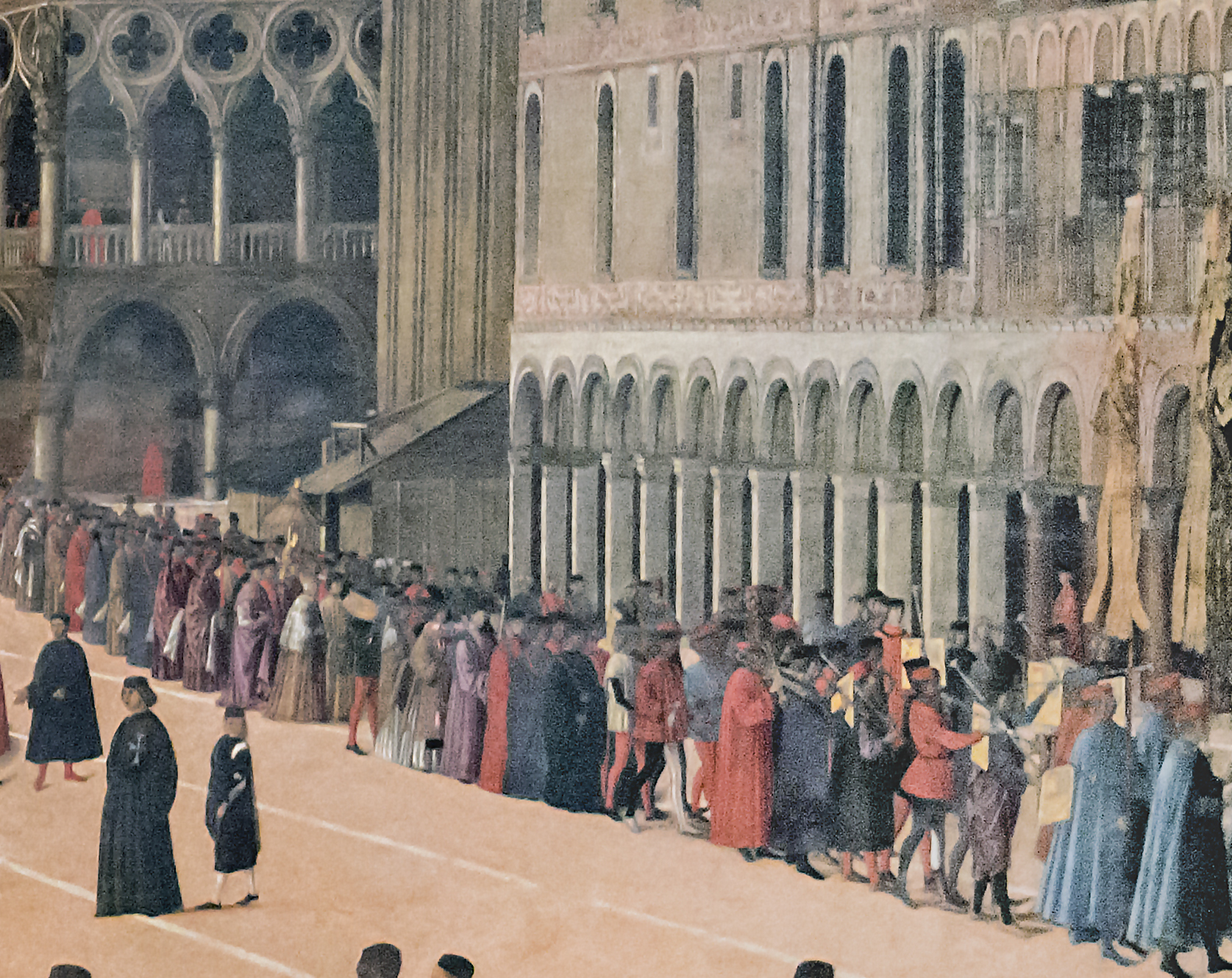
This is by Gentile Bellini himself, who succeeds in suggesting the vast expanse of the Square of St Mark’s just as effectively as any modern photograph while also giving us a superbly detailed, highly accurate account of the elaborate façade of the main civic church, with its cupolas, the four horses, the original mosaics, and the five arches.
(He also shows the two flanking buildings that I mentioned earlier (the Procuratie and one corner of the Doge’s Palace); and he does not forget the bottom of the Bell-tower, the Campanile.
If you know Venice well, you might ask: ‘Where is the Clock-tower?’ To this, there is a simple answer: it had fallen down and was not rebuilt until after this picture was painted.)
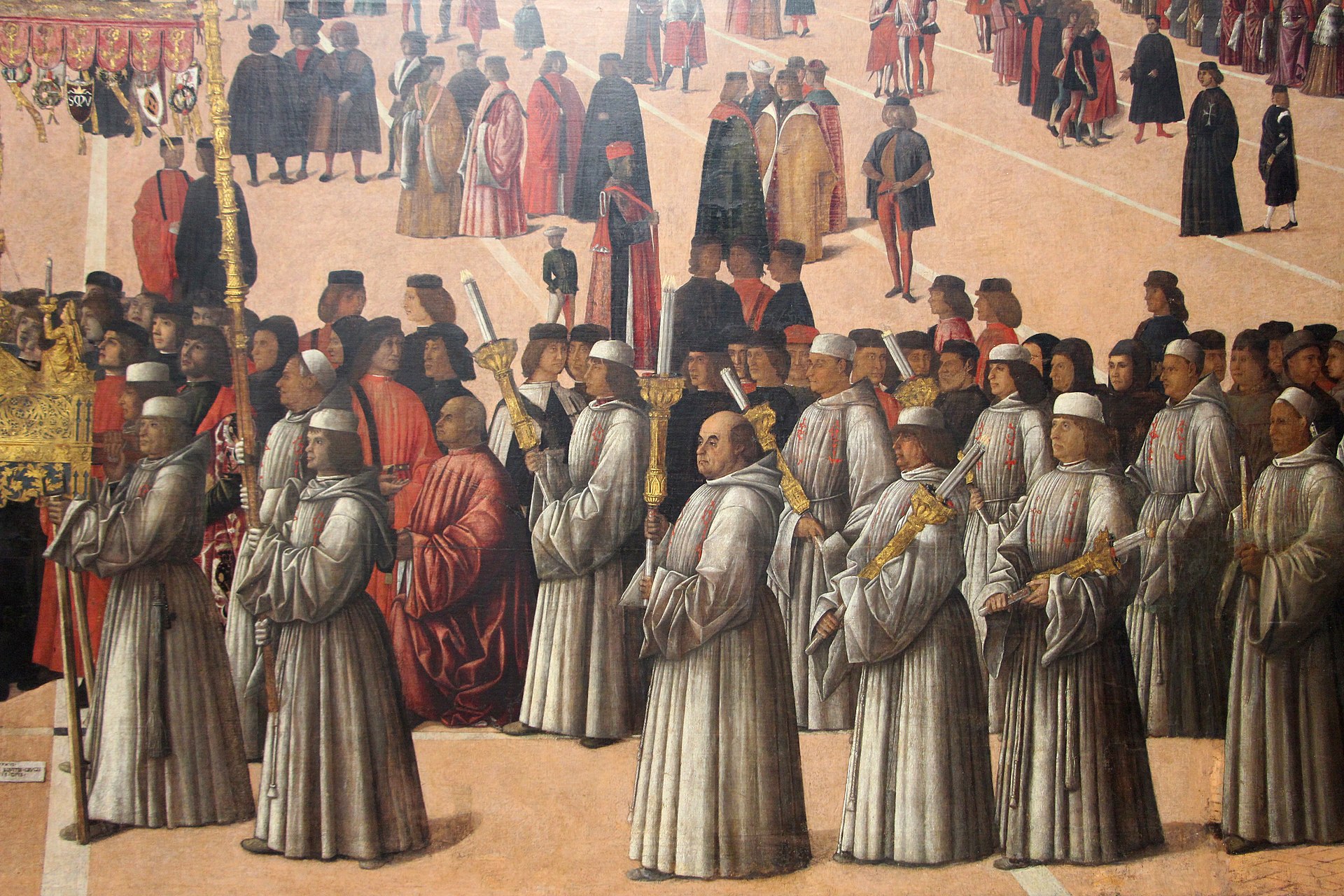
What we see in this scene is a procession on a far greater scale than that of a mere funeral like that in the Mansueti. We are looking at the real relic and reliquary being carried under a superb baldacchino (in the centre foreground). All the members of the School are there on parade, since the leaders have already gone across the Square.
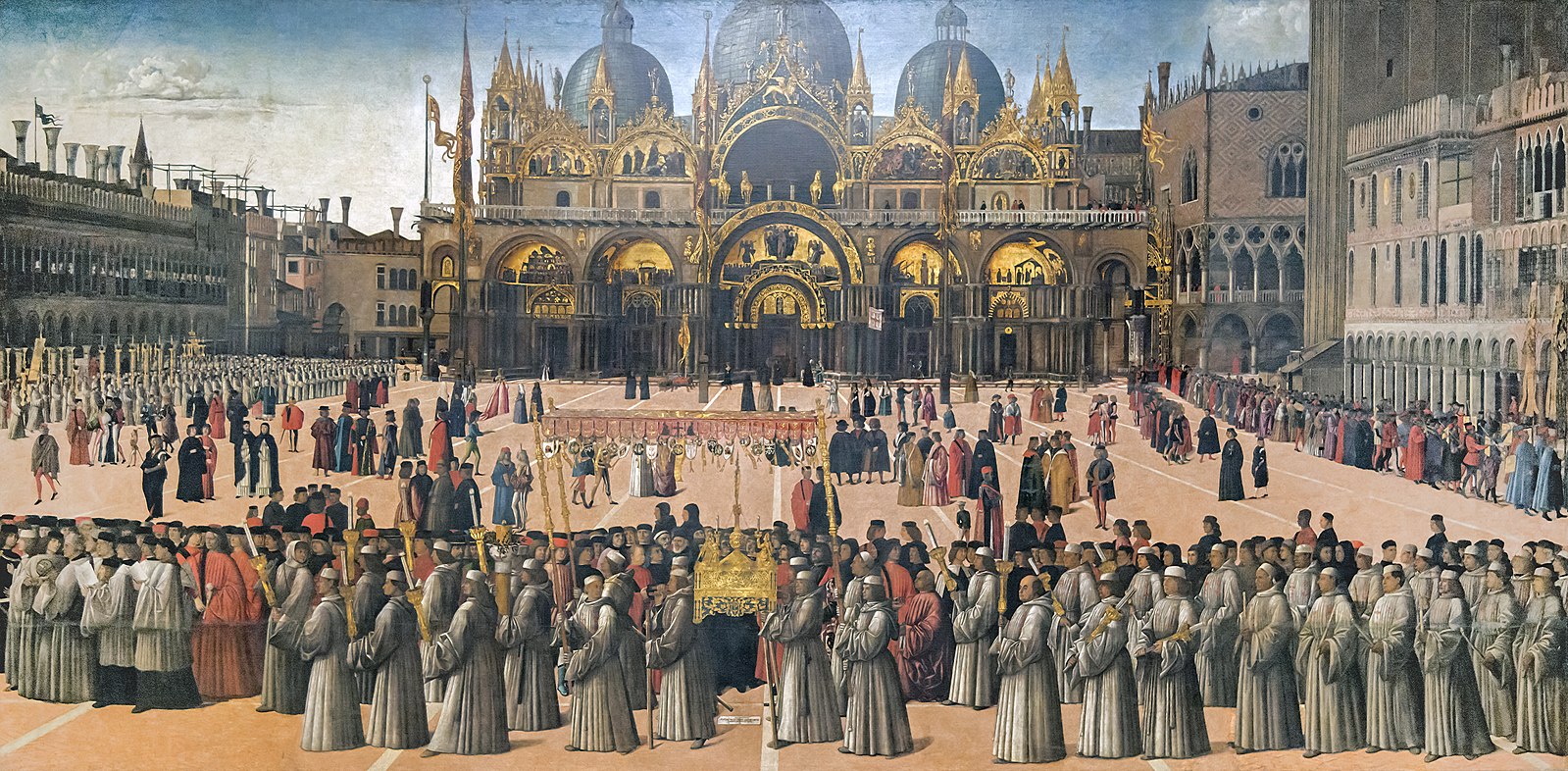
The day is the Feast of St Mark, April 25th.
A second procession—on the right—which is shown emerging from the Doge’s Palace, is headed by the Doge himself; and the School is here affirming its own central role in the civic and religious festivities of that day.
It may therefore seem rather pedantic to record that this particular procession is supposed to have taken place in the year 1444, and that the kneeling figure is a merchant from Brescia, a certain Jacopo de’ Salis, who made a vow to the relic on that day—a vow which resulted in his son’s recovery from a serious wounding.
The picture is inscribed with a significant phrase: ‘The work of Gentile Bellini, Knight of Venice, inflamed by love of the Cross’, amore incensus.
We cannot understand the phenomenon of the Schools, unless we understand this mixture of social display, popular religious feeling and personal belief; just as we cannot enjoy this picture, if we do not appreciate the mixture of stiffness and naivety in the figures, and the quite extraordinary sophistication of the perspective and the rendering of the play of light, which are already pointing the way forward to Canaletto 200 years later.
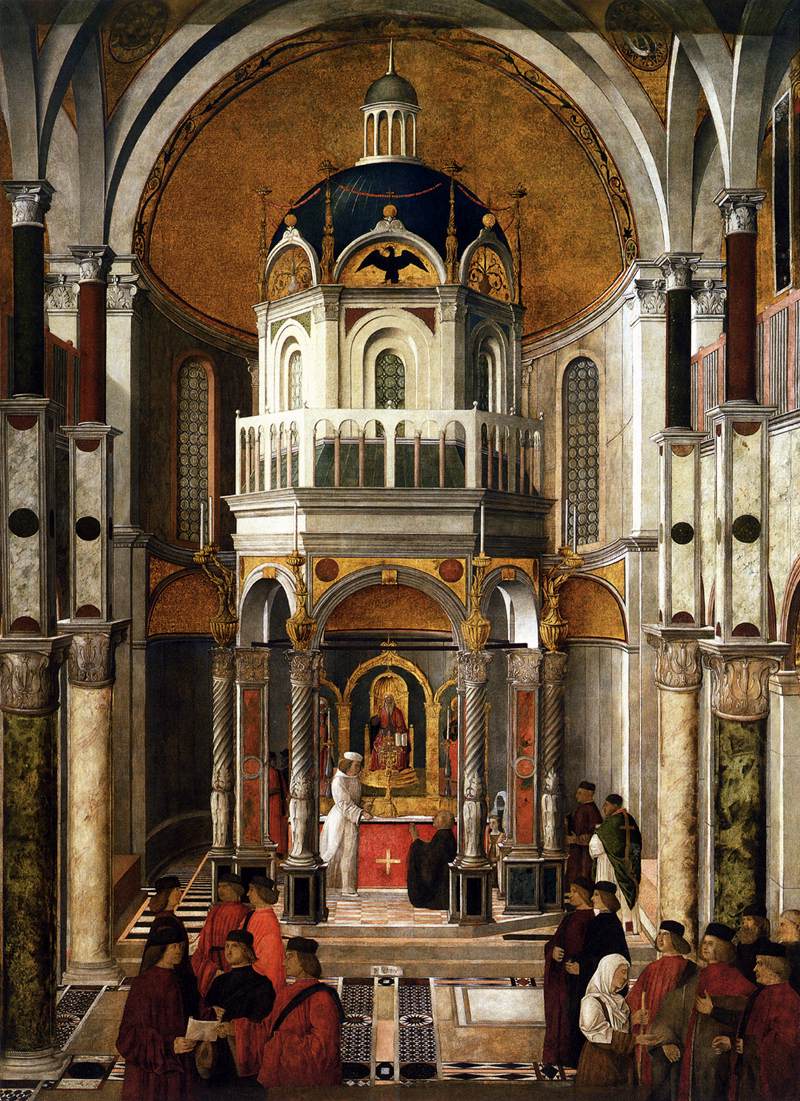
We must now mentally move across to the other long wall and glance at two much narrower ‘indoor’ scenes, balancing each other at either end, and both exploiting the high view-point which is common to all the paintings. The first canvas, which you see here, is about six feet wide and is once again by Gentile Bellini.
I will not spend long on either canvas in this pair; but in the first we should note, at least, the eagle of St John on the superb ciborium above the altar.
It is splendidly illuminated by the imagined light, streaming in from the windows high on the left; and its prominence suggests that the scene is set in the apse and nave of the Church of Saint John, next door to the School.
I should explain, too, that the miracle here represented is once again a relatively minor one.
A certain Pietro de’ Ludovici was cured of the quartan aigüe when he was touched by a candle that had been near the cross.
The same sort of comment is required for the other narrow canvas by Giovanni Mansueti at the other end of the wall. (It is about seven feet wide).
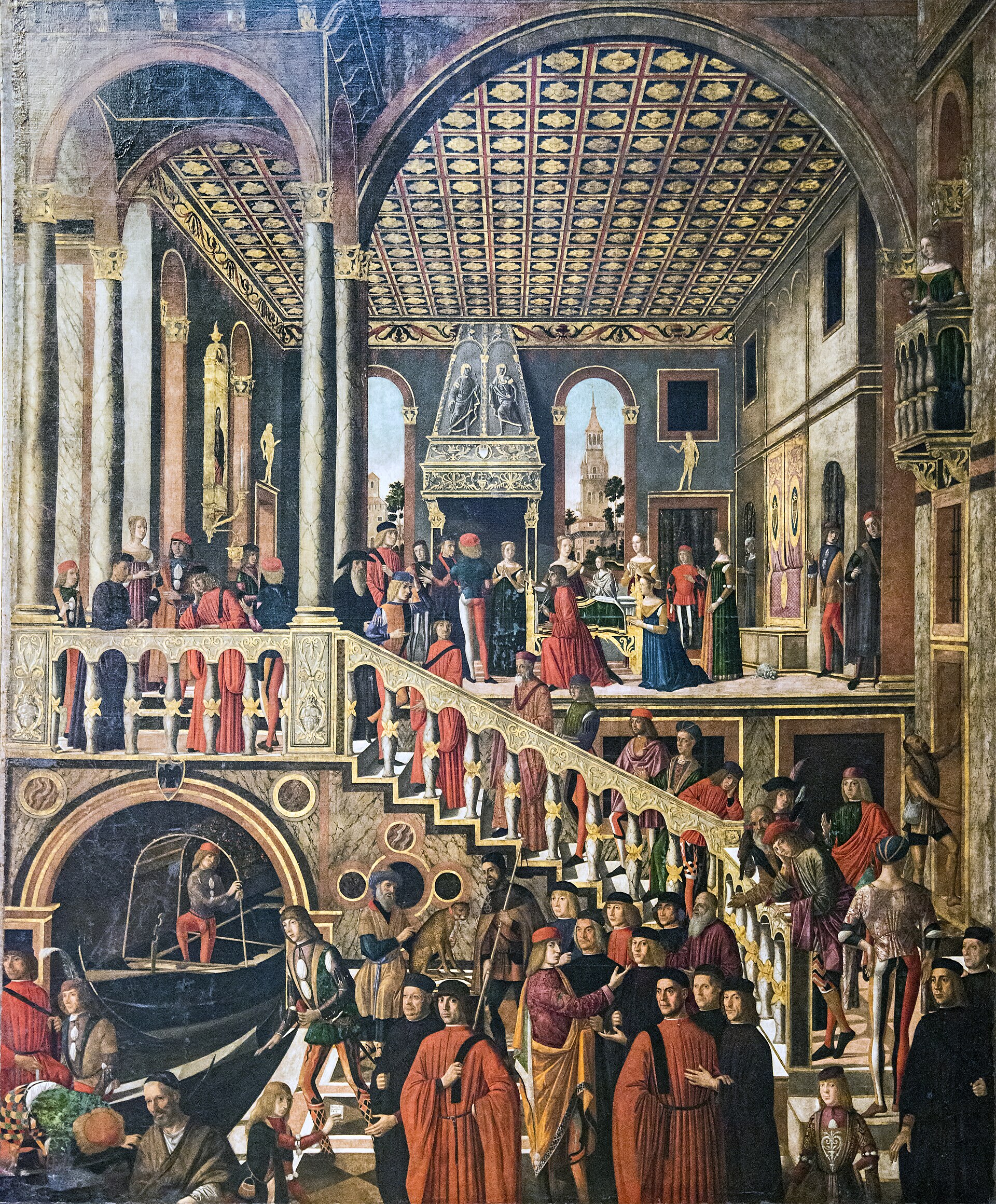
Even if you ignore the gondolas and the cramped space in the lower half of the painting, and concentrate on the splendid hall—the hall of the house of Ser Nicolò Benvegnudo, with light streaming through the marble columns to illuminate the magnificently coffered ceiling—and even if you look hard at the principal figures, I defy you to work out for yourselves that Benvegnudo’s daughter, an invalid from birth, was cured of her ailments in the year 1414, when she touched three candles which had been in contact with the reliquary.
Which is not to imply, of course, that the painting is other than quite entrancing on its own terms. I love the split-level composition and the balustrade that guides the eye upward from gondola to chimney breast.
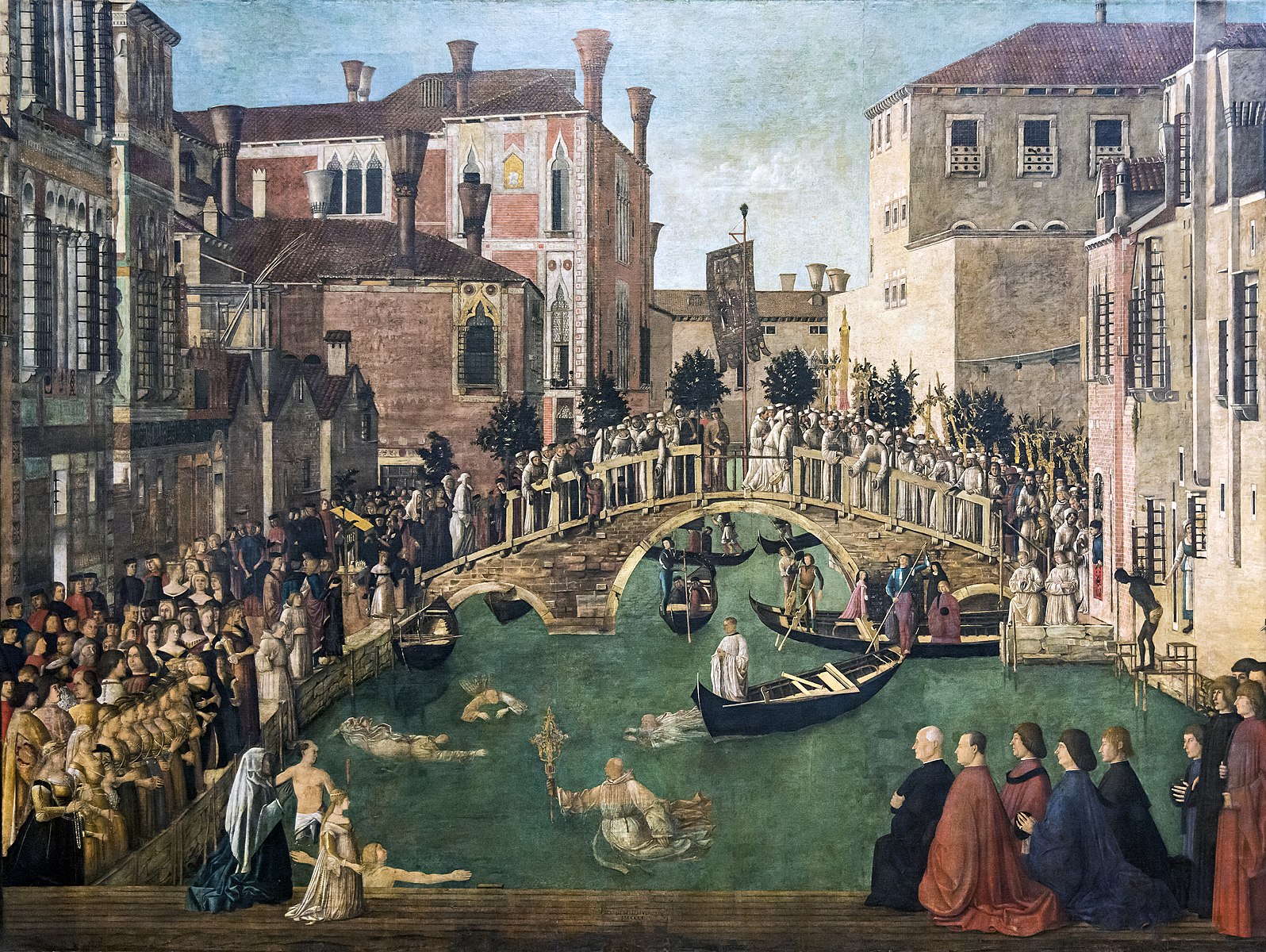
Let us go back outdoors again, and back to Gentile Bellini, for the picture in the middle of this wall, which measures eleven feet by fourteen.
It is the only one in the whole cycle which makes the miracle itself the central event.
We are in front of the Ponte San Lorenzo, crossing the Rio San Lorenzo, near the church of that name, north of the Riva degli Schiavoni.
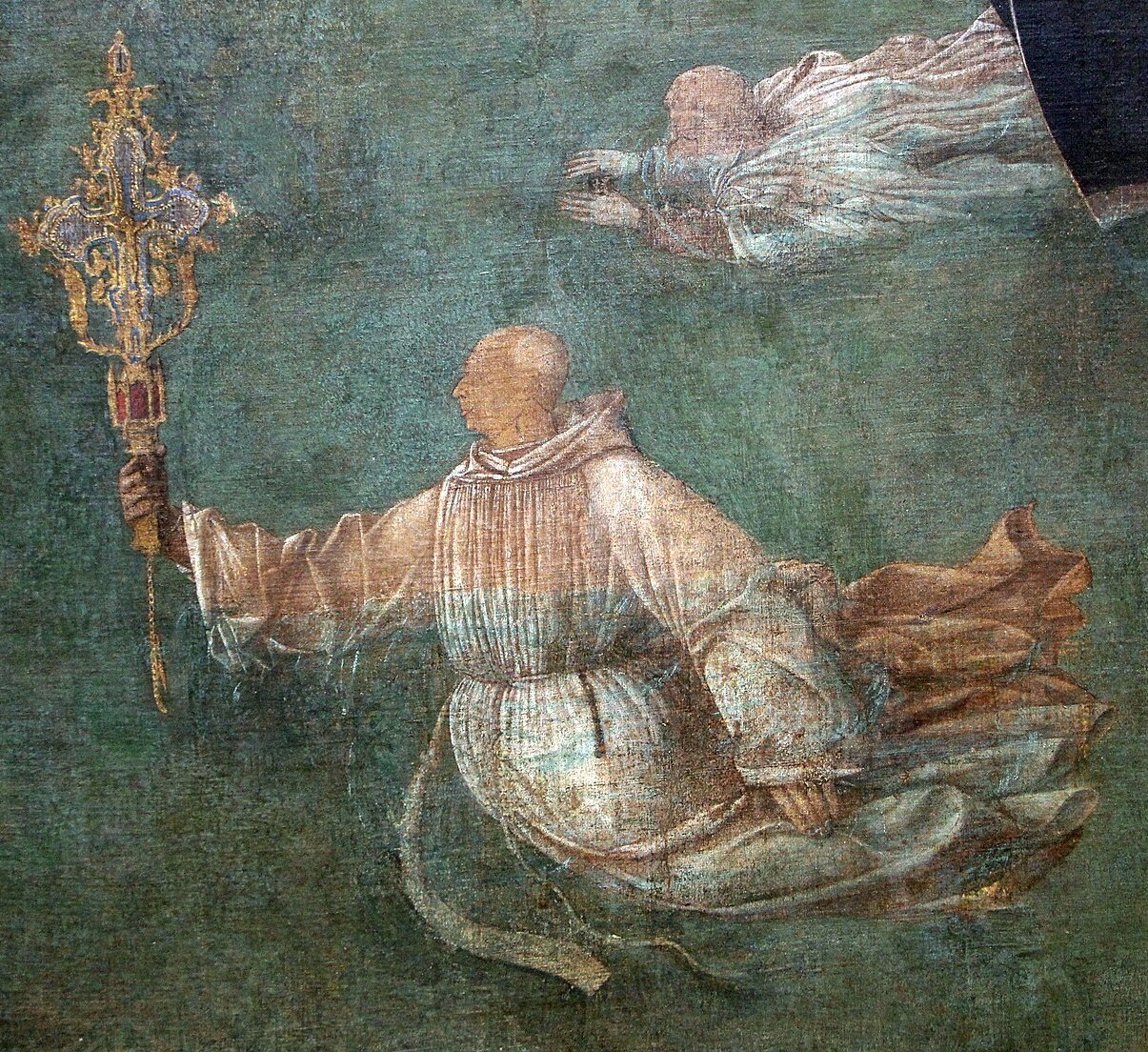
We are supposed to be back in the period between 1370 and 1382, just a few years after the School received its precious relic, and we are witnessing the first, and the most bizarre, of the recorded miracles. The relic was being carried in procession by the brethren (as we have seen twice before), but, as they were crossing the bridge, the relic fell into the water. Various people stripped off and plunged in to rescue it, or, at least, were preparing to take the plunge.
The cross, however, evaded them all, and would allow itself to be saved only by the Guardian General of the School, who in those years was a certain Andrea Vendramin—obviously, the man who is here pictured fully dressed, but not weighed down by his robes.
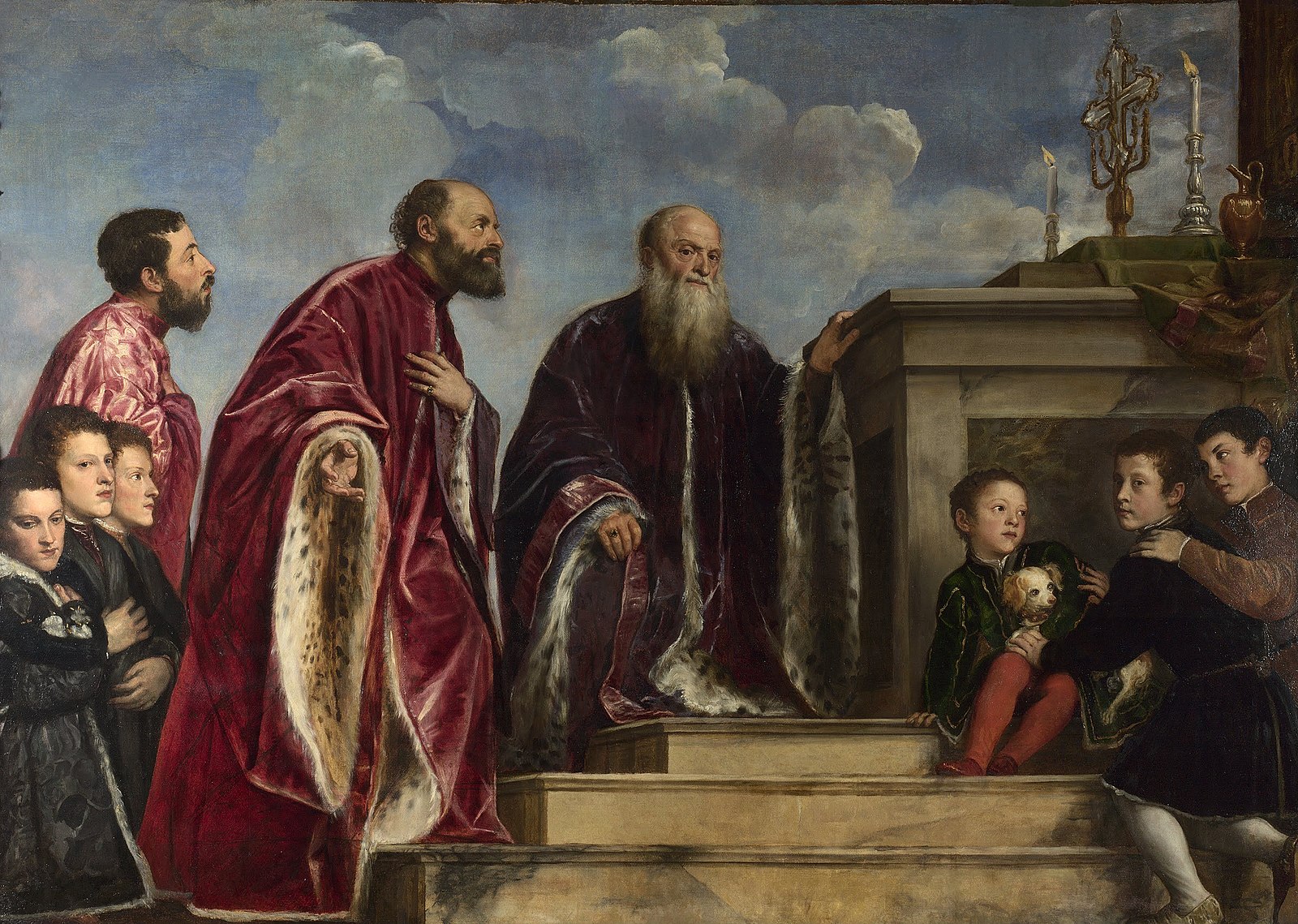
The family was very proud of this event, and when Titian portrayed a later Andrea Vendramin with his father and his sons in the mid 1540s, he painted the family revering the relic in the reliquary on the altar, together with the candles that were prominent in the later miracles.
Gentile’s rendering of space and architecture is once again wonderfully convincing and enjoyable for its own sake.
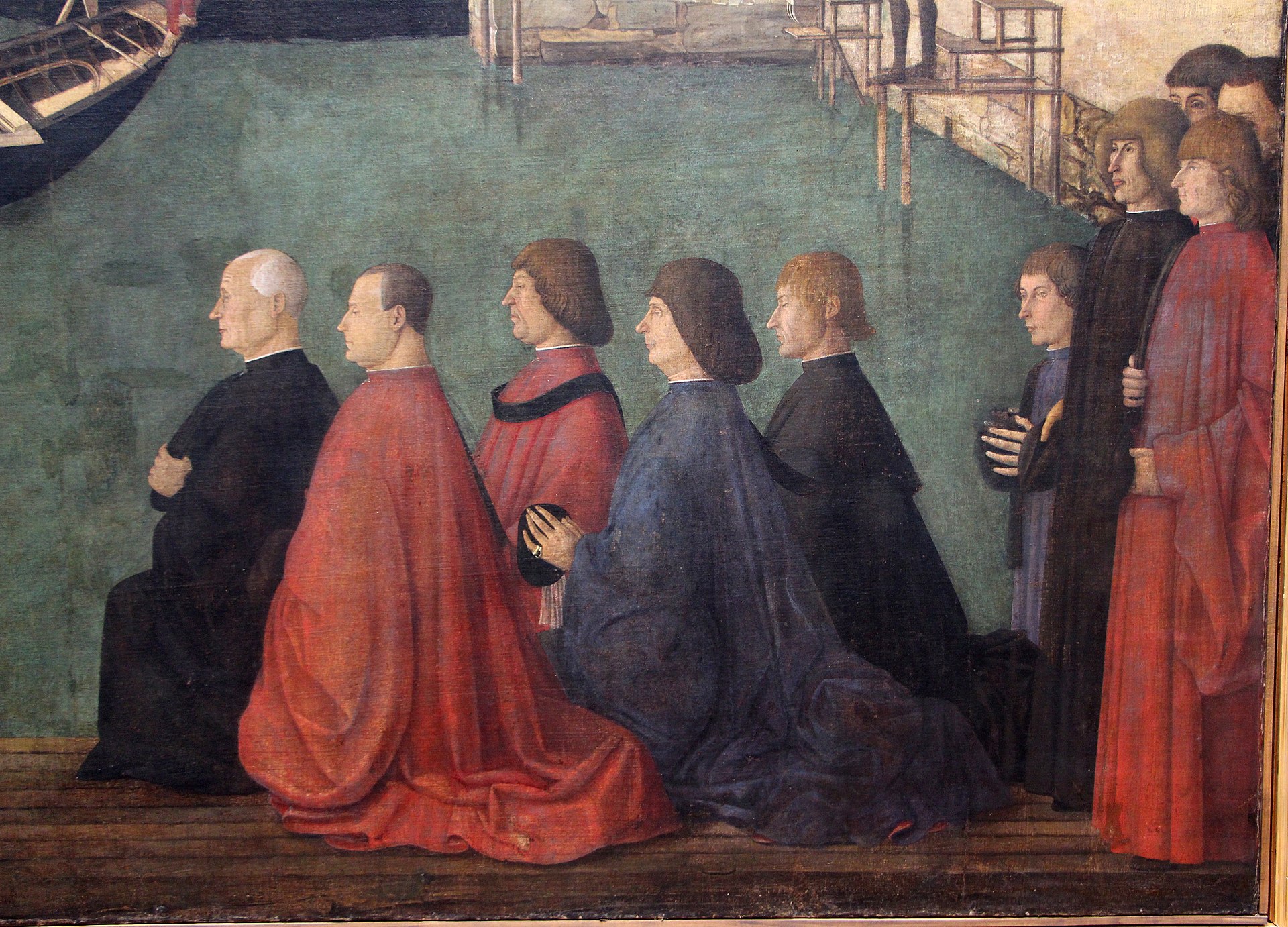
In this case, though, the human figures in the foreground are also particularly interesting. Ridolfi, writing in 1648 and usually well-informed, says that the kneeling men on the right are portraits of the Bellini clan: Jacopo (portrayed posthumously), his sons Gentile and Giovanni, his son-in-law Mantegna, and a grandson.
Similarly, it is known that the ladies on the left represent Caterina Cornaro and her retinue, she being a Venetian noblewoman who married the King of Cyprus in 1472, and ruled Cyprus as its Queen from the time of his death in 1474 until she ceded the island to Venice in 1489—that is, only eleven years before this canvas was painted (it is dated 1500).
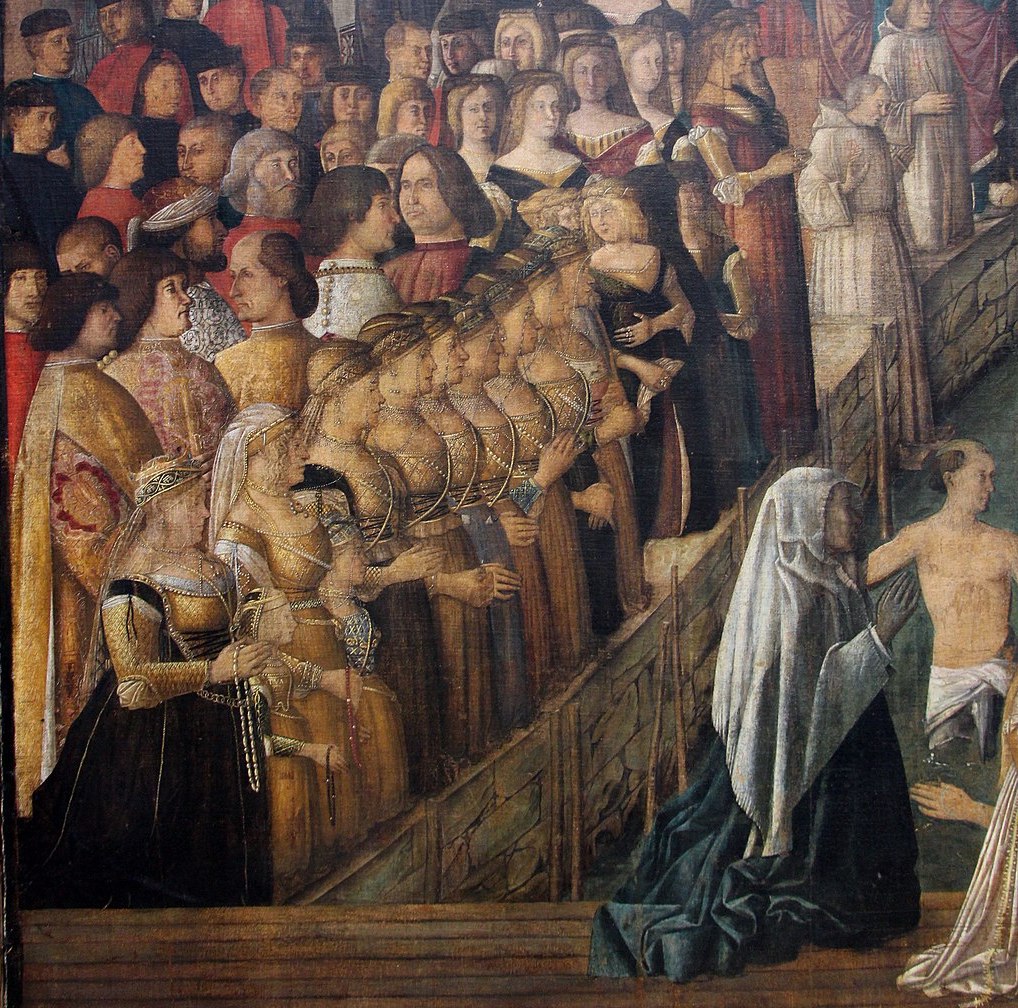
And so—last, but emphatically not least—we come to the canvas from the School of St John, which now occupies the whole of the entry wall in the room in the Accademia, but used to be in the position of honour above the altar. (It measures eleven and a half feet by twelve and a half.)
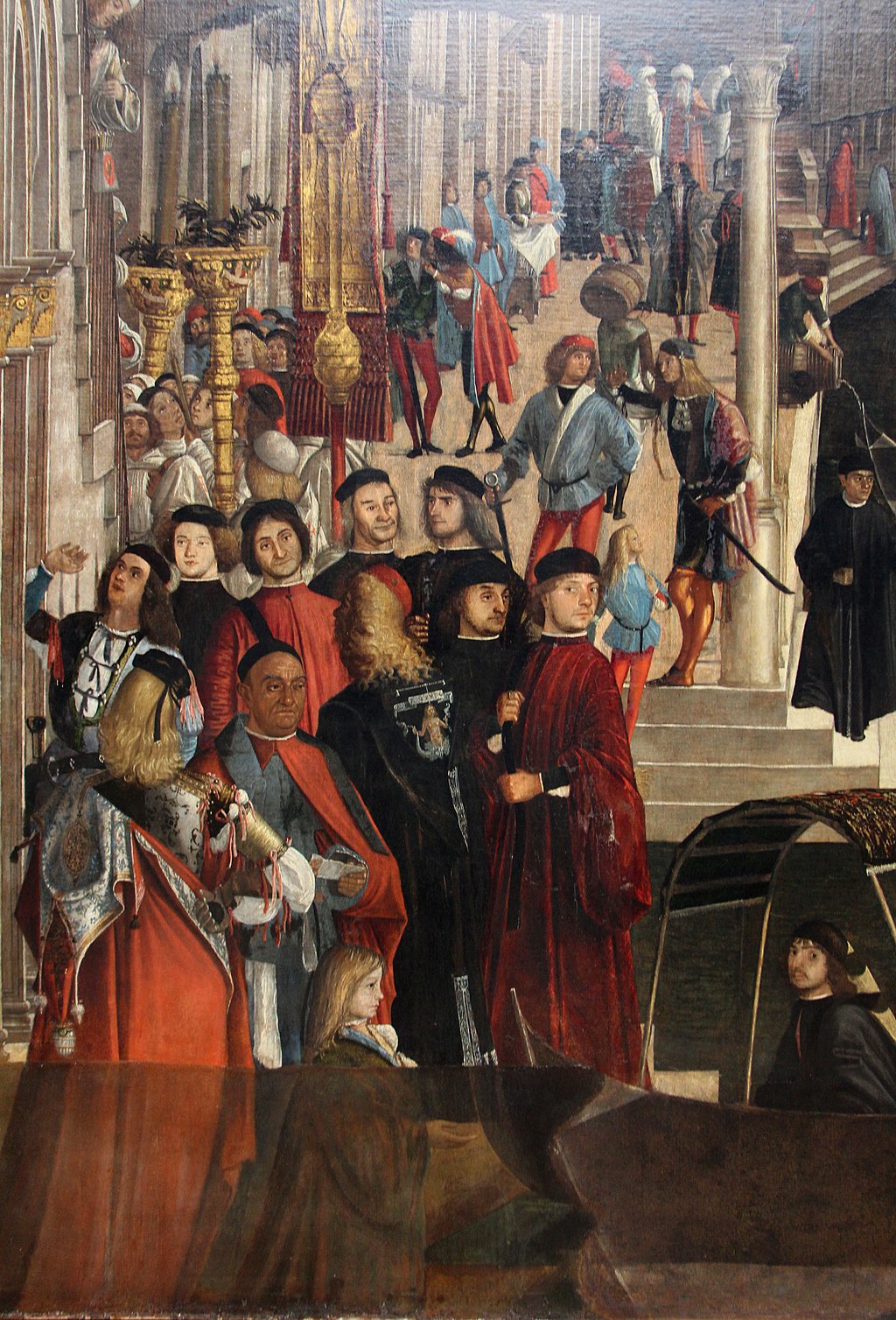
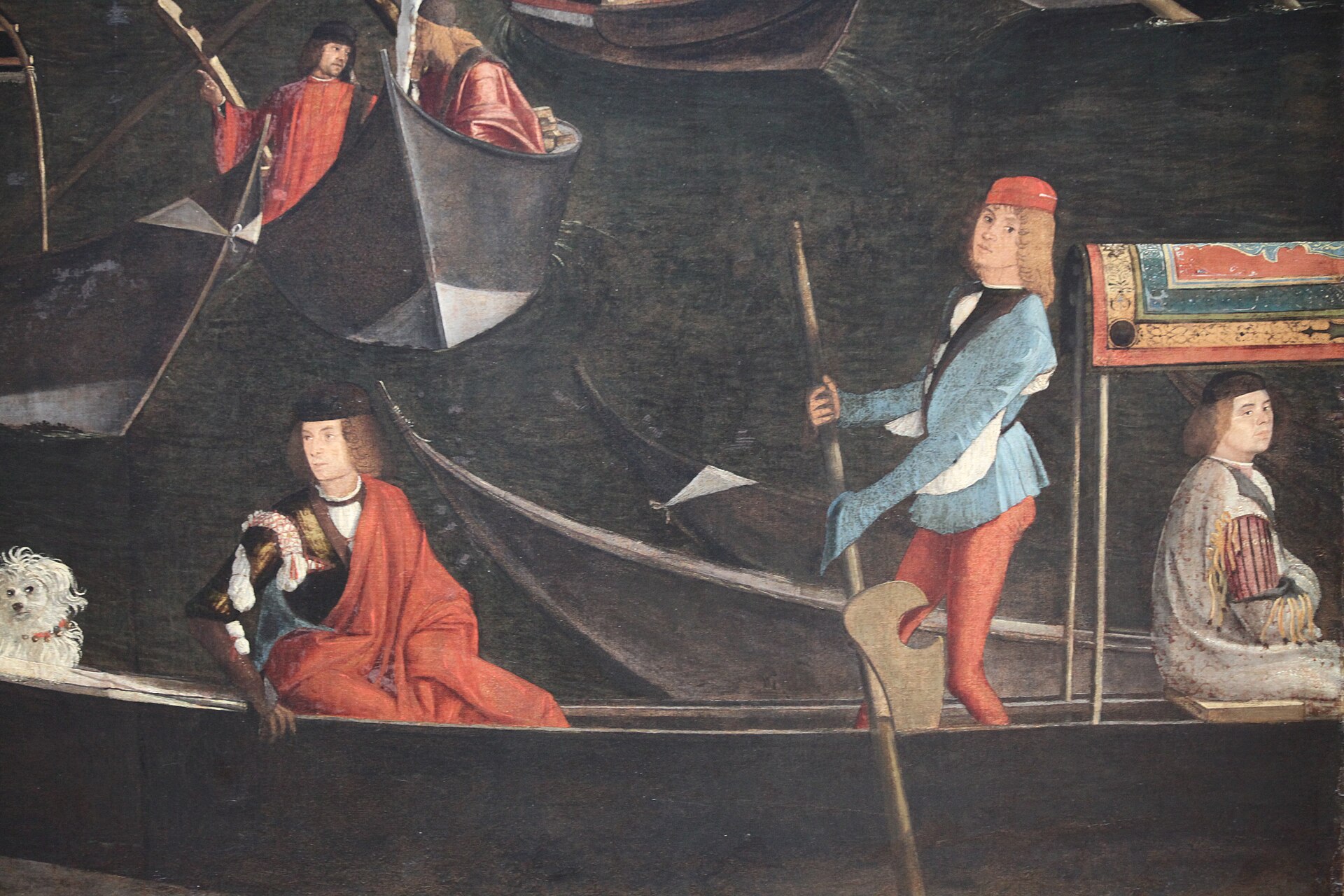
It was painted in the year 1500 by Carpaccio; and it shows the left bank of the Canal Grande (with the Riva del Vin), looking north-east, just before the Canal swings through 90 degrees to the north-west, on the other side of the Rialto. The bridge is the wooden predecessor of the stone bridge that was erected in the 1590s.
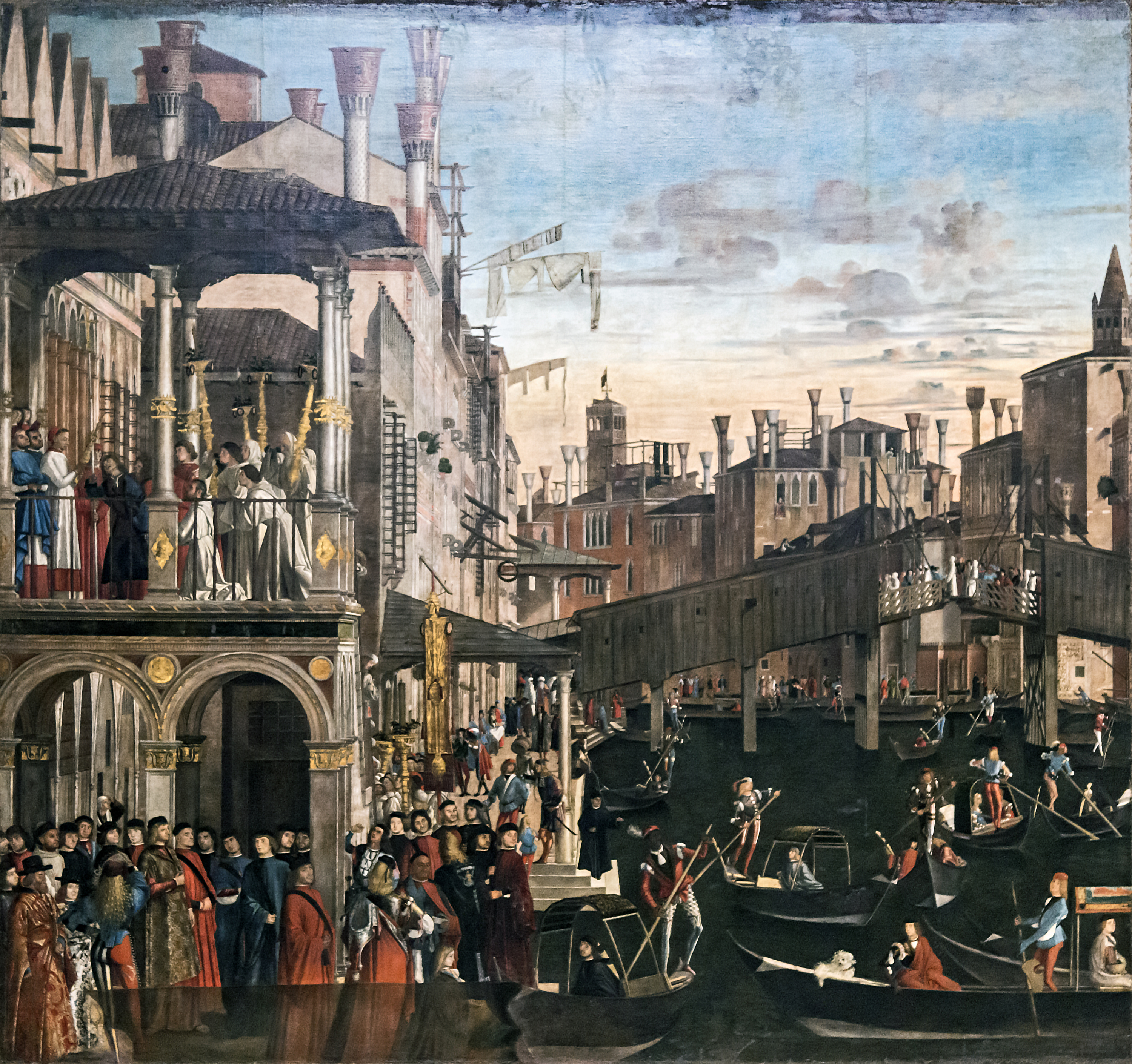
The miracle represented was the most recent of all in the cycle, since it took place in 1494.
The loggia represents the town palace of a certain Francesco Querini, a high ecclesiastic, patriarch of Grado (a town on the coast near Trieste); and it is Querini who has just used the relic to perform an act of healing.
Earlier we saw people suffering from a wounding, a fever (the quartan aigüe), and an unspecified hereditary complaint. This is a case of mental illness; and the power of cross is here casting out an ‘unclean spirit’ that had possessed the patient in black.
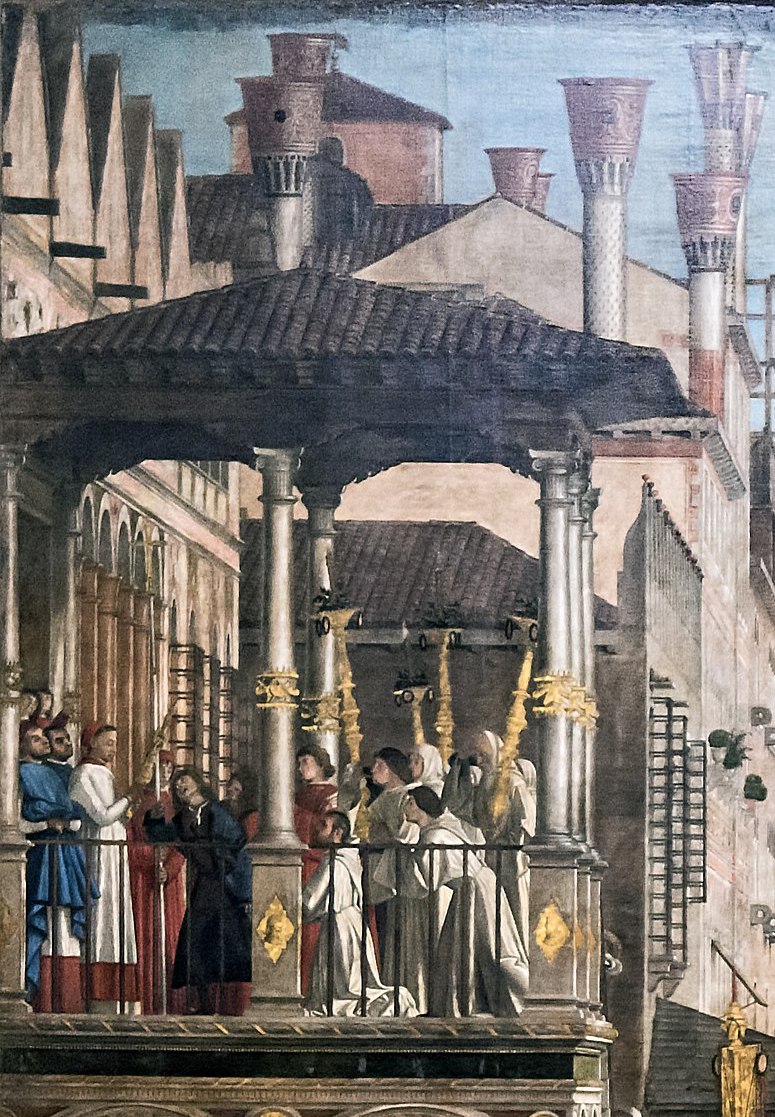
It is a wonderful picture—wunderbar, full of wonders—at once poetic and packed with realistic detail. We feel sure it is telling us how Venice looked in the last years of the fifteenth century—from the pub sign of a famous inn called the Sturgeon; to the skyline with its characteristic chimneys and the campanili of St John Chrysostom and the Santissimi Apostoli; to the rickety old Rialto bridge, with members of the Scuola crossing over; to the splendid costumes and portraits in the area to the lower left. And perhaps most memorable of all, for the tiny gondolas, criss-crossing on the dark waters of the Grand Canal.
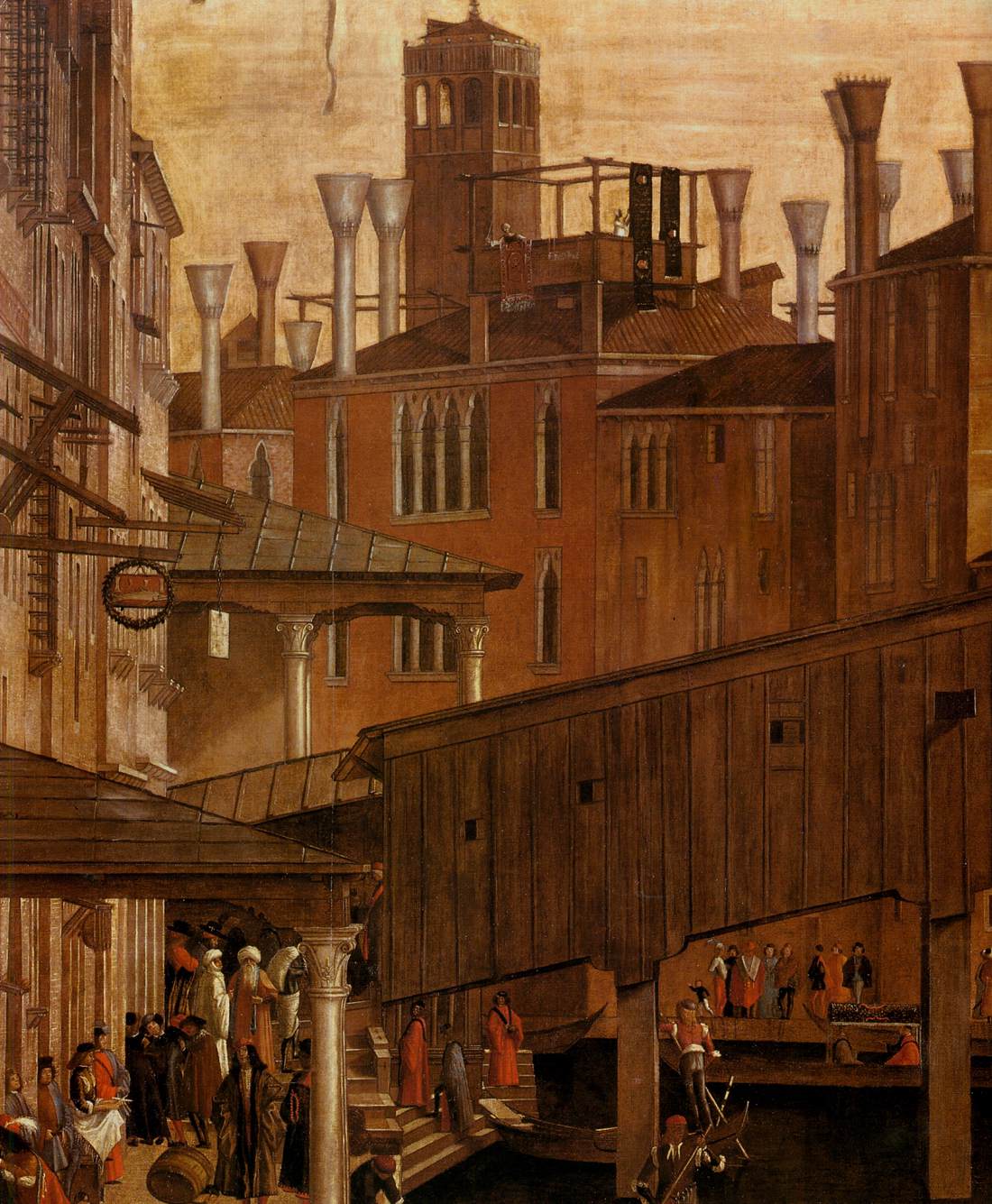
Carpaccio would have been coming up to forty years of age (we do not know his exact date of birth) when he painted that superb record of Venice between 1496 and 1500.
We shall follow him now into the next decade, the years between 1502 and 1507, when he was asked to evoke scenes from the distant past (the third and fourth centuries) and from distant locations (they are set in the Near East).
This time he was working for one of the minor Schools, whose premises lie to the north of the Riva degli Schiavoni, not very far from San Lorenzo (and not very far from the minor School of St Ursula).
The Scuola was for a community of non-Venetians; specifically, Dalmatians or Slavs (‘Schiavoni’). It was founded in 1451 to protect the interests of this community, and, in particular, to act as a kind of ‘Mission to Dalmatian Seamen’ to ensure that they were looked after in illness and old age and were given a Christian burial. The Dalmatians had no fewer than three patron saints—George, Jerome and Tryphonius—but the community was usually known as the School of St George.
They were given the lease of a former hospice, or hospital, dedicated to St Catherine, the hospital having been the property of the Knights of Jerusalem, who were the successors of the Knights of the Temple—the Templars—who were based at the neighbouring church of St John of the Temple.
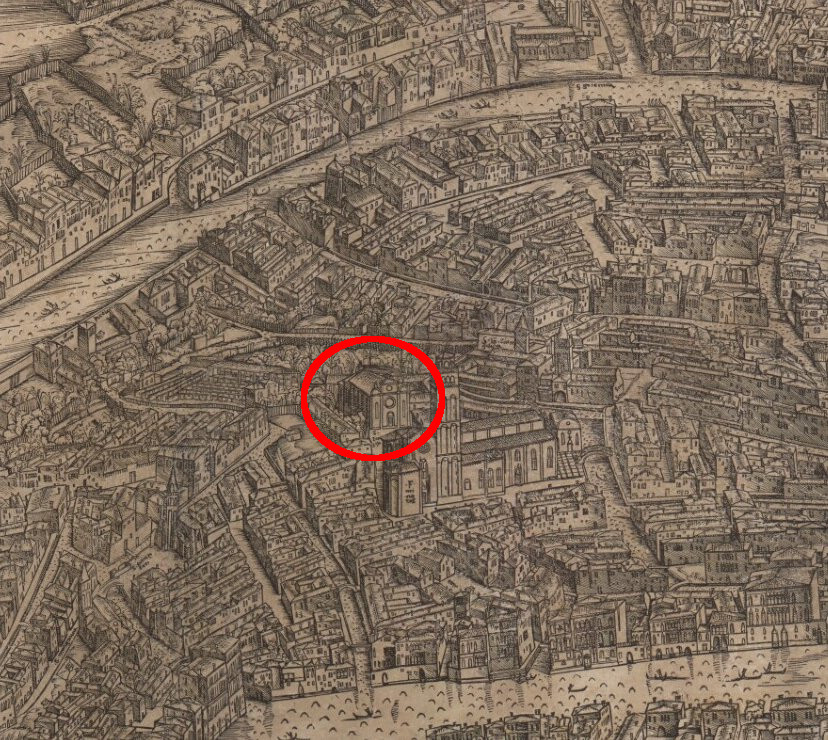
This detail from the famous woodcut of 1500 shows you the church and the building beside the canal which the School of the Dalmatians shared with a very much smaller, minor School of St John.
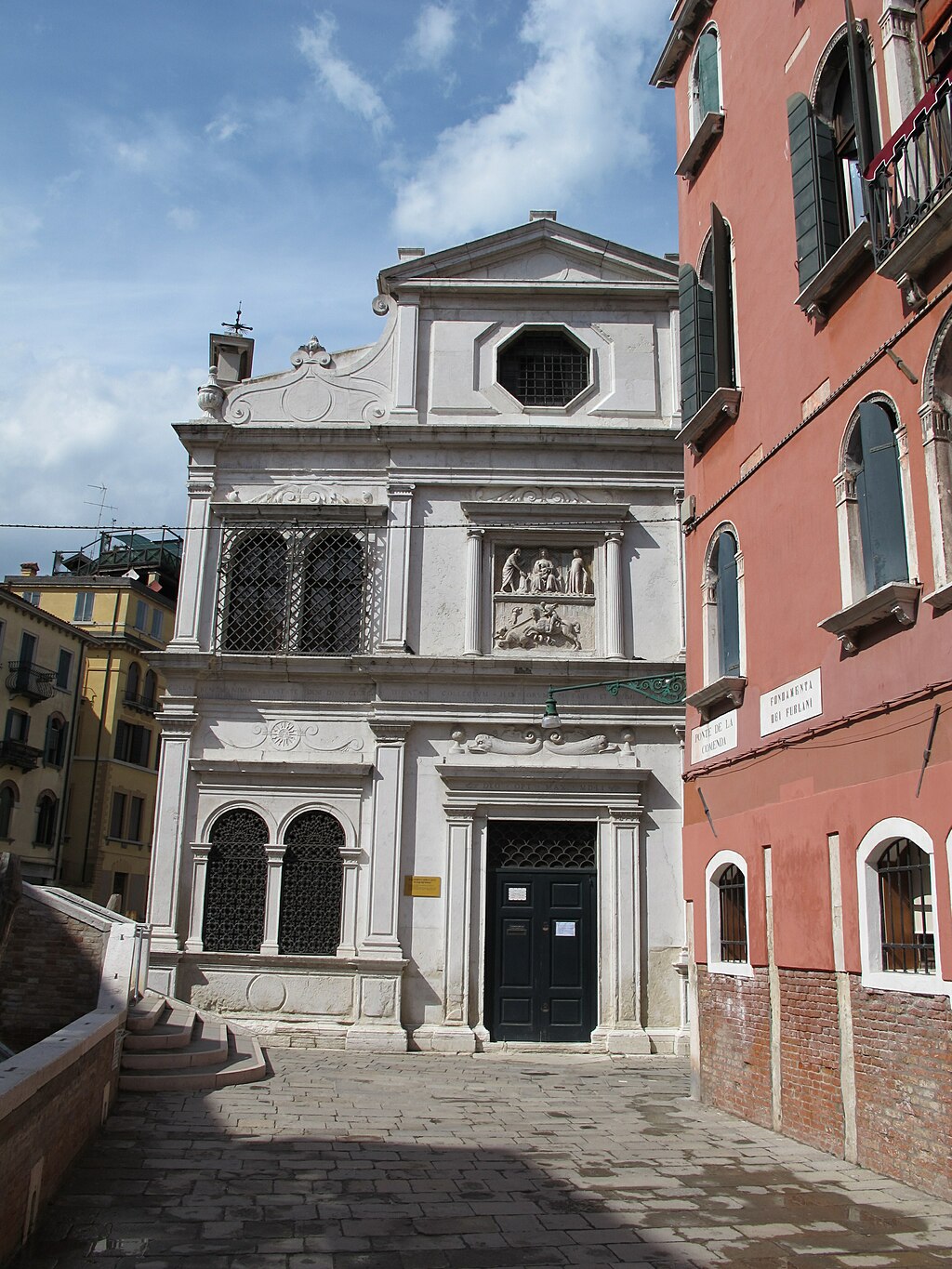
The building was about forty feet wide and about sixty-five feet long on the canal side. Notice that it had a pitched roof, with a rose-window flanked by two Gothic windows, and square grilled windows on either side of the door. It also had two storeys, the ground floor being the Oratory, and the upper floor the Sala dell’Albergo.
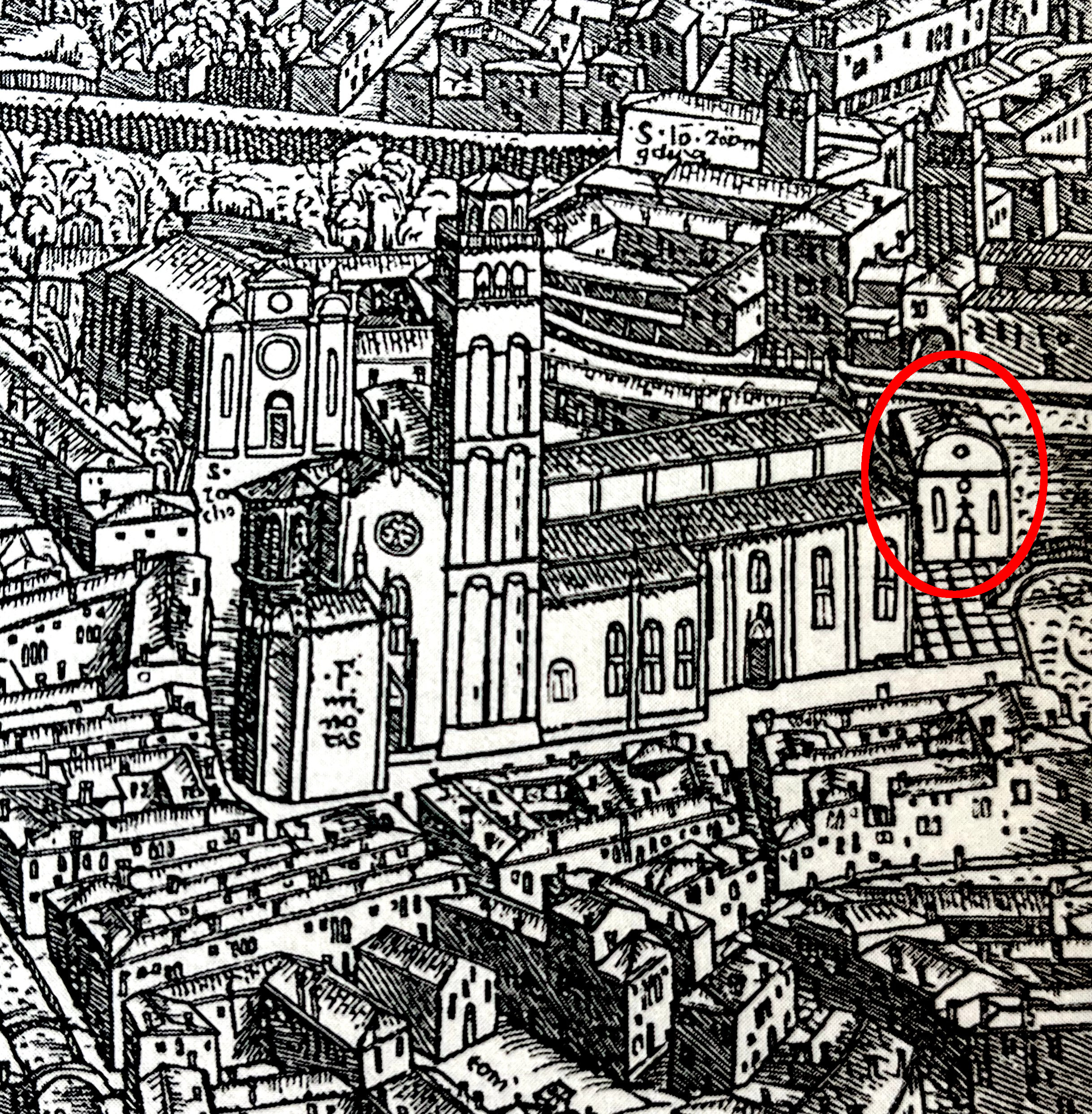
The community prospered in the second half of the fifteenth century, and then, in 1502, the School had a special piece of luck analogous to that of the major School of St John. They received, from the Patriarch of Jerusalem, a precious relic of St George, which they installed in a place of honour in the upper room, the Sala dell’Albergo. It was probably the arrival of the relic which led the Guardians of the School to commission paintings from Carpaccio representing scenes taken from the lives of their three patron saints to adorn that upper room.
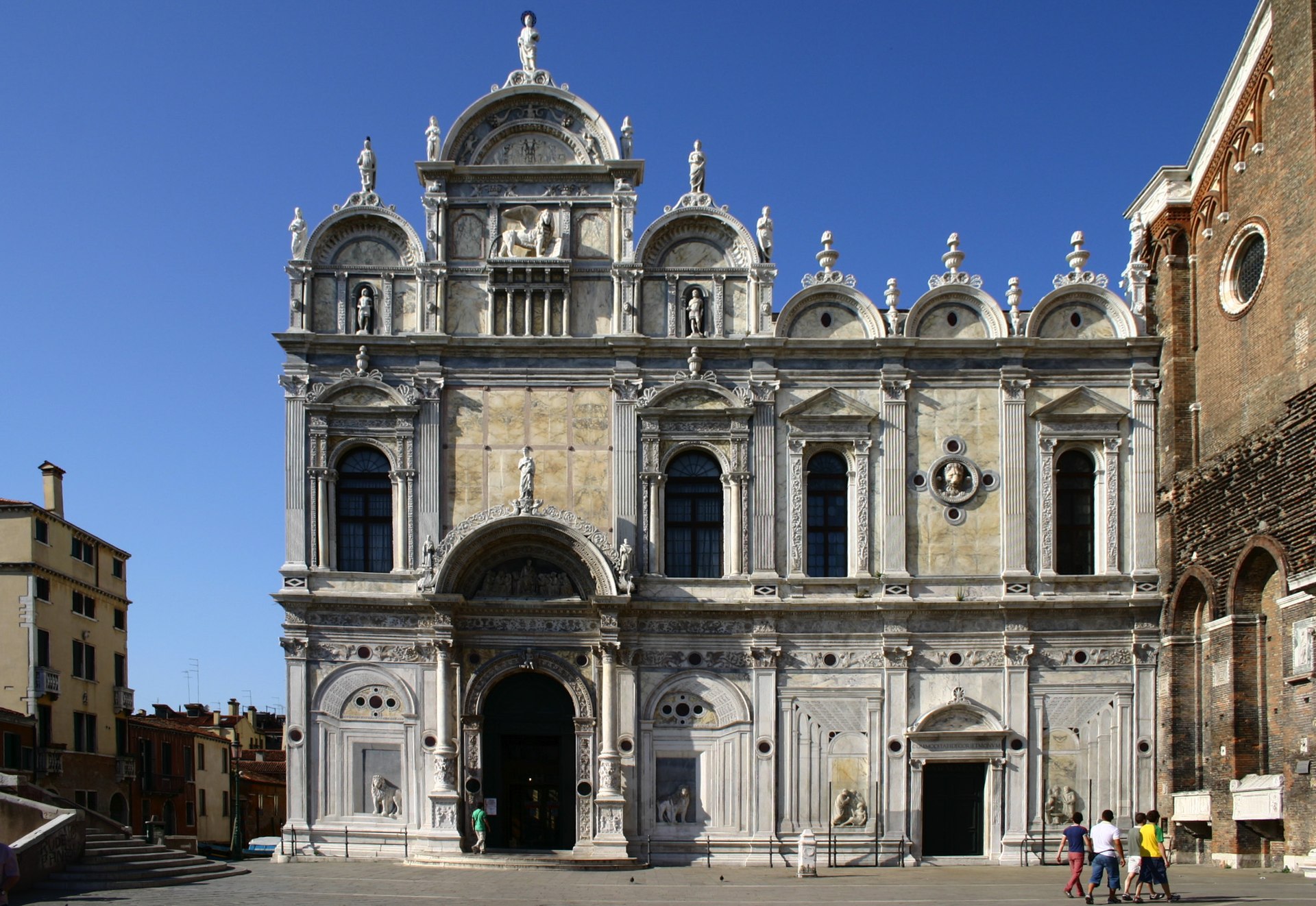
By 1551, the old building of the School was collapsing, and so the brethren rebuilt it on the same site, giving the new two-storey building its handsome façade. Unfortunately, the layout and dimensions were not identical, and they moved Carpaccio’s canvasses down to the ground floor.
They were installed in the room you see here, which you enter directly from the main door, and which measures thirty-eight feet by twenty-seven.
It has a very low ceiling; and the canvasses were trimmed, filled out, and rearranged with respect to the original sequence.
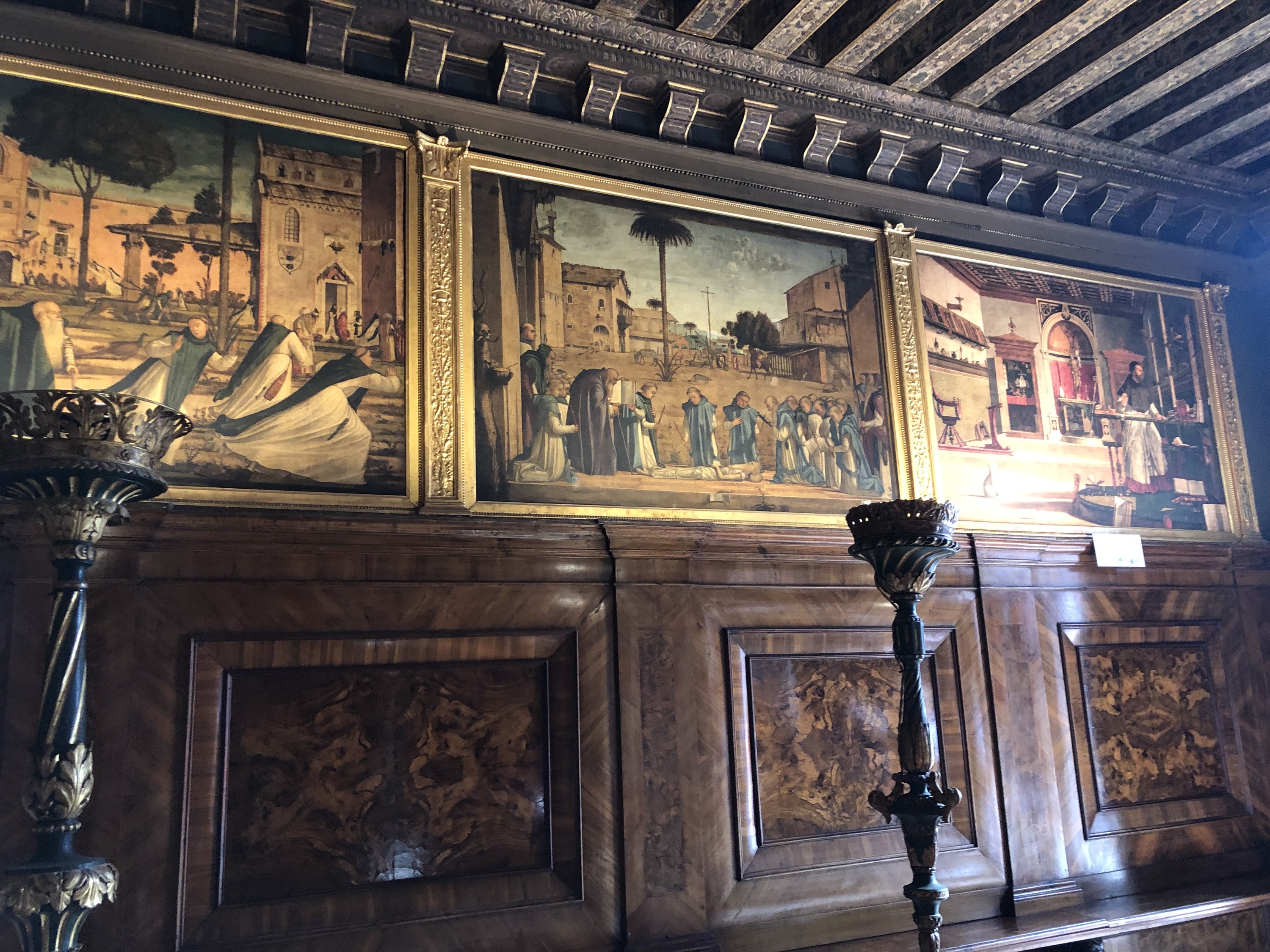
Here is another photograph of the ground floor room as it now appears, looking towards the altar this time, with the canvasses in the positions they had received by 1557.
As we work our way through the paintings, remember that this is not the right room (it should be upstairs), nor the right layout of the pictures, but that it is the right building, on the right site, from the right century, and the pictures are arranged at the right height—that is, beginning about six feet from the ground.
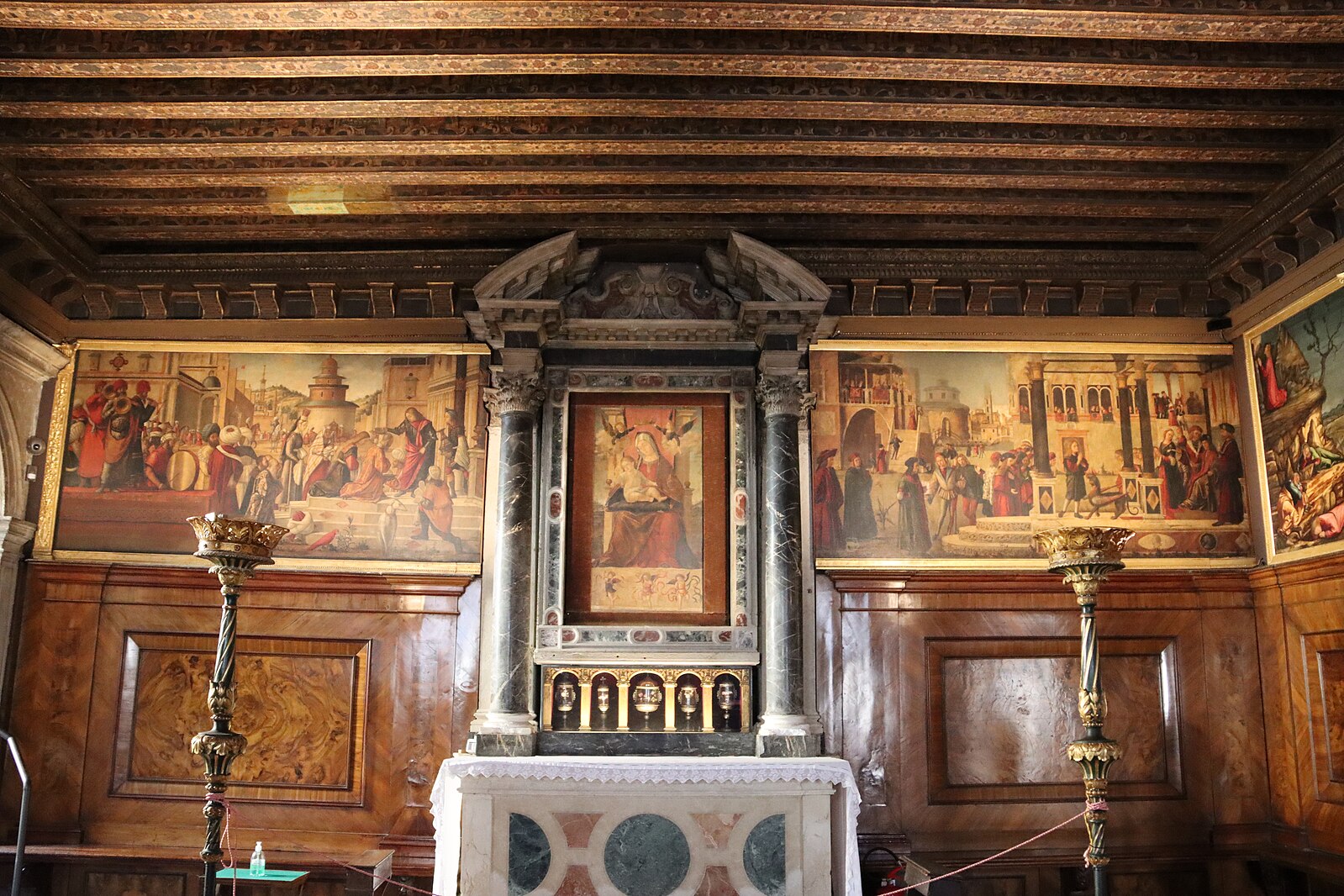
There are nine paintings by Carpaccio in the room, each a little over four feet high; two devoted to Jesus, one to Tryphonius, and three each to George and Jerome.
The New Testament scenes, relatively narrow and now placed on the right-hand wall, probably lay on either side of the altar in the original, upper room.
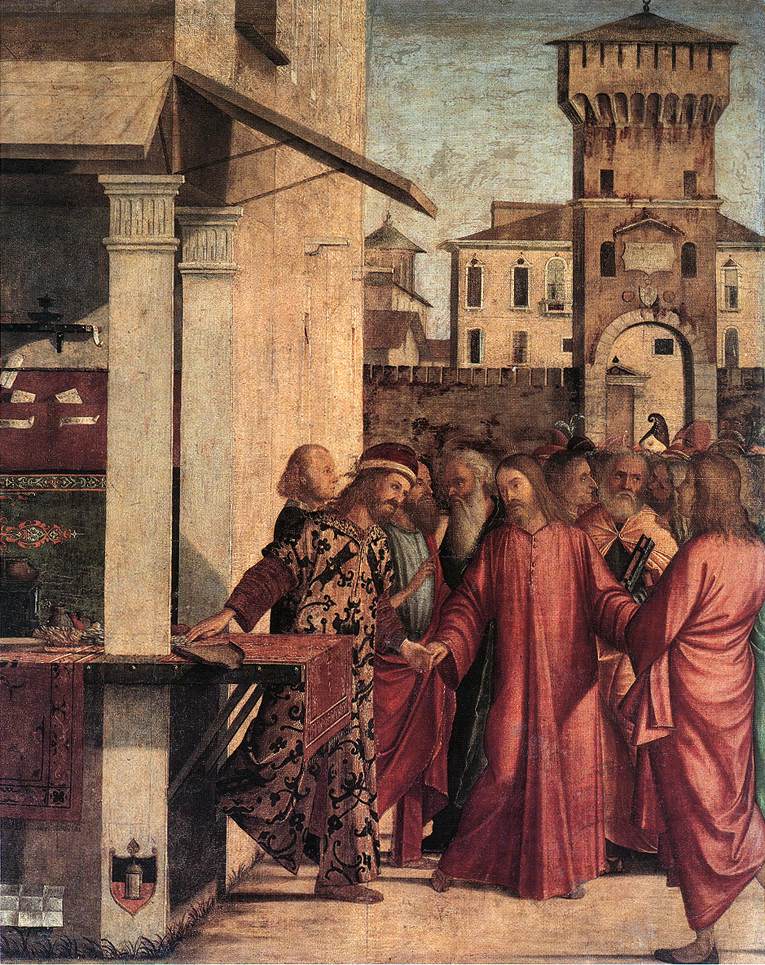
They show the ‘Agony in the Garden’ (a not very interesting picture, probably already existing), and the ‘Calling of St Matthew’, the splendid scene you see here, where Matthew, the tax-collector, is shown as a contemporary Venetian money-changer with a scoop for the small coins, seen against the background of a tower from the Jewish ghetto in Venice.
Opposite the altar wall in the original layout (now it is on the right of the altar) probably lay the canvas you see here, which is the same height but fully ten feet wide, and was almost certainly wider still originally, since it seems to have been cut down on the left (the vanishing point of the perspective having probably been in the centre).
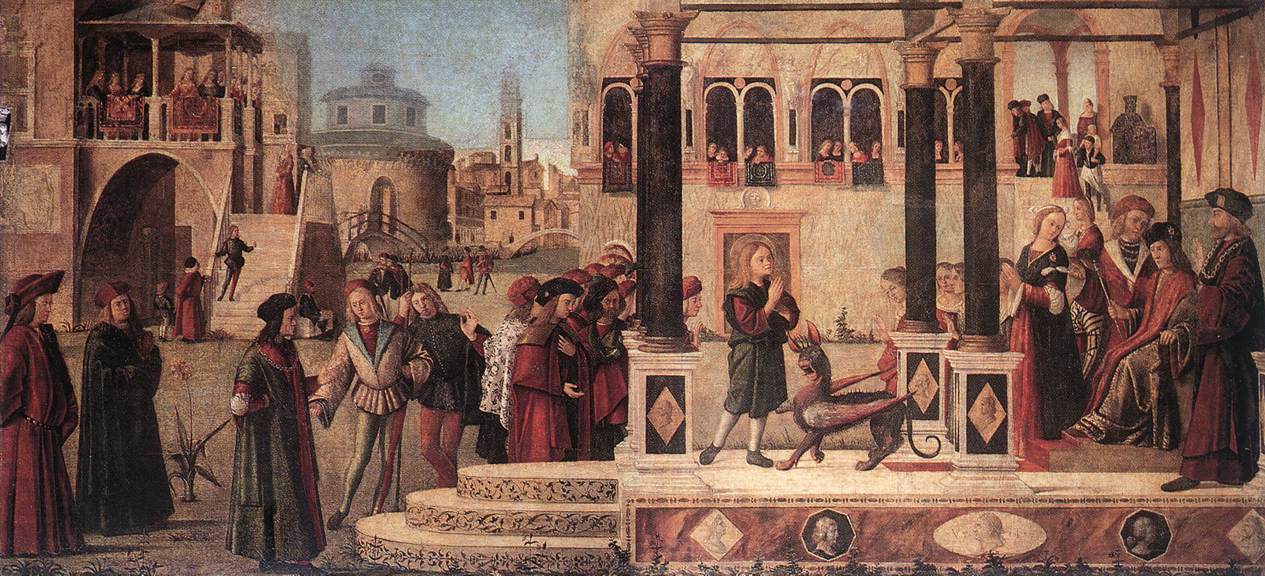
It was the last to be painted. Compositionally, it is based on the opening scene of the Ursula Legend. And it seems to have a lot of workshop in the actual execution. For all these reasons, I will not look at it in detail, but merely explain that Tryphonius was a twelve-year-old duck-herd, with a reputation for casting out evil spirits.
When he was summoned by the Emperor Gordian to exorcise his daughter, the evil spirit fled even before his arrival. At the Emperor’s request, however, the boy called back the evil spirit or demon, who ‘reappeared immediately amid the crowd’ in the form of a ‘black dog, with eyes of flame, dragging its head along the ground’. (Carpaccio makes him a basilisk, with its head held high).
The spirit then held a charming conversation with the young saint, which led to many conversions.
One of the long walls in the original Upper Room was reserved for the three canvasses devoted to St George (the name saint of the School), which hung in the same sequence as one sees them today, but did not turn the corner.
The first one measures a little over four feet by nearly twelve, and of all the pictures in this series, it has the least need of any explanation! Nevertheless, I still think it worthwhile to focus on a few of the details that Carpaccio took over from the Golden Legend version of the story. (It should be borne in mind that the Council of Nicea in 325 had rejected the whole Legend of St George as apocryphal and that there were several conflicting versions in circulation.)
George was a native of Cappadocia and he served in the Roman army with the rank of Tribune. A chance journey took him one day into the neighbourhood of Silena, a town in the province of Libya.
Near this town, in a lake as large as an ocean, there dwelt a horrible dragon. In order to appease the monster, the citizens had been offering him two sheep a day. But in time the number of sheep was so depleted, that they offered him one sheep and one human being, chosen by lot. By the day St George reached the city, nearly all the young people in the town had been eaten up.
And on that day, the lot had fallen on the only daughter of the King; and she had walked towards the lake where the dragon dwelt.
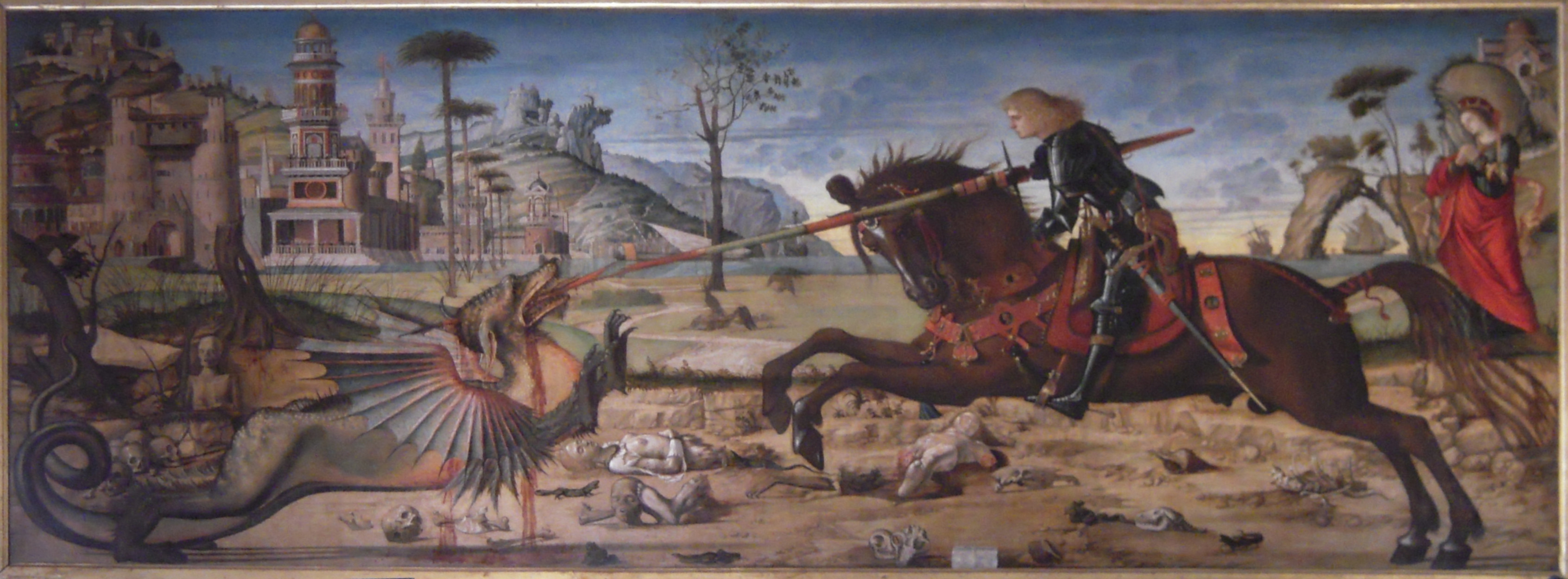
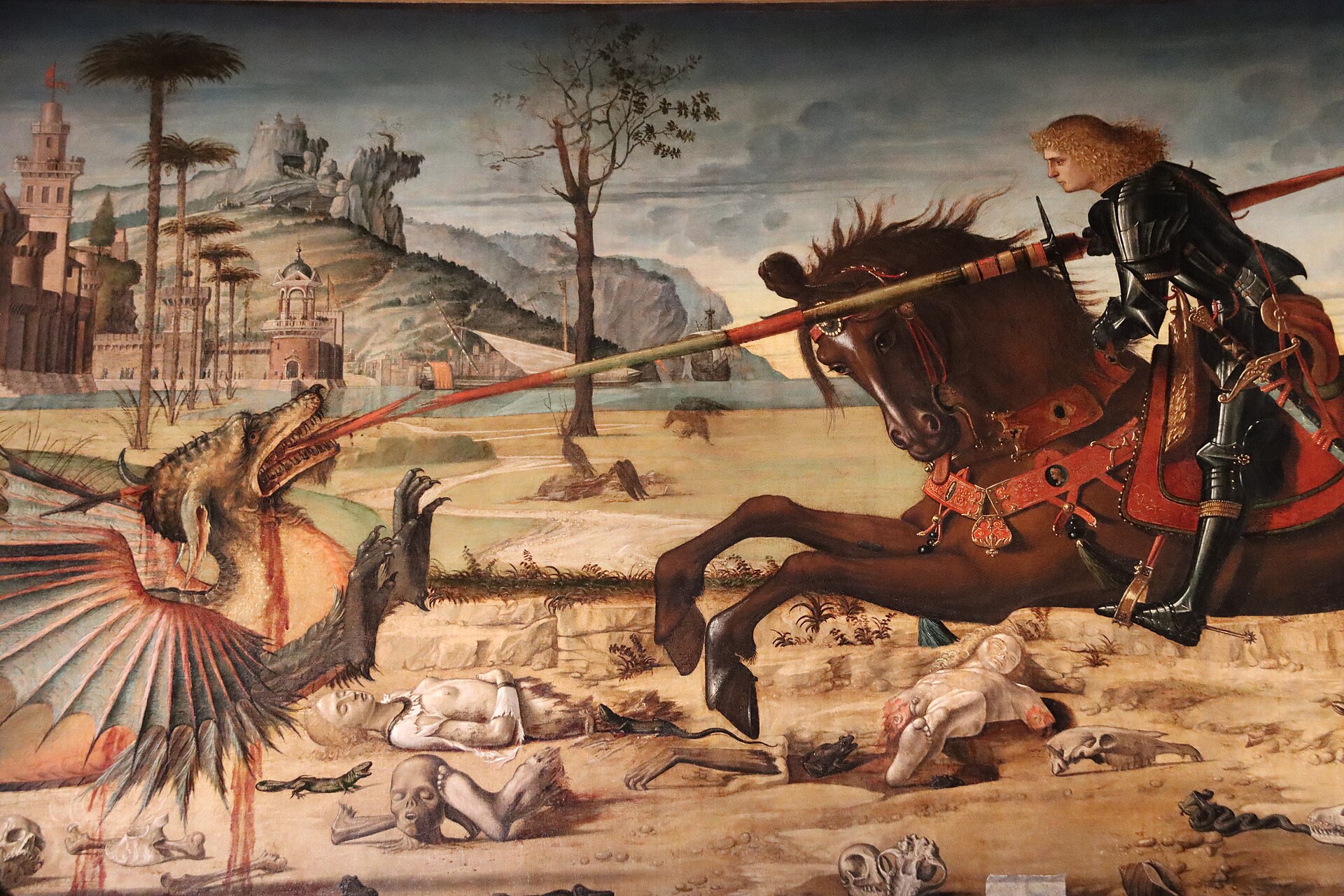
Notice just how much information Carpaccio has provided in the setting. You can see a desert, in Libya, strewn with human remains; trees blasted by the dragon’s poisonous breath; the eastern city of Silena (with the town-gate modelled on drawings of the town-gate at Cairo); a lake, which is big enough to take large ships; and a princess, who has gone out to meet her fate.
Carpaccio has solved the problem of the awkward dimensions (the painting is very long and thin) by putting the very heraldic dragon in profile, except for his tail; by giving George a lance, instead of the sword mentioned in his text; by putting the horse too in profile, except for its head; and by stretching out the front legs and tail of the horse as far as they will go.
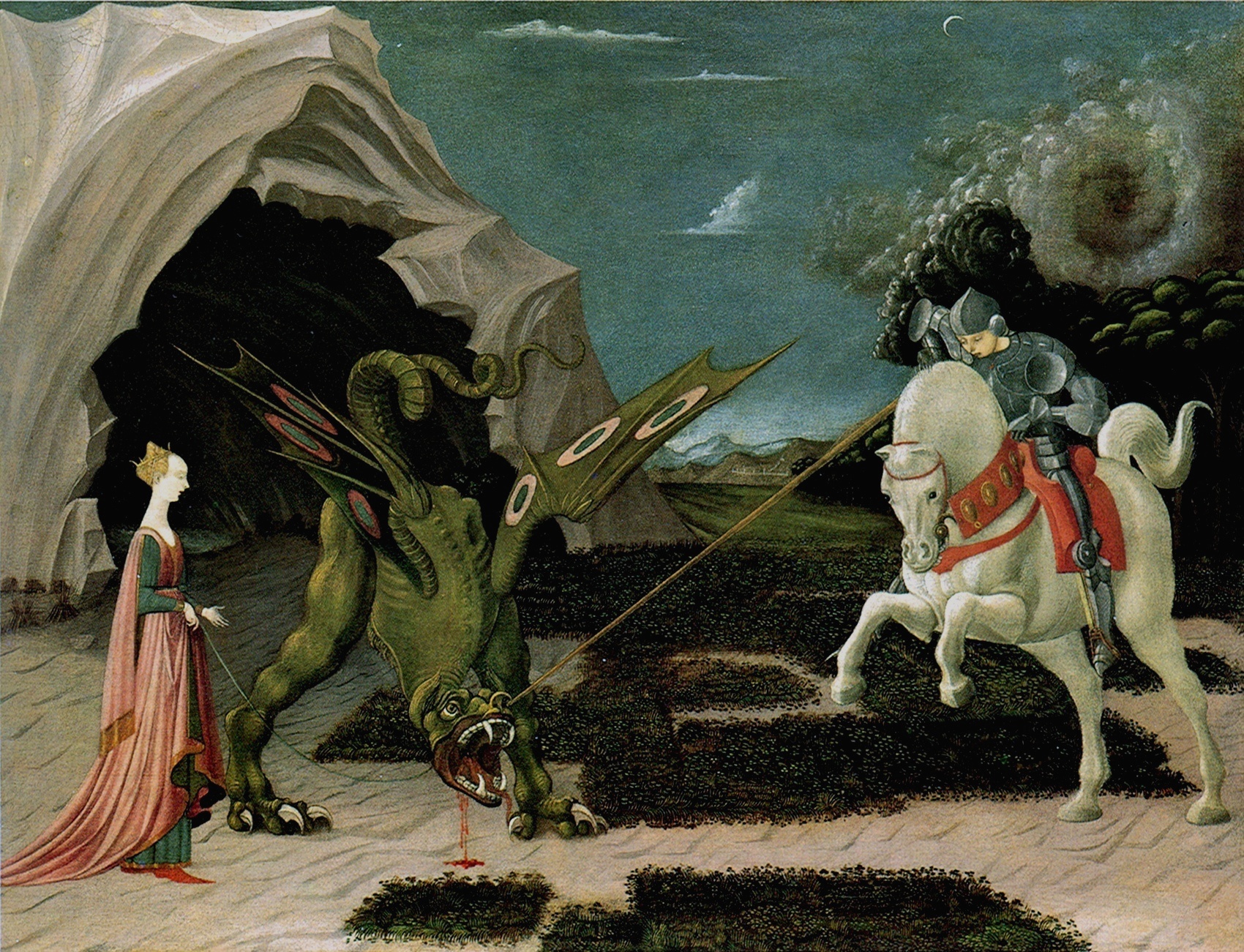
As you can see, the spear goes right through the dragon’s head. But in the Golden Legend version of the story, it is important that George does not slay the dragon there and then.
Instead: ‘He dealt the monster a hurt that threw him to the ground. Then he said to the princess: “Fear nothing; put your girdle about the dragon’s neck.” This she did, and the dragon followed her like a little dog on a leash.’
(Paolo Uccello, in the version in the National Gallery (dated c. 1470), had ‘telescoped’ these two moments in the story.)
The next scene in Carpaccio’s cycle is exactly the same size.
It is set in the main square of the city of Silena, and the simple story goes like this:
When the people of the city saw them drawing near, they fled in panic. But St George signed to them to come back, and said: “You have nothing to fear, for the Lord has sent me to deliver you. Believe in Christ, be baptised, and I shall slay the monster that persecuted you.” Then the King and all his people were baptised. And George, drawing his sword, slew the dragon.
One of the fascinating things about this picture is the way in which Carpaccio looked for real oriental models for the buildings in Silena, finding them in a series of woodcuts of buildings in the Holy Land. You will see that the building in the centre is imitated from the so-called ‘Temple of Solomon’ in Jerusalem, a building which had already been used in a Crucifixion scene by the painter Alvise Donati.
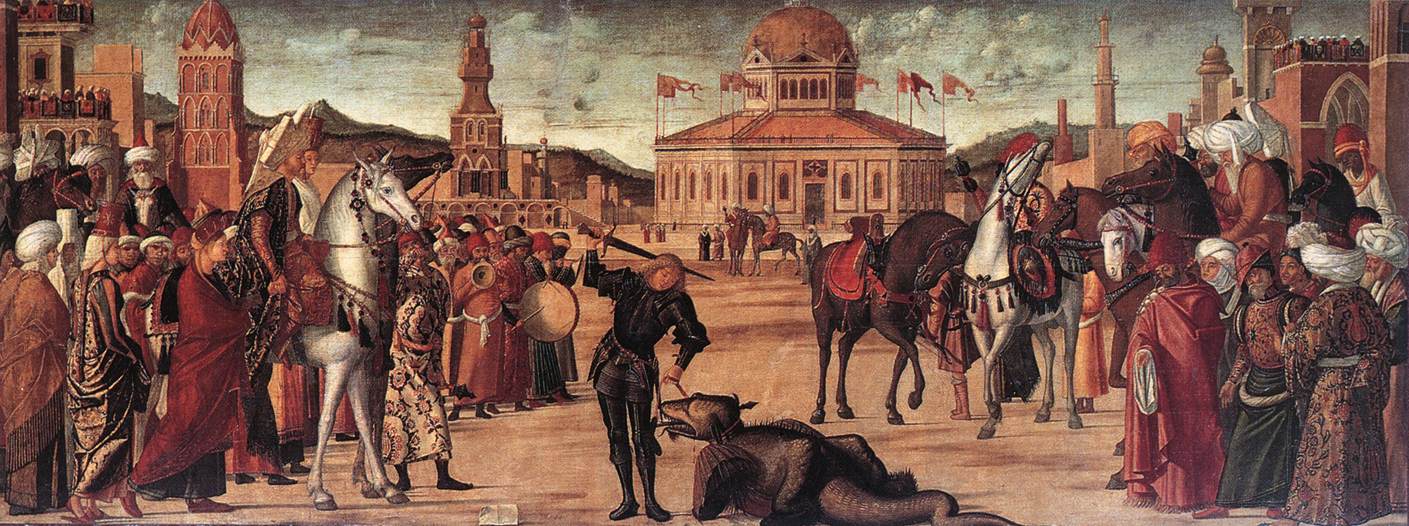
The greatest charm of the picture lies in the details. For example, on the left, look at the oddly proportioned horse, of which one could say either that Carpaccio left it to one of his assistants, or that the horse’s mother had been too friendly with a camel. Or, on the other side, register the contrast between the rearing white steed and the lowered head of the dark horse (St George’s, obviously), who also seems a little restive in the presence of the dragon.
Other good examples of Carpaccio’s fascination with detail can be found in the loving representation of oriental costumes, especially the turbans, which derive from various sources, including the same book of woodcuts used for the buildings.
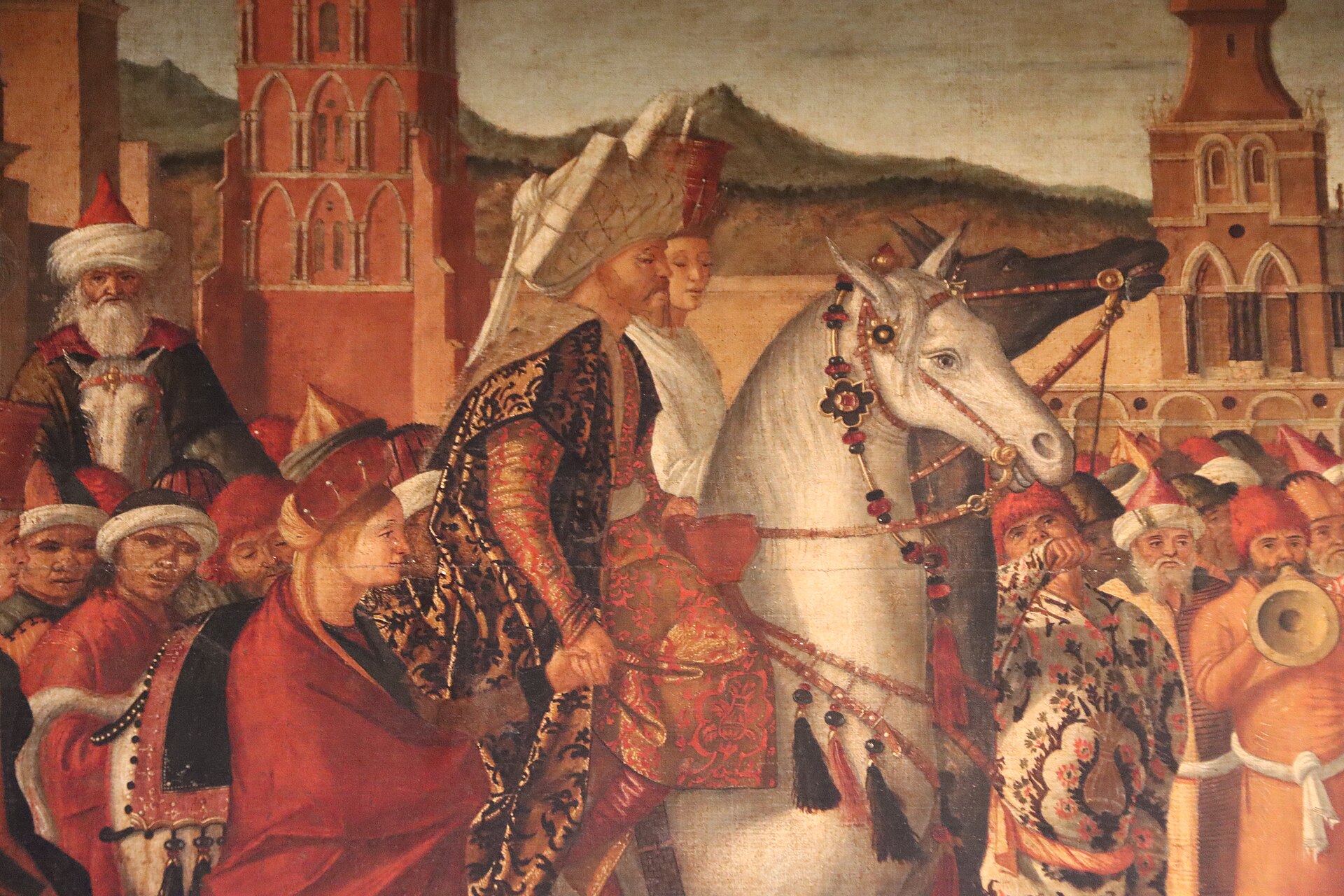
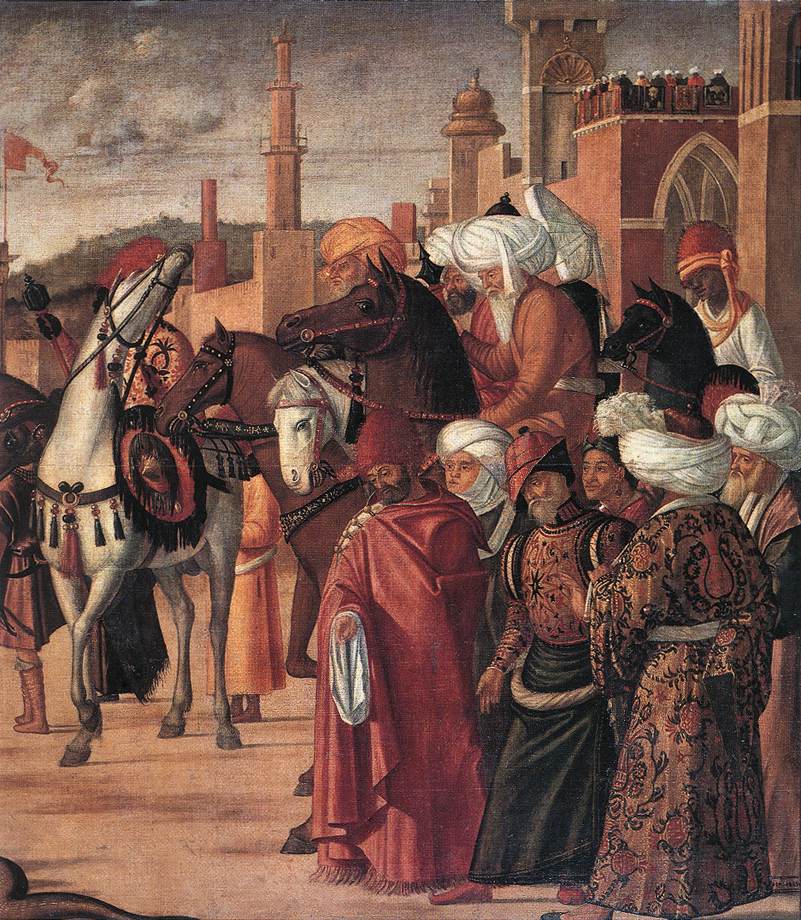
The third painting has been cut down by about two and a half feet (on the right this time; the vanishing point of the perspective would have been central), and it must have been designed originally to fit over a door (the area beneath the musicians being a later addition).
The light is still imagined as falling from the left (casting shadows to the right), as in the first two canvasses, which is a clear indication that all three were intended for the same wall on the Upper Floor, and that they did not ‘turn the corner’ as they do in the present layout on the Ground Floor.
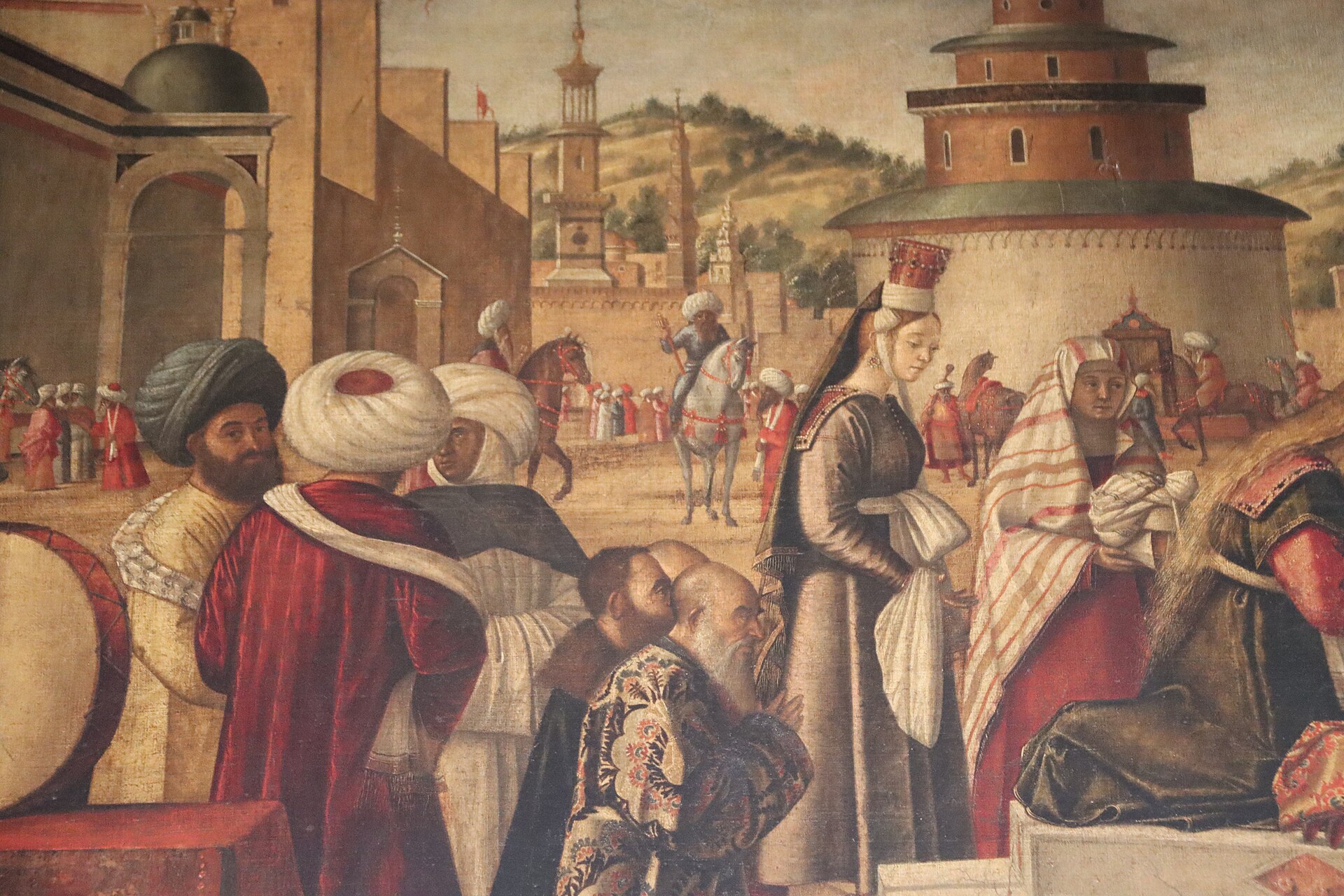
There is little to add with regard to the story. This is clearly the improvised baptism of the citizens of Silena (‘twenty thousand men, and a multitude of women and children’, according to the Golden Legend), their baptism being, you remember, the pre-condition of George’s killing the dragon.
So, what you see is George himself (still wearing his black armour under a red cloak), beginning the long day’s work by baptising the kneeling king and queen, while the rescued princess assists him by holding a pitcher of water.
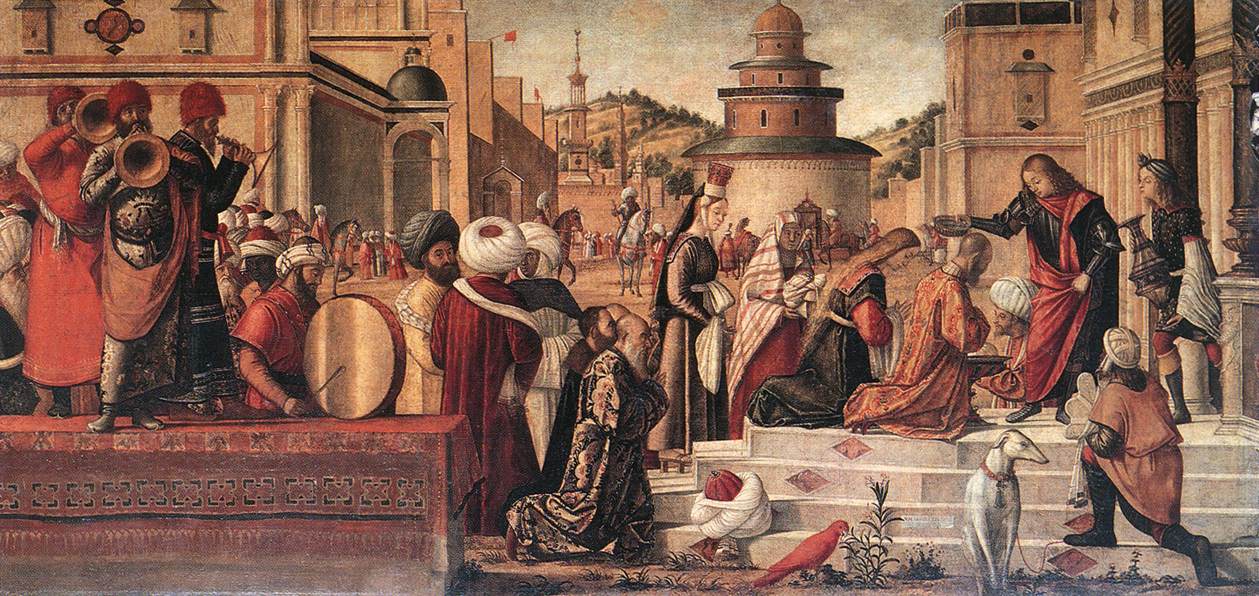
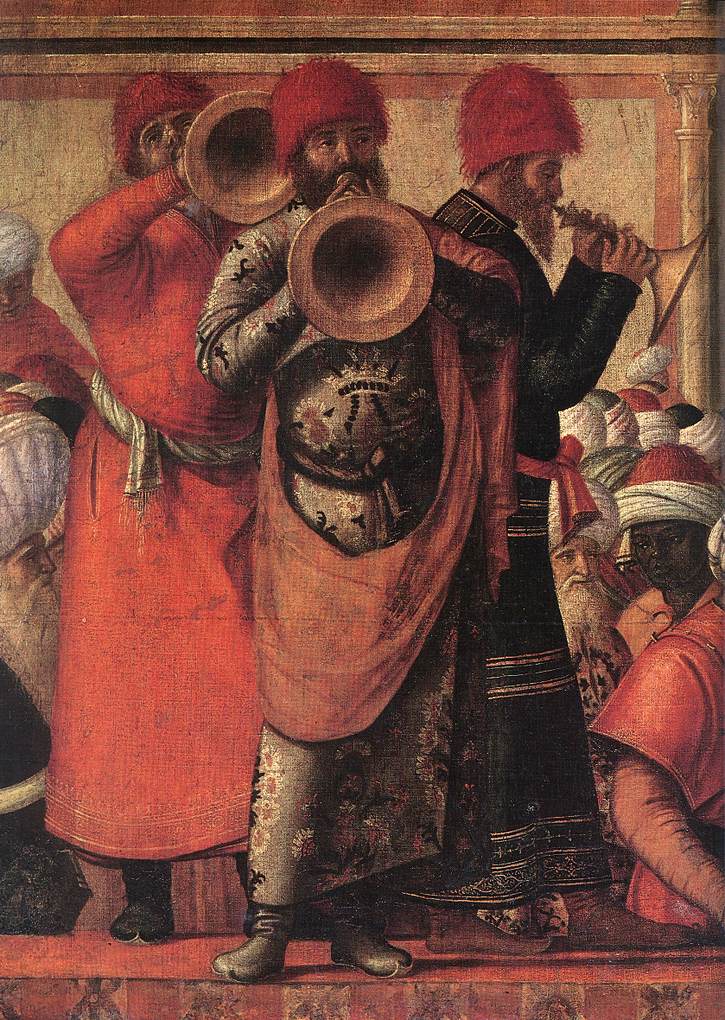
Yet again, the pleasure lies in the details—especially, another collection of exotic head-coverings, and, of course, the musicians.
Enjoy the different textures of the red busbies and the embroidered coats; the implausibly short stem of the shawm and its implausibly large bell; or the way in which the pot-bellied man at the rear is getting ‘into the groove’, while the musician in the centre, very cool, is lifting his right foot only just enough to keep time.
Remaining in the same room, we must now change gear mentally as we pass from a fairy tale hero (who has now been removed from the Roman Catholic calendar despite the fact that he is the patron saint of England) to one of the best documented ‘Fathers’ and ‘Doctors’ of the Church, the man who re-translated the Bible from the Hebrew and Greek to give us the Latin Vulgate—St Jerome.
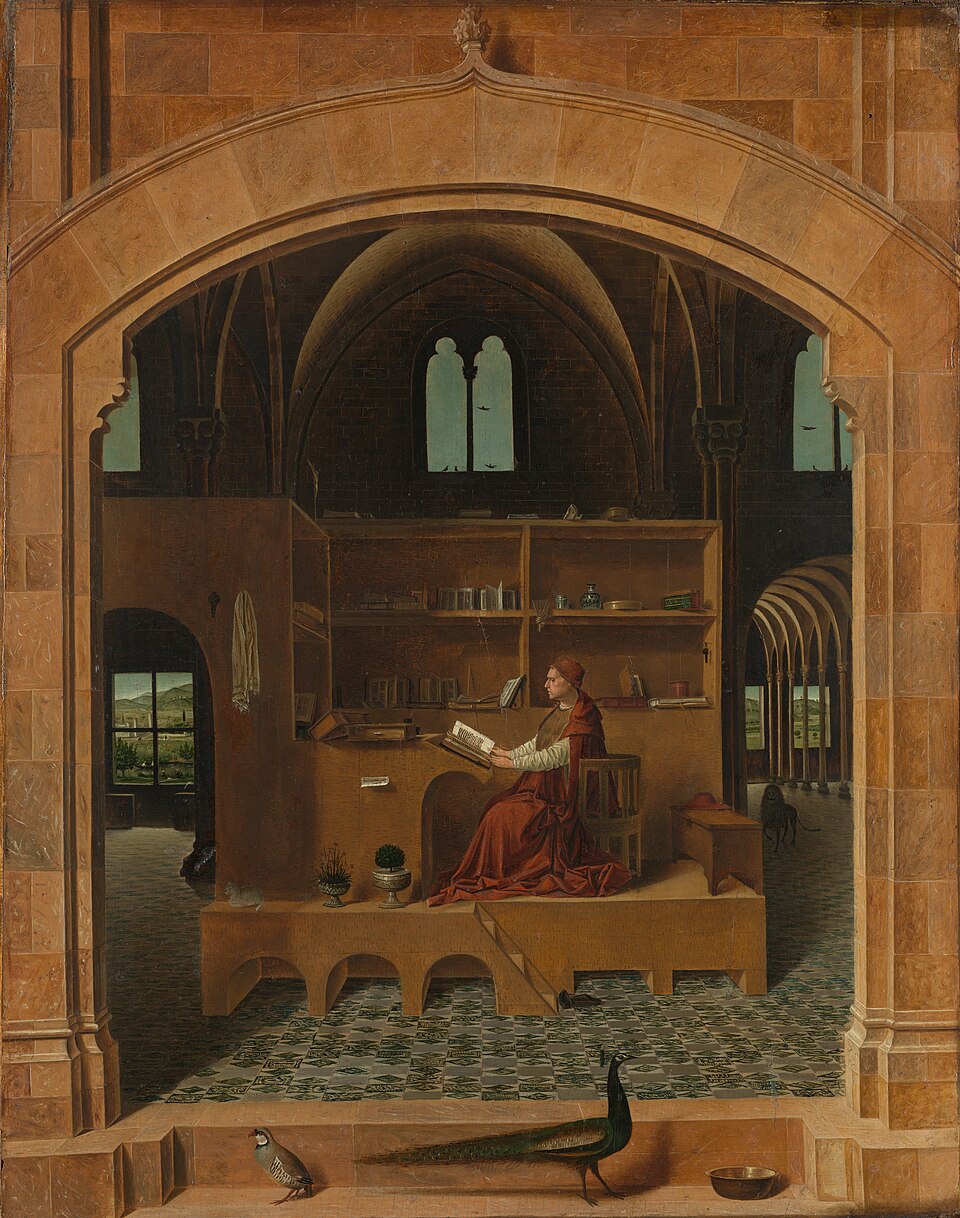
You see him, first, as he appears in one of the jewels of the National Gallery, a tiny painting by Antonello of Messina (dated c. 1475), which is a mere eighteen inches high.
The reason for the association of St Jerome with George and Tryphonius in the ‘School of the Dalmatians’ is explained in the Golden Legend, where we read that he was born in the town of Stridon on the borders of Dalmatia and Pannonia.
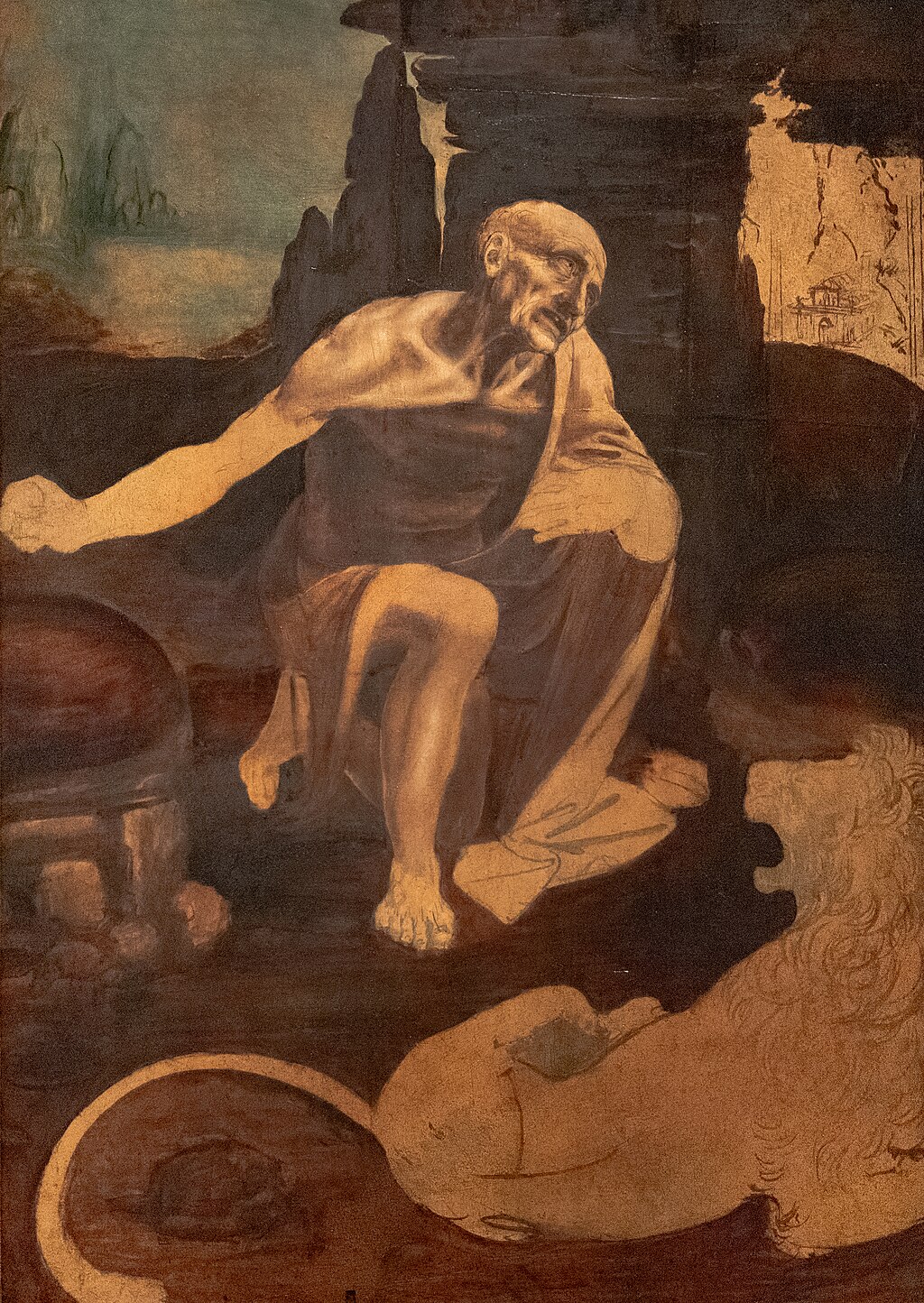
The Golden Legend tells of Jerome’s early studies, and of his famous dream when he heard God accuse him of being ‘not a Christian, but a Ciceronian’. It tells, too, how he was made a cardinal at the age of thirty-nine, how he was a hot favourite for the Papal tiara, but was ‘framed’ in a sex scandal, and then spent four years of abstinence and penitence in the wilderness—which is where he is portrayed by Leonardo in this unfinished panel (dated c. 1480).
After this long penitence, Jerome went to the town of Bethlehem where he joined a monastery and ‘laboured for fifty-five years and six months at the translation of the scriptures’.
It is in Bethlehem, at the end of his life, that Carpaccio takes up the story, in the first of three pictures in the School.
(The canvasses are now ranged on the wall opposite the St George-cycle—as was originally intended, since the light is consistently imagined as coming from the same window in the room, and therefore falling from right to left.)
The story goes as follows:
One day, as evening was drawing on, and Jerome sat with the brethren to hear the sacred lessons, suddenly a lion came limping into the monastery. At the sight of him, all the other monks fled; but Jerome went forward to meet him as a host meets his guest.
In the event, the saint removed a thorn from his paw, and the grateful lion remained in the service of Jerome and the monks for the rest of his life.
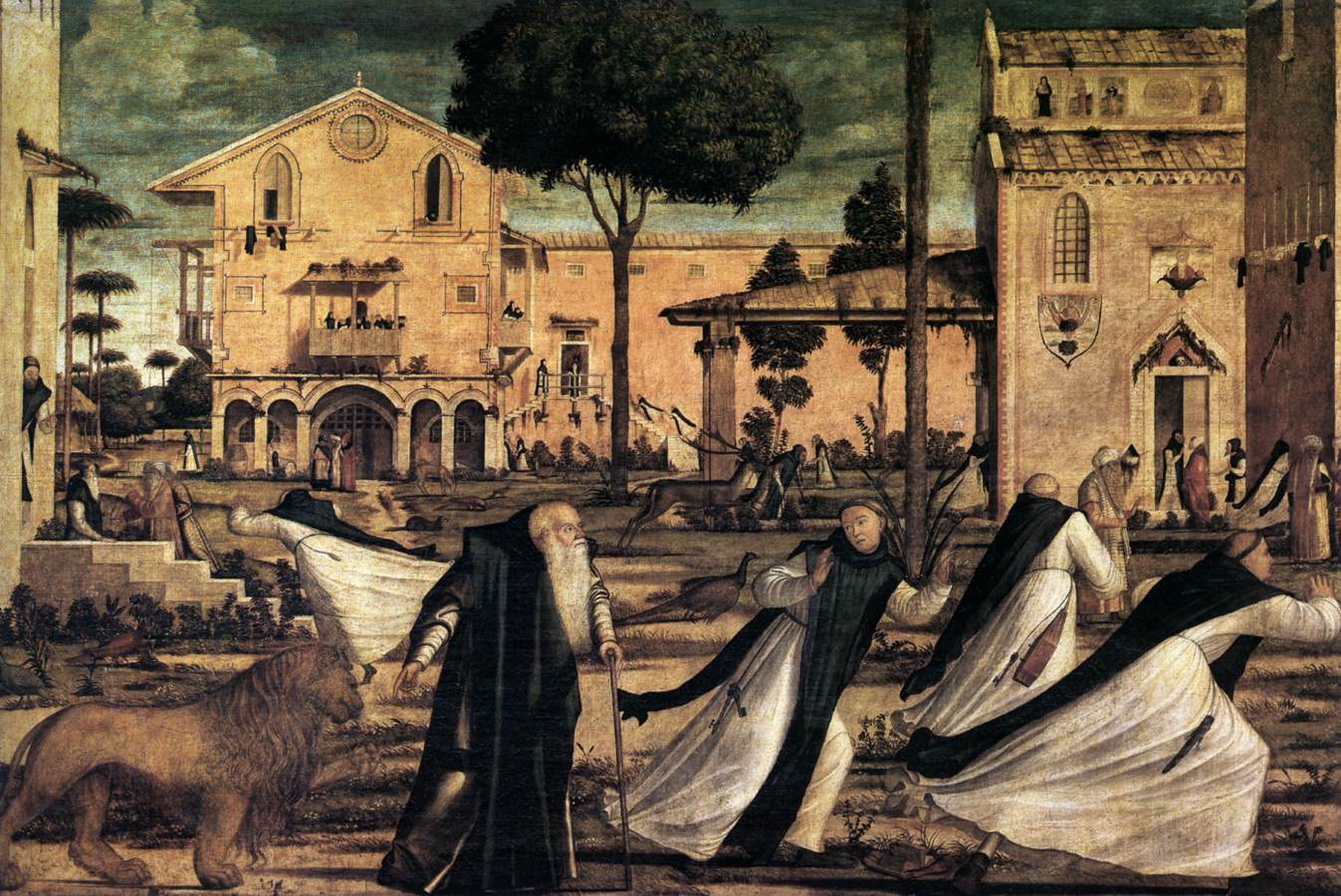
There is a hilarious contrast here between the placid lion and the old man (with his walking stick), on the one hand, and the four monks on the other, who are dashing away from great danger like sprinters from the starting blocks.
For my money, though, the poetry of the picture lies in the setting. The church and convent are decidedly ‘local’; and yet the sunbleached scene has a suitably ‘oriental’ feel in the rendering of the sandy soil, the scrub and the pines.
The building on the right—with its mosaics above the entry, below the window and in the clerestory—is none other than the church of the Knights of St John; while the building on the left closely resembles the School of St George itself, as we saw it in the woodcut of 1500 (which is why I asked you earlier to remember the pitched roof, the rose-window, and the two Gothic windows). The main difference is that Carpaccio has given the painted building an extra storey in the portico of the ground floor.
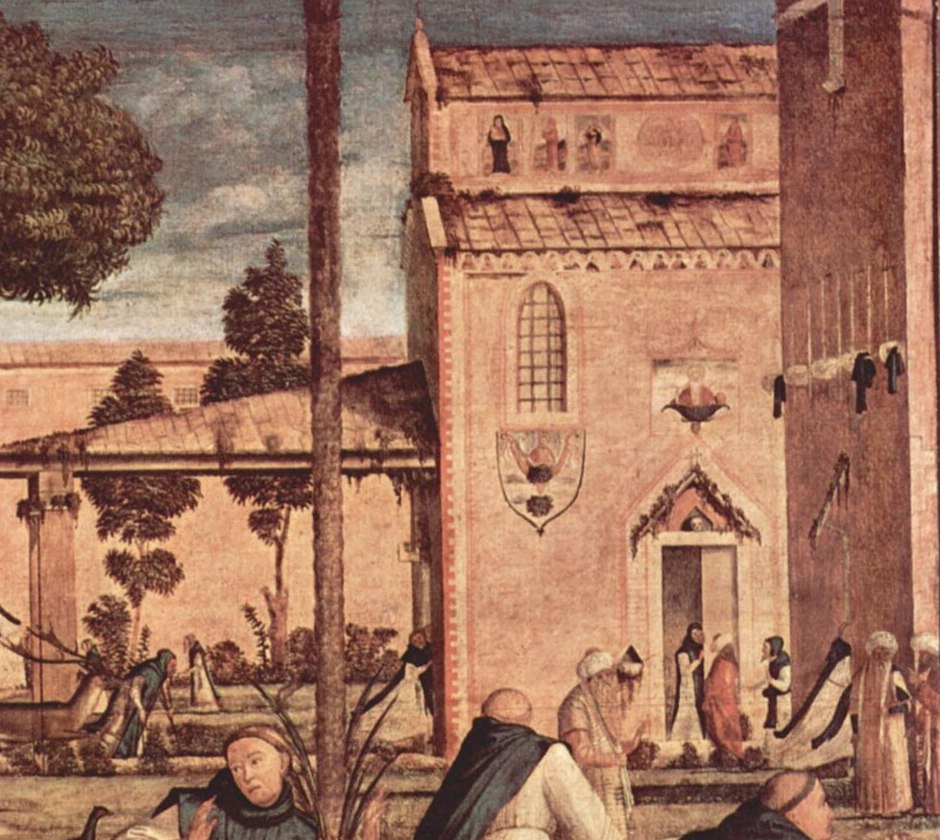
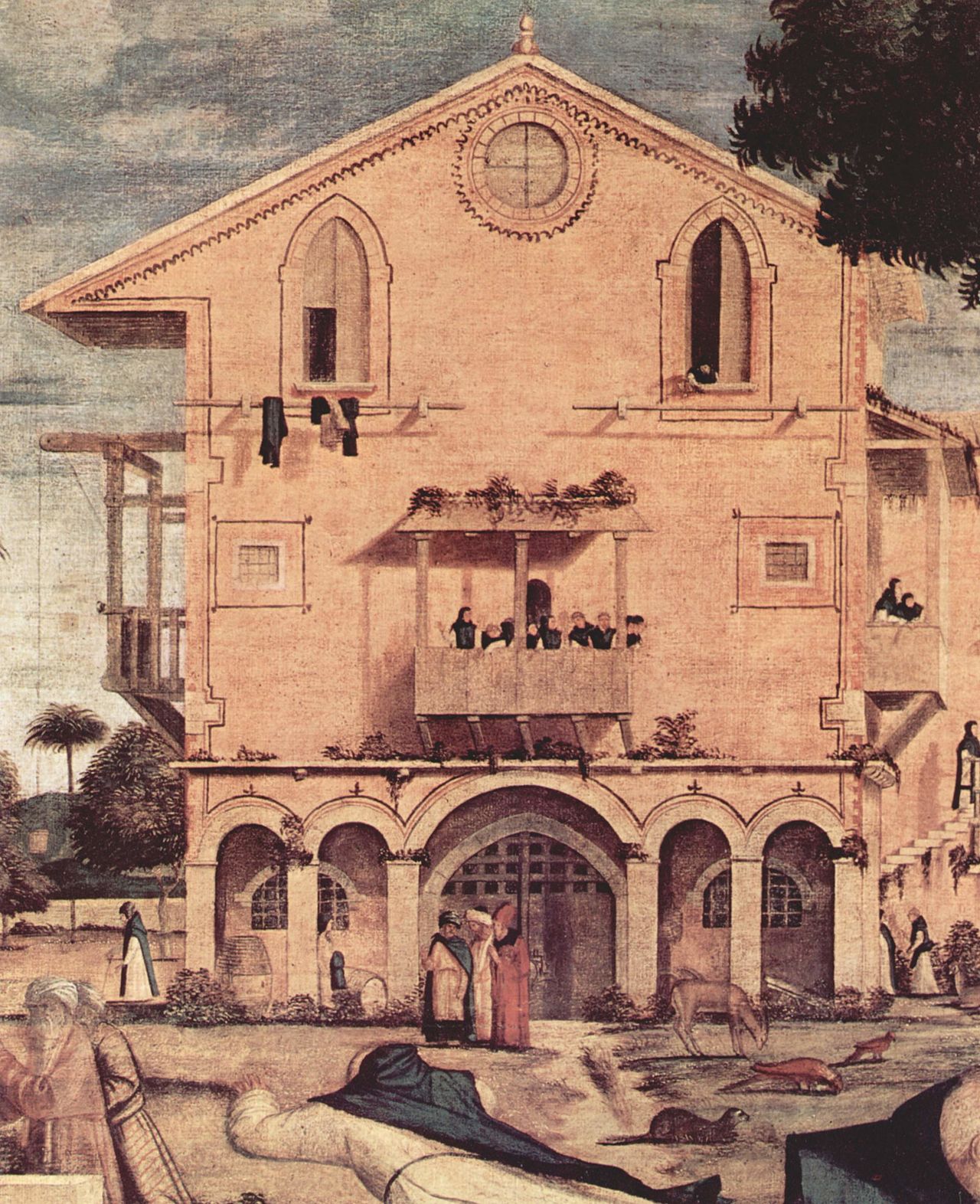
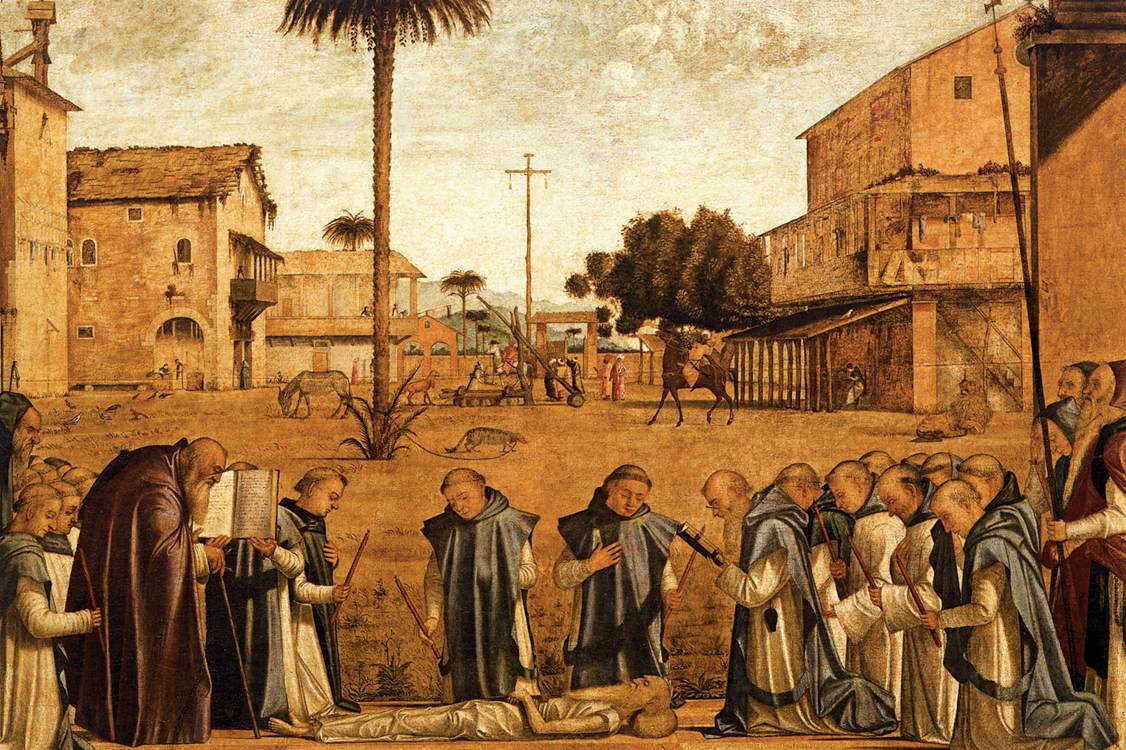
The same approach is valid too for the appreciation of the second painting, identical in size (about four and a half feet by seven), which shows the funeral service for the saint, who died at the age of ninety, in the year 420.
There is painterly pleasure in the attention to detail, for example in the rigidity of the corpse; and there is some gentle humour in the observation of the old men, especially the one wearing spectacles to read the funeral service.
But the greatest charm again lies in the setting. It shows the same convent and the same church as in the scene with the lion, but they have now been ‘capriciously’ pulled apart and are shown at a greater distance and from a radically different angle. Hence, the buildings are separated by an expanse of sand where a donkey on the left is grazing near some birds quite undisturbed by the couchant lion on the right, and where the pines recede towards low, distant hills.
We come now to the last painting devoted to St Jerome.
Its place in the sequence was a mystery until the 1960s, because everybody assumed that it represented St Jerome in his study, exactly as we saw him in the little painting by Antonello. The question then was, why had it been placed last?
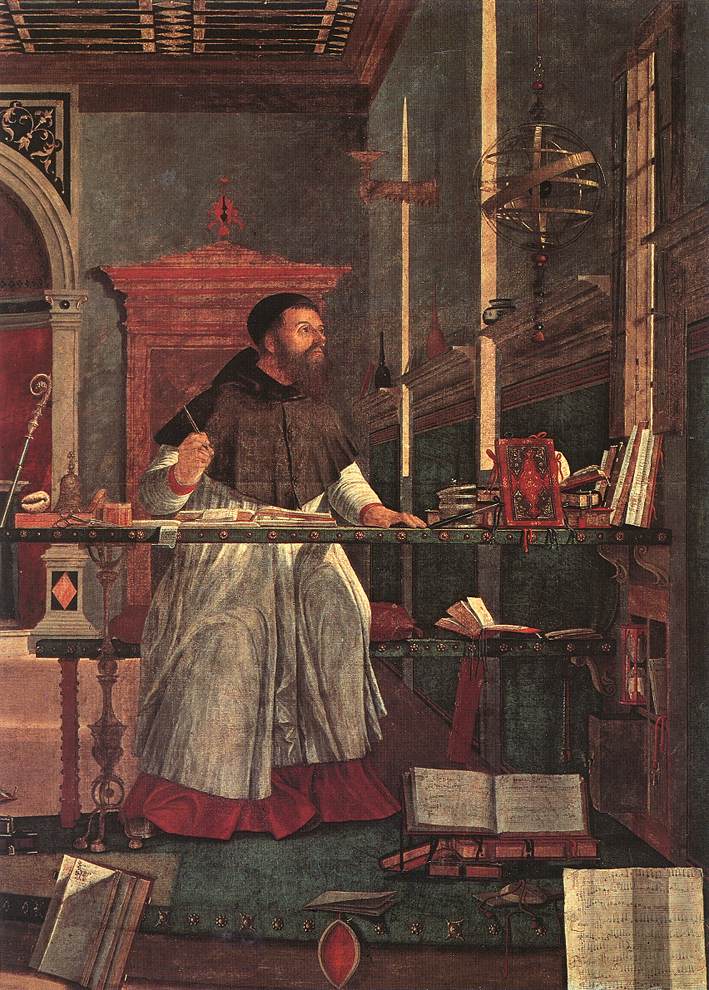
It is now known, however, that Carpaccio turned away from the Golden Legend to another version of Jerome’s life, published in Venice in 1485, and that the seated scholar is not Jerome but St Augustine, who was far away in north Africa, and who was in the act of writing a letter to Jerome when he became aware of a strange light, and heard a voice announcing that Jerome had just died.
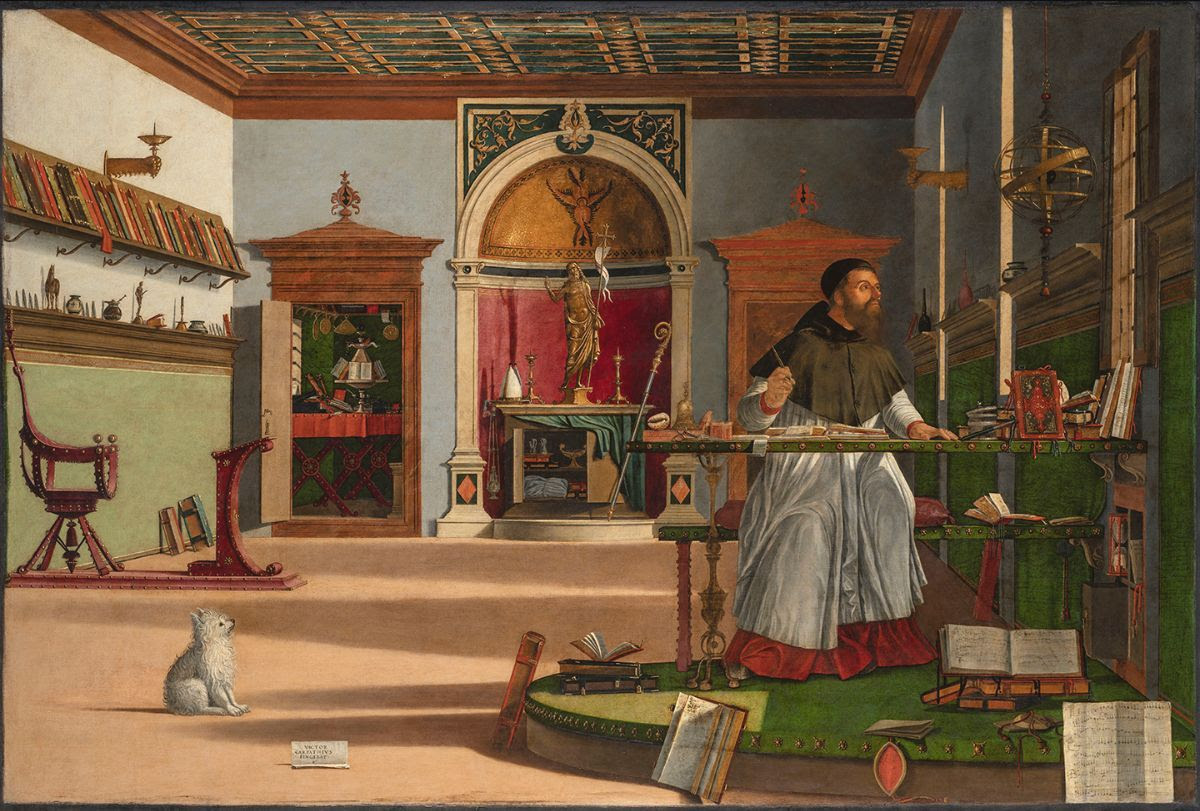
We are lucky enough to have a superb preliminary study, in ink and wash, which enables us to appreciate Carpaccio’s control of perspective and his power to model forms merely with gradations of a grey scale without the distractions of colour and detail.
Comparison with the study also shows how he later gave the story a greater impact by making the light more intense outside the window and showing Augustine as far more rapt by what he sees and hears.
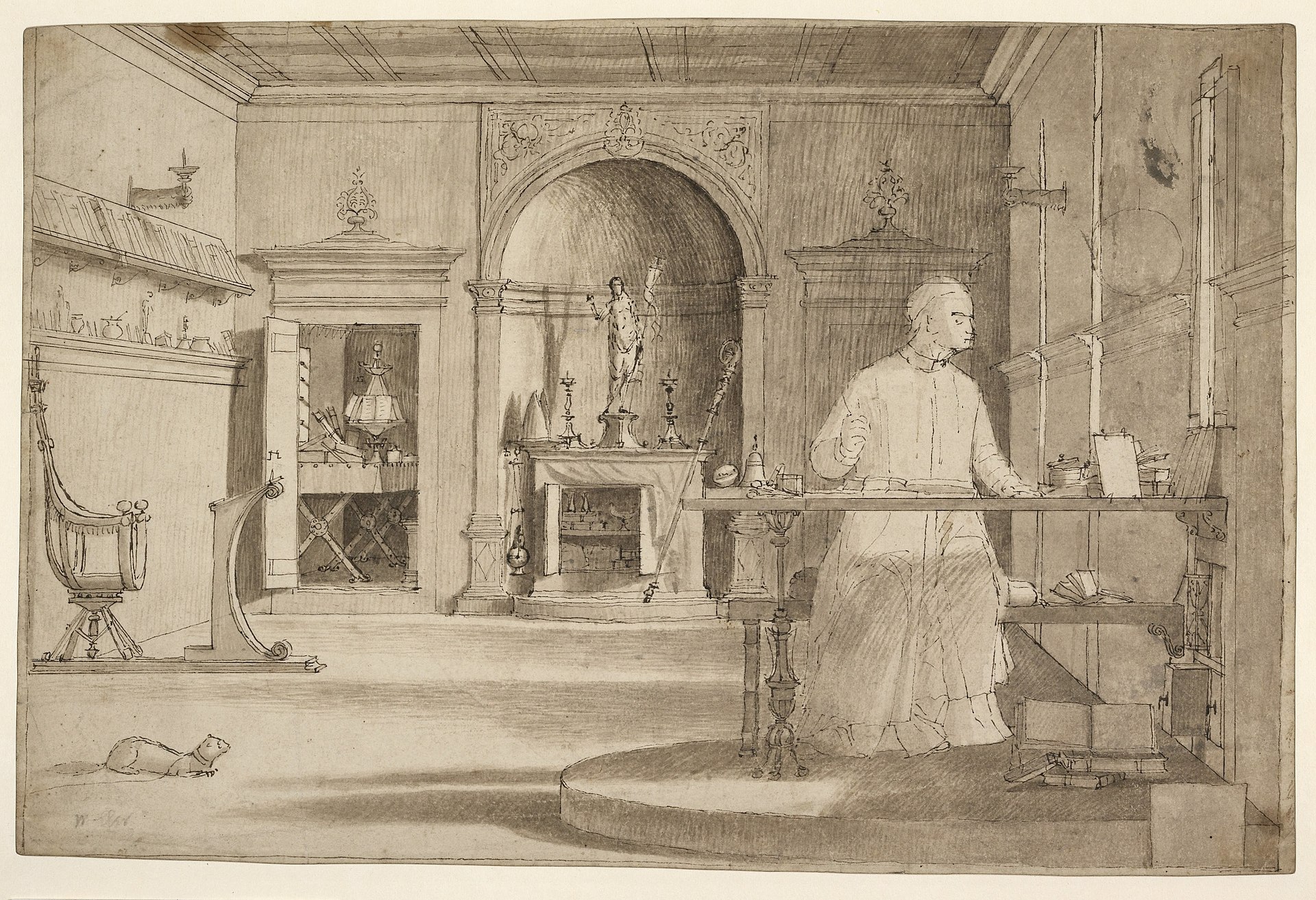
Even having appreciated the quality of the drawing, though, one still wants to enjoy the colours of the painting and the amazing wealth of extra details in its recreation of the study of a humanist cardinal in the late fifteenth century.
(Some say that it is intended to be a posthumous portrait of the famous Cardinal Bessarion, who had died in 1472, thirty years earlier.)
Focus on the altar (with its statue of the risen Redeemer) between the candlesticks and the bishop’s mitre and staff, and on the cupboard below which contains the vessels needed to celebrate mass, complete with a curtain to conceal the vessels when necessary.
And enjoy the splendid red leather chair with brass studs, attached to the prie-dieu in front of the well-stocked bookshelf, and the sill with all its bric-à-brac; and in the corner, notice the closet with a folding table, and a four-sided lectern with books and instruments.
The saint is at his desk, which is raised on a dais that has books propped up against it or lying open to reveal perfectly transcribeable Renaissance motets in three and four parts.
His writing instruments lie on the table. There is a model of the planetary spheres and the Zodiac on the wall.
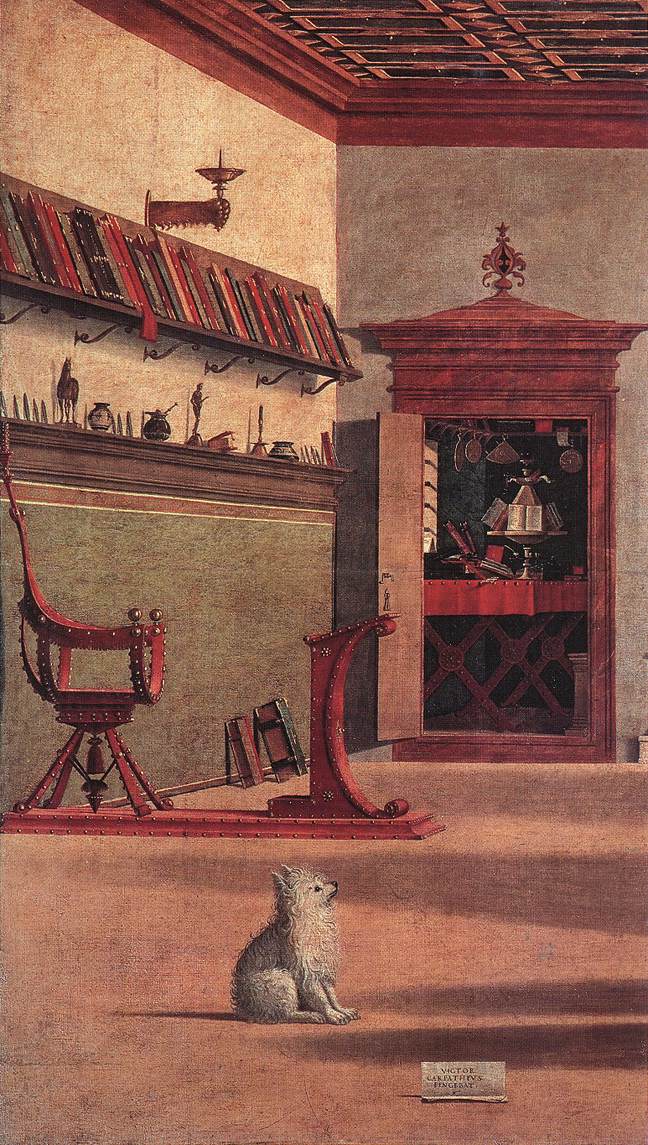
And we must not neglect the pooch, who is rocking back on his haunches, his hair bristling, as he looks at the celestial light which illuminates both him and the notice, ‘Vittore Carpaccio painted it.’
I am not alone in counting this as my favourite among all Carpaccio’s works—even including the cycle of canvases devoted to St Ursula, which form the subject of the next lecture…