Carpaccio: The Legend of St Ursula
[Note. This lecture follows closely on the heels of its predecessor, since we remain in the world of the Venetian Schools at the turn of the sixteenth century and the canvasses they commissioned to adorn their principal rooms. It will make good sense if read in isolation, but it does not repeat the social and historical information provided for La scuola di San Giovanni and La scuola di San Giorgio degli Schiavoni.]
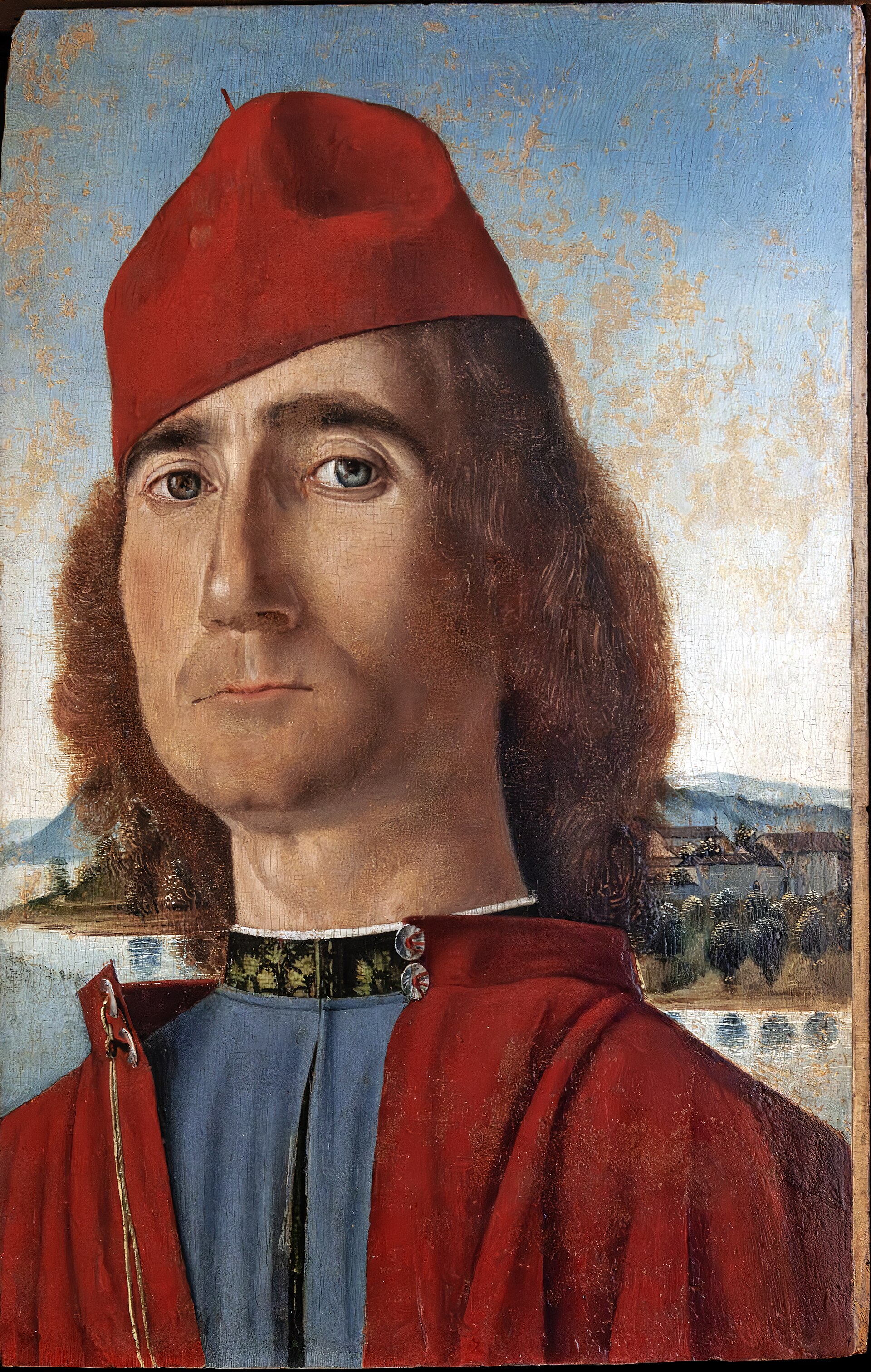
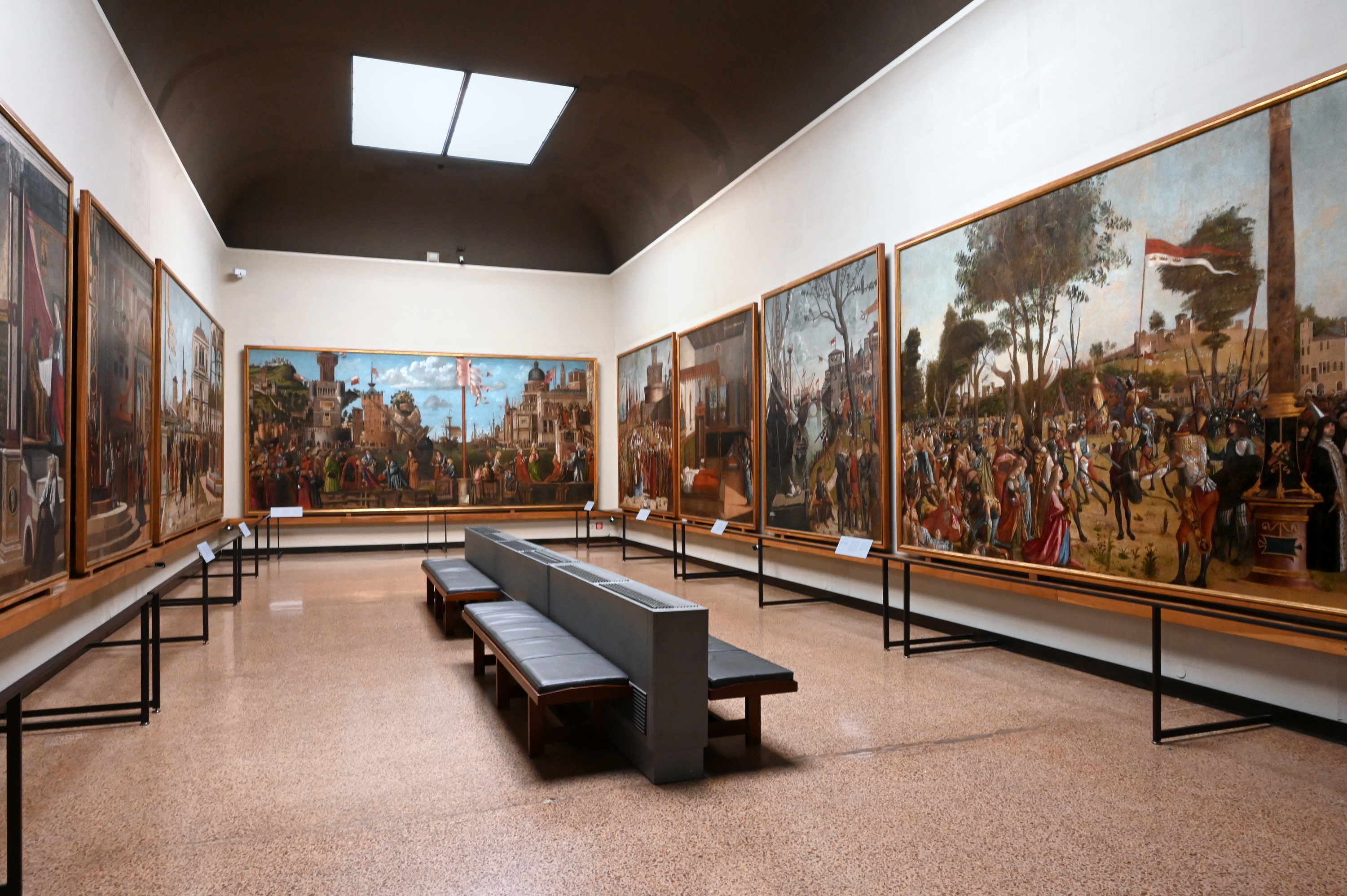
Carpaccio’s most substantial contribution to Italian Narrative Art are the nine canvasses that make up the Legend of St Ursula, dating from the 1490s, which are now displayed—correctly, but with the kind of sensitivity one would expect in an airport lounge—in a single room in the Accademia.
Our first task is to restore them in imagination to their original home, namely the Sala dell’Albergo in the School of St Ursula, a building about half a mile away which was demolished after the suppression of the confraternity by Napoleon in 1806.
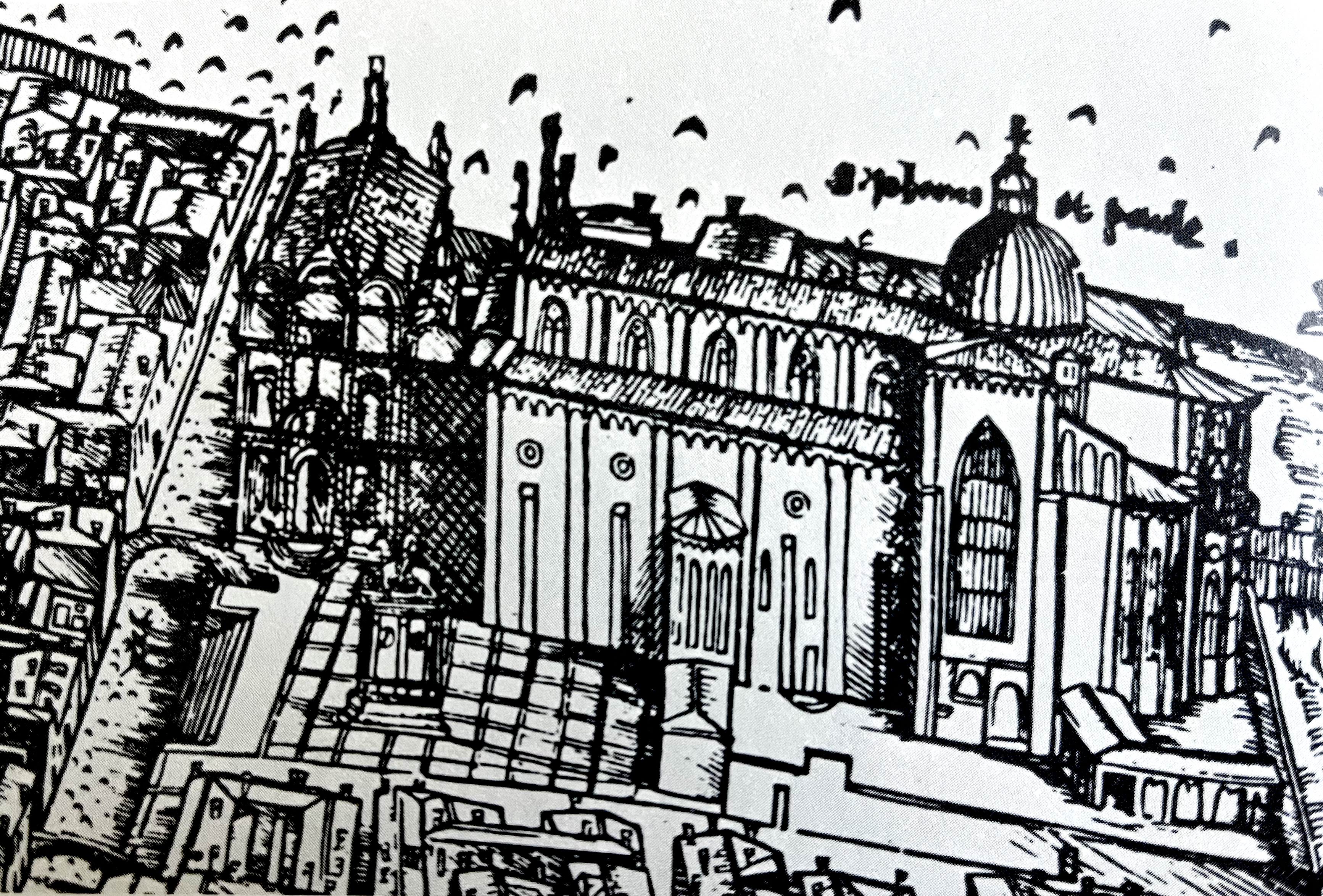
The Scuola di Sant’Orsola stood close to the huge Dominican church of St John and St Paul, in the north-east of the city; and it is important to keep in mind that this church had become very important during the fifteenth century—almost a kind of Westminster Abbey, in the sense that many of the Doges were buried there.
(The detail here is taken from the famous woodcut of Venice in 1500 made by Jacopo de’ Barberi.)
The confraternity of St Ursula was the richest of the so-called ‘minor’ Schools; and it was natural for early scholars to assume that the headquarters lay in an impressive building (to the left in the woodcut), where there is now a small square in front of the church (as shown in the first photograph).
But it is now accepted that it was in a much humbler building tucked in to the side of the church, crouching next to the five-windowed apse of a side-chapel and not much bigger than the ‘hut’ on its site (in the second photograph).
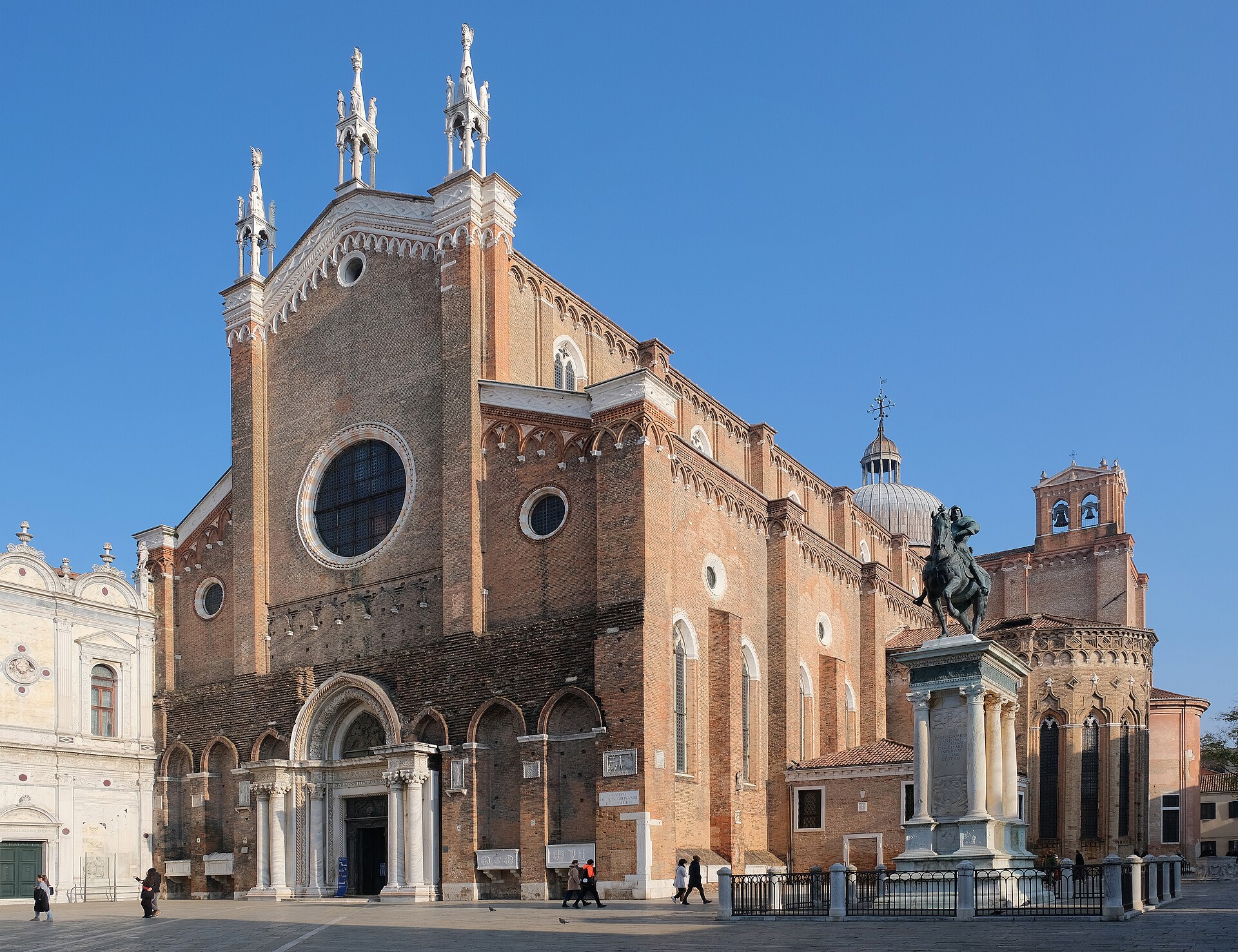
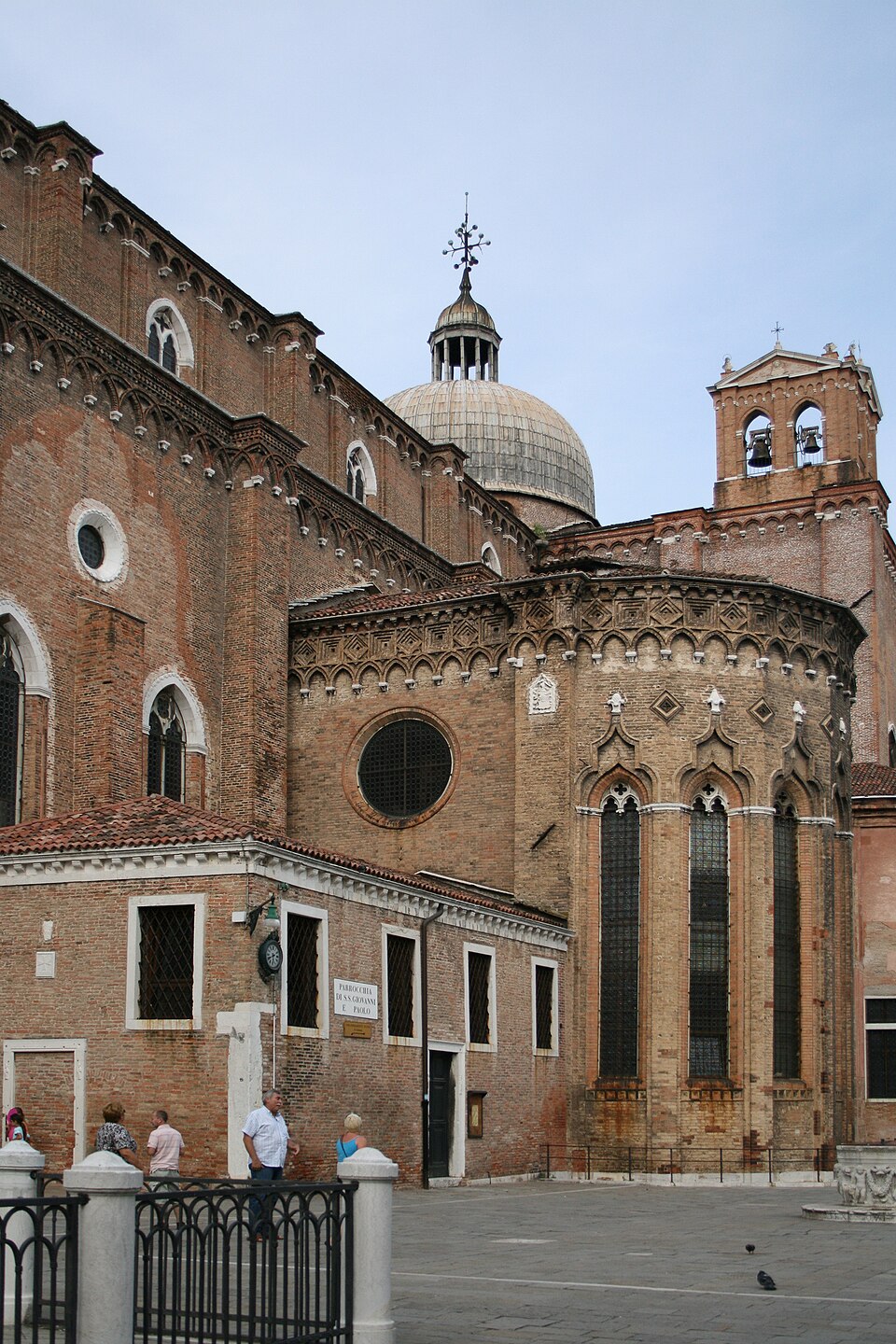
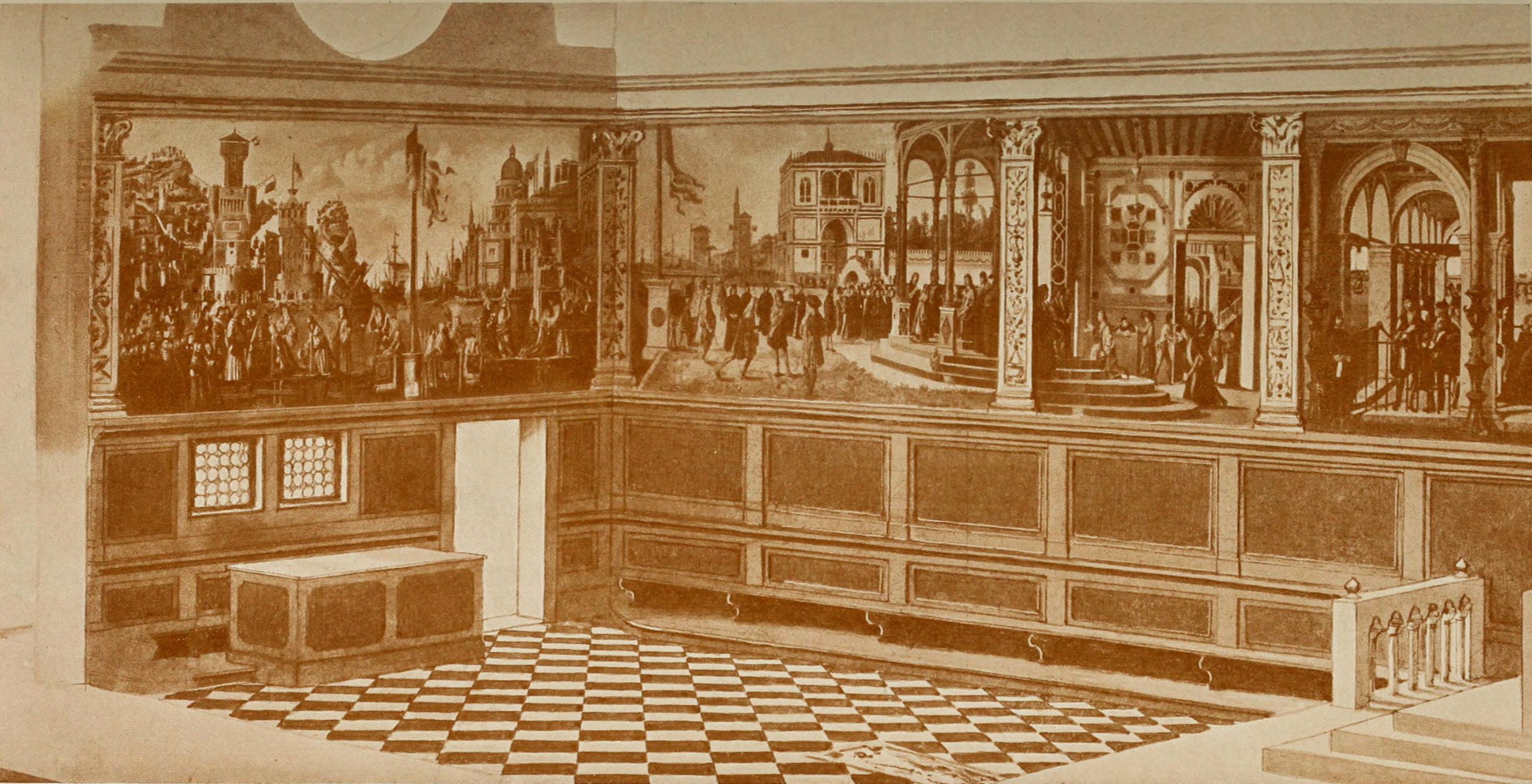
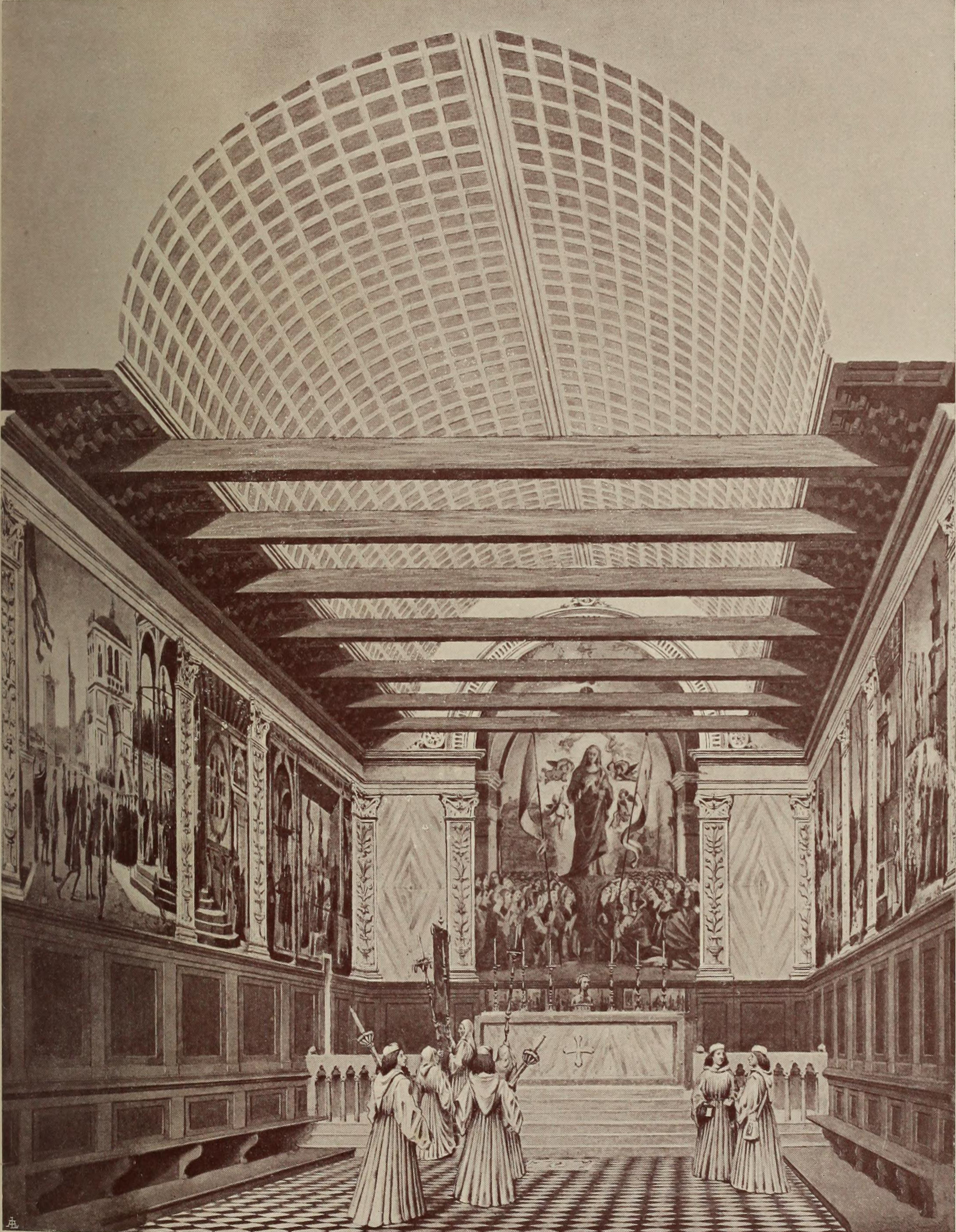
The principal room measured only about sixty feet long by twenty-five feet wide and so the larger of these two engravings from 1904 gives a false impression of its size, even if the mood it creates is more sympathetic to Carpaccio’s paintings than the whitewash and black metal of the Accademia. (The smaller engraving is just right in this respect.)
Ludwig and Molmenti clearly proceeded on the assumption that the building was the grander of the two demolished candidates. And, alas, they not only got the building wrong, but they arranged the canvasses on the ‘wrong’ walls.
They assumed that the main source of natural light in the room came from the west wall. (For two centuries it had been normal for artists to make the source of the imagined light in a pictorial cycle coincide with the main light source in the given room.) But it is now established that the light in the Sala dell’Albergo came from the east window, on the altar wall, and that the narrative was meant to unfurl along the south wall, cross over, and return up the north wall. (This is how the pictures are now arranged in the Accademia.)
But let us come to the canvasses themselves, which were commissioned in 1488 and executed between 1489 and 1496 (with those intended for the north wall being painted first).
The narrative of the life and martyrdom of St Ursula and her companions was taken from the Golden Legend, in the entry for the 21st of October.
And I show you here—as an appetiser—another interpretation of the same story which had been executed shortly before 1489, quite independently, by the Flemish artist Hans Memling, in the six panels on the side of a small reliquary, just three feet high, intended to stand in the Hospital of St John in Bruges.
Memling’s advanced technique in oil painting, and especially the richness and depth of his palette, was to exercise a significant influence on Venetian art; and I will return to his cycle later to provide some stylistic contrast and to fill in some missing scenes.
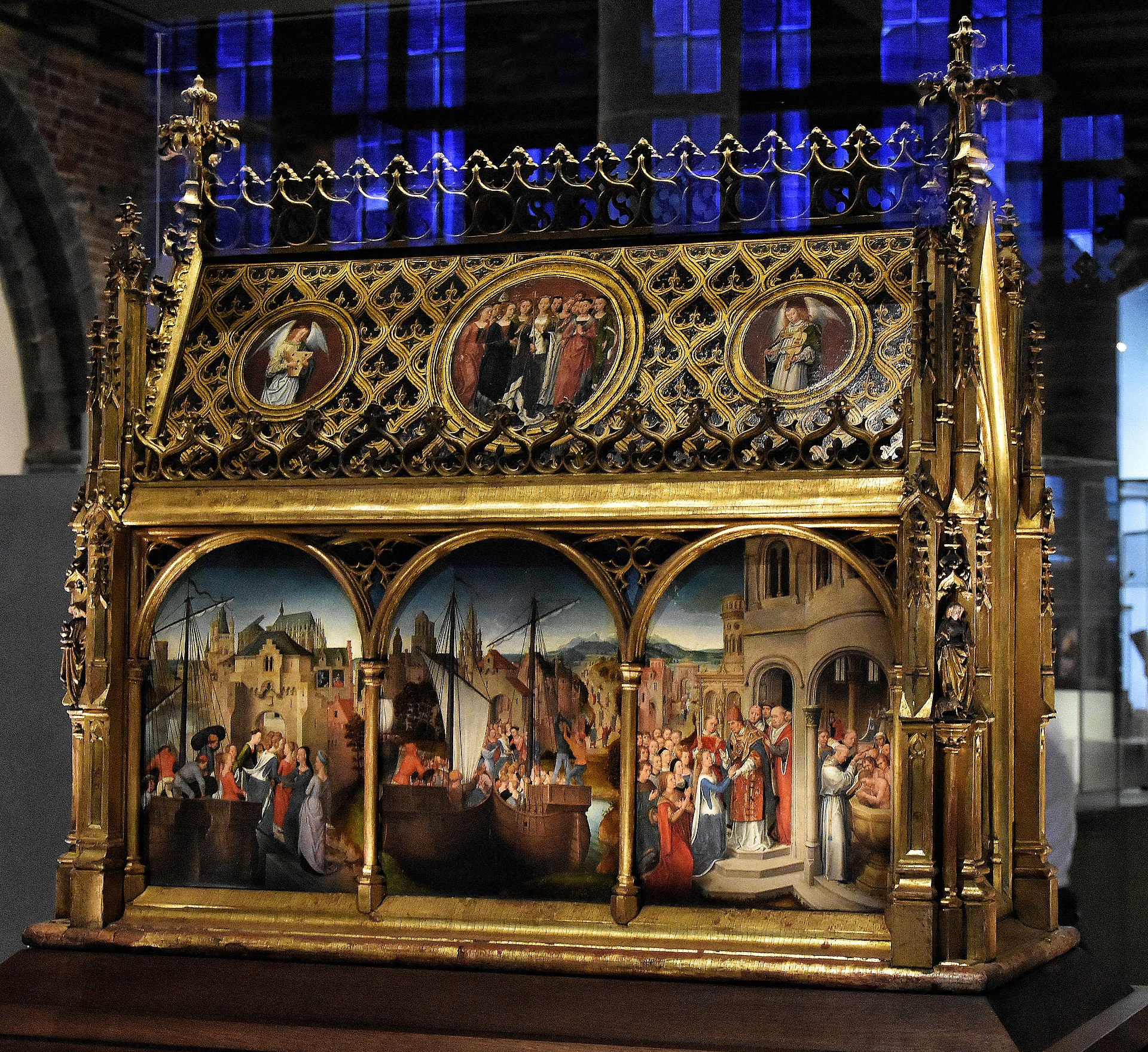
The story, as told in the Golden Legend, is in essence a folk tale, a variant on the ancient motif of a princess who attempts to avoid marriage by imposing impossible conditions on her suitors. And apart from the gory end to the tale, most of the episodes are similar to those which take up the greater part of many medieval romances—embassies, arrivals, festivities, farewells, and departures.
It is these motifs on which Carpaccio seizes in the opening canvasses of his cycle (which, I remind you, were intended to hang on the south wall).
The first, closest to the altar, measures nine feet high by nineteen feet across.
The canvas has clearly been cut down by about a foot on the right; and the intimate interior scene must have been as wide as the public portico and was presumably closed by another marble pilaster.
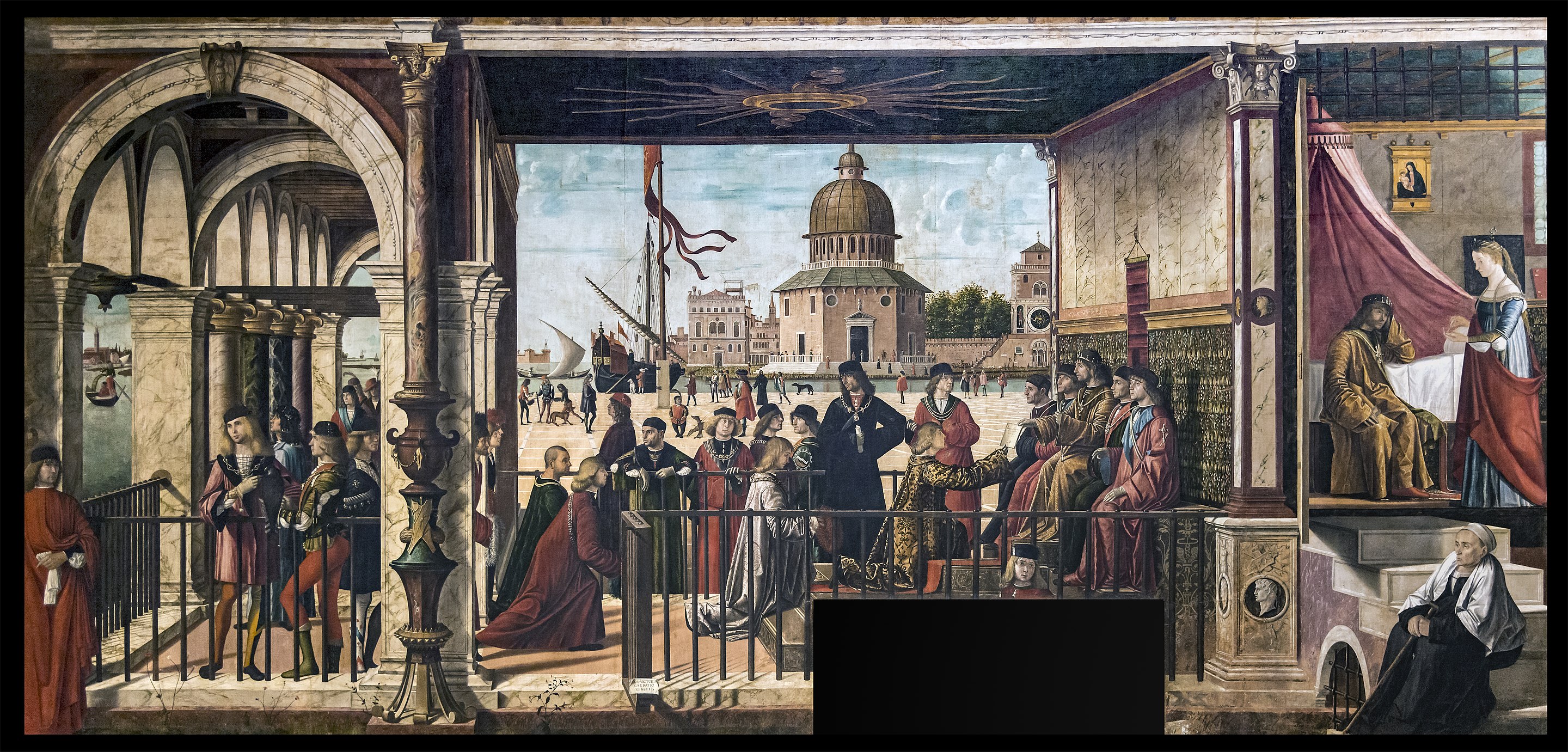
One’s first impression of the centre of the composition, here, is of a Venetian scene, or of what would have later been called a Venetian capriccio, implying that it offers a cheerful mixture of real and imaginary buildings.
Beyond the water, on the right, you see a distant cupola, a clock tower and a marble-faced palazzo. The water clearly surrounds and pierces the city; and it must be deep enough to accommodate a sea-going ship. You can also see a wherry, with its billowing lateen sail, of the kind used for light transport between the islands or in the smaller canals.
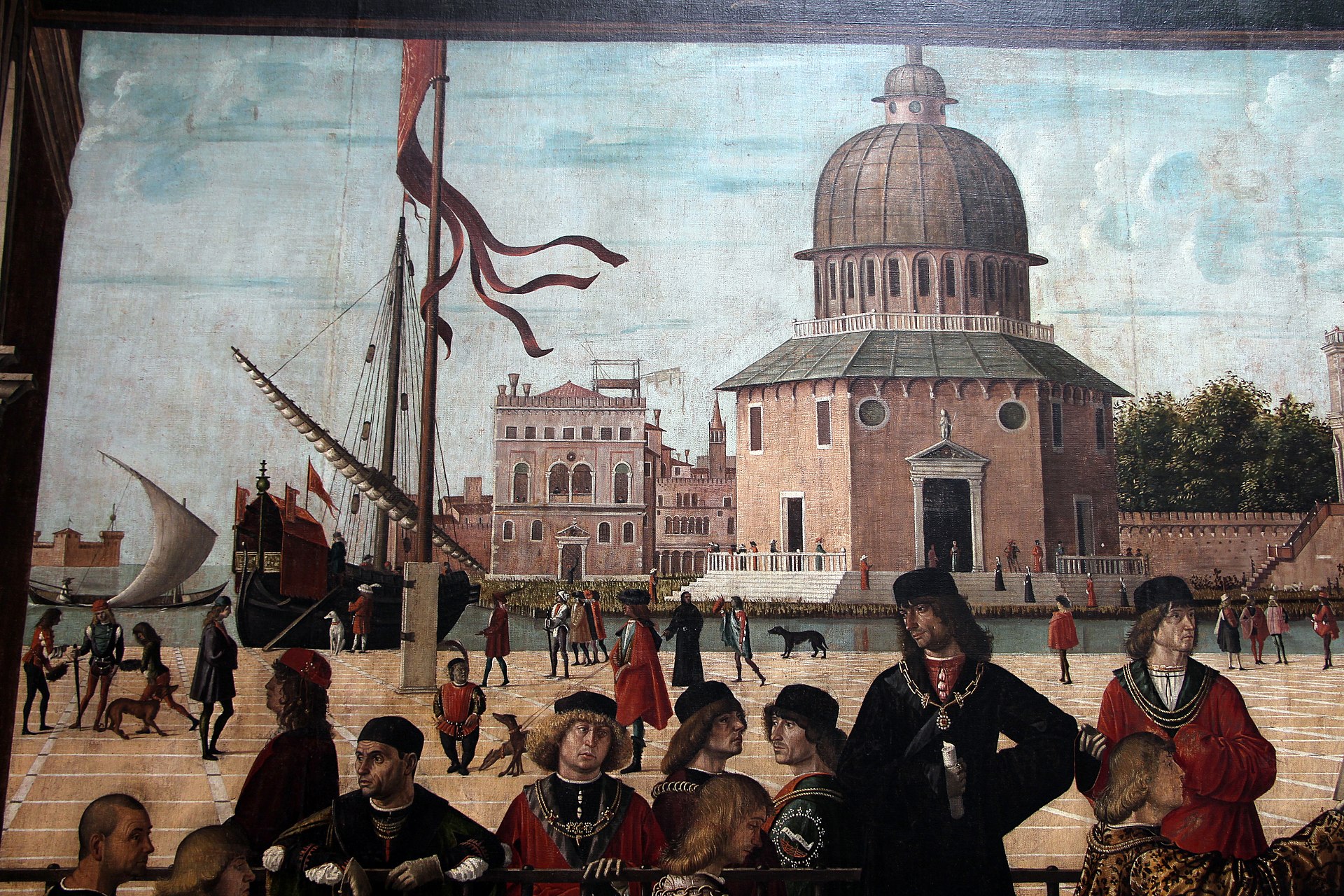
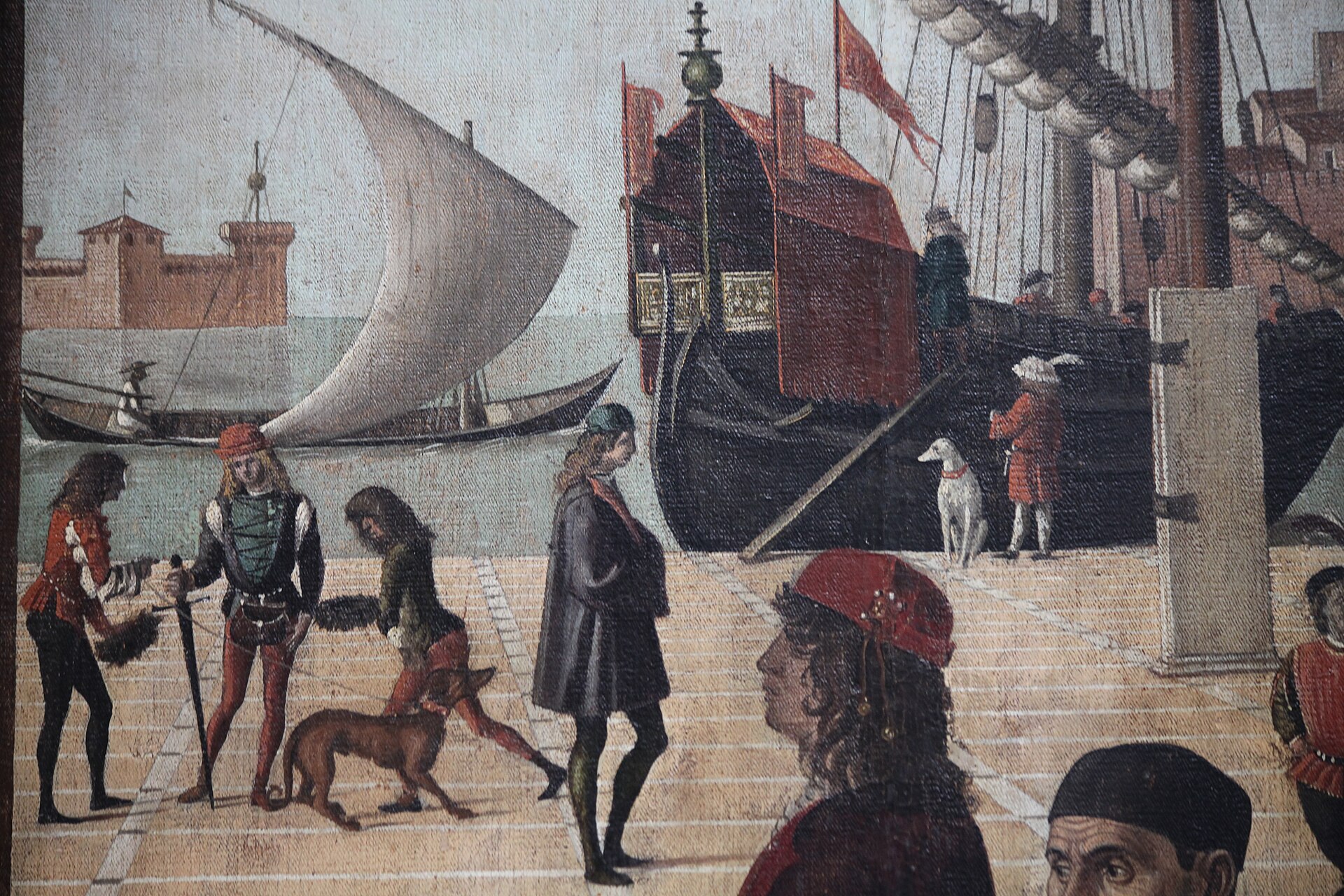
In the shallower water to the left, through a conveniently missing column, you can make out what has become for us the symbol of Venice—the passenger-carriage or ‘taxi’, the fifteenth-century ancestor of the modern one-oared gondola.
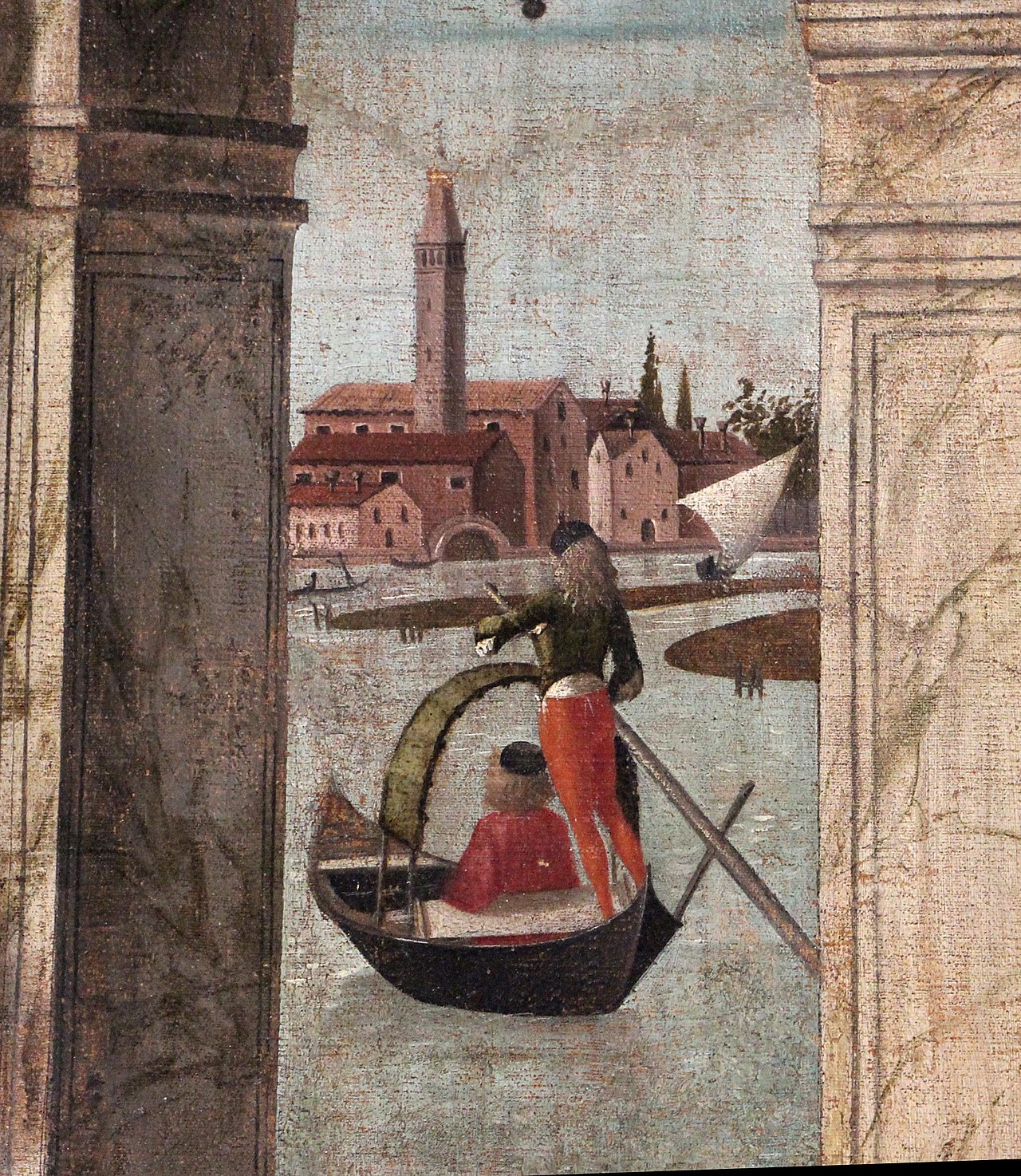
If the Venetian details are ‘capricious’ (also in the normal sense of the word, in that they are only tenuously relevant to the story) there is nothing capricious in Carpaccio’s technique, which represents one of the ‘points of arrival’, punti di arrivo, in fifteenth-century experiments with light and perspective.
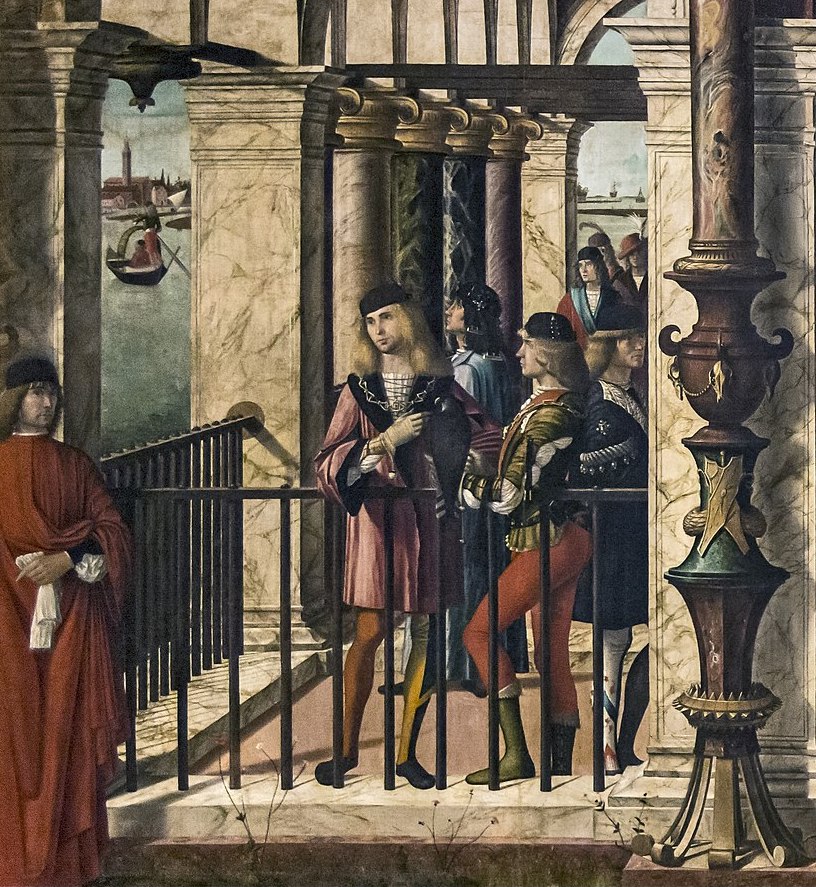
Look carefully at the cast shadows, which indicate that the light falls from high and over the left shoulder of the spectator. (Focus in particular on the shadow of the head and shoulders (only) of the man dressed in red in the foreground, or the thin shadows cast by both sections of the railing; and don’t miss the intricate shadow on the wall cast by the oddly elaborate carving of the column.)
Pay equal attention to the perspective. The main orthogonals converge, as required, on the vanishing point on the horizon, which is placed at a comfortable height, affording plenty of ground on which to position the actors.
But the system is asymmetrical, with the vanishing point placed well to the left of centre, with the result that the portico, with its Ionic columns, is nicely displayed in depth; the unimportant entry wall is almost cut off; while the right-hand wall spreads out to form an impressive backdrop to the crowned king and his counsellors.
So, what is going on? Where are we supposed to be?
The scene is set not in Venice, but in Brittany, and the Golden Legend version of the story begins as follows:
There was in Brittany a most Christian king named Maurus, who had a daughter called Ursula. She shone with such wisdom, beauty, and holiness of life, that her fame became known everywhere.
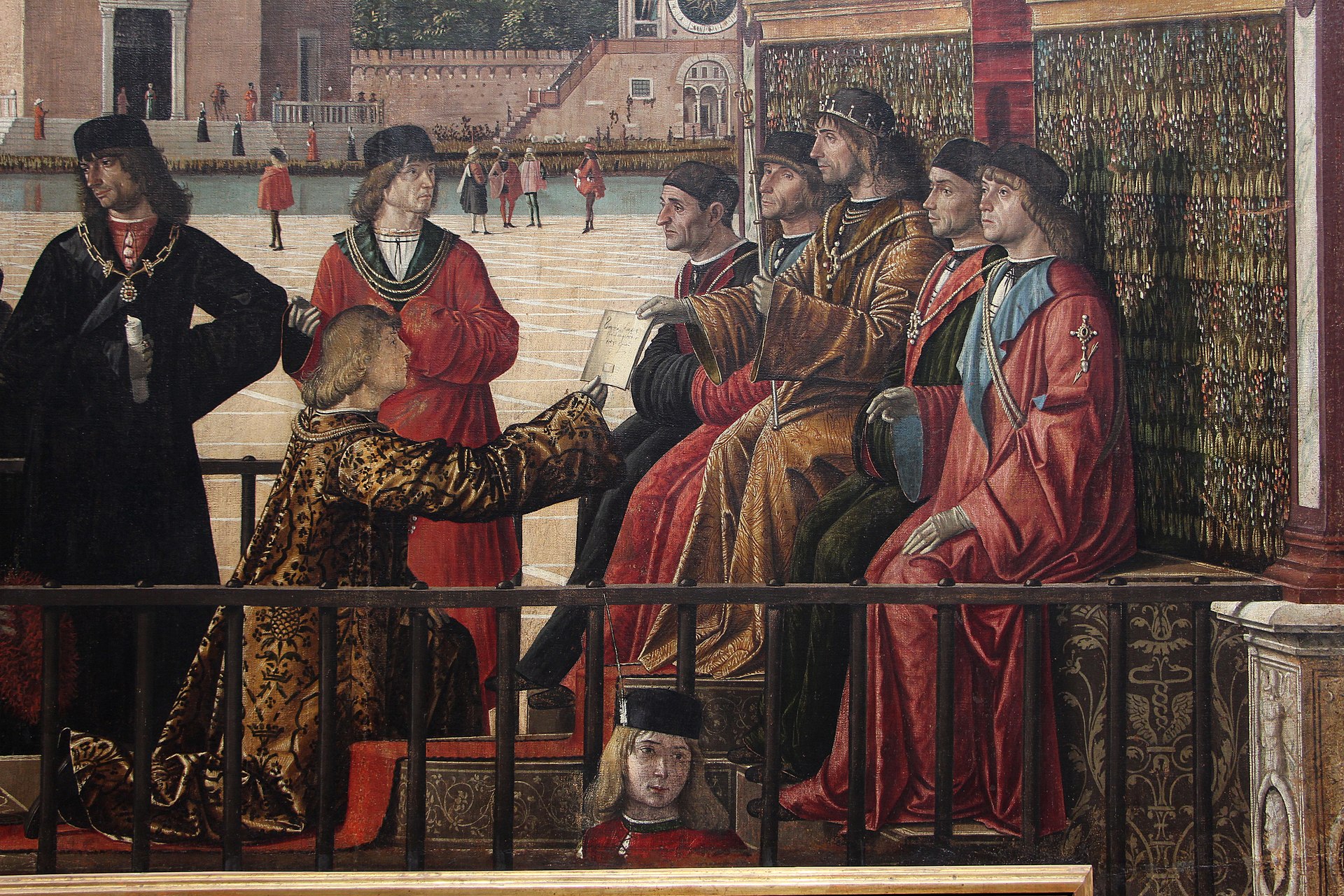
The king of England heard the renown of this virgin and declared that his happiness would be complete if she became the wife of his only son. He therefore sent a solemn embassy to the damsel’s father.
The ambassadors lavished promises and flattery upon the king but added dire threats if they should be sent back empty-handed.
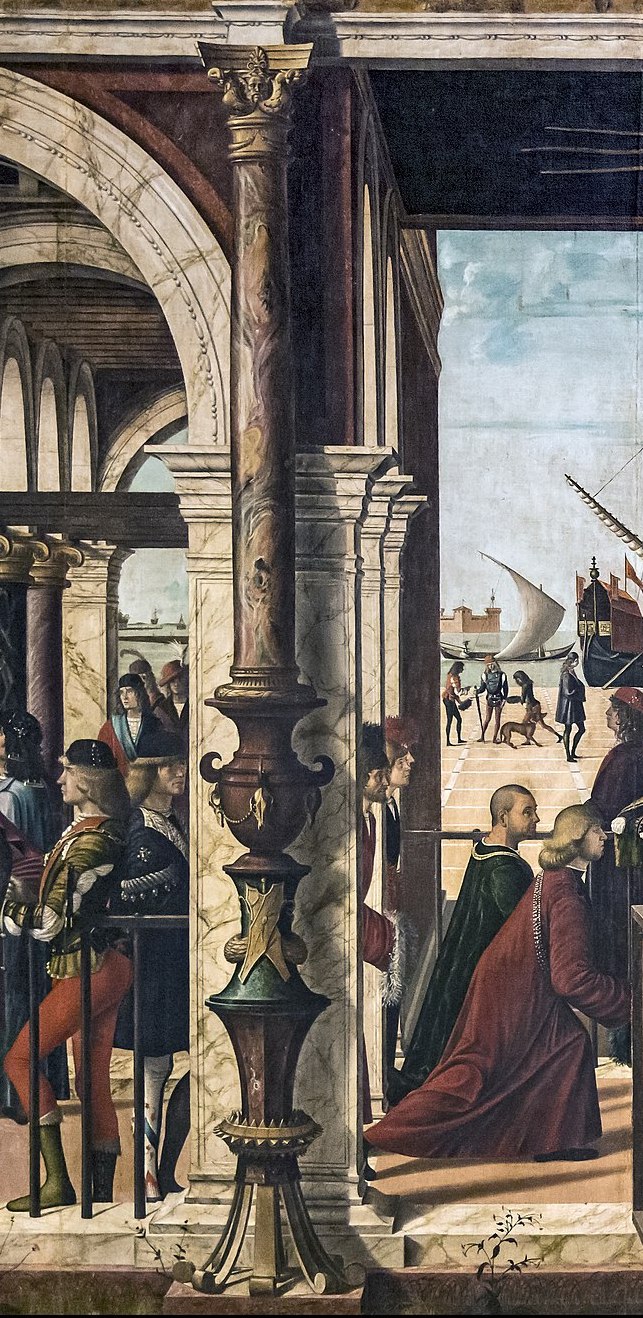
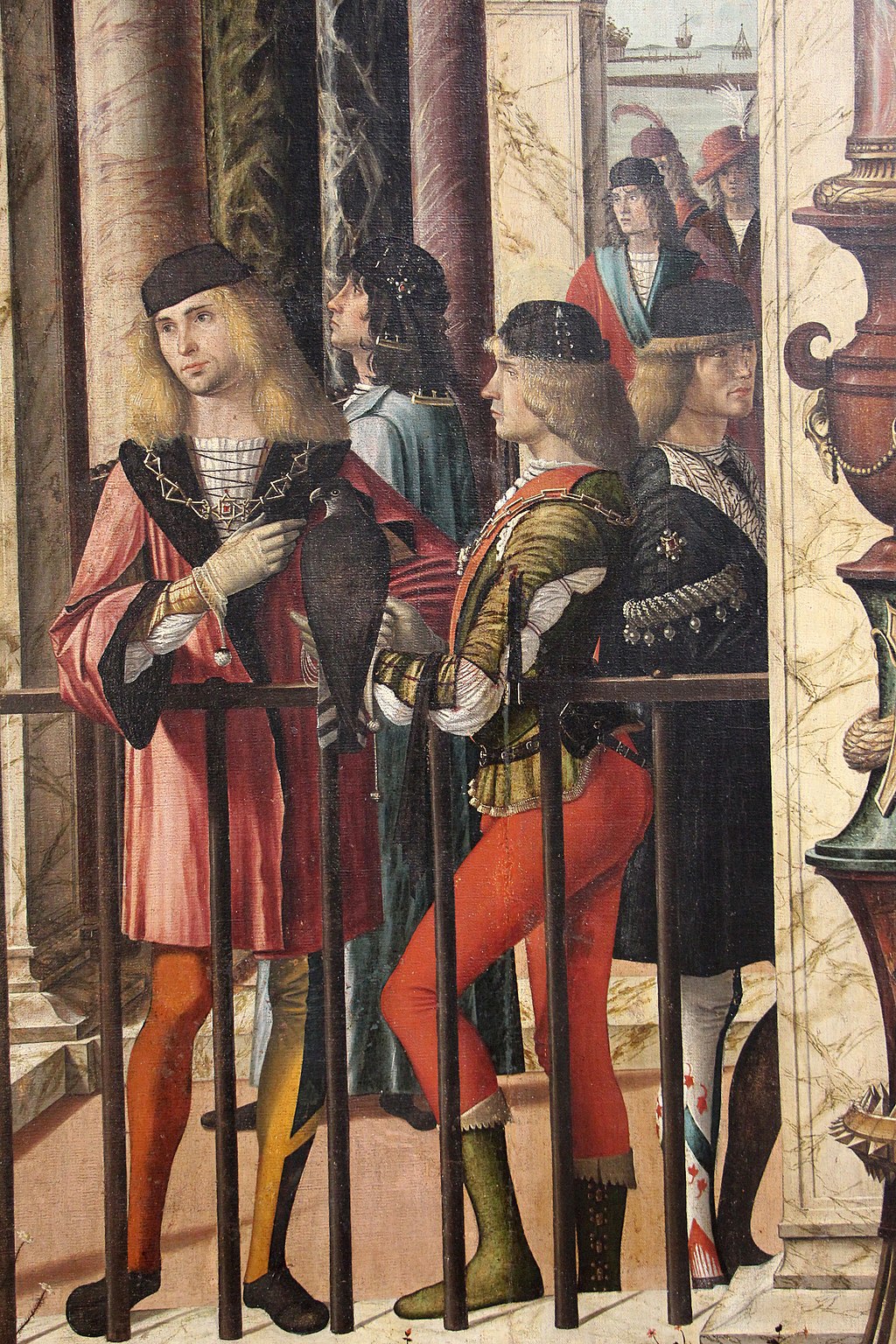
One may, then, interpret the gorgeous robes as a sign of ‘solemnity’, and the three levels of kneeling as a mixture of ‘flattery’ and ‘threat’. We should pause, though, to look at the area on the left in order to admire the magnificent polychrome marble column, (with its very unclassical base), and, in particular, the portrait studies of the young noblemen who are standing negligently by the railing, one with a falcon on his wrist. Every detail of their attire is lovingly observed: the hose (wrinkles and all), the doublet or coat, the slashed sleeves and draw strings, the shoulder-length hair, and the flat hats.
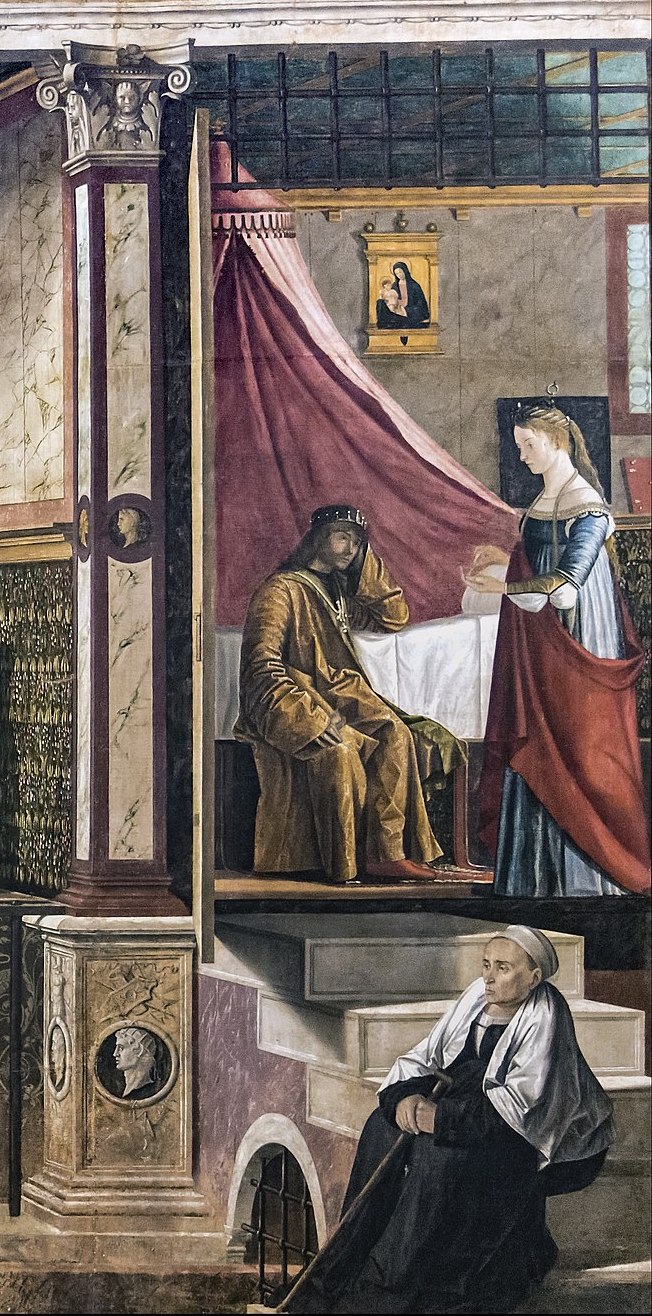
We return now to the story, and to the scene in the bedroom on the right of the painting, where King Maurus is shown for a second time, listening attentively to his daughter, who is of course the heroine of the tale.
The Golden Legend continues:
On hearing the demands, the king was distraught with fear, not only because he deemed it unworthy to hand over a Christian maiden to a worshipper of idols, but also because he knew that she would by no means consent. But Ursula, being inspired by God, proposed that he should yield to the king’s demand, putting as a condition that the suitor should grant her ten virgins as companions.
A condition, you might think, not unreasonable for the daughter of a king, and in perfect accord with the matter-of-fact way in which she is ticking off her points on her fingers. But then she goes on to demand that her suitor should also assign, to her and to each of her ten companions, a thousand other virgins–hence, eleven thousand and ten virgins in all! This is where the fairy-tale comes in.
I have already spent a long time on this first canvas and must therefore hasten past the marvellous study of the old nurse, in her white shawl over the black dress, who seems to be seated in our space (almost in the room itself), providing a link between us and the stairs and the bedroom.
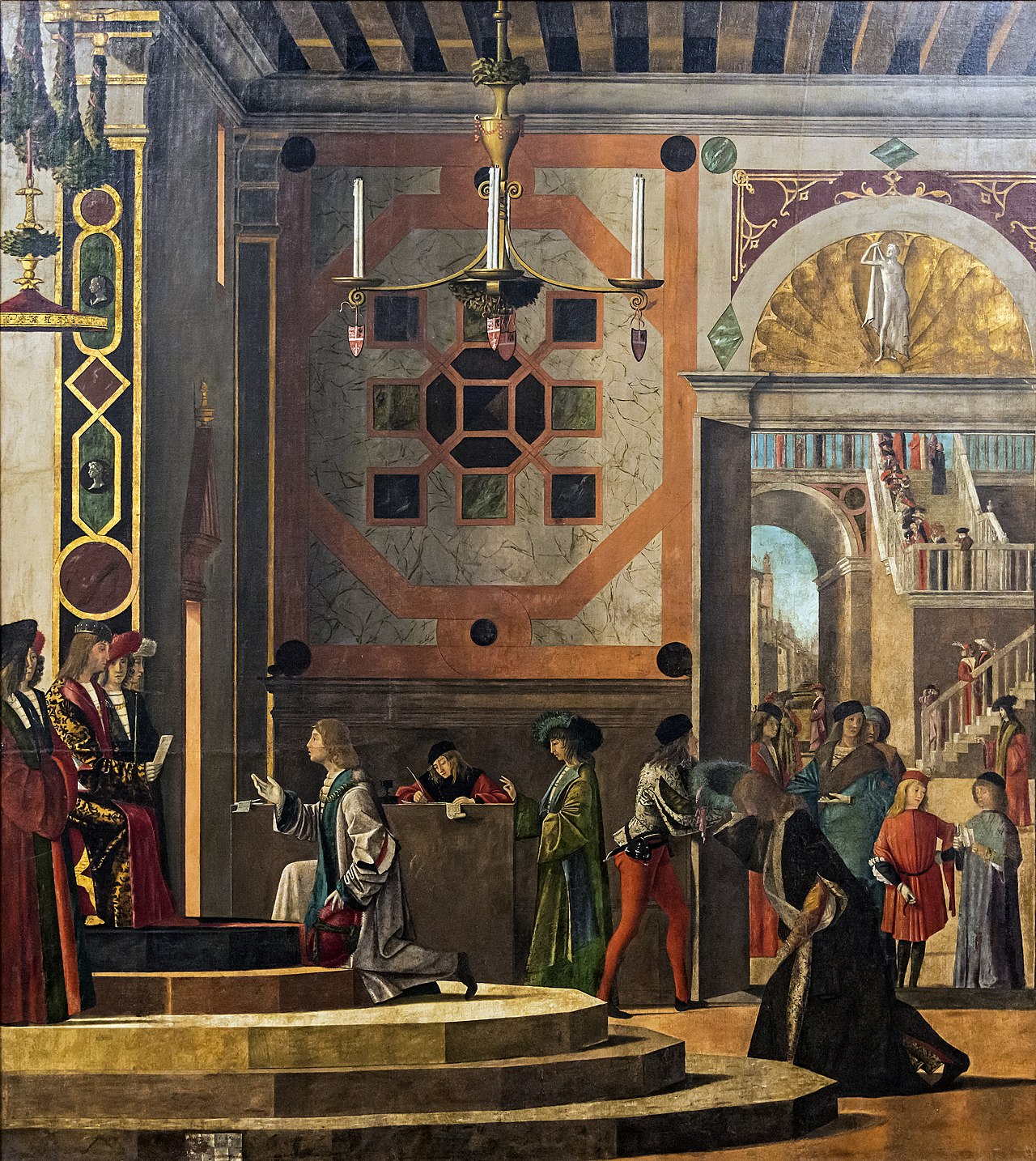
The second canvas is almost square, nine feet high by slightly over eight, and it used to lie immediately to the right of the first.
It is the following morning. The English ambassadors return to King Maurus to receive his response to their demands. He reads from a parchment the requirement outlined above and some even more amazing conditions, which are being recorded by the scribe with his quill. The King of England was to prepare a fleet for Ursula; to allow her a delay of three years which she might devote to the practice of virginity; his son was to be baptised and instructed in the faith; and after those three years, Ursula together with her 11,000 companions would go on a pilgrimage to Rome.
The scene is reversed with respect to the first, but the energy of the story is still travelling from left to right, since the king is dictating, not listening. Notice in this regard too, the hindmost of the English ambassadors: he is withdrawing and making his obeisance without turning his back; and his retreat is reinforced by the fall of the light, which is casting the shadows from left to right (as you see on the steps), and playing beautifully on the front of the robes of the young official. There is some virtuoso use of perspective, too; but I shall not guide you up the stairs or into the street, as I would rather you concentrated on the festoons, the foreshortened canopy, the intarsia pattern on the wall, and the chandelier.
The third canvas lay to the right again. It is wider, being seventeen feet across.
As far as the development of the narrative is concerned, Carpaccio might be said to be ‘pushing his luck’. He sticks firmly to the fairy-tale theme of the ‘impossible demands’, and he shows us the English ambassadors for the third time, as they arrive back in London. Again, we see only two of the ambassadors—one scuttling like the White Rabbit from the quayside (which needs weeding), the other already kneeling before his royal master, who receives him in an octagonal loggia raised on three marble steps of different colours.
All we need to know for the story is that ‘the young prince gladly consented to the conditions, was baptised immediately, and gave orders that the virgin’s demands should be fulfilled with all speed’.
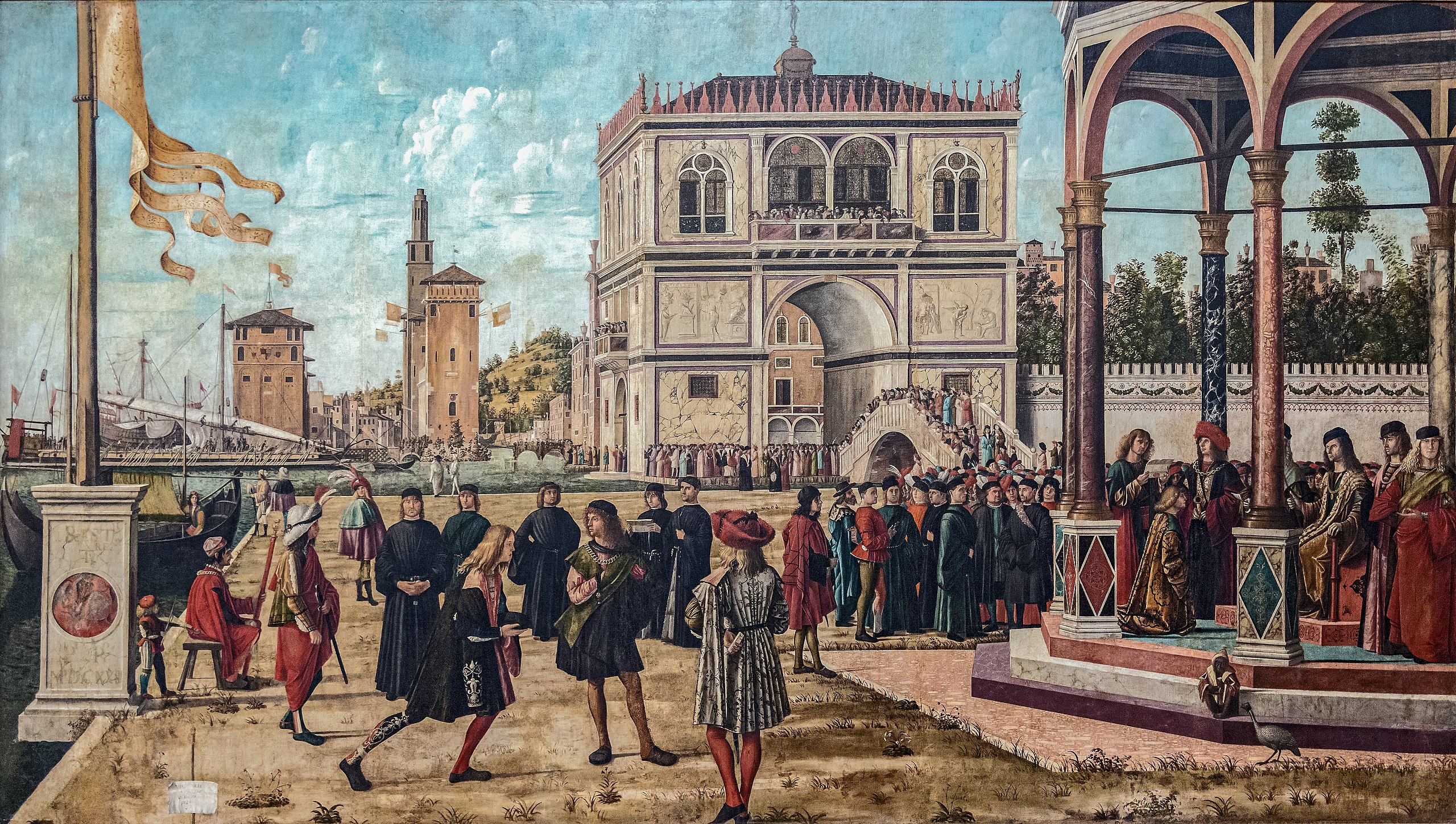
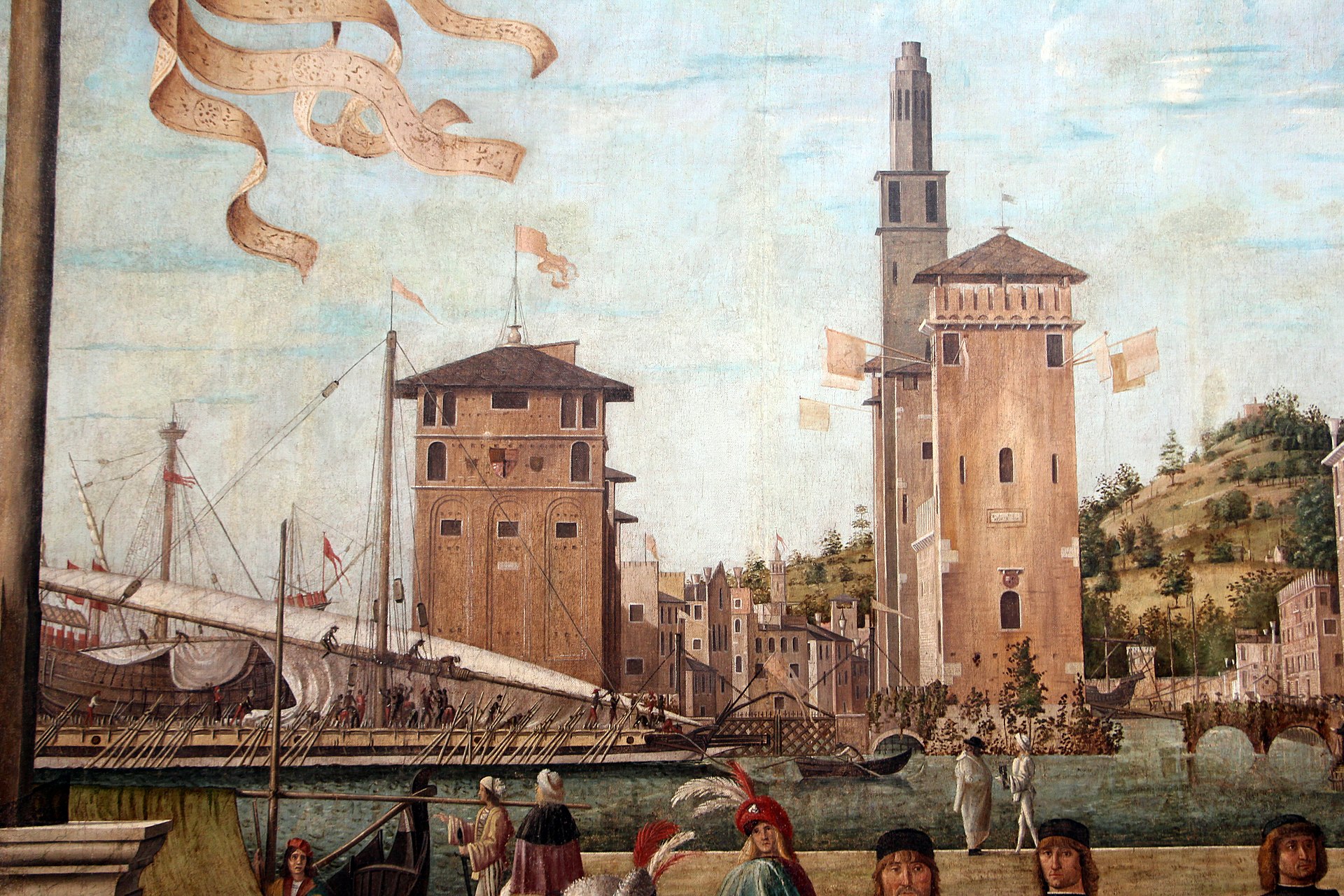
The composition exploits the full width of the canvas; the light, rather cooler, falls from the left again; and its direction is reinforced by that of the wind which is pushing out the ends of the pennant.
London looks as much like Venice as Brittany did: notice the Venetian war galley which is being moored in front of brick towers that recall the shape of the Venetian Arsenal; the canal piercing the land under the low bridge; and the splendid, exotic, marble-faced palace, proportioned like a triumphal arch, with a balcony crowded with spectators.
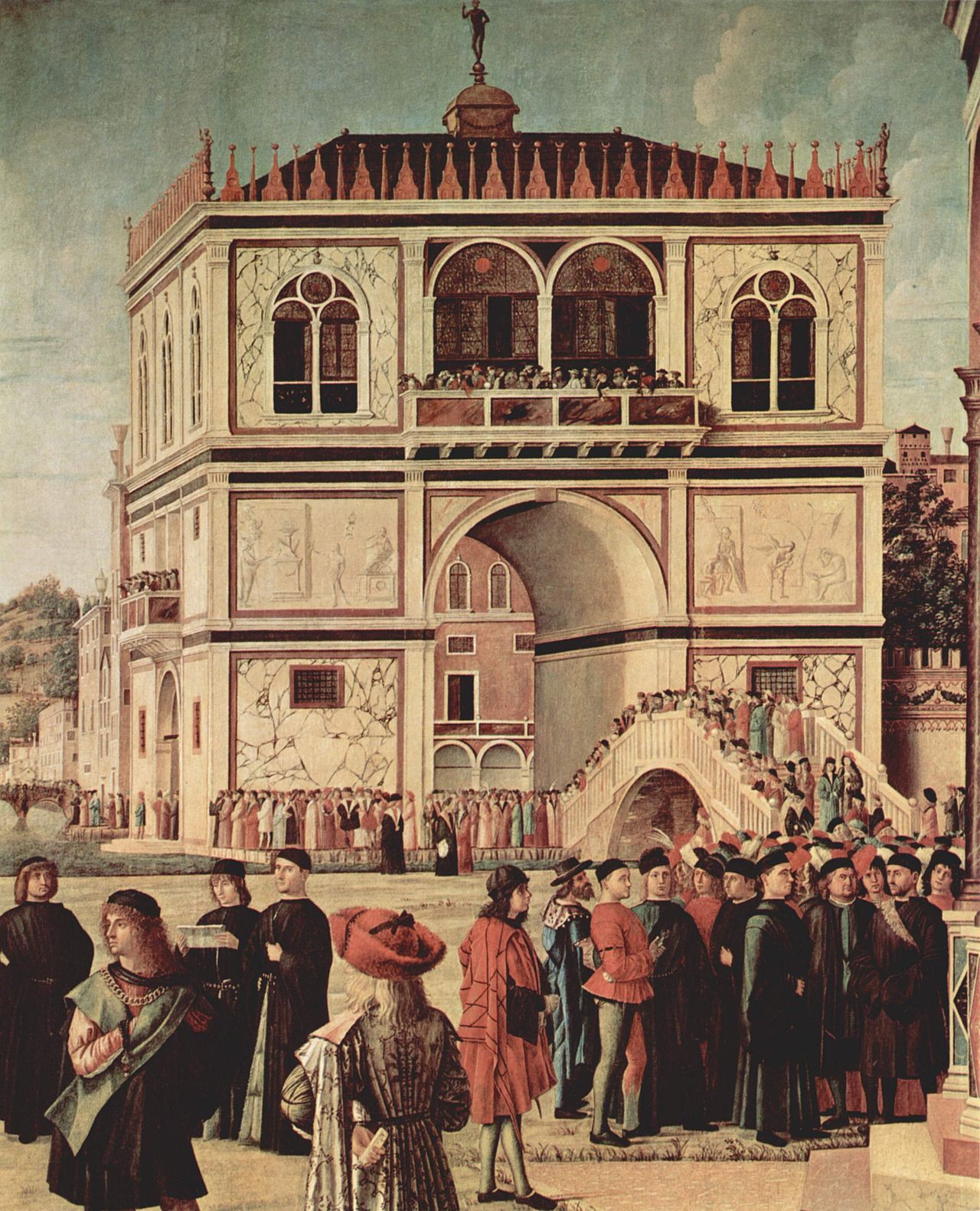
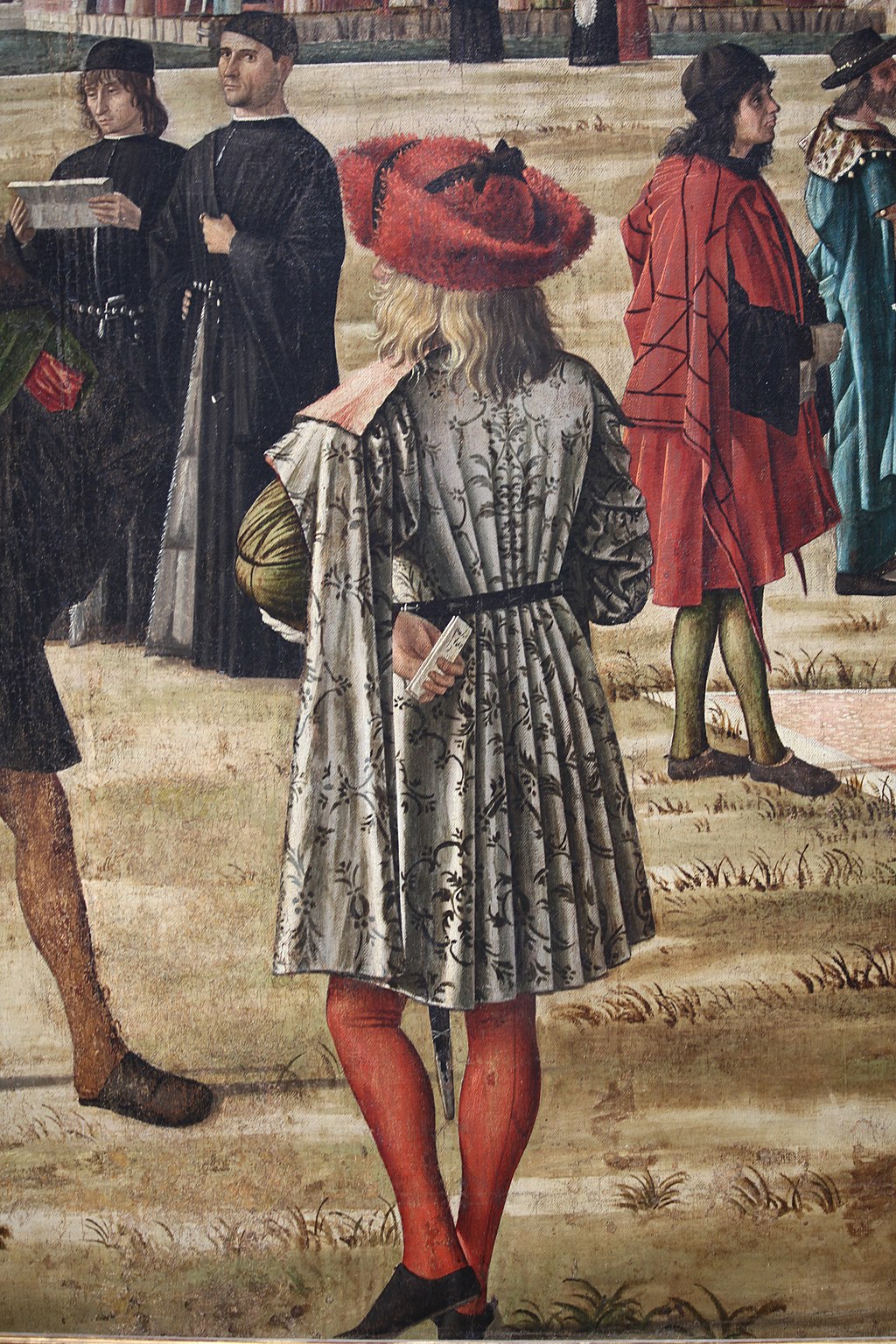
Male fashions too were clearly just as advanced in London as they were in Brittany, as you can see in the young man in the first detail, with his broad red hat over his blond locks, glorying in the pleats of his brocaded cloak.
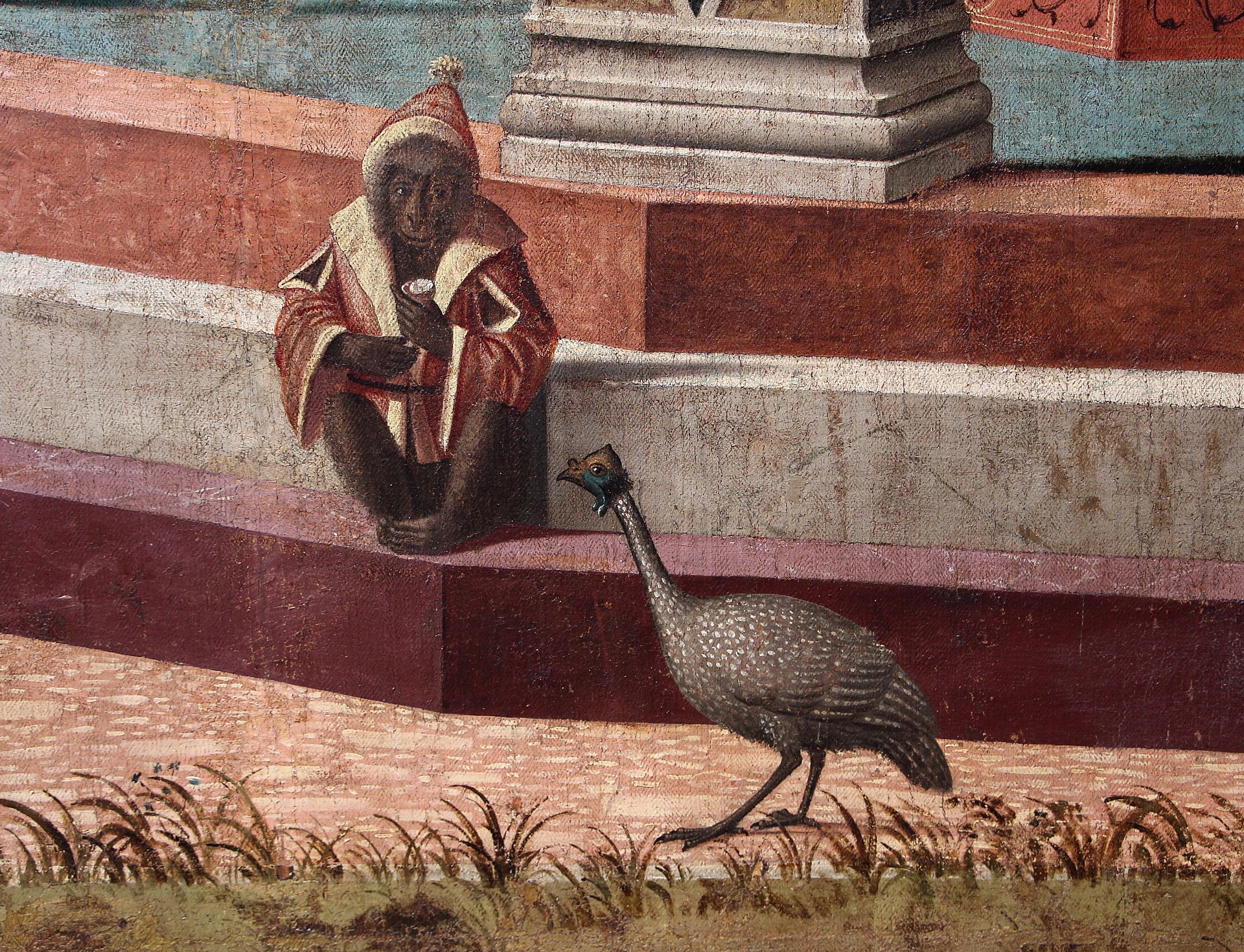
The whole surface is crowded with highly enjoyable details, but none is perhaps more charming than the monkey on the steps of the loggia who is dressed in a jester’s costume and senatorial robes, and is curling his toes just as babies do, while clearly determined not to give his ice-cream or bun to the advancing guinea fowl.
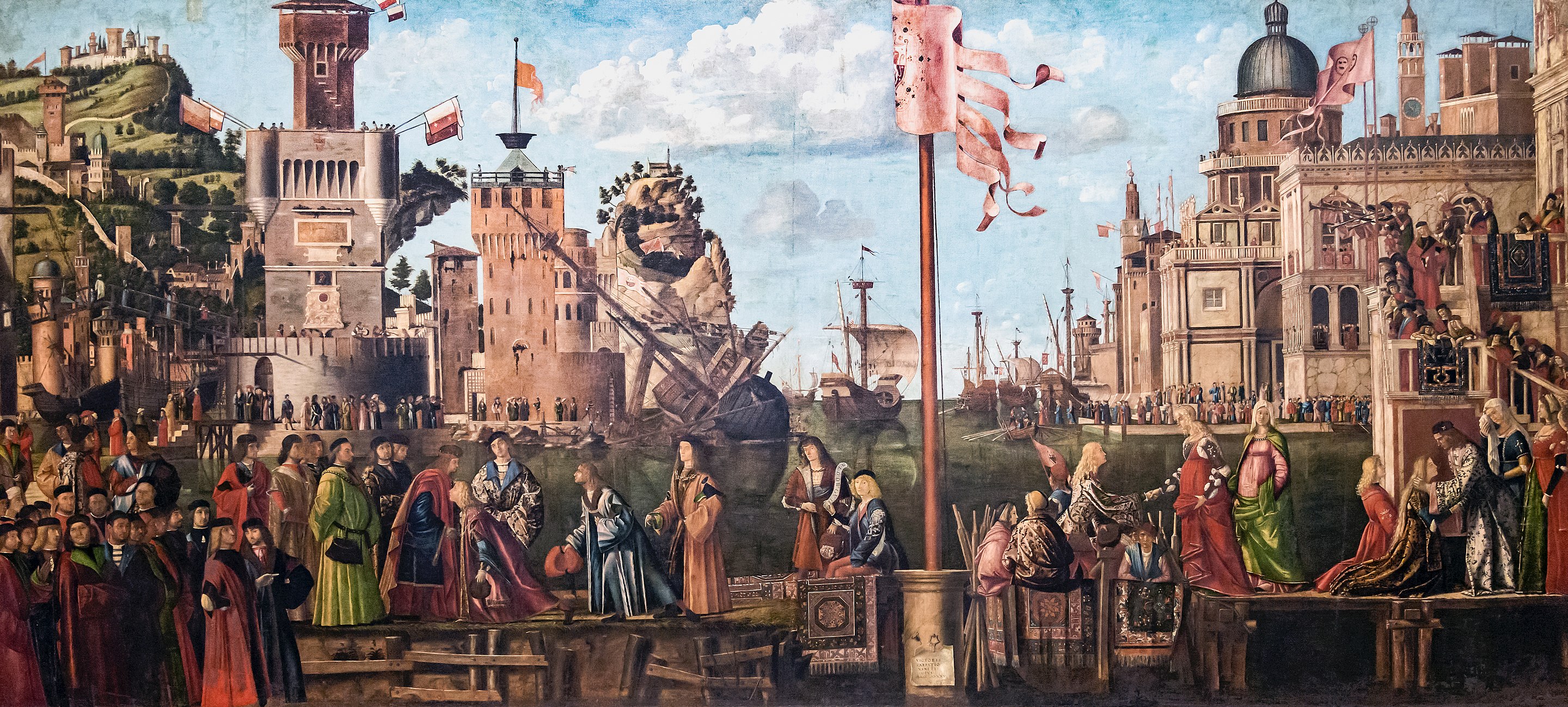
We now turn the corner to the west wall, where the main entry door lay underneath the widest of the canvasses, which measures nine feet high by twenty feet across.
It shows the consequences of the negotiations in the first and the third scenes, but now at the level of heads of state, rather than of ambassadors.
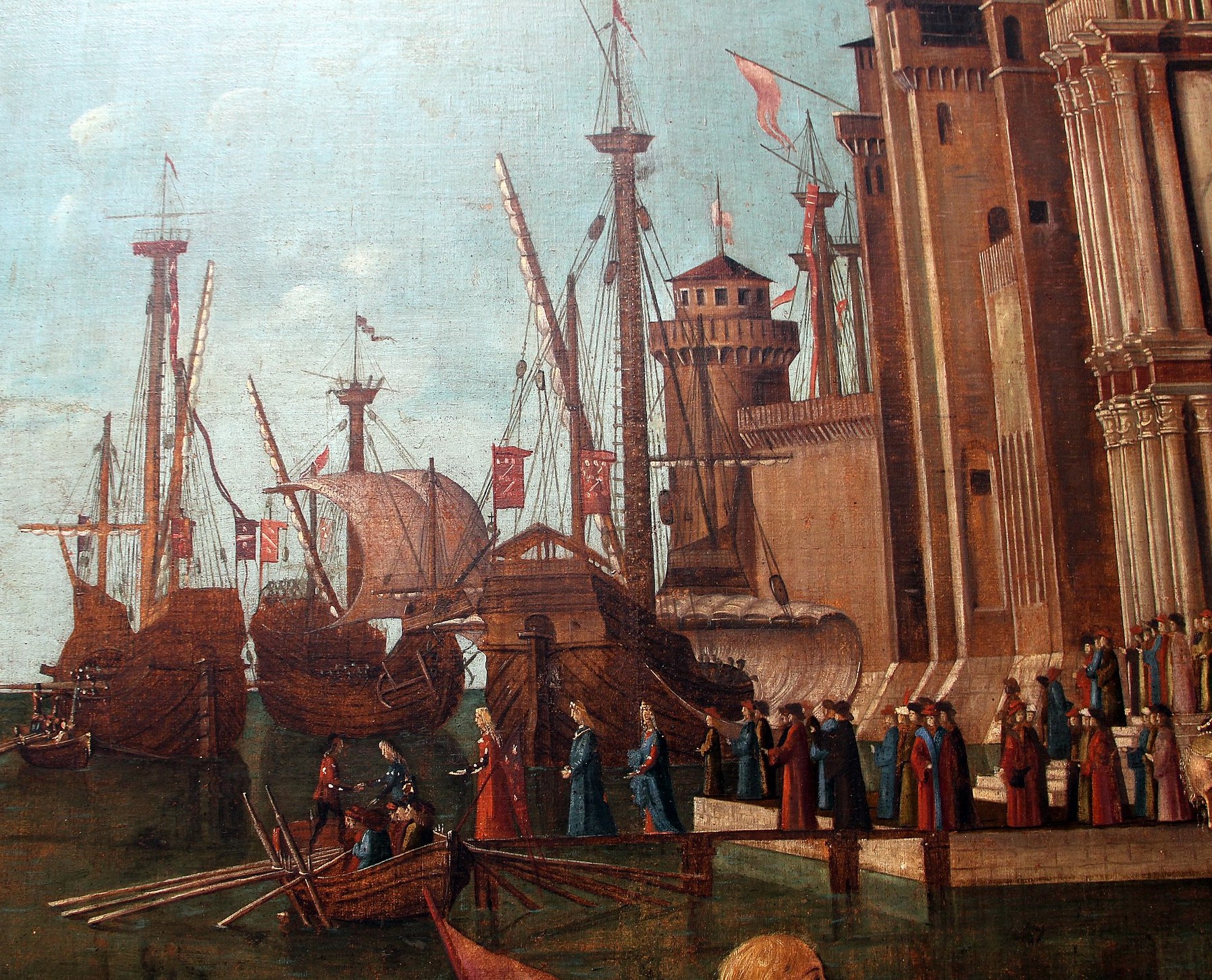
There are two leave-takings, two embarkations, and one disembarkation. What looks like a single vast harbour, with a narrow neck, under the expanse of brilliant sky, is in the story, two harbours; and the flagpole with its pennant marks a division between places and events (typically, it is placed well off-centre).
To the left, beneath steep hills and military buildings, lies a port in England; while to the right lies Brittany, with the cupola of a cathedral behind another splendid marble-faced palace, glowing brightly in the same clear light.
There is almost nothing further to relate as regards the story, except to point out that Carpaccio has abandoned the Golden Legend for a different version of the legend, in which the groom actually accompanied his bride and the 11,000 virgins on their pilgrimage to Rome.
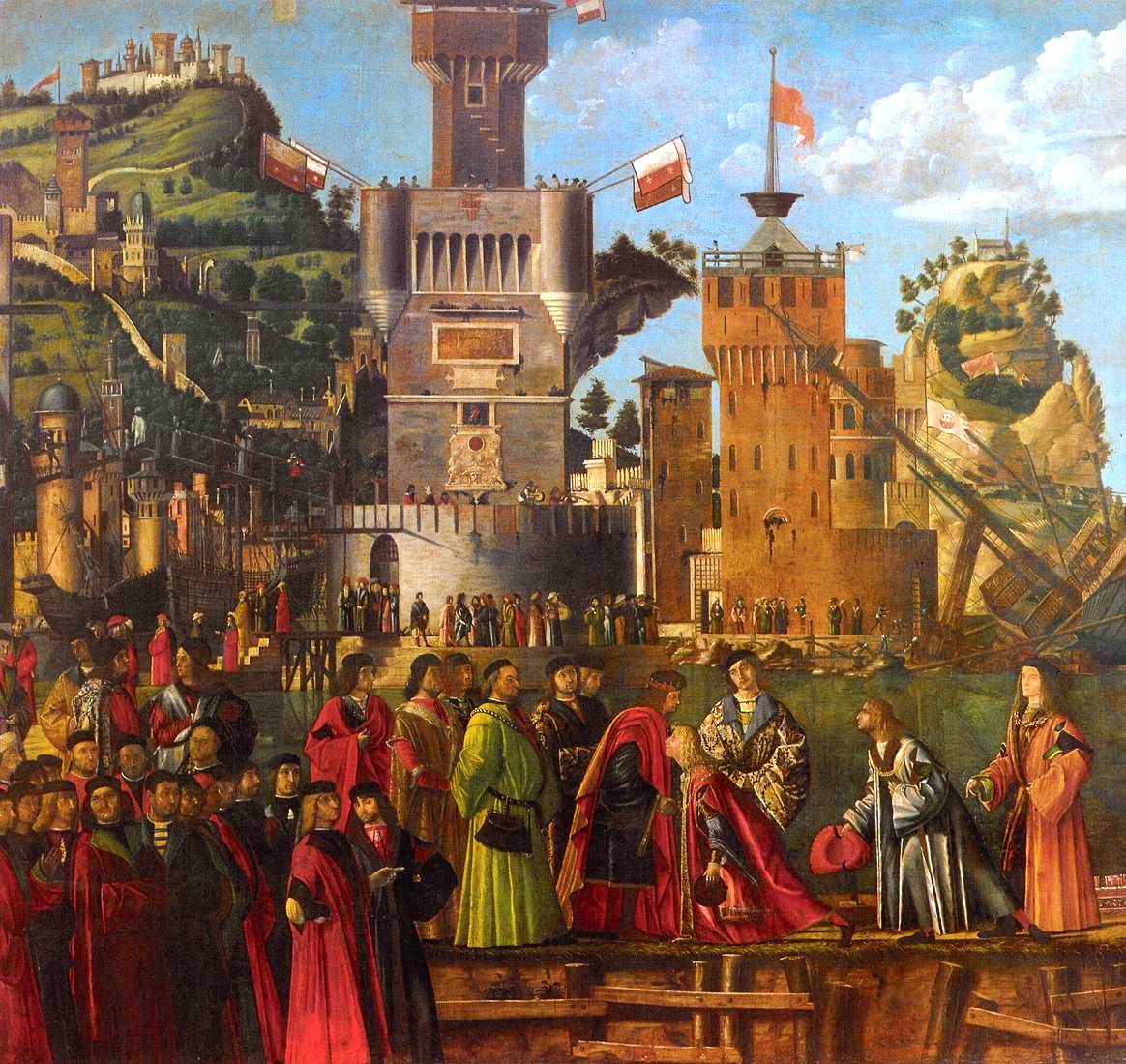
Closing in on the English side of the harbour, look first at the group of nobles (with many obvious portraits), and then at the royal gentlemen-in-waiting, behind King Conon of England, who is bidding farewell to his kneeling son, Prince Ethereus, whose attendant lord makes an obeisance behind him.
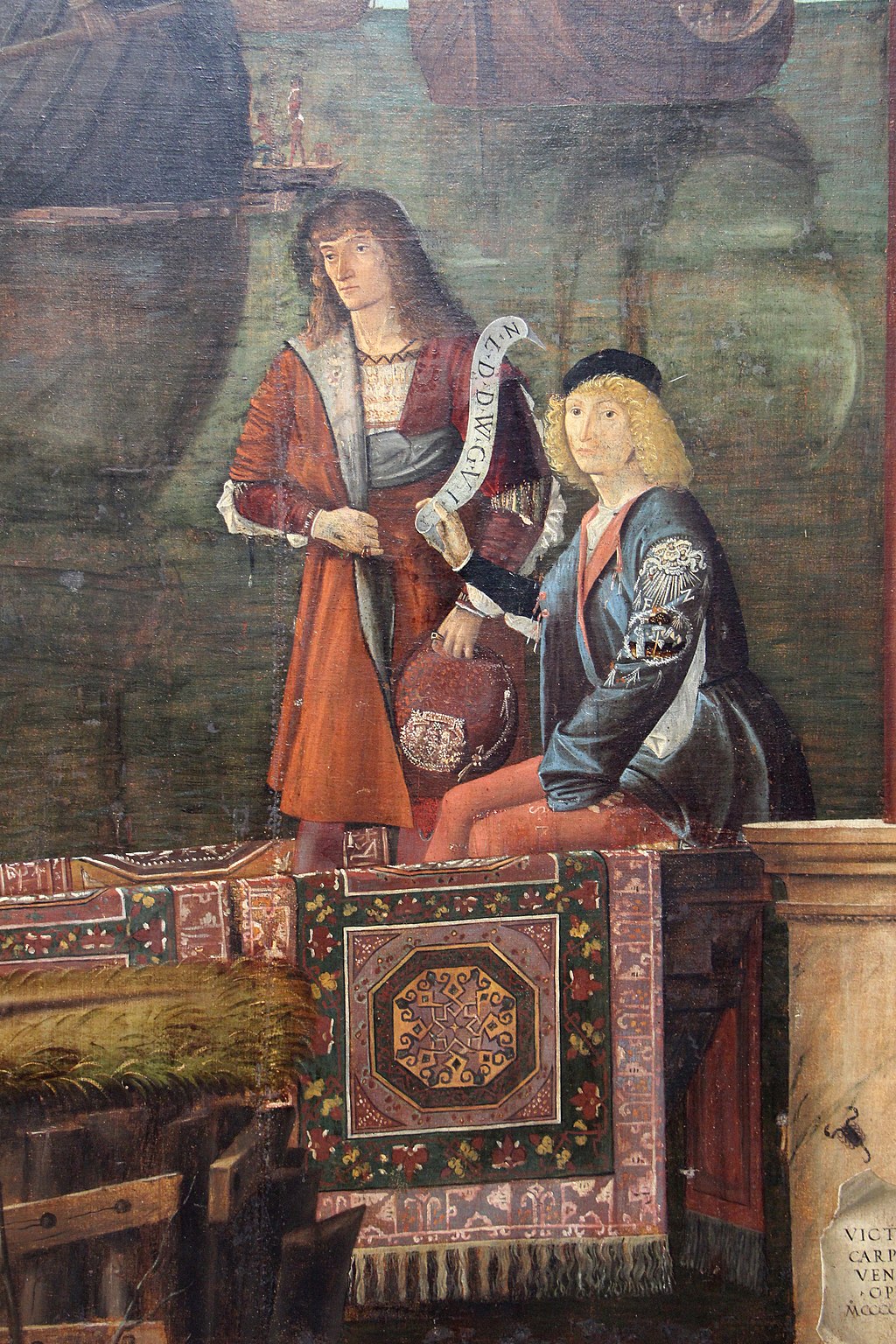
The cutter in which Ethereus is about to embark lies on the far side of the jetty on which the group are standing—except for its richly caparisoned stern, where two young men are seated, holding a still enigmatic scroll.
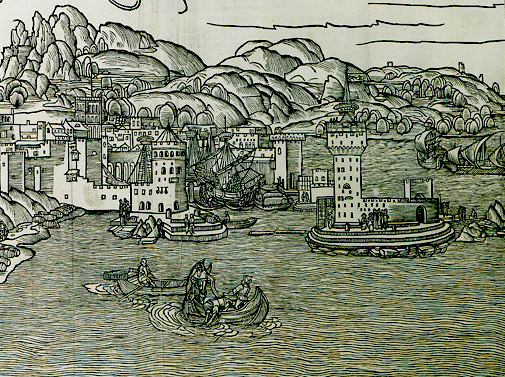
The fortifications in the background (brick and stone, unlike the marble of Brittany) are another ‘caprice’, derived from the woodcut you see here, published in the 1480s, showing the Venetian-controlled island of Crete (notice in particular the tower).
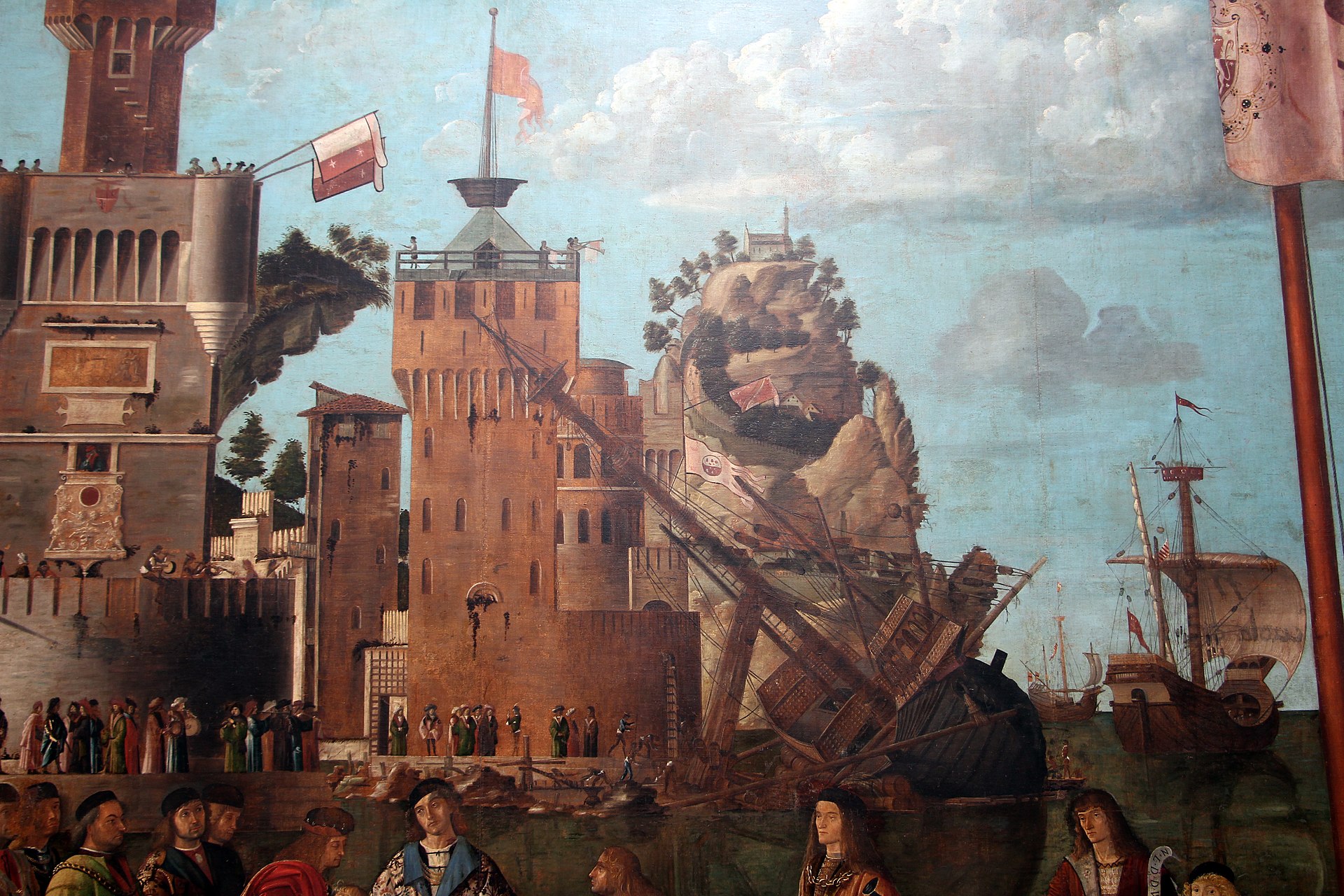
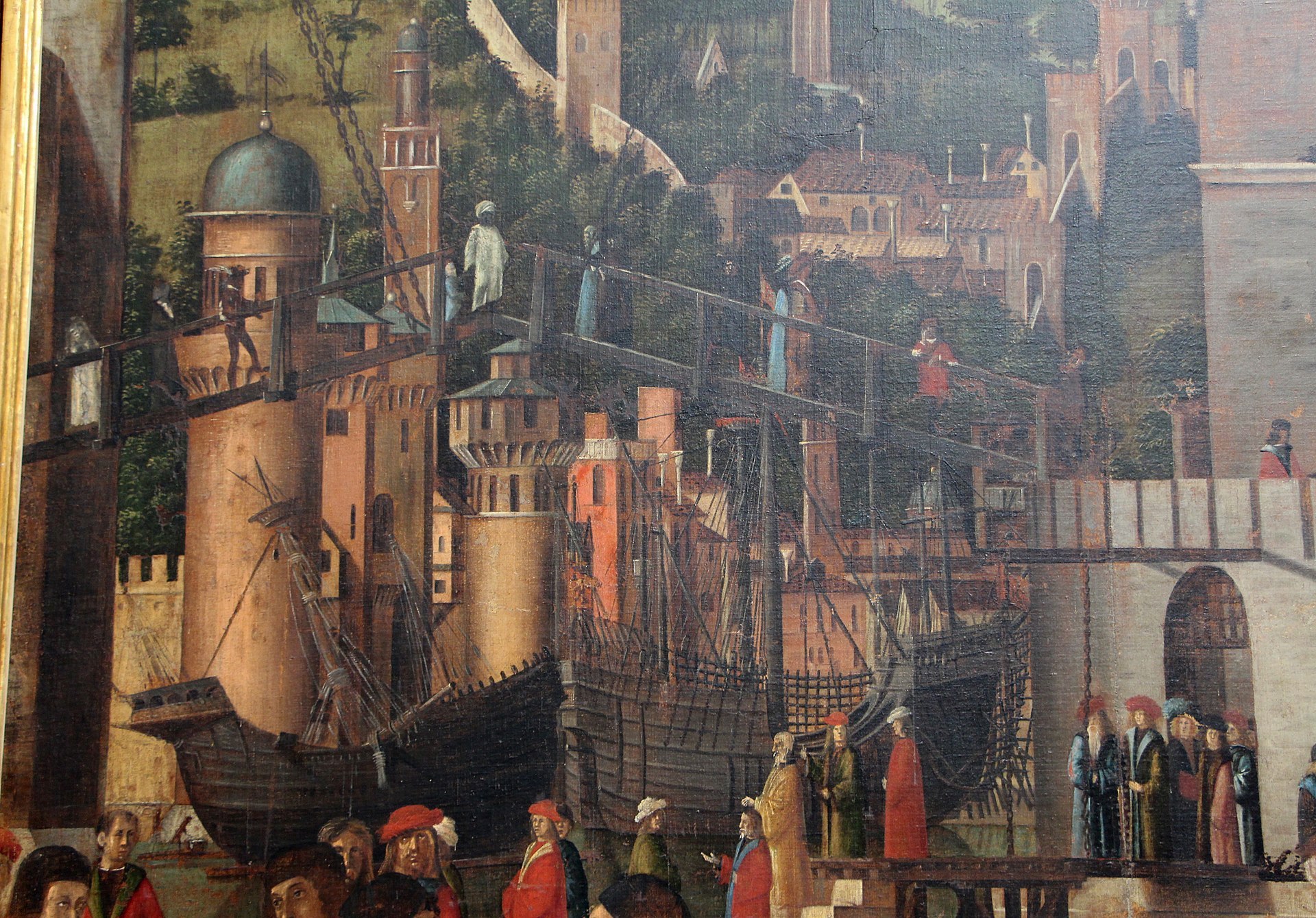
Again, there are hosts and hosts of wonderful details. I particularly enjoy the rickety wooden draw-bridge, suspended by chains left and right, and the amazing angle of the mast dragged over by the battery of pulleys that serve to winch the ship over on its side so that it can be careened and have repairs carried out below the water line.
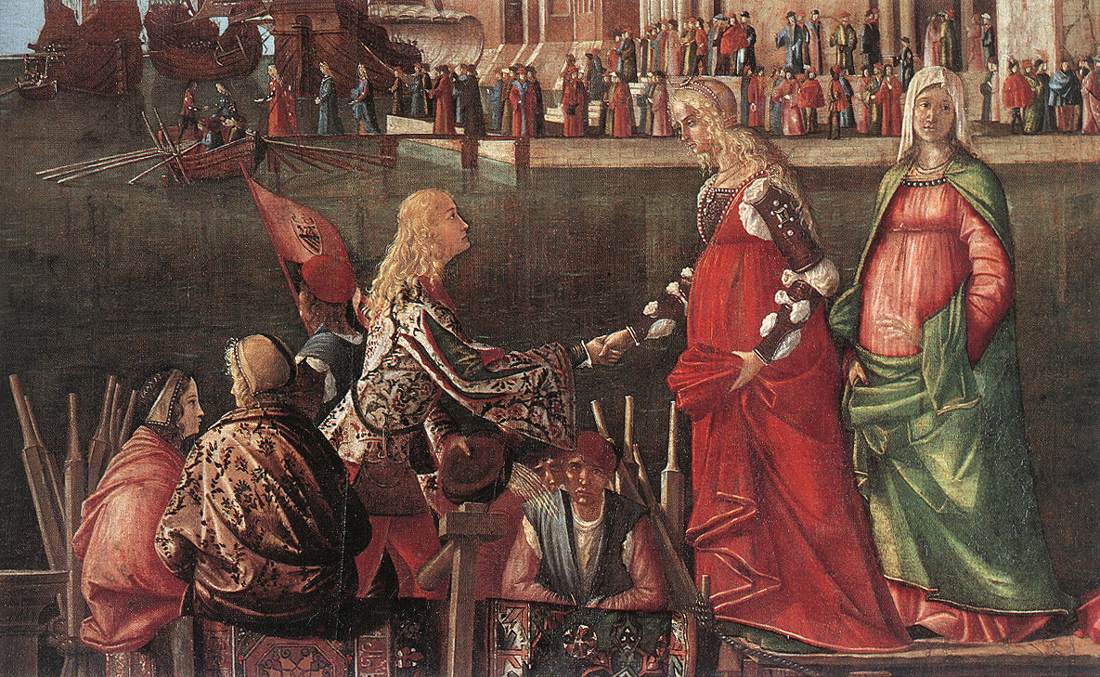
We now move to the other side of the dividing flagpole, where we see Prince Ethereus disembarking from his ‘state barge’, which is presented stern on, with the tiller projecting towards us (notice how the oars have been carefully placed to pin the boat to the landing stage).
He steps up and out, every bit the fairy-tale prince with his brocaded coat and flowing blonde hair, and he is officially welcomed by Princess Ursula, dressed in the height of fashion—which has the side effect of making her look several months pregnant.
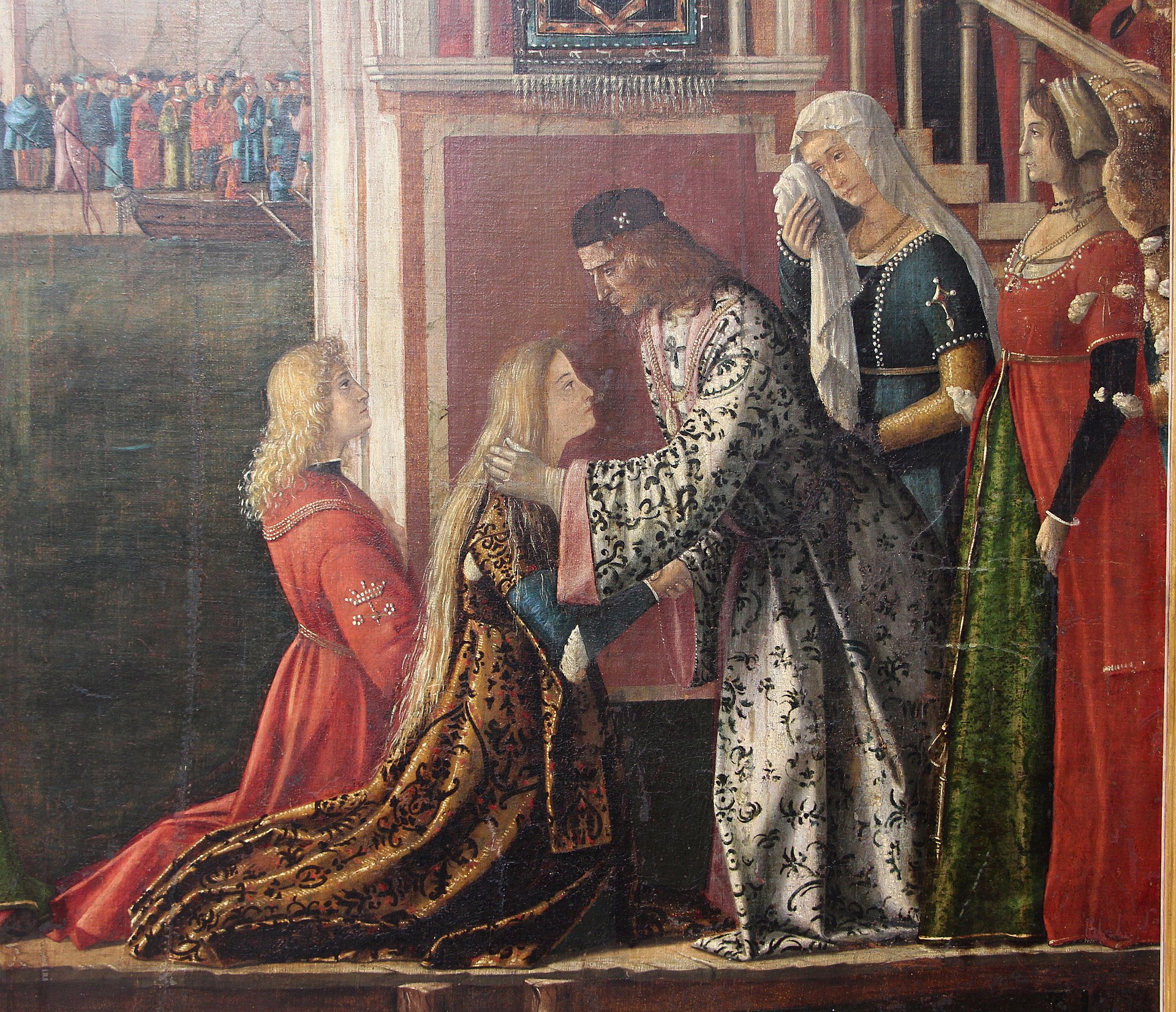
Scarcely have they met in person, when a fleet (as stipulated in the marriage contract) begins to assemble in the harbour, to take the couple (and the 11,000 virgins!) on a voyage to the mouth of the Rhine, thence up the river to Basel, and overland to Rome.
We do not see the virgins yet, only the betrothed couple, kneeling side by side to pay farewell to King Maurus, while the nameless Queen dabs her eye, as a mother should.
Next, we must make our way along a very Venetian fondamento in front of the marble palace and cathedral, until we come to the third cutter.
This vessel, held with its oars in the shallow water against the little gangway, will soon take the royal couple out to the ships, which are already hoisting their foresails for the voyage.
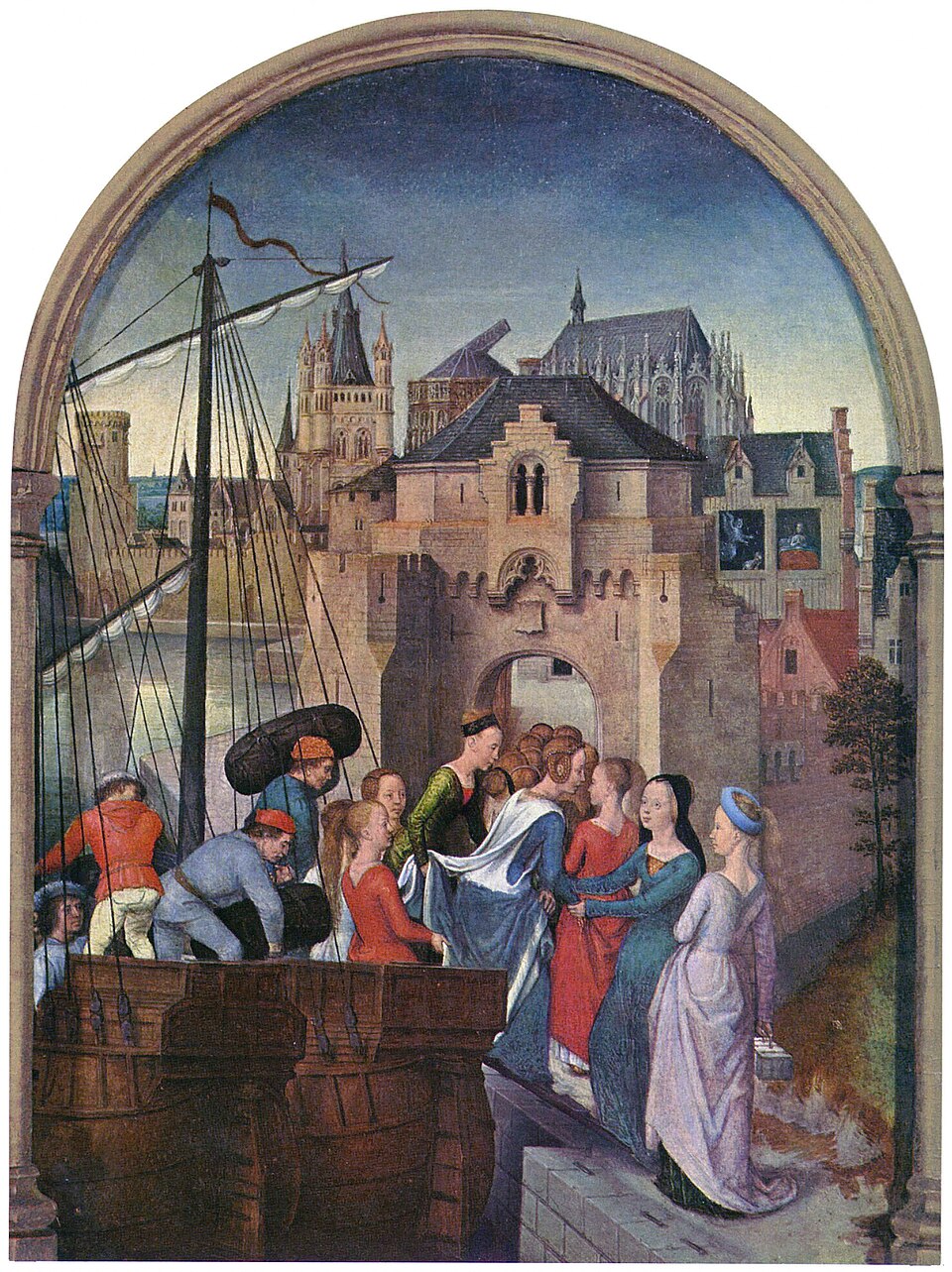
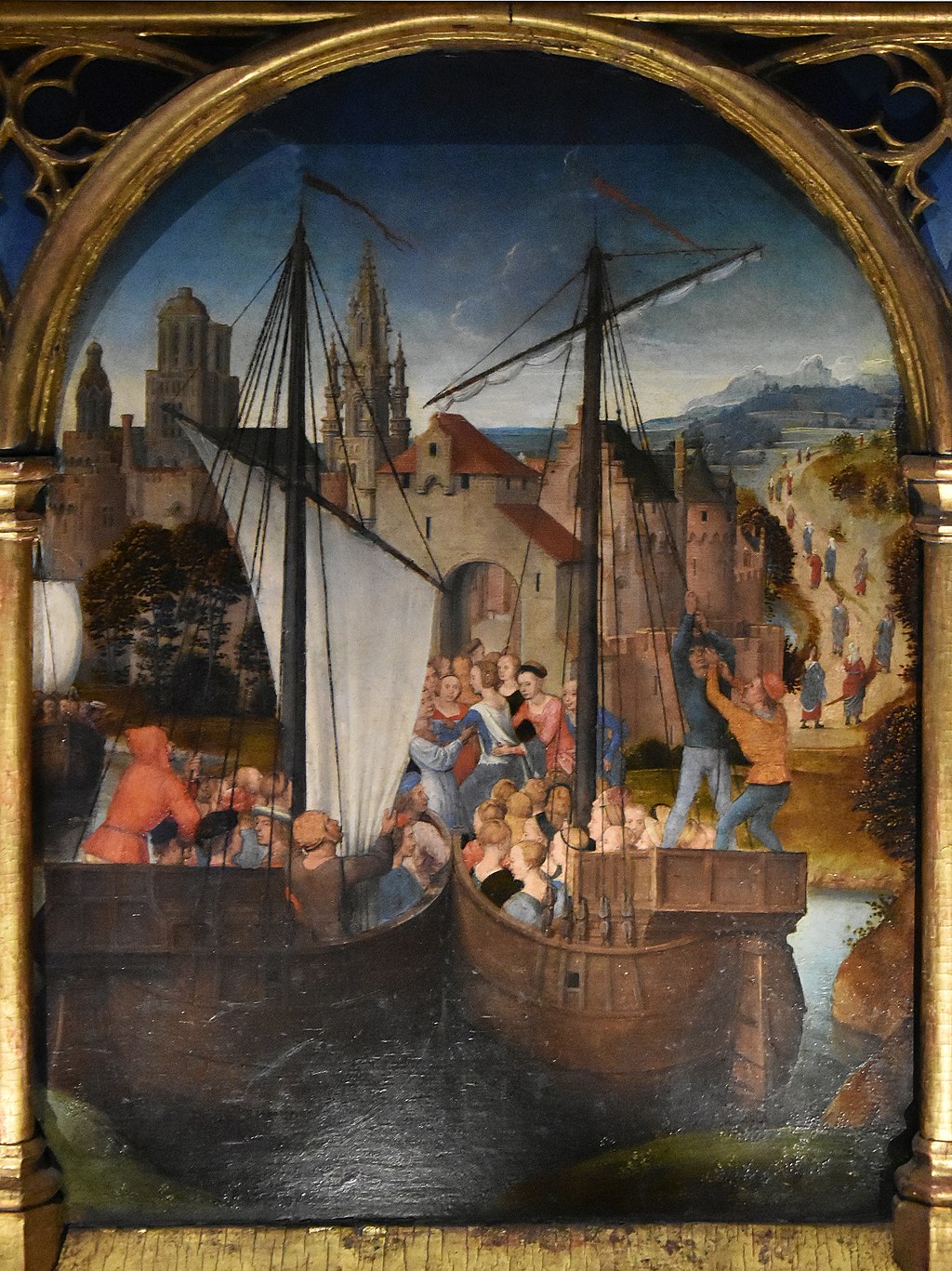
At this point I whisk you away from Venice in the 1490s to Bruges in the 1480s, and from a scale of nine feet high to a mere fifteen inches, as we glance for a moment at the first panel in Memling’s reliquary.
The main point of the shift is to allow you to register the huge differences in conventions between Italian Renaissance Art and Northern Gothic Art. But Memling’s panel will also enable us to follow the eleven thousand virgins (here reduced to eleven) on their journey, because, in the words of the Legend: ‘At length in the space of one day a favourable wind bore them to a port in Gaul whence they went to Cologne.’
Notice the still unfinished cathedral in the background, and do not neglect the diminutive window of the bedroom in which Ursula had a vision of an angel before she continued her journey, because it is this dream (in a somewhat bigger bedroom) that will form the subject of the next canvas in Carpaccio’s cycle, which was designed to cover the west end of the north wall of the School of St Ursula in Venice.
The story could hardly be simpler.
The Lord appeared to Ursula and foretold to her that they would every one return to Cologne and would there win the crown of martyrdom.
But the supernatural vision provides the excuse for one of the most memorable and detailed domestic interiors to be found anywhere in Italian fifteenth-century painting, and also for one of the most ‘poetic’ studies of the fall of light.
Remember that the natural light used to come from over the altar in the School of St Ursula (that is, from the east end), and notice that the pictorial light is represented as falling right to left, as you can clearly see in the shadow cast by the angel who is holding the palm of martyrdom in his hand.
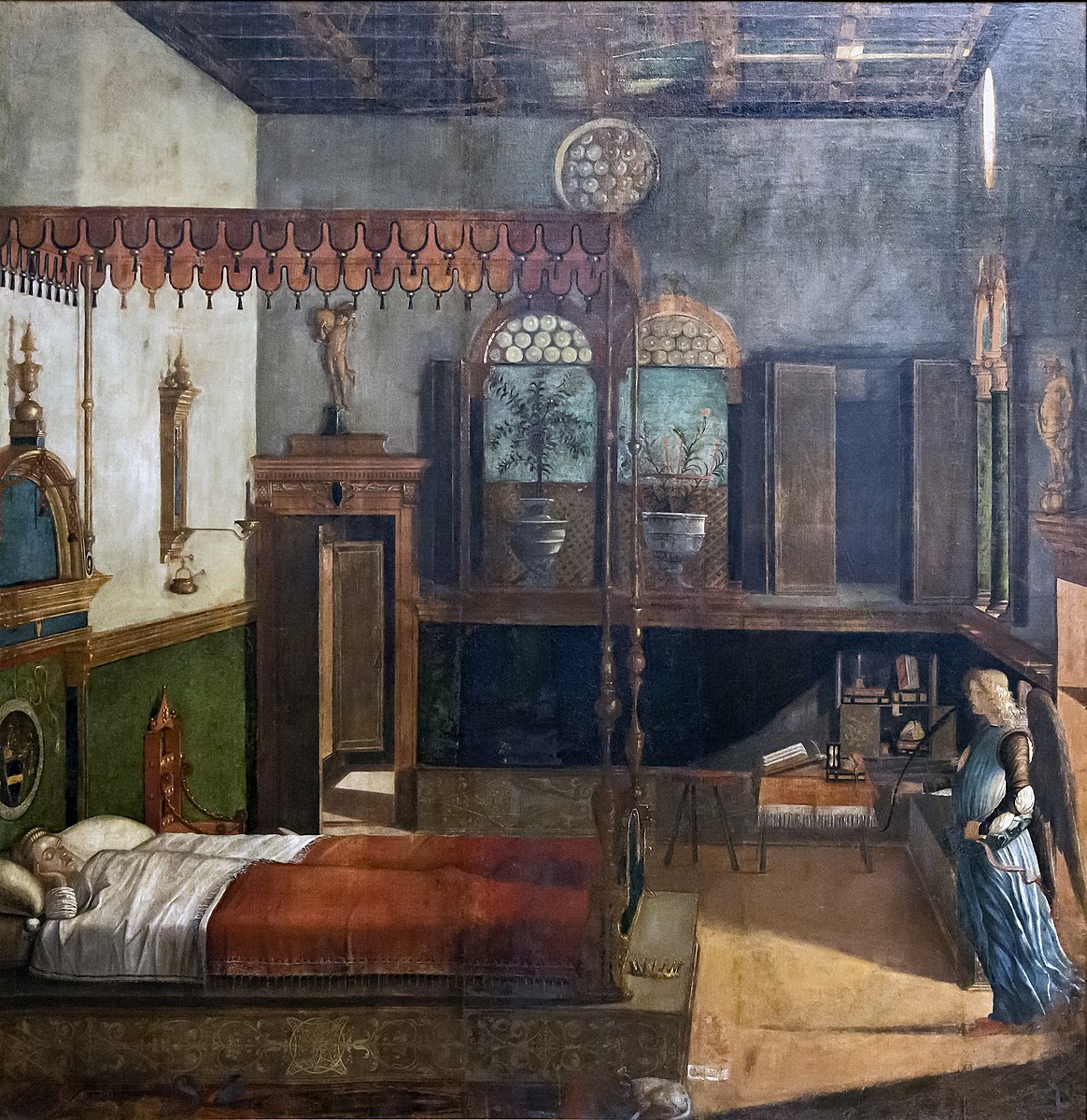
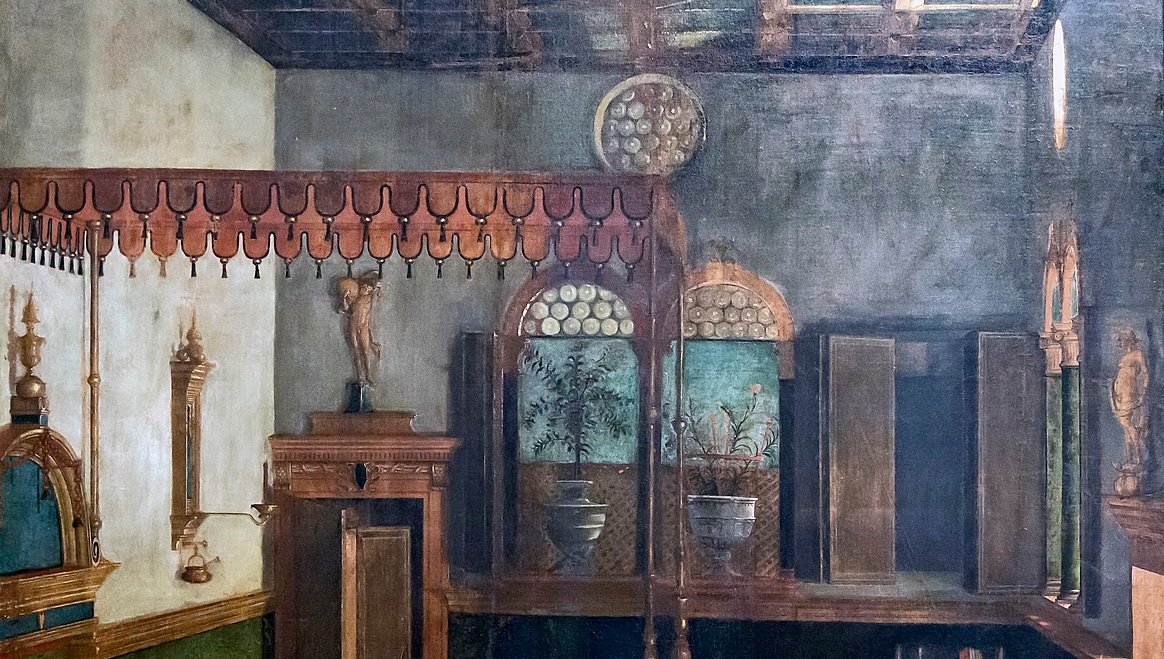
In some ways, the light is the most important agent here. It fans out over the pink floor, casting the angel’s shadow before him. From the oculus, it catches the rafters. From the right hand windows, it catches the underside of the canopy and falls to illuminate the bookcase, table and stool. Most importantly, it lights up the whole of wall opposite, thus inviting us to enjoy the bedhead, the chair, and the foreshortened icon with its candle-arm and little bowl for the holy water.
More light falls from a hidden window in the passageway, and filters through the mullions and lattice of the rear window, which provides a light background for the potted plants, myrtle and carnations, which tell not of martyrdom, but of love and marriage.
Back to Memling again in the second panel on his reliquary, which is an illustration of the next sentence in the Golden Legend:
Thence, at the angel’s command, they set out [up the Rhine] for Rome; and making port at the city of Basel, they left their ships there and continued their journey on foot.
On the right, you can see a dozen of the virgins resolutely tucking up their skirts and setting out up the lane towards the foothills of the Alps.
They all got safely to Rome, where the pope, whose name was Cyriacus, ‘was overjoyed at their arrival, for he too was a native of Brittany, and they found many kinswomen among their number; wherefore he and his clergy received them with the highest honours’.
We have rejoined Carpaccio in this image—and you should have experienced a huge visual shock at the difference in style, because this scene was painted before any of the five we have looked at so far.
He has chosen to represent the meeting of two processions.
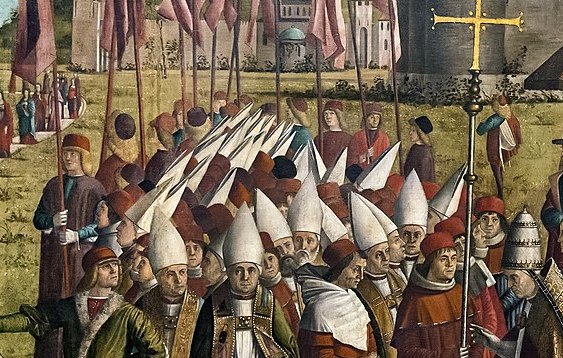
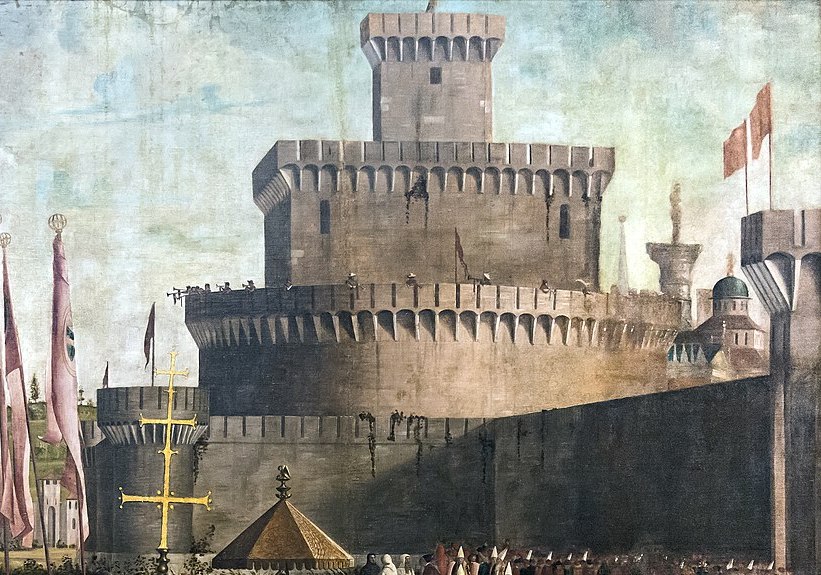
From the right, with the light behind them, the ‘clergy’ emerge from a city gate in Rome—including a prodigious number of bishops. Then they vanish from view, before reappearing to line up behind the pope, who is shown wearing his tiara underneath the portable baldacchino.
Typically, Carpaccio relishes the opportunity to represent the superb ecclesiastical copes of the senior bishops immediately behind the pope.
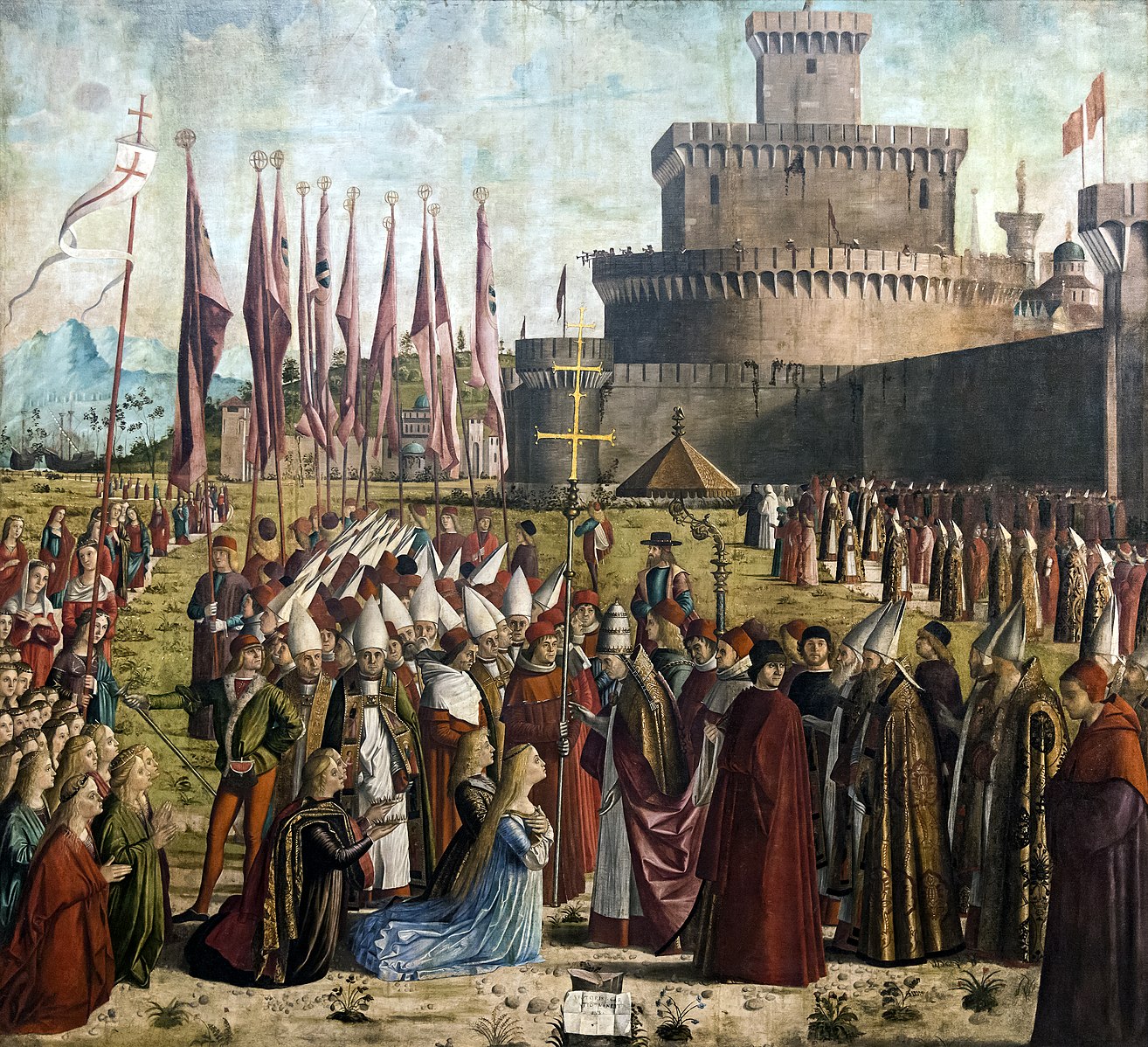
On the left, you can just make out two of the ships, from which there advance—on a narrow strip of white carpet—the 11,000 virgins, who also disappear to the left (to suggest the numbers), and re-emerge, kneeling, in the left foreground behind Princess Ursula and Prince Ethereus. These two are very much a royal couple, as the crowns held out behind them remind us.
In the background, Carpaccio borrows from some woodcut or medal to give a fairly accurate representation of Castel Sant’Angelo, adding his own loving representation of the light that warms the right side of the gigantic barrel and slants across its wall.
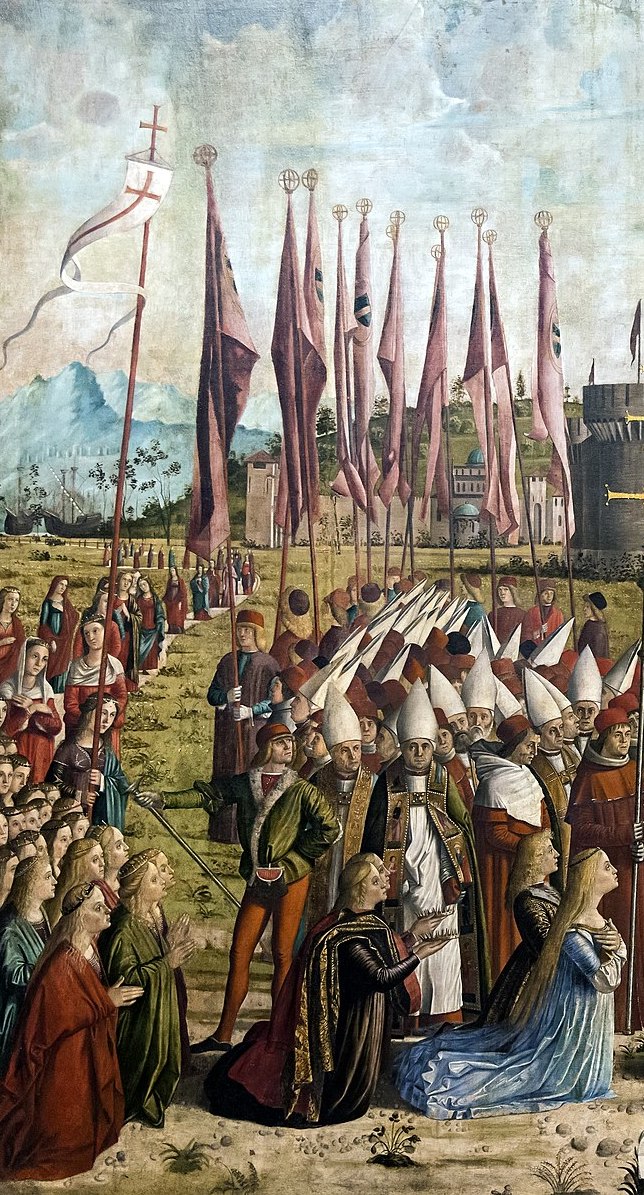
But this early canvas is chiefly remarkable for the contrast between the huge area of ochre (in walls, ground and clouds) and the bright colours and abstract patterns of the red banners and the white mitres of the bishops.
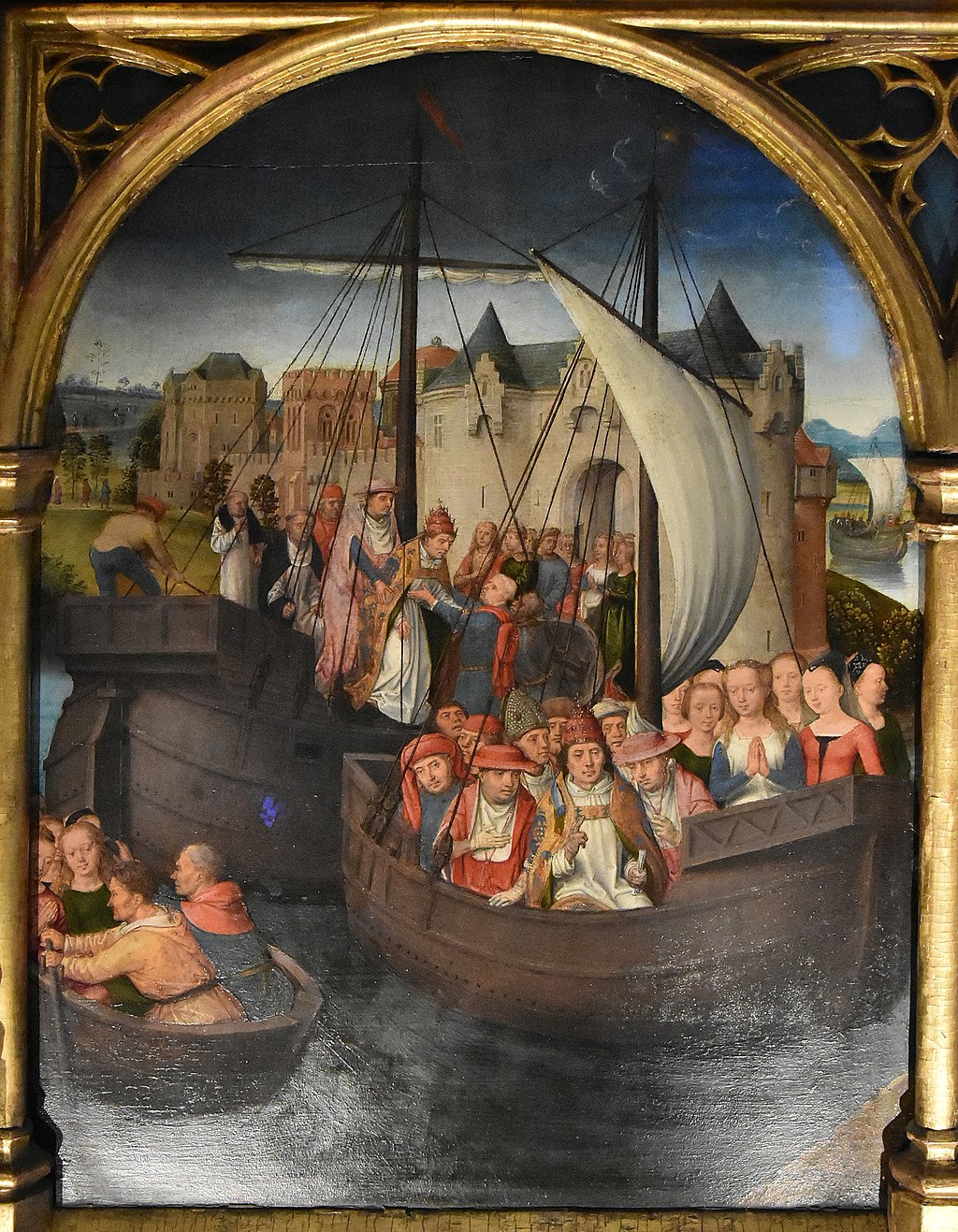
When Ursula and the 11,000 virgins set out from Rome on the return journey, they were accompanied by Cyriacus (who resigned the papacy) and a retinue of cardinals and bishops.
You can see them clearly in the first panel on the second side of Memling’s reliquary, where they are shown in front of the city gate of Basel, first embarking, and then setting out on the journey downstream along the Rhine towards Cologne.
However, all these celebrations and honours had excited the envy of two wicked captains of the Roman soldiery, Maximus and Africanus.
Having informed themselves about the course of the virgins’ journey:
they sent messengers to their kinsman Julian, the king of the nation of the Huns, and urged him to lead his army against the virgins, since they were Christians, and to slaughter them when they arrived at Cologne. Thus, when all the virgins with the aforementioned bishops returned to Cologne, they found the city besieged by the Huns.
This is the subject of Carpaccio’s seventh canvas, which was actually the first to be painted (it is signed and dated 1490) and was designed to lie in the middle of the north wall of the School, with the imagined light still consistently represented as coming from the east window to the right.
So, the city is meant to be Cologne; and since the same flags fly over the city as over the tiny tents of the besieging Huns, we may assume that the city has already been captured.
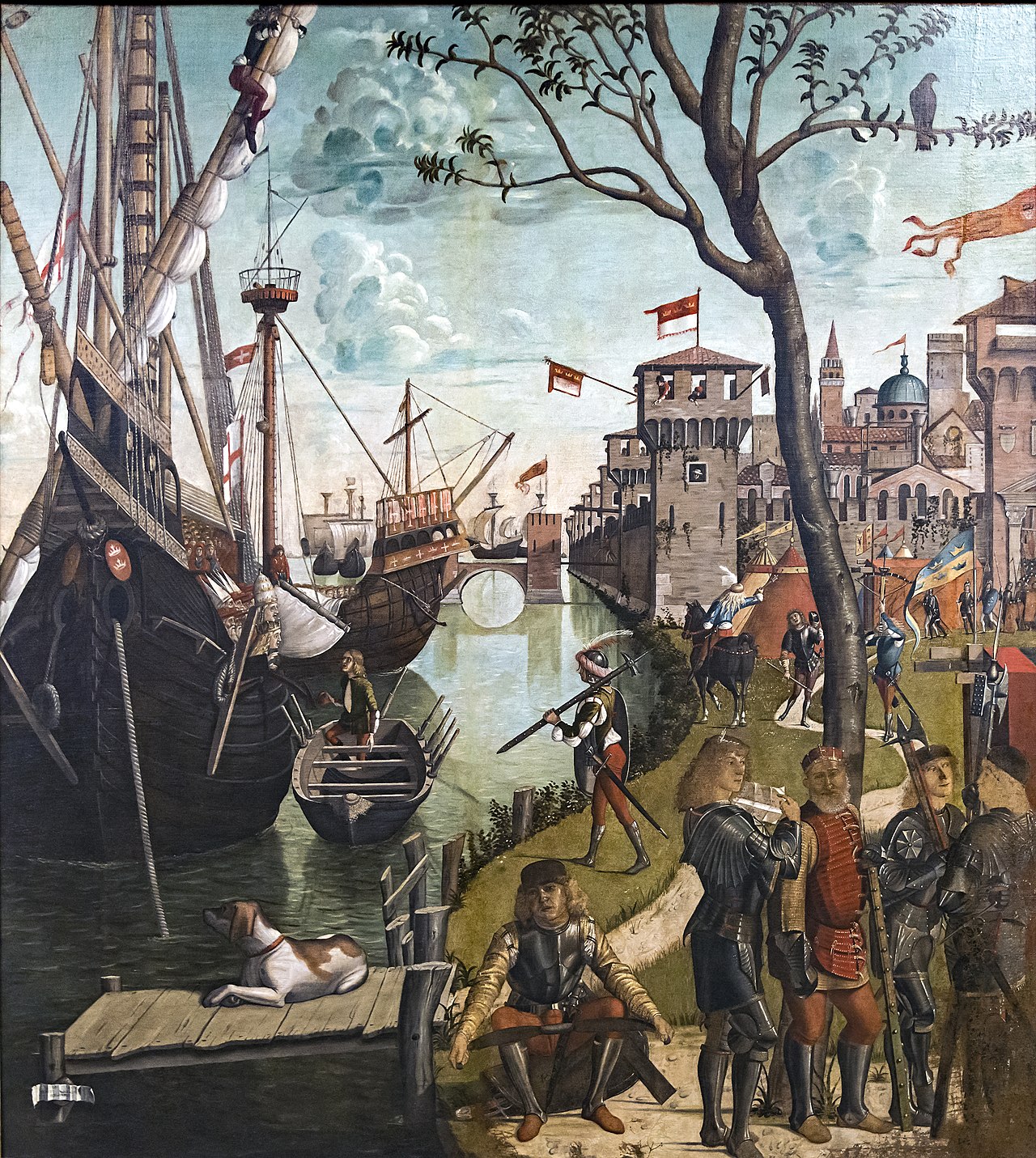
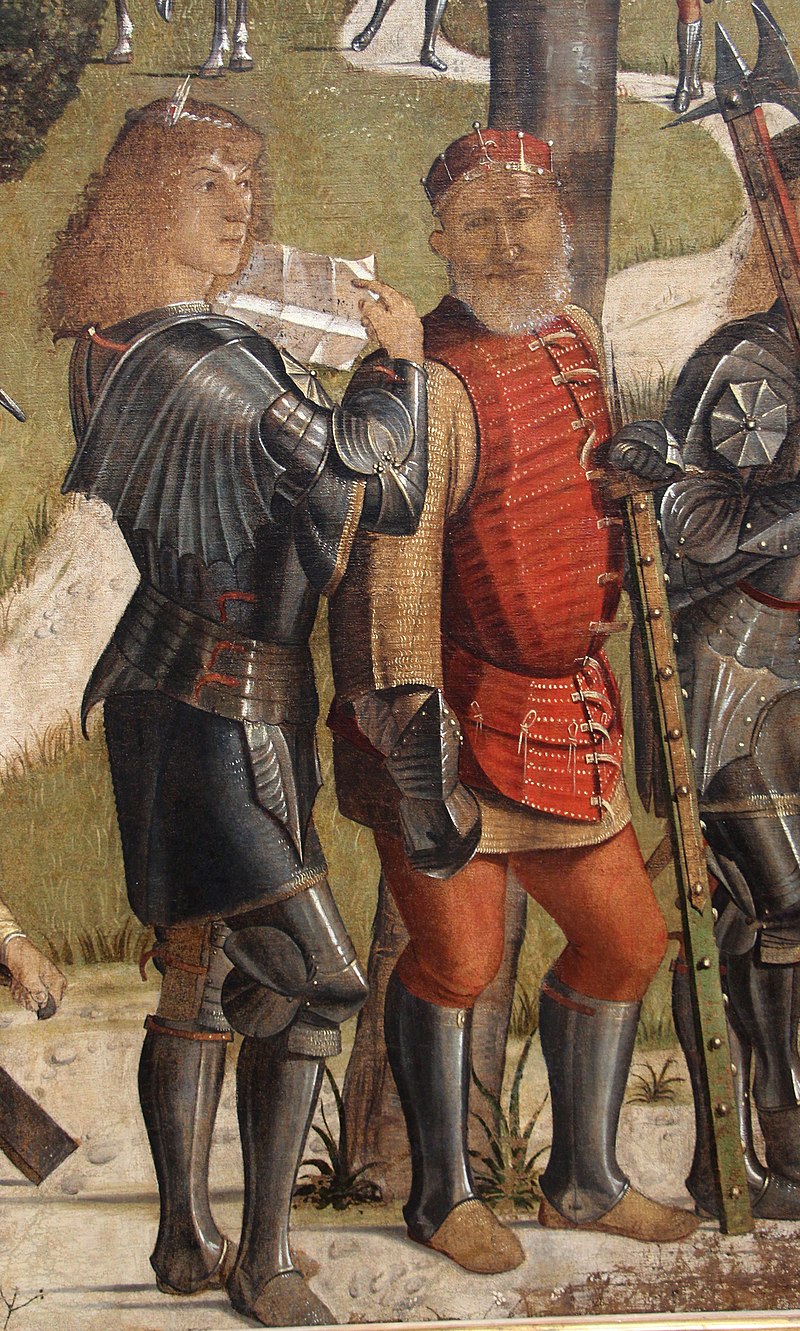
In the foreground, we see (in red) the king of the Huns, Julian, identified by his crown, and a younger man, his son, who is reading from the letter dispatched by the perfidious Maximus and Africanus.
The impending violence is foreshadowed in the almost leafless tree, with a solitary bird of prey perched on a branch.
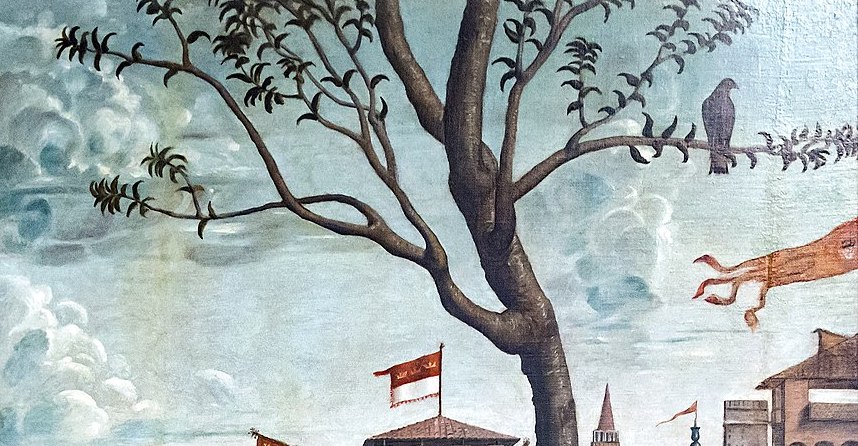
The river is therefore the Rhine, and on it we see the leading ships of the flotilla bearing the 11,000 virgins, sailing down towards the ship that is already at anchor.
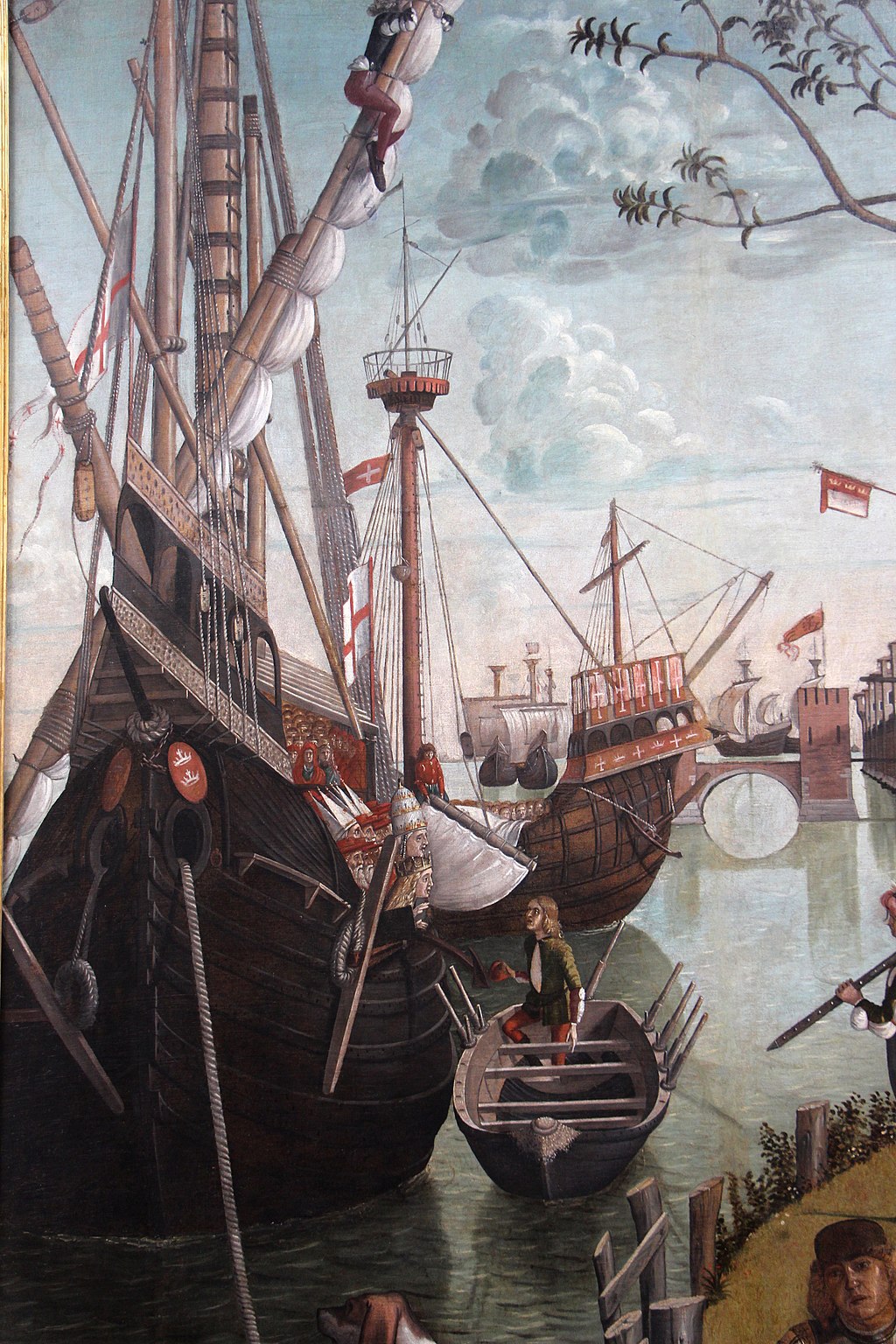
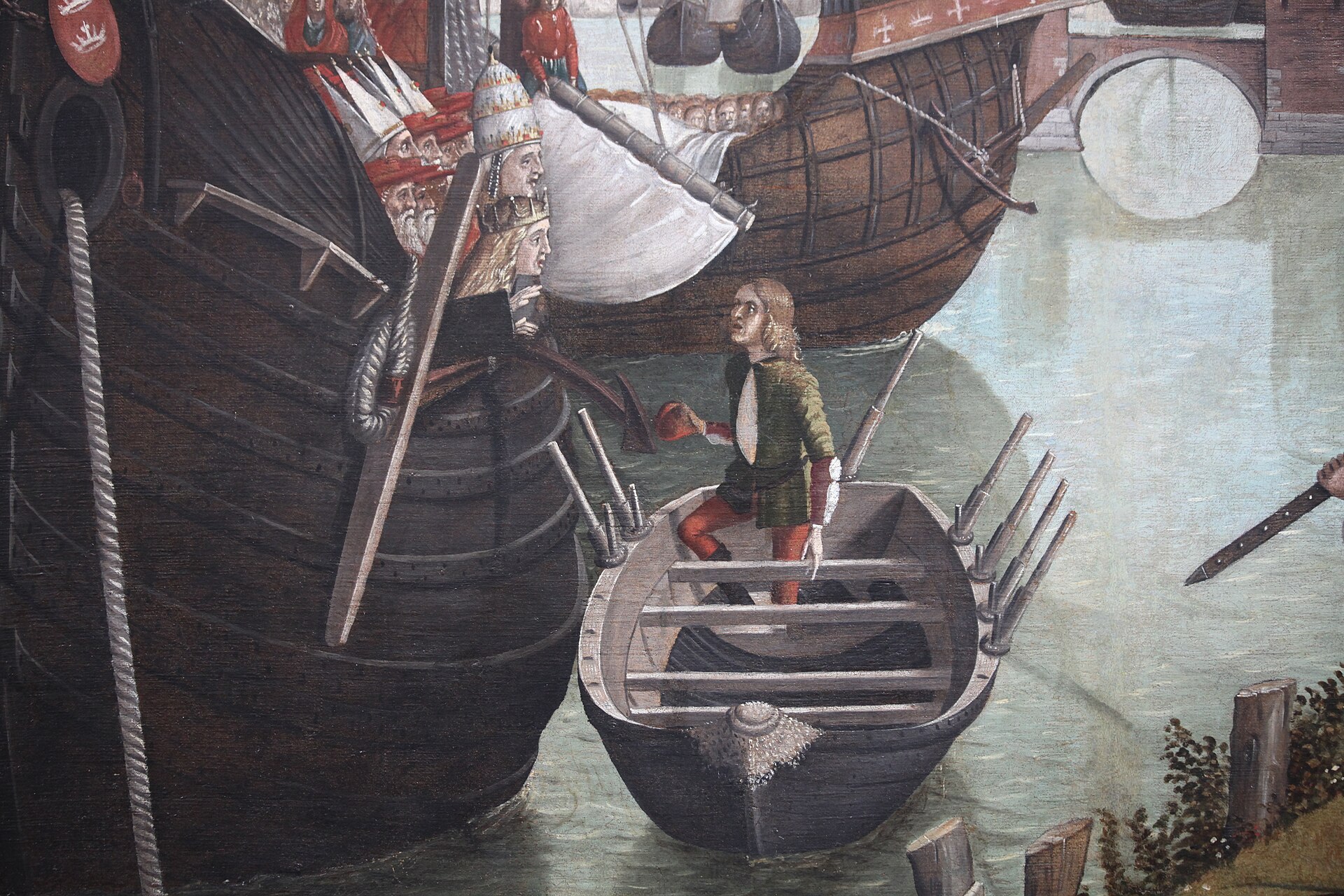
The greatest charms of this rather uncertain composition are to be found in the play of the light on the river (reflecting the arch of the bridge), in the details of the ship,(with anchor cable, bowsprit, and sailor furling the sail), and the heads of Cyriacus and Ursula, who are looking apprehensively at the small rowing boat that will take them ashore.
They are identified by tiara and crown, respectively, as they kneel in front of white-mitred bishops who in turn appear at the head of a huge ‘cargo’ of virgins in the hold amidships.
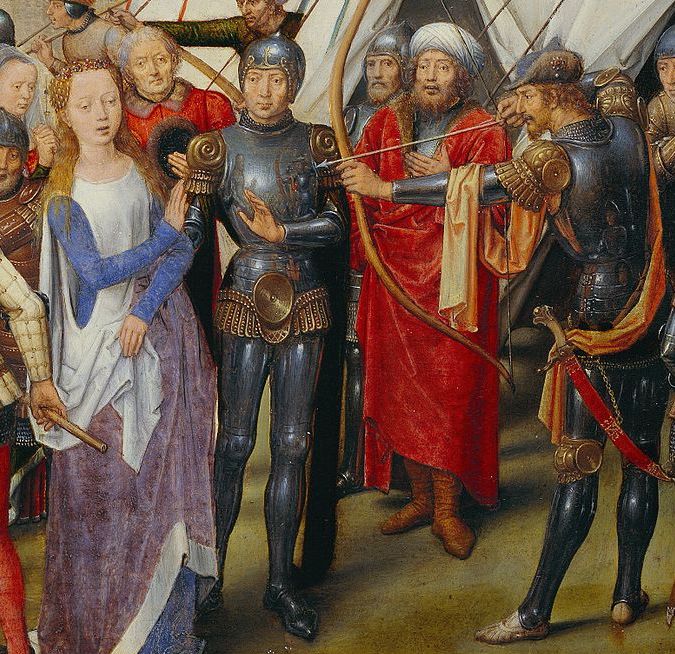
I show you here—correctly, side by side—the last two panels from Memling’s reliquary in Bruges, which give us an illustration for the conclusion of the story in the Golden Legend. (Notice that they share a continuous skyline and offer another study of the unfinished Gothic cathedral at Cologne.)
[Thus all the virgins, with the aforementioned bishops, returned to Cologne, and found the city besieged by the Huns.]
And when the barbarians saw them, they fell upon them with a tremendous shout, and, like wolves raging among the sheep, put the whole multitude to death.
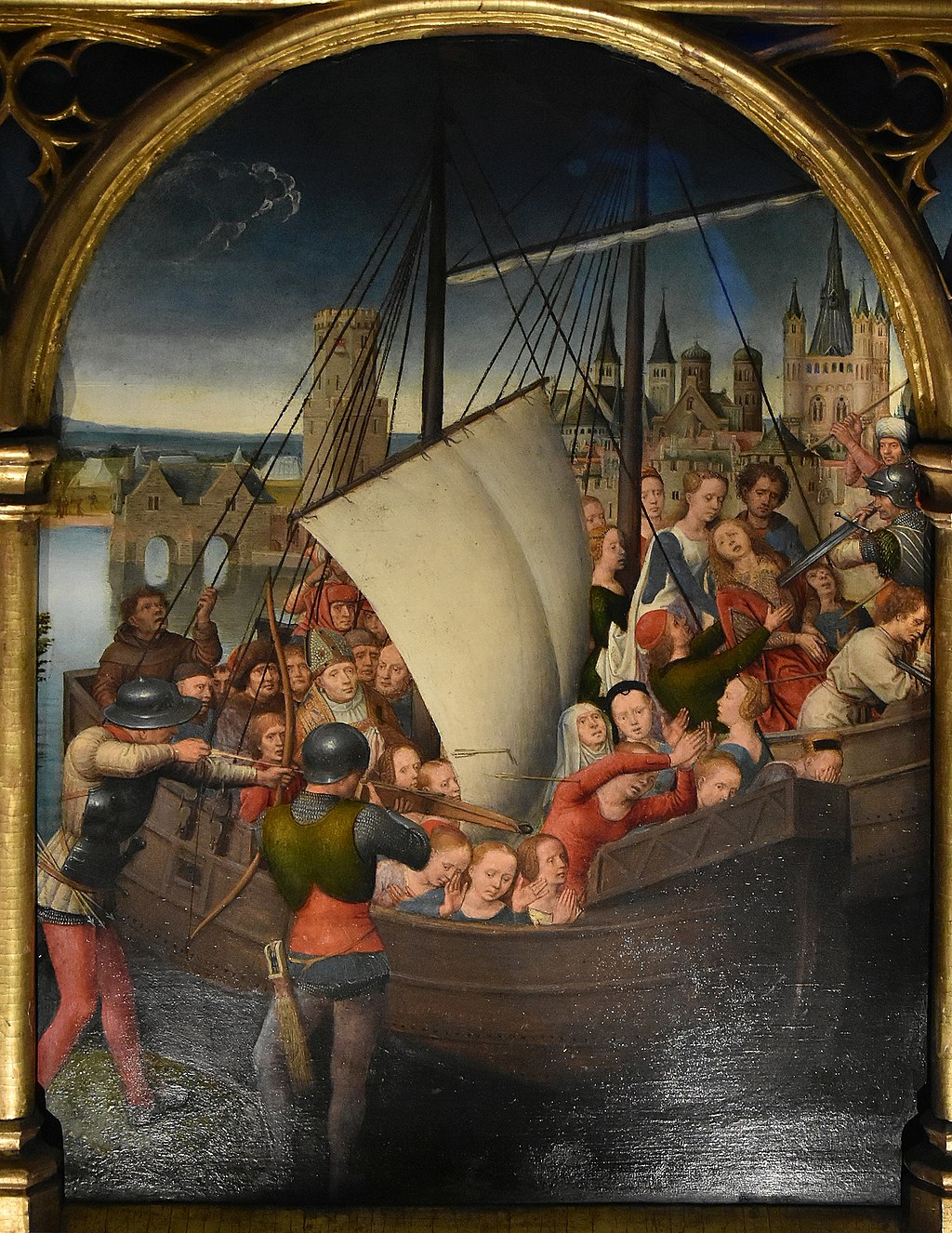
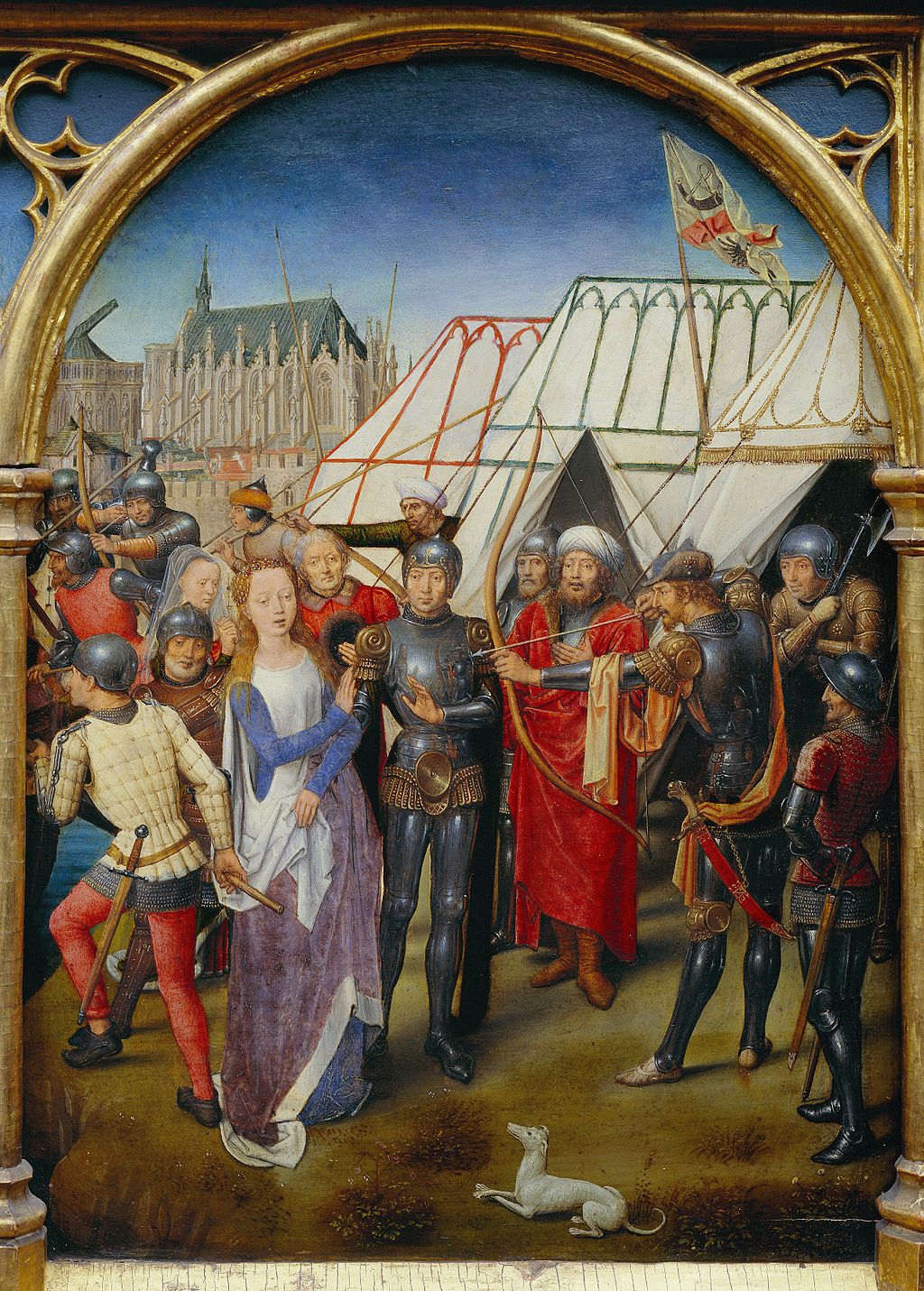
The story continues:
And when the rest had been killed, they came to Ursula, and the prince was dumbfounded at her wondrous beauty. He consoled her for the death of the virgins, and promised that he would take her to wife. But she spurned the offer, and he, seeing himself treated with contempt, aimed an arrow at her, and pierced her through, and in this way consummated her martyrdom.
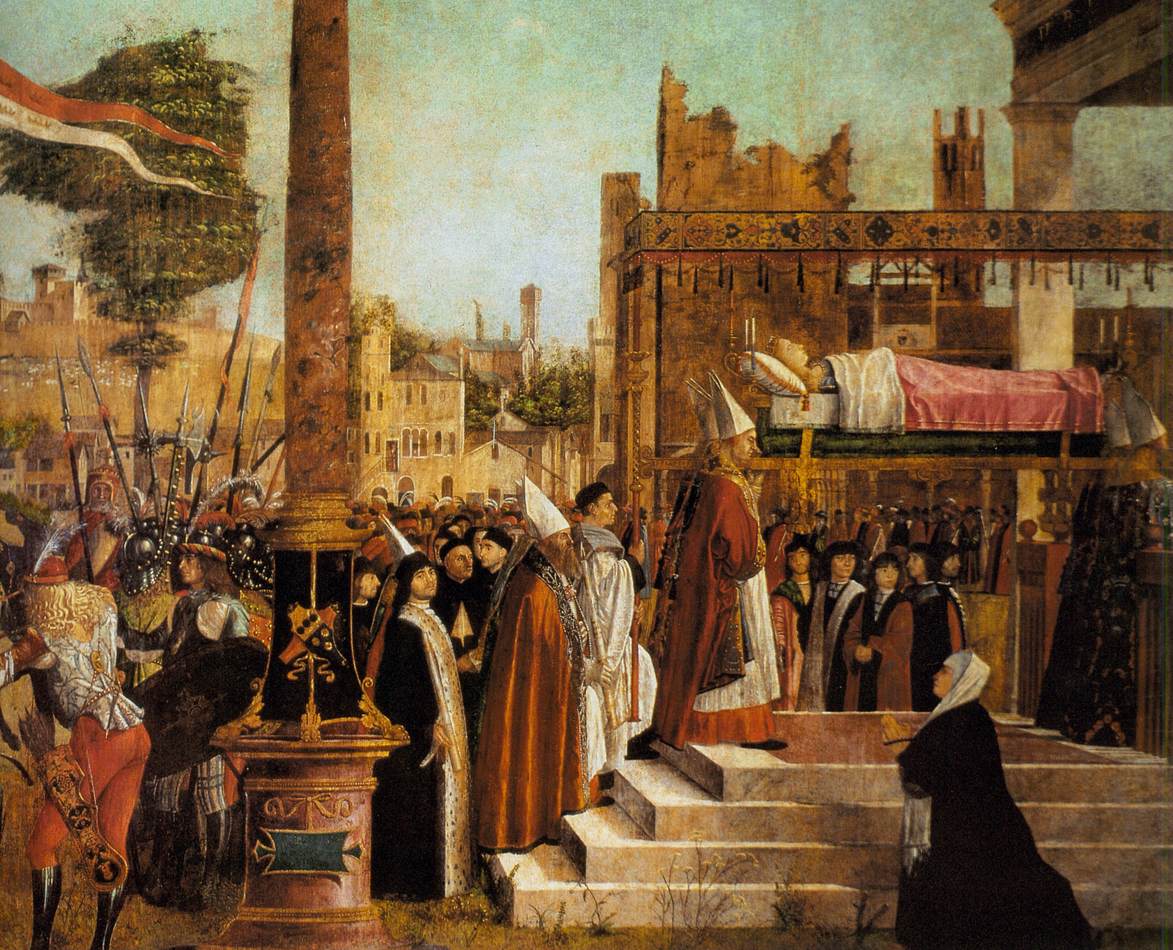
Carpaccio’s version of the same scene is eighteen feet wide by nine feet high, and it used to lie immediately to the left of the altar wall in the School.
It is divided by the column into two distinct moments: the martyrdom, and the funeral.
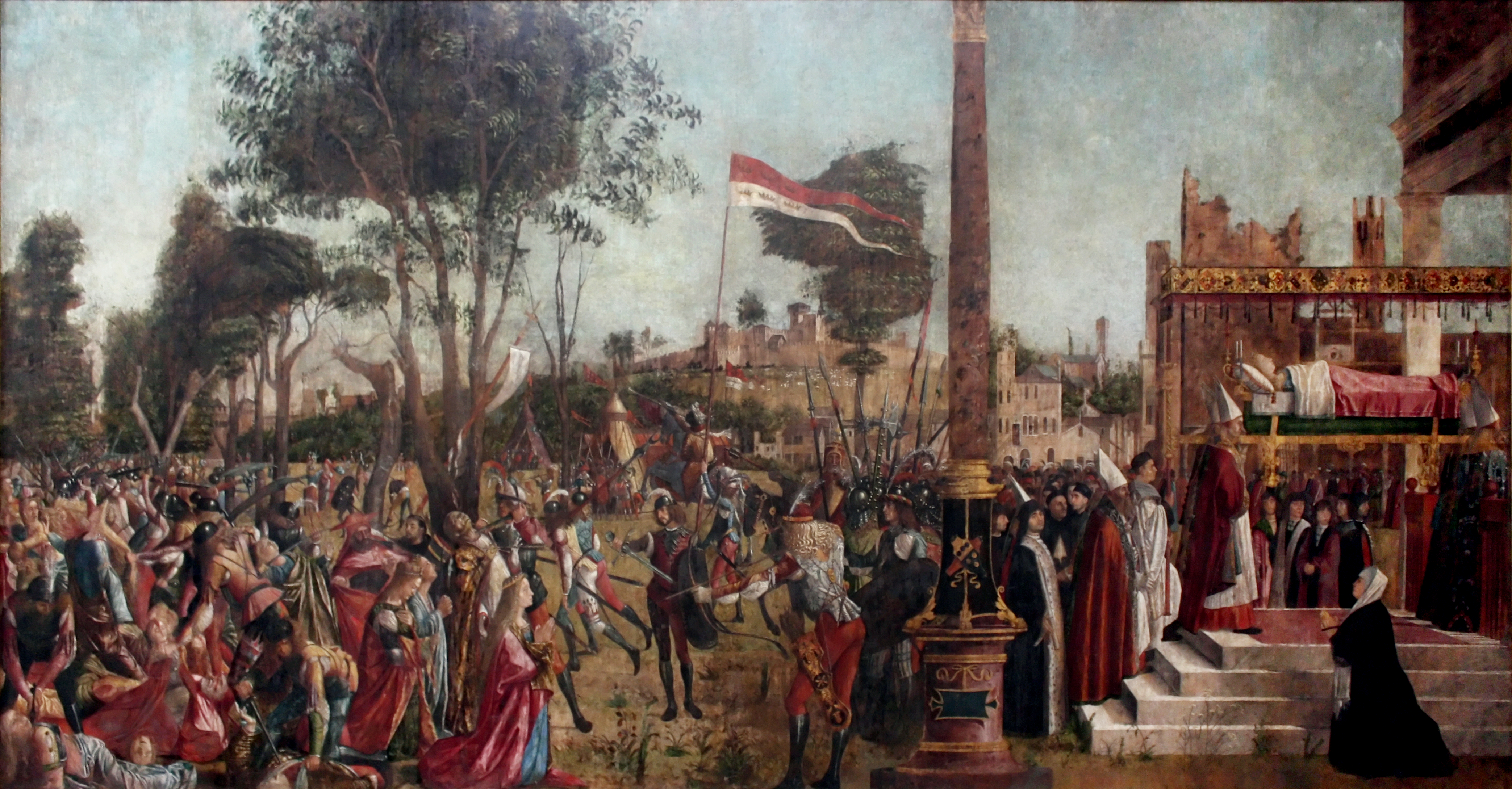
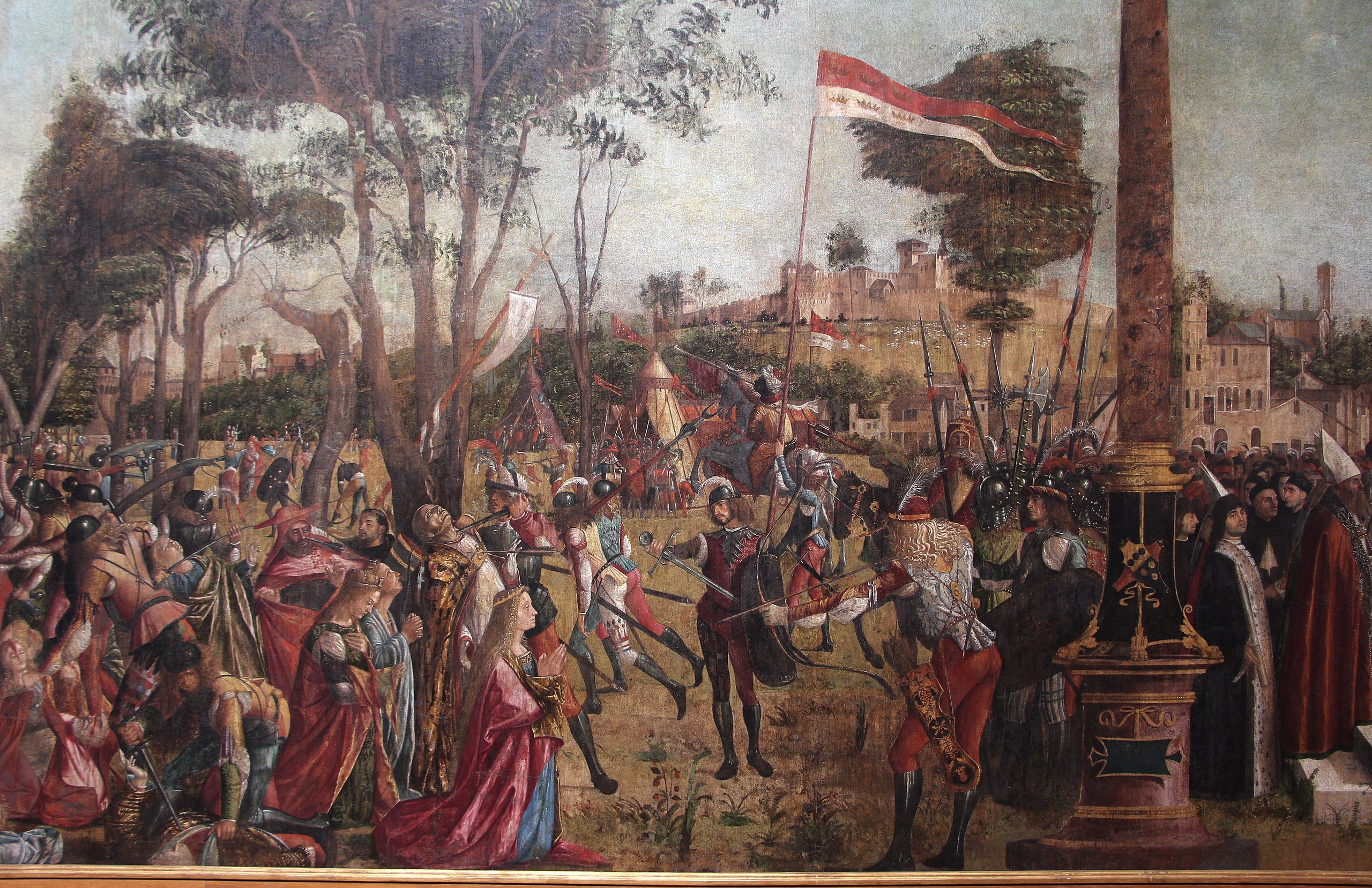
The martyrdom lies to the left of the scene-divider.
The wind blows through the Hunnish banner from left to right, but the column of trees and the slope of the hill, like the light, all seem to follow the direction of the action, which unfolds from right to left.
In his headquarters, marked by the pikes and halberds, King Julian gives the order, which is echoed by the galloping trumpeter. The officer unsheathes his sword, and the troops attack the unresisting victims: the pope is stabbed in the throat, the cardinal in the cheek, a girl has her throat cut from behind, and scimitars are splitting heads right back into the distance.
To the right of the column, we come to the last procession in which Ursula will take a part.
As in the opening scenes, we see splendidly robed figures mounting white marble steps.
Four bishops are carrying Ursula’s body on their shoulders, underneath a superb canopy. They are moving off-stage into a huge mausoleum, which already bears the name ‘Ursula’. And just as Ursula’s body under the canopy should remind us of her dream in the bedroom, so the kneeling woman in the right foreground, dressed in black with a white shawl, should make us think of the old nurse in the first scene.
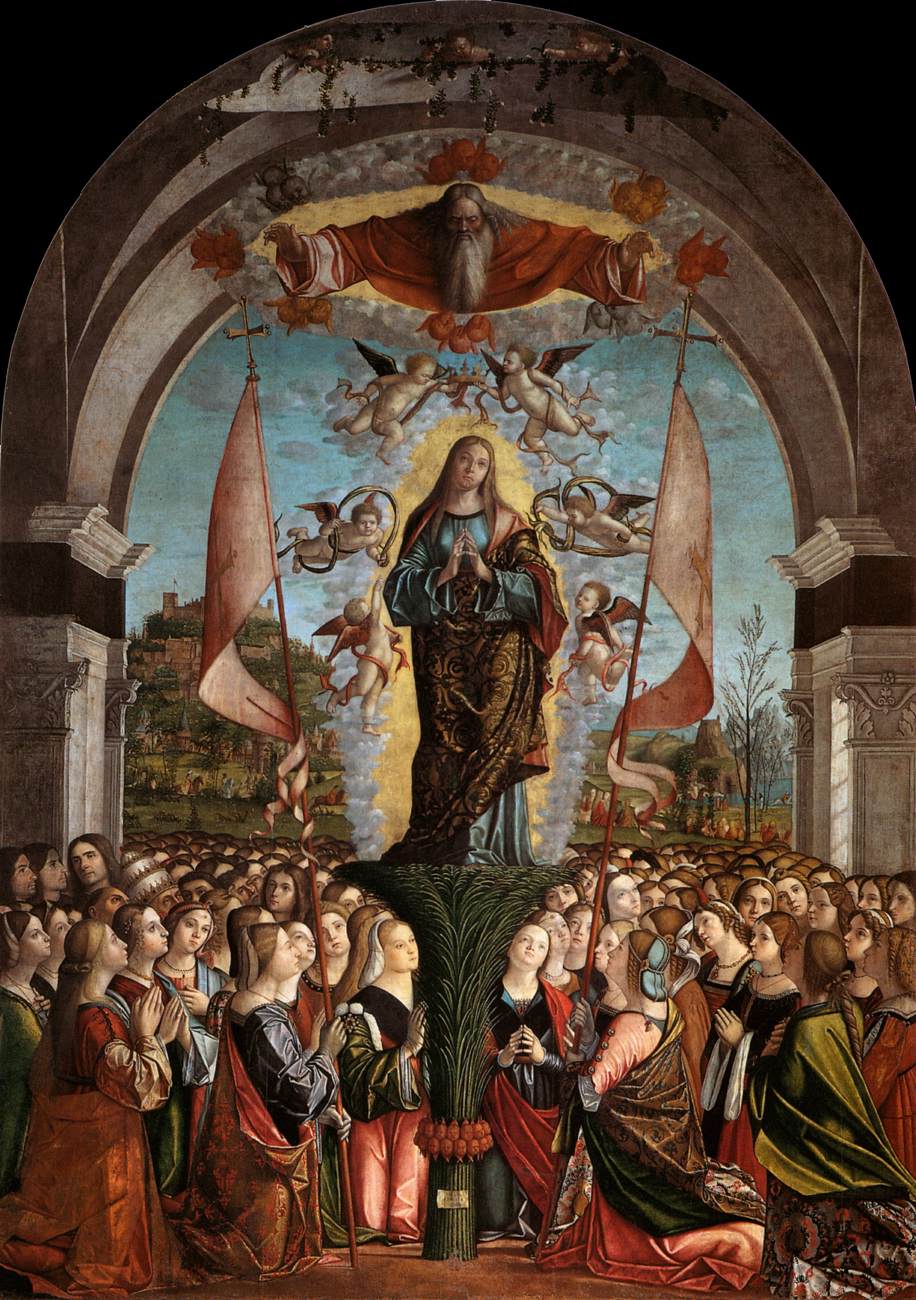
We come finally to the canvas intended for the east wall—a round-topped altarpiece, sixteen feet high, which represents the apotheosis of Ursula, or rather, her reception into heaven.
God the Father opens his arms. Ursula balances on a ‘bush’ made up of 11,000 palms of martyrdom held together by two circles of angelic heads. The ground is packed with virgins, and you should also be able to spot the head of Prince Ethereus standing next to pope Cyriacus (wearing his tiara).
That was the last scene in the narrative but, alas, it does not give Carpaccio any opportunity to excel in all the things he does best. So, I will round off this lecture—and give you a chance to revise—by showing you once again this glorious detail from one of the last canvasses to be painted. Click on the image to make it as big as possible.
Begin top left by picking out the tiny ‘gondola-taxi’, seen in the distance across the lagoon through a convenient gap in the colonnade. Next, enjoy the perspective of the classical pilasters and columns converging on the (invisible) vanishing point on the horizon (not neglecting the architect’s use of polychrome marble).
Come to the foreground and focus briefly on the three spindly weeds springing out of dusty soil on our side of the parapet. Then rest your eyes for a full minute on every detail of the fashionable clothes worn by the two young noblemen whose arms rest so casually on the iron balustrade.
Next, relish the crazily non-classical column on the right, as it ascends from its splayed metal legs, changes character at the toothed circlet in order to imitate two earthenware vases (complete with handles), expensively glazed and ornamented, and finally remembers its true function by rising as a slender polychrome shaft. Last not least, remember all the implications of the shadow it casts on the wall to the right.
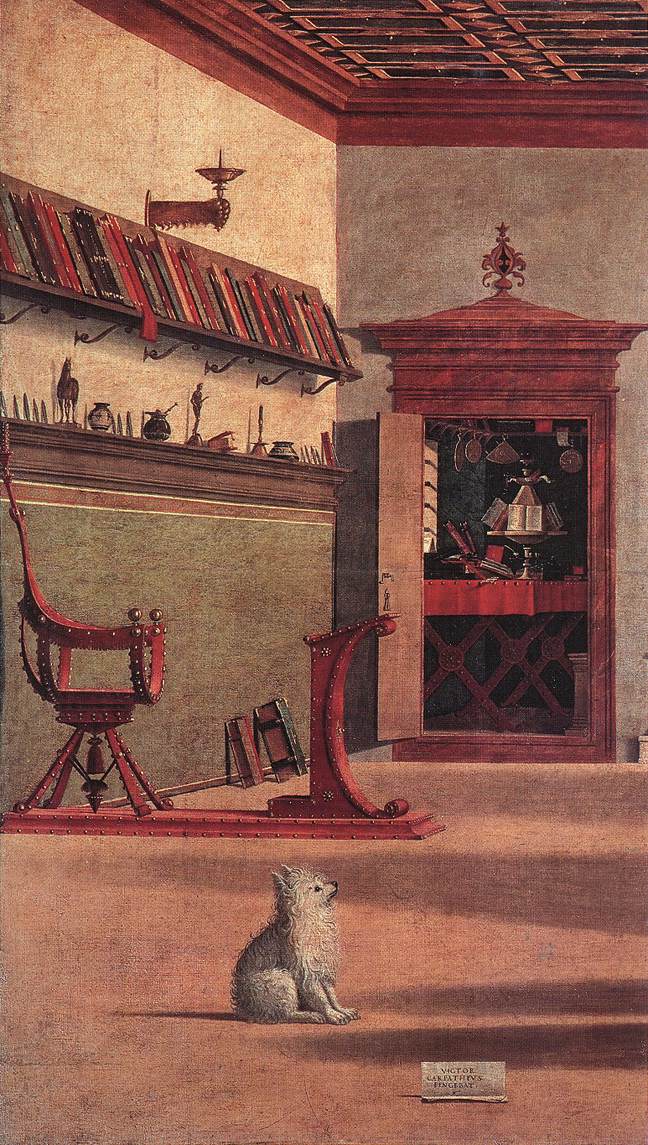
Now you can feel the full force of the charmingly original signature on the little cartellino on the floor in St Augustine’s study in La scuola di San Giorgio, which could be not unfaithfully paraphrased as: ‘This was made by none other than Carpaccio.’
VICTOR CARPATHIUS FINGEBAT